



Interoperability Solutions in Healthcare: An Essential Guide
A care-coordination founder starts Monday with four EHR integration tickets open, two security design decisions blocking a release, and a clinician escalation about medication reconciliation that failed overnight. The APIs are responding. The records are arriving. Yet the care team still can't trust what appears in the workflow.
That situation is common because interoperability solutions in healthcare are often evaluated as connectivity products. Buyers compare FHIR support, interface counts, and API catalogs while a critical question goes unanswered: can a nurse understand the exchanged data quickly enough to act safely at the point of care?
Why Interoperability Is a Workflow Problem First
Healthcare interoperability is the ability of systems, applications, and people to reliably access, interpret, and act on clinical and administrative data across organizational boundaries. The definition matters because a successful exchange isn't the same as a successful workflow. A medication record that arrives without dosage context, source provenance, or a clear update status may satisfy an interface contract while creating more work for a clinician.
Maya, the founder in the opening scenario, doesn't have an abstract standards problem. She has a product release at risk, an integration team spending time on reconciliation, and a nurse manually checking two systems before approving a medication list. Her next investment shouldn't be another endpoint until the team understands where the workflow breaks.
Practical rule: Measure interoperability by the user's next action, not by the number of records transferred.
A useful workflow review follows one clinical journey from beginning to end:
-
Referral intake: Can the receiving team identify the patient and understand why the referral was made?
-
Clinical review: Are allergies, medications, diagnoses, and results presented with source and timing?
-
Care coordination: Can the user act without re-entering information into another EHR or SaaS application?
-
Exception handling: Does someone own incomplete, conflicting, or delayed data?
The discipline described in healthcare workflow optimization software applies directly here. Map the work before selecting the integration architecture. That exposes manual re-entry, ambiguous terminology, missing consent, and identity mismatches that an API inventory won't reveal.
The U.S. hospital market has made real progress. By 2023, 70% of non-federal acute care hospitals routinely or sometimes engaged in all four domains of interoperable exchange: send, receive, find, and integrate, compared with 23% in 2014, according to ONC's 2023 interoperability data brief. Availability has improved, but availability alone doesn't guarantee that exchanged information is complete, understandable, or useful at the bedside.
The Four Layers of Healthcare Interoperability
A production integration has four layers. Treating them as separate design concerns makes troubleshooting faster and prevents a team from buying a monolithic platform to solve unrelated problems.
Foundational connectivity
This is the network and transport layer. An Epic system and a third-party application need a working connection, authentication, routing, and reliable message delivery. TLS, DNS, queues, retries, and observability belong here.
Structural exchange
The structure defines how data is packaged. A legacy ADT feed may use HL7 v2 pipe-and-hat segments. A modern API may return a FHIR Patient resource in JSON. Both can carry demographic information, but they expose different implementation choices, validation rules, and failure modes.
Semantic meaning
Structure doesn't guarantee meaning. One system may represent a sex or gender value as female, another as F, and a third through a coded concept with a different purpose. Terminology services, value sets, profiles, and mapping rules determine whether downstream software can interpret the data consistently.
Organizational trust
Production depends on agreements and operating rules. Those may include a signed business associate agreement, documented patient consent, permitted-use policies, security review, incident procedures, and a trust agreement connected to a Qualified Health Information Network.
Most integration firefights sit between the structural and semantic layers. The message is valid, but a required element is missing, a local code has no mapped equivalent, or a receiving application can't distinguish a historical value from a current one. Projects also stall at the organizational layer when legal, privacy, security, and network approvals arrive after engineering has already built the interface.
The practical conclusion is simple: map every tool and budget line to a layer. Use an interface engine for message routing, a terminology service for meaning, an identity service for matching, and governance controls for consent and accountability. Don't expect one FHIR platform to solve all four.
The Modern U.S. Standards Stack
A payer can expose a compliant FHIR API and still leave a provider troubleshooting missing data during a patient visit. The modern U.S. stack works as a chain of responsibilities, and each layer must reduce that operational burden. FHIR carries the payload. US Core constrains the implementation. USCDI defines expected data classes. TEFCA provides a nationwide governance and exchange framework.
FHIR became a major interoperability milestone after HL7 first presented Fast Healthcare Interoperability Resources in 2011, expanding from an initial 49 resources to 149 across later releases, as described by HL7's FHIR history. FHIR provides an API-focused structure for representing and exchanging clinical and administrative data. FHIR Release 4.0.1 contains the first normative resources identified for stable implementation. That normative core gives engineering teams a dependable baseline, but it does not guarantee that a receiving application will display the data usefully.
The US Core Implementation Guide establishes the U.S. baseline for implementation. It constrains FHIR resources and defines the minimum RESTful interactions needed to access patient data. This matters at the point of care, where a technically valid response still fails if a required element is absent, a profile is wrong, or the application cannot place the result in the clinician's workflow.
| Layer | Standard | Role in integration |
|---|---|---|
| Payload and API | HL7 FHIR R4 | Represents and exchanges clinical and administrative resources |
| U.S. implementation profile | US Core | Constrains resources, required elements, and interactions |
| Data expectations | USCDI | Defines standardized health data classes and elements |
| Network governance | TEFCA | Supports exchange across participating networks under shared policies |
| Terminology | LOINC, RxNorm, SNOMED CT | Gives laboratory, medication, and condition data consistent meaning |
The April 22, 2024 TEFCA version 2.0 required participating health information networks to support HL7 FHIR, according to the ONC TEFCA overview. TEFCA launched in December 2023 and uses a network-of-networks model built around QHINs. By June 2026, HHS reported that more than 1 billion health records had been exchanged through TEFCA in less than a year, as reported by Becker's Hospital Review.
A 2026 buyer should require every RFP response to name its applicable US Core version, supported USCDI data classes, FHIR capabilities statement, and TEFCA participation or integration plan. The stack still leaves workflow provenance, bulk-data behavior, and local terminology mapping to the product team. Those gaps create troubleshooting hours unless the implementation handles them explicitly. Teams assessing delivery options can use Bridge Global's FHIR integration services as a reference for the engineering questions a production implementation must answer.
Choosing the Right Integration Pattern
There are four practical patterns. None is universally correct, and the cheapest starting point can become the most expensive operating model once customers, EHRs, and clinical workflows multiply.
Direct point-to-point connections can work for a tightly controlled pilot with one EHR and one use case. They provide direct control and may shorten the path to an initial demonstration. Their weakness is operational: every new customer introduces another authentication model, data variation, support process, and release dependency.
HL7 v2 interface engines, including products such as Mirth and Rhapsody, remain useful for ADT, orders, results, and other legacy feeds. An engine gives teams routing, transformation, queue management, and monitoring. It doesn't automatically provide semantic governance or a modern product API, so pair it with terminology and identity services.
API platforms, including 1upHealth, Redox, Particle Health, and Health Gorilla, can reduce the number of direct connections a startup must maintain. Depending on the contract and use case, they may provide FHIR access, SMART-on-FHIR launch, network connectivity, or bulk export capabilities. The trade-off is dependency on the platform's coverage, pricing, release schedule, and exit options.
FHIR-native builds using technologies such as HAPI, Firely, or AWS HealthLake offer more control over data models, validation, and product behavior. They also transfer more responsibility to the buyer. The team must operate conformance testing, security, terminology, patient matching, monitoring, and partner onboarding.
| Pattern | Best for | Time to first customer | 3-year cost range | FHIR maturity |
|---|---|---|---|---|
| Point-to-point | One controlled workflow and a small partner set | Often shortest initial path | Low initial cost, high expansion risk | Depends on the team |
| HL7 v2 interface engine | Enterprise legacy feeds and message routing | Moderate | Platform and operations dependent | Usually additive rather than native |
| API platform | Startups needing broad connectivity | Often faster than building a network | Subscription and usage dependent | Usually strong, verify profile coverage |
| FHIR-native build | Teams needing control and a durable product layer | Slower without existing expertise | Engineering and operations intensive | Highest potential, highest ownership |
Use this checklist before choosing:
-
Customer count: A startup with several pilot customers should be cautious about building separate point-to-point interfaces.
-
Legacy dependency: An enterprise replacing multiple feeds likely needs an engine plus governance, not a FHIR-only rewrite.
-
Compliance burden: Clarify who handles audit evidence, access controls, breach response, and data retention.
-
Time to first customer: Separate a demo from a supported production deployment.
-
Long-term economics: Model connection, transaction, implementation, support, and migration costs over the contract term.
-
Exit path: Require standard data exports and documented mappings.
For teams modernizing older estates, integration strategies for legacy enterprises offer useful context on bi-directional integration decisions. The decision should end with a named owner for each operational responsibility, not just a selected technology.
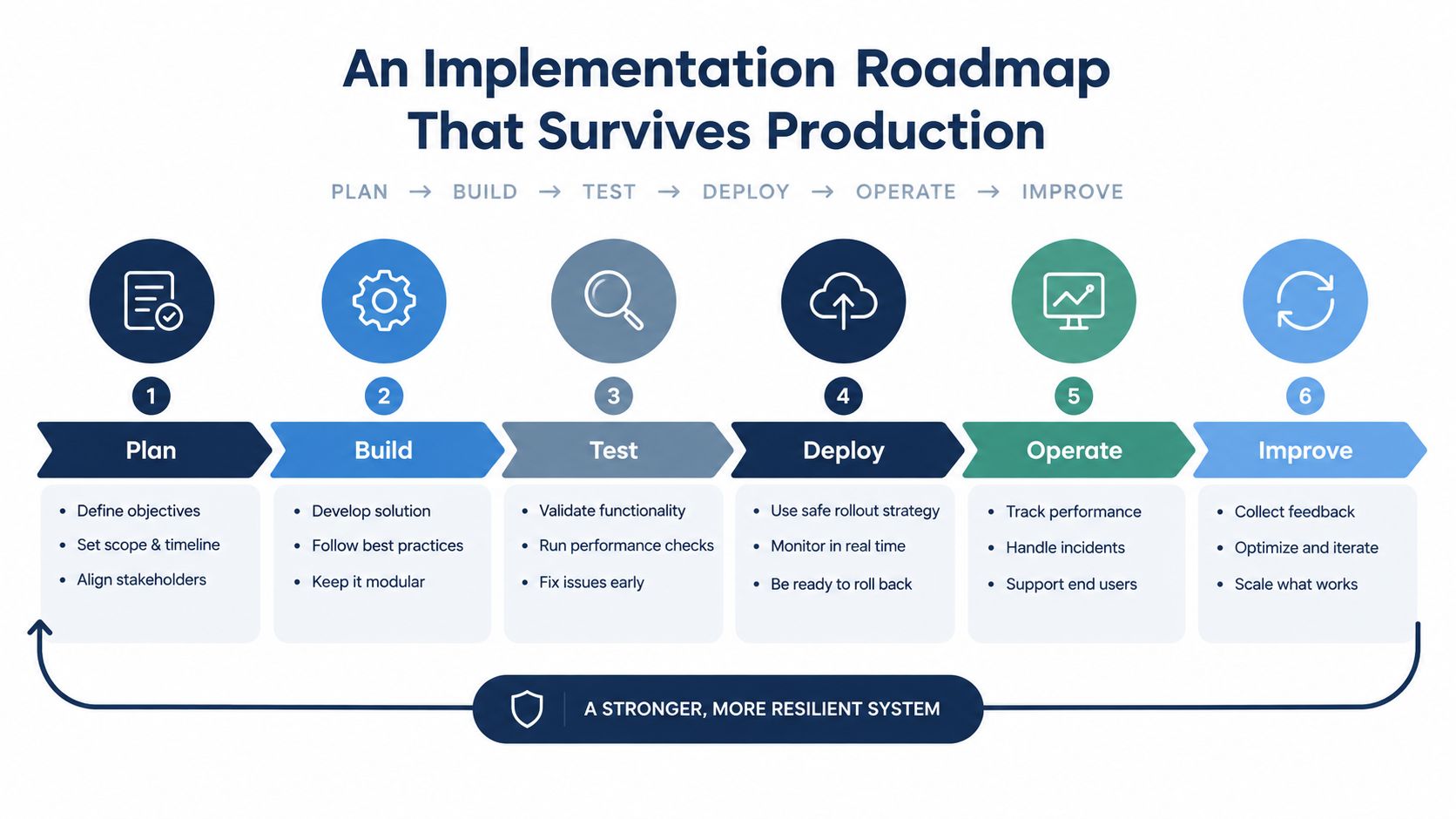
An Implementation Roadmap That Survives Production
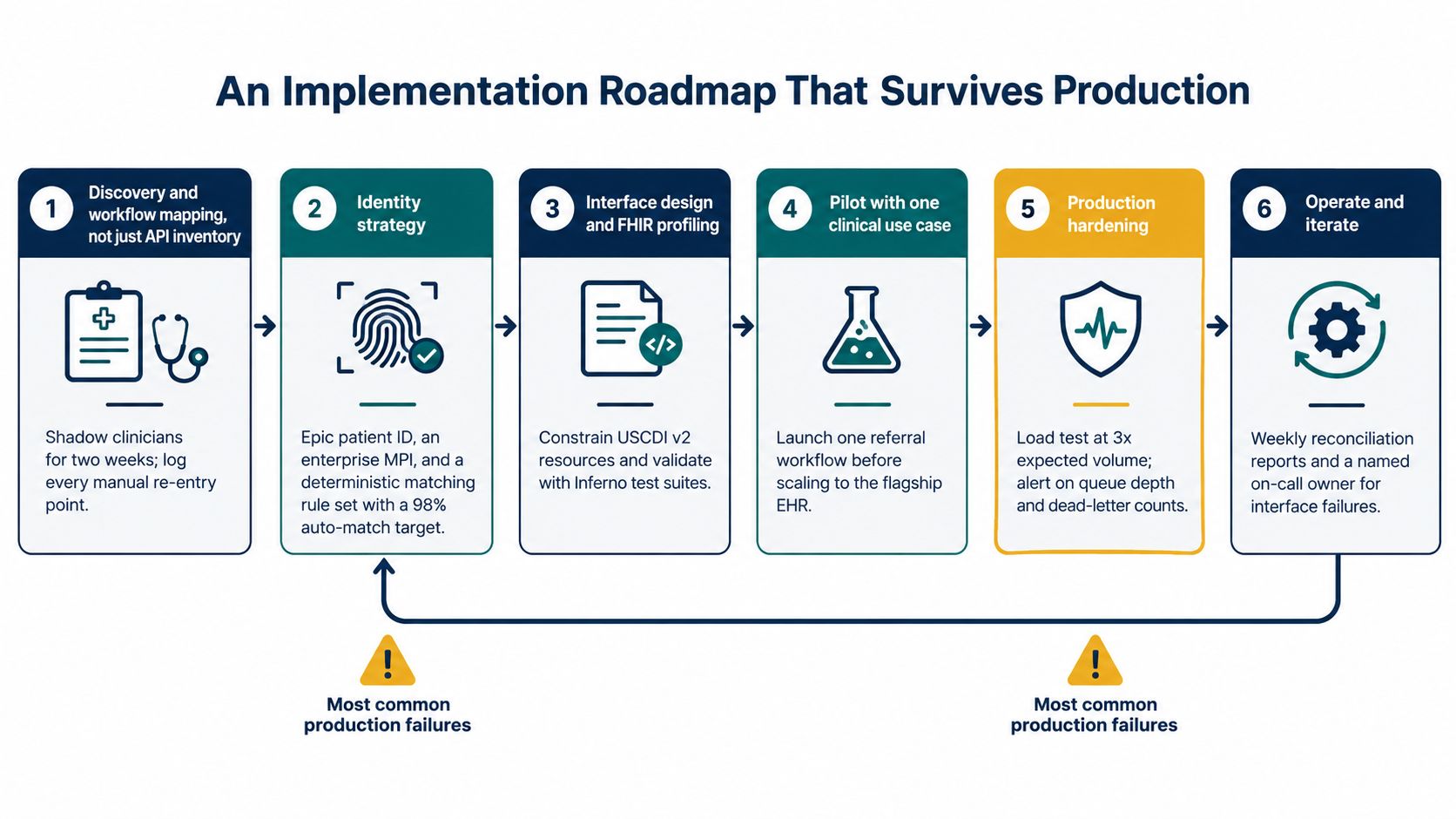
A credible roadmap starts with the clinical task, not the flagship EHR. Pick one workflow, define the user’s decision, and identify the minimum information required to support it safely.
Start with discovery and identity
Document the current workflow by observing how staff receive, verify, amend, and act on data. Inventory source systems, but also record manual re-entry, duplicate records, delayed updates, and escalation paths.
Then define identity. Decide how the source EHR patient identifier, an enterprise master patient index, application subject tokens, and matching rules relate to one another. Don’t let each interface invent its own patient-matching logic.
Design consent and the interface together
Consent and authorization aren’t cleanup tasks. Review the permitted purpose, HIPAA minimum necessary requirements, applicable state rules, user roles, SMART scopes, and the data elements needed for the specific workflow. CMS’s Interoperability Framework names FHIR APIs conforming to US Core, a full FHIR capabilities statement, and USCDI V3 or later among its expectations, alongside terminology such as LOINC for labs, RxNorm for medications, and SNOMED for conditions.
Create profiles and validation rules before implementation. Test sandbox-to-production differences, error payloads, rate limits, missing data, and terminology edge cases. Run user acceptance testing against real clinician scenarios, not only successful API responses.
Operate with explicit failure criteria
A go-live plan needs rollback conditions, queue monitoring, dead-letter handling, reconciliation reports, and a named on-call owner. Establish a governance cadence that includes product, clinical operations, security, privacy, data governance, and engineering.
Production advice: If nobody owns an incomplete medication record, the interface is not finished.
Three decisions frequently derail delivery: waiting too long to determine the appropriate Epic onboarding route, underestimating SMART-on-FHIR approval and security review, and postponing terminology mapping until after launch. Treat each as an early workstream, not a dependency hidden in the engineering backlog. Teams building a durable operating model can use this healthcare data interoperability strategy to structure governance around data ownership, standards, and workflow outcomes.
When More Exchange Becomes More Noise
More data can make a clinical workflow worse. A clinician may receive a large volume of documents that contain duplicate medications, conflicting histories, outdated results, and notes without enough context to determine what matters now. The exchange succeeded technically, but the care team inherits reconciliation work.
The OECD defines interoperability as secure exchange, interpretation, and coordinated use of data. Its recommendations include open standards such as HL7 FHIR, IHE profiles, and openEHR, alongside vocabularies including SNOMED CT and LOINC. The distinction between exchange and interpretation is the important part. FHIR can standardize the resource structure while leaving clinical meaning ambiguous if profiles, terminology, and provenance aren’t governed.
The operational burden remains visible even in mature environments. A 2026 survey cited by Medical Economics found that nearly one in four organizations spent more than 20 hours per week troubleshooting integration issues. The same analysis argues that incomplete, inconsistently structured, or context-poor records can force clinicians to interpret data manually.
Build a normalization layer before adding more endpoints:
-
Terminology services: Normalize LOINC, SNOMED CT, RxNorm, and ICD-10-CM at ingestion.
-
Value-set governance: Curate specialty-specific values and document local-code mappings.
-
Identity and deduplication: Resolve records against an enterprise MPI before presenting them to users.
-
Context preservation: Keep source, author, timestamp, status, and transformation history.
-
AI-assisted extraction: Use NLP pipelines, such as Amazon Comprehend Medical or Azure Text Analytics for Health, to structure unstructured notes with human review and traceability.
Procurement committees should fund this layer against concrete outcomes: fewer manual reconciliation tasks, fewer unresolved interface exceptions, and faster clinician review of the information that supports a decision. The highest-value investment may be a clinical data normalization capability rather than another FHIR endpoint.
Vendor Selection Criteria That Actually Matter
Evaluate vendors as risk-reduction partners, not as feature catalogs. Ask for evidence in the exact workflow you plan to launch, and separate a product demonstration from proof that the vendor can operate the integration after go-live.
Put these questions in the RFP
-
FHIR conformance: Which FHIR releases, resources, profiles, and implementation guides are supported? Ask for validation results, not a logo on a slide.
-
US Core implementation: Which version is supported, and which mandatory elements and interactions are implemented?
-
SMART on FHIR: Can the platform launch applications, manage scopes, handle user and patient context, and document authorization behavior?
-
TEFCA position: Is the vendor participating through a QHIN, integrating with a participating network, or only offering an application-level API?
-
Terminology: How are SNOMED CT, RxNorm, LOINC, ICD-10-CM, local codes, value sets, and version changes managed?
-
Identity: Does the architecture support OpenID Connect, SMART scopes, patient matching, merge handling, and identity audit trails?
-
Security and compliance: Request the HIPAA posture, independent assurance reports, access controls, encryption approach, incident process, and any HITRUST or SOC 2 Type II evidence that applies.
-
Audit detail: Can the system show who accessed, transformed, rejected, amended, or exported a record?
-
Pricing: Is the commercial model based on connections, transactions, covered lives, environments, support tiers, or a combination?
-
Portability and references: Can you export data in standard formats, recover mappings, and speak with customers running the same clinical workflow?
A vendor that says “FHIR compatible” without naming profiles, required elements, error behavior, and supported interactions hasn’t answered the question. The same applies to security claims that don’t explain tenant isolation, access review, operational logging, and incident escalation.
Use a weighted scorecard. Give the highest weights to workflow fit, conformance evidence, identity and terminology handling, security operations, and exit portability. Give lower weight to the size of the API catalog if the additional resources don’t support your first clinical use case.
The cheapest integration vendor often loses to the vendor that explains its production failures honestly.
Ask for a recent incident review with sensitive details removed. Look for queue behavior, notification timing, customer communication, root-cause ownership, and remediation tracking. A mature partner can explain what went wrong without pretending that standards eliminate operational risk.
For organizations comparing delivery models, Bridge Global’s custom healthcare software development is one possible route when the product needs a custom integration layer, workflow application, or healthcare SaaS capability rather than a standalone connector.
Your 90-Day Next Steps and FAQ
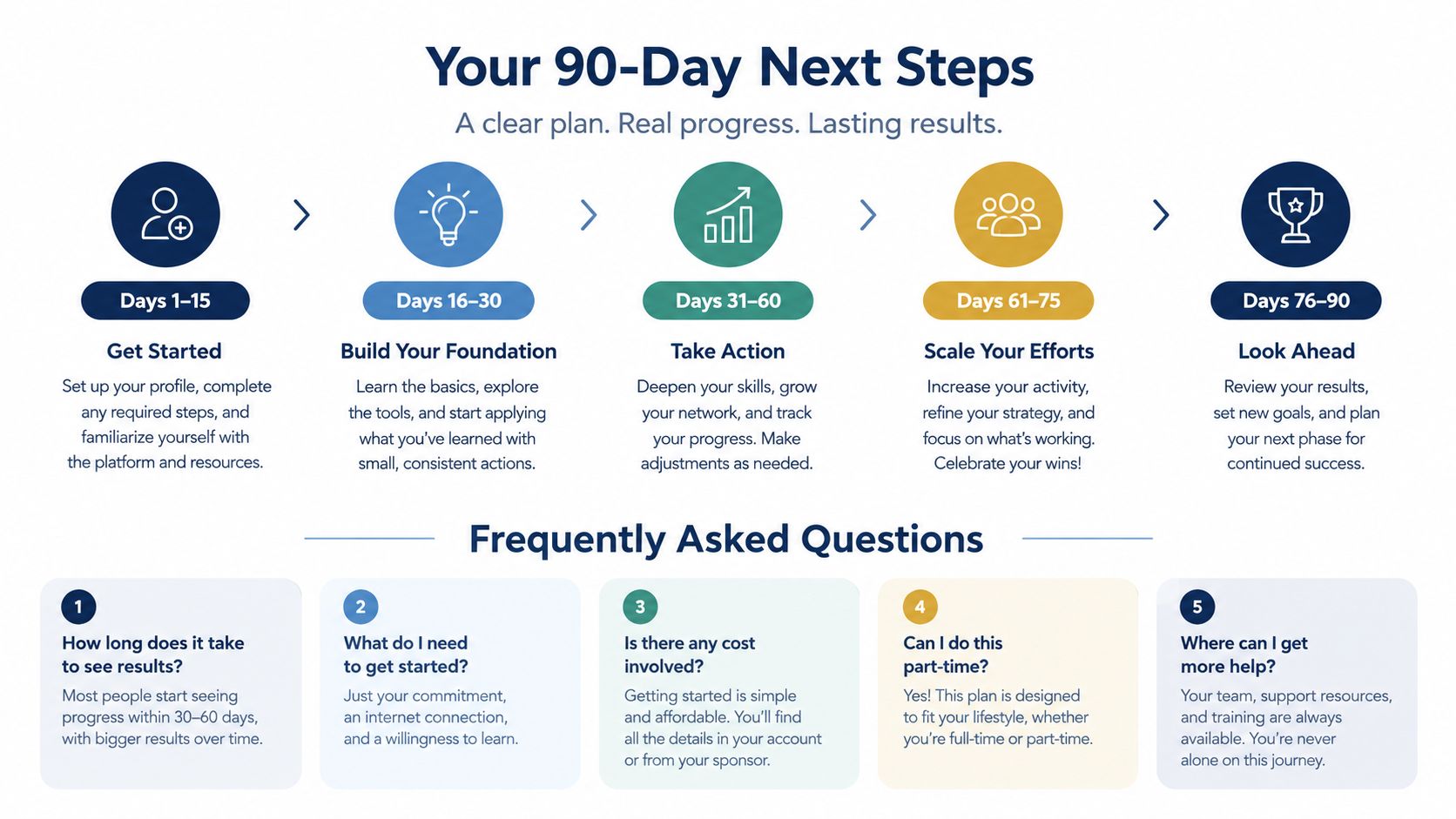
A focused 90-day plan should produce a tested workflow decision, not a large backlog of interfaces.
Days 1 through 30
Inventory data sources, owners, identifiers, formats, terminology, consent constraints, and current manual work. Map the chosen use case to the relevant USCDI data classes, then select one clinical workflow instead of trying to integrate the flagship EHR all at once.
Days 31 through 60
Run a discovery sprint with a FHIR-first vendor or implementation team. Validate resources against the applicable US Core profiles, test identity and consent flows, review SMART authorization, and exercise incomplete, conflicting, and delayed data. Include a clinician in every review of the returned payload.
Days 61 through 90
Finalize the contract with audit, security, service-level, data-retention, mapping-ownership, and exit clauses. Run a limited sandbox or controlled production launch, define rollback criteria, and measure integration troubleshooting hours against the team’s starting baseline.
Frequently Asked Questions
What does clinical interoperability mean?
It means that authorized systems and care teams can access, interpret, and use clinical information across organizational boundaries. A record transfer isn’t enough if the receiving user can’t understand its meaning, provenance, or relevance to the current decision.
Is FHIR a replacement for HL7 v2?
Not automatically. FHIR is well suited to API-based exchange and modern application workflows, while HL7 v2 remains important for many existing ADT, order, and result feeds. Most enterprise programs need coexistence, translation, and governance during the transition.
Does TEFCA require every healthcare company to become a QHIN?
No. TEFCA is a network governance framework built around QHINs and participating organizations. A buyer must determine whether its use case, exchange partner, permitted purpose, and network arrangement require direct participation, an intermediary, or another compliant route.
Is an organization ready for healthcare AI once it has FHIR APIs?
No. AI also needs consistent terminology, usable provenance, identity resolution, access controls, representative data, and evaluation processes. FHIR can improve the data interface, but it doesn’t guarantee that the resulting dataset is complete or clinically meaningful.
What decision matters most before signing an integration contract?
Decide who owns workflow usability and operational failure after go-live. The contract should make that responsibility visible through support boundaries, audit access, data portability, mapping ownership, incident response, and measurable reconciliation expectations.
Start with one workflow, one accountable product owner, and one measurable baseline for troubleshooting effort. Then choose the smallest interoperability architecture that can support that workflow while preserving a credible path to more customers, more data, and stricter governance.
Bridge Global can help healthtech teams design and build FHIR-based integrations, healthcare software, data normalization layers, and AI-enabled workflows across EHR and digital health environments. If your team needs to turn exchanged data into a usable production workflow, visit Bridge Global to discuss the integration challenge and the next engineering step.

About Preethi Saro Philip
Preethi Saro Philip is a Post Graduate Research Degree holder in Economics with more than 10 years of experience in writing, editing, research and teaching. She has an intense passion for content crafting and calls herself a ‘wordsmith’. She enjoys writing on wide-ranging topics including business, technology, health & lifestyle, education, environment etc.
View all posts by Preethi Saro Philip →