



Healthcare Workflow Optimization Software: A Practical Guide
You're probably looking at a stack of disconnected systems right now, and your clinicians are feeling it every shift. The EHR has one version of the patient story, the lab portal has another, scheduling lives somewhere else, and secure messaging has turned into a side channel for chasing context. That's exactly where healthcare workflow optimization software earns its keep, not by replacing core clinical systems, but by making them work like one operational layer.
The category is growing because the pain is real. The healthcare workflow automation market is estimated to reach over $110 billion by 2034, and providers are reported to save about $18 billion annually by automating administrative workflows, with healthcare cited as one of the fastest-growing automation segments at 11.22% CAGR in the source brief. In practice, that money only shows up when software removes handoffs, rekeying, and waiting, not when it adds another interface to babysit.
What Healthcare Workflow Optimization Software Actually Does
An ER physician shouldn't have to bounce between four screens while a patient waits for a decision. Yet that's the lived reality in many hospitals. The EHR holds the chart, the lab portal has the results, scheduling has the next slot, and secure messaging carries the follow-up question, which means the clinician becomes the integration layer.
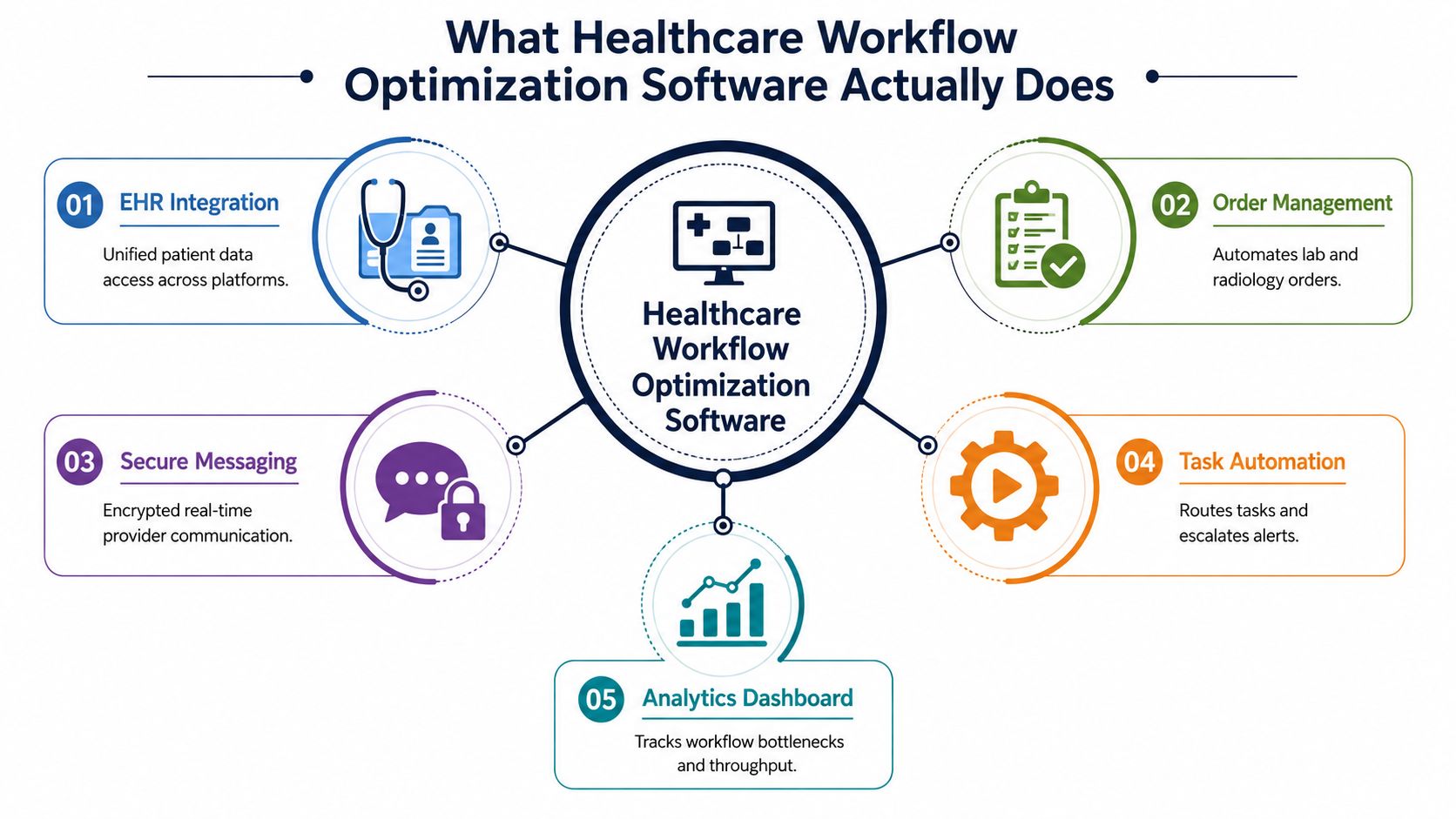
The connective layer, not another app
Healthcare workflow optimization software is the system that coordinates people, data, and tasks across clinical and administrative work. Think of it as air traffic control for care operations. It doesn't replace the aircraft, meaning the EHR, LIS, RIS, or billing system; it coordinates the signals so each one lands in the right place at the right time.
That distinction matters because generic task tools stop at assignment. Real workflow software is event-driven and state-aware, so it reacts when a lab result lands, a discharge order is signed, or a prior authorization stalls. It surfaces the next action to the right role instead of making staff hunt for context across tabs.
What good workflow software actually coordinates
In a real deployment, the platform does more than route to-do items. It can manage task routing, trigger decision support, automate documentation steps, and coordinate inter-departmental handoffs. It also has to preserve clinical meaning, so a transport delay, a missing consent, or a denied claim isn't just a status update; it becomes an actionable event.
For teams that are also dealing with service and support automation, the logic is similar to what's described in autonomous ticket resolution for healthcare, where the system has to understand context before it can resolve anything safely. The same principle applies to clinical workflow: context first, automation second.
Don't confuse it with task software
Project management tools can help a department track work, but they don't solve healthcare integration debt. A checklist app won't reconcile EHR identifiers, keep audit trails intact, or push a discharge task into the right queue when the chart changes. If the software can't connect clinical systems and react to live events, it's not workflow optimization; it's just organized waiting.
Why Health Systems and Healthtech Startups Are Investing Now
A hospital buys this category for one reason: manual coordination has become too slow, too costly, and too brittle to keep expanding. Clinician burnout, margin pressure, rising patient demand, and patient expectations for digital coordination all push the same way. If the software cannot survive in the hospital's real system environment, the demo does not matter.
| Driver | Health Systems | Healthtech Startups |
|---|---|---|
| Clinician time pressure | Reduce chart-prep, handoff chasing, and admin drag | Build less-friction integrations that keep pilots from stalling |
| Revenue leakage | Cut denials, shorten discharge delays, tighten billing workflows | Turn workflow performance into a clearer contract value story |
| Operational scale | Standardize workflows across departments and sites | Prove repeatable deployments across hospital accounts |
| Buyer expectations | Show interoperability and governance, not just automation | Support EHR connectivity and secure data exchange from day one |
The business case is no longer abstract. Analysts at Mordor Intelligence's market overview point to healthcare workflow automation as part of a broader market that keeps attracting attention because cost savings and coordination gains show up at system level. For CTOs, the point is straightforward: every minute pulled out of non-clinical drag gets multiplied across staffing, throughput, and revenue-cycle execution.
Health systems are buying relief, not novelty
Providers want less friction where it costs the most. Chart-prep gets shorter when task routing is built into the clinical flow. Denials become easier to prevent when scheduling, documentation, coding, and billing handoffs stay synchronized. Discharge cycles move faster when the right tasks trigger automatically instead of waiting for someone to notice.
The value is operational, not decorative. If a platform only adds another screen, it adds another queue. If it pulls context from the EHR, moves work to the right role, and keeps audit trails intact, it starts removing real waste.
Startups need integration depth
For healthtech startups, the failure mode is predictable. The product does not collapse because the idea is weak; it collapses because integration work was underestimated. Workflow software that connects cleanly to hospital systems keeps pilots alive long enough to become contracts, especially when buyers want proof that the tool fits existing infrastructure.
Startups that want repeatable deployments need more than a clean UI. They need dependable event handling, clear system boundaries, and a deployment model that matches hospital risk tolerance. That is why teams often start with custom healthcare software development and choose from the right software development service models based on integration complexity, timeline, and support burden.
Core Features That Separate Real Workflow Software from Task Tools
A shallow tool can assign work. A real platform can move work through a hospital without breaking compliance, context, or data integrity. That difference shows up fast when clinicians touch the system, because healthcare punishes brittle software immediately.
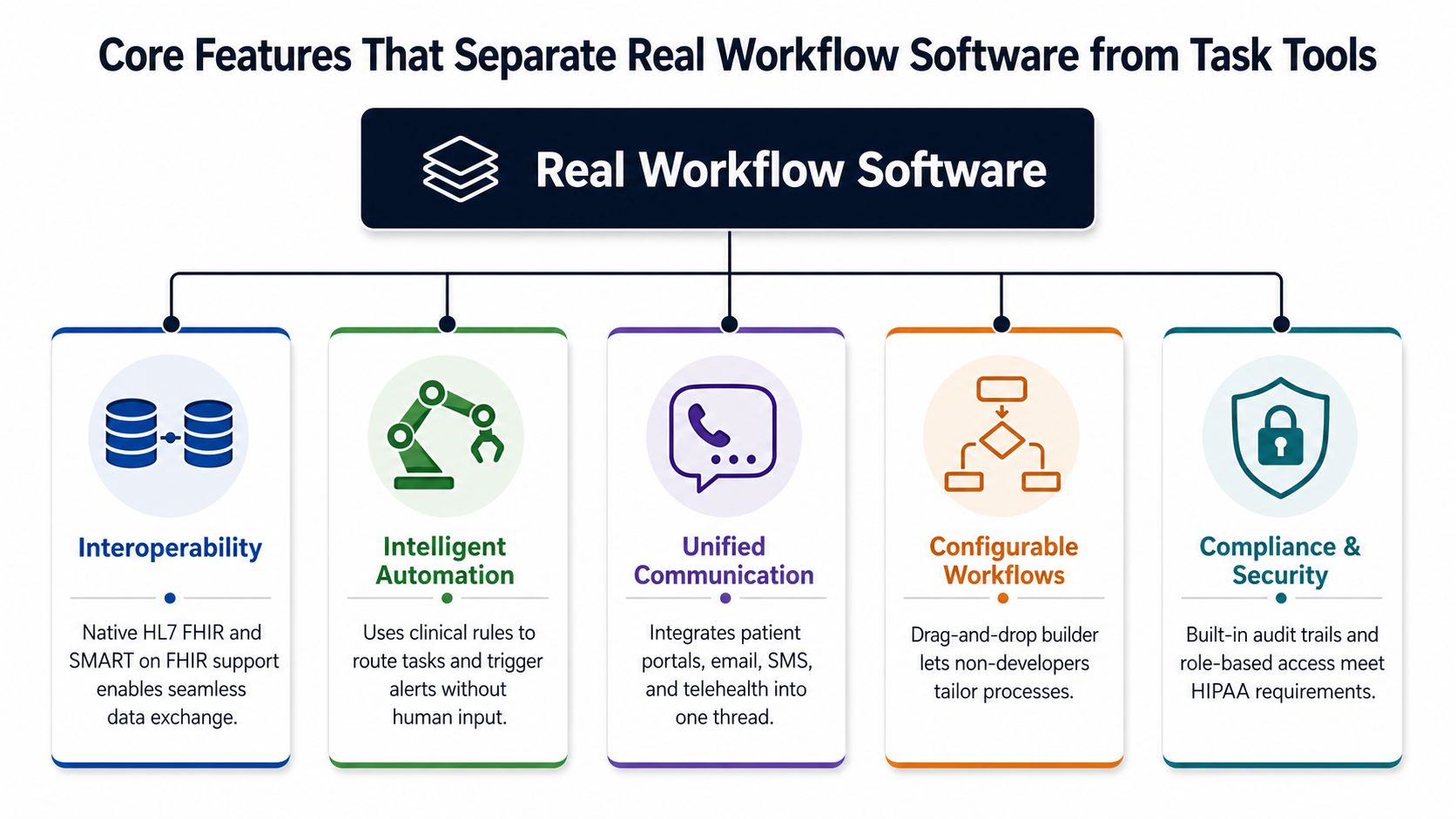
Interoperability is the first test
If a vendor says “we integrate,” push for specifics. The baseline is HL7, FHIR, and ideally SMART on FHIR support that enables bi-directional exchange instead of chart viewing only. The durable value comes from synchronized data flow between the EHR, collaboration tools, patient management systems, and point-of-care apps, not from a dashboard that just mirrors what already exists.
That's why interoperability is defined as the ability of different systems and applications to access, exchange, integrate, and cooperatively use data across boundaries. If the vendor can't explain how identifiers, events, and exceptions move across systems, the “integration” is probably just a read-only feed.
Automation has to be event-driven
Good automation routes prior authorizations, refills, discharge tasks, and escalations without human stitching. Bad automation just turns a manual checklist into a digital checklist. The useful pattern is an event-driven rules engine that reacts to state changes, then hands off to the right role with the right data attached.
AI helps only when it reduces noise
Ambient documentation, risk scoring, and inbox prioritization are valuable when they filter signal from noise. They become harmful when they create a second inbox or flood staff with low-confidence alerts. If a vendor's AI can't show how it supports workflow judgment instead of overriding it, treat it as a pilot feature, not a platform capability.
Analytics should expose bottlenecks, not vanity charts
You want dashboards that measure cycle time, throughput, queue delay, and bottleneck detection at the task level. Visit-level summaries are too blunt to improve operations. If the software can't show where a handoff stalls, you'll know volumes changed, but not why.
Compliance and governance must be built in
HIPAA-grade access controls, audit trails, and consent handling can't be bolted on later. Healthcare SaaS has to start with compliance and interoperability from day one, because the cost of failure isn't churn; it's patient harm. That's why any credible stack should also include AI development services and, where appropriate, enterprise AI solutions designed for controlled clinical use.
Automation without interoperability just digitizes manual pain.
For teams standardizing operating procedures around these systems, a clean SOP framework helps keep workflow ownership visible as the platform grows. And if you're evaluating the broader architecture, the internal guide on healthcare automation frameworks is worth comparing against your current stack.
How to Evaluate Vendors Without Getting Sold To
Buy the integration depth first. Everything else is secondary. A polished demo with drag-and-drop rules doesn't matter if the vendor can't prove mature FHIR support, clear auditability, and stable data-portability terms.
| Criterion | What to Verify | Red Flag |
|---|---|---|
| Integration maturity | FHIR R4 or R5 support, bi-directional sync, identity matching, exception handling | “We support interoperability” with no architecture detail |
| Workflow configurability | Can clinicians or ops admins adjust flows without code | Every change needs a developer ticket |
| AI governance | Model boundaries, human override paths, logging, retraining policy | Black-box scoring with no documentation |
| Audit fidelity | Step-level traceability across users, events, and exceptions | Logs that stop at the app boundary |
| Data portability | Export rights, migration support, retention terms | Contract language that traps your data |
Ask for proof, not promises. A vendor should show you one deployment where HL7 v2 to FHIR mapping broke and how they fixed it. Then ask for one customer that left. The exit story tells you more than the sales deck ever will.
The technical scrutiny matters because workflow products sit on top of messy hospital reality. If the vendor hasn’t built durable API and integration patterns, your team will inherit the failure later. That’s why it’s smart to compare the vendor’s claims with a serious engineering view, like the one in healthcare platform API engineering, before you sign anything.
A useful shortlist also checks deployment shape. Cloud, hybrid, and on-prem all have trade-offs, but the more constrained the hospital environment, the more important identity controls, logging, and interface maintenance become. If the implementation plan is vague, the platform probably is too.
An Implementation Roadmap That Sticks
The fastest path to failure is trying to automate everything at once. The fastest path to adoption is sequencing the work around one high-volume workflow, one owning team, and one clear rollback path. That keeps the project from turning into a custom software graveyard.
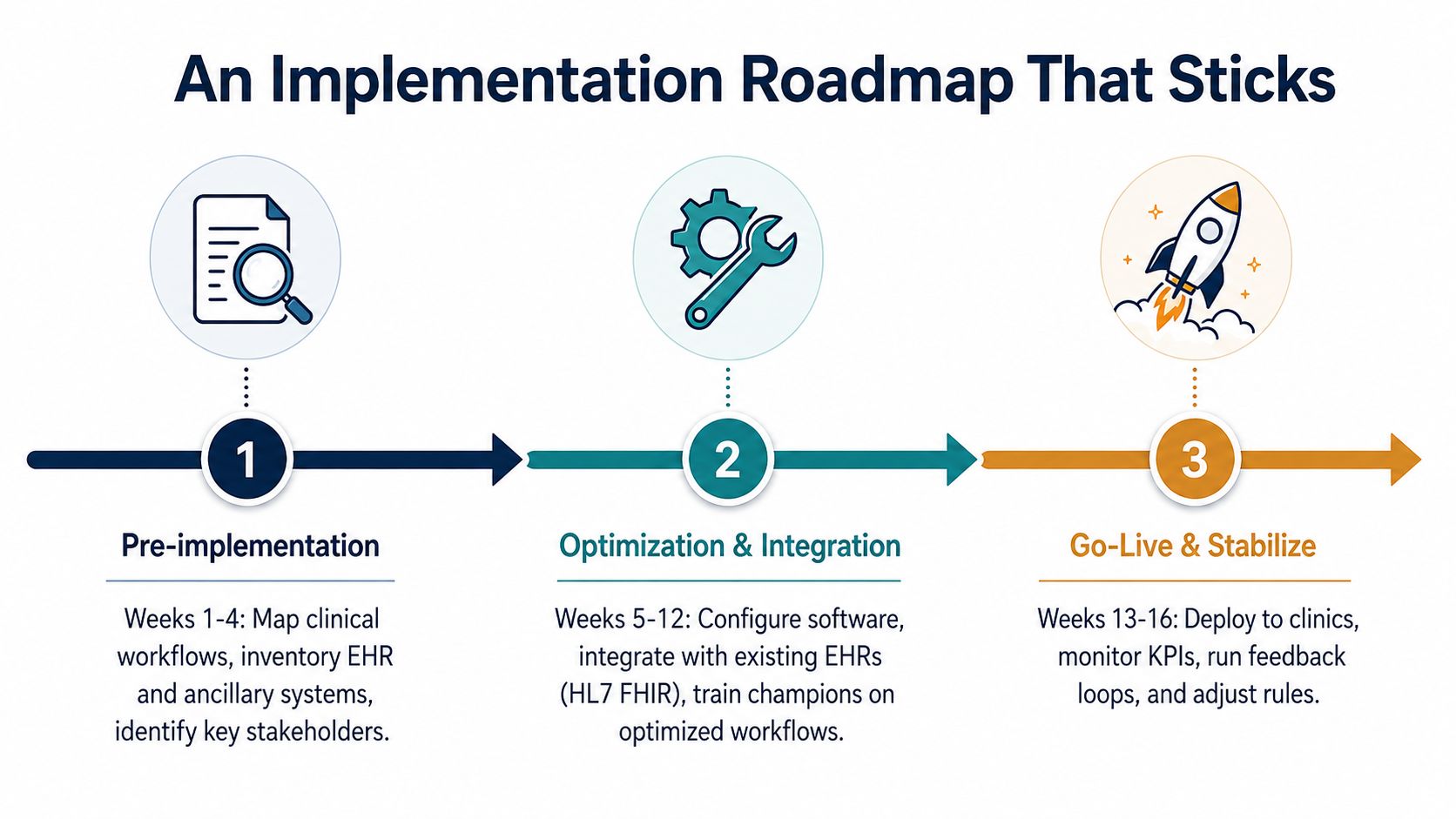
Pre-implementation
Start by mapping the actual clinical workflow, not the idealized one. Inventory every EHR, ancillary system, and messaging path that touches the process. Lock down baseline success criteria, then assign executive sponsorship and frontline ownership so the project doesn’t drift during procurement or security review.
At this stage, a practical AI implementation roadmap matters because clinical software changes aren’t just technical. Harvard’s guidance for health care AI deployment groups the work into workflow assessment and system engineering, accuracy evaluation and model selection, MLOps, and change management, which is exactly the kind of structure workflow programs need to avoid improvisation.
Peri-implementation
Pilot one high-volume workflow first. Review KPIs every two weeks, keep rollback gates explicit, and collect clinician feedback while the workflow is still easy to change. The goal here is not perfection; it’s proving the platform can move real work without creating new failure modes.
For healthcare teams building the implementation layer with partners, custom software development and healthcare integrations are the practical capabilities that determine whether the pilot survives first contact with the hospital environment. If the vendor or integrator can’t show how messages, identities, and event flows will be handled, pause the rollout.
Post-implementation
Expand in waves, not all at once. Harden retraining cadence for any AI-assisted components, formalize compliance audits, and capture operational evidence that shows whether the workflow is working. This is also where SaaS product development becomes relevant for startups that need to turn a pilot into a repeatable product line.
Don’t let “configuration” become a euphemism for endless customization.
The cleanest programs keep decision gates visible. If the workflow isn’t stable, you don’t widen scope. If staff is still bypassing the system, you fix the handoff. If a model is noisy, you tighten governance before adding another department.
Short Case Scenarios for Providers and Healthtech SaaS
A Series B startup building prior authorization software has a different problem set than a community hospital deploying triage automation. The software category is the same, but the deployment reality isn’t. One team fights integration debt and sandbox validation; the other fights clinical governance and alert fatigue.
Scenario A: A healthtech SaaS company
A startup selling prior authorization automation enters a pilot with one hospital system. The founder’s team uses EHR integration, task automation, and audit logging to prove that the product can move requests without forcing staff to retype data. The hard part is not the rules engine; it’s the interface layer, because one broken mapping can stall the whole sale.
The team validates the sandbox before production, confirms the FHIR objects they’ll touch, and keeps the first scope narrow enough to survive procurement and security review. Their first real win isn’t broad adoption; it’s getting to a production pilot without creating extra work for the hospital IT team. That’s the difference between a product that demos well and a product that can be sold into healthcare.
Scenario B: A 400-bed community hospital
A community hospital deploys AI-assisted triage in the emergency department to route cases faster and reduce queue confusion. The chosen pillars are AI-assisted triage, compliance and governance, and analytics that show whether alerts are helping or just adding noise. The clinical team insists on override controls because no emergency workflow can depend on an unreviewable model.
The deployment starts with one ED workflow, then expands only after clinicians trust the recommendations. The hospital measures whether the tool gets patients to a clinician faster and whether staff stop bypassing the system during peak volume. If alert fatigue rises, the rollout stalls until the rules are tuned.
Bridge Global’s relevance here is practical, not decorative. If you need a healthtech software development partner that can build around interoperability, workflow logic, and AI-enabled clinical software, that’s the kind of engagement model this category calls for. Their client cases are useful when you want to compare delivery patterns rather than buy a generic pitch.
Measuring ROI and Avoiding the Migration Traps
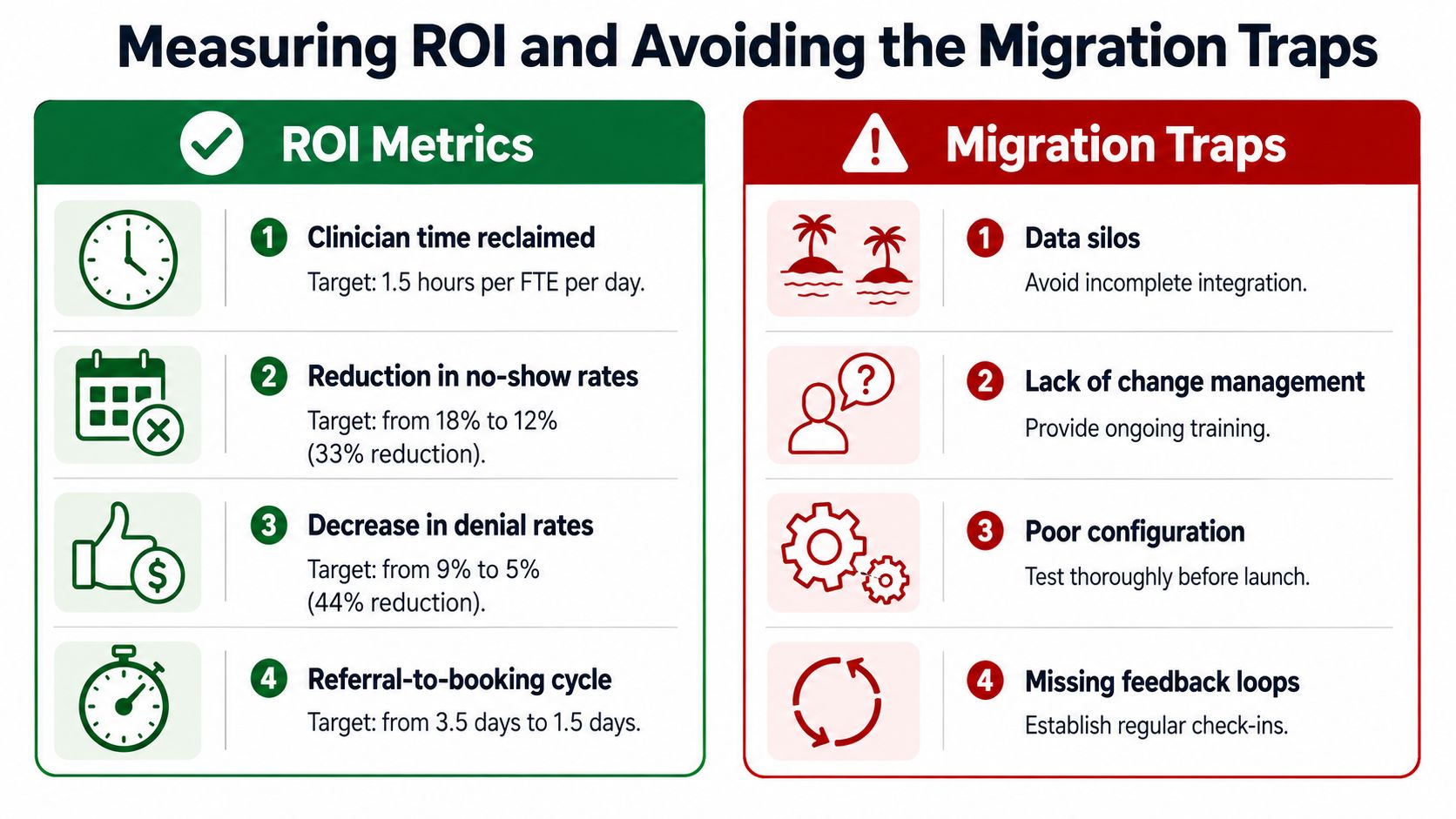
The ROI discussion has to be boring and specific. Leaders should track clinician time reclaimed per FTE, reduction in no-show or denial rates, average referral-to-booking cycle, and net revenue per encounter. If those aren’t baselined before kickoff, the investment won’t be judged later.
Use a formula the finance team will accept
The simplest model is this: (hours saved × loaded labor cost) + (revenue recovered or accelerated) − (license + integration + change-management cost) over a 12 to 24 month horizon. Keep the math tied to actual workflow outcomes, not soft claims about “efficiency.” If you can’t defend the assumptions in budget review, you don’t have ROI; you have optimism.
The internal guide on healthcare process intelligence is a good companion when you want to trace where time is lost inside a workflow, rather than guessing. That matters because the biggest cost wins usually come from removing hidden rework, not from flashy automation.
The migration traps that quietly break the math
Data mapping debt is the first killer, especially when HL7 and FHIR objects don’t line up cleanly. Dual-keying during cutover is the second, because staff lose trust when they have to enter the same data twice. Scope creep onto legacy EHR modules is the third, since it turns a targeted workflow project into a never-ending platform replacement effort.
Underestimating retraining time is just as dangerous. If nurses, coordinators, or billing teams are forced to relearn the process without strong support, adoption drops and the old workaround survives. These aren’t surprises; they’re design decisions you can plan around.
What to do before you buy
-
Baseline the four KPIs first: You need a before picture, or the after picture won’t mean much.
-
Require a written migration plan: It should include cutover timing and rollback criteria.
-
Assign one executive sponsor: Workflow programs fail when no one owns the cross-functional friction.
-
Schedule a 90-day ROI review: Don’t wait a year to discover the platform didn’t change operations.
If you’re ready to turn disconnected care processes into a governed, interoperable workflow layer, Bridge Global can help design and build that stack around your existing systems. Visit Bridge Global to discuss a healthcare workflow program that fits your integration reality, not a generic software template.

About Preethi Saro Philip
Preethi Saro Philip is a Post Graduate Research Degree holder in Economics with more than 10 years of experience in writing, editing, research and teaching. She has an intense passion for content crafting and calls herself a ‘wordsmith’. She enjoys writing on wide-ranging topics including business, technology, health & lifestyle, education, environment etc.
View all posts by Preethi Saro Philip →