



Healthcare Automation Frameworks That Actually Work
On a typical Tuesday, the intake team is juggling a messy referral queue, a clinician is waiting on documentation that doesn't line up with the chart, and compliance has already flagged a workflow change because nobody can explain who owns the audit trail. That's the starting point for healthcare automation frameworks, not a vendor demo or a slide deck. If automation keeps creating brittle bots, hidden scripts, and review gaps, the problem isn't the tool. It's that the organization never defined the framework.
That's why the right question isn't, “What can we automate?” It's, “What should be automated, who owns it, what data can it trust, and how do we prove it won't break under audit?” When teams skip that discipline, they end up buying features instead of building an operating model. For product leaders, that means rethinking automation as a governance problem first and a software decision second.
Why Most Healthcare Automation Initiatives Stall
A healthcare automation program stalls fast when every workflow is treated as a candidate for full automation. A bot can look polished in a demo and still fail in production because the process is vague, the fields do not match, or nobody agreed on escalation rules. In healthcare, those failures are not minor. They hit scheduling, claims, documentation, and patient trust at the same time.
The market is pushing in the opposite direction. One industry estimate says the global healthcare automation market grew from $72.6 billion in 2024 to $80.3 billion in 2025, a 10.6% year-over-year increase, with projections reaching $110.61 billion by 2030. That growth matters because automation is moving from a back-office experiment to a core operating assumption. The same source says automated data entry and record management can reduce errors by 50% to 80% versus manual handling, which is exactly why weak process design gets exposed so quickly.
The failure mode is not tooling
Teams buy software before they define ownership. Then the intake bot double-books slots, the CDS rule gets ignored because clinicians do not trust it, and the compliance group blocks the release because audit logging is incomplete. None of those failures are random. They happen when no one specifies the data contract, the decision boundary, or the override path.
Practical rule: if a workflow has no named owner, it is not ready for automation.
A framework-first approach changes the procurement conversation. Instead of asking a vendor what it can automate, ask what it assumes about data quality, what it logs, and what happens when a step fails. That pushes the team away from fragile point solutions and toward a design that can survive EHR changes, policy updates, and staffing churn. If you are working with a healthtech software development partner on delivery, that clarity should start in discovery, not after implementation starts.
What a Healthcare Automation Framework Is
A healthcare automation framework is the operating system for automated workflows in care delivery and healthtech products. The framework is the set of contracts that decides how data moves, how rules execute, how humans intervene, and how the organization proves control.
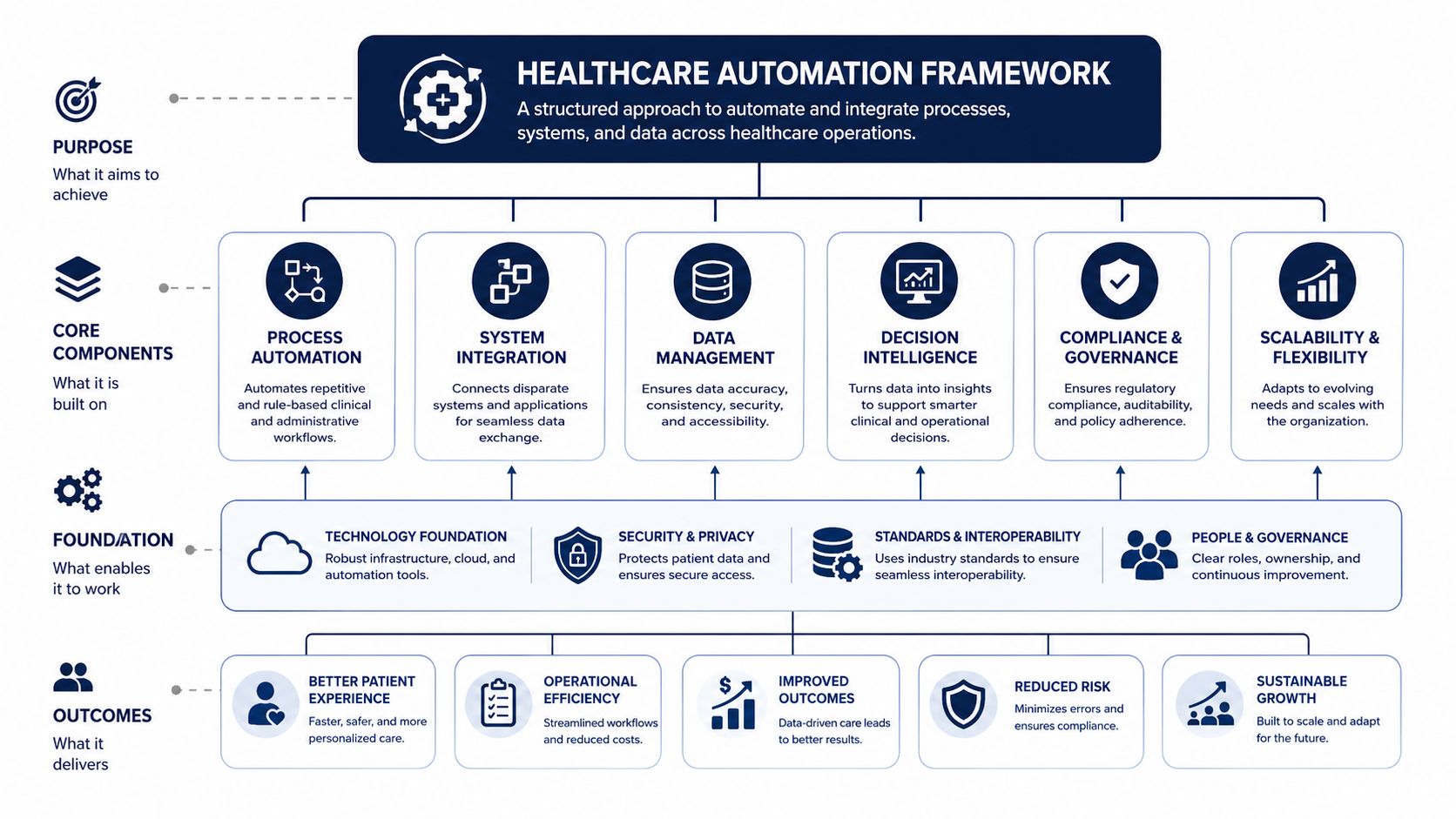
The strongest production designs separate the system into five interoperable layers: infrastructure, data, algorithm, application, and security/compliance, because each layer has a different job and a different owner. That separation matters. It keeps model logic out of brittle workflows, lets teams audit decisions independently, and makes it possible to swap components without rewriting the whole stack.
Why the data layer carries the most weight
Healthcare data is messy by default. Different systems encode the same concept in different ways, fields are missing, and some records are incomplete or contradictory. That makes the data layer the most important part of the framework, because bad inputs create bad automation no matter how polished the interface looks.
FHIR helps here because it gives the framework a common representation layer across EHRs and integration patterns. Research on Cardea describes an open automated machine-learning framework for electronic health records that uses FHIR as its representation interface, then automates data assembly, auditing, feature engineering, model selection, and hyperparameter tuning. That is the right mental model. The framework is not the workflow itself. It is the layer that makes the workflow repeatable, auditable, and tolerant of change.
A useful internal shorthand is simple. A framework is the contract layer, and the workflow is the thing running on top of it.
The stack should make bad data visible early, not bury it under a pretty interface.
The practical test is direct. If product, engineering, and compliance cannot point to the layer where a failure belongs, the framework is too vague to trust. For a deeper architecture view, see healthcare automation architecture.
The Four Framework Types You Will Evaluate
Most procurement conversations blur tools that solve different problems. That leads to weak comparisons. A workflow orchestration platform, an RPA layer, a clinical decision support engine, and an interoperability framework all sit inside the same automation discussion, but each one owns a different part of the stack.
Compare the categories by center of gravity
| Framework Type | Primary Job | Best Fit | Watch Out For |
|---|---|---|---|
| RPA-led automation | Repeating clerical tasks across systems | Narrow admin workflows with stable rules | Brittle scripts and hidden dependencies |
| Workflow orchestration platforms | Coordinating steps, handoffs, and exception paths | Multi-team processes with approvals and queues | Treating orchestration like a fix for bad data |
| Clinical decision support systems | Guiding clinical or operational decisions | Triage, ranking, reminders, and alerts | Trust collapse if recommendations aren't explainable |
| Interoperability frameworks | Standardizing exchange and transformation | Healthtech platforms that move data across systems | Integration sprawl without governance |
RPA works when the task is concrete, frequent, and rule-bound. It fits repetitive admin work, then breaks down when the process changes often or the edge cases keep multiplying. Workflow orchestration is stronger when the problem is handoffs, queues, and exception management. It gives you process control, but only if the underlying data model is sane.
What breaks in regulated healthcare
Clinical decision support changes the discussion because the framework now affects judgment, not just throughput. If clinicians cannot explain or validate the recommendation path, trust drops, and the governance gap becomes obvious fast. Interoperability frameworks are less glamorous and often more important, because they standardize exchange and transformation so the rest of the stack does not degrade into custom point-to-point wiring.
The right fit depends on where the workflow lives. A regional provider may need orchestration and interoperability first, while a SaaS vendor may need an integration framework that can survive multiple client environments. If a vendor says one platform handles all four jobs equally well, they are collapsing distinctions that matter in production.
As we explored in our guide to healthcare workflow intelligence, the win is rarely a single tool. It is the right center of gravity for the right workflow.
Where AI Changes the Framework and Where It Does Not
AI adoption inside healthcare is already broad. A 2026 healthcare AI statistics compilation says about 80% of hospitals use AI in at least one clinical or operational function, AI use among physicians rose from 38% to 66%, and the FDA had cleared or approved about 1,250 AI/ML-enabled medical devices by May 2025. Those figures tell you AI is no longer a side project. It’s part of the framework surface area.
The mistake is assuming AI belongs everywhere. It doesn’t. AI helps when the problem involves pattern recognition, ranking, or noisy input, and it hurts when the process is deterministic and must be exactly repeatable.
Use AI where uncertainty is the problem
In the data layer, AI can help with normalization, entity resolution, and anomaly detection. That’s useful when records come in with inconsistent formats or partial matches. In the algorithm layer, AI can rank risk, prioritize queues, and support prediction. In the application layer, it can assist with ambient documentation, scheduling optimization, or summarization.
But deterministic eligibility checks, claims edits, and routing rules don’t need AI. They need consistency. If you add a probabilistic model to a process that should be rule-based, you create review burden without improving the outcome.
Governance has to move with the model
AI also changes the security and compliance layer. Model cards, drift monitoring, and human-in-the-loop checkpoints stop being nice-to-haves and become control points. That’s the governance gap many organizations miss. A system can look modern and still be impossible to defend if nobody can explain which version of the model made a call, who reviewed it, and what data it used.
For teams exploring AI development services or enterprise AI solutions, the framework question comes first. If you can’t place the model in the right layer, you’re not designing a system. You’re decorating one.
Selecting the Right Framework and Running the First 90 Days
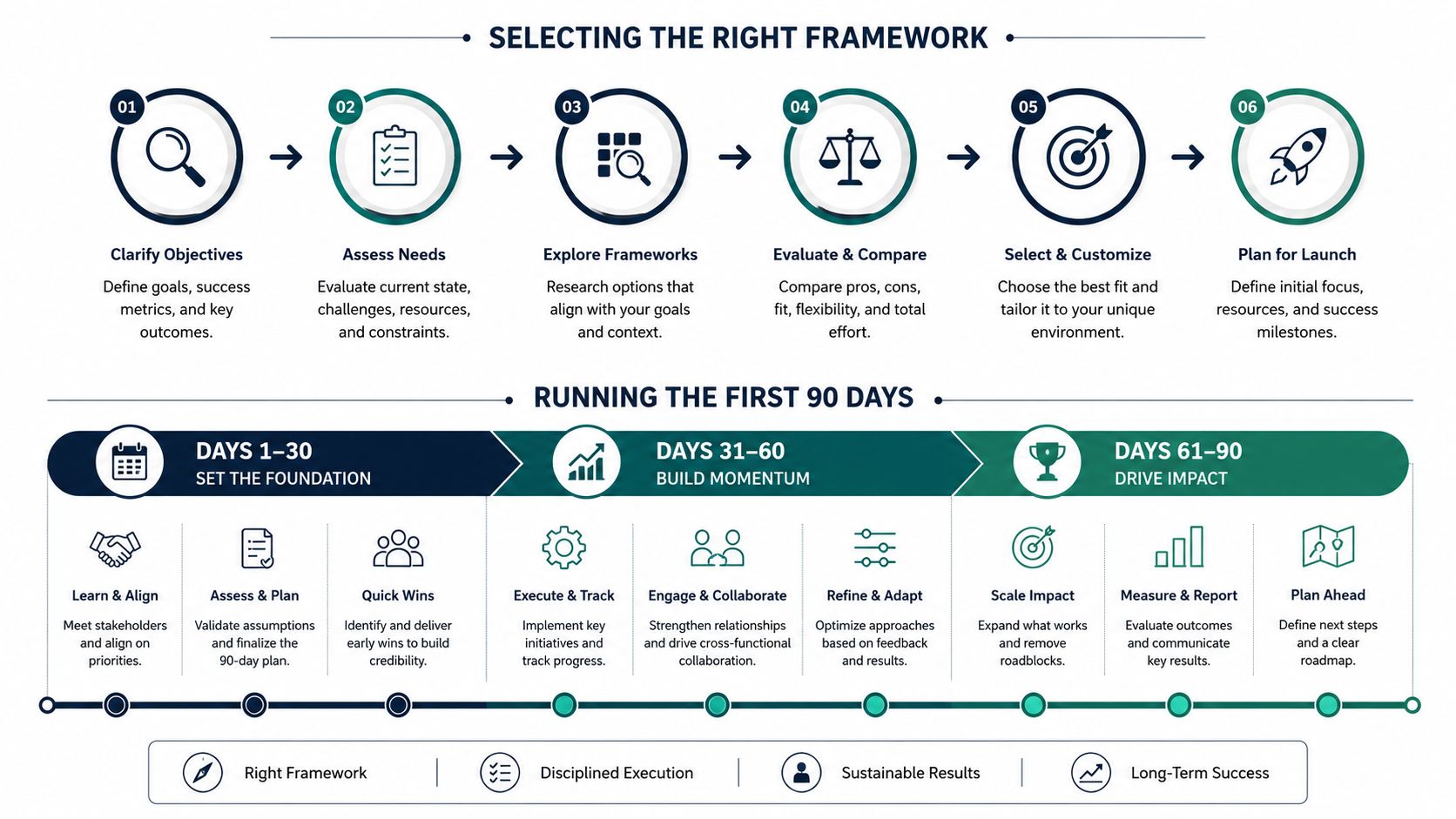
The selection criteria should be blunt. If a framework doesn’t support data contracts, auditability, compliance posture, observability, and a clear view of lock-in exposure, keep looking. Those aren’t optional capabilities in healthcare. They’re the minimum bar for anything that touches records, claims, or clinical workflow.
The operational pattern that works is predict, prioritize, reallocate, recover. Predict where failure is likely. Prioritize the riskiest cases. Reallocate staff from repetitive tasks to higher-value work. Recover capacity in revenue, access, or throughput. That sequence is simple enough to manage and strong enough to defend in a steering committee.
What to do in the first 90 days
Start by mapping one workflow against the five-layer model. That gives you a live view of where data enters, where decisions happen, and where overrides must be logged. Then run a small pilot in one department, not a broad rollout. The goal isn’t to prove the entire platform; it’s to prove the framework can hold under real operational conditions.
A custom software development team can build the framework around your constraints, while software development service models help you decide how much capacity stays in-house. For integration-heavy programs, the engineering bottleneck is usually the security and data layers. That’s where a healthtech software development partner is often the practical choice, because domain-specific integration work takes more than generic app building.
Selection rule: choose the framework that minimizes custom exceptions, not the one with the longest feature list.
The first 90 days should end with a decision, not a report. Keep the pilot if the data contracts hold, the audit trail is complete, and the handoffs are visible. Kill it if the workflow depends on manual rescue to stay afloat.
Compliance, Equity, and the Limits of Full Automation
Healthcare automation has to survive legal scrutiny, but compliance isn’t the only constraint. A framework can satisfy a checklist and still be a bad fit if it ignores consent, data residency, or the people expected to use it. That’s especially true in safety-net hospitals, rural clinics, and other low-resource environments where implementation capacity is uneven.
The policy discussion around AI in healthcare makes this even more explicit. The governance gap paper in the background research points to the need for audit trails, human oversight, validation, and traceability in workflows that influence coding, treatment, consent, or patient-facing guidance. That’s the right standard. If your framework can’t show who did what, when, and why, you don’t have governance. You have hope.
Don’t over-automate workflows that need human judgment
The McKinsey and EIT Health analysis found that healthcare has one of the lowest overall automation potentials, with only 35% of time spent potentially automatable and only 15% of current work hours expected to be automated in the midpoint scenario. That number should make product teams more disciplined, not more pessimistic. If most work won’t be automated, then the framework has to make partial automation, human review, and exception handling first-class design choices.
Equity matters for the same reason. A framework that assumes perfect connectivity, clean data, and abundant technical staff will underperform in communities that already face resource constraints. That’s why fallback paths, low-friction override hooks, and continuous monitoring aren’t extras. They’re the difference between a usable system and a system that only works in the lab.
For teams extending their platform through custom healthcare software development, healthcare integrations, or a healthcare cybersecurity automation program, the design brief should be conservative. Automate the predictable parts. Keep humans in the loop where the workflow depends on interpretation, escalation, or patient trust.
Measuring a Framework With KPIs That Matter
A framework can look successful on paper and still fail in practice. Task completion speed means little if the workflow is generating bad data, weak handoffs, or brittle exception handling. Measure healthcare automation frameworks by the layer they own and the failure mode they create. That keeps the review focused on control, not presentation.
The KPI set should cover throughput and reliability, data quality, compliance readiness, and business impact. Each family answers a different question about whether the framework is reducing work or merely relocating it. The error reduction question belongs here too, because automated data entry and record management can cut errors sharply versus manual handling, as noted by GetCodesHealth. That claim only matters if your own implementation proves the same pattern through live audit results and operational checks.
Put the right numbers in front of the team
-
Throughput and reliability: Queue depth, integration failure rate, and mean time to recovery show whether the workflow stays stable under load.
-
Data quality: Rejection rates, FHIR resource completeness, and drift indicators show whether the framework is consuming clean inputs and producing usable outputs.
-
Compliance readiness: Audit log completeness, policy override rate, and documentation completion show whether the system can survive review without gaps.
-
Business impact: Labor hours reallocated, claim denial rate change, and revenue integrity recovery show whether the automation changed outcomes, not just activity.
Output volume by itself hides the core problems. A fast workflow that keeps bouncing records back to staff is still a broken workflow. Watch data-quality rejection rates and integration error rates together, and you catch issues before they become patient-facing or finance-facing. That is the difference between a dashboard that decorates meetings and an operating signal that changes decisions.
Where to Go Next and What to Ask Your Vendor
Before the next steering meeting, ask five questions. Does the framework define clear data contracts: does it produce a complete audit trail, can humans override it without breaking the workflow, how does it handle interoperability changes, and what observability exists for drift, failures, and exception paths?
If a vendor can’t answer those cleanly, they’re selling surface area, not control. The next move is usually one of three things, depending on the gap: SaaS product development for platform teams, custom software development for workflow rebuilds, or enterprise AI solutions when the framework needs predictive logic with governance built in. If your team still needs a structured translation from strategy to delivery, an AI implementation roadmap can help anchor the sequence.
The teams that win in 2026 won’t be the ones that automate the most. They’ll be the ones that automate the right workflows, preserve auditability, and keep human judgment where it still matters.
Bridge Global helps product and engineering teams build healthcare platforms that can handle integration, auditability, and AI governance without turning every workflow into a custom exception. If you’re designing healthcare automation frameworks or trying to rescue one that’s already brittle, visit Bridge Global and review how their delivery model fits your stack, your compliance needs, and your rollout plan.

About Preethi Saro Philip
Preethi Saro Philip is a Post Graduate Research Degree holder in Economics with more than 10 years of experience in writing, editing, research and teaching. She has an intense passion for content crafting and calls herself a ‘wordsmith’. She enjoys writing on wide-ranging topics including business, technology, health & lifestyle, education, environment etc.
View all posts by Preethi Saro Philip →