



Healthcare Cybersecurity Automation: An Implementation Guide
92% of healthcare organizations were targeted by cyberattacks in the past 12 months, and incidents averaged 40 attacks per organization. That’s not a compliance problem anymore; it’s a workflow problem, because security teams can’t manually sort, verify, and respond at that pace without slowing clinical operations. Healthcare cybersecurity automation has moved from a nice-to-have to the only practical way to keep up with the volume, the cost, and the speed of modern attacks.
The financial pressure is just as stark. Industry reporting shows the healthcare sector remains the most expensive for breaches, and AI plus automation have already shown measurable gains in detection speed and response cost reduction, which makes the case for automation operational, not theoretical. The challenge is deploying it in a way that protects patient data without breaking the systems clinicians depend on every minute of the day.
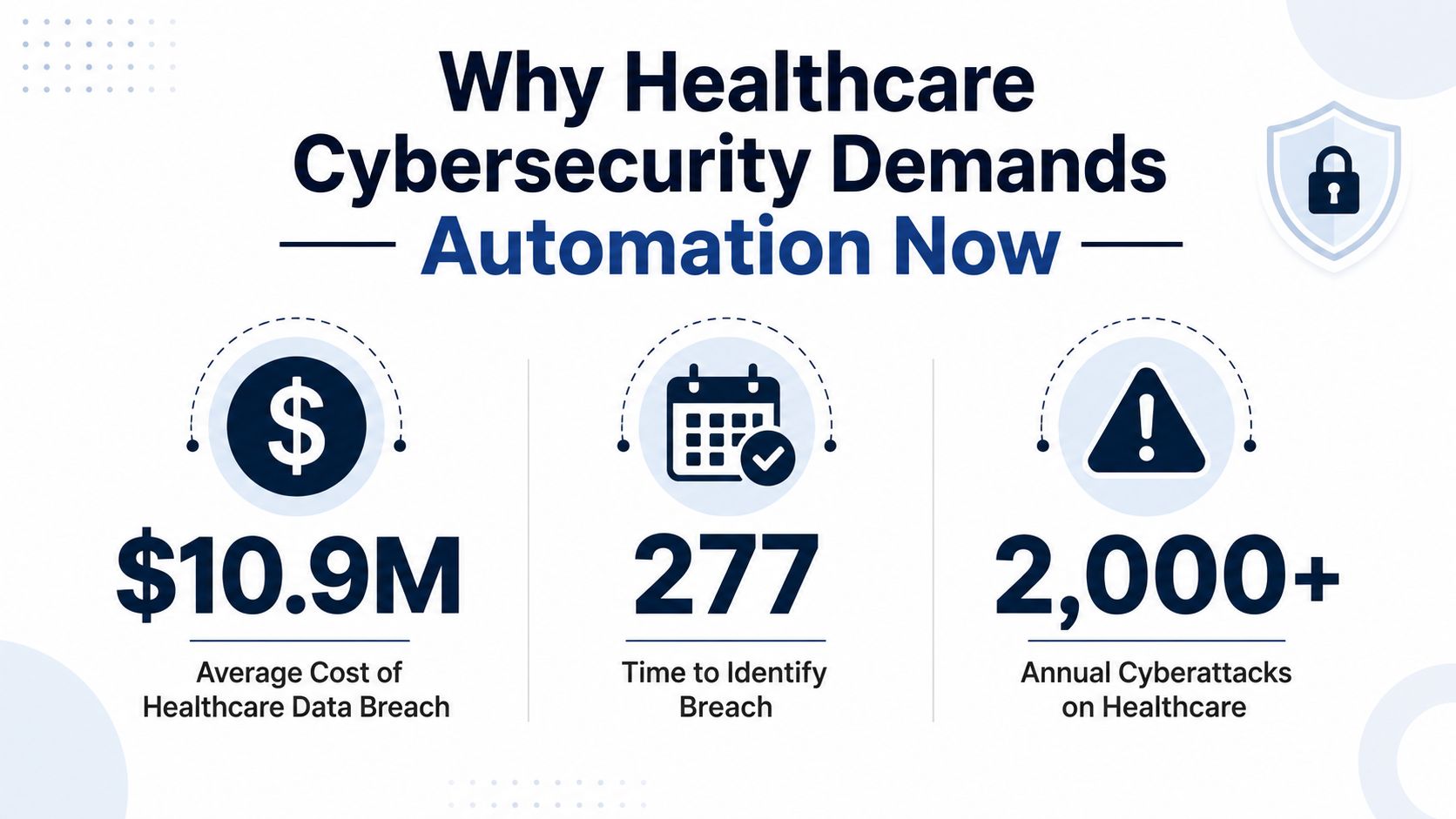
Why Healthcare Cybersecurity Demands Automation Now
Healthcare is absorbing too many attacks for manual defense to keep pace. In the first half of 2024 alone, the U.S. saw 387 healthcare data breaches involving 500+ records, an 8.4% increase over the first half of 2023, according to the healthcare cybersecurity statistics overview from Dialog Health. That same source set reports that AI and automation tools helped organizations detect and contain incidents 98 days faster on average and saved nearly $1 million in incident response costs.
Manual response breaks first
Manual monitoring depends on humans noticing patterns, escalating alerts, and coordinating response across teams that already have competing priorities. That model fails fast when security events arrive in clusters, when third-party access creates noisy logs, and when downtime carries clinical consequences. Healthcare breach data in the same source set shows why timing matters; response delays turn into operational disruption, not just IT cleanup.
IBM’s healthcare breach analysis shows organizations using serious AI and automation in security reduced breach cost by $1.76 million and shortened the breach lifecycle by 108 days on average. A separate healthcare-focused source reports the sector’s average breach cost was $7.42 million in 2025, and that healthcare has been the most expensive industry for data breaches for 14 consecutive years. Those numbers explain why automation isn’t a side project. It’s the only sane way to compress detection, triage, and containment windows.
Operational downtime changes the equation
In healthcare, breach cost isn’t only about records or fines. One healthcare-focused source reports ransomware caused nearly 19 days of average downtime for U.S. healthcare organizations, which means the response path has to preserve service delivery as well as security. That’s also why practical lifecycle work, like secure equipment disposition, matters. If you’re planning refreshes or decommissioning programs, the Georgia HIPAA ITAD services guide from Beyond Surplus is a useful reference for handling sensitive assets without creating a new exposure point.
Automation becomes the lever because it reduces the amount of manual judgment required during the most repetitive, failure-prone parts of defense. It doesn’t replace people. It gives them a fighting chance to act before an incident becomes a care disruption.
Mapping Critical Assets and Establishing Security Baselines
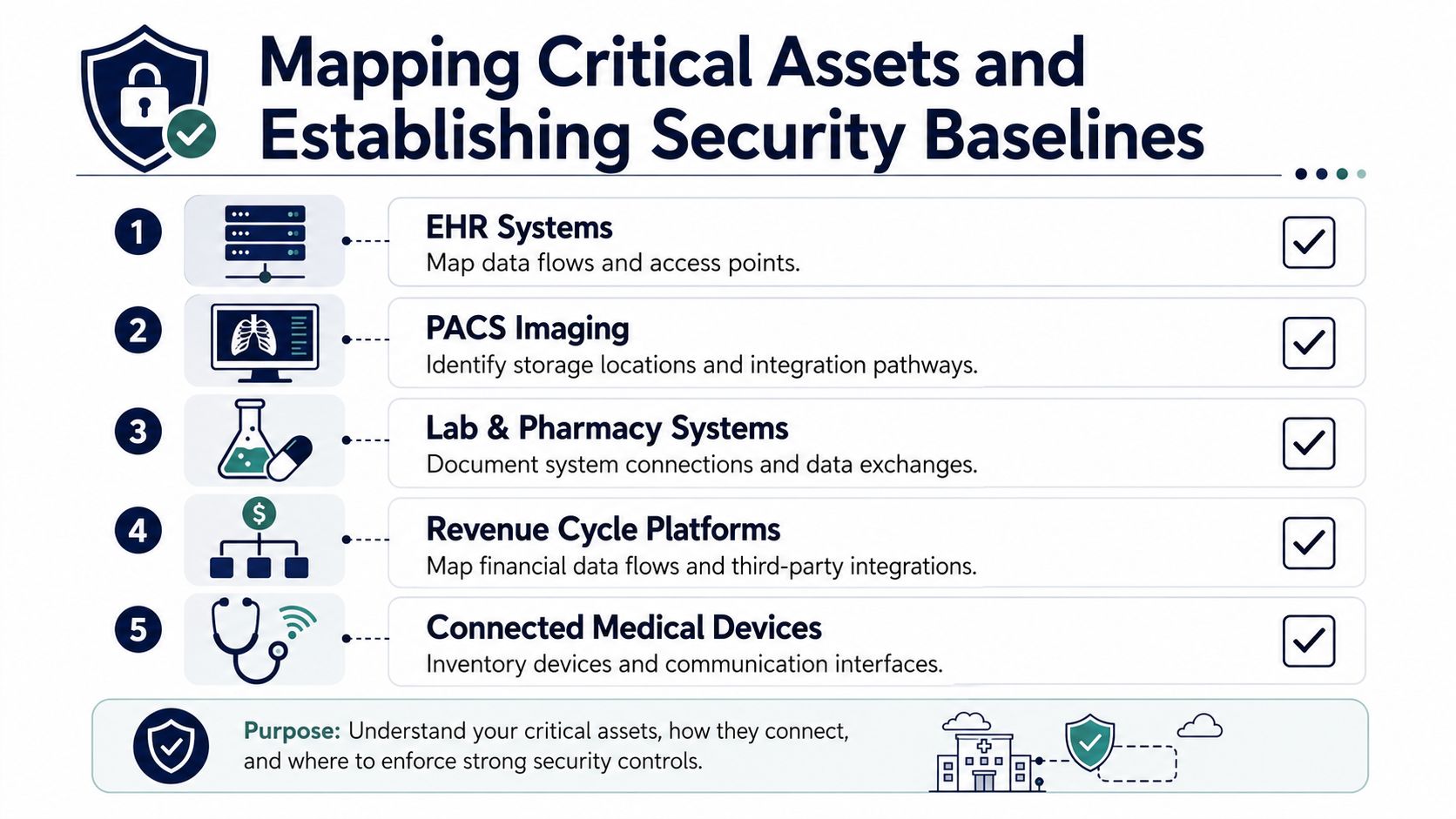
Before any control gets automated, the environment has to be mapped in clinical terms, not just technical terms. Start with the systems that move patient care and revenue: EHR, PACS, lab and pharmacy platforms, revenue cycle systems, identity services, and connected medical devices. If those assets aren’t documented with owners, dependencies, and access paths, automation will either miss the risk or create noise around the wrong one. For a deeper operating view on the broader control stack, see healthcare data security best practices.
Measure the baseline before you automate
A workable baseline starts with MTTD, MTTR, phishing click rate, audit findings, and recovery times. Censinet’s healthcare benchmarking guidance recommends MTTD within 24 hours, MTTR within 72 hours, 95% adherence to NIST CSF 2.0 controls, 100% PHI encryption at rest and in transit, weekly vulnerability scans covering 98% of devices, and remediation of critical device vulnerabilities within 7 days. Those targets are useful because they force teams to define what “good” looks like before automation begins.
Practical rule: if you can’t measure current exposure, you can’t prove automation improved it.
The most common mistake is skipping coverage baselines and jumping straight into tools. That usually inflates alert volume without reducing risk, because teams can’t tell whether new detections reflect better visibility or just more noise. Baselines give you a control point for every future tuning decision.
Map workflows, not just assets
Clinical and operational workflows matter as much as device inventories. A patch window that works for a finance app may be unusable for imaging, and a vendor access policy that is fine for a reporting portal may be unsafe for an infusion environment. Automation planning confronts these realities, because the same control can be safe in one network segment and disruptive in another.
If you’re defining the first wave of automation, start with the flows that have the clearest ownership and the fewest exceptions. Then tie every automated action to a named business process, a recovery expectation, and a patient-safety impact level. That makes it possible to stage rollout without guessing.
Building a Layered Security Testing Stack Across the SDLC
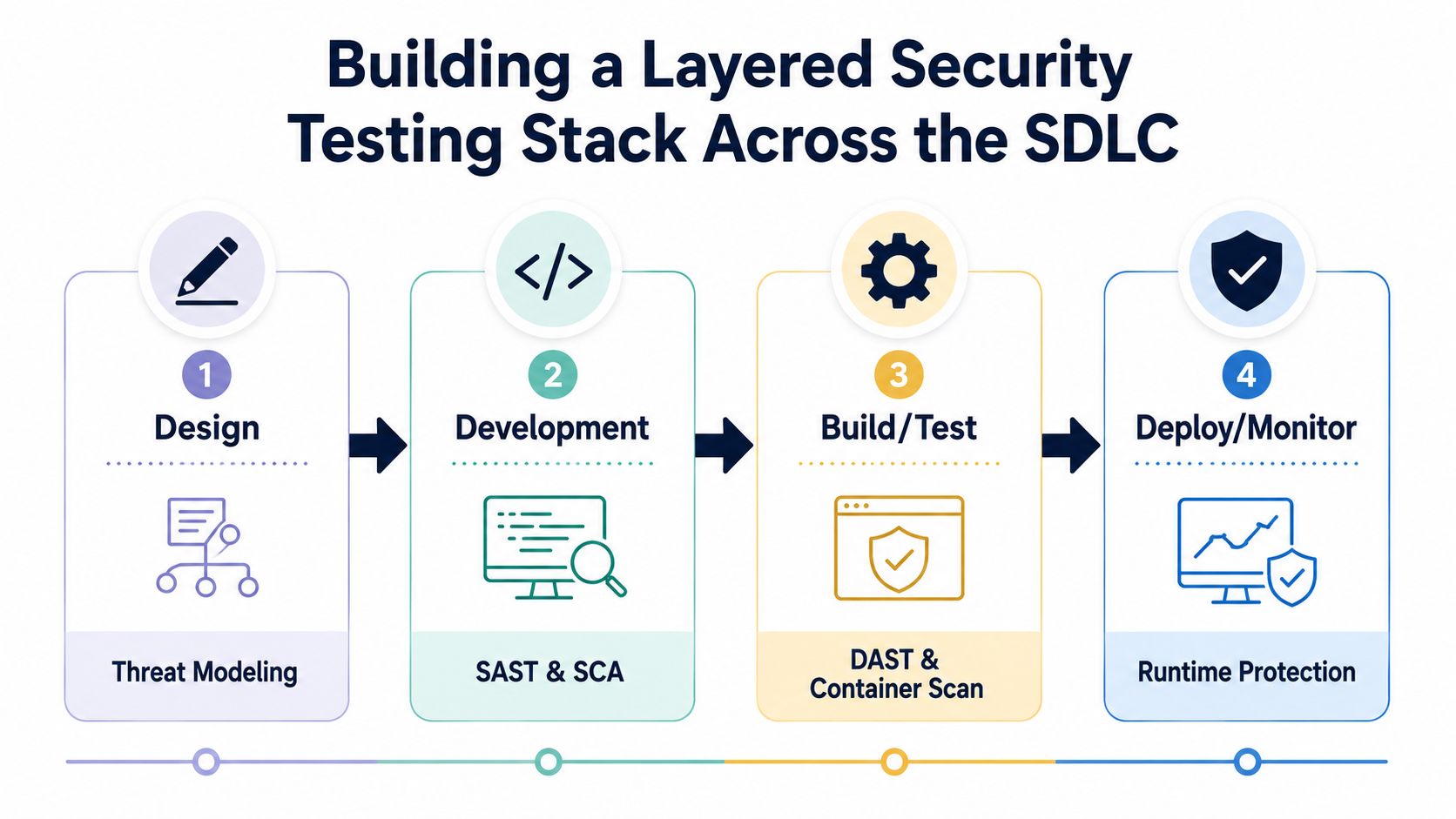
Healthcare apps and device-adjacent systems need layered testing because a single scanner class leaves blind spots. The strongest stack starts on commit with SAST and secrets scanning, moves into DAST against live apps and APIs, adds IAST for runtime context, and uses SCA to catch third-party package risk. Before release, container and Kubernetes checks should verify posture, then production monitoring through SIEM and UEBA keeps watch over live behavior. For a broader implementation view, the article on custom healthcare software development is a useful companion.
Match the test method to the clinical surface
FHIR and HL7 endpoints often need agentless or read-only assessment methods, because service disruption in a clinical interface can be worse than a missed test run. Identity systems and medical IoT devices create similar constraints, especially when vendors own parts of the stack or when the device can’t tolerate invasive tooling. In those environments, read-only validation is slower, but it’s safer and more realistic.
Static tools are still necessary, but they’re incomplete. They catch code-level issues and leaked credentials, but they don’t see session handling mistakes, runtime authorization flaws, or behavior under load. Runtime testing catches a different class of problems, and dependency scanning catches the drift that appears after release. You need all three views if patient data moves through the system.
Tie testing to clinical criticality
A test failure in a scheduling portal and a test failure in a medication workflow should not trigger the same operational response. That’s why automation has to be linked to PHI impact and clinical criticality, not just severity labels from a scanner. The better setup is one where release gates, alert routing, and exception handling all reflect how much patient care depends on the affected component.
Static checks tell you what the code contains. Runtime checks tell you what the system actually does.
This is also where the testing stack should support change control, not fight it. If a scanner blocks a release without context, teams will route around it. If it shows the exact exposure, the dependency chain, and the affected clinical service, engineers can make a defensible decision fast.
Implementing Zero Trust Without Disrupting Clinical Workflows
Zero trust in healthcare works only when it respects the speed clinicians need. The model isn’t just login checks; it includes continual authentication, multi-factor authentication using phone-based, biometric, or location-aware verification, encryption of data in motion, and an automation and orchestration layer that triggers responses based on predefined policy. The architecture review in secure healthcare software architecture is a useful companion for teams designing those boundaries.
Keep identity and access decisions context-aware
A nurse at a bedside terminal, a radiologist opening imaging data, and a vendor supporting a device all need different levels of friction. If the policy engine ignores that context, clinicians end up fighting the system, and support teams start creating exceptions that weaken the model. The answer is to use role, location, device trust, and session context together, then reserve stricter prompts for unusual combinations.
Microsegmentation and network isolation help, but they can’t be treated as stand-alone controls. Mixed clinical and administrative networks create routing dependencies that need staged rollouts and explicit exception handling for life-critical systems. The policy design has to allow fast access where it’s safe, then tighten automatically when risk changes.
Use orchestration to reduce manual exceptions
An automation layer should do more than log events. It should trigger a predefined sequence when policy conditions are met, such as stepping up authentication, restricting a session, or isolating a noncritical segment. That works best when the action set is small, the triggers are clear, and the rollback path is documented.
Workflow-safe zero trust means the policy follows the clinical reality, not the diagram on the slide.
The biggest failure mode is trying to enforce an elegant model on an environment full of vendor dependencies and legacy device constraints. That approach usually generates workarounds instead of resilience. The practical version is slower to design, but it survives contact with real care delivery.
Deploying AI for Threat Detection and Incident Response
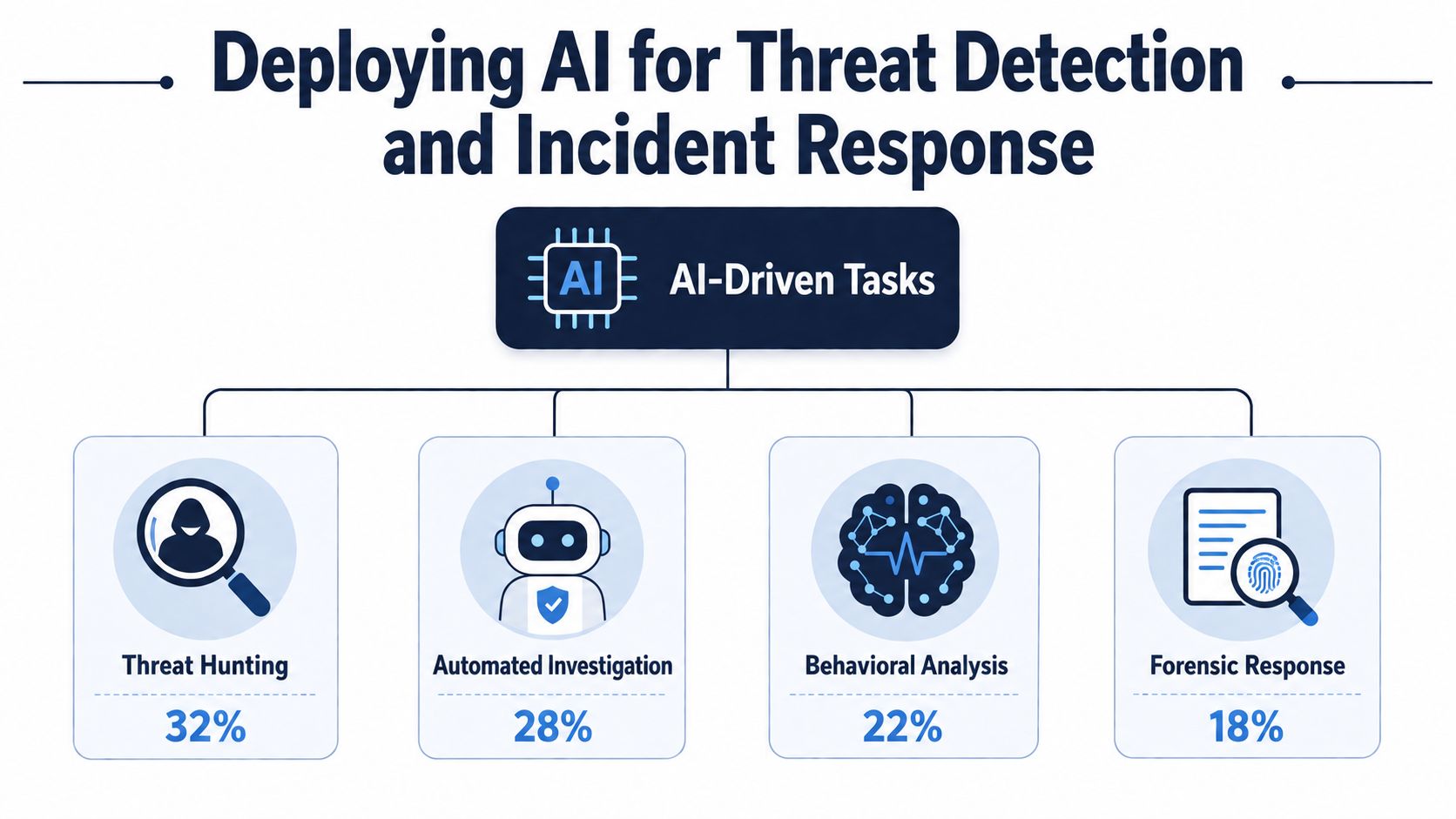
AI in healthcare security already gets used for distinct detection jobs, not as a single catch-all platform. According to a 2025 study in the American Journal of Medical Sciences and Innovation, among healthcare organizations using AI, threat hunting accounts for 32% of use cases and anomaly detection for 28%. The same source separates machine-learning anomaly detection, deep-learning zero-day exploit detection, and NLP-based threat analysis into different operational techniques, which matters because each one needs a different workflow, data feed, and response boundary.
Start with a formal risk assessment
AI works best when it targets the right assets first. A healthcare-focused review in the Dumas archive says the assessment phase should begin with a formal risk assessment or scan to establish the organization’s cybersecurity baseline before AI enters response workflows. That sequence matters because it keeps teams from automating around the wrong priorities, especially in environments where clinical devices, vendor access, and mixed networks all behave differently.
Before any model is tuned, the operational picture has to be clear. Security teams need a baseline that includes the systems that can tolerate automated action, the systems that need human approval, and the systems that should only be observed. Observability also matters here, which is why teams often pair detection work with healthcare observability solutions to understand what is normal before they let automation take over part of the response path.
Separate the AI tasks
Threat hunting and anomaly detection are different jobs, and automated investigation or forensic response are different again. If those functions get blurred together, analysts receive vague results and playbooks become hard to tune. A better design assigns AI to one detection or triage function at a time, then defines the handoff to the human responder so the tool does not make decisions it was never meant to make.
One healthcare ICT review, as noted in the review, reports a global average damage reduction of 1.76 million USD per attack when AI-based cybersecurity and automated systems are used. It also recommends controls that fit automated environments, including encryption at rest and in transit, multi-factor authentication, regular backups and recovery systems, and continuous auditing/monitoring. That combination matters because AI without control discipline only creates faster confusion.
For teams building the response path, the strongest pattern stays simple. Let AI flag likely threats, let the playbook isolate or enrich evidence where policy allows, and let analysts review the exceptions. When configured well, the workflow can identify and eliminate threats without external assistance, but only for the incident classes you’ve modeled.
Common Automation Pitfalls and How to Avoid Them
The hardest problems in this space aren’t usually technical. Endpoint management, human error, weak security awareness, remote-work security, and the tradeoff between security investment and service delivery quality still shape outcomes in healthcare. That’s why automation plans fail when they assume the tool is the solution instead of the operating model.
The most expensive mistakes are predictable
First, teams automate before baselining risk and coverage, then they can’t prove whether anything improved. Second, they buy a single scanner and assume it covers code, runtime, dependency risk, and cloud posture, which it never does. Third, they deploy zero trust without accounting for clinical access patterns, so staff start bypassing controls whenever the workflow gets in the way.
AI is useful, not magical
AI can reduce triage load and improve signal quality, but it doesn’t remove the need for policy design. If the underlying data is messy, the alerting logic is too broad, or the response playbooks are built around idealized systems, the output just becomes faster noise. Health systems need automation that respects device constraints, vendor access, and the fact that some systems can’t tolerate aggressive intervention.
The right question isn’t, “Can we automate this?” It’s, “Can we automate this without creating a clinical workaround?”
Security investment also has to match service delivery reality. A control that’s perfect on paper but creates delays in medication, imaging, or admissions will lose support quickly. The better path is phased rollout, explicit exceptions, and reviews that include clinical stakeholders, not just security and infrastructure teams.
Your Healthcare Cybersecurity Automation Roadmap
A practical roadmap starts with asset mapping, baseline KPIs, and a first-pass risk tier for each workflow. Then automate the controls that reduce the most manual effort around the highest-criticism assets, such as identity checks, alert enrichment, vulnerability scanning, and dependency testing. After that, layer in zero trust policies and AI-assisted detection where the baseline data shows the biggest operational gap.
A useful business case can be built from the documented reduction figures already in the market. IBM’s healthcare analysis shows a $1.76 million average cost reduction and a 108-day shorter breach lifecycle with serious AI and automation in security, which gives leaders a grounded way to model return without inventing internal assumptions. From there, track MTTD, MTTR, coverage, false positives, and exception volume. If those metrics don’t move, the automation is probably mis-scoped.
For teams evaluating build versus buy, decision criteria should be blunt. Choose tools that integrate with your clinical systems, support read-only assessment where needed, and give you workflow-level visibility instead of generic dashboards. If you need help shaping the architecture, custom software development, software development service models, AI development services, enterprise AI solutions, AI implementation roadmap, healthcare integrations, SaaS product development, and client cases are the right Bridge Global pages to review before you commit to a program.
Bridge Global helps healthcare teams design and deliver secure automation that fits real clinical workflows, not just ideal diagrams. If you’re planning healthcare cybersecurity automation, visit Bridge Global to discuss architecture, integrations, and implementation support that can be aligned with your risk, compliance, and product goals.

About Preethi Saro Philip
Preethi Saro Philip is a Post Graduate Research Degree holder in Economics with more than 10 years of experience in writing, editing, research and teaching. She has an intense passion for content crafting and calls herself a ‘wordsmith’. She enjoys writing on wide-ranging topics including business, technology, health & lifestyle, education, environment etc.
View all posts by Preethi Saro Philip →