



How to Build a Healthcare Data Interoperability Strategy
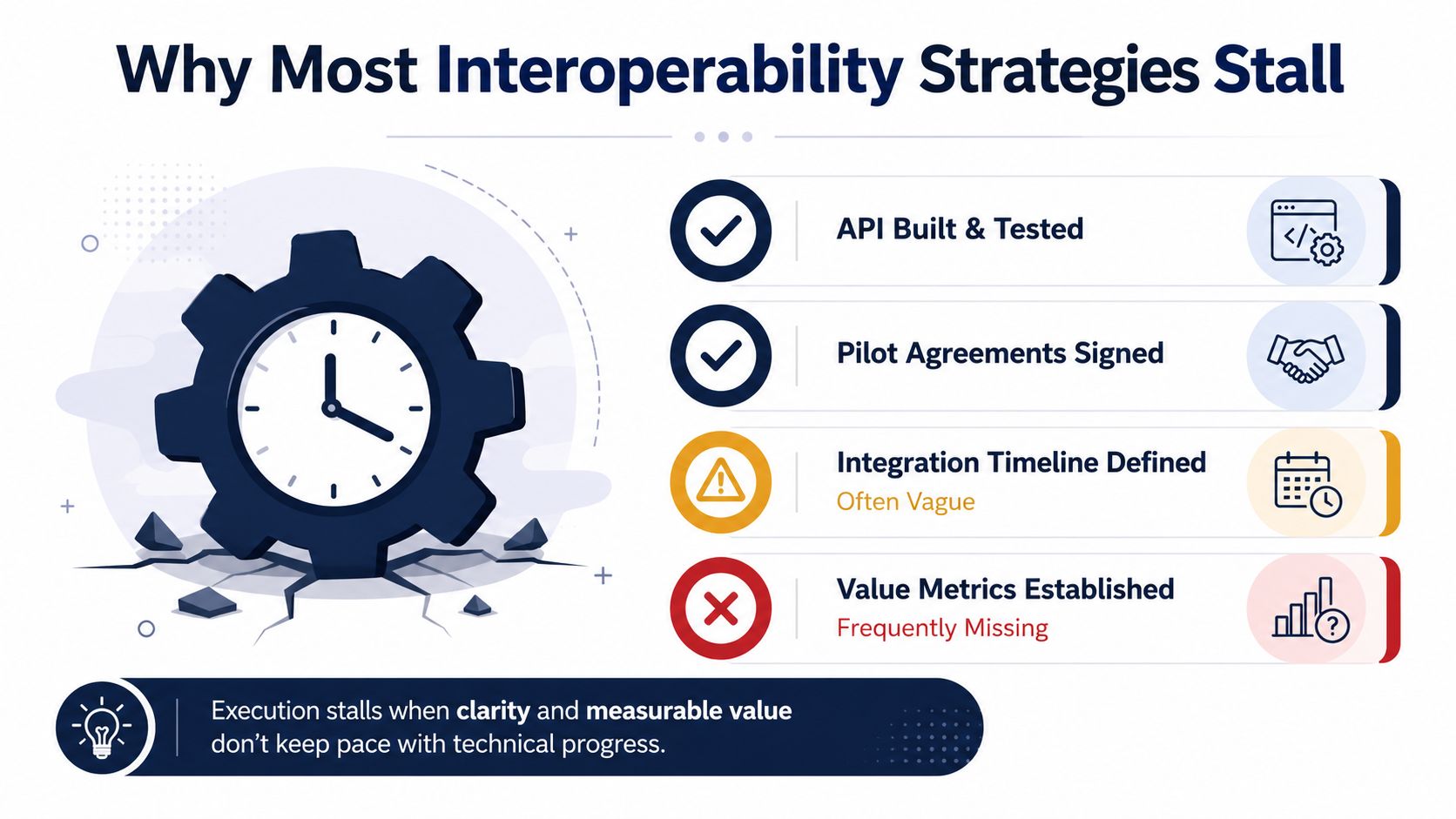
You're probably already living the gap. The API is built, the partner pilot looked promising, and the demos felt clean. Then the hard work started, because the other system couldn't consume the payload cleanly, identity didn't match, clinical users ignored the result, and the integration budget began to look like a compliance expense instead of a business investment.
That's where a healthcare data interoperability strategy either becomes useful or stalls out. The ones that work treat interoperability as a sequencing, governance, and funding problem first, and a standards problem second. They ask what has to be true for exchanged data to change a workflow, reduce rework, or support downstream analytics, then they choose the technical path that can survive partner realities.
Why Most Healthcare Interoperability Strategies Stall Before They Start
A team can ship a clean API and still fail the market test. I've seen that happen when the pilot partner's EHR couldn't consume the message the way the team expected, when the identity layer was too loose to trust in production, and when clinicians never saw the exchanged data in the workflow that mattered. The problem wasn't just technical; it was that nobody had defined what “success” meant beyond connectivity.
The ONC's hospital interoperability data shows why this keeps happening at scale. In 2021, more than 6 in 10 hospitals were doing all four major exchange functions, and the share doing so rose 51% from 2017 to 2021, but that same brief still showed that only 62% had outside clinical information at the point of care and 71% used it. In other words, the network problem had improved faster than the workflow problem.
Start with readiness, not enthusiasm
A practical assessment doesn't need a 200-page report. It needs a short list of the bottlenecks that will block everything else. I usually look at four areas: systems and data inventory, partner ecosystem mapping, clinical workflow review, and compliance posture.
For the systems inventory, list the EHRs, labs, payers, devices, and any middleware already in play. For partner mapping, write down who can send, who can receive, who can only test, and who is still asking for a PDF because they're not ready for structured exchange. For workflow, identify the exact point where a clinician, registrar, or care coordinator will use the outside data, because if that moment doesn't exist, the integration will be technically successful and operationally dead.
Practical rule: if the data won't change a handoff, a decision, or a reconciliation step, it's not ready for production priority.
Score the blockers, then sequence the work
A simple scoring pass works better than a vague strategy deck. Mark each readiness area as low, medium, or high, then circle the two or three items that sit in the lowest state and affect the most partners. That gives you a real sequencing plan.
This is also where a seasoned healthtech software development partner can save you from rebuilding the same integration layer twice. The right external team does more than code interfaces; it helps you decide which custom healthcare software development work should stay internal, which pieces need outside clinical integration experience, and which dependencies must be resolved before you write a line of production logic. If your team already has strong product and architecture ownership, a focused build can work. If you're missing governance, terminology, or integration QA, hand those parts off early.
The most common mistake is treating interoperability like a feature backlog item. It's really a system of dependencies, and those dependencies need to be surfaced before scope gets locked.
Choosing Standards Without Overthinking the Acronyms
Standards matter after the use case is clear. A hospital interface that needs stable high-throughput messaging is a different animal from a patient-facing app or a cross-network exchange program, so the first decision is the exchange problem, not the acronym.
The CDC describes U.S. interoperability strategy as a multi-pronged effort built around a universal governance, policy, and technical floor through TEFCA, plus national uniform data elements under USCDI and USCDI+. That policy floor matters because it shows where the ecosystem is headed, not just what is easiest to build this quarter.
Use the standard to answer the right question
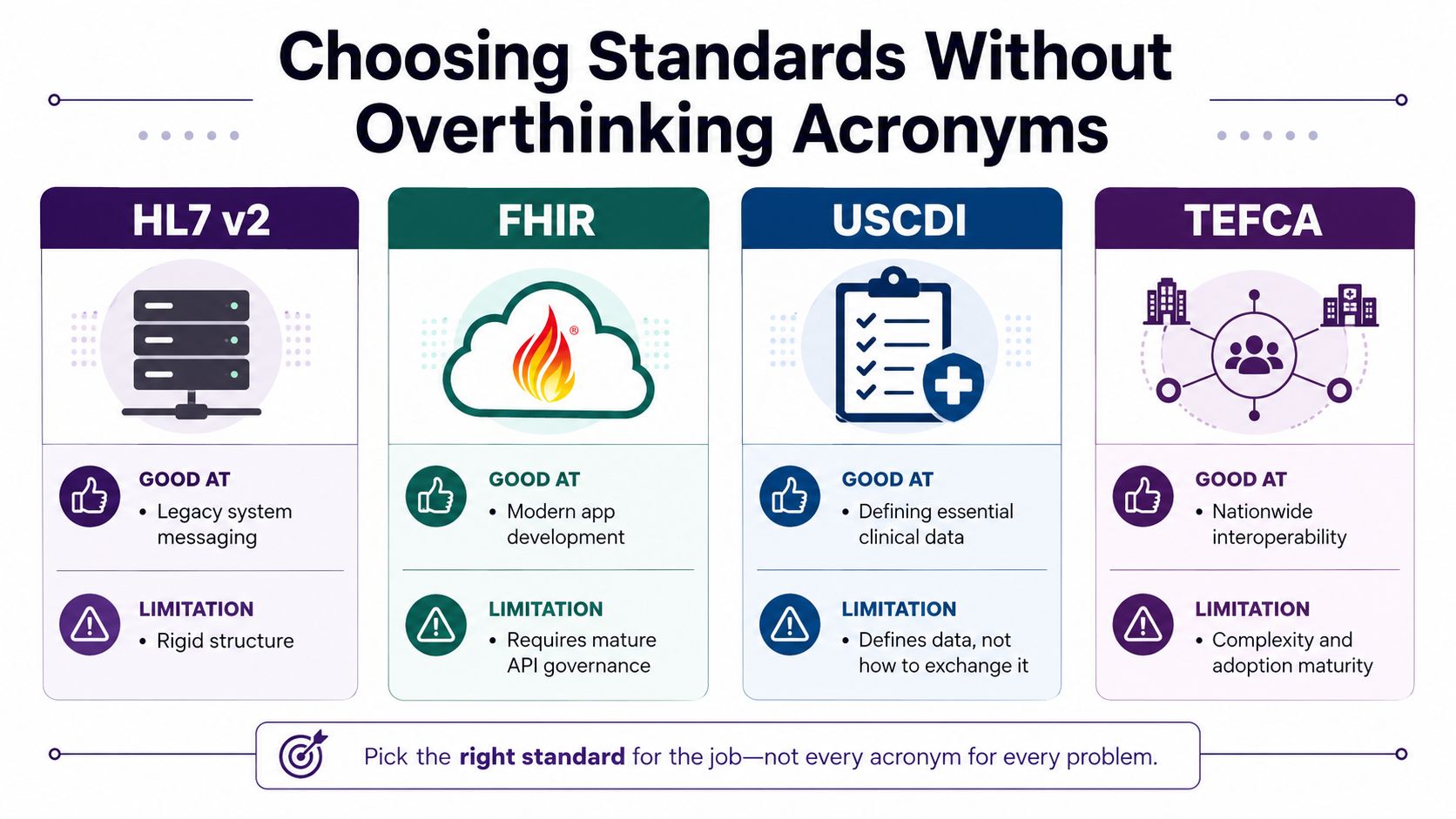
HL7 v2 answers, “How do we keep legacy operational messages moving?” It still matters when the partner environment is old, the throughput is high, and the interface already exists.
FHIR answers, “How do we build modern app and API experiences around clinical resources?” It is the baseline teams should start from when they need web-native exchange or reusable services. A practical FHIR integration services guide can help teams translate that standard into implementation choices without drifting into theory.
USCDI answers, “Which data elements need to be consistently represented?” It provides the common content floor, which is why it matters for teams planning reusable products or downstream AI work. That is also where AI development services start to care, because models are only as useful as the consistency of the data they learn from.
TEFCA answers, “How do we participate in cross-network exchange with a national governance frame?” Use it when the use case extends beyond one trading partner or one private network.
For Epic-connected workflows, Epic documentation workflow is a useful companion to this decision.
Default to the smallest standard stack that can grow
In practice, the safest baseline is usually FHIR plus USCDI, with HL7 v2 kept where legacy workflows still need it. That gives you modern APIs without pretending the hospital world has already shed its older messaging layers. If cross-network exchange is in scope, design with TEFCA in mind early so you are not retrofitting governance later.
Build for the data shape you want downstream, not the data shape your first partner happens to tolerate.
Designing the Integration Architecture and API Layer
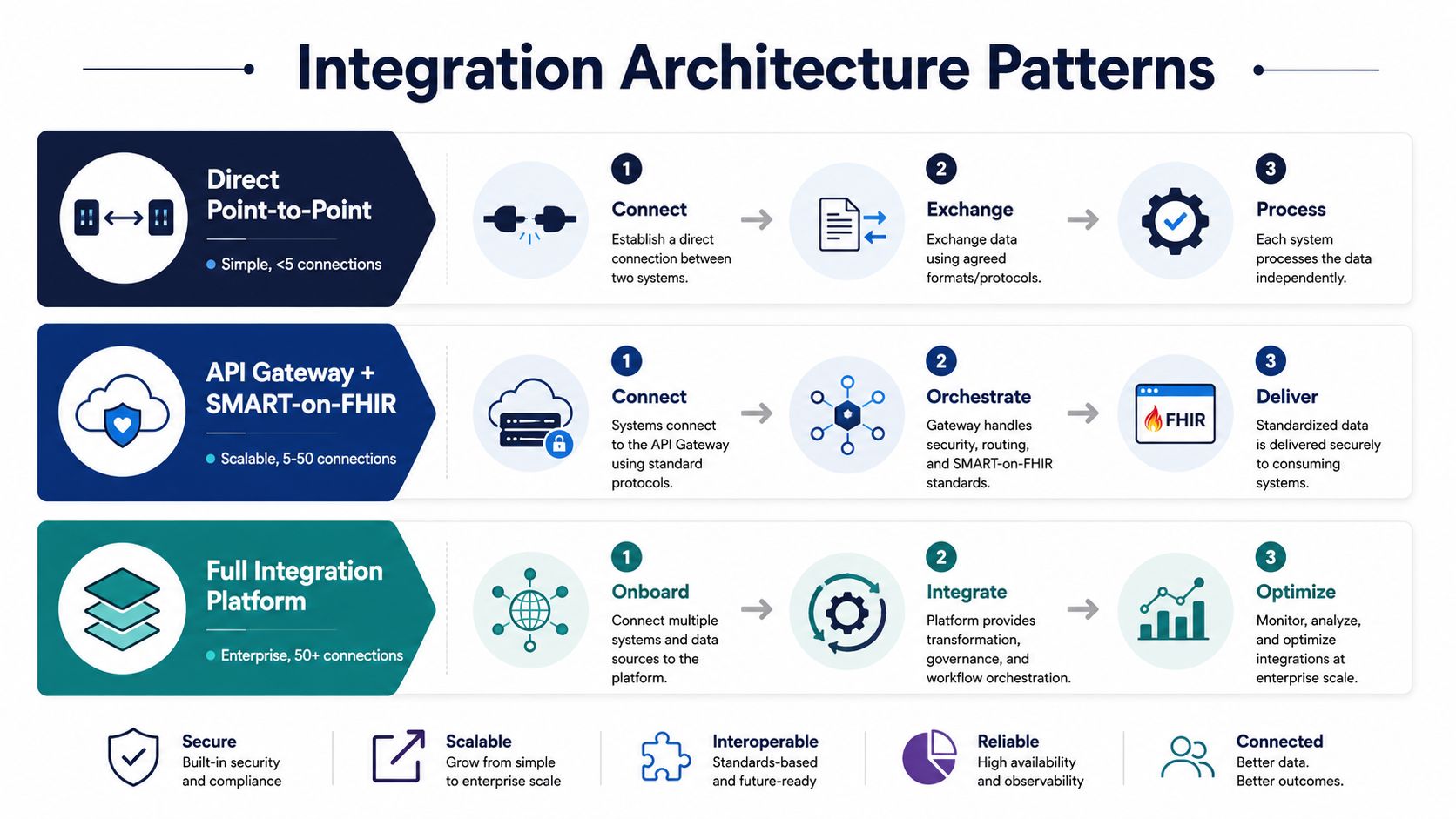
The architecture choice decides whether interoperability work stays adaptable or turns into a maintenance burden. Point-to-point links are tempting because they look quick, but every new partner adds coordination work and more failure points. A gateway model with a SMART-on-FHIR layer gives you one control point for authentication, routing, and policy enforcement. A fuller integration platform makes sense when the partner set is broad, and the operational load is already heavy.
The trade-off is control versus speed. Healthcare integration products can speed up identity handling, terminology services, bulk export endpoints, and event delivery, but they can also bake in assumptions that are painful to unwind later. Keep the data contract portable even if the delivery tooling changes. That is the part that protects the program when funding shifts or a partner changes direction.
Pick the pattern that matches partner scale
Direct point-to-point works when you have very few connections and a narrow use case. It is simple to stand up, but it becomes brittle fast because every new interface adds its own mapping, testing, and support path.
An API gateway works better when you need reusable control over authentication, versioning, and request routing. Teams that need a practical reference for how these choices show up in real implementations can use healthcare integration architecture guidance to frame the boundary between the EHR, the integration tier, and the services built around it. For large Epic-connected programs, Epic documentation workflow is also useful because it shows how a major EHR ecosystem exposes integration touchpoints.
A full integration platform fits enterprise settings where the connection count, governance burden, and support load justify the overhead. If you are weighing custom software development, the question is which layer should stay under your control because it carries clinical risk and which layer can safely remain commoditized.
Build for translation, not just transport
A good architecture includes an identity broker, a terminology service, a webhook or event layer, and a way to handle bulk export without turning every query into a custom project. That matters when the team needs to serve both current exchange needs and later analytics work without rebuilding the plumbing each time.
One practical pattern is to normalize around canonical models at the boundary, then translate into partner-specific formats only at the edge. That keeps downstream analytics and AI pipelines from inheriting a pile of one-off fields. It also makes later SaaS product development easier, because reusable services depend on stable contracts, not on whatever format one partner happened to prefer.
Funding follows architecture decisions. Teams that choose the wrong boundary end up paying for repeated mapping work, duplicated validation, and one-off exception handling that never shows up in the original business case.
Governance, Identity, and Consent as One Operating Layer
Privacy, identity, consent, and governance get treated like separate checkboxes far too often. In production, they behave like one layer. If any one of them is weak, the system may pass review and still fail when a registrar cannot trust a match, a clinician cannot see the right context, or an audit trail does not line up with the actual exchange.
The clearest evidence I have seen comes from structured exchange itself. A review of interoperable EHR impact found that automatically populated patient identifiers improved correct patient-ID entries from 35.5% to 81% across eight hospitals. That is not just a data quality win; it is a governance decision expressed in the data flow.
The sequencing problem shows up here too. Teams that spend early budget on policy language before they fix identity matching usually end up funding the same work twice, once in the governance deck and again in the interface backlog. I have seen more programs stall on mismatch handling than on the standards discussion itself, because the people approving the budget want to know which exchange paths are safe to open first.
Design the trust layer into the workflow
Patient identity matching should be part of the integration path, not a cleanup step after the message lands. Consent capture should live close to the event that triggers exchange, because retroactive consent logic tends to create exceptions that nobody can explain quickly. Audit logs need enough detail to show what was sent, why it was sent, and who saw it.
A practical implementation usually starts with a clear hierarchy for identity assertions, then adds exception handling for the edge cases that will appear in real operations. That is where a healthcare identity management approach helps teams separate patient matching rules, account-level access, and directory controls without pretending those problems are independent. See the practical guidance in healthcare identity management.
The same operating layer has to accommodate HIPAA, GDPR, and state-level requirements without turning the team into lawyers. The practical move is to define policy boundaries early, then encode them where the data moves. If the policy only lives in a document, it will drift from the implementation.
Expect AI to expose the cracks first
Teams exploring enterprise AI solutions often discover their worst normalization issues here. AI systems do not politely ignore inconsistent identifiers, loose terminology, or half-defined consent states; they surface them when the model output does not reconcile with the source of truth.
If the matching logic is fuzzy, the model will inherit the fuzziness.
For teams considering whether to extend their stack with external delivery support, AI development services only pay off when the interoperability layer already produces predictable inputs. Otherwise, the model team becomes a cleanup crew for the integration team's missing standards.
Phased Rollout, Testing, and the KPIs That Drive Adoption
The rollout should move in phases, not as one all-or-nothing launch. Start with one partner, expand to a few, roll into production, then keep tuning the exchange based on what staff uses. That sounds obvious, but a lot of programs still define success as “the message arrived,” which is too low a bar for healthcare.
The ONC's 2023 data makes the adoption gap hard to ignore. 71% of hospitals had electronic access to needed external clinical information at the point of care, but only 42% often used it. Access is not adoption, and your KPI stack should reflect that difference.
Use phase-specific exit criteria
| Phase | Primary KPI | Target Direction | Clinical Interpretation |
|---|---|---|---|
| Pilot with one partner | Successful message delivery rate | Up | The integration is technically stable enough for controlled use |
| Multi-partner expansion | Time to connectivity | Down | New partners can be onboarded without repeated rework |
| Production rollout | Data completeness on critical clinical variables | Up | The receiving workflow gets enough context to matter |
| Continuous improvement | Gap between availability and actual use | Down | Clinicians are using the information in care delivery |
The research base also warns against assuming technical capability equals real exchange. One systematic review found exchange occurred in only 41% of transitions in one study, despite 85% of hospitals reporting the capability to exchange data electronically. That gap is why test plans need clinical scenarios, not just interface checks.
Test for operational truth, not just compliance
I like to combine message validation, workflow observation, and exception review in the same cycle. If a message passes schema checks but lands in a screen nobody opens, the implementation is incomplete. If a data feed looks clean but is missing critical variables, the value is lower than the dashboard suggests.
There’s also a safety angle that can’t be ignored. Poor EHR deployments were associated with more than 18,000 EHR-related patient safety issues in the United States between 2007 and 2018, with underreporting likely. Monitoring has to be designed for capture, not just compliance.
Funding, Sequencing, and the Question Most Guides Skip
Many interoperability plans underestimate how hard it is to pay for the work. In HHS interviews on data integration for value-based care, stakeholders pointed to the high cost of integration relative to benefit, legal concerns, and payer-provider relationships as major barriers, while patient and workforce issues were often left out of the framework (HHS ASPE). This is the primary constraint for many teams, not whether they’ve memorized the latest acronym.
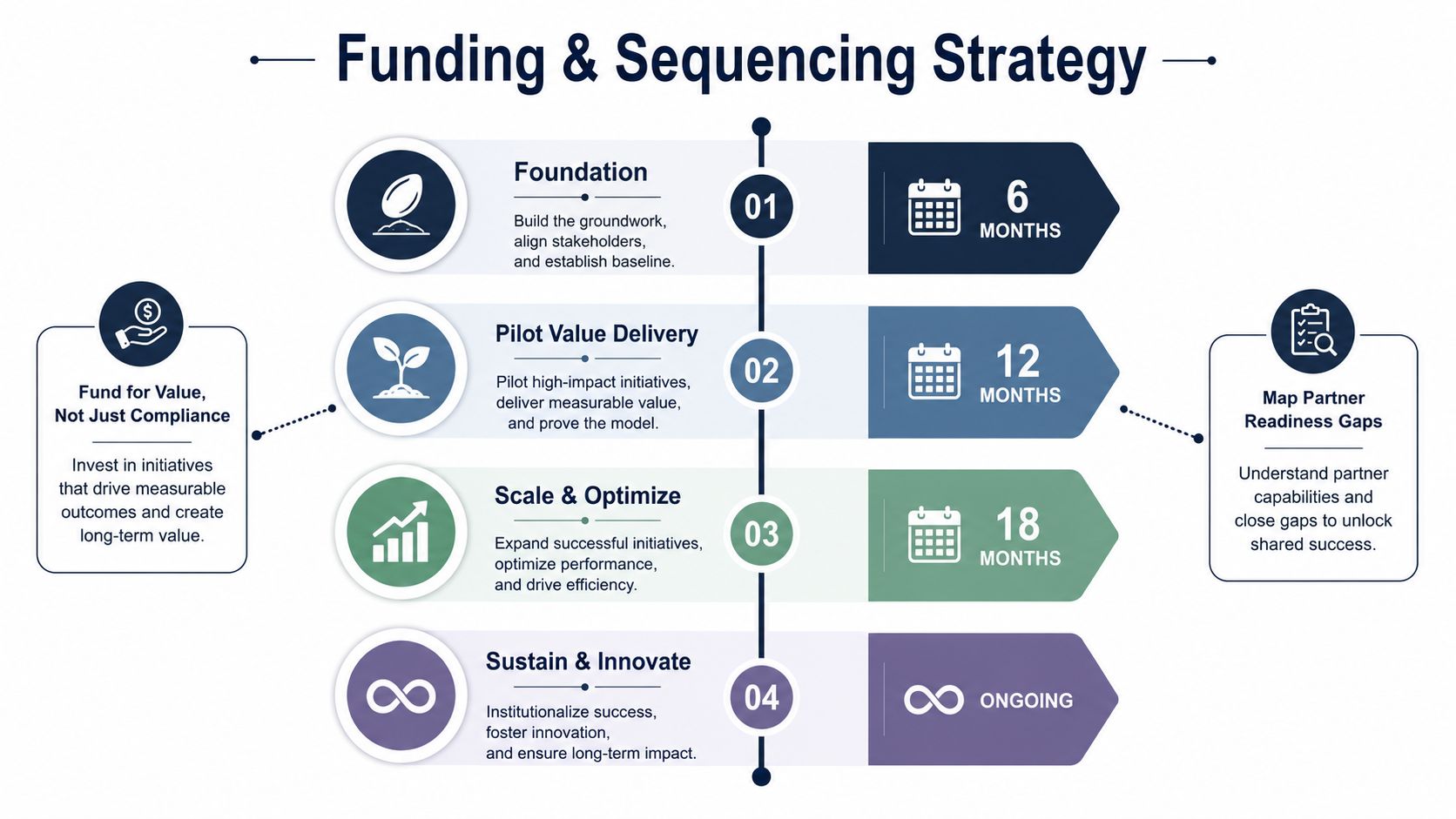
The other overlooked issue is partner readiness. A 2023 study found that hospitals serving patients from the highest-social-deprivation areas were less likely to engage in interoperable exchange, which points to a real digital divide in participation. If your strategy only works with mature partners; it’s not a strategy, it’s a narrow demo plan.
Fund for value, not just compliance
The funding model needs near-term operational wins. Reduced reconciliation work, faster onboarding, and fewer duplicate tests are easier to defend than vague future gains. If the budget only makes sense after years of population-level measurement, it’ll usually lose to more obvious priorities.
State policy can help here. The National Governors Association says states can advance interoperability with programmatic and reporting requirements, and by using contracts, rules, or legislation that require standardized data collection, interoperability, and governance. Aligning with those requirements can open doors instead of adding one more burden to the build.
Budget rule: if you can’t tie a phase to an operational owner and a visible workflow gain, it’s probably too early to fund at full scale.
Sequence by readiness gaps
I’d start with the partner that has the clearest clinical use case and the least fragile governance setup. Then move to the next partner only after the data quality, consent handling, and support process are proven in production-like conditions. That sequencing reduces rework and keeps the program from spreading too thin.
The bridge between policy and delivery matters here, which is why I’d rather see teams align their roadmap with a practical AI implementation roadmap mindset than a purely technical release calendar. A phased model keeps the economics honest and makes it easier to justify the next tranche of work.
Practical Answers for Teams About to Build
Onboarding timelines are usually longer than the first sales conversation suggests, because partner readiness is the hidden variable. If the other side needs mapping, testing windows, legal review, or identity cleanup, you’re not just integrating systems, you’re coordinating organizations. That’s why sequencing matters more than optimism.
The next question is whether your internal team is enough. If the work is limited to one partner, one workflow, and a narrow data contract, an in-house team can often carry it. Once you need reusable integrations, governance, terminology control, and operational monitoring, it starts to look more like a platform program than a feature task.
Build for reuse only after the first path works
A lot of teams want to make the integration layer AI-ready from day one. That instinct is right, but the data shape has to be stable first. If the core contracts keep changing, model work just magnifies the cleanup.
That’s where SaaS product development patterns help. A reusable service boundary, versioned APIs, and explicit partner adapters make future expansion easier than one-off scripts tied to a single trading partner. It also keeps you from turning every new use case into a fresh integration project.
What to inspect in vendor claims
Watch for claims that focus on connectivity without proving operational fit. If a vendor can’t explain how it handles identity, terminology, auditability, and exception management, you’re buying transport, not interoperability.
Use a simple test:
-
Ask for workflow evidence: Show where a clinician or coordinator sees the exchanged data.
-
Ask for failure handling: Explain how bad matches, partial payloads, and retries are managed.
-
Ask for portability: Identify what breaks if the partner changes systems or standards.
-
Ask for data quality controls: Show how normalization errors are detected and corrected.
If you need delivery support rather than strategy advice, a healthtech software development partner is the role Bridge Global fills across healthcare builds, from integration architecture to compliant engineering. It sits alongside internal product ownership, not above it, and it’s most useful when the roadmap has already been sequenced, and the team needs execution that won’t collapse under partner complexity.
A good interoperability program doesn’t start with a standards lecture. It starts with the key question: what has to happen for exchange to become trusted, used, and worth funding?
If you’re planning a healthcare integration program and want help turning the strategy into a buildable roadmap, talk with Bridge Global. We work on healthcare-grade integration, data architecture, and AI-ready platform design, so your interoperability layer can support real workflows instead of just passing interface tests. Visit Bridge Global to discuss the right delivery model for your team.

About Stephanie Cornelissen
Stephanie Cornelissen is a Technical Solutions Consultant with strong experience helping organizations navigate complex digital change. She works closely with teams to align business goals with practical, scalable technology solutions. With expertise in system architecture, integrations, and emerging technologies, she focuses on solving real-world problems through thoughtful execution. She enjoys working where technology meets business strategy and measurable growth.
View all posts by Stephanie Cornelissen →