



Healthcare Identity Management: A Practical Guide
You're probably already living with the problem. A nurse signs into one workstation, a patient calls because the portal locked them out, an auditor asks for an access trail, and a third-party app is still holding a token longer than anyone intended. In healthcare, identity isn't a login screen in isolation; it's the control plane that shapes care delivery, privacy, and accountability across every system that touches data.
That's why healthcare identity management has moved from a niche IT concern to a core product and operations topic. Market estimates point to sustained growth across major analyses, including one that valued the global healthcare identity and access management market at USD 1.63 billion in 2024 and projected USD 4.26 billion by 2030 at a 17.5% CAGR from 2025 to 2030, alongside other estimates that put the market at USD 3.84 billion in 2023 or USD 4.57 billion in 2024 with continued growth expected (Grand View Research). That growth is happening because hospitals, portals, imaging systems, partner apps, and remote workflows all depend on identity decisions that have to be safe, fast, and auditable.
The Identity Problem Every Healthtech Team Eventually Hits
A locum clinician arrives for a night shift and needs access right away. A patient can't get into the portal after changing their phone number. A billing partner still has an old permission scope. Then the auditor shows up and asks for proof that each access grant was justified, logged, and revoked on time.
That mix of urgency and oversight is why identity in healthcare is never just a security feature. It's a daily operational workload that affects patient safety, clinician experience, and compliance posture at the same time. In HIMSS Market Insights research sponsored by Patient ID Now, organizations reported spending an average of 109.6 hours per week resolving patient identity issues, with more than 10 full-time employees on average involved in that work, and annual identity-resolution costs exceeding USD 1 million in many cases (HIMSS Market Insights).
Why the same problem keeps reappearing
The pattern shows up in SaaS platforms, hospital environments, and device fleets alike. A clinician wants fast access, a product team wants clean permissions, and compliance wants evidence that controls were enforced. Those goals overlap, but they don't automatically align.
Practical rule: if identity decisions aren't visible in the product design, they'll reappear later as support tickets, audit findings, or risky workarounds.
A healthtech product team usually feels this first in the user experience. Shared workstations, rotating staff, and emergency access all expose how brittle static logins become once real clinical workflows start moving. That's why identity belongs in the product architecture, not just in an IT policy binder.
There's also a talent side to this. Teams building remote-care workflows often need to understand how identity behaves in distributed clinical roles, including roles that can work outside a traditional hospital. If that's familiar, the remote telehealth nurse practitioner jobs resource is a useful lens for how modern care delivery is reshaping access patterns.
The rest of the topic becomes much easier once you treat identity as a lifecycle rather than a login event. That shift is what separates a system that merely authenticates people from one that can support modern care.
What Healthcare Identity Management Actually Covers
Healthcare identity management is the discipline of confirming who someone is, deciding what they can do, and proving it later. It covers patients, clinicians, administrators, contractors, devices, and partner systems, because healthcare operations rarely stay inside one trust boundary.
A good mental model is a hospital wristband. It has to be issued correctly, checked at the right moment, refreshed when conditions change, and reconciled against every door, ward, and record system that depends on it. If the wristband is wrong, the whole flow starts to drift.
The main layers in plain language
Identity management handles the lifecycle, which means creating an identity, updating it when something changes, and removing it when access should end. In healthcare, that includes joiner-mover-leaver events for workforce accounts and enrollment, recovery, and proxy updates for patient accounts.
Access management decides what happens at sign-in and after sign-in. That includes authentication, authorization, and step-up checks when someone tries to do something sensitive, such as prescribe or approve a high-risk action.
Identity governance and administration is the control layer around the rules. It covers approvals, reviews, attestations, and the logic that keeps permissions from drifting beyond what the role requires.
Single sign-on reduces repeated logins across clinical tools, while multi-factor authentication adds a stronger verification layer for higher-risk situations. Consent management, patient matching, and audit logging sit alongside those controls, because healthcare identity has to protect both privacy and correctness.
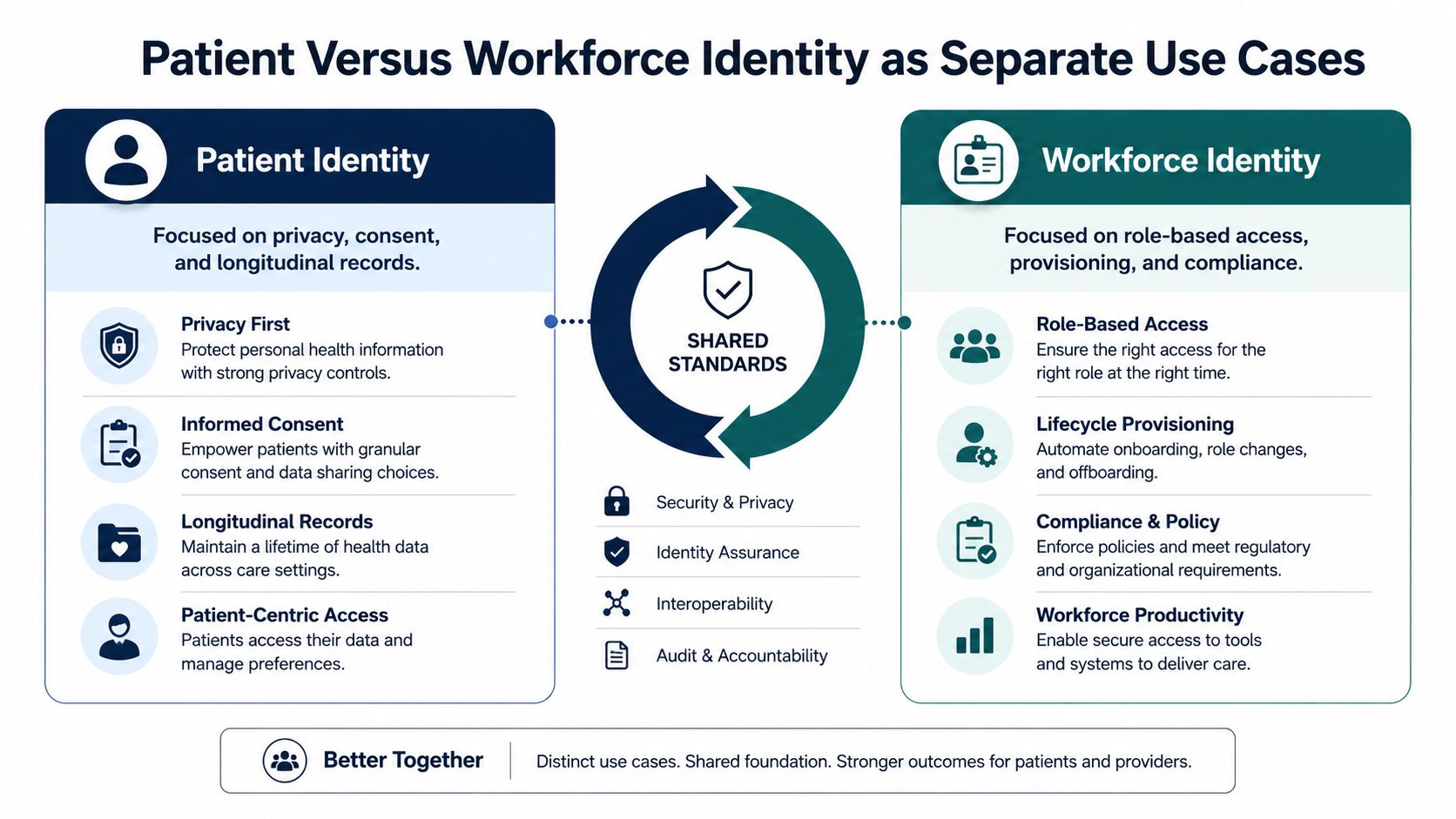
A useful way to read this is to separate who the identity belongs to from what the system needs to prove. Patient identity is about privacy, consent, and longitudinal records. Workforce identity is about role-based access, provisioning, and compliance.
The two sides share infrastructure, but they don't share the same policy logic. That's where many implementations go wrong, because the team builds one generic access model and expects it to fit both clinical staff and patients.
The controls are interconnected. If provisioning is sloppy, MFA won't fix it. If patient matching is weak, audit logs won't restore trust later.
If you're building or buying a platform, that's the core concept to keep in view. The rest of the stack only works when the identity lifecycle, access rules, and evidence trail all line up.
Patient Versus Workforce Identity as Separate Use Cases
Patient identity and workforce identity live on the same backbone, but they behave like different products. One is event-driven and distributed across portals, billing, telehealth, and support. The other is HR-driven, more stable, and tied to job function, location, and organizational change.
Patient identity and workforce identity do not recover the same way
A patient may recover access through portal questions, SMS, support workflows, or a telehealth re-verification path. A clinician usually recovers through directory, help desk, or delegated admin processes tied to employment status. If those paths are mixed, users get confused, and security teams lose control.
| Dimension | Patient identity | Workforce identity |
|---|---|---|
| Trust anchor | Enrollment evidence, demographics, consent | HR status, credentials, department, location |
| Typical access | Portal, mobile app, billing, telehealth | EHR, imaging, scheduling, devices, admin tools |
| Recovery path | Support-heavy, event-driven, often cross-channel | Help desk or admin-driven, tied to employment |
| Consent obligation | Central to access and sharing | Usually role and policy-based |
| Common risk | Account takeover, synthetic fraud, duplicate records | Privilege creep, shared logins, orphaned accounts |
The biggest mistake is assuming patient and workforce identities should follow the same rules. They shouldn't. A patient account has to support consent, proxy access, and recovery without making care harder to reach. A workforce account has to support rapid provisioning, clinical handoffs, and emergency access without creating permission sprawl.
This is also where shared clinical workstations create tension. A nurse may need quick badge access, a provider may move between units, and an admin user may only need narrow scheduling access. The system has to be generous with usability, but strict about what each identity can touch.
The lifecycle difference matters because it shapes architecture. Workforce identity is usually cleanest when it flows from HR triggers and role assignments. Patient identity is messier, because it's tied to a person's journey across systems, not a single employment record or department roster.
Standards, Protocols, and Compliance That Shape the Stack
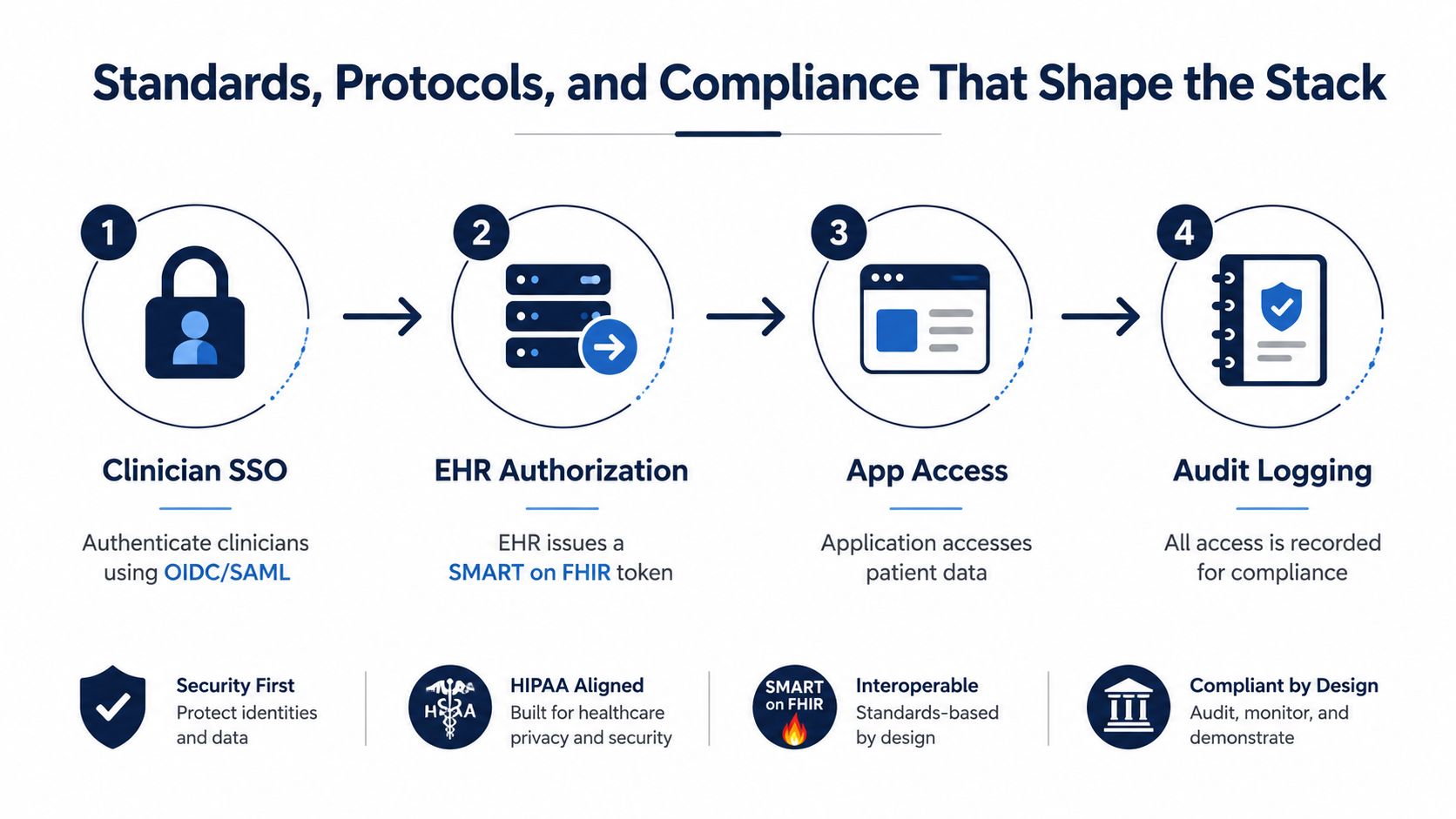
The standards behind healthcare identity management are less about competition and more about division of labor. SAML and OIDC handle sign-in, OAuth2 handles delegated access, FHIR carries clinical data, and HL7 keeps older systems talking to each other. The stack only works when each layer does its own job.
A typical flow looks like this. A clinician signs in through OIDC or SAML SSO, the EHR issues a SMART on FHIR token, and the app uses that token to request the specific data it needs. Meanwhile, HL7 v2 feeds or FHIR messages can move identity and clinical events between systems behind the scenes. A useful technical reference for platform teams is the healthcare platform API engineering guide, because the identity layer often sits right on top of those integration decisions.
Compliance sits underneath the protocol layer
In the US, HIPAA's Security Rule shapes how access, auditability, and safeguards are designed. In the EU, GDPR adds requirements around lawful basis, data subject rights, breach handling, and data minimization, while country-specific health data laws can tighten the rules further. The identity system has to respect those obligations from the start, not after the launch date.
Standards are enablers, not guarantees. A clean OAuth flow can still violate policy if the permissions model is wrong.
That's why minimum necessary access, consent management, audit logging, and data residency decisions have to be built into the design. You can't bolt them on later without reworking the trust model. A product team should map each identity flow to the standards it touches before choosing a vendor, because the wrong match creates rework in both architecture and compliance.
For teams looking at broader integration architecture, the healthcare integration architecture guide is a helpful companion, since identity decisions always depend on where patient, workforce, and device data move.
The practical takeaway is simple. Don't start with vendors or features. Start with your data flows, your trust boundaries, and your legal obligations, then see which standards support them cleanly.
Threat Models and How AI Improves Identity Decisions
Healthcare is attractive to attackers because identity controls sit across many systems, many roles, and many recovery paths. Credential theft and reuse are common risks. So are clinician phishing, insider misuse of legitimate access, account takeover through patient portal recovery, synthetic identity creation, and the slow sprawl of third-party SaaS access.
The pressure is worse in healthcare because the environment is noisy. Staff rotates, contractors come and go, clinicians work across sites, and legacy systems often can't enforce modern controls. That makes it easier for a bad actor to hide inside normal access patterns.
Where AI helps, and where it can mislead you
AI can improve identity resolution by linking fragmented records more intelligently, especially when patient data is split across systems with inconsistent formats. It can also help with device and location risk scoring, anomaly detection on access patterns, and fraud graph analysis during enrollment or account recovery. In practice, that gives security teams a better shot at spotting suspicious behavior before it becomes a breach.
The useful version of AI here is narrow and supervised. It flags unusual behavior, ranks risk, and helps triage. It does not get to make final clinical or legal decisions on its own.
A few guardrails matter:
-
Explainable outputs: Reviewers should understand why a login or recovery step was flagged.
-
Human review for high-risk actions: Especially when access affects prescribing, sensitive records, or account recovery.
-
Model monitoring: Behavior changes over time, so drift has to be watched.
-
Bias checks: A fraud model that over-flags certain groups creates a new problem while trying to solve another.
The deeper point is that stronger verification only helps if it's aligned with fraud monitoring. If you harden login but ignore recovery and enrollment, attackers just move to the softer path. A good security workflow needs one view of suspicious identity events, not three disconnected queues.
For teams comparing security approaches, the healthcare data security best practices guide pairs well with this topic because identity controls only work when the broader data-security posture is consistent.
AI can make the system smarter, but it can also make false confidence easier. The right design uses AI as a detector and assistant, not as a replacement for policy.
Architecture Patterns and EHR Integration
A usable healthcare identity stack usually has five parts: an identity provider layer, a directory of record, a policy engine, an audit lake, and integration adapters for EHRs, PACS, billing, telehealth, and connected devices. The point is not elegance for its own sake. The point is to keep policy changes from forcing a rewrite of the whole stack.
A healthtech software development partner often designs this as a modular system, especially when healthcare integrations have to reach across multiple product lines. In larger builds, custom healthcare software development usually plugs into existing identity services rather than replacing them wholesale. Bridge Global is one example of a vendor that positions this work across product engineering and integration layers, but the architecture principles matter more than the logo.
What the integration layer has to handle
SSO helps clinicians avoid password fatigue across multiple tools. Identity orchestration handles step-up authentication when someone tries to do something sensitive, such as prescribing or accessing a high-risk workflow. That way, the system stays usable without lowering the bar for risky actions.
EHR integration is rarely uniform. Some systems support SMART on FHIR cleanly. Others still depend on HL7 ADT feeds for patient identity, IHE profiles for interoperability, or proprietary extensions and batch interfaces that require careful mapping. Break-glass accounts still exist too, and they need explicit monitoring instead of blind trust.
Device identity matters in the same way. Shared workstations, infusion pumps, and mobile clinical apps shouldn't rely on shared logins if stronger device identity or attestation is possible. Certificates and device trust can reduce ambiguity, especially when a human identity alone doesn't tell the whole story.
The architecture works best when it stays modular. Policy should be adjustable without ripping out the identity provider, the audit layer, or every integration adapter. That flexibility is what keeps the system useful as clinical workflows, regulations, and partner apps change.
A Phased Implementation Roadmap for Healthtech Teams
A good rollout starts by admitting that no one can fix healthcare identity in a single release. The useful approach is phased: discover, design, deploy, and optimize. That keeps the team honest about dependencies, especially when EHR integration and patient-facing workflows are both in scope.
Discover before you build anything
Start by mapping users, systems, regulations, and pain points. Find where identities are created, where they drift, where they get duplicated, and where support staff is manually intervening. Then decide whether the right move is to build, buy, or partner.
If the program needs heavy analytics or fraud detection, an AI implementation roadmap can help organize the decision. If the team needs model training, monitoring, or workflow intelligence, enterprise AI solutions may fit. Startups that need packaged delivery often use a software development service model, and a SaaS product development engagement can suit a platform team that needs speed without building every layer internally.
Design the trust model before configuring tools
Define the role model, attribute model, consent model, and integration pattern. Prototype the flows that matter most, such as clinician SSO and patient enrollment, before you roll out the full stack. If you need deeper engineering support, custom software development is usually where the heavy lifting sits.
Governance checklist: change control, break-glass procedure, periodic access review, and incident playbook.
Deploy in waves, then instrument everything
Start with the highest-friction, highest-value user groups. Roll out carefully, keep rollback paths available, and monitor support load, access failures, and exception rates from day one. Then tighten the weak spots instead of spreading the rollout across every system at once.
Optimize with controls that learn over time
Once the basics work, add adaptive MFA, identity analytics, AI-assisted fraud detection, and continuous attestation. Retire legacy accounts as fast as the operational environment allows. Teams often find that the biggest win is not a shiny feature, but the removal of old permissions that no one wanted to clean up.
For teams that want to compare delivery models and see how similar programs were handled in practice, the client cases library is a useful reference point. The common thread is usually the same: identity success depends on sequencing, not just tooling.
KPIs, Build Versus Buy, and FAQs for Healthtech Leaders
A product leader rarely wins budget approval by saying identity is important. They win it by showing which metrics move and what risk they reduce. The most useful KPIs are the ones that expose operational drag and compliance exposure.
| KPI area | Example metric | Why it matters |
|---|---|---|
| Provisioning | Time to provision | Shows how quickly new users can work |
| Offboarding | Time to deprovision | Measures how fast access disappears after role change or exit |
| Authentication | Percentage of accounts with MFA | Tracks how much of the estate has stronger verification |
| Support load | Password reset volume | Reveals friction and hidden admin cost |
| Operations | Help desk cost per identity issue | Helps quantify the business case |
| Risk | Identity-related incident count | Shows whether control failures are trending up |
| Compliance | Audit finding closure time | Measures how quickly gaps get resolved |
| Patient experience | Patient portal abandonment rate | Indicates whether identity flows are too hard |
| Fraud defense | Synthetic identity detection rate | Shows whether suspicious enrollments are being caught |
The build-versus-buy decision usually comes down to five things: regulatory burden, integration depth, in-house identity expertise, time to market, and total cost of ownership. The hidden cost is almost always integration and operations, not the license itself. Startups and scale-ups often lean on a healthtech software development partner for the integration-heavy phases, while AI development services can help with analytics and fraud layers when internal capacity is thin.
Quick answers to the questions teams ask most
How do you handle shared clinical workstations?
Use strong session handling, fast re-authentication where needed, and device-aware controls so the workstation doesn’t become the identity. Shared hardware needs individualized accountability.
How long does a typical rollout take?
It depends on how many systems and recovery paths are involved, but the honest answer is that healthcare identity work is phased, not instant. Teams usually move by workflow and risk, not by one big switch.
Are patient-facing biometrics ready for prime time?
Sometimes, but only when the enrollment, recovery, and fallback paths are clean. Biometrics can help, but they don’t remove the need for fraud monitoring and support options.
What do regulators look for in an identity audit?
They want to see that access was justified, limited, logged, reviewed, and removed when no longer needed. They also care about whether exceptions, break-glass access, and recovery flows were governed rather than ignored.
Healthcare identity management works best when it’s treated as a lifecycle, not a feature. If you’re planning a platform, modernizing an EHR-connected workflow, or untangling patient and workforce access across products, Bridge Global can help you design the integration, governance, and AI layers around those needs. Reach out if you want a partner that can map the identity flow, connect it to the clinical stack, and turn the architecture into a delivery plan.

About Upendra Jith
Upendrajith completed his Master's in English and has been a commercial content developer for the past three years. He's more inclined to develop content with a 'street-smart' delivery on topics such as technology, media, or anything he can get his hands on. He has a fixation on lyrics, dark poetry, media, technology, and flow arts.
View all posts by Upendra Jith →