



Insurance Automation Software: Where It Pays Off
Which insurance process would you automate first if you had to defend the choice to an auditor, a claims director, and a finance lead in the same meeting? Most shortlists answer with a tool. Insurance automation software is the workflow, document, rules, and integration layer that carries quoting, underwriting, servicing, billing, and claims work through the business with fewer manual touches, and it earns its cost where volume is high, rules hold still, and mistakes are expensive to unwind. Programmes that stall rarely picked the wrong model. They picked a process nobody owned, or connected two systems without deciding which one holds the truth.
Insurance Automation Software Across the Value Chain
Automation spread through insurance from core operations outward, not from a single claims application. A 2016 McKinsey analysis found that the top 20 to 30 end-to-end insurance processes can account for as much as 40% of operating costs and 80% to 90% of customer activity, and estimated that digitising them could cut human service costs by 30% to 50%. The same analysis projected that automation could eventually consolidate or reduce up to 25% of full-time insurance positions across roughly a decade, and it was careful to say the effect lands on activities inside jobs before it lands on whole occupations.
The practical conclusion for anyone modernising a legacy estate is that value comes from automating connected processes across the policy lifecycle. An isolated tool that speeds up one desk usually moves the queue somewhere else.
| Process | Typical tools | Where automation fits |
|---|---|---|
| Quoting and distribution | Agency management systems, rating engines, API gateways | Pre-fill applications from broker submissions and return rated quotes inside defined rules |
| Onboarding and KYC | Identity verification services, document capture, sanctions screening | Extract identity data from documents and route only failed checks to staff |
| Underwriting intake | Intelligent document processing, rules engine, underwriting workbench | Classify submissions, extract risk data and flag missing information before an underwriter opens the file |
| Policy servicing and endorsements | Policy administration system, workflow engine | Standardise change requests and generate endorsement documents from validated data |
| Billing | Billing engine, payment gateway, RPA for reconciliation | Match payments to policies and automate reminders and cancellation notices |
| Claims first notice of loss | Claims management system, FNOL portal, document AI | Capture loss details, validate policy status and open the file with triage data |
| Renewals | Policy administration system, rules engine, CRM | Trigger renewal offers and re-rate on updated risk data |
| Compliance reporting | Data warehouse, reporting tools, workflow engine | Assemble regulatory and audit extracts from source systems on a fixed schedule |
Selection is where most of the risk sits, and it doesn't need a scoring model with twenty inputs. Score each candidate process from one to five on monthly volume, rule stability, cost of error, and the number of systems it touches. Processes that score high on all four pay back first, because volume funds the build, stable rules keep the logic testable, expensive errors justify the controls, and few integrations keep the first release small.
Screening rule: if two processes score the same, start with the one whose failure you could reverse inside a day.
Adoption is no longer the constraint. In Roots' 2025 State of AI Adoption in Insurance survey, 60% of respondents reported using AI for process automation and 64% for data and document processing. What separates the working programmes from the stalled ones is process choice and ownership, not tool availability.
Most first releases also expose handoffs that no one documented. For a close look at where files sit between systems, addressing insurance claims processing bottlenecks maps the queue points that automation tends to reveal. Our own guide to implementing claims processing automation covers the claims-specific build sequence and doesn't need repeating here.
Matching Each Technology to the Job It Does
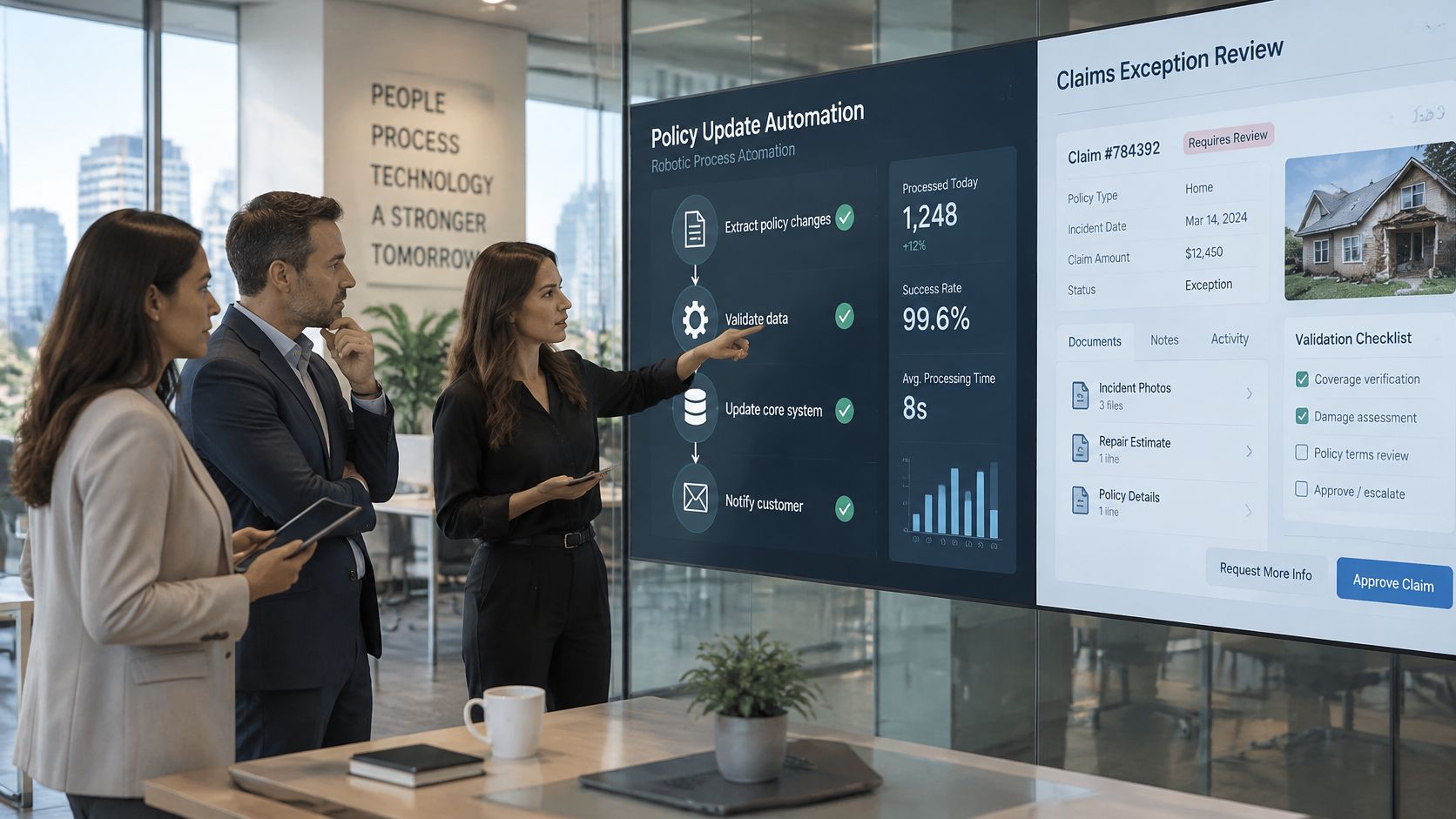
Every automation technology fails in its own characteristic way. Robotic process automation breaks when a screen changes. A rules engine breaks when someone edits a decision table without a regression test. A language model breaks by sounding certain about an exclusion that does not apply to the policy in front of it. Choose the technology whose failure your team can detect, reverse, and explain to an auditor, and choose nothing more expensive than that.
| Technology | Best fit | Main limit | Choose it when |
|---|---|---|---|
| Robotic process automation (RPA) | Repetitive screen-based tasks such as status updates and data entry | Breaks when screens or exception paths change | The legacy system has no usable API and the process is stable |
| Workflow and BPM | Routing, ownership, approvals and service-level deadlines | Limited interpretation of unstructured content | Work needs named owners, deadlines and escalation paths |
| Intelligent document processing | Classifying and extracting data from forms, letters and PDFs | Accuracy depends on document variety | High volume of semi-structured documents arrives daily |
| Rules engine | Eligibility, referral thresholds and payout tables | Brittle when rules are undocumented or scattered | Decisions must be explained, versioned and tested |
| LLMs and agents | Summarising files, drafting correspondence and answering coverage questions | Probabilistic output needs controls and review | The output is unstructured text that a trained reviewer checks |
| APIs and event integration | Moving policy, billing, claims and CRM data between systems | Requires owned contracts, versioning and monitoring | Systems must share state in near real time |
The RPA evidence is real but narrow. A study of RPA across 12 insurance companies found claims processing was the primary use case, with reported averages of about 50% lower processing time and 30% to 40% lower processing costs, plus 22% higher customer-satisfaction ratings after automation. Those figures are industry benchmarks, not your baseline. Score the candidate against your current cycle time, unit cost, and complaint rate, or the percentage is someone else's result. The same study notes that bots which only imitate user-interface actions fail when workflows or exception paths shift. RPA therefore sits on an orchestration layer with idempotent steps, audit logs and a human exception queue. It does not replace that layer. Name who owns the bot definition, the queue, and the response when a screen changes. If that owner is "the vendor," you do not yet have a workflow.
Language models fail differently. A systematic evaluation of LLM claims handling recorded an average score of 82.44% on standardised insurance-clerk examination cases for one model, with processing measured in seconds and reported costs as low as $0.10 per claim. A high score on exam-style cases does not show how the model treats a missing medical report. Keep deterministic policy and payout rules in front of the model. Require confidence thresholds and source-document references. Route ambiguous or high-severity claims to an adjuster. Who may change a threshold, and who signs the exception, belongs in the same design as the prompt. I would not put an LLM on a payout table that must be versioned and regression-tested. That job stays on the rules engine. Use the model where the output is text a trained reviewer can reject.
Underwriting splits the same way: extraction, referral rules, and drafted questions do not share one failure mode or one owner. The guide to AI underwriting software is the reference for that split before a technology is locked to the job.
Build, Buy or Low-Code for Insurance Workflows
Four criteria settle most build-versus-buy arguments before a vendor deck opens. How differentiated is the decision logic? How much regulatory evidence must you produce under your own name? How many systems does the workflow touch? And how much engineering capacity will you have to maintain it two years after launch?
A custom build gives complete control of the rules, the data model and the audit log, and it takes the longest to reach a first working flow. A packaged platform shortens time to a working flow when your process matches its standard model, and its controls are configurable only inside that model. A low-code workflow tool handles internal forms, approvals, and routing well, and it gets thin on data-heavy rating or extraction work. A hybrid keeps differentiated logic in owned code and buys commodity steps such as document capture, which only works if ownership of each layer is written down and reviewed.
Buying does not transfer the governance duty. Regulatory analysis of the NAIC bulletin notes that insurers should retain documentation for AI systems, data, and predictive models developed by third parties, and procurement, integration, testing, and monitoring all need to be auditable.
Evidence test: name the decision rule most likely to change in the next six months, then ask who can change it, how the change is tested, and where the change is logged.
I'd also price this over three years rather than one. Integration, testing, monitoring, retraining, support and exit costs all belong in the comparison, and any number you build before checking your own volumes and staffing is an indicative estimate.
There's a reason the integration line dominates. EY's 2025 survey of 100 insurers identified data privacy, data quality, security and legacy-IT integration as the leading barriers to generative-AI implementation, and all four are properties of your estate rather than the vendor's product. For a carrier with a core system and a handful of specialist tools, the durable split is owned code for the decision logic that differentiates you through custom software development, and bought components for document capture and routing where vendor documentation meets your evidence needs. The choice of how you staff and sequence that work is covered across our software development service models.
Connecting Policy, Billing, Claims and CRM Systems
Start with data ownership before any integration pattern. Policy number, coverage limits, and underwriting status belong to policy administration. Premium, invoice, and payment status belong to billing. Reserves, claim status and adjuster notes belong to claims. Customer identity, contact preferences and consent belong to the CRM. Write that list down and get it signed off, because every duplicate-record incident traces back to two systems that both believed they owned the same field.
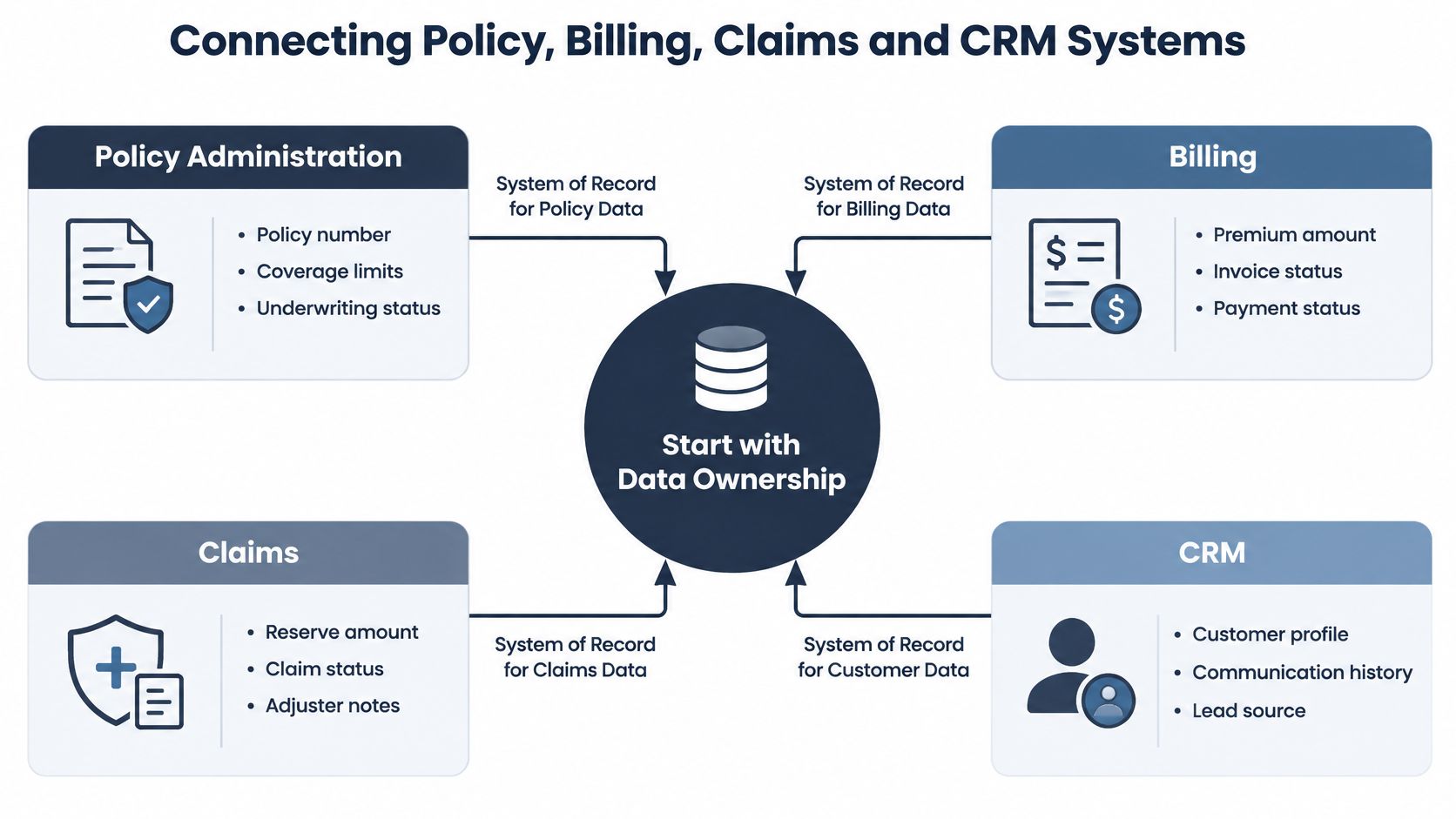
Pattern selection follows the question you're asking. A synchronous API call suits a coverage lookup at first notice of loss, where the claims system needs an answer before it can open the file. Event-driven messages suit endorsements, cancellations, and approved payments, where the sender shouldn't wait, and the receiver must tolerate redelivery.
| Connection | Integration pattern | Data that must match | Failure to prevent |
|---|---|---|---|
| Policy administration to billing | Event on policy issue, endorsement or cancellation | Policy number, effective dates, premium and term | Billing runs on a stale term or premium |
| Policy administration to claims | Synchronous API lookup at first notice of loss | Insured party, coverage, limits and policy status | A claim opens against a lapsed or misidentified policy |
| Claims to payments | Event on approved payment with idempotency key | Payee, amount, reserve and approval reference | A retried message creates a duplicate payment |
| CRM to policy administration | Shared customer identifier with consent flags | Customer identity, contact preferences and consent status | Two customer records exist for one insured person |
| Document store to all systems | Reference by document ID and version | Source document, extracted fields and version | Extracted data becomes detached from the source file |
The payment row carries the most expensive failure mode on the list. An idempotency key on every payment event means a retried message can't pay a claimant twice, and it costs you one unique constraint. Pair it with a reconciliation job that compares policy, billing, and claims totals on a fixed schedule, so the drift surfaces on a report instead of a customer call. Failures belong in a dead-letter queue routed to a named team with an owner and a response time, not a shared mailbox that three people watch.
Policy and servicing flows are covered in more depth in our guide to insurance policy management software. One practice worth copying for every new connection: document the data owner, the trigger, the retry behaviour and the reconciliation check before anyone writes code. Teams that also want to turn workflow histories into training data find the event trail pays a second time, because a logged decision sequence is the raw material for testing later automation.
Governance Controls for Automated Insurance Decisions
The NAIC Model Bulletin on the Use of Artificial Intelligence Systems by Insurers, adopted on December 4, 2023, expects insurers that use AI to make or support decisions in regulated practices to maintain a written AI Systems program covering governance, risk-management controls, and internal audit. It's guidance rather than a binding model law, and regulators may still request information about your AI use during an examination.
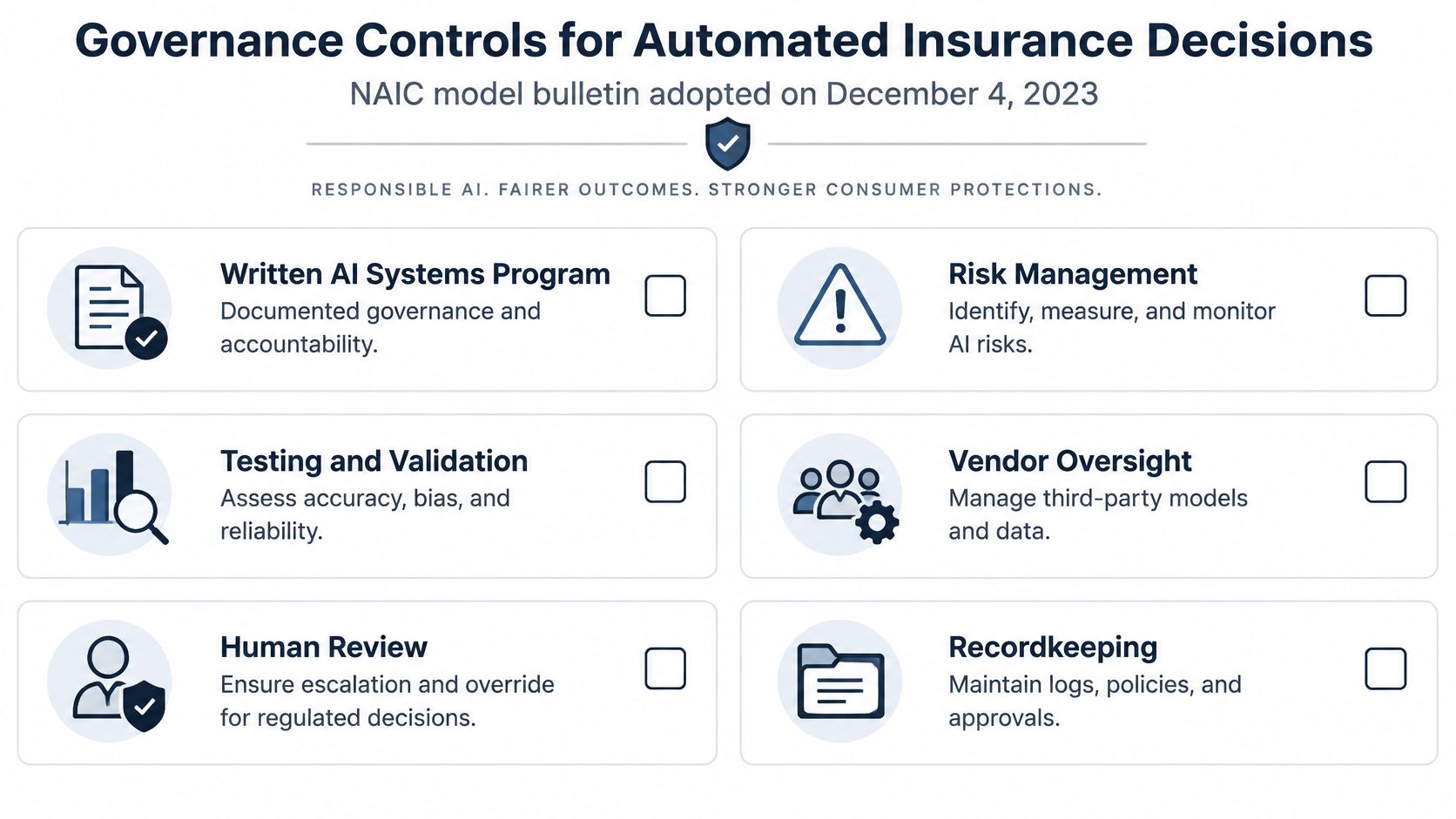
Read the program requirement as a list of artifacts your platform has to produce:
-
A named owner per decision point: Underwriting, rating, claims administration and payment, fraud detection and customer-facing decisions each need a person accountable for the rule and the model behind it.
-
A decision record per event: Inputs, rule or model version, confidence score, human override, and downstream action, joined by a case identifier.
-
Referral thresholds: Low-confidence or high-impact cases route to trained reviewers, with the threshold itself versioned and tested.
-
Override and suspension authority: Somebody must be able to stop a rule or model in production, and that authority should be documented rather than assumed.
-
Restricted, logged access to rule changes: A decision table edit is a production change and needs review, testing and an audit entry.
-
Outcome monitoring: Drift, subgroup error rates and adverse consumer outcomes checked on a schedule, not after a complaint arrives.
-
Third-party documentation on file: Model cards, validation results and data lineage for anything you bought.
EIOPA's AI governance principles require adequate human oversight across the entire lifecycle and clear, documented roles for the people involved. That makes human review an operational step with an owner and a queue, not a sentence in a policy document saying staff may review outputs. EIOPA's supervisory expectations also ask for training and testing data that is complete, accurate, and appropriate, with limitations documented and addressed, and treat controls as proportionate to the risk of each application. Pricing and risk assessment in life and health insurance carry the highest bar in that framing.
Audit test: pull ten closed claims at random and check whether a reviewer could reconstruct why each automated step ran and who approved it.
EU carriers and MGAs carry two more obligations in the same design. Regulation (EU) 2024/1689, the AI Act, lists AI used for risk assessment and pricing in life and health insurance among high-risk uses in Annex III, which adds conformity and documentation duties. The GDPR, in Article 22, restricts decisions based solely on automated processing that produce legal or similarly significant effects. One review step and one decision log can serve both regimes, but confirm the obligations for each product line and jurisdiction with counsel.
Measuring ROI Against Your Own Baseline
What did this process cost, and how long did it take, before the software went live? That baseline is the number a programme review should defend. An automation percentage is the weakest figure on the slide.
A team can lift straight-through processing by pushing difficult cases into an exception queue. The dashboard improves while the customer waits longer and the complaint count climbs. An NTT DATA report on insurance AI leaders shows why the distinction matters: 86.7% of those leaders support AI in back- and mid-office workflows, while only 29% of insurers run front-to-back processes through AI agents or automation. Back- and mid-office support is widespread among those leaders. A front-to-back redesign remains uncommon.
| Metric | How to measure | Baseline needed |
|---|---|---|
| Cycle time per claim or submission | Timestamp from intake to decision, compared by cohort | Median cycle time by product and complexity band before go-live |
| Straight-through rate | Share of cases closed with no manual touch | Manual touch count recorded per case type |
| Rework rate | Cases returned to an upstream step for correction | Error and return log for the same period |
| Leakage | Payouts outside policy terms found in a sampled file audit | Sampled audit results before automation |
| Exception queue load | Items entering the queue per day and time to clear | Queue volume and clearance times before rollout |
| Triage accuracy | False positives and false negatives on a labelled sample reviewed by experts | Expert-labelled sample of manual decisions |
| Complaints and appeals | Complaints and appeals per 1,000 policies, with the upheld-appeal share | Complaint and appeal log for the prior 12 months |
| Cost per transaction | Fully loaded staff, platform and oversight cost divided by volume | Full-time cost and volume for the same process |
Cohort comparison is the part teams skip. Measure automated and manual cohorts over the same period, split by product line and claim complexity, so a benign mix or a quiet season does not get credited to the software. Include oversight cost, which means reviewer time, monitoring, reconciliation, and the platform bill. A saving that only appears before those costs is not a saving.
Name an owner for the integration that stamps intake and decision, and a second owner for the exception queue and the sampled leakage audit. Cycle time is only as honest as those status events. If nobody owns the feed, timestamps drift, queue age stops matching the operational log, and finance will reject the baseline. Governance sits in the same workflow: the metric and the person accountable for it are one design, agreed before go-live.
Partial automation is often the better answer for complex or vulnerable-customer cases, where a reviewer should stay in the path. The target is the right share of automation per segment. A lower percentage with fewer appeals can be the stronger result against your own complaint log.
Published results are worth reading as design evidence rather than as a forecast. McKinsey reports that UK insurer Aviva deployed more than 80 AI models in its claims operations, cutting liability-assessment time for complex claims by 23 days and customer complaints by 65%, with its motor-claims programme saving more than £60 million in 2024. Treat that as one insurer’s reported outcome on its own estate. Using it as a target imports someone else’s baseline into your business case.
Fix the baseline window, define the counterfactual, and agree the metric set with finance and claims leadership before launch. Review it quarterly. I would reject any vendor percentage that cannot be recomputed from your own logs. If the numbers cannot be defended in that room, they will not survive an audit either.
Phased Roadmap and Your First Pilot Decision
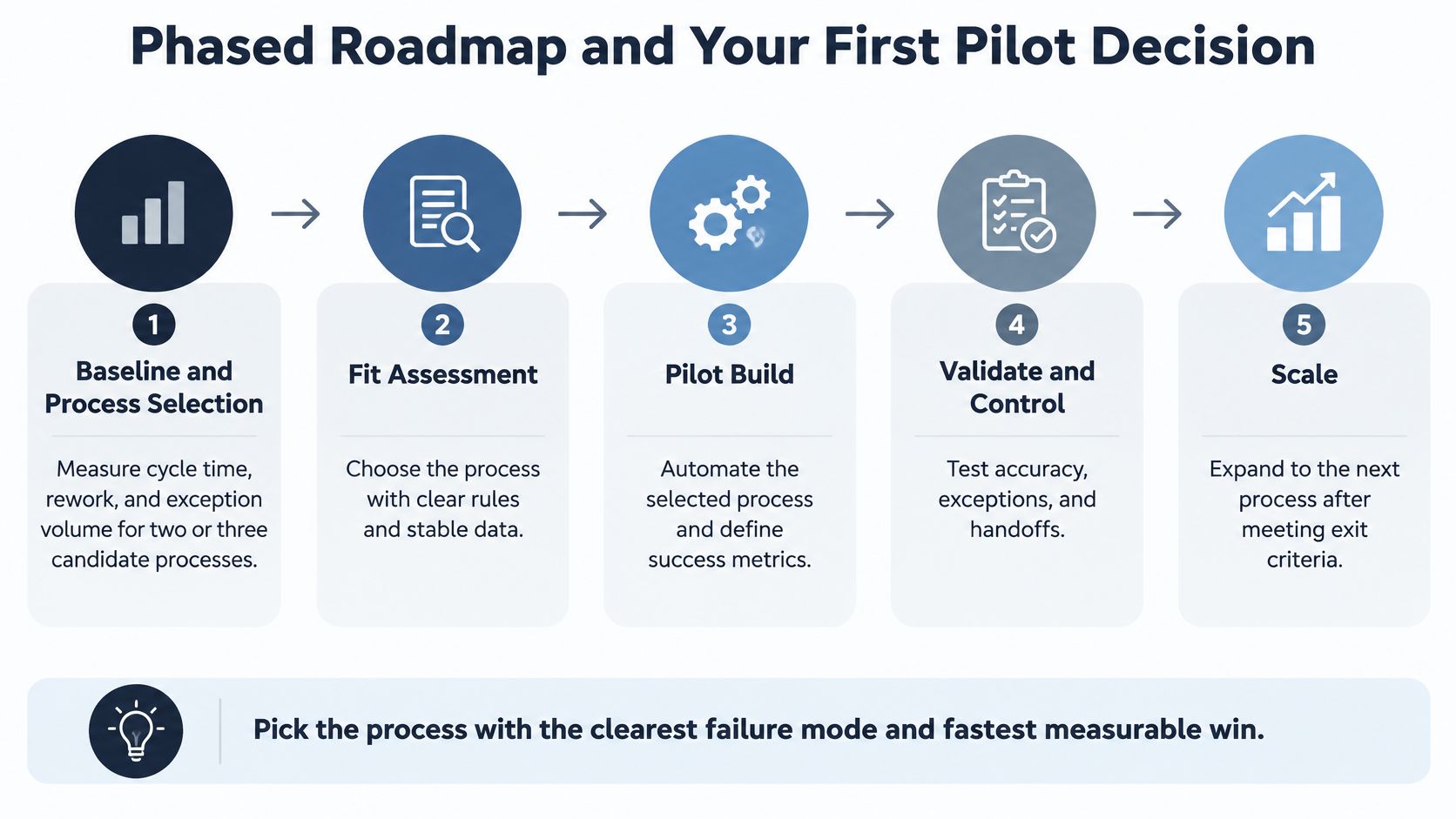
Sequence the work in five phases, and treat each exit criterion as a gate rather than a milestone to announce.
-
Baseline and process selection: Measure cycle time, rework, and exception volume for two or three candidates. Exit when finance accepts the baseline numbers.
-
Pilot on one line of business or one claim type: Human review on every exception, no silent auto-approvals. Exit when the pilot has run a full month of representative volume.
-
Control testing and audit evidence: Compliance and internal audit read the decision records before anyone scales. Exit when they can reconstruct a sample unaided.
-
Scale to adjacent processes: Reuse the same integration contract and governance pattern rather than inventing a second one. Exit when the second process meets the first one’s control standard.
-
Continuous monitoring: Rule and model review on a fixed calendar, with retraining and a documented change history. Exit criteria don’t apply here; this one runs for the life of the system.
Durations depend on your integration estate, the number of systems touched and how clean the data is, so treat any schedule someone quotes before the baseline as an indicative estimate with assumptions attached.
Change management decides whether the pilot survives contact with the operations floor. Name the claims or underwriting lead who owns each decision point, define who can override the system and on what grounds, and train staff on what it does and does not handle. Adjusters need to know how their queue changes and which cases still arrive with a human decision attached, because a queue that gradually fills with the hard cases is how a good pilot loses its sponsors.
My default first pilot: the highest-volume process with stable rules and a measurable baseline, whose failure can be reversed within a day.
Where the roadmap involves models rather than rules, our AI implementation roadmap sets out how discovery, sequencing and delivery fit alongside the rest of the programme.
Conclusion
Take the high-volume process whose failure you can reverse, connect it through integration you own with an event trail that survives a retry, and keep decision records a reviewer can follow without asking an engineer. Judge the result on end-to-end outcomes against your own baseline, and leave the automation percentage out of the board pack. Teams scoping a platform or an integration programme can review the insurance software development work we do, and our insurance client cases describe each engagement as its own case page sets it out.
Frequently Asked Questions
Can we automate a legacy policy system that has no usable API?
An integration layer usually comes first, even when it feels slower than buying a bot. RPA can bridge a screen gap for a defined period, provided it sits behind an API or event layer with an exception queue and a named owner. Replacing the core system is a separate decision with its own business case, and mixing the two into one programme is how both slip.
What do EU rules change in the design?
The GDPR restricts decisions based solely on automated processing that have legal or similarly significant effects, and the AI Act treats risk assessment and pricing in life and health insurance as high-risk use. One human review step with a written rationale, recorded in the decision log, can satisfy both regimes. Confirm the obligations for each product line and jurisdiction with counsel before the build starts.
Can an MGA with a small team run this?
Yes, by buying the commodity parts and keeping owned code for the rules that set underwriting or claims outcomes. Document capture, routing, and correspondence generation are well served by platforms, while your differentiated logic stays testable and portable. Assign governance ownership to one named person even when engineering is outsourced, because the accountability doesn’t outsource with it.
How do we prove that automation saved money?
Compare automated and manual cohorts over the same period with the same product and complexity mix, then include oversight, exception handling, and platform costs in the total. Unit cost savings alone don’t count, since work shifted to a reviewer or an IT team still costs money. Agree on the metric set with finance before launch so the argument isn’t settled after the fact.
Which data problems should we check first?
Look for missing policy identifiers, inconsistent status codes across systems, and decision rules that exist only in staff memory. Each one breaks automation in a different way: the first stops matching, the second produces contradictory case states, and the third can’t be tested or versioned. Fix the identifier and status definitions before the pilot, and write the undocumented rules down while the people who know them are still on the team.
Bridge Global builds insurance platforms and the integrations around them, from claims and underwriting workflows to policy administration and the AI components that sit inside those flows. If you’re scoping an automation programme and want the integration contracts and audit evidence designed before a vendor is chosen, the team can work through that with you. Start at Bridge Global to see how the engagements are structured.

About Stephanie Cornelissen
Stephanie Cornelissen is a Technical Solutions Consultant with strong experience helping organizations navigate complex digital change. She works closely with teams to align business goals with practical, scalable technology solutions. With expertise in system architecture, integrations, and emerging technologies, she focuses on solving real-world problems through thoughtful execution. She enjoys working where technology meets business strategy and measurable growth.
View all posts by Stephanie Cornelissen →