



Claims Processing Automation: How to Implement It Well
Automate everything is bad advice for claims. The programs that hold up in production don't chase maximum straight-through processing. They automate routine, well-bounded cases reliably, and they make exceptions visible, explainable, and easy for a qualified handler to reverse.
That's the right lens for claims processing automation across health, motor, property, and travel. Speed matters. So do payment accuracy, auditability, and knowing when a disputed or vulnerable-customer case shouldn't move without a person.
Setting Business Goals and Measuring ROI
Teams still frame automation as a unit-cost play. That's too narrow, and it leads to dashboards that celebrate volume while rework grows elsewhere.
Scale explains why small gains matter. In the United States, nearly 9 billion healthcare claims are processed annually, at an estimated $12 to $19 per claim and a 4- to 6-week processing and payment cycle, according to a Health Affairs Scholar analysis of U.S. claims scale and automation. The same source notes about 80% of claims are adjudicated automatically or need only a minor adjustment, while best-in-class processing at private payers reaches about 95% without manual intervention. Prior authorization lags badly, with fewer than 25% determined automatically even though more than 90% are ultimately approved.
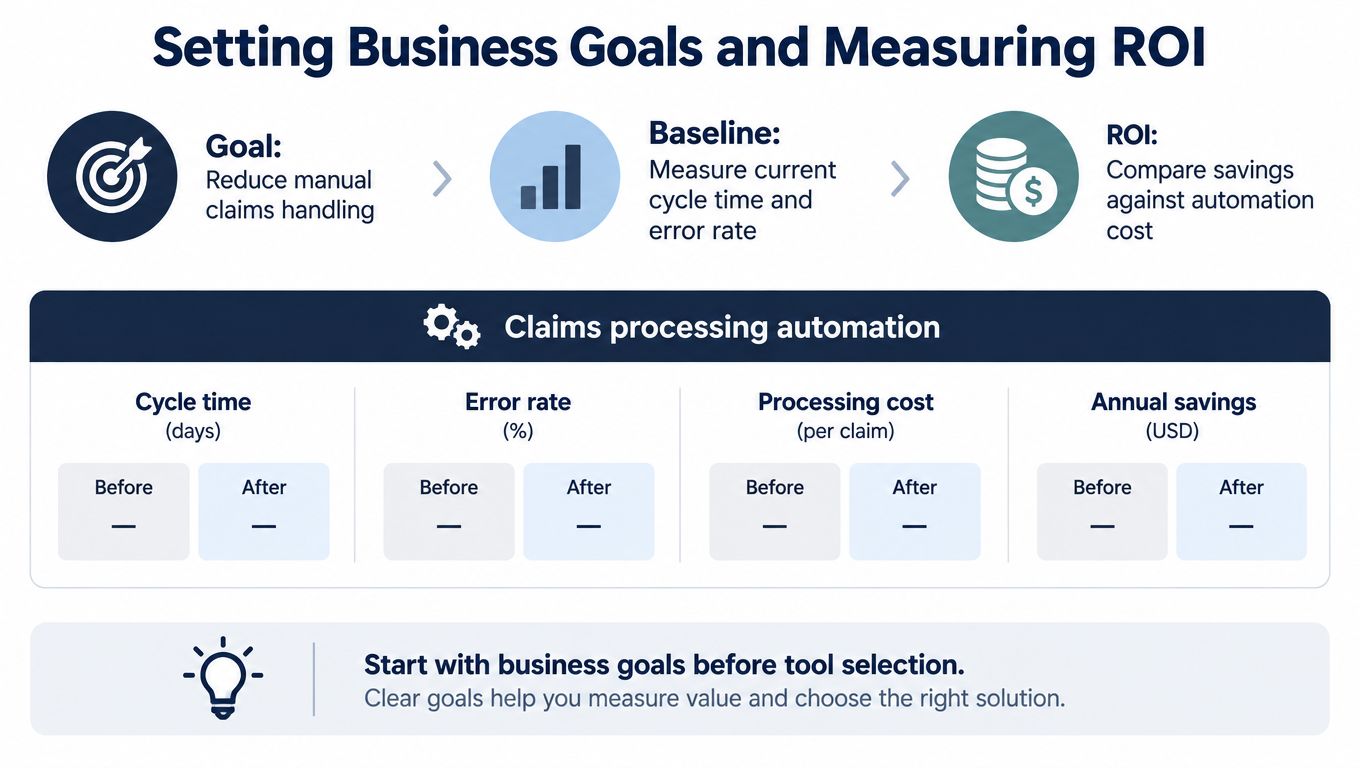
Baseline the work before you buy the tool
Break ROI into measures you can baseline by claim type before any build starts. If you can't measure them today, you won't prove value later.
-
Unit processing cost: Labor, review, rework, and exception handling per claim, not just system cost.
-
End-to-end cycle time: From first notice or submission to payment or reasoned denial.
-
Payment accuracy and rework rate: Corrected claims, appeals, and reopened files.
-
Escalation rate: Which claims reach a handler, why, and at what confidence level.
-
Labor redirected: Time moved from data entry to medical review, fraud investigation, and customer contact.
Historical economics show why the baseline matters. A University of Amsterdam thesis citing a 2006 AHIP survey reported that an electronic claim cost about $0.20 when processed by the core claims system or a software robot, compared with about $2.05 for human processing. It also reported that most large insurers automated the first pass for about 70% to 85% of claims. Don't use those figures as your forecast. Use them to understand the shape of the opportunity, then measure your own cost.
Practical rule: Set targets for routine claims and exception quality together. A higher automation rate with rising rework isn't progress.
Designing Intake and Document Pre-Processing
Downstream adjudication can't fix bad intake. If a member identifier, procedure code, or billed amount is extracted wrongly, you've automated an error at speed.
Claims arrive through portals, EDI, email, scanned paper, and photos. Your first job is classification. Separate claim forms from invoices, medical reports, repair estimates, and correspondence, then preserve the source document with every extracted field.
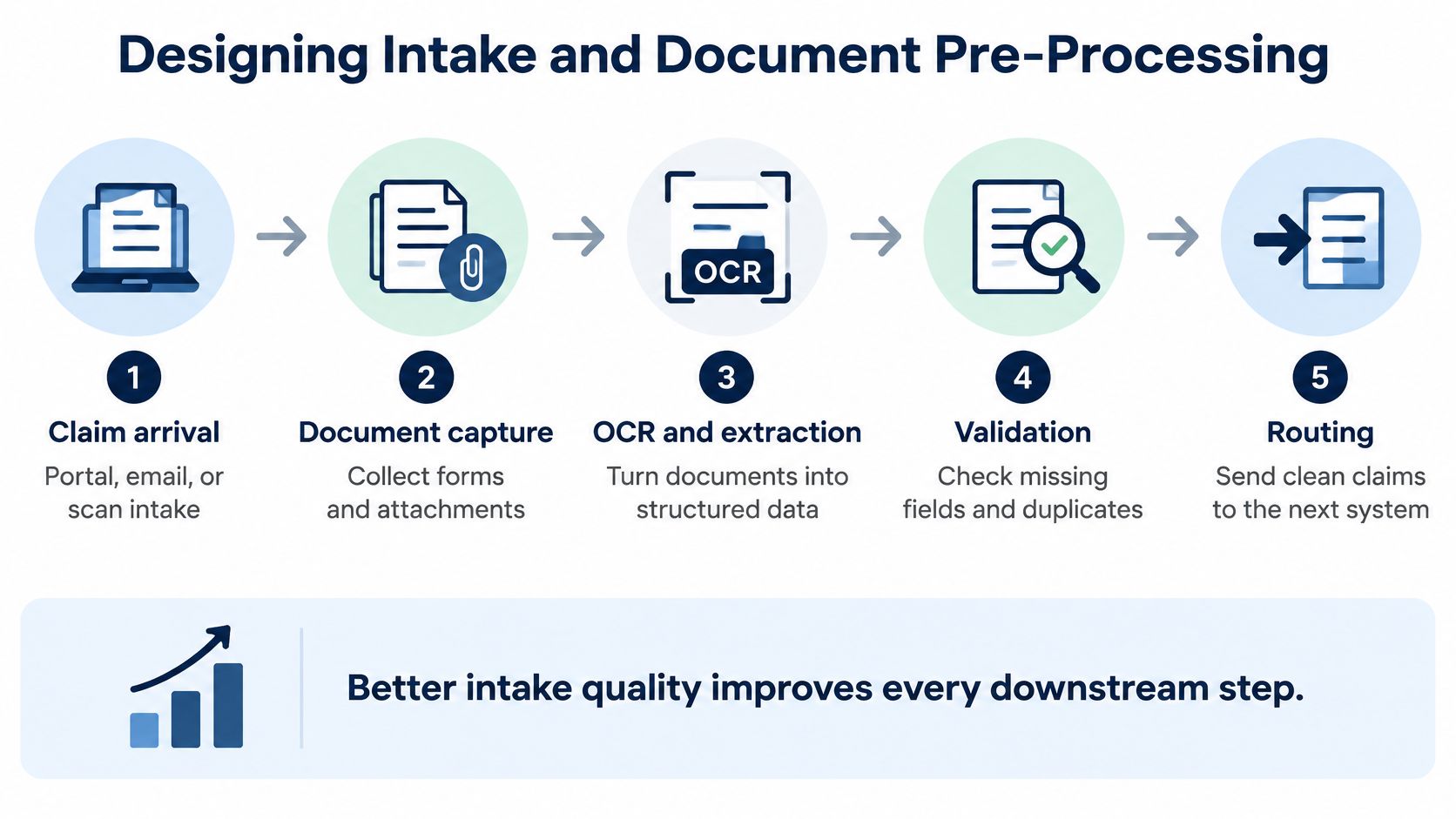
Extract, validate, then route
Use OCR and intelligent document processing for structured and semi-structured fields such as policy numbers, diagnosis and procedure codes, dates of service, and amounts. Use NLP where the content is unstructured, such as clinical narratives, adjuster notes, and repair descriptions. Don't use NLP to guess at a field that a deterministic check should verify.
EIOPA reports that insurers use generative AI in claims to optimize claim review, support fraud detection, automate data collection, and extract data from unstructured documents such as invoices and medical reports, in its Generative AI Market Survey. The same survey found 49% of insurers had developed a dedicated AI policy. Extraction still needs validation against source documents and business rules before it drives a decision.
Our guide to AI document processing for operational workflows covers the controls the extraction layer needs in production.
-
Field-level confidence: Score each extracted field, not just the whole document.
-
Cross-checks: Validate member, policy, provider, and coverage data before adjudication.
-
Duplicate detection: Compare claimant, date, amount, and document hash to catch resubmissions.
-
Missing-document checks: Hold the claim and request what's missing instead of guessing.
Take a hospital bill with a handwritten amendment to one charge. The printed fields may extract cleanly, while the amended amount falls below your confidence threshold. Route that field for human confirmation, keep the rest of the file moving, and record who confirmed it. One unreadable field should pause automation, not strand the entire claim.
Choosing Between Rules Engines and Machine Learning
Don't choose one decisioning approach for every claim. Segment by complexity, document structure, and exception risk, then layer the methods.
Deterministic rules fit coverage, eligibility, fee schedules, and statutory checks. They're reproducible, easy to version, and straightforward to defend on appeal. Machine learning fits pattern-heavy work such as anomaly detection, document classification, and prioritization, provided you have enough well-labeled history and can explain the output.
| Decision factor | Deterministic rules engine | Machine learning decision |
|---|---|---|
| Explainability | High. Each rule and version can be shown. | Variable. Needs reason codes and output validation. |
| Data requirement | Policy and coverage logic, maintained by experts. | Large, representative, labeled historical cases. |
| Change handling | Fast for explicit rule changes, slower at scale. | Needs retraining and regression testing. |
| Best fit | Eligibility, limits, coding edits, deadlines. | Triage, fraud signals, extraction, anomaly scoring. |
| Appeal readiness | Strong, decisions reproduce exactly. | Weaker unless inputs and model version are logged. |
Segment before you automate
Apply rules first for entitlement basics. Add machine-learning decisioning only where labeled data and explainability controls exist. Route low-risk, high-confidence claims through straight-through processing, and send low-confidence, anomalous, or financially material claims to a handler.
Straight-through processing measured only in aggregate hides the segments where automation is failing.
Measure STP by claim type, extraction confidence, exception category, rework rate, payment accuracy, cycle time, and escalation rate. That breakdown tells you whether to fix intake, revise a rule, or retrain a model.
Delivery partners typically cover this layering work end to end. For example, Bridge Global builds this kind of capability through insurance software development combined with AI development services, covering intake, decisioning, integration, and the human review workflow around them.
Connecting Core Systems, EHR Data and Data Pipelines
The hardest problem usually isn’t the model. It’s fragmented data across policy administration, claims management, billing, medical or repair review, and customer service, with no single version of the claim.
Build around a canonical claim object. It should carry claim identifiers, claimant and policy references, documents, extracted fields with confidence scores, decision history, payments, and correspondence. Every system reads and writes against that shared representation instead of passing spreadsheets and status codes between silos.
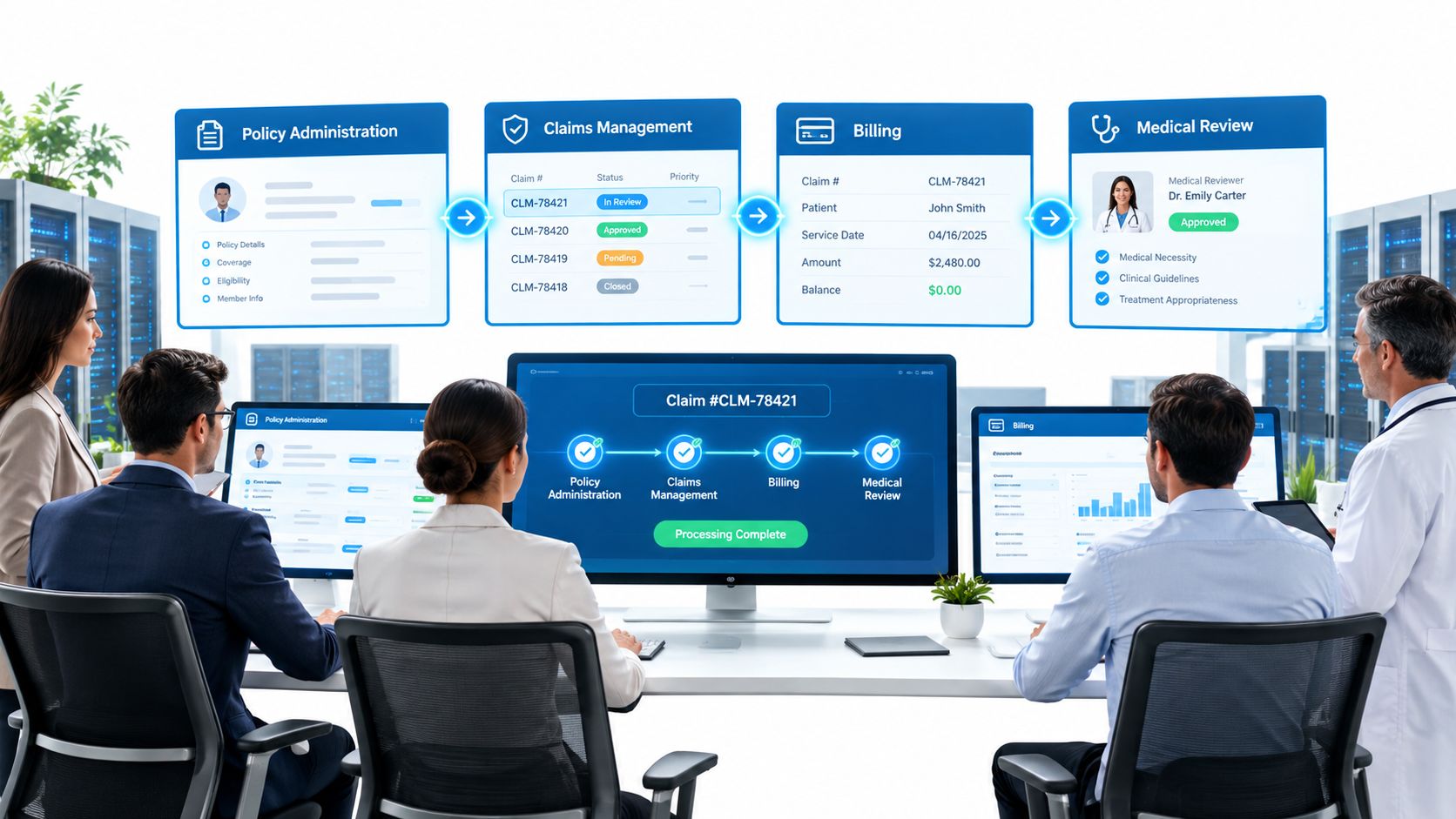
Health data needs its own discipline
For health claims, EHR data arrives through HL7 v2 messages and FHIR resources, and the two rarely align perfectly. Plan for identity matching when patient records conflict, terminology mapping for codes, and correction workflows that don’t overwrite the original evidence. That integration layer is covered in work on healthcare integrations and, at platform level, in our guide to healthcare data platform development.
Use event-driven integration so a document arrival, coverage check, or payment approval updates every dependent system once, in order, with lineage. If you can’t prove which record, rule, and model version produced a decision, you don’t have an audit trail. You have a log file.
External data raises the bar further. Weather feeds can support property and motor triage, but they introduce consent, lineage, and conflicting-record questions. Visibility and reliable orchestration may deliver value sooner than another predictive model.
Distinguish two things clearly in your architecture. Automating document intake is low risk. Automating an entitlement decision carries legal, clinical, and reputational risk, and it needs stronger controls, approvals, and evidence.
Governing, Securing and Testing Automated Decisions
Governance isn’t a review meeting after launch. It’s a design requirement, because claims administration sits inside the regulated insurance life cycle.
The National Association of Insurance Commissioners expects insurers to maintain a written AI systems program for AI that makes or supports decisions in regulated practices, explicitly including claims administration and payment, and fraud detection, as set out in the NAIC Model Bulletin on the Use of Artificial Intelligence Systems by Insurers, adopted in December 2023. That puts intake, document interpretation, triage, settlement recommendations, payment authorization, and fraud referrals in scope.
Make oversight proportional to impact
EIOPA’s AI governance principles for insurance call for adequate human oversight and say governance measures should be proportionate to the potential impact of an AI use case on consumers. Small, non-material claims may justify limited intervention. High-value, disputed, or vulnerable-customer cases require stronger oversight, a recorded reason for automation or escalation, and a reviewer who can challenge or reverse the result.
That caution matters to claims teams as well: handlers generally want automation to support their judgment on complex files, not replace it. Design for both views.
For health claims, HIPAA shapes how protected health information is accessed, logged, and shared, as detailed in our guide to HIPAA-compliant software development. Where software functions cross into regulated medical territory, assess MDR and FDA considerations case by case rather than assuming a claims tool is automatically out of scope.
-
Golden datasets: Fixed, expert-reviewed cases run against every rule or model change.
-
Champion and challenger testing: Compare a new model against the current one before promotion.
-
Sampling of auto-approved claims: Periodic human review to catch silent accuracy drift.
-
Adverse-decision testing: Verify denial and reduction explanations are accurate and readable.
Test fairness and override behavior too. If handlers routinely override one rule, that rule is wrong, unclear, or missing context.
Rolling Out Automation and Planning Your First Pilot
Start with one low-complexity, high-volume segment. Standard travel reimbursements, routine outpatient bills, or simple glass claims work better than disputed liability or complex injury files.
Run the automated path in shadow mode first. Let it extract, validate, and recommend while handlers still decide. Compare outcomes claim by claim, fix the exception categories that recur, and only then allow straight-through processing for cases above your confidence threshold.
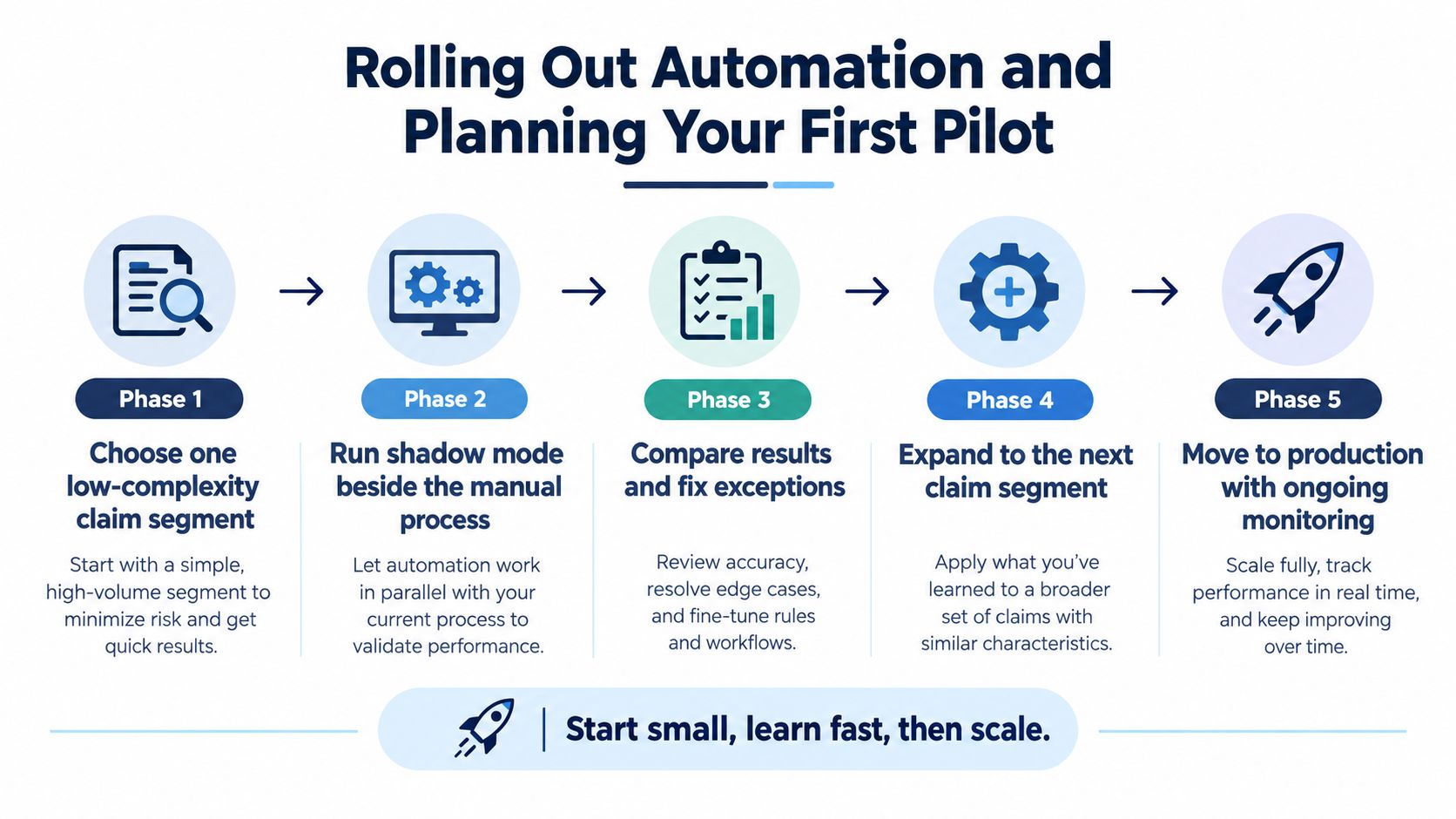
Expand only when the evidence supports it
Agree expansion thresholds in advance for rework, escalation, payment accuracy, and cycle time. Monitor them by claim type, extraction confidence, and exception category, and watch model drift and override patterns after launch.
Automation should also protect hard deadlines. EU motor liability rules require a reasoned offer or reasoned reply within three months after a claim is presented, under Article 22 of the Motor Insurance Directive (2009/103/EC). Timestamp the first notice, calculate the deadline, and escalate files approaching breach. Don’t let a queue manage a statutory obligation.
-
Measuring volume only: Pair STP with rework, accuracy, and exception cost.
-
Letting extraction errors propagate: Gate adjudication on field-level confidence.
-
Automating sensitive cases too early: Keep disputed and vulnerable-customer claims human-led until controls mature.
-
Ignoring handler feedback: Review overrides weekly during the pilot.
Your first scoping step is concrete. Pick one claim type, document its current cycle time and rework rate, write its escalation rules, and choose how you’ll staff the build using software development service models as one way to structure that decision.
Frequently Asked Questions
Will claims processing automation replace claims adjusters?
No. It removes data entry, document sorting, and routine checks, while adjusters keep complex liability, negotiation, fraud judgment, and vulnerable-customer cases. Their role shifts toward exceptions and accountability for automated outcomes.
What’s the difference between straight-through processing and touchless handling?
Straight-through processing means a claim completes without manual intervention because it passed validation and decision rules. Touchless handling is broader marketing language that often ignores exception queues, sampling, and appeals. Measure the first, and be skeptical of the second.
Can we automate on top of a legacy claims system?
Usually, yes. An integration layer with a canonical claim object, APIs or event feeds, and document processing in front of the legacy core can deliver value without a full replacement. Replacement becomes necessary when the core can’t expose data, log decisions, or support required controls.
How do we know our automation will satisfy auditors and regulators?
Keep a written AI program, decision records, model and rule versions, data lineage, and testing evidence for accuracy and fairness. Record why each claim was automated or escalated, and sample auto-approved claims so oversight is demonstrable rather than assumed.
If you’re scoping a first pilot or modernizing an existing claims platform, Bridge Global can help you design the intake, decisioning, integration, and human review controls as one system. Visit Bridge Global to discuss your claim segments, legacy constraints, and the evidence you’d need before expanding automation.

About Preethi Saro Philip
Preethi Saro Philip is a Post Graduate Research Degree holder in Economics with more than 10 years of experience in writing, editing, research and teaching. She has an intense passion for content crafting and calls herself a ‘wordsmith’. She enjoys writing on wide-ranging topics including business, technology, health & lifestyle, education, environment etc.
View all posts by Preethi Saro Philip →