

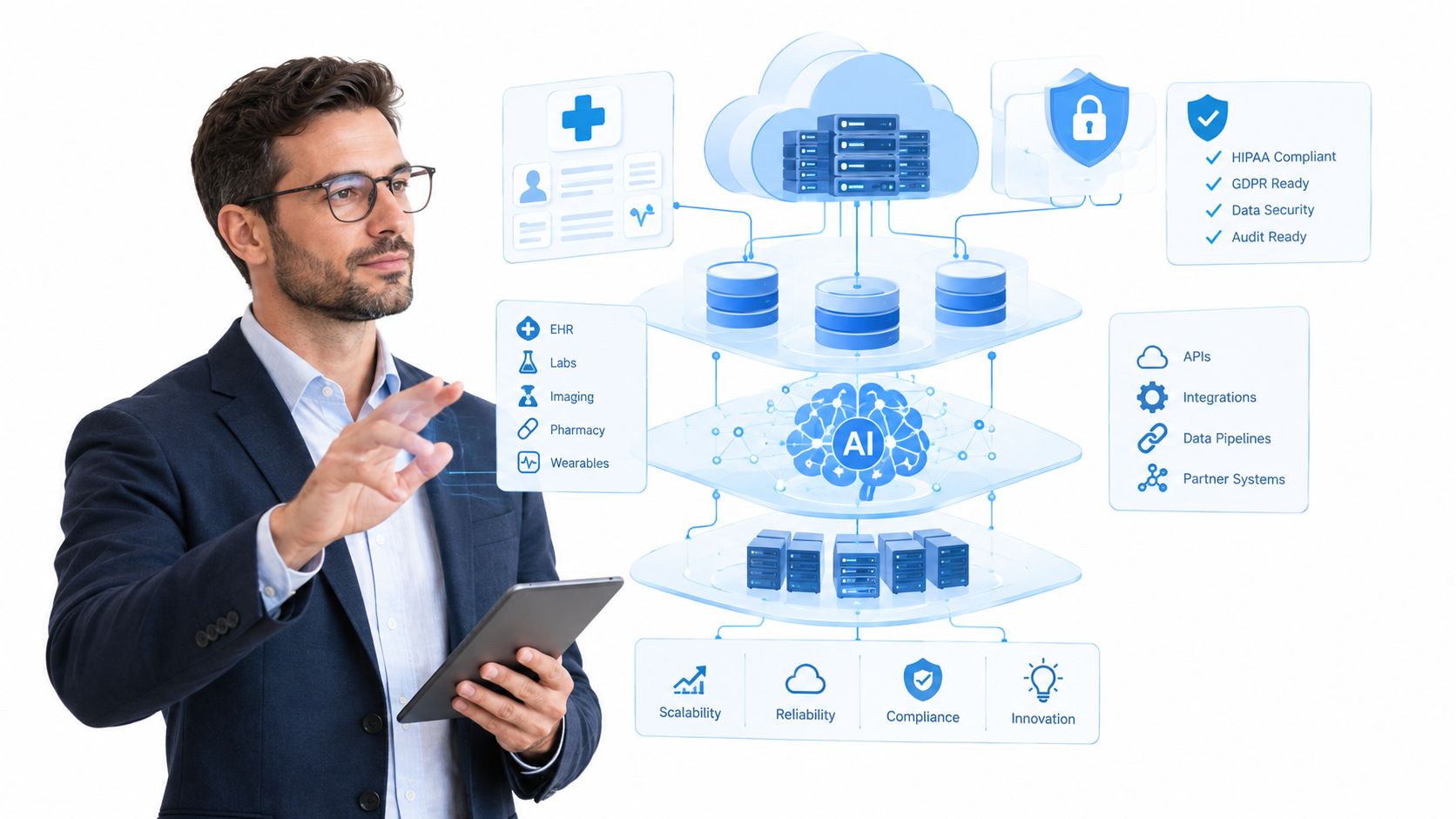

Healthcare Data Platform Development: A Practical Guide
A lot of teams are in the same spot right now. They've connected an HL7 feed, landed data in a warehouse or lakehouse, built a few dashboards, and proved that data can move. Then a hospital pilot gets close, security starts asking where ePHI lives, product realizes consent isn't modeled well enough for partner-specific rules, and engineering discovers that patient identity, terminology normalization, and auditability were treated like follow-up tasks instead of platform primitives.
That's where healthcare data platform development stops being a data project and becomes an operating model problem. You're not just building ingestion and analytics. You're building a system that has to survive compliance review, support messy interoperability, stay reliable under changing interfaces, and remain usable for clinical and operational teams after launch.
For companies evaluating a healthtech software development partner, the hard part usually isn't writing one more connector. It's deciding what belongs in the platform core from day one, what can be phased, and what will become expensive if postponed.
Why Healthcare Data Platforms Break Before They Scale
A familiar failure pattern starts small. A team builds a promising prototype around one EHR source, one tenant, and one use case. The demo works. The data lands. The dashboard refreshes. Everyone assumes scale will mean more compute, more connectors, and maybe a better API layer.
Then the hard questions arrive.
The pilot customer wants separate tenant boundaries. Legal wants purpose-specific access rules. Security asks for immutable audit trails, access reviews, and proof that identifiable data is segregated from analytics workflows. Product wants patient-submitted data to flow back into the system without breaking source-of-truth assumptions.

What breaks isn't usually the pipeline runtime. It's the missing architecture around it.
Most healthcare platforms fail long before scale limits them. They fail when real-world consent, identity, audit, and data ownership rules hit a model that was only designed to move records.
The architectural decisions teams postpone too long
Three choices create most of the downstream pain:
-
Tenant segregation matters early. If you treat multi-tenant isolation as a later infrastructure setting, you usually end up rewriting storage, access patterns, and support workflows.
-
Identity strategy can't be bolted on. Patient matching, user federation, service identity, and organization boundaries affect everything from API design to reconciliation.
-
Regulatory scope changes system shape. HIPAA, contractual obligations, and cross-border privacy requirements influence what gets stored, where it moves, and who can see derived outputs.
What production teaches quickly
In production, healthcare data platforms don't get judged by clean architecture diagrams. They get judged by whether a hospital can trust them, whether analysts can use them without overexposure to raw PHI, and whether interface changes can be absorbed without operational chaos.
That's why the strongest platforms treat compliance text as build input, not legal fine print. The gap between “we support healthcare data” and “we can operate this safely at scale” is mostly made of unglamorous design choices: access control, data lineage, terminology discipline, consent state, auditability, and exception handling.
Discovery and Compliance Framing
Before provisioning infrastructure, lock down discovery. This is the stage where teams either reduce years of rework or commit to it without noticing.
The regulatory foundation is not new. The U.S. Department of Health and Human Services notes that the final HIPAA Privacy Rule was published in December 2000, with compliance for most covered entities becoming mandatory on April 14, 2003, and small health plans receiving until April 14, 2004. The final HIPAA Security Rule was published on February 20, 2003, with most covered entities required to comply by April 20, 2005, and small health plans by April 20, 2006. HHS also notes that the Privacy Rule covers protected health information in electronic, oral, and paper form, while the Security Rule specifically protects electronic protected health information, and that the 2013 Omnibus Rule expanded privacy, security, enforcement, and breach-notification requirements under HITECH.
That history matters because it explains why role-based access, encryption, activity logging, business-associate governance, and incident handling belong in the architecture from the start.
Start with stakeholder reality, not feature ideas
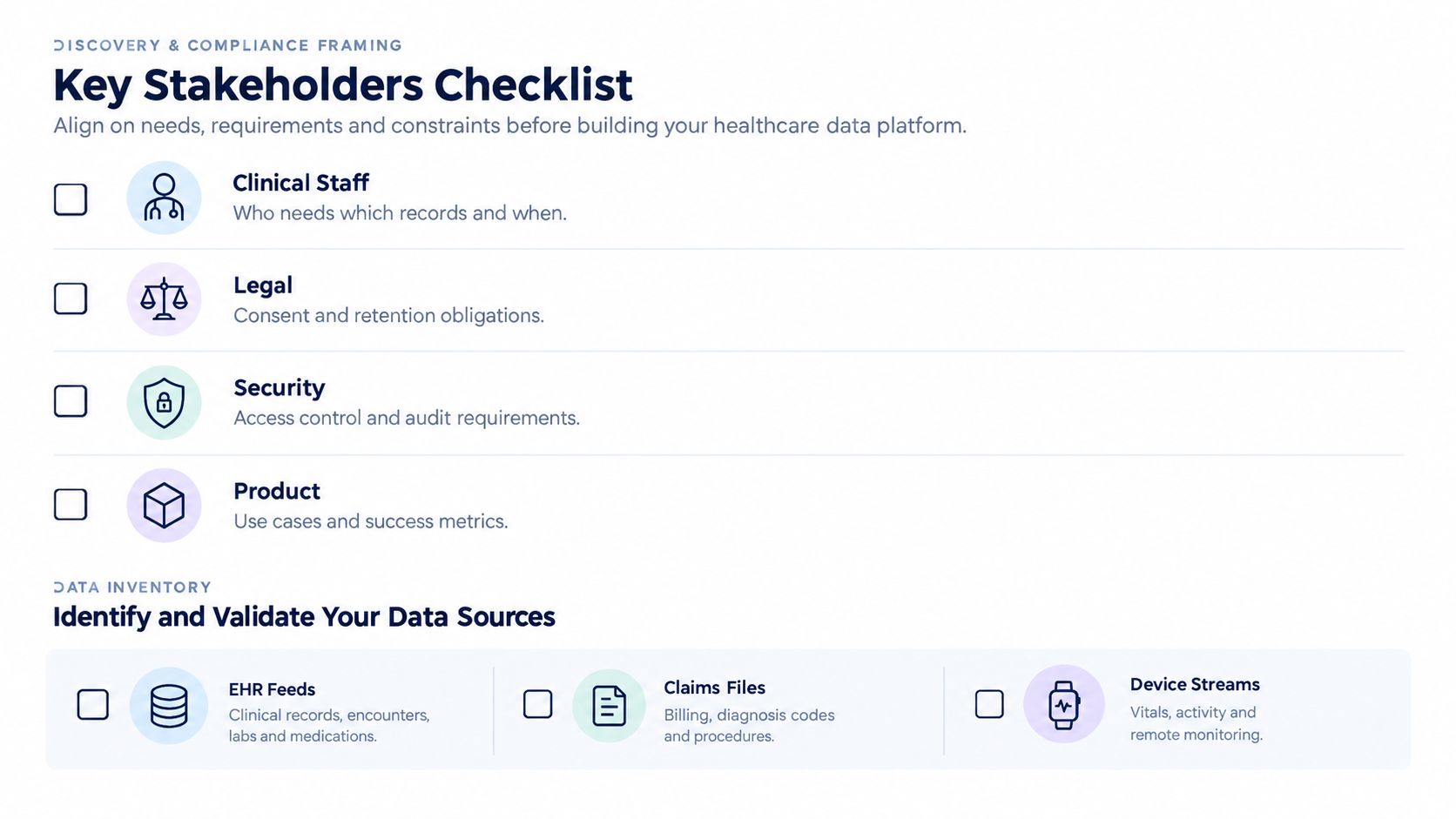
A useful discovery pass includes four voices that often disagree for good reasons:
-
Clinical stakeholders need to define which records are needed, when they're needed, and which delays are unacceptable in workflow.
-
Legal and compliance teams need to define retention boundaries, consent requirements, contractual responsibilities, and whether the product acts as a covered entity workflow, business associate service, or another regulated role.
-
Security teams need data-flow visibility, authentication expectations, audit requirements, and vendor-risk boundaries.
-
Product leaders need clear use cases, tenant models, and success criteria tied to real operations rather than abstract platform completeness.
Translate HIPAA and GDPR into implementation workstreams
HIPAA security work is structured across administrative, physical, and technical safeguards. HHS describes the Security Rule as requiring regulated entities to protect the confidentiality, integrity, and availability of ePHI through those safeguard categories.
That creates separate engineering and operating workstreams:
-
Administrative safeguards drive governance, policies, risk management, and evidence collection.
-
Physical safeguards affect device handling, media controls, and facility-related responsibilities where relevant.
-
Technical safeguards become code and configuration. Authentication, authorization, audit logging, integrity controls, and transmission security live here.
For European users, GDPR Article 9 treats health data as a special category of personal data and generally prohibits processing unless a specific exception applies, including explicit consent for specified purposes, care delivery or management under applicable legal conditions, and certain public-health activities with legal support and safeguards.
Practical rule: Never model European health-data processing as one broad “consent accepted” flag. Tie datasets and workflows to a documented legal basis and enforce purpose restrictions in product logic.
Discovery outputs worth insisting on
Before build starts, teams should leave discovery with:
-
A data inventory covering EHR feeds, claims, device streams, uploaded files, admin tools, and downstream exports
-
A role matrix for users, support staff, service accounts, and partner access
-
A consent and purpose model that product and legal both recognize
-
A vendor map for subprocessors, business associates, and interface owners
-
Retention and deletion rules that match both regulation and customer contracts
Without those decisions, architecture becomes guesswork dressed up as velocity.
Platform Architecture for Health Data
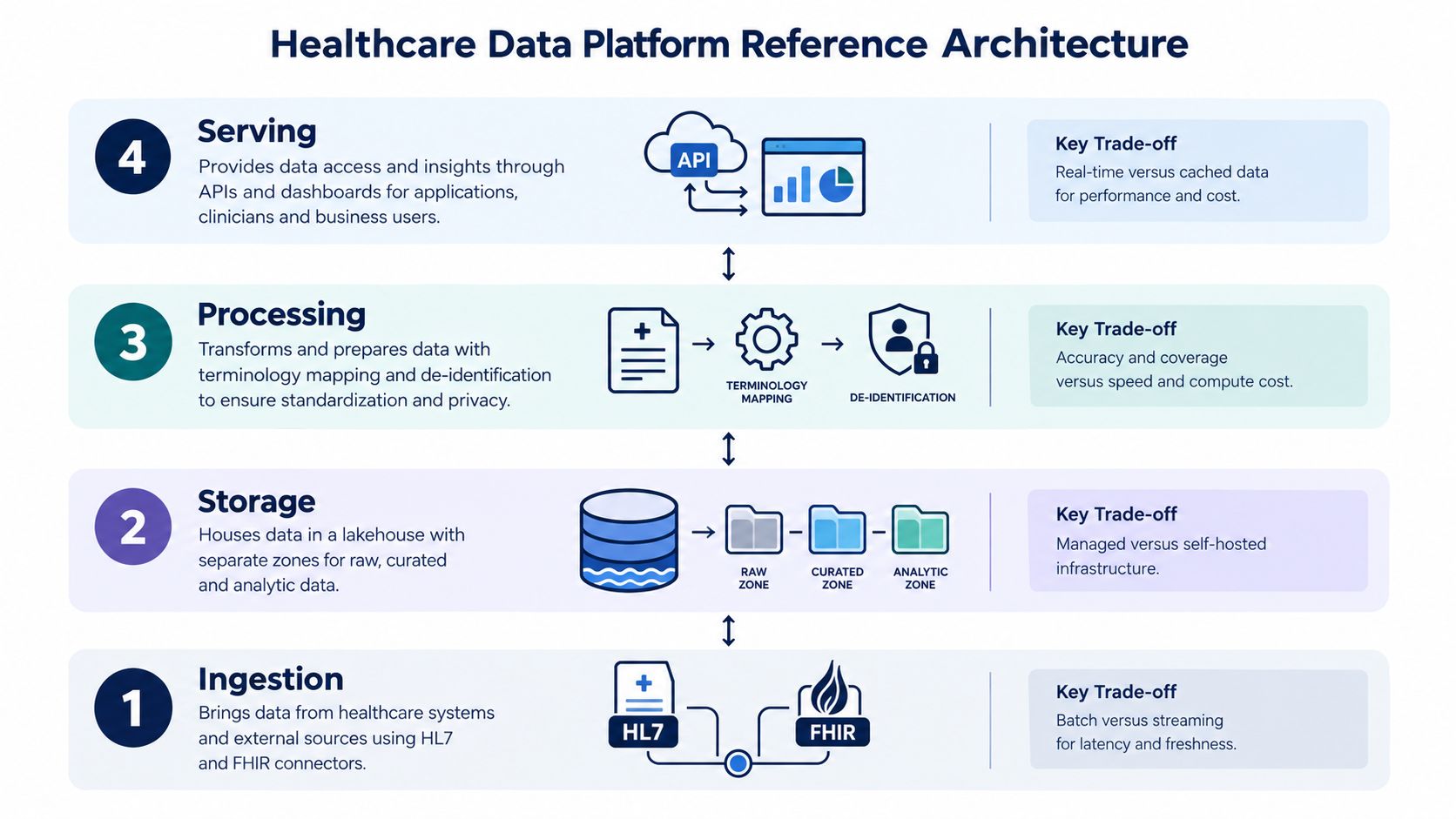
Good healthcare platforms are usually boring in the right places. They separate concerns cleanly, limit blast radius, and make data movement explicit. The reference pattern is straightforward: ingestion, storage, processing, and serving. The hard part is choosing the boundaries.
Ingestion and storage decisions shape everything later
At ingestion, the first trade-off is batch versus streaming. Batch is often enough for claims, retrospective analytics, and periodic operational reporting. Streaming becomes necessary when workflows depend on near-real-time admission events, device data, or intervention triggers. Teams often overbuild streaming early and underinvest in replayability, idempotency, and source tracing.
Storage needs explicit zones and explicit rules. Raw landing zones are useful, but they become dangerous if everyone treats them as queryable product data. Curated zones should hold standardized, quality-checked, access-controlled data products. Analytic zones should expose only what specific workloads need.
Processing is where trust gets built or lost
Processing is not just ETL. It's where you normalize terminology, manage patient identity, apply de-identification rules, validate incoming records, and preserve provenance.
A few boundaries matter:
-
Clinical operational data should remain separate from broad analytics access.
-
Identifiable datasets should be separated from de-identified or limited-use analytic datasets.
-
Consent state should be available as a first-class input to downstream services, not hidden in a side table.
-
Mapping logic needs versioning. Source interfaces change without notice, and unversioned transformations make incident analysis miserable.
As we explored in our guide to healthcare data pipeline architecture, most downstream instability starts upstream with unclear landing-zone contracts and weak schema ownership.
Serving layers need workload-specific design
Serving should not mean one giant endpoint for every use case. A healthcare platform usually needs multiple serving patterns:
| Serving pattern | Best fit | Main trade-off |
|---|---|---|
| Transactional APIs | Apps, portals, partner integrations | Strict latency and authorization demands |
| Analytics models and dashboards | Operational reporting, care programs, finance | Risk of overexposing source detail |
| Event delivery | Notifications, workflow triggers, downstream sync | Ordering and retry complexity |
A FHIR server, a warehouse, and an AI sandbox should not all share the same access assumptions just because they sit on the same cloud account.
If your team is still deciding whether to buy, assemble, or build these layers, a partner experienced in custom healthcare software development or broader custom software development can help define where product differentiation ends, and platform plumbing begins.
Interoperability with HL7 and FHIR
A hospital can expose a FHIR endpoint and still leave a referral workflow unreliable. Interoperability is a continuous mapping, validation, and governance discipline, not a one-time standards choice.
Hospital adoption shows why API-first design matters. An analysis by the U.S. Office of the National Coordinator for Health Information Technology found that in 2022, more than two-thirds of hospitals used an HL7 FHIR API to support patient access to EHR data through apps. About two out of three hospitals used a FHIR API for this purpose, a 12-percentage-point increase from the previous year. Across non-federal acute-care hospitals, 69% reported using standards-based APIs for patient access, 45% used them to submit patient-generated health data, nine in ten used APIs to let apps grant patients access to EHR data, and six in ten used APIs to let patients submit data through apps. Still, one in six hospitals did not use a FHIR API for patient access in 2022.
FHIR adoption is established, while maturity remains uneven. Production failures usually come from inconsistent meanings, missing fields, stale mappings, and unclear ownership rather than from the absence of an API.
Start with a canonical model, not direct source-to-app wiring
Define a canonical data model and a terminology service before connecting applications directly to source systems. Map source fields into FHIR resources, constrain those resources with implementation guides, and validate the results continuously. In the United States, ONC-approved testing covers FHIR R4, US Core profiles, SMART App Launch, Bulk Data Access, OpenID Connect, and related certification criteria. A practical workflow includes data-element coverage analysis, vocabulary validation, round-trip testing, and negative testing.
A peer-reviewed assessment of FHIR coverage against clinical registry requirements found that FHIR represented approximately 80% of required data elements overall, with registry-specific coverage ranging from 71% to 92%. That supports FHIR as a strong foundation, while leaving clear work for extensions, local profiles, and source-specific handling.
Build four controls into the platform:
-
An extension strategy for elements FHIR does not cover
-
Versioned mappings because source semantics and interfaces change
-
Provenance fields so applications and analysts can trace values to their origin
-
A reconciliation queue for records that fail validation or cannot be mapped safely
Choose the right integration pattern
| Pattern | Best fit | Main trade-off |
|---|---|---|
| Point-to-point connections | One or two tightly scoped integrations | Becomes fragile as partners grow |
| Integration engine | Mixed HL7, files, and legacy workflows | Adds operational overhead and interface ownership |
| API gateway plus FHIR services | App ecosystems, partner APIs, and patient access workflows | Requires stronger identity, authorization, and lifecycle governance |
Measure maturity through workflow outcomes, not endpoint counts. Reliable referral exchange, patient access, and submit-back workflows expose data-quality failures that a connection inventory will miss. Teams handling adjacent communication workflows can also use this guide to secure messaging for clinics when designing exchange around care delivery.
For implementation decisions, Bridge Global’s FHIR integration services provide a reference point for deciding which standards and mapping controls belong in a shared platform and which should remain close to individual products. That boundary affects operating cost, release coordination, and the speed of fixing a broken source mapping.
Security Engineering as a Lifecycle
Security reviews often happen too late. By the time the checklist arrives, data has already spread into backups, support tooling, notebooks, and lower environments.
HIPAA doesn’t support that posture. Under the U.S. HIPAA Security Rule, covered entities and business associates must perform an accurate and thorough assessment of potential risks and vulnerabilities to the confidentiality, integrity, and availability of ePHI. That assessment has to cover the full information lifecycle, including interfaces, cloud storage, backups, administrative tools, endpoints, vendors, and data-transfer paths, not just the production application database.
The security sequence that works in real platforms
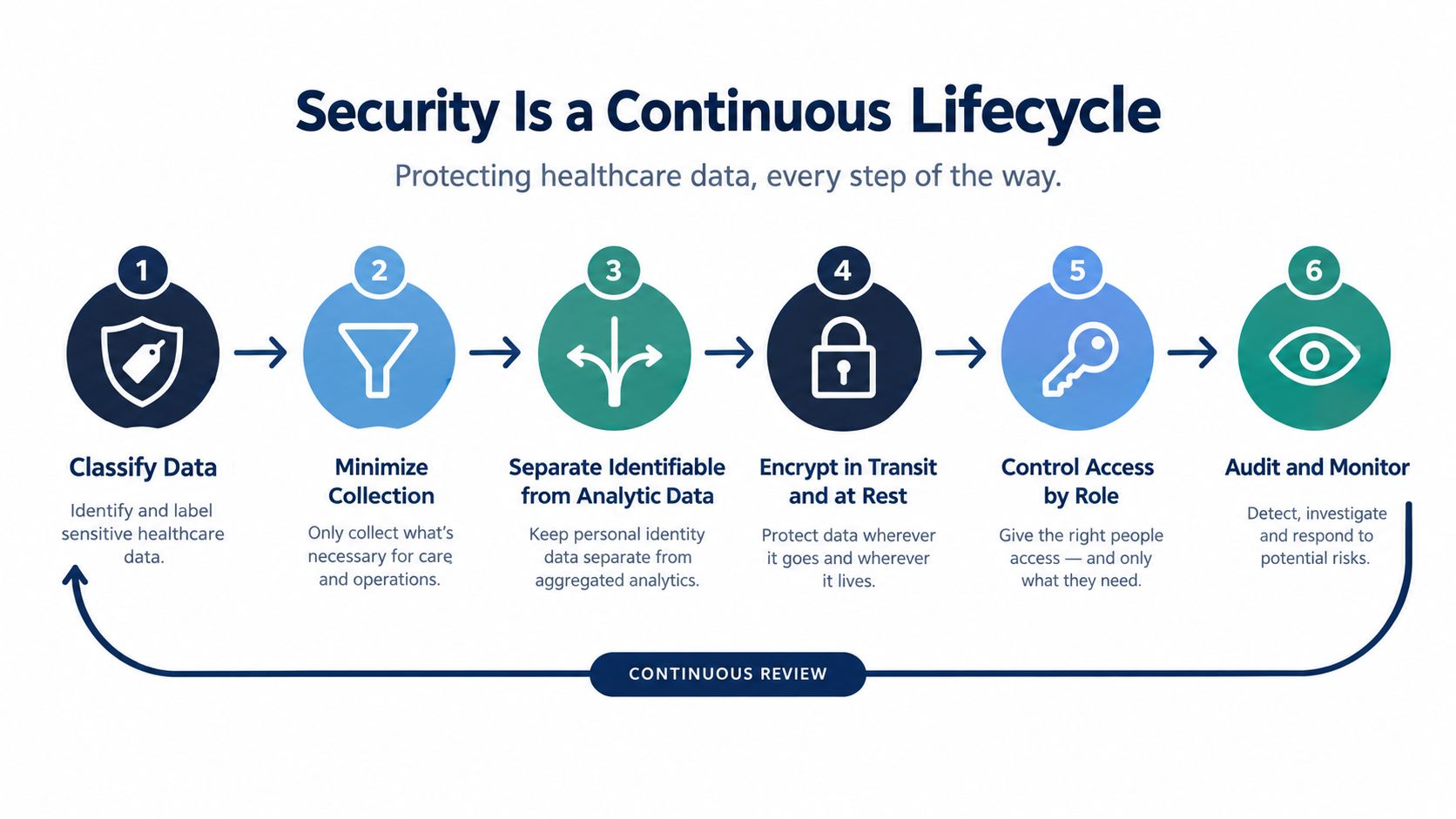
Treat security as an operating loop:
-
Classify sensitive data early: Tag ePHI, quasi-identifiers, operational metadata, and derived datasets differently.
-
Minimize collection and retention: If a field doesn’t support a defined workflow, don’t ingest it by default.
-
Separate identifiable from analytical data: Don’t let convenience turn the analytics environment into a second production copy.
-
Encrypt in transit and at rest: Then test key handling, rotation, and service-to-service assumptions.
-
Enforce least privilege: API authentication is not enough without object-level authorization and role-specific access boundaries.
-
Centralize audit and monitoring: Logs need integrity, retention discipline, and review paths that someone owns.
Why this budget line is justified
The economic argument is blunt. IBM’s 2025 breach benchmark reported healthcare as the costliest industry, with an average breach cost of $7.42 million, while healthcare organizations took 279 days on average to identify and contain incidents.
That’s why strong teams define measurable acceptance criteria such as:
-
Mean time to detect and mean time to contain
-
Percentage of privileged access reviewed
-
Patch-age distribution
-
Backup recovery-point and recovery-time objectives
-
Percentage of sensitive records covered by audit telemetry
Security acceptance criteria belong in CI/CD and disaster-recovery exercises. A control that exists only in policy usually fails at the worst moment.
The mistakes that keep repeating
Healthcare teams repeatedly get burned by the same habits:
-
PHI copied into development because synthetic data wasn’t prioritized
-
Broad analyst access to raw tables because governance slowed down a sprint
-
API-level trust without record-level authorization checks
-
Indefinite event retention because nobody owned deletion rules
For teams also reviewing provider communication controls in multilingual environments, Tribulys has a useful explainer on sécuriser les échanges de santé (secure health data exchanges) that complements platform-level security thinking.
A practical engineering reference on this topic is Bridge Global’s guide to healthcare data security best practices, especially when you need to turn policy language into deployable controls.
Data Governance and the AI Hype Trap
A centralized lake or lakehouse does not make a platform AI-ready. It just gives you a place where data can accumulate.
The bigger operating problem is usually data quality. A 2025 healthcare data-quality report found that 79% of respondents said poor data quality significantly affected enterprise goals, 61% rated patient data quality as mixed, 86% were concerned about the effort required to build interfaces for different message formats, and 64% were concerned about the direct cost of acquiring external data.
Those numbers align with what platform operators already know. Interface maintenance and operational data quality consume more energy than model selection.
What teams miss when they say they’re ready for AI
They usually mean one of three things:
-
data from several systems is now centralized
-
someone can run feature engineering in a notebook
-
an LLM demo can summarize a record set
None of that proves trustworthiness. A production platform still needs controls for schema drift, delayed feeds, duplicate patients, terminology mismatches, null-heavy fields, late corrections, and provenance gaps.
Reliability beats novelty
Data products should earn trust before they feed predictive systems or generative interfaces. The minimum quality bar is operational, not aspirational:
-
Completeness for critical fields and source populations
-
Timeliness relative to the workflow that consumes the data
-
Consistency across sources and transformations
-
Lineage from source event to downstream use
That means budgeting for connector versioning, regression tests on mappings, exception queues, data observability, and human stewardship. These are recurring operating costs, not launch tasks.
If your team can’t explain why a value changed, where it came from, and who approved the exception path, it’s not ready for high-stakes AI use.
Governance forums matter more than another AI proof of concept
Operating model matters again. Someone must own data products. Someone must resolve quality exceptions. Someone must approve semantic changes. Without that forum, platforms drift into silent inconsistency.
For teams planning advanced capabilities, Yellow.ai’s piece on enterprise AI governance is a useful companion read because it connects AI ambitions to the controls and ownership structures that enterprise systems need.
If AI is part of your roadmap, align it with an AI implementation roadmap, and only expand after the data foundation supports repeatable trust. Later-stage organizations can then evaluate AI development services or broader enterprise AI solutions in the context of governed healthcare workloads rather than isolated demos.
From Launch to Continuous Operation
A healthcare data platform earns trust through its operating behavior after launch. Start with one workflow, one partner group, and an operating model that exposes failures under pressure. Connecting every source at once creates more exceptions than the team can classify or resolve.
A phased rollout matches how interoperability maturity develops in practice: begin with one high-value workflow, then expand once coverage, validation, and exception handling hold up in production. Treat FHIR resources as exchange models rather than database tables, normalize terminology deliberately, and validate clinical meaning alongside message syntax. Guidance on health IT standards and technology provides useful context for those decisions.
What a disciplined launch sequence looks like
A practical sequence includes:
-
Start with one high-value workflow: Referrals, patient access, discharge events, claims enrichment, or device monitoring are common candidates.
-
Define service levels around outcomes: Track freshness, reconciliation lag, failed interface rate, and queue aging in terms that business and clinical teams can act on.
-
Instrument data products, not only pipelines: A successful job run does not prove that downstream data is complete, timely, or usable.
-
Control interface change rigorously: Connector versioning, contract tests, and rollback plans protect production systems when partners alter mappings or payloads.
-
Run recovery drills: Backups count only when restore paths are tested, documented, and owned.
The operating budget must include connector maintenance, mapping regression tests, terminology updates, exception review, observability, and incident response. These costs recur because partner systems and clinical workflows change continuously.
The partnership model that usually works best
Healthtech teams should retain product direction, domain decisions, data accountability, and compliance ownership. They may not need every specialist role as a permanent internal position. A mixed model can pair internal decision-makers with external engineering capacity for integrations, platform hardening, and periods of increased delivery demand.
Different stages call for different arrangements. A startup validating a SaaS workflow may need focused SaaS product development. A provider modernization effort may require substantial work across healthcare integrations. Teams comparing delivery options can review software development service models, while relevant client cases can help procurement assess comparable work.
FAQs
Should you build the whole healthcare data platform in-house?
Not always. Build the components that define product advantage, data rights, and workflow differentiation. A partner can handle standard plumbing, integration accelerators, or operating support when internal capacity is limited.
How long does audit readiness usually take?
It takes longer when discovery was weak. Early definitions for access models, data flows, vendor boundaries, and evidence collection reduce later rework. Without them, readiness becomes architecture cleanup combined with a documentation scramble.
What’s the most underestimated ongoing cost?
Interface and data-quality operations. Connectors drift, source semantics change, and exceptions accumulate unless named owners review and resolve them continuously.
Bridge Global helps teams turn healthcare data platform development into an executable product and engineering plan, covering regulated architecture, interoperability design, and long-term platform operation. Teams building a compliant SaaS platform, modernizing integrations, or preparing an AI roadmap on health data can visit Bridge Global for strategy, build, and ongoing delivery support.

About Upendra Jith
Upendrajith completed his Master's in English and has been a commercial content developer for the past three years. He's more inclined to develop content with a 'street-smart' delivery on topics such as technology, media, or anything he can get his hands on. He has a fixation on lyrics, dark poetry, media, technology, and flow arts.
View all posts by Upendra Jith →