



AI Underwriting Software: A Buyer’s and Builder’s Guide
AI underwriting software reads insurance submissions, extracts structured data from documents, scores risk, supports pricing, and routes each case to the right path. Underwriters should still approve material decisions, especially where evidence is incomplete or the exposure is unusual. I would judge any product by one test first. Can your team reproduce a decision months later, field by field and model version by model version?
Core Functions and Components
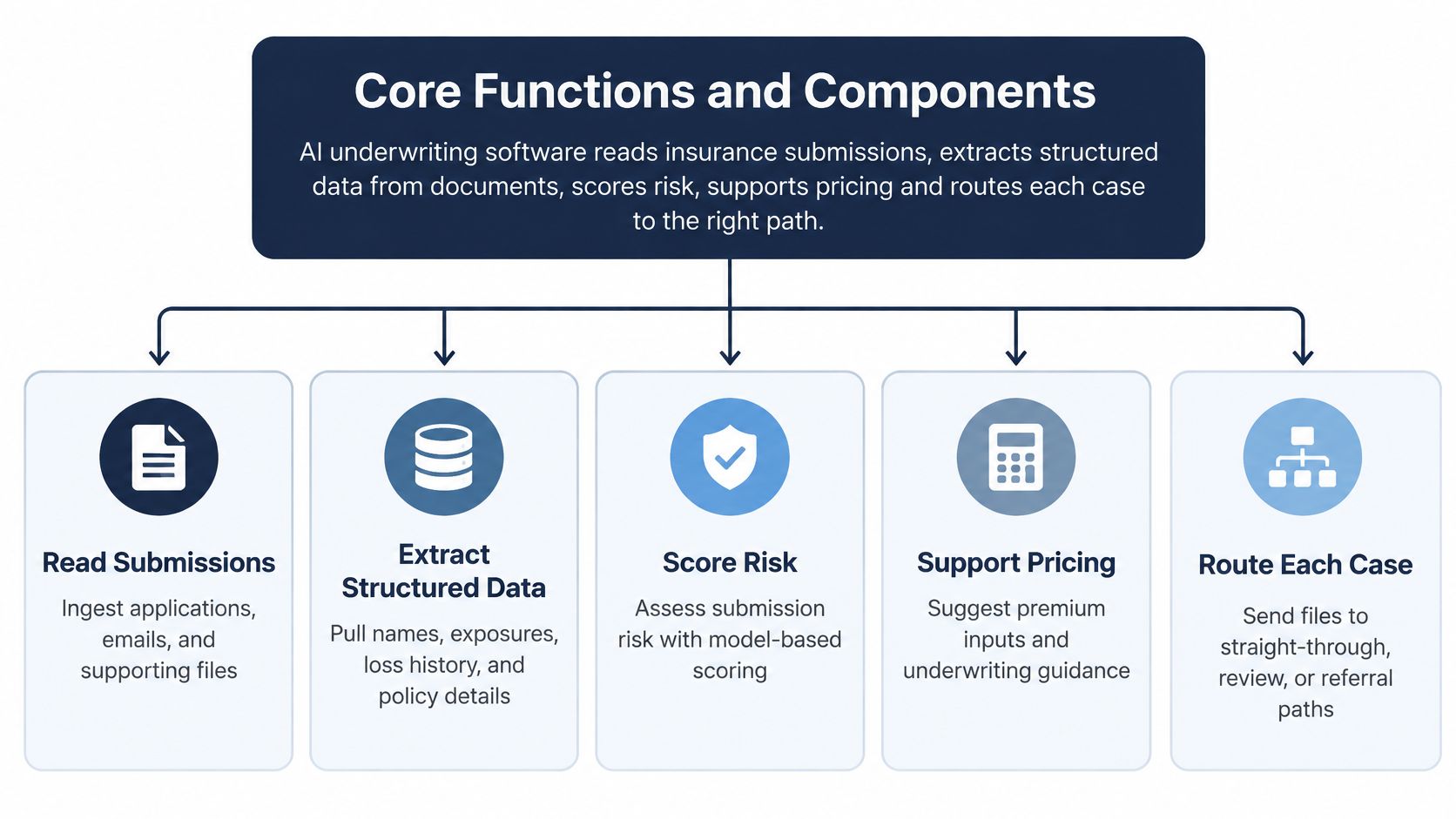
The workflow starts with submission intake and data extraction. The software ingests applications, broker emails, loss runs, and supporting files, then pulls names, exposures, limits, and prior losses into structured fields. Each extracted field should keep a pointer to its source page or cell so an underwriter can verify it without reopening the whole file.
Risk scoring and pricing support come next. Models estimate risk class or expected loss, while deterministic rules check appetite, completeness, and referral triggers. The rating engine still owns the filed price in most architectures. The AI layer supplies features, flags, and a recommendation with reason codes.
Triage and routing send clean standard risks toward straight-through processing and send borderline cases to a named underwriter. Behind those functions sit models that score, data feeds that supply evidence, and integrations that write recommendations back to policy and claims systems.
Accenture's 2025 underwriting research surveyed 430 senior underwriting executives across 11 countries and found respondents expected AI adoption in underwriting to rise from 14% to 70% within three years. They also expected AI's impact on underwriting tasks to increase from 17% to 75% over the same period. That gap matters because early value usually comes from removing repetitive intake work, leaving underwriters more time for complex selection and broker negotiation. For the broader concept, see our guide to AI in insurance underwriting. If a demo can't show a traceable recommendation for one real case, you're looking at extraction and routing only.
Use Cases by Line of Business
| Line of business | Typical AI underwriting use | Where underwriters stay in control | Main data inputs |
|---|---|---|---|
| Personal auto and homeowners | Automated intake and scoring for standard risks | Unusual property, prior loss history and exceptions | Applications, telematics where permitted, property data, prior claims |
| Life and health | Risk classification, medical data extraction and pricing support | Incomplete or high-severity medical evidence | Application answers, medical records and prescription history where permitted |
| Commercial property and casualty | Submission intake, loss-run extraction and exposure analysis | Large or complex accounts and broker negotiation | Submissions, loss runs, inspection reports and schedules of values |
| Specialty and large commercial | Document reconciliation and preliminary risk analysis | Most material decisions requiring specialist expertise | Policy wording, contracts, engineering reports and external data |
| Cyber | Questionnaire parsing, external scan signals and control-maturity scoring | Coverage limits, aggregation risk and emerging threat judgement | Security questionnaires, external attack-surface scans and incident history |
McKinsey's Insurance Productivity 2030 analysis projects manual pricing and underwriting will largely disappear for most personal and small-commercial products by 2030, with more than 90% automation possible in simpler lines such as auto, home and personal liability. The same analysis says underwriters in large commercial insurance spend approximately 30% to 40% of their time on administrative activities, including rekeying information and manually executing analyses.
That split should drive sequencing. Start where submissions are standardised, volume is high, and a wrong decision has contained cost. Extend into specialty work once your evidence trail survives audit. Our overview of AI solutions in insurance covers adjacent uses, while the Canadian cyber insurer case shows a cyber context. Teams comparing underwriting discipline across financial services may also find commercial lending insights from Visbanking useful for how lenders structure committee review.
Data Sources and Data Quality
A model can't recover from bad inputs. It can only score them faster.
Internal data includes policy administration records, claims history, prior underwriting decisions, and broker submissions. That history carries your actual appetite and loss experience, so it usually matters more than a vendor's generic benchmark. Watch for legacy codes that changed meaning after a core migration.
Third-party data includes property records, geocoding, business registries, and credit-based data where law permits its use. Telematics and IoT data include driving behaviour and building sensor readings. Both need explicit consent records and permitted-use flags where personal data is involved.
Ask a vendor to demonstrate six checks on your own files.
-
Schema validation: Reject or quarantine fields that fail type and range rules at ingestion.
-
Completeness by product: Report missing required fields per line, not as one global average.
-
Source provenance: Keep the originating file, page, and extraction confidence on every field.
-
Freshness and drift: Date each external record and flag stale values before scoring.
-
Entity resolution: Match broker, insured and location records across spelling variants.
-
Consent flags: Block use where consent or permitted purpose is absent.
Say a loss run arrives with shifted columns from one broker. The extractor reads incurred losses as claim counts and every downstream score is wrong. Provenance lets you find and reprocess only the affected submissions. Teams building training sets should also review referral opportunities for underwriting data to understand how underwriting notes get sourced for model work. Each field behind a decision must trace to a dated source, or you can't rebuild the input snapshot later.
Integration with Core Systems
Follow a submission in order, and you will find the integration list. The CRM or broker portal supplies submission and broker identity. Document management stores attachments beside extracted fields and preserves the link between each field and its source file.
The rating engine receives risk features and returns a price or referral. The policy administration system receives bound terms, endorsements, and the final decision status. Claims systems supply prior loss history that feeds back into the next renewal score, so define how late-reported claims update an in-flight submission.
Interface rules worth fixing early
For each interface, specify direction of flow, event or API pattern, schema version, and message retention rule. Record requests and responses in an event log or message store. That log becomes the evidence you use to rebuild an input snapshot when an examiner or a broker disputes a declination.
Decide which system owns the decision record before you write any interface code. A record split across the rating engine and the policy system slows every review.
Test by replaying historical submissions and comparing system output with decisions underwriters made. Investigate disagreements individually, because some will expose old manual errors and some will expose extraction faults. Our article on AI integration in insurance covers wider integration patterns. Wire the straight-through segment first. It carries the fewest exceptions and gives you the cleanest acceptance test set.
Build, Buy or Extend Your Policy Administration System
| Option | Fits best when | Main cost driver | Main risk |
|---|---|---|---|
| Buy a dedicated underwriting platform | Speed to production matters and standard lines come first | Licence fees and integration work | Vendor dependency and limited access to model logic |
| Extend the policy administration system | The core system is current and one data model is wanted | Core upgrade and module configuration | Model choice limited to the core vendor roadmap |
| Build in-house | Model risk, MLOps and data engineering skills already exist | Hiring and ongoing model maintenance | Slow time to production and full validation burden |
| Co-build with an engineering partner | Delivery capacity is needed while rules and data stay under insurer ownership | Shared team cost over the build period | Ownership of code, models and documentation must be agreed in advance |
Weigh four criteria in committee. First, do you employ people who can run model validation, MLOps and data engineering after go-live? Second, how soon must production volume move? Third, how much control do you need over model logic, thresholds, and retraining data? Fourth, can the vendor supply lineage, validation reports, change history and reason codes in a format your auditors can use?
Extending a current core often gives cleaner data flow and fewer interfaces. It also ties your model choices to one vendor's release train, which can be painful when extraction models improve faster than core platforms do. A dedicated platform reverses that trade-off. For background on the core side, read our guide to insurance policy management software. Enterprise teams weighing internal delivery against a partner may also use AI build-or-partner guidance for enterprise teams as a general workflow automation reference.
Put five questions to every vendor. Which data does the model use? How was it validated and by whom? How are threshold changes logged and approved? Can decision records be exported in full? What happens to your models and history if the vendor changes architecture or the contract ends?
I would recommend a hybrid for many mid-sized insurers. Buy or extend for intake and extraction. Keep pricing rules, referral thresholds and the decision log under your own control. Any cost figure in a business case should be labelled an indicative estimate with its assumptions stated, including licence scope, integration count and internal staffing.
Regulation Across EU and US Markets
| Instrument | Scope | What the software must support |
|---|---|---|
| EU AI Act | High-risk AI, including risk assessment and pricing for life and health insurance | Risk management, data governance, record-keeping, human oversight and transparency |
| NAIC AI Model Bulletin (US) | Insurers' use of AI in decisions across adopting states | Written AI governance programme, testing, data lineage, vendor oversight and record retention |
| Colorado insurance AI rules | Life insurers first, governing external consumer data and algorithms | Governance and risk-management framework with controls against unfair discrimination |
EIOPA’s insurance-sector guidance identifies pricing and risk assessment in life and health insurance as high-risk uses of AI under the EU AI Act framework. EIOPA highlights data governance, record-keeping, fairness, cybersecurity, explainability and human oversight as core considerations. In practice, that means traceable inputs, documented decisions and a reviewer who can change the outcome.
GDPR Article 22 adds a separate constraint. Decisions based solely on automated processing that produce legal or similarly significant effects need safeguards, including the right to obtain human intervention, express a view, and contest the decision. Your workflow needs a contest route that reaches a person with authority, and your notices need to name that route plainly.
In the US, the NAIC artificial intelligence topic page describes the AI Model Bulletin expectation of written governance programmes covering risk management, internal audit, data quality and lineage, bias, privacy, testing and record retention. By March 2025, 24 states had adopted the bulletin with little or no material change, and the NAIC is piloting an AI Systems Evaluation Tool in 12 states. Colorado started with life insurers and requires a governance and risk-management framework for external consumer data and algorithms that could produce unfair discrimination.
Design for the strictest rule that applies across your markets. That’s cheaper than maintaining separate control sets per state or country. Check application dates against current official timetables and confirm obligations with counsel, because this article isn’t legal advice and state adoption keeps moving.
Model Governance and Audit Trail Requirements
The Federal Reserve SR 11-7 model risk management guidance defines model validation as the set of processes and activities used to verify that a model performs as expected, consistent with its design objectives and business uses. Applied to underwriting, a model that scored well in development can still be unsuitable in production if its population, input definitions, or decision use changes.
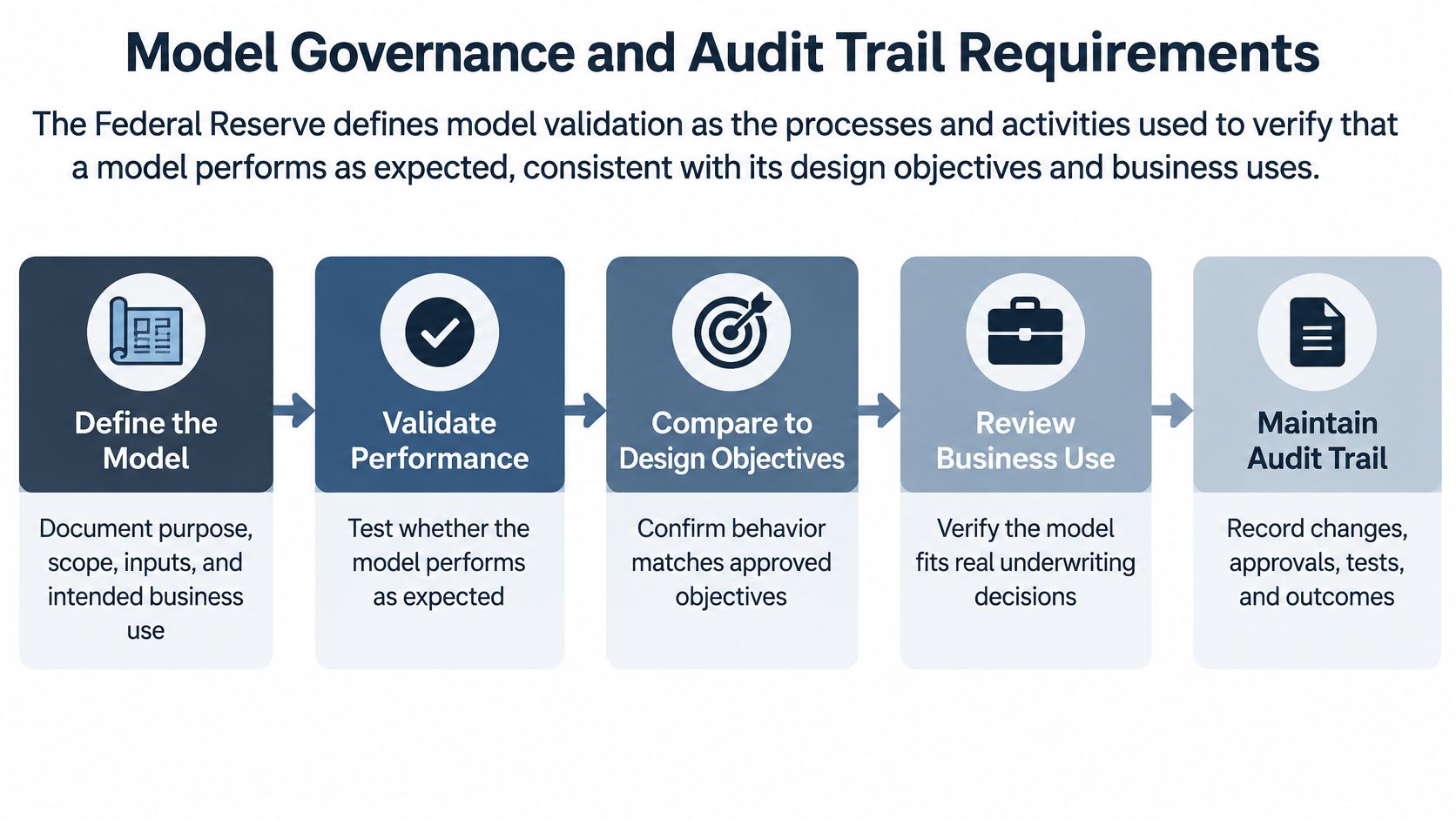
Use this checklist in procurement and architecture reviews.
-
Explainability: Return reason codes and calibrated probabilities for every recommendation, in language an underwriter can repeat to a broker.
-
Fairness testing: Test outcomes by subgroup before release and on a fixed schedule, with documented remediation when disparities appear.
-
Human-in-the-loop routing: Set written thresholds for borderline, high-value, and adverse decisions, and record who approved each threshold.
-
Audit trail: Store model version, feature set, input snapshot, threshold in force, approver identity, and override reasons for every case.
-
Drift monitoring: Track input distribution and outcome rates by product and region, with alerts that trigger review rather than quiet retraining.
-
Independent validation: Separate validators from the team that built or bought the model, and keep validation reports with the release record.
-
Retention: Match decision record retention to the regulatory record schedule for each market you write.
One technical warning deserves attention. As risk classification expands from two classes toward many tiers, class boundaries get harder to learn, and accuracy can fall. Set thresholds by product and risk tier instead of reusing one cutoff across the book.
Examiner test: Pick one declined application at random. You should be able to show the inputs, the model version, the reasons, the human reviewer, and every override within one working session.
Sequence the Rollout and Track the Right KPIs
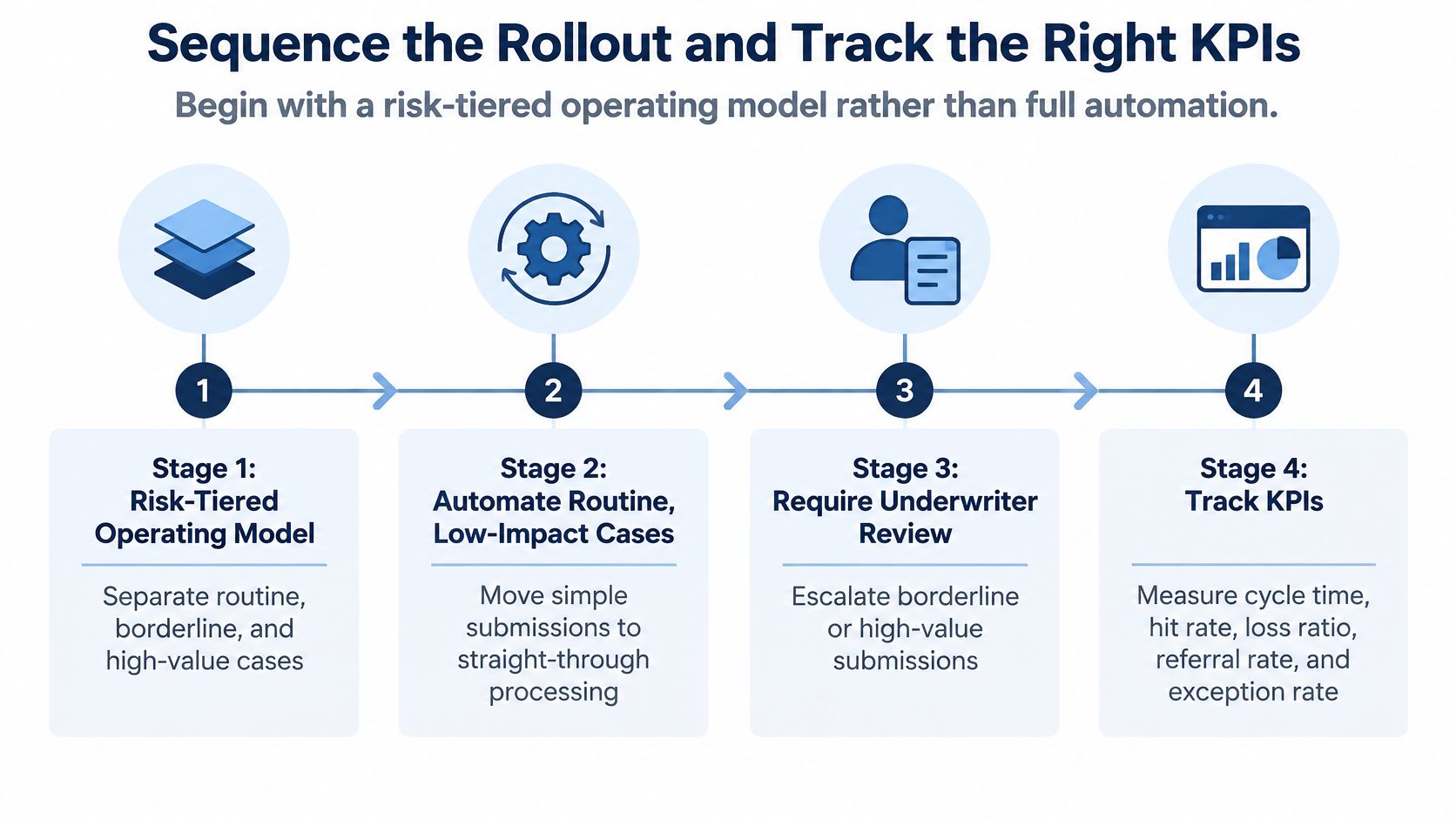
A rollout succeeds when an underwriting decision can be reproduced months later, across EU and US operations. Start with a narrow risk tier, preserve the evidence behind each recommendation, and expand only when the record is complete and performance holds.
-
Choose the first line. Start with standardised, high-volume submissions and contained loss severity. Define the target risk tier and the decisions the system may recommend.
-
Baseline current performance. Record cycle time, rekeying time, referral rate and quote turnaround before the model enters the workflow.
-
Run in shadow mode. Compare recommendations with underwriter decisions across the seasonal submission mix. Investigate disagreements before enabling automated routing.
-
Release a limited segment. Allow straight-through processing only for cases within written, approved thresholds. Route exceptions and incomplete evidence to a person.
-
Review monthly. Check performance, overrides and their reasons, drift alerts, and outcomes by segment. Keep the same decision record available for review across jurisdictions.
A study of 59,381 insurance applicants reported 0.831 test accuracy and a Matthews correlation coefficient of 0.624 for XGBoost binary risk classification, with performance declining as the task expanded to more risk classes, according to the health insurance underwriting benchmark. Treat those results as context, not an acceptance target. Track straight-through rate, referral rate, override rate, extraction error rate, disparity by segment, and turnaround time by product and risk tier. Portfolio averages can hide weak performance in a small segment.
For delivery context, see Bridge Global’s insurance software development overview and insurance client cases. Bridge Global helps insurance companies with claims and policy management, integrations, and analytics. Use submission volumes and referral patterns to choose a first line, then set the evidence and review requirements before rollout.
Frequently Asked Questions
How much does AI underwriting software cost?
Cost depends on scope, licence model, integrations, and the validation work your own team must fund. Ask vendors to state their assumptions and separate initial implementation from ongoing model maintenance. Integration and maintenance can outweigh the initial licence.
Will it replace underwriters?
Underwriters remain responsible for complex risks, high-value accounts, exceptions and decisions where evidence is thin or contested. Software can support intake, extraction and routing of standard risks, with clear thresholds for when a case goes to a person.
Does GDPR allow fully automated underwriting?
Article 22 restricts decisions based solely on automated processing when they have legal or similarly significant effects. Where such decisions are permitted, safeguards include human intervention and the right to contest. Configure the workflow to capture the review and its outcome.
Which line of business should go first?
Choose a standardised, high-volume personal or small-commercial line where the cost of a wrong decision is contained. Confirm extraction accuracy, thresholds, and reproducibility of the decision record before expanding to specialty or complex life business.
How do we prove a decision was sound months later?
Keep the model version, dated input snapshot, threshold in force, and reviewer identity together on the decision record. Include override reasons and any required adverse-action notices. A reproducible record should let reviewers reconstruct the recommendation and explain why the case was accepted, referred, or declined.
Bridge Global builds insurance software for claims and policy management, integrations, and analytics. If you are scoping intake automation, model governance, or core integration work, map one submission flow and its referral rules to a first risk tier. The rollout should preserve the evidence needed to reproduce each decision while fitting the insurer’s existing development workflow.

About Preethi Saro Philip
Preethi Saro Philip is a Post Graduate Research Degree holder in Economics with more than 10 years of experience in writing, editing, research and teaching. She has an intense passion for content crafting and calls herself a ‘wordsmith’. She enjoys writing on wide-ranging topics including business, technology, health & lifestyle, education, environment etc.
View all posts by Preethi Saro Philip →