



Healthtech Engineering Support for Startups: Founders Guide
For any healthtech startup, a brilliant idea is just the blueprint. The real work, the part that actually lands funding and carves out a place in the market, comes down to building the thing. That’s where healthtech engineering support for startups comes in: it’s the specialized crew that turns your vision into a secure, scalable, and market-ready product.
The Strategic Advantage of Specialized Healthtech Engineering

Think of your startup’s concept like a groundbreaking car design. It might look incredible on paper, but without a world-class team to build the engine, wire the electronics, and navigate every single safety regulation, it’s never leaving the garage. A specialized healthtech software development partner is that engineering team.
This isn’t just about hiring coders. It’s about bringing in a team that already understands the unforgiving terrain of the healthcare industry. Unlike other tech verticals, healthtech has a unique set of non-negotiables: strict regulatory compliance, bulletproof data security, and an architecture built from day one to scale and connect with other systems. Getting this right isn’t an expense; it’s your single most important early-stage investment.
Key Pillars of Healthtech Engineering Support
Choosing the right engineering partner is one of those make-or-break decisions that will directly impact whether you stall out or become a market leader. A strong partner doesn’t just build what you ask for; they bring a strategic framework to the table, ensuring your product is functional, compliant, and ready for whatever comes next.
The right engineering support transforms a healthtech idea from a high-risk concept into a fundable, market-ready asset. It’s the difference between building a product and building a trusted healthcare solution.
This support covers the entire journey, from poking holes in your initial concept to providing long-term maintenance after launch. An experienced partner offers more than just development firepower; they provide the strategic guidance needed for custom healthcare software development. That includes knowing how to navigate HIPAA and GDPR, building systems that can responsibly handle sensitive patient data, and creating a tool that clinicians will actually trust and use.
To give you a clearer picture, we’ve broken down the essential components you should be looking for in any engineering support partner.
Table: Key Pillars of Healthtech Engineering Support
This table summarizes the core components of a robust engineering partnership. Think of these as the must-haves that separate a good partner from a great one.
| Pillar | Why It Matters For Your Startup | Core Activities and Focus Areas |
|---|---|---|
| Regulatory Compliance | Avoids massive fines, builds trust, and is non-negotiable for market entry and investor confidence. | HIPAA/GDPR readiness, secure data handling, audit trail implementation, and building with privacy-by-design principles. |
| Scalable Architecture | Ensures your platform can grow with your user base without costly redesigns or performance degradation. | Cloud-native development, microservices, containerization, and designing for high availability and load balancing. |
| Data Security | Protects sensitive patient information (ePHI), which is your biggest liability and a core user expectation. | End-to-end encryption, access control management, threat modeling, and implementing robust cyber compliance solutions. |
| Clinical Workflow Integration | Guarantees your product fits into existing healthcare processes, which is essential for user adoption by clinicians. | Interoperability standards (HL7/FHIR), EMR/EHR integration, and user-centric design based on real-world clinical scenarios. |
Ultimately, a partner who delivers on these four pillars isn’t just a vendor; they become an extension of your founding team, dedicated to building a solution that is both technologically sound and commercially viable.
Why Generic Software Development Is a Recipe for Disaster
Silicon Valley’s favorite mantra, “move fast and break things,” has fueled incredible innovation across many industries. But when you apply that thinking to healthtech, it’s not just a bad idea; it’s a catastrophic failure waiting to happen. The stakes are completely different when your code impacts a clinician’s diagnosis or a patient’s well-being, not just a social media feed.
Think about it. A simple bug in a diagnostic tool could lead to a devastating misdiagnosis. A security lapse in a patient portal could expose sensitive health records, creating a nightmare of personal and legal problems. This isn’t the place for guesswork; it requires a level of precision that generic software development just can’t deliver.
The High Cost of Non-Compliance
The healthtech world is built on a foundation of strict rules designed to protect patients and their data. Regulations like the Health Insurance Portability and Accountability Act (HIPAA) in the US and the General Data Protection Regulation (GDPR) in Europe aren’t just suggestions; they are ironclad legal frameworks.
And the penalties for getting it wrong are severe. A single HIPAA violation can lead to fines of up to $50,000 per incident, capped at $1.5 million annually. Beyond the money, a compliance breach can shatter your startup’s reputation, making it nearly impossible to regain the trust of patients, providers, or future partners.
For any healthtech startup, compliance isn’t a feature you tack on at the end. It has to be the bedrock of your entire product. A generic development team often treats security and regulations as an afterthought, which is a mistake that can easily kill your business.
This is precisely where specialized healthtech engineering support for startups becomes so critical. A team that lives and breathes custom healthcare software development knows that compliance has to be woven into every line of code and every architectural choice from day one.
Investor Scrutiny Goes Way Beyond the Pitch Deck
When you’re trying to raise capital, smart investors dig much deeper than your growth projections. They perform intense due diligence on your technical foundation, zeroing in on your compliance and security posture. They know a non-compliant product isn’t a scalable asset; it’s a huge liability.
You can expect them to ask some tough questions:
-
Is your data architecture truly built to protect electronic Protected Health Information (ePHI) according to HIPAA’s strict rules?
-
Have you implemented solid cyber compliance solutions to guard against data breaches?
-
Can your team prove they have real-world experience building and launching secure healthcare apps?
If you can’t give confident, specific answers, your funding prospects will quickly dry up. Investors don’t see specialized engineering as a cost. They see it as a crucial investment that de-risks their money. A solid tech and compliance strategy shows you get the unique challenges of this market and have built something that can last. This understanding is the starting point for any effective digital transformation consulting.
Integration Nightmares with Legacy Systems
Then there’s the messy reality of the healthcare industry’s IT infrastructure. Many hospitals and clinics still run on older, legacy systems, and your product has to talk to them without a hitch. This requires deep knowledge of interoperability standards like HL7 and FHIR.
A generic development team, unfamiliar with these protocols, might build a brilliant product in a vacuum that completely falls apart in a real hospital. As we’ve explored in our guide on building a HIPAA-compliant application, integration is a massive hurdle that demands specialized expertise right from the start. Partnering with a team that has a proven track record, as highlighted in our client cases, ensures your solution can actually function in this complex environment.
Without that foresight, your innovative app ends up as an isolated island of data – useless to the very people it was designed to help.
So, you know you need serious engineering firepower. The real question is, how do you get it? Picking the right way to bring developers on board is just as critical as the technology you choose. This single decision will have a massive impact on your startup’s budget, speed to market, and your product’s future.
It’s not a simple choice. Each path has its own set of trade-offs, and the best one for you depends entirely on your funding situation, product roadmap, and what you’re trying to achieve as a business. Let’s walk through the three main ways healthtech founders tackle this.
The In-House Team
This is the traditional route: hiring your own full-time developers, project managers, and QA specialists who work only for you. The biggest perk here is control. Your team lives and breathes your product vision, embedding your company culture into every line of code.
But that control comes at a serious cost. Building an in-house team is painfully slow and expensive, especially when you’re hunting for talent with specific healthtech experience. The time and money sunk into recruiting, onboarding, salaries, and benefits can be a dealbreaker for early-stage startups that need to be lean and move fast.
Project-Based Outsourcing
On the complete opposite end, you have project-based outsourcing. This is where you hire an outside agency to build a specific part of your product, like your Minimum Viable Product (MVP), often for a fixed price. It’s a fantastic way to get something built quickly without the long-term financial burden of a full-time team.
The downside is that it’s purely a transaction. Once the project is done, the agency’s involvement usually ends. This leaves you with no one to help iterate or scale, creating knowledge gaps that become a real headache for ongoing maintenance. For a complex healthtech platform that needs to evolve constantly, this model often falls short. If you’re looking for something more enduring, as we explored in our guide to finding a strategic software delivery partner, that is a great resource.
The Dedicated Development Team Model
A dedicated development team strikes a powerful balance between the two extremes. With this hybrid approach, a technology partner provides a full-time team of experts who work exclusively on your project. They are fully dedicated to you but remain on the partner’s payroll. You get the focus of an in-house team with the flexibility and speed of outsourcing.
For a lot of healthtech startups, this is the sweet spot. You get access to top-tier, pre-vetted talent without the massive headache and expense of direct hiring. It allows you to scale your engineering muscle up or down as your needs change.
This model is built on deep collaboration. The dedicated team becomes a true extension of your own, completely invested in making your product a success. It’s the go-to choice for founders who need both niche expertise and a long-term partner to guide them from a simple MVP to a market-leading platform. The best partners offer flexible product engineering services that can grow right alongside your startup.
This flowchart can help you map out your own decision-making process for building a team.
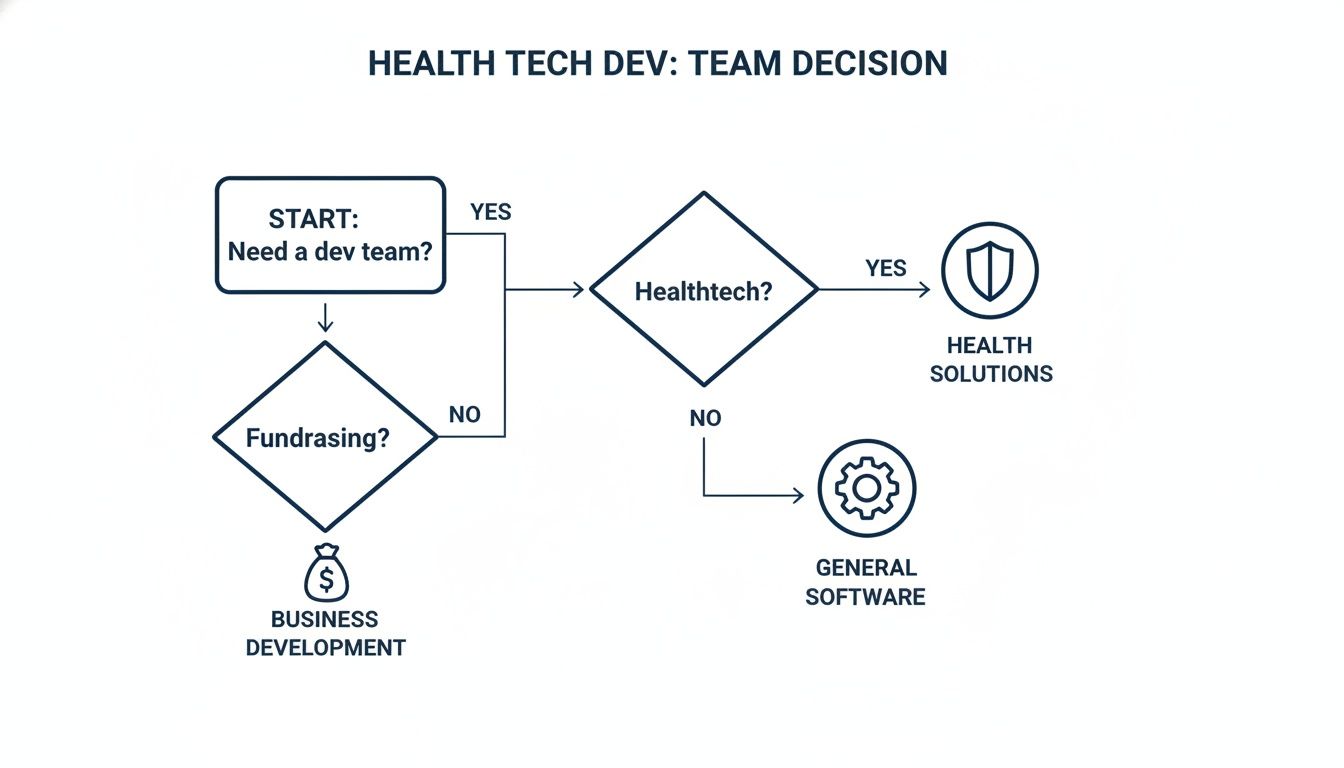
As you can see, the need for specialized healthtech know-how quickly becomes a critical factor. How you choose to engage your engineering talent isn’t just a logistical choice; it’s a strategic one that can set you up for either rapid growth or a series of frustrating setbacks.
5. Weaving AI into Your Healthtech Product

In healthtech, artificial intelligence isn’t some far-off idea; it’s the engine that separates a good idea from a truly game-changing product. For startups, this is the secret sauce that captures the attention of both users and investors. It’s about building solutions that are not just functional, but genuinely smart.
Investors have certainly taken notice. By 2026, AI-focused companies were projected to pull in a massive 55% of all healthtech funding. This isn’t just a trend; it’s a fundamental shift. AI-enabled startups were raising an average of $34.4 million per round – an 83% premium over their non-AI counterparts. The message from the market is loud and clear: intelligence sells.
From Predictive Models to Personalized Care
So, what does this look like in the real world? We’re talking about AI-powered tools that can sift through population data to predict disease outbreaks before they happen. Or diagnostic algorithms that give radiologists a second set of eyes, helping them catch the faint, early signs of cancer.
These applications are already here, and they are changing lives.
-
Predictive Analytics: Imagine models that flag patients at high risk for sepsis or heart failure, giving clinical teams a crucial head start on intervention.
-
AI-Powered Diagnostics: Think of tools that help clinicians interpret X-rays and MRIs with greater speed and precision, reducing diagnostic errors.
-
Personalized Treatment: This is the holy grail. Algorithms can analyze a patient’s unique genetic profile and lifestyle to suggest therapies and medications tailored just for them.
Data and Infrastructure: The Bedrock of Great AI
Of course, none of this happens by magic. Effective AI is built on a solid foundation, and that foundation is data. Your machine learning models will only ever be as good as the data you train them on. The first, and most critical, step is creating a rock-solid plan for collecting, cleaning, and securing high-quality datasets. In healthcare, this is a minefield of privacy and compliance challenges.
Beyond the data itself, you need the right technical plumbing to train and deploy your models. This is where an expert partner can make all the difference, helping you integrate AI for your business with a clear strategy. As we cover in our guide to AI and software development, having the right AI transformation framework from day one is non-negotiable.
For startups looking to push the boundaries, the conversation often turns to advanced techniques. Learning how to fine-tune LLMs, for example, allows you to adapt powerful language models to understand niche medical jargon, creating a far more accurate and valuable clinical tool.
Untangling the Knot of Healthtech Compliance and Security

For any healthtech startup, security and compliance aren’t just boxes to tick. They are the absolute bedrock of your business. In an industry where one data breach can completely shatter patient trust and ruin your reputation, getting this right is non-negotiable. It’s about building your product on a foundation of security from the very first line of code.
Regulations like HIPAA in the United States and GDPR in Europe aren’t simply legal speed bumps. They represent a fundamental promise to protect sensitive health data. Working with a partner that provides expert healthtech engineering support for startups ensures they don’t just know the rules; they know how to embed them into your product’s DNA. This avoids the nightmare of trying to bolt on security after your product is already built.
What HIPAA and GDPR Actually Mean for Your Code
At its core, a regulation like HIPAA is all about safeguarding electronic Protected Health Information (ePHI). For your engineering team, this isn’t some abstract legal concept; it translates into very specific, concrete tasks that define how your software works, how data moves, and who gets to see it.
Building compliant custom healthcare software development isn’t a vague goal. It rests on a few critical technical pillars:
-
End-to-End Encryption: Data must be unreadable to unauthorized parties, whether it’s stored on a server (at rest) or traveling across a network (in transit). No exceptions.
-
Granular Access Controls: Users should only be able to access the bare minimum information required for their role. A front-desk coordinator, for instance, has no business seeing a patient’s detailed clinical history.
-
Immutable Audit Trails: Every single action, from a doctor viewing a chart to an admin updating permissions, must be logged permanently. These logs can’t be edited or deleted.
-
Secure Data Storage Protocols: This means choosing HIPAA-compliant cloud providers and configuring every database and server to meet rigorous security standards.
Building a HIPAA-compliant application isn’t just about using the right tools; it’s a mindset. It means every architectural decision is viewed through the lens of patient privacy and data security.
As we’ve explored in our deep dive on HIPAA-compliant application development, this level of expertise is something you rarely find in a generalist development team.
The Role of a Proven Security Partner
Your first and most important line of defense is choosing the right engineering partner. You need a team that can do more than just talk about compliance; they need to show you a portfolio of secure, audited systems they’ve already built. Look for partners with real-world expertise in cyber compliance solutions and a track record of success, like the ones detailed in our client cases.
For instance, understanding how experienced medical device development services manage the entire process from concept to a fully compliant product offers a roadmap for success. Their experience ensures your product isn’t just innovative but also ready to withstand the intense scrutiny of regulatory bodies.
A partner with this background asks the tough questions from day one. They’ll challenge your assumptions and advocate for a more secure design, ultimately shielding your startup from the devastating financial and reputational fallout of a security incident. This isn’t just about avoiding risk; it’s about building a product that clinicians, patients, and investors can believe in.
Your Roadmap from MVP to Market Leadership
Taking a healthtech idea from a concept to a real, market-leading product is a marathon, not a sprint. It starts with a focused Minimum Viable Product (MVP) and grows into a scalable, compliant platform. Getting there requires a clear, practical plan. It’s all about making smart trade-offs between speed, cost, and the non-negotiable rules of the healthcare game.
The first step is to get ruthless about defining your MVP. It’s easy to get caught up in building every feature you’ve ever dreamed of, but the most successful startups I’ve seen focus on solving one critical problem and doing it exceptionally well. A good engineering partner acts as a crucial sounding board here, helping you resist the urge to over-engineer. They’ll help you pinpoint the core function that delivers real value and proves your idea has legs, keeping initial costs down and getting your product in front of users much faster.
Building Your Product Roadmap
Once your MVP is locked in, it’s time to map out the future. A product roadmap isn’t a static document you write once and file away; think of it as a living guide that shifts and adapts based on real user feedback and what the market is telling you. This is where your engineering partner really earns their keep. They help you plan for scale, future integrations, and new features, all while making sure compliance is baked in from the start.
A solid roadmap usually breaks down like this:
-
Phase 1 (MVP Launch): Nail the core features, get initial users onboarded, and implement essential security measures.
-
Phase 2 (Post-Launch Iteration): Act on user feedback, make existing features even better, and start expanding your compliance documentation and protocols.
-
Phase 3 (Scaling): Begin adding the big-ticket items, like AI/ML models or integrations with EMR/EHR systems, and optimize performance as your user base grows.
This phased approach keeps your technical build perfectly in sync with your business goals. A strategic partner who offers expert custom software development is key to making sure that alignment never drifts.
Checklist for Choosing Your Engineering Partner
Picking the right partner is arguably the most important decision you’ll make. This isn’t just about hiring a vendor; you’re looking for a co-builder who is as invested in your vision as you are. Use this checklist to screen potential partners and make sure they have the specialized know-how your healthtech startup demands.
-
Do they have proven healthtech experience? Don’t just take their word for it. Ask to see case studies or examples of secure, compliant healthcare apps they’ve actually built. Diving into a partner’s client cases can tell you a lot about what they can really do.
-
How deep is their compliance knowledge? Can they explain, in plain English, how they build for HIPAA and GDPR from day one? They should be able to talk confidently about their approach to data encryption, access controls, and audit trails.
-
What is their development methodology? You’re looking for an Agile approach. This isn’t just a buzzword; it means they have a flexible process that can adapt to user feedback and market shifts without derailing the project.
-
Can they support you beyond the MVP? Find a partner who provides long-term product engineering services. Your goal is to grow, and you need a team that can scale right along with you.
The initial 90 days of a partnership set the tone for everything that follows. You should expect a deep-dive discovery phase, a detailed project plan with clear milestones, and a collaborative communication rhythm. A great partner will feel like an extension of your own team from the very start.
By following this roadmap, you can methodically de-risk your venture and build a product that isn’t just innovative but also trusted, secure, and built for the long haul.
Frequently Asked Questions
It’s natural to have questions when you’re diving into the world of healthtech engineering. To wrap things up, let’s tackle a few of the most common ones we hear from founders just like you.
How Early Should I Engage a Healthtech Engineering Partner?
As early as possible. Seriously – even when your idea is just a concept on a whiteboard. A good healthtech software development partner can jump in at the idea validation stage to help you figure out what’s technically feasible, what the compliance roadmap looks like, and how to scope a smart MVP.
Getting this expert input before a single line of code is written is the best way to avoid expensive missteps down the road. It helps you start on a solid footing.
Can I Build a Healthtech App with a General Development Team?
You could, but it’s a huge gamble. A generalist team might build a great-looking app, but they almost never have the deep, nuanced understanding of HIPAA, GDPR, and interoperability standards like HL7/FHIR that are non-negotiable in healthcare.
Getting these things wrong can lead to crippling fines, devastating data breaches, and a product that’s dead on arrival. This is why specialized healthtech engineering support for startups isn’t a luxury; it’s a much safer, more strategic investment.
What Is the Biggest Mistake Founders Make with Healthtech Engineering?
We see this one all the time: treating security and compliance as an afterthought. Founders get excited about features and plan to “bolt on” the compliance pieces later.
Unfortunately, it just doesn’t work that way. Security and compliance have to be woven into your product’s architecture from day one. Trying to reverse-engineer them into a finished app is often impossible or so expensive it might as well be. This is exactly why you need a partner who lives and breathes custom healthcare software development.
How Much Does Healthtech Engineering Support Typically Cost?
The cost really depends on your needs. It can swing widely based on the engagement model you choose, how complex your product is, and whether you need specialized skills like AI development services.
For many startups, a dedicated development team hits the sweet spot. It gives you access to top-tier, specialized talent at a predictable monthly cost, but without the overhead and long-term commitment of hiring a full-time in-house team from scratch.
Ready to turn your healthtech idea into a secure, compliant, and market-defining product? At Bridge Global, we provide the specialized engineering support your startup needs to thrive. Our deep expertise in AI-driven development and unwavering focus on regulatory compliance ensure your vision is built on a foundation of trust and innovation.

About Upendra Jith
Upendrajith completed his Master's in English and has been a commercial content developer for the past three years. He's more inclined to develop content with a 'street-smart' delivery on topics such as technology, media, or anything he can get his hands on. He has a fixation on lyrics, dark poetry, media, technology, and flow arts.
View all posts by Upendra Jith →