


Healthcare Product Engineering Services for Market Readiness
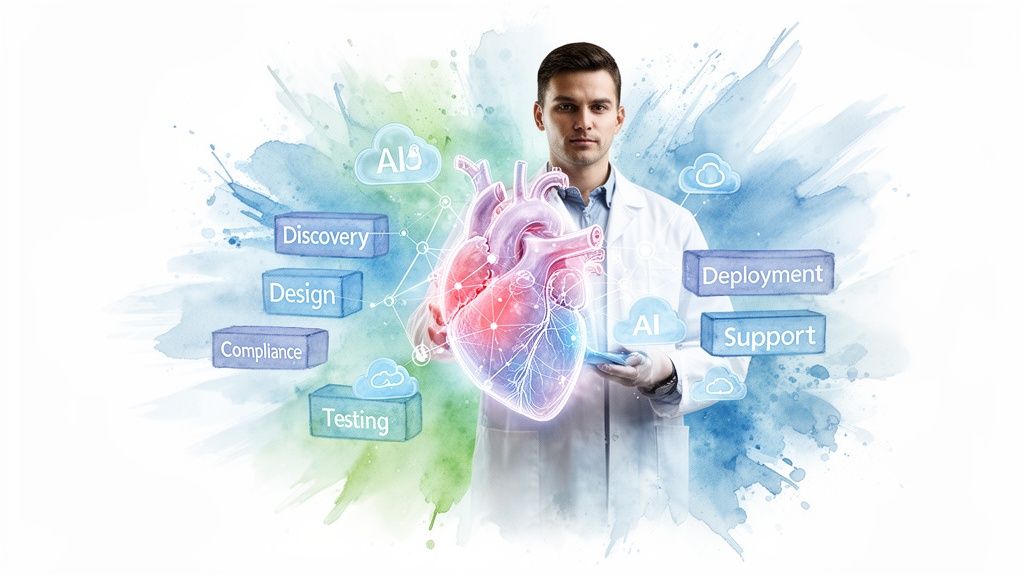
Healthcare has moved far beyond the four walls of a clinic. Today, it’s a world of AI-powered diagnostics, remote patient monitoring, and sophisticated mobile apps. Healthcare product engineering services are what turn these ambitious ideas into real-world, life-changing tools. It’s a unique field that blends high-level engineering with an intimate understanding of strict medical regulations to build, launch, and support modern health solutions.
The Digital Transformation of Healthcare

The entire healthcare industry is shifting its foundation from paper records and isolated data silos to a connected, digital-first approach. This isn’t just about going paperless for convenience; it’s about fundamentally improving patient outcomes, boosting efficiency for providers, and making quality care more accessible to everyone.
This change is happening for a reason. The explosion in demand for telehealth, the push toward personalized medicine driven by our own data, and the ever-growing challenge of managing chronic diseases all demand solutions that old-school methods simply can’t deliver. Effective digital transformation consulting is key to navigating this shift.
Why Expert Engineering Is Non-Negotiable
This is where healthcare product engineering services become essential. Building a healthtech product is worlds apart from developing a standard consumer app. The complexity is on a whole different level.
Think of it like this: constructing an office building and constructing a state-of-the-art hospital both involve architects and builders. But the hospital requires an extraordinary degree of precision, specialized systems, and rigid adherence to safety and regulatory codes. The same is true in the digital realm.
A great healthtech software development partner doesn’t just write code. Their expertise runs much deeper, covering crucial areas that can make or break a product:
-
Deep Domain Knowledge: They genuinely understand clinical workflows, patient privacy mandates, and the day-to-day challenges doctors and nurses face.
-
Regulatory Mastery: They live and breathe the alphabet soup of regulations like HIPAA, GDPR, and FDA guidelines, ensuring every single feature is compliant.
-
Technical Excellence: They know how to apply complex technologies like AI, IoT, and cloud computing to build systems that are secure, scalable, and can talk to each other.
In essence, a successful healthcare product is born from the convergence of medical insight and engineering prowess. Without a partner who understands both, even the most brilliant idea can fail to meet market needs or regulatory standards.
The opportunity to innovate in healthcare has never been greater. We see it in AI tools that spot diseases earlier and in remote monitoring systems that keep people safer at home. But turning that opportunity into a safe, effective, and compliant reality requires a disciplined, expert-led engineering process.
Understanding Healthcare Product Engineering Services
When you hear healthcare product engineering services, don’t just think about writing code. Think of it as the complete, end-to-end journey of bringing a digital health idea to life, from a rough concept scribbled on a napkin to a fully supported, market-ready solution. This is a specialized discipline that’s about so much more than technology; it’s about building products that are safe, compliant, and genuinely effective in a clinical setting.
It’s a bit like building a modern hospital. You wouldn’t hire a general construction crew and hope for the best. You’d need architects who understand patient flow, builders with experience in medical-grade infrastructure, inspectors who know every line of the health code, and a team for ongoing maintenance. A healthcare product engineering services partner plays all of those roles for your digital product.
Beyond Standard Software Development
This is where we move far beyond the scope of traditional software development. A typical software project might focus primarily on technical features and speed. In healthcare, that’s not enough. The process has to cover every single phase of the product’s life, from the initial strategic planning to long-term updates after it launches. This is non-negotiable in a field where user needs are incredibly specific, and the regulatory stakes couldn’t be higher.
At its core, healthcare product engineering is the fusion of deep clinical domain knowledge with disciplined engineering. It’s a commitment to ensuring a product isn’t just technologically sound, but also clinically useful, easy for patients and doctors to use, and tough enough to pass strict regulatory audits.
This process always involves a few key pillars:
-
Ideation and Strategy: We start by stress-testing the idea. Does it solve a real-world problem for clinicians or patients? What is its core value proposition?
-
User-Centric Design (UI/UX): This means designing intuitive workflows specifically for busy clinical environments and for patients who may not be tech-savvy.
-
Compliant Development: Regulations like HIPAA and FDA requirements aren’t an afterthought. They are baked into the architecture and development process from day one.
-
Continuous Evolution: A product launch is the beginning, not the end. The solution needs constant support, security monitoring, and feature updates to stay relevant and safe.
As we explored in our guide on software engineering in healthcare, this specialized, safety-first mindset is what separates successful healthtech products from those that never get off the ground.
General vs. Healthcare Product Engineering: A Core Comparison
The difference really comes into focus when you put general and healthcare product engineering side-by-side. The priorities, skill sets, and consequences of failure are worlds apart.
| Aspect | General Product Engineering | Healthcare Product Engineering |
|---|---|---|
| Primary Goal | Feature richness and market adoption. | Patient safety, clinical efficacy, and data security. |
| Regulatory Focus | General data privacy (e.g., GDPR). | Strict adherence to HIPAA, FDA, GDPR, and other medical regulations. |
| User Base | Broad consumer or business audience. | Highly specialized users like clinicians, patients, and lab technicians. |
| Data Sensitivity | Varies, but often commercial data. | Extremely sensitive Protected Health Information (PHI). |
| Development Cycle | Rapid, iterative cycles focused on speed. | Methodical, with built-in compliance and validation at every stage. |
| Failure Impact | Financial loss or brand damage. | Direct risk to patient health and severe legal penalties. |
This table makes it crystal clear why you can’t just apply a generic software development approach to a healthcare product. The stakes are simply too high. Every decision and every line of code has the potential to impact a person’s health, making expert healthcare product engineering services an absolute must.
The Healthtech Product Development Lifecycle: From Idea to Impact
Bringing a new healthtech product to life is more of a disciplined marathon than a chaotic sprint. It’s a journey that transforms a promising idea into a market-ready solution that genuinely improves patient care or clinical workflows. Think of healthcare product engineering services as the structured roadmap for this journey. Each phase logically builds on the one before it, ensuring the final product is secure, compliant, and truly valuable.
The entire process is a series of interconnected stages, starting with the initial spark of an idea and extending far beyond the launch day to include ongoing support and evolution.
The diagram below shows a high-level view of this path, breaking it down into the foundational stages of ideation, design, and finally, development.
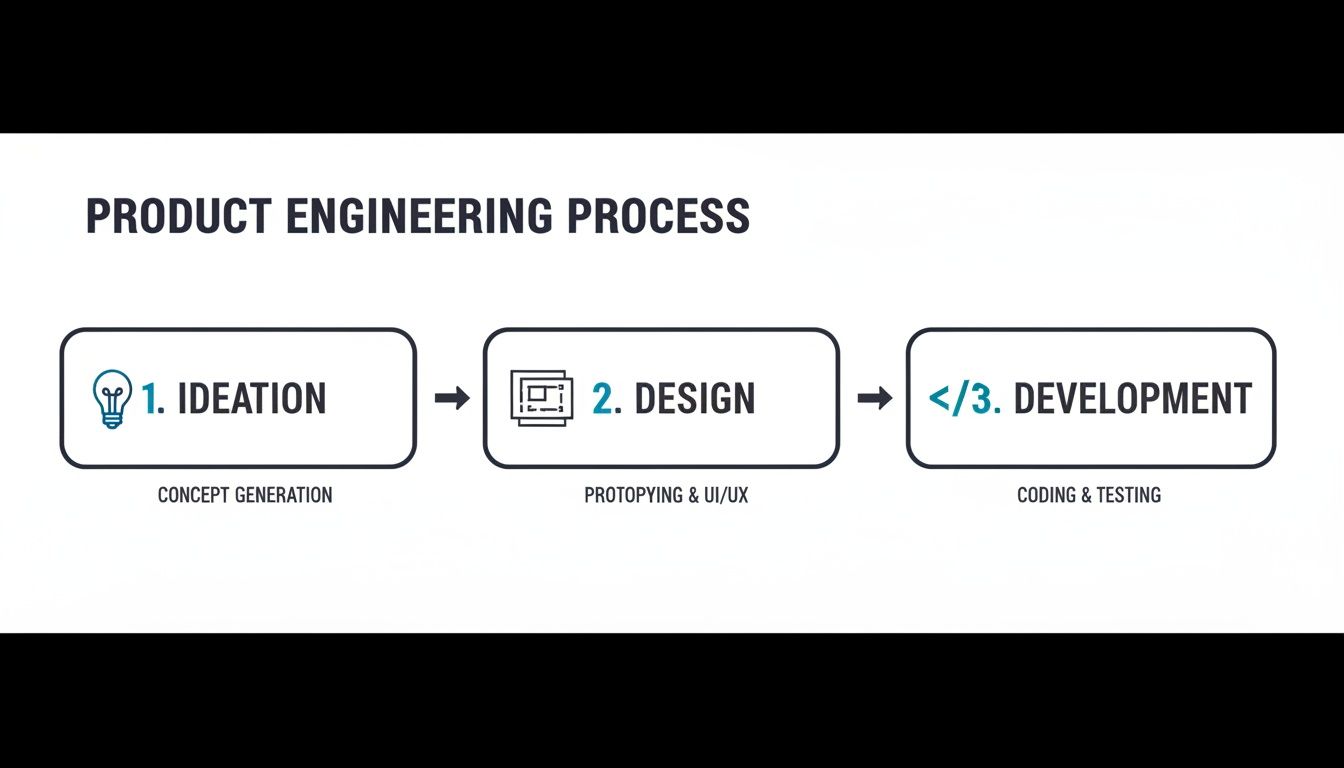
As you can see, building a successful product is about so much more than just writing code. It requires a thoughtful progression from a well-defined concept to a carefully planned and executed reality.
Discovery and Strategy
Every great healthtech solution begins by answering one critical question: What real-world problem are we solving? The discovery phase is all about validating the core idea through deep market research, interviews with clinicians and patients, and a clear-eyed technical feasibility analysis.
This is where you lock down the product-market fit, define the essential features for a Minimum Viable Product (MVP), and lay out a clear strategic roadmap. It’s about making sure you’re building the right thing before you pour resources into building it right.
Design and Architecture
Once the concept is proven, the focus shifts to creating a product people can actually use. In healthcare, this is a unique challenge. You need to design intuitive interfaces that work for both busy, tech-savvy clinicians in high-pressure situations and patients who might not be digital natives. When working to make a product accessible to everyone, using a detailed ultimate WCAG compliance checklist is a massive help for any development team.
At the same time, the engineering team is laying the architectural foundation. This technical blueprint absolutely must be:
-
Scalable: Ready to grow with your user base and handle ever-increasing data loads.
-
Secure: Built from the ground up to protect highly sensitive Protected Health Information (PHI).
-
Interoperable: Designed from the start to seamlessly connect and share data with existing systems like EHRs and EMRs.
Development and Integration
This is the phase where the designs and architecture start turning into a tangible product. Working in agile sprints, development teams build out the features one by one. This iterative approach allows for constant feedback and adjustments, which is essential in a dynamic field like healthcare.
Integration is a huge piece of the puzzle here. Modern healthcare tools don’t operate in a silo. A key part of this stage involves connecting the new software with existing clinical systems, third-party data sources, and other essential APIs to create a smooth, uninterrupted workflow for the people using it every day.
The medical device engineering services market, a key segment of healthcare product engineering, is valued at USD 6.24 billion in 2026 and is on track to hit USD 9.39 billion by 2030, growing at a 10.7% CAGR. This surge is driven by the demand for smart, connected devices – over 50% of new medical products now incorporate IoT and AI, underscoring the need for expert lifecycle management.
Compliance and Security
Security and compliance aren’t just a final checkbox; they are fundamental principles woven into every single phase of development. This stage involves a dedicated push to ensure the product meets all necessary regulatory standards, from HIPAA in the United States to GDPR in Europe.
This means implementing strong security controls, performing regular risk assessments, and meticulously preparing all documentation needed for potential audits. As we explored in our guide, a deep understanding of the nuances of HIPAA-compliant application development is non-negotiable to avoid crippling fines and reputational damage.
Testing and Quality Assurance
In healthtech, a software bug is never just a minor glitch; it can have serious consequences for patient safety. That’s why the testing phase is one of the most vital.
Quality assurance (QA) goes far beyond just checking if buttons work. It must include:
-
Usability Testing: Watching real clinicians and patients interact with the product to ensure it’s intuitive and efficient.
-
Security Testing: Actively trying to break the system to find and fix vulnerabilities before they can be exploited.
-
Performance Testing: Pushing the system to its limits to make sure it stays fast and stable, even under heavy use.
Deployment and Launch
You don’t just flip a switch and go live. Rolling out a healthtech product is a carefully orchestrated event, often starting with a phased deployment or a pilot program with a trusted partner hospital.
This controlled launch provides a chance to gather crucial real-world feedback, iron out any last-minute kinks, and properly train users before a full-scale release.
Maintenance and Evolution
The product launch isn’t the finish line; it’s the starting line for a new race. The final stage is a continuous cycle of support, maintenance, and improvement. This involves everything from providing ongoing technical support and deploying critical security updates to developing new features that keep the product relevant, competitive, and valuable for years to come.
Integrating AI and Advanced Tech in Healthcare Products
Today’s healthcare products are evolving far beyond simple digital record-keeping. They are becoming intelligent partners in patient care, a shift driven by advanced technologies like Artificial Intelligence (AI) and the Internet of Things (IoT). These aren’t just buzzwords; they are fundamentally changing what’s possible in diagnostics, treatment, and ongoing patient monitoring. The real work of modern healthcare product engineering services is to expertly weave these powerful technologies into solutions that are not just innovative but also safe, reliable, and clinically sound.

Think of it this way: a basic car gets you where you need to go, but a self-driving car uses a sophisticated network of sensors, data, and AI to navigate the world more safely and efficiently. That’s exactly what’s happening in healthcare. By building AI into medical products, we’re creating a new class of tools that can help predict issues before they become critical, personalize care down to the individual, and amplify the expertise of our healthcare professionals.
The Rise of Intelligent Health Solutions
AI in healthcare isn’t a far-off vision; it’s already here, delivering tangible results. To truly make the most of this shift, healthcare product engineering services are zeroing in on sophisticated AI-powered healthcare solutions. These intelligent systems are being put to work across every part of the care journey.
Here’s a look at what this means in practice:
-
Predictive Diagnostics with Machine Learning: Imagine AI models trained on millions of medical images, like X-rays or MRIs. They can learn to spot patterns the human eye might miss, leading to earlier and more precise detection of diseases like cancer or diabetic retinopathy.
-
Personalized Treatment Plans: By analyzing a patient’s unique genetic makeup, lifestyle data, and medical history, AI can help clinicians pinpoint the most effective treatment protocols for that specific person. This is a huge step away from the old one-size-fits-all approach.
-
Real-Time Remote Patient Monitoring (RPM): Wearable IoT devices, from smartwatches to continuous glucose monitors, are constantly streaming vital health data. AI systems analyze this information in real time, flagging anomalies, alerting care teams to potential emergencies, and giving patients immediate feedback.
The impact of this is huge. The healthcare and life sciences product engineering services market is projected to hit USD 257.6 million by 2030, growing at a steady 7.6% CAGR. These services are crucial for building the AI-enhanced diagnostic tools and accurate wearable devices that directly improve patient outcomes.
Building the Technical Foundation
Bringing these advanced features to life takes more than just a clever algorithm. It requires a strong technical backbone, which is where expert AI development services come in. Two pieces of this foundation are absolutely critical: cloud computing and interoperability.
Cloud platforms give us the scalable and secure power needed to handle the enormous volumes of data that modern health apps generate. At the same time, interoperability standards like FHIR (Fast Healthcare Interoperability Resources) act as a universal translator, letting different systems, devices, and applications share data without a hitch. As we’ve detailed in our AI transformation framework, getting these elements right is the key to a truly connected and intelligent healthcare system. As we explored in our guide, you can learn more about what’s next in AI trends in healthcare.
Why Partnering with a Healthtech Expert Makes Sense
The “build versus buy” question is a classic one. For a healthcare provider or a startup, the thought of building a new healthtech product internally can be tempting. But it really boils down to one thing: focus. Is your core business delivering care and growing your organization, or is it managing software logistics?
When you look at it that way, bringing in a specialized partner for healthcare product engineering services starts to look less like outsourcing and more like a smart, strategic move. It’s about letting experts handle the engineering so you can focus on the healthcare. You’re not just offloading work; you’re gaining a system for turning your vision into a real, market-ready product without getting bogged down in the process.
Accelerate Your Time to Market
In healthtech, timing is everything. Getting your solution to clinicians and patients before the competition is a massive advantage. But if you decide to build an in-house team from scratch, you’re starting from a dead stop. You have to find and hire the right people, establish workflows, and get up to speed on incredibly complex regulations – all before you even write a single line of code.
A dedicated partner hits the ground running. They’ve done this before. They have proven development frameworks and even pre-built components ready to go. This experience helps them sidestep the common traps and delays that can plague internal projects, shaving months off your timeline and getting your product into users’ hands that much faster.
Seamlessly Navigate Regulatory Hurdles
HIPAA, FDA clearances, GDPR, these aren’t just acronyms on a checklist. They’re intricate legal frameworks where one small misstep can result in staggering fines, a damaged reputation, and a complete loss of trust from the market.
This is where a true healthtech engineering partner proves its worth. For them, compliance isn’t a chapter in a manual; it’s the entire book.
Bringing in a firm with deep, hands-on experience with medical regulations means compliance is baked into your product’s DNA from the very first day. They incorporate robust cyber compliance solutions from the outset, turning what could be your biggest risk into a predictable, managed part of the development cycle.
Access Specialized, Hard-to-Find Talent
Let’s be honest: building a great healthtech product requires a team of unicorns. You don’t just need talented developers. You need AI engineers who understand healthcare data, cybersecurity experts who specialize in patient privacy, and UX designers who know how to create intuitive interfaces for busy, high-stress clinical settings. Finding, hiring, and keeping that kind of talent is a huge undertaking.
Partnering gives you instant access to a ready-made, cross-functional team of these specialists. You get:
-
AI and ML Engineers: Who can build out the predictive analytics and smart features you need.
-
Healthtech UX/UI Designers: Who genuinely understand clinical workflows and user needs.
-
Compliance Officers: Who ensure every single feature is built to meet strict regulatory demands.
This lets you tap into expert AI development services and other in-demand skills without the months-long, expensive headache of recruiting them yourself.
Improve Cost-Effectiveness and Focus on Your Core Mission
A full-time, in-house development team is a major fixed expense on your balance sheet, regardless of whether you’re in a heavy development phase or a lighter maintenance period. A partnership model gives you much more financial control and flexibility. You can easily scale the team up for a big product launch and then scale it back down for ongoing support.
Flexible arrangements, like a dedicated development team, allow you to manage costs while getting top-tier talent. This approach to custom software development also frees up your internal team and your capital to focus on what you do best: providing excellent patient care and executing your core business strategy.
How to Choose the Right Engineering Partner
Picking the right engineering partner is probably the single most important decision you’ll make for your product. This isn’t just about comparing prices or features on a spreadsheet. You’re looking for a co-pilot, someone who genuinely understands the tricky landscape of healthtech. A good partner won’t just build what you ask for; they’ll push back, challenge your ideas, and help you see around corners to avoid the pitfalls you don’t even know are there.
So, how do you separate the real experts from the rest? You need a practical way to vet them. Here’s a checklist to help you look past the sales pitch and focus on what actually delivers results in healthcare product engineering services.
Evaluate Proven Healthcare Experience
First things first, dig into their track record. A partner’s past projects are the best window into your future success. Don’t be swayed by a flashy list of company logos. Instead, ask for detailed client cases that show they’ve solved problems like the ones you’re facing.
You’re looking for proof that they get the small details of clinical workflows and the real-world patient experience. Ask them to walk you through a project from start to finish. What were the biggest hurdles? How did they solve them? Honest testimonials from other healthtech leaders can also give you a feel for how they operate and if they’re truly reliable.
Scrutinize Deep Compliance Knowledge
In the world of healthcare, compliance isn’t just another item on a list; it’s the bedrock of your entire product. Any potential partner’s deep understanding of regulations like HIPAA, GDPR, and the FDA submission process is absolutely essential. Don’t let them get away with a simple, “Oh yeah, we do that.”
You need to get specific. Try asking questions like these:
-
How do you build privacy and security into the product from day one?
-
Can you show me how you document everything for a regulatory audit?
-
What’s your experience with different classes of medical device software?
Their answers should show you that compliance is baked into their DNA, not just something they tack on at the end.
Assess Technical Expertise and Innovation
Of course, a great partner needs to have serious technical chops. Look at their skills in key areas like cloud architecture, secure data management, and mobile development. But what really separates the best from the rest is how they approach innovation.
Ask them how they can use AI for your business to give you a real competitive edge. Do they have a concrete plan, like an AI transformation framework, or are they just throwing around buzzwords? This is a huge differentiator. The global product engineering services market is projected to hit USD 2.76 trillion by 2035, with healthcare leading that growth thanks to AI and IoT. You need a partner who’s at the forefront of this shift, not just trying to keep up. Read more on the product engineering services market growth from Precedence Research.
Demand Transparent Processes and Flexible Models
The best partnerships are built on trust and transparency. A good firm will run on agile methods, giving you a clear view of their progress with regular check-ins and shared tools. This approach eliminates surprises and keeps you in the driver’s seat.
Finally, talk about how they structure their engagements. Do they offer different models that can adapt to your needs? Maybe you need a straightforward project-based team for a specific task, or perhaps a dedicated development team that feels like part of your own company. This kind of flexibility is key, allowing you to scale up or down and make sure the partnership always aligns with your business goals.
FAQs on Healthcare Product Engineering Services
What is the difference between custom software development and product engineering?
Custom software development focuses on creating a unique solution for a specific internal business need, like a custom patient portal for one hospital network. Healthcare product engineering is about designing, building, and maintaining a scalable, market-ready product that can be sold to many customers, such as a commercial telehealth platform. The former solves one problem; the latter builds a business asset.
How long does it typically take to develop a healthcare product?
The timeline varies significantly based on complexity. A Minimum Viable Product (MVP) for a simple wellness app might take 4-6 months. However, a complex, AI-driven diagnostic tool requiring FDA clearance could take 12-24 months or more. An experienced partner can often reduce this time by leveraging existing frameworks and regulatory expertise.
Why is regulatory compliance (like HIPAA) so critical?
In healthcare, data is extremely sensitive. Regulatory compliance is non-negotiable for ensuring patient safety and data privacy. Failure to comply can lead to severe penalties (millions in fines), legal liability, and a complete loss of patient and provider trust, which can be fatal for a healthtech product.
How do product engineering services handle data interoperability?
Expert services achieve interoperability by building systems on modern standards like HL7 and FHIR (Fast Healthcare Interoperability Resources). This allows the new product to seamlessly and securely communicate with existing systems like Electronic Health Records (EHRs), lab systems, and other health applications, creating a unified workflow for clinicians.
Are these services affordable for startups?
Yes. Partnering with an engineering firm is often more cost-effective for a startup than building an in-house team. Flexible engagement models, such as a dedicated development team, allow startups to access top-tier talent and scale their investment according to funding and milestones, avoiding the high fixed costs of full-time staff.
Ready to turn your healthtech vision into a compliant, market-ready reality? Bridge Global provides the AI-driven engineering expertise and deep regulatory knowledge needed to build the future of healthcare.

About Upendra Jith
Upendrajith completed his Master's in English and has been a commercial content developer for the past three years. He's more inclined to develop content with a 'street-smart' delivery on topics such as technology, media, or anything he can get his hands on. He has a fixation on lyrics, dark poetry, media, technology, and flow arts.
View all posts by Upendra Jith →