



Healthcare Digital Infrastructure: A Complete Guide
A remote monitoring app doesn't usually fail in the demo. It fails on a Monday morning when several clinics push data at once, the EHR integration layer slows down, and the product team learns that “connected” doesn't mean “production-ready.” That gap is where healthcare digital infrastructure lives, the part of the stack that decides whether digital care feels reliable or brittle.
For CTOs and product leaders, this is no longer just an IT question. It's the foundation for scheduling, prescribing, patient access, analytics, and AI delivery, and the OECD's data show how quickly that foundation has shifted from partial digitization to broad clinical adoption in a little over a decade, with more than 93% of primary care practices using EMRs on average across OECD countries in 2021, up from 70% in 2012. The core question now isn't whether the record exists. It's whether the rest of the stack can move fast enough, safely enough, and observably enough to support care at scale.
Why Healthcare Digital Infrastructure Matters Now
The most common failure mode I see is simple. A product team ships a useful workflow, then discovers the clinical environment can't absorb the load. The app works in staging, the FHIR endpoints work in isolation, and then real users hit the system through legacy EHRs, VPNs, aging Wi‑Fi, and vendor throttles.
That's why healthcare digital infrastructure can't be treated as plumbing behind the scenes. It's the operational backbone that connects clinical workflows, patient data, and increasingly AI-driven insights. In business terms, it defines whether a healthtech platform scales without constant rework or stalls under the weight of integration debt and compliance friction.
The shift from records to operational ecosystems
The old model centered on the EHR as a closed system of record. The current model is distributed and API-first, because care delivery has become more mobile, more patient-facing, and more dependent on cross-system data exchange. In 2021, 16 of 26 OECD countries had most patients able to view EMR data through a portal, and 13 of 26 let patients communicate with providers through a portal. That matters because the modern stack has to serve clinicians, patients, and downstream analytics at the same time.
Practical rule: if the architecture can't sustain concurrent clinical reads and writes, it won't support population health, remote monitoring, or AI workflows reliably.
The infrastructure decision also shapes regulatory exposure. OECD survey data show fragmentation is still real, with only 15 of 27 countries reporting a nationally unified EHR system in 2021, even though 24 countries had adopted a minimum data set for standardized core health information. That's the practical reality for vendors too. Standardization is progressing, but integration maturity still varies widely, so the architecture has to tolerate inconsistency instead of assuming perfect upstream systems.
The teams that win don't just buy software. They build a dependable exchange layer, a clean data model, and a deployment path that can survive real clinical use. If you're evaluating a healthtech software development partner, this is the first place to test them, not in a slide deck, but in how they think about latency, governance, and interoperability under load.
Core Components of Modern Healthtech Stacks
Think of a hospital without plumbing, electrical, or HVAC. The building exists, but care delivery collapses the moment real traffic starts. Healthcare digital infrastructure works the same way. Each layer supports the next, and skipping one usually creates hidden debt that shows up later as outages, stale dashboards, or failed AI outputs.
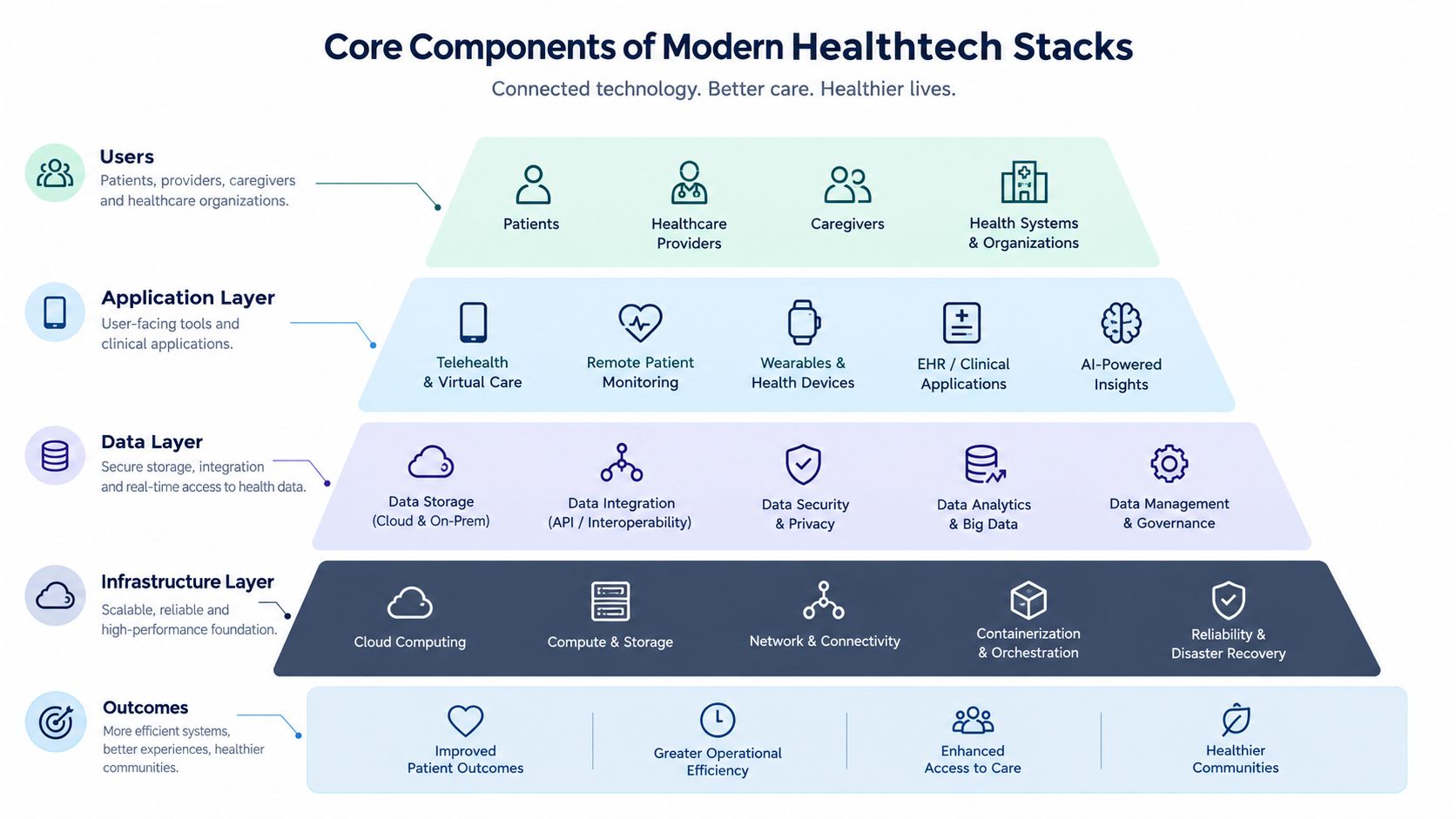
The six layers that actually matter
1. Data platforms: Clinical data lakes, FHIR servers, and analytics models like OMOP CDM are where raw operational data becomes usable. Without this layer, AI projects end up trained on incomplete, stale, or poorly mapped records. That's how teams get model behavior that looks plausible in a demo and unreliable in production.
2. Interoperability engines: API gateways, HL7 v2 to FHIR bridges, and SMART on FHIR launch contexts make systems talk to each other. FHIR earns its keep here because it changes integration from one-off mappings to resource-based exchange. For a practical implementation reference, see our healthcare data exchange solutions guide.
3. Security and compliance: Zero-trust access, audit logging, encryption, and BAA chains aren't optional wrappers. They're operational controls that shape vendor selection, access design, and incident response. For SaaS teams, the core requirement is to map PHI flows before implementation, then enforce least privilege across every integration.
4. Cloud infrastructure: HIPAA-eligible services, multi-region failover, and selective edge compute let platforms survive uneven clinical demand. This layer is especially relevant in distributed care settings where connectivity is inconsistent, and uptime expectations are unforgiving.
5. Integration middleware: RPA can keep older systems moving, but it should be a bridge, not a destination. Event-driven messaging usually ages better than brittle point-to-point scripts because it decouples producer and consumer behavior.
6. AI and ML pipelines: Feature stores, model serving, and drift monitoring only work when upstream data is trustworthy. Rushing AI before the data platform is stable creates technical debt that shows up as fragile predictions and avoidable clinical risk.
The architecture study on cloud/EHR design is a useful reminder here, because it reduced system communication to a single repository-backed point and achieved 100% compliance with the authors' interoperability evaluation framework, showing how standardization around HL7 FHIR and OpenEHR can simplify integration while preserving availability. That's not a universal blueprint, but it does prove the core point. Simplify the communication surface, and the rest becomes easier to govern.
For teams designing autonomous workflows and agentic systems, governing agentic infrastructure is also worth reading because the control plane matters as much as the model itself.
Interoperability Standards and Compliance Requirements
A lot of vendors say they “support FHIR.” In practice, that can mean anything from a thin read-only API to a production-grade exchange layer that handles paging, versioning, terminology mapping, and referential integrity without falling over. The difference matters, because healthcare buyers don't need marketing claims. They need systems that survive live clinical traffic.
What to implement first
Start with the resource model, not the brochure. For most platforms, Patient, Observation, and Condition are the first FHIR resources to map cleanly to the data elements in your product. Then connect authorization through OAuth 2.0 and SMART on FHIR scopes, because access control needs to match clinical context, not just user identity.
For U.S. deployments, CMS requires networks to provide or facilitate access to data using FHIR APIs that follow the US Core FHIR implementation guide, include a full FHIR capabilities statement, and support USCDI v3 or later with terminology mappings such as LOINC, RxNorm, and SNOMED. The ONC's 2026 standards update also matters operationally, because approved standards became available for voluntary use in certified modules beginning August 29, 2026, and the set includes USCDI v6, US Core IG STU 9.0.0, C-CDA Release 5.0.0, and updated Da Vinci guides for prior authorization, including CRD 2.2.1, DTR 2.2.0, and PAS 2.2.1. ONC's 2026 reference edition also shows the baseline is revised annually, not frozen.
Standards comparison for implementation planning
| Standard | Scope | 2026 Key Changes | Implementation Priority |
|---|---|---|---|
| FHIR R4/R5 | Core exchange layer for clinical data | R5 adoption grows as vendors modernize APIs | High, because it underpins external integration |
| USCDI v3/v4 | Minimum data elements for exchange | Expanded policy expectations around structured exchange | High, because it determines what data must move |
| ONC/Cures Act requirements | Interoperability and information access | Standards baseline updated through annual reference changes | High for U.S. health IT products |
| FHIR Bulk Data Access IG | Population-level exports | Important for analytics and cohort workflows | Medium to high for enterprise reporting |
Compliance stack that holds up in production
HIPAA Security Rule safeguards still shape the technical baseline, but production readiness goes beyond a policy checklist. HITRUST CSF helps formalize control coverage, and SOC 2 Type II matters when you're selling SaaS into regulated buyers. For security validation, ePHI defense with pentesting is useful because it treats the interface between infrastructure and privacy controls as an active attack surface, not a paperwork exercise.
If a platform can't prove pagination, versioning, and referential integrity under load, it's not really FHIR-ready; it's just FHIR-branded.
Architecture Patterns for Healthtech Platforms
There isn't one correct architecture for every team. The right choice depends on how many systems you need to touch, how fast you need to ship, and how much legacy burden you're carrying. The wrong choice is usually the one that optimizes for the first six months and punishes the next six years.
Monolith, microservices, or event-driven hub
A monolithic EHR-centric design still works for tightly controlled environments with one primary clinical system and limited external dependencies. It's simpler to reason about, easier to test early, and often cheaper to start. The problem is that scaling the product usually means scaling the monolith's coupling, so every new integration becomes a risk multiplier.
A microservices-based cloud-native stack fits startups and product teams that need fast iteration and clear service boundaries. Container orchestration, managed databases, and serverless functions reduce operational drag, but they also introduce coordination overhead. Cold-start behavior, service discovery, and observability all become real engineering concerns.
An event-driven interoperability hub is usually the better fit for enterprises, multi-facility rollouts, and complex vendor environments. It creates a central place for message normalization, transformation, and routing, which reduces point-to-point sprawl. The trade-off is governance. If the hub becomes a bottleneck or a political choke point, delivery slows.
| Architecture Pattern | Best For | Scalability | Complexity | Vendor Lock-in Risk | Typical Use Case |
|---|---|---|---|---|---|
| Monolithic EHR-centric | Early prototypes, single-system environments | Limited | Lower upfront, higher later | Medium | Internal workflow automation |
| Microservices cloud-native | Startups, product-led scaling | High | High | Medium | Patient apps, modular SaaS platforms |
| Event-driven interoperability hub | Enterprises, multi-site networks | High when governed well | High | Lower than point-to-point | Cross-system clinical exchange |
Data lake or federated mesh
A centralized data lake makes analytics easier, especially when you need a shared reporting layer across multiple systems. A federated mesh gives more autonomy to source systems and can be easier to align with jurisdictional constraints, but it can also make governance harder. If you’re dealing with PHI across multiple regions, the privacy model should drive the architecture, not the other way around.
For platform teams considering healthcare cloud architecture, the decision point is usually less about fashion and more about control. A managed cloud pattern can reduce ops burden, but only if you can maintain clear service boundaries, traceability, and vendor accountability.
Use point-to-point connections only when the integration is short-lived or genuinely isolated. Once the same pattern starts repeating, you’ve built a maintenance tax, not an architecture.
Hidden Bottlenecks That Derail Digital Health Deployments
Vendor demos rarely fail on feature coverage. They fail on environment friction. The hidden bottlenecks are usually physical, network-level, or operational, and they show up only after the product reaches real users in real buildings.
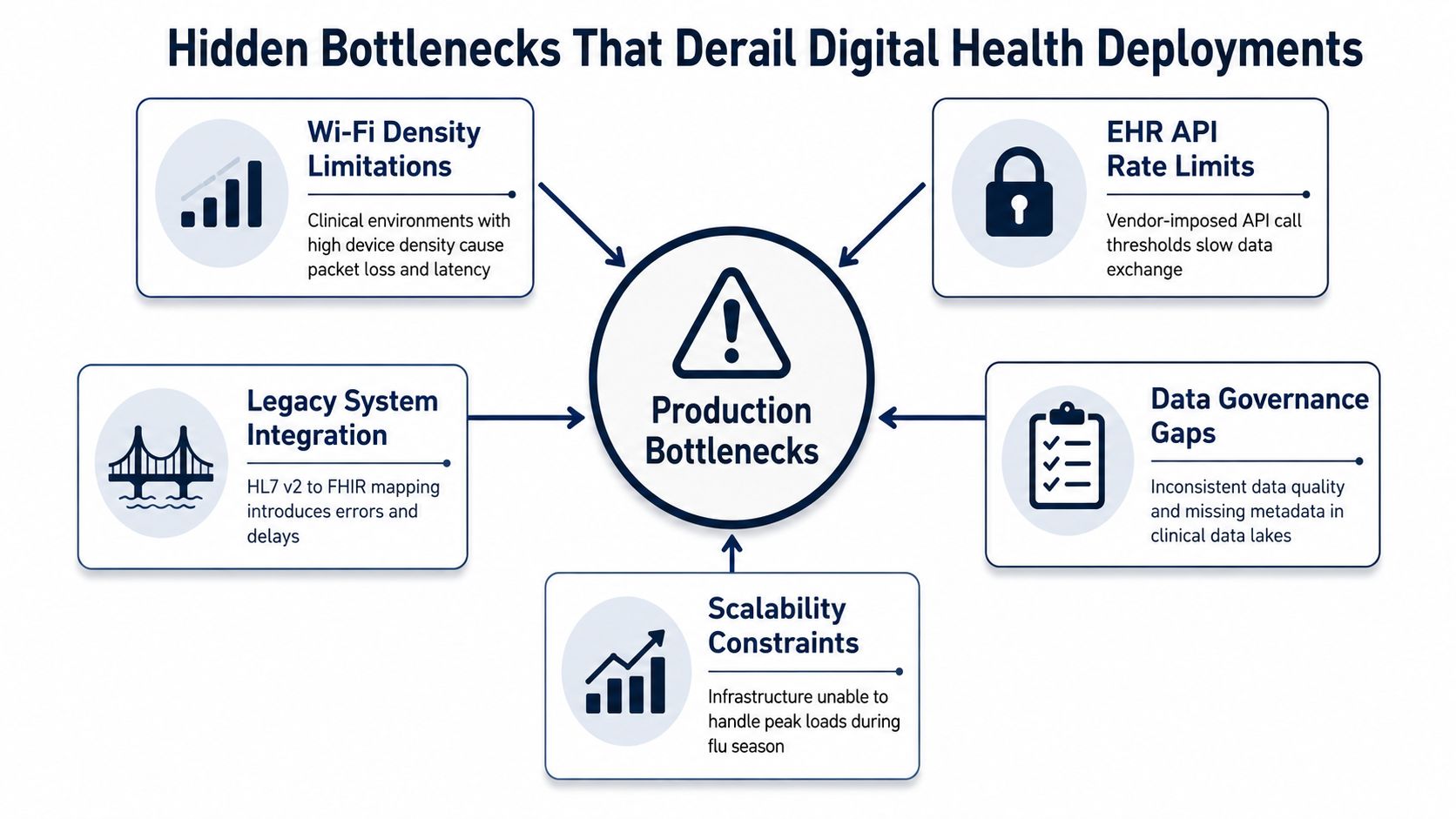
Where deployments usually break
Wireless reliability becomes a real constraint in busy clinical spaces. If device density is high, packet loss and retransmission can disrupt real-time monitoring, especially when multiple endpoints try to sync at once. That’s one reason hospital network pressure is now an AI readiness issue, not just an IT issue, because the stack has to move data predictably enough to support latency-sensitive workloads.
Integration friction is just as common. A separate survey noted that nearly one in four organizations spend more than 20 hours per week troubleshooting integration issues, and 58% cite staffing or vendor limitations as their biggest barrier. That’s exactly why “we connected the API” is not the same thing as “we shipped interoperability.”
Legacy routing adds another drag. HL7 v2 message streams, TLS handshake overhead, and connection pooling problems can all pile up during admission spikes. None of that shows up in a polished product tour, but it absolutely shows up in production logs.
Rural latency and scalability are different problems
Rural and smaller-provider environments need special treatment. In a 2025 rural healthcare IT report, 67% of rural providers said they struggle to achieve full interoperability because of legacy systems and weak integration support, and only 42% of Critical Access Hospitals were connected to a regional or national HIE versus 71% of FQHCs. The lesson is straightforward. A cloud platform doesn’t automatically fix long-haul latency or weak local networking.
If you want to find the bottlenecks early, use distributed tracing for clinical workflows, simulate rural connections before go-live, and load test the same EHR integration patterns your users will trigger in the field. Database indexes matter too. A poorly designed patient demographic table can become the slowest component in the stack, regardless of how much compute you add.
Implementation Roadmap and Partner Selection
The fastest teams don’t start with tools. They start with governance. Discovery, foundation, integration, and hardening each need different gates, different owners, and different success metrics.
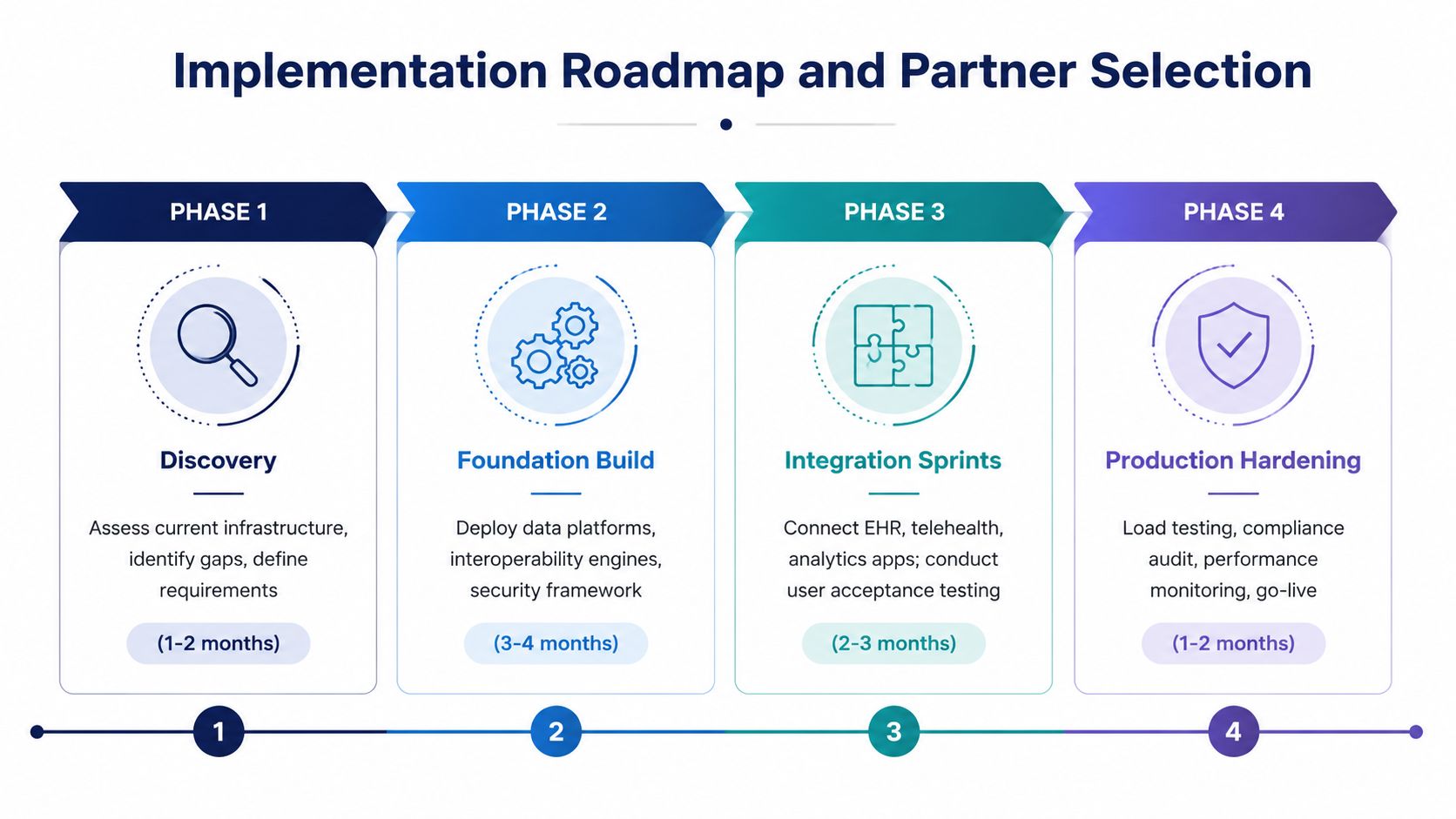
A phased delivery model that survives audits
Discovery should map current systems, PHI flows, and integration dependencies. This is the point to decide whether your next move is API work, data normalization, or legacy bridging. It’s also where security architecture reviews belong, before engineering starts building shortcuts.
Foundation build is where data platforms, interoperability engines, and security controls come together. If you’re working with a specialized partner, this is often the stage where custom healthcare software development and custom software development become relevant, because the architecture has to fit clinical constraints rather than generic product patterns.
Integration sprints should focus on the core endpoints: EHRs, telehealth, labs, analytics, and patient portals. This is also the right time to validate routing logic, event handling, and exception states. If a team can’t explain how they’ll handle a failed patient match or a missing terminological mapping, they’re not ready for production.
Production hardening means load testing, HIPAA risk review, conformance checks, and monitoring. A related discussion in our healthcare platform transformation guide goes deeper on the business side of that shift.
KPIs and selection criteria
Track API response time for clinical retrieval, FHIR resource validation pass rates, mean time to integrate new data sources, and infrastructure cost per active patient record. Those metrics expose whether the architecture is improving delivery or just creating a more expensive stack.
Use this vendor checklist:
-
SOC 2 Type II evidence: Ask for real audit outputs, not just a badge.
-
FHIR implementation depth: Verify load behavior, pagination, and terminology mapping.
-
BAA flexibility: If they handle PHI, the contract has to match the risk.
-
SLA guarantees: Clinical systems need uptime language that reflects actual care impact.
-
Standards alignment: Support for USCDI updates and interoperability specs matters more than a polished sales demo.
For some teams, software development service models make the delivery trade-off clearer, especially when you’re deciding between internal platform engineering and a managed build partner. If AI is part of the roadmap, AI development services, enterprise AI solutions, and an AI implementation roadmap should be evaluated against the same infrastructure checklist, because model performance depends on the stack beneath it. For productized digital health offerings, SaaS product development and well-designed healthcare integrations are often the difference between a pilot and a platform. You can also review client cases to see how delivery structure affects outcomes in regulated builds.
Frequently Asked Questions
How expensive is it to achieve FHIR compliance from scratch?
The primary cost is rarely the API itself. It comes from mapping legacy data, building terminology alignment, testing pagination and versioning behavior, and maintaining security controls over time. If the product has multiple EHR touchpoints, the effort grows quickly.
Should we build or buy the interoperability layer?
Buy when speed matters and the use case is standard. Build when the integration logic is a core differentiator or when you need deep control over routing, governance, and observability. Many teams end up with a hybrid model.
How do we avoid legacy EHR integrations derailing the roadmap?
Treat them as a separate workstream with explicit scope and fallback paths. Use canonical data models, isolate transformation logic, and test against real integration patterns early, not after feature launch.
What should we expect from 2026 USCDI updates?
The important move is to treat standards as a living baseline, not a one-time compliance task. ONC’s annual reference updates and the approved SVAP standards show that implementation planning now has to assume ongoing change, not static specifications.
When should we bring in a specialized partner?
Bring in a partner when compliance, interoperability, and AI-readiness all land on the same timeline. That’s where experienced healthtech engineering teams can reduce risk without forcing you to build every capability in-house.
If you’re planning a healthcare platform, don’t start with the model or the UI. Start with the infrastructure that moves, secures, and validates the data those layers depend on. Bridge Global helps teams design and deliver compliant digital health systems, from integration-heavy builds to AI-ready platforms, and you can explore how their work fits your roadmap at Bridge Global.

About Upendra Jith
Upendrajith completed his Master's in English and has been a commercial content developer for the past three years. He's more inclined to develop content with a 'street-smart' delivery on topics such as technology, media, or anything he can get his hands on. He has a fixation on lyrics, dark poetry, media, technology, and flow arts.
View all posts by Upendra Jith →