



Healthcare Data Exchange Solutions: An Essential Guide
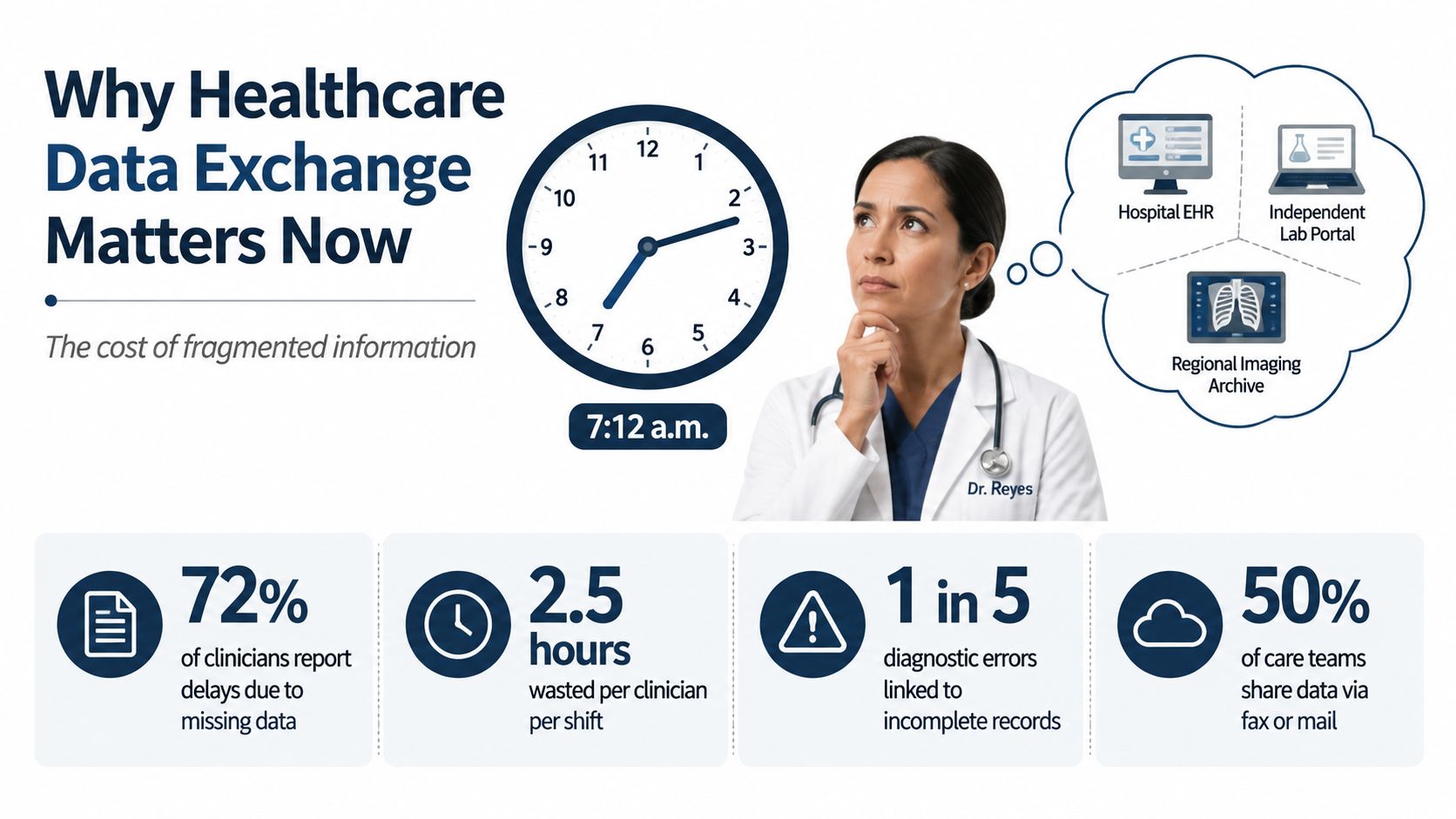
At 7:12 a.m., Dr. Reyes is ready to review the first patient on the schedule. The creatinine result she needs sits somewhere across a hospital EHR, an independent lab portal, and a regional imaging archive. She can find fragments of the record, but the values don't reconcile cleanly, so she spends the next several minutes searching, comparing, and deciding whether to order information the system may already contain.
That situation is familiar to product teams building health platforms, provider networks connecting acquired practices, and medical device companies moving data into clinical workflows. Healthcare data exchange solutions must do more than transport files. They need to identify the right patient, preserve clinical meaning, enforce consent, support legacy systems, and deliver information where clinicians can act on it.
This guide approaches exchange as a product and architecture problem. It covers solution categories, standards, integration patterns, security controls, implementation sequencing, vendor evaluation, and the move from isolated data movement toward governed data liquidity.
Why Healthcare Data Exchange Matters Now
Dr. Reyes' problem isn't a missing API alone. It's a chain of operational failures. One system may expose a lab value through an interface, another may use a different identifier, and a third may store the supporting context in a document or image archive. The result is friction at the point of care, where a clinician needs a trustworthy clinical picture rather than another login.
Fragmented information can delay diagnosis, encourage duplicate imaging, increase documentation work, and weaken coordination across organizations. In value-based care, incomplete data can also make it harder to attribute services correctly, close care gaps, and support reimbursement decisions. The financial impact is often indirect, but the operational signal is visible every time staff manually reconcile records.
The infrastructure has moved beyond pilots
The U.S. TEFCA network illustrates the change in scale. By May 8, 2026, nearly 500 million health records had been exchanged through TEFCA, up from roughly 10 million in January 2025, according to the U.S. health IT announcement on TEFCA's national network. That shift shows how trusted national infrastructure can move from limited exchange to broad operational use.
Hospital capabilities have matured as well. In 2025, 76% of non-federal acute care hospitals engaged in all four measured electronic exchange domains. The same source reports that hospitals could send summary-of-care records at a 92% rate, receive at 87%, find at 84%, and integrate at 78%. Participation across all four domains rose from 23% in 2014 to 70% in 2025, demonstrating a substantial long-term change in interoperability readiness. These figures support a practical conclusion: exchange is becoming core infrastructure for referrals, care coordination, and data liquidity, not a niche connectivity project.
Product implication: The question has shifted from “Can our systems connect?” to “Can clinicians and downstream services use exchanged data reliably inside existing workflows?”
The rest of the market is following that direction. Estimates place the global health information exchange market at USD 2.20 billion in 2025, rising to USD 4.25 billion by 2031 at a projected 11.62% CAGR, while another estimate places the broader health data interoperability market at about USD 3.6 billion in 2025 and USD 13.5 billion by 2035, implying 14.1% annual growth. These projections come from Mordor Intelligence's healthcare information exchange market estimate and the Research and Markets interoperability market report. Product teams need to act on that convergence this quarter by choosing an architecture, defining a governed data model, and prioritizing workflows where missing information creates the most risk.
Core Solution Types You Will Encounter
Most evaluations surface four solution categories. A postal-service analogy helps separate them without pretending they're interchangeable.
An HIE network resembles a public mail carrier. It provides a trust and routing environment that lets participating organizations exchange standardized clinical information across regional or national boundaries. A QHIN operating under TEFCA is a practical example. It's useful when the problem is discovery and exchange across organizations that don't share the same vendor or integration team.
APIs and FHIR endpoints work more like an on-demand courier. A verified application requests a defined parcel, such as a patient's medications, encounters, or claims, and the receiving system returns structured resources. A SMART on FHIR application launched inside Epic illustrates this model. It's a strong fit for patient-facing apps, payer-provider workflows, clinician tools, and partner ecosystems that need controlled, granular access.
Middleware and integration engines act as sorting facilities. They translate message formats, route transactions, queue failures, apply transformations, and monitor delivery. Rhapsody and Mirth are familiar examples for routing ADT messages between hospital systems, laboratories, registries, and downstream applications. These platforms are especially valuable when a team has many interfaces and needs centralized operational control.
Finally, adapters and interface engines handle the last mile. A custom adapter might ingest device telemetry from a wearable cohort, convert proprietary payloads into a normalized model, and publish the result to a clinical or analytics platform. Legacy HL7 v2 feeds and DICOM streams often need this kind of focused translation before modern applications can consume them.
Why buyers combine categories
A provider network may use an HIE for cross-organization discovery, an integration engine for internal routing, and FHIR APIs for applications. That combination isn't redundant. Each layer solves a different boundary problem.
| Solution Type | Typical Use Case | Latency Profile | Ownership Model | Best Fit |
|---|---|---|---|---|
| HIE network | Cross-organization record discovery and exchange | Near real time to asynchronous | Shared network or governed exchange | Regional and national coordination |
| FHIR API | App, payer, patient, or partner access | On demand or near real time | API owner with consumer controls | Structured, granular data access |
| Middleware or integration engine | Translation, routing, queuing, monitoring | Real time or batch | Central integration team | Multi-system operational exchange |
| Adapter or interface engine | Legacy, device, or specialty protocol conversion | Workflow dependent | Product or integration owner | Last-mile interoperability gaps |
The mistake is choosing a category before mapping the workflow. Start with the participants, data types, trust boundaries, failure handling, and latency requirement. Then select the smallest combination that can support the workflow without creating another unmanaged interface estate.
Standards and Data Models That Hold It Together
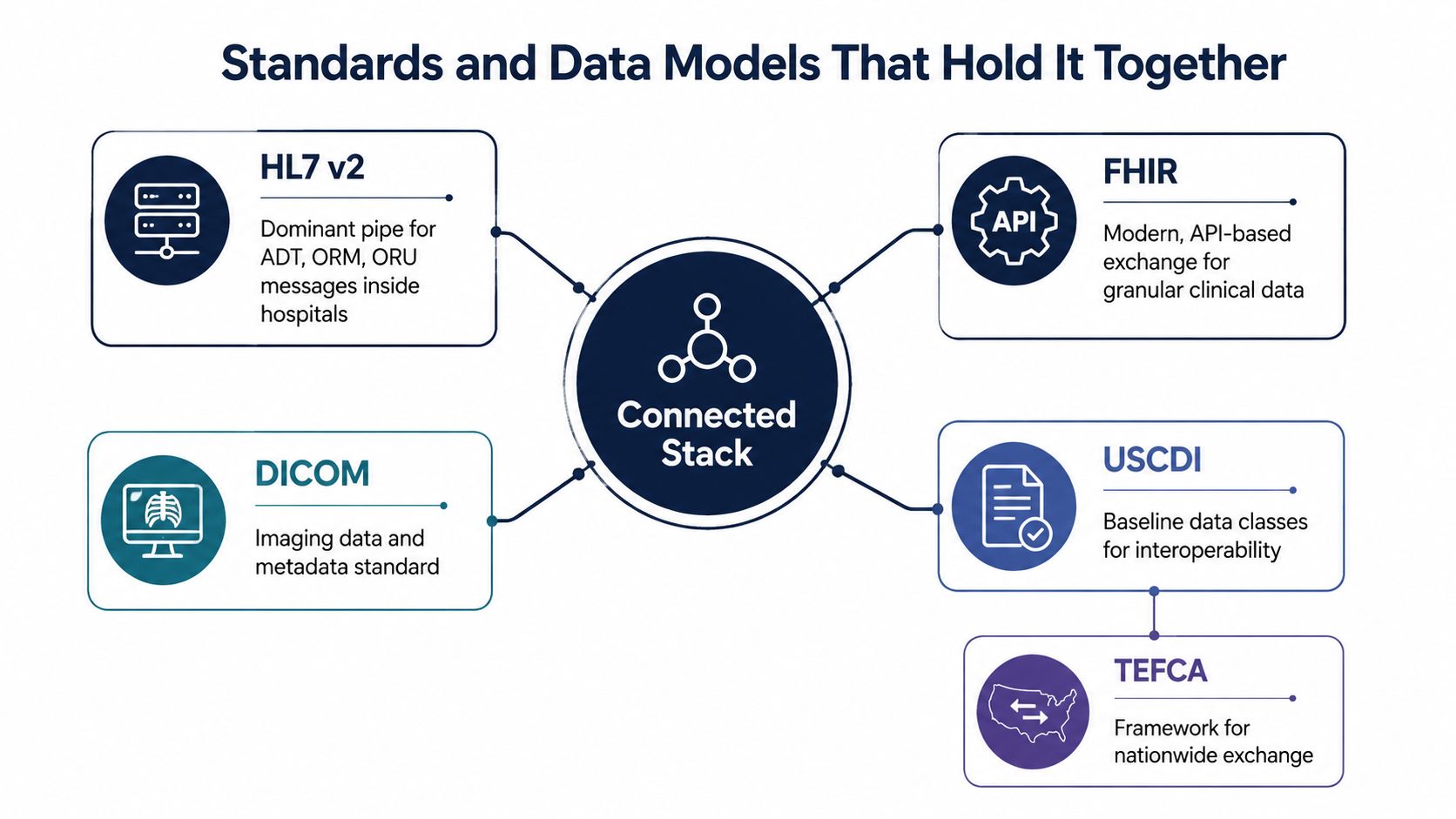
FHIR, HL7 v2, DICOM, USCDI, and TEFCA aren't competing glossary terms. They occupy different layers of the exchange stack.
Inside hospital walls, HL7 v2 remains the dominant pipe for operational messages such as ADT, ORM, and ORU. An admission can generate an ADT message, an order can travel as an ORM message, and a result can return through an ORU message. These feeds are dependable workhorses, but they often carry local conventions, optional fields, and site-specific mappings that require careful profiling.
FHIR supplies the modern API layer. Its RESTful resources let applications request and exchange granular clinical and administrative information instead of relying only on large documents or tightly coupled custom interfaces. CMS identifies FHIR R4.0.1 as the foundational standard for patient-access and payer APIs, including access to claims, encounters, costs, and defined clinical data through third-party applications of the patient's choice in its interoperability and patient access fact sheet.
A connected exchange path
DICOM remains the imaging substrate. Images and associated metadata need to remain intact as they move through archives, viewers, clinical systems, and exchange services. Modern architectures may expose imaging through WADO-RS while preserving DICOM semantics underneath.
USCDI defines the minimum data classes that certified health IT must support for exchange. USCDI v3 became the baseline in the ONC Health IT Certification Program on January 1, 2026, according to the ONC HTI-1 final rule. This makes the data dictionary a product concern, not merely a regulatory reference. Teams need to know which elements they support, how they map them, and where local extensions remain necessary.
TEFCA sits above the transport and data formats as a policy and trust framework. It helps participating networks federate exchange nationally, while the underlying systems still rely on standards such as HL7 v2, FHIR, and DICOM.
A single encounter may therefore cross several layers. An admission generates HL7 v2 messages, a clinician application retrieves FHIR resources, imaging moves through DICOM services, USCDI elements shape the exchangeable minimum dataset, and TEFCA governs a cross-network query. The architecture works only when teams define identity, terminology, provenance, and consent across the entire path.
For a practical framework on planning these dependencies, see our guide to healthcare data interoperability strategy. The important design choice is not selecting one standard. It's deciding where each standard belongs and how the platform preserves meaning between them.
Choosing the Right Architecture for Your Stack
Architecture determines how much change one integration creates elsewhere. A point-to-point connection is direct and easy to understand at first. One system sends data to another through a dedicated interface. That approach can fit a small environment with a handful of stable systems, but every new destination adds another dependency and another place to maintain mappings.
An Enterprise Service Bus centralizes routing and transformation. Systems connect to the bus, which applies shared rules before delivering messages. This can provide strong governance in a large hospital environment, though the bus may become a bottleneck if every change requires central coordination or if its canonical model becomes too rigid.
API-led connectivity exposes reusable services through managed interfaces. A patient, encounter, or medication service can support several consumers while enforcing authorization, throttling, versioning, and observability. It suits external partners and application ecosystems, but API ownership must be explicit. Without product discipline, teams create inconsistent endpoints that look modern while reproducing old fragmentation.
Event-driven architecture publishes events to a broker or topic so multiple consumers can react independently. A discharge event, critical lab result, or device observation can trigger several downstream workflows without the source system knowing each consumer. This pattern improves decoupling and supports asynchronous resilience, but it adds operational demands around event contracts, replay, ordering, and monitoring.
A decision matrix for product teams
| Architecture | Best Fit Scenario | Latency Profile | Governance Overhead | Typical Cost Trajectory |
|---|---|---|---|---|
| Point to point | Small estate with stable system pairs | Real time or batch | Low at first, high as connections multiply | Low entry cost, rising maintenance burden |
| ESB | Centralized enterprise routing and transformation | Real time, queued, or batch | High central governance | Significant platform investment, controlled scaling |
| API led | Partner access, mobile apps, reusable services | On demand or near real time | Moderate to high | Investment shifts toward API product operations |
| Event driven | High-volume events and independent consumers | Near real time or asynchronous | High contract and observability needs | Higher platform complexity, strong reuse potential |
Use system count, latency tolerance, governance maturity, and cloud posture together. A small organization with under five connected systems may sensibly begin with managed interfaces. A network with 50 or more systems needs stronger shared controls, even if it still uses direct connections at the edge. A cloud-native product may favor API-led and event-driven patterns, while a hospital with extensive legacy infrastructure may need an ESB or integration engine as an intermediate layer.
Hybrid designs usually age better than rigid commitments. An API layer can serve external partners while an event bus handles clinical telemetry internally. As discussed in our healthcare platform API engineering guide, the goal is to make boundaries explicit so each pattern has a clear responsibility.
Security and Compliance as Design Constraints
A healthcare exchange platform handles more than messages. It handles individually identifiable health information, access decisions, consent conditions, and evidence of who did what. CDC guidance explains that data standards improve consistency and efficiency across diverse systems, while HIPAA's Privacy, Security, and Breach Notification Rules govern exchanges of individually identifiable health information in its data interchange guidance.
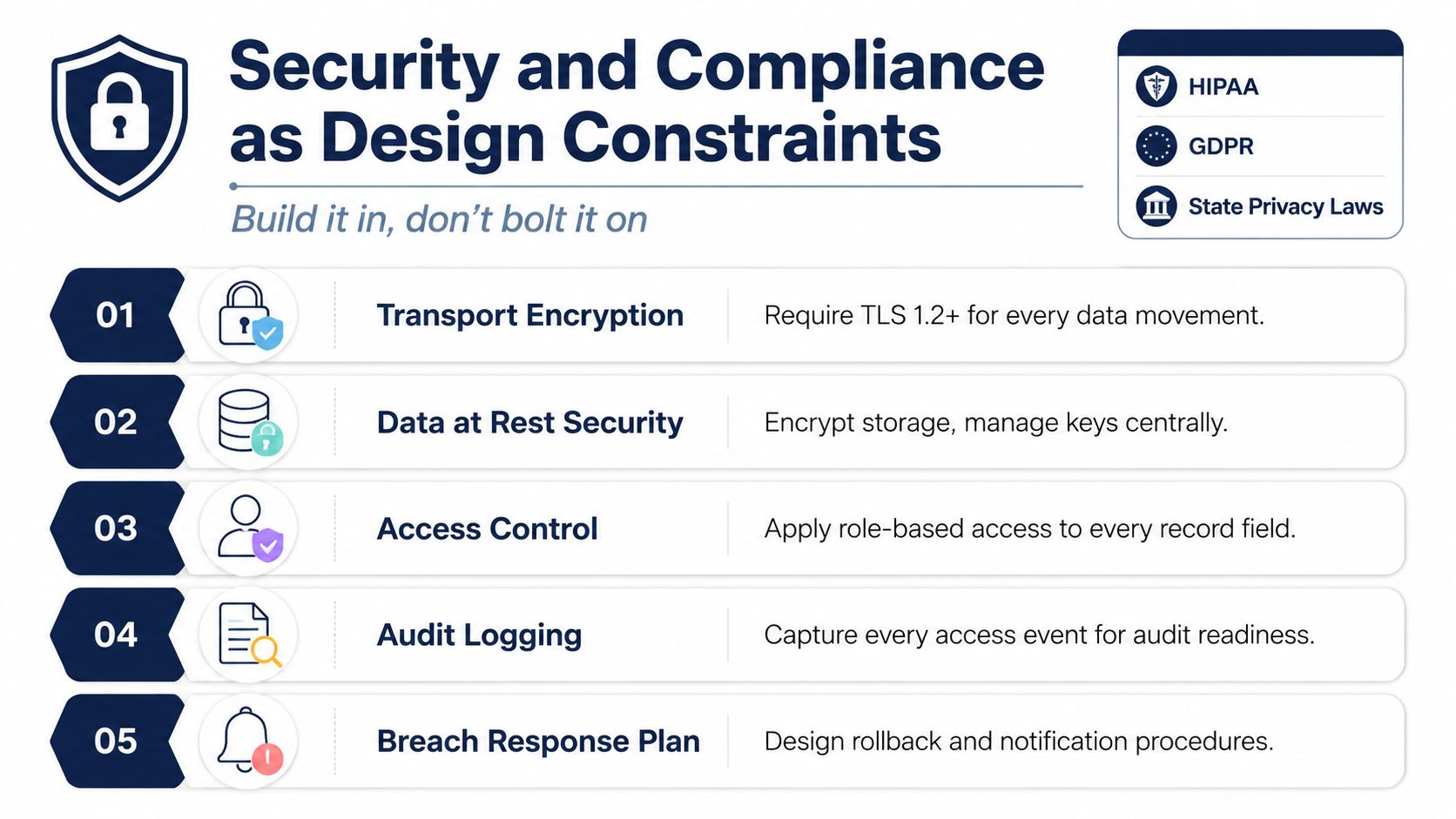
That means security decisions belong in the architecture review, not at the end of implementation. HIPAA, GDPR, and applicable state privacy laws should shape transport, storage, identity, retention, and access policies before teams write integration code.
Controls that belong in the workflow
-
Transport protection: Use modern TLS for every connection and validate certificates and service identities rather than treating a private network as trusted.
-
Storage protection: Encrypt databases, object stores, backups, and temporary queues. Central key management gives security teams control over rotation and access.
-
Consent enforcement: Tie consent to a verified patient identity, purpose of use, data category, recipient, and expiration or revocation state.
-
Role-based access: Limit access by user role, organization, purpose, and, where necessary, record or field sensitivity. Emergency break-glass access should be explicit, time-bound, and audited.
-
Immutable audit evidence: Record authentication, authorization, access, transformation, delivery, failure, and administrative events in a tamper-resistant log.
HITRUST CSF can provide a structured control reference where an organization needs a defensible security program, though certification or alignment doesn't replace direct legal analysis. Teams should map controls to concrete platform behavior, such as whether a revoked consent prevents a downstream FHIR request or whether an emergency access event generates an immediate review queue.
Design constraint: Every integration should answer four questions before production. Who may access the data, for what purpose, through which channel, and what evidence remains afterward?
Security becomes harder to retrofit as AI tools, third-party APIs, analytics services, and device ecosystems widen the trust boundary. A platform that treats consent, encryption, access control, and auditability as reusable services can apply the same protections across new workflows instead of rebuilding them for every connection.
Implementing Exchange Without Drowning in Integration Debt
Integration debt begins when a pilot solves one workflow but leaves behind a custom mapping, an undocumented exception, and no owner for the next change. The cure isn't a larger interface team. It's a delivery sequence that turns each integration into a reusable capability.
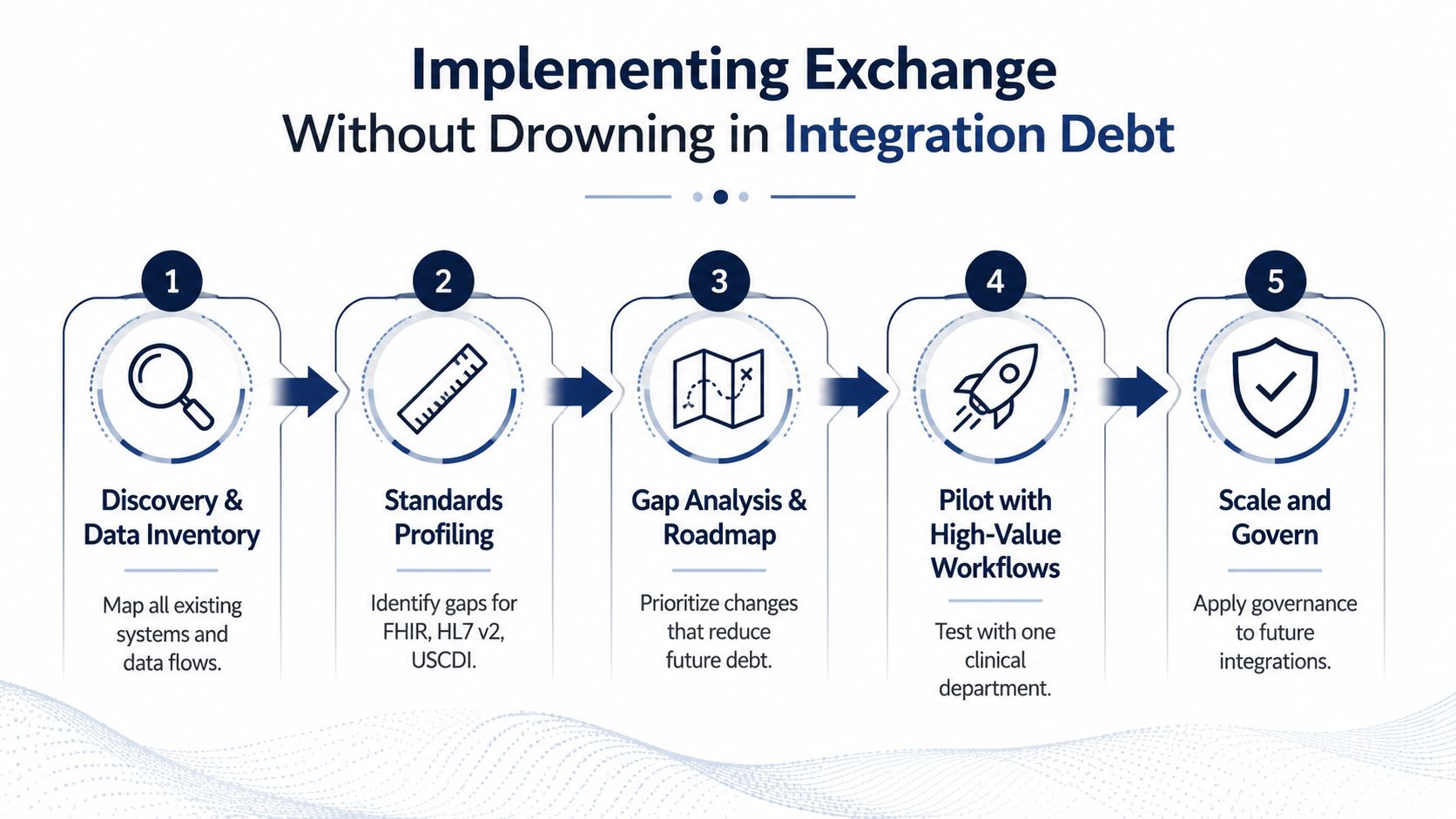
Start with discovery and a data inventory. Map every source, destination, message, API, document, image stream, identifier, transformation, queue, and manual workaround. Include ownership and failure handling. A spreadsheet alone won't expose runtime dependencies, so pair the inventory with interface logs and interviews with clinicians, analysts, interface specialists, and security staff.
Establish the reusable foundation
Standards profiling comes next. For each high-value resource or message, document the supported FHIR profile, HL7 v2 segments, DICOM metadata, terminology bindings, USCDI coverage, and local extensions. The objective isn't to force every source into an abstract universal model. It's to identify where normalization creates reuse and where preserving source fidelity matters.
A reference architecture should then define the canonical model, identity resolution approach, routing rules, error queues, security services, and ownership boundaries. A canonical model is useful when it represents stable business meaning, such as an encounter or observation. It becomes harmful when it hides clinically meaningful source distinctions or turns every local variation into an endless exception list.
The implementation path should stay narrow enough to learn:
-
Discovery and inventory: Establish the system map, data owners, clinical workflow, and measurable failure points.
-
Standards profiling: Compare actual payloads with FHIR, HL7 v2, DICOM, and USCDI expectations.
-
Gap analysis: Prioritize changes that reduce future interface duplication, not just the fastest visible connection.
-
Focused pilot: Choose one high-value workflow, such as discharge notification or critical lab delivery, and test end to end.
-
Scale and govern: Convert successful mappings into templates, connectors, API contracts, and catalog entries.
Prevent pilots from becoming permanent exceptions
Teams often stall by skipping governance, selecting a pilot with no operational owner, or launching several pilots before proving one reusable pattern. Remediation requires a small integration center of excellence, a governed API catalog, and a rule such as one approved contract per resource type unless a documented clinical reason requires an exception.
Observability should be part of the first release. Monitor latency, delivery failures, queue age, schema drift, duplicate patients, missing required fields, and downstream clinical impact. Our healthcare enterprise integration guide provides related context on organizing these capabilities across a broader enterprise.
A useful dashboard doesn't stop at technical uptime. It shows whether the right patient record arrived, whether a clinician could use it, whether a referral completed, and whether a failed message received human attention. That is how a product team proves exchange value without confusing message volume with better care.
Evaluating Vendors, ROI, and Where AI Adds Leverage
Vendor selection works best through three lenses: technical fit, compliance posture, and economic value. A platform can have excellent FHIR support and still fail if it can't connect to the organization's EHR, preserve DICOM workflows, or expose enough operational telemetry for an integration team to troubleshoot production failures.
Compare vendors on evidence, not feature lists
| Lens | Key Criteria | Scoring Signal |
|---|---|---|
| Technical fit | FHIR R4 or R5 support, HL7 v2, DICOM, certified APIs, sandbox access, EHR and analytics integration | Working proof of the highest-risk workflow |
| Compliance posture | HITRUST or SOC 2 evidence, breach-notification commitments, access controls, audit-log detail | Current documentation and contractually defined responsibilities |
| Economic value | Interface reduction, reclaimed clinician time, avoided duplicate work, data-quality gains | Baseline metrics and a benefits model tied to workflow outcomes |
Ask vendors to demonstrate failure handling, not just a successful transaction. A credible evaluation should test malformed messages, duplicate identities, revoked consent, unavailable destinations, delayed acknowledgments, schema changes, and audit review. The product team should also clarify whether the vendor owns mapping updates, infrastructure operations, terminology maintenance, and incident response.
ROI extends beyond subscription fees. Model the cost of interfaces that can be retired, manual reconciliation that can be reduced, clinician time returned to care, readmissions potentially avoided through better coordination, and data-quality defects corrected before they reach analytics or billing. These are hypotheses until measured, so define a baseline during discovery and validate it during the pilot.
Where AI can add leverage
AI can help with schema mapping between legacy HL7 v2 and FHIR, anomaly detection across transaction patterns, clinical risk signals surfaced inside workflow, and natural-language queries for population health. It should support human decisions and transparent review, especially when transformations could alter clinical meaning.
A team exploring autonomous workflow design may also benefit from this resource on building AI agents for enterprises. For healthcare exchange, the relevant question isn’t whether an agent can call an API. It’s whether the agent has bounded permissions, reliable provenance, explainable outputs, consent awareness, and a safe escalation path.
Bridge Global can be evaluated as one potential engineering partner for custom healthcare software development, including standards-based healthcare integrations and custom platform work. Teams comparing providers should still apply the same proof-based criteria, review relevant client cases, and require a workflow demonstration against their own data contracts.
From Data Movement to Data Liquidity
Data movement answers a narrow question: did one system send information to another? Data liquidity asks a more useful question: can authorized people, services, and models access trustworthy clinical, claims, social-context, and device data when a workflow needs it?
That distinction changes the product architecture. Liquidity depends on persistent identity, reusable contracts, searchable provenance, governed consent, terminology alignment, and clear ownership. It also creates a foundation for longitudinal patient records, real-time decision support, and AI models trained on broader populations rather than a single EHR slice.
The public health opportunity shows why chart sharing is only one use case. In 2025, 64% of connected health information organizations said they already provided data to public health agencies to fill gaps involving clinical, laboratory, encounter, race and ethnicity, and home-address information. Another 24% said they could provide it but didn’t yet, according to the ONC data brief on HIE organization capabilities for public health exchange. The untapped value lies in deciding which information should move, in what format, for which downstream purpose, and with what consent.
Three moves for this quarter
-
Inventory and retire: Document every interface, identify redundant point-to-point connections, and assign owners to the ones that remain.
-
Pilot meaningful events: Use an event-driven channel for a high-value event such as a discharge or critical lab result, then measure delivery, usability, and workflow response.
-
Create shared governance: Give a cross-functional council authority over consent, data quality, reuse rights, identity, terminology, and exception handling.
The implementation gap remains significant. Industry coverage reported that roughly 43% of payers had not started API implementation and about 47% of providers had not begun implementation or testing in late 2025, while a 2025 CMS initiative attracted voluntary pledges from more than 60 companies. Those figures, summarized in coverage of healthcare data exchange strategies for 2025, point to a market moving from standards discussion toward execution.
Exchange becomes a strategic asset when each trusted source can support several governed consumers without a new bespoke project. Start with the interface inventory, choose one clinically meaningful event, and establish ownership for the data contract before adding another integration.
Bridge Global helps healthcare product teams design and build secure, standards-based exchange platforms across HL7, FHIR, DICOM, and connected healthcare workflows. Visit Bridge Global to discuss your integration architecture, pilot scope, and path from fragmented interfaces to governed data liquidity.

About Preethi Saro Philip
Preethi Saro Philip is a Post Graduate Research Degree holder in Economics with more than 10 years of experience in writing, editing, research and teaching. She has an intense passion for content crafting and calls herself a ‘wordsmith’. She enjoys writing on wide-ranging topics including business, technology, health & lifestyle, education, environment etc.
View all posts by Preethi Saro Philip →