



Healthcare Cloud Architecture for Compliance & Scalability
The most popular advice about healthcare cloud architecture is also the most misleading: move the workload to a public cloud, apply a HIPAA checklist, and optimize later. That approach treats healthcare technology like ordinary enterprise software. It ignores legacy EHR dependencies, clinical latency, data residency, auditability, interoperability, and the governance burden that arrives when AI starts making or influencing decisions.
Healthcare cloud is still an architectural discipline, not a completed migration project. More than 80% of healthcare organizations were using a public cloud provider, yet only one of 36 organizations surveyed had fully migrated its infrastructure, while nearly 40% said at least 90% of their IT systems remained on premises. The practical conclusion is clear: hybrid design is the operating reality.
A durable healthcare cloud architecture must connect clinical systems, payer workflows, devices, analytics, and AI without making every future integration a custom project. It must also preserve service continuity while teams modernize in stages. The strongest designs begin with interoperability and AI readiness, then select cloud services and migration patterns that support those constraints.
Why Healthcare Cloud Is Still an Architecture Problem
Healthcare workloads are interconnected systems, so cloud adoption alone does not solve healthcare IT. A provider may run a modern patient portal beside an on-premises EHR, imaging archive, laboratory system, identity directory, and device estate. Each has different availability expectations, data formats, upgrade cycles, and ownership boundaries.
A lift-and-shift strategy leaves those boundaries unresolved. Moving a database without redesigning interfaces, identity flows, audit collection, and failure handling relocates the dependency. The organization may gain elastic infrastructure while retaining brittle point-to-point integrations and unclear responsibility for protected health information.
Hybrid is a design choice, not a temporary failure
Azure was the most commonly used primary cloud provider in the KLAS summary, followed by Amazon Web Services, yet provider preference has not removed the need for hybrid architectures. A hospital may keep latency-sensitive systems or specialized appliances on premises while placing patient engagement, analytics, integration, and selected clinical services in the cloud.
The architectural question is which workload belongs in each execution environment and what contract connects it to the platform. That contract should define identity, data ownership, event semantics, API behavior, observability, recovery, and decommissioning responsibilities. These definitions prevent vendor-specific services from becoming hidden dependencies.
Practical rule: Treat every migration wave as a product and operating-model change with defined identity contracts, data ownership maps, and rollback paths, not as a server relocation exercise.
Regulatory change also belongs in the architecture. A data layer designed only for current interfaces may fail when payer APIs, patient-access requirements, clinical decision support documentation, or AI oversight expectations change. Standards-based APIs and explicit governance boundaries provide room to evolve without rewriting the entire platform.
What makes healthcare different
Clinical systems carry consequences that generic enterprise applications often do not. A delayed administrative workflow is inconvenient. A delayed device alert, incomplete medication history, or unavailable clinical record can affect care delivery.
The global healthcare cloud computing market was estimated at USD 46.1 billion in 2023 and USD 53.8 billion in 2024, with a projection of USD 120.6 billion by 2029 at a 17.5% compound annual growth rate, according to MarketsandMarkets. That growth reflects cloud's role in digital health, telemedicine, AI-enabled workflows, and secure data platforms. It does not simplify the architecture.
Each workload needs its own control boundary. Transactional clinical systems require predictable integrity and access control. Analytics needs governed copies or views. AI needs curated, traceable data and controlled model execution. Devices may require edge processing before sending selected events to cloud services. The architecture succeeds when these paths remain connected without sharing every failure mode.
Core Components of a Healthcare Cloud Stack
A useful healthcare cloud architecture can be read as a set of layers. Each layer has a distinct responsibility, and each should expose controls that can be tested independently. This prevents teams from hiding security, integration, or recovery assumptions inside application code.
Start with the workload and data layers
The compute layer should match the workload rather than defaulting to one runtime. Containerized services work well for APIs and integration workers. Managed serverless functions suit event transformations and lightweight orchestration. Virtual machines remain useful for legacy applications that can't yet be refactored.
The data layer needs stronger separation than a typical SaaS environment. Keep transactional records, raw clinical documents, normalized FHIR resources, telemetry, and analytical datasets in deliberately governed zones. Use tiering for retention and access patterns, but don't move ePHI into a cheaper or slower tier without validating retrieval, encryption, deletion, and audit behavior.
The network layer should isolate sensitive data planes from general workloads. Private service endpoints, controlled ingress, service-to-service authorization, and explicit egress policies reduce the chance that a convenience integration becomes an uncontrolled path to clinical data.
Make identity and interfaces first-class
Identity belongs at the center of the stack. Use workforce identity, workload identity, patient identity, and service credentials as separate concerns. Applications should receive only the permissions they need, and privileged operations should be traceable to a person or accountable service principal.
The integration layer commonly includes an API gateway, FHIR server or FHIR-native data layer, interface engine, event bus, and validation services. An API gateway can enforce authentication, throttling, schema validation, and routing before requests reach clinical services. An event bus can distribute alerts and updates without forcing every downstream system to remain synchronously available.
Finally, build the observability layer across both control-plane and data-plane activity. Metrics tell operators whether a service is healthy. Logs show what happened. Traces connect an API request to an interface transformation, database operation, and downstream event. For healthcare, those records must support investigation, access review, and operational accountability.
The most common production mistake is to build these layers in sequence and postpone identity, audit, and integration design. Those controls influence data models and service boundaries from the beginning, so retrofitting them usually creates duplicated pipelines and inconsistent permissions.
Compliance and Security Controls That Shape Architecture
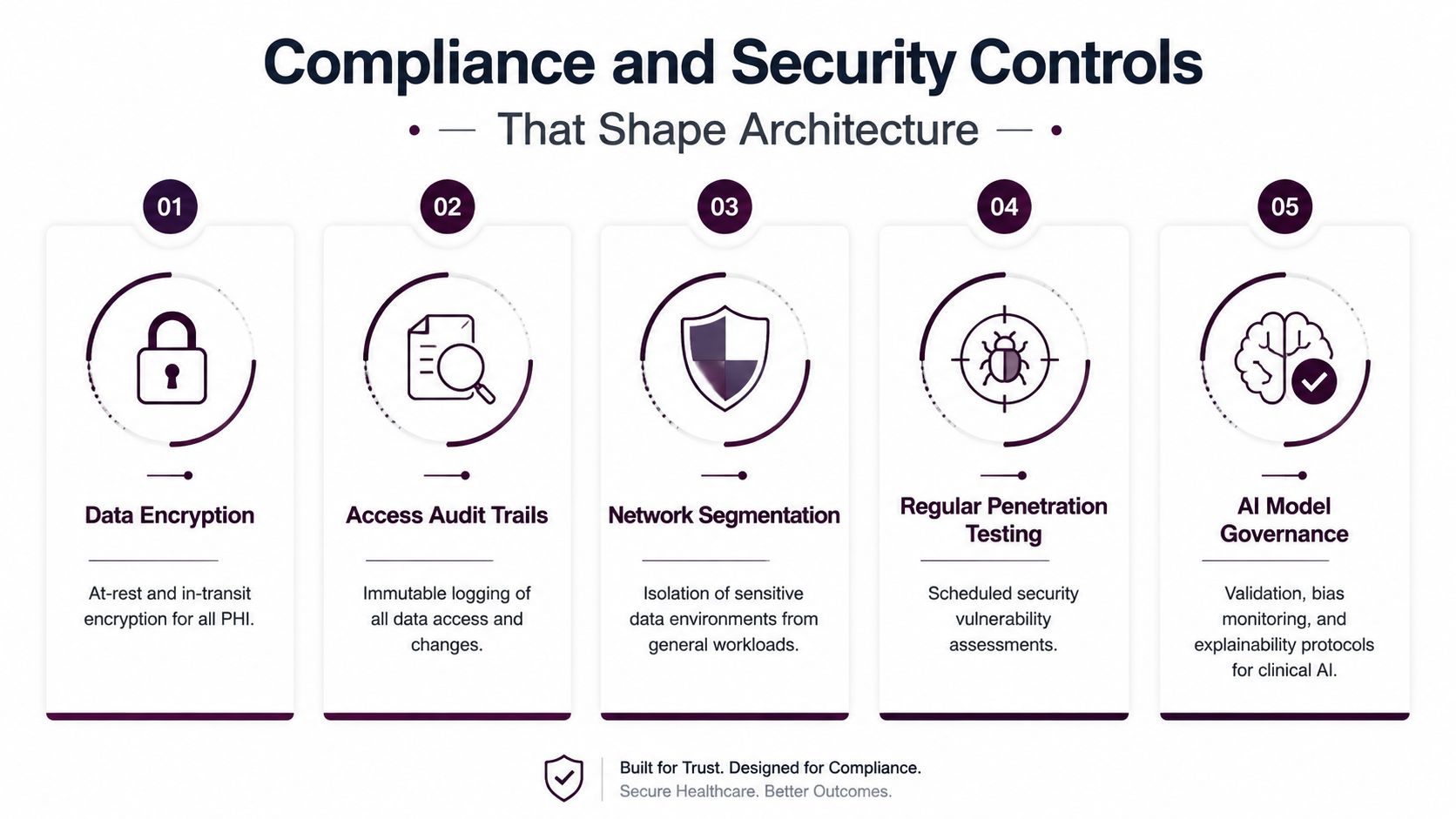
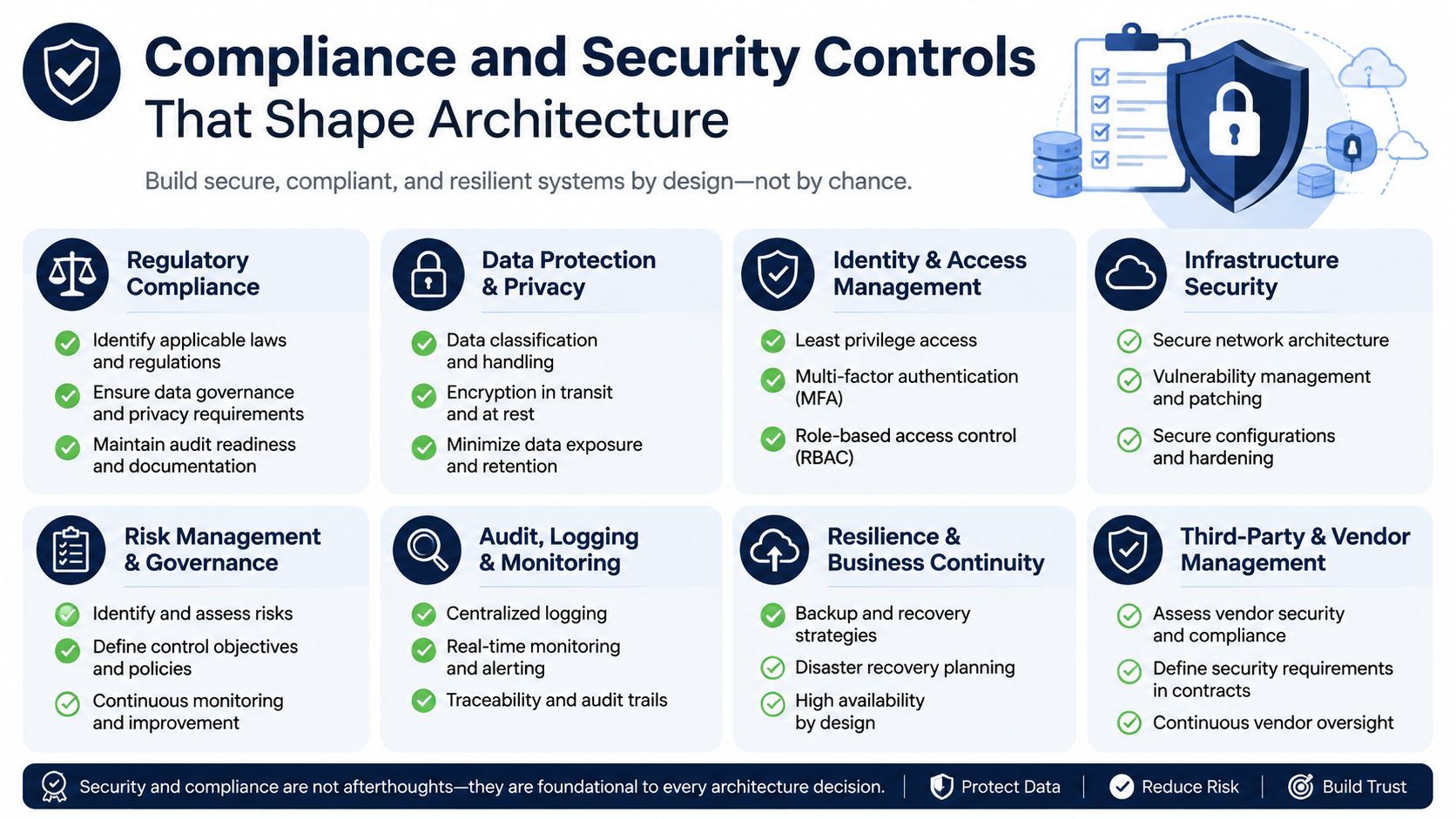
Compliance shouldn't sit in a document repository while engineers make infrastructure decisions. HIPAA obligations, GDPR considerations, contractual controls, and AI governance expectations directly affect how data moves, who can access it, how keys are managed, and what evidence the organization can produce during an investigation.
For ePHI, the architecture should enforce encryption in transit and at rest with customer-managed keys, together with immutable audit logging across control-plane and data-plane activity, as outlined in this healthcare cloud HIPAA compliance guide. TLS should protect every relevant path. A centralized, KMS-backed key strategy should support rotation and separation of duties. Logs should make access events, configuration changes, and key-use events attributable and resistant to tampering.
Design for evidence, not just prevention
Preventive controls matter, but production systems also need to explain what happened after an incident. A useful audit record connects the actor, purpose, resource, operation, timestamp, result, and originating service. Application logs alone aren't enough if an administrator changes a policy, a service assumes a role, or a key decrypts a protected object outside the application path.
Customer-managed keys provide stronger organizational control and clearer separation between provider operations and customer authorization. They also add responsibility. Teams must define ownership, rotation procedures, recovery behavior, break-glass access, and the consequences of disabling a key. Provider-managed encryption can reduce operational effort, but it may offer less control over the exact key lifecycle and segregation model.
A zero-trust approach extends beyond network location. Every request should be authenticated, authorized, and evaluated against context. That means short-lived credentials, workload identity, least privilege, privileged-access review, and policy enforcement at service boundaries.
Keep governance close to deployment
AI introduces another control plane. An organization needs to know which models are in use, what data they consume, who approved them, how performance is monitored, and what human review applies to their outputs. NIST's AI Risk Management Framework, released in January 2023, organizes responsible AI governance around Govern, Map, Measure, and Manage.
Those functions should appear in delivery artifacts, not only governance meetings:
Govern: Assign accountable owners, approval paths, policies, and escalation procedures.
Map: Document intended use, affected users, data sources, dependencies, and foreseeable misuse.
Measure: Test quality, bias, drift, security, explainability, and clinical workflow impact.
Manage: Apply mitigations, monitor production behavior, handle incidents, and review changes.
A compliant platform makes these controls repeatable through infrastructure as code, policy checks, centralized logging, access reviews, and release gates. It doesn't rely on a final audit sprint to discover that the evidence trail was never collected.
Choosing Cloud Providers and Deployment Models
Provider selection should follow workload and operating constraints. AWS, Azure, and Google Cloud can all support healthcare workloads, but service eligibility, contractual coverage, regional availability, integration tooling, internal skills, and existing enterprise agreements will shape the practical choice.
A provider comparison is useful only if it exposes trade-offs rather than declaring a universal winner.
Cloud Provider Comparison for Healthcare Workloads
| Provider | HIPAA BAA Coverage | Healthcare Managed Services | Hybrid Connectivity | Best Fit |
|---|---|---|---|---|
| Amazon Web Services | Available for eligible services under the applicable agreement and configuration | Broad managed infrastructure, data, analytics, and machine learning options | Strong connectivity patterns for data centers, private networks, and staged migration | Teams with deep AWS capability, event-driven platforms, and broad service selection |
| Microsoft Azure | Available for eligible services under the applicable agreement and configuration | Strong alignment with Microsoft identity, data, analytics, and enterprise tooling | Well suited to organizations already invested in Microsoft networking and identity | Health systems standardizing around Microsoft enterprise services |
| Google Cloud | Available for eligible services under the applicable agreement and configuration | Strong data, analytics, and machine learning capabilities | Supports hybrid and multicloud patterns through its connectivity and platform tooling | Data-intensive platforms with substantial analytics and AI requirements |
The table describes platform fit, not automatic compliance. A BAA doesn't make an application compliant by itself. Teams still need correct configuration, access controls, retention policies, monitoring, incident response, and documented operating procedures.
Match the deployment model to the workload
Public cloud offers managed services, elasticity, and a broad ecosystem. It often suits healthtech SaaS products that need to scale product features without operating every infrastructure component. The trade-off is exposure to provider-specific APIs, service limits, and usage-based cost complexity.
Private cloud can support tighter control or specific institutional requirements, but the customer or operator carries more responsibility for capacity, patching, resilience, and specialized security operations.
Hybrid cloud remains the pragmatic default when legacy EHRs, on-premises devices, institutional data policies, or continuity requirements constrain migration. It works only when the team defines reliable connectivity, identity continuity, data synchronization, and failure behavior.
Multi-cloud can reduce dependence on one provider or satisfy regional and customer requirements, but it increases platform variation. Duplicating every service across providers usually costs more and creates inconsistent control implementation. A better pattern is to standardize interfaces, data contracts, identity policy, observability, and deployment practices while placing selected workloads where they make operational sense.
For a deeper treatment of infrastructure decisions, see this guide to cloud infrastructure for healthcare systems. Provider choice should remain reversible at the interface and data-contract level, even when the underlying implementation uses managed services heavily.
Designing for Interoperability and AI Readiness
Cloud hosting alone does not make a healthcare platform AI-ready. The usable foundation is data that carries consistent meaning, clear provenance, and enforceable rules for access and reuse. That means designing across EHR records, claims, device data, patient-generated information, and research sources from the start.
A FHIR-native data layer and API-led exchange usually age better than a collection of point-to-point connectors. They provide explicit resource models, versioned interfaces, validation boundaries, and controlled access to selected information without exposing broad database permissions.
FHIR adoption also reflects operational requirements. A CAQH 2025 report projects that almost 63% of medical plans intend to develop a FHIR-based prior authorization API in preparation for the CMS 0057-F deadline scheduled for January 2027, as documented in the CAQH FHIR report. Prior authorization therefore requires more than an interface. The design must cover versioning, payer connectivity, workflow state, authorization, audit records, and failure recovery.
Build one governed data layer for varied sources
A durable integration architecture commonly includes:
FHIR resources for normalized clinical exchange and patient-access workflows.
API gateways for authentication, validation, throttling, and lifecycle control.
Event streams for updates, alerts, and downstream processing without tight coupling.
Raw zones that preserve source fidelity across documents, device payloads, and claims files.
Curated analytical zones for governed feature engineering and reporting.
Metadata and lineage services that record origin, transformations, consent, and model use.
Do not force every workload into FHIR. FHIR fits exchange and clinical semantics, while analytical and research workloads may need columnar stores, domain-specific schemas, or de-identified datasets. Preserve source records and transformation lineage so engineers, clinicians, and auditors can trace how a model feature or clinical display was produced.
Put latency-sensitive logic near devices
Cloud-only processing can perform poorly for real-time monitoring. A peer-reviewed health-monitoring study measured 107.5 to 119.9 milliseconds for a cloud model versus 38.2 to 33.8 milliseconds for a hybrid fog-edge model, indicating that preprocessing and decision logic closer to the device can reduce response time by roughly two-thirds. The findings appear in the published health-monitoring study.
Edge processing creates its own operating burden: device management, secure updates, observability, and model version control. Use it when response time, unreliable connectivity, or local filtering justifies that burden. Send governed events and relevant summaries to the cloud for longitudinal analysis, while retaining enough context to investigate decisions later.
The healthcare data interoperability strategy should define the platform boundary, not a specific cloud provider. Model serving, feature management, human review, drift monitoring, and approval records can then connect to the same governed foundation as clinical exchange. That separation helps the architecture absorb provider changes, regulatory updates, and new AI workloads without rewriting every integration.
Implementation Roadmap and Governance Framework
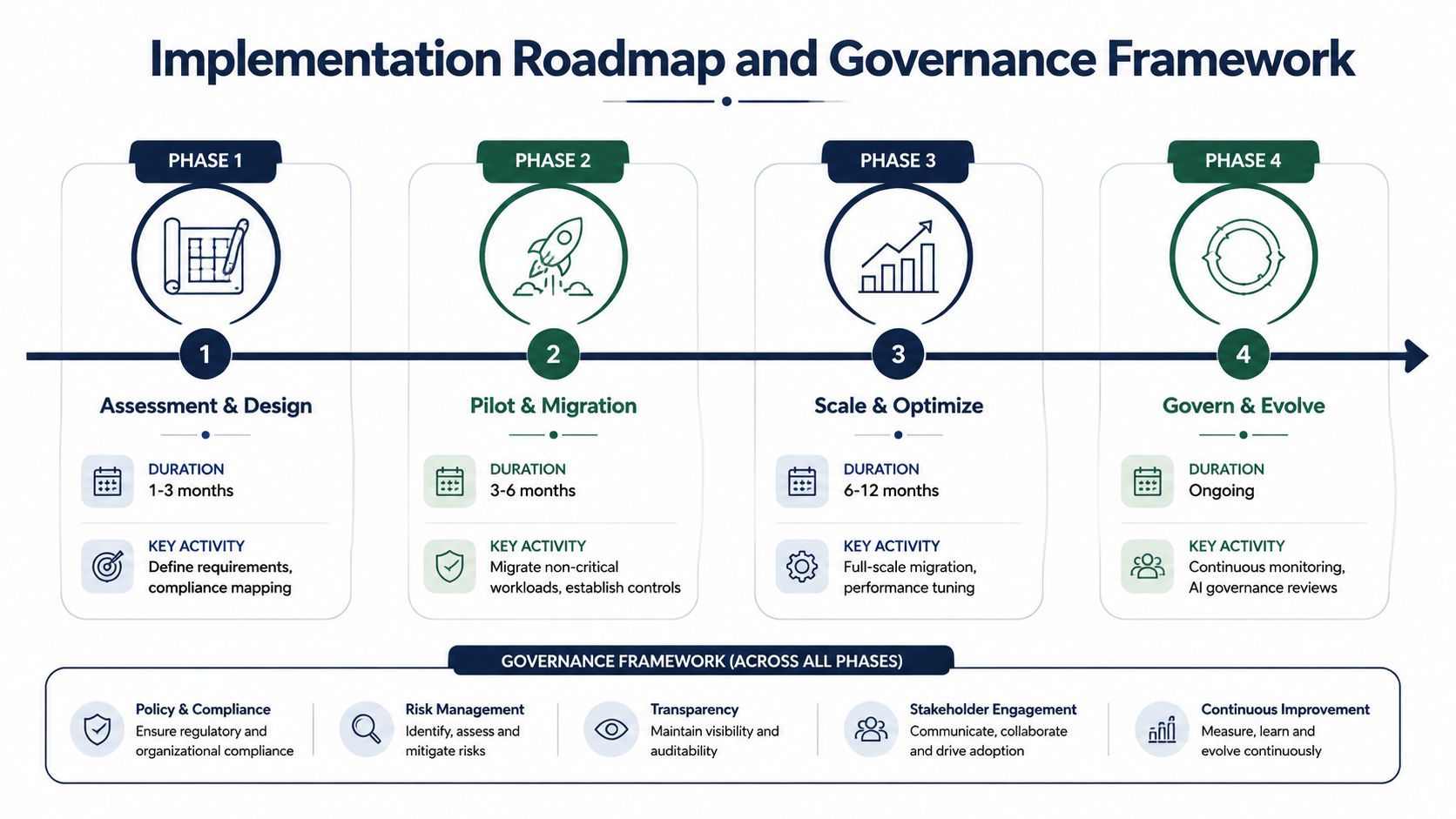
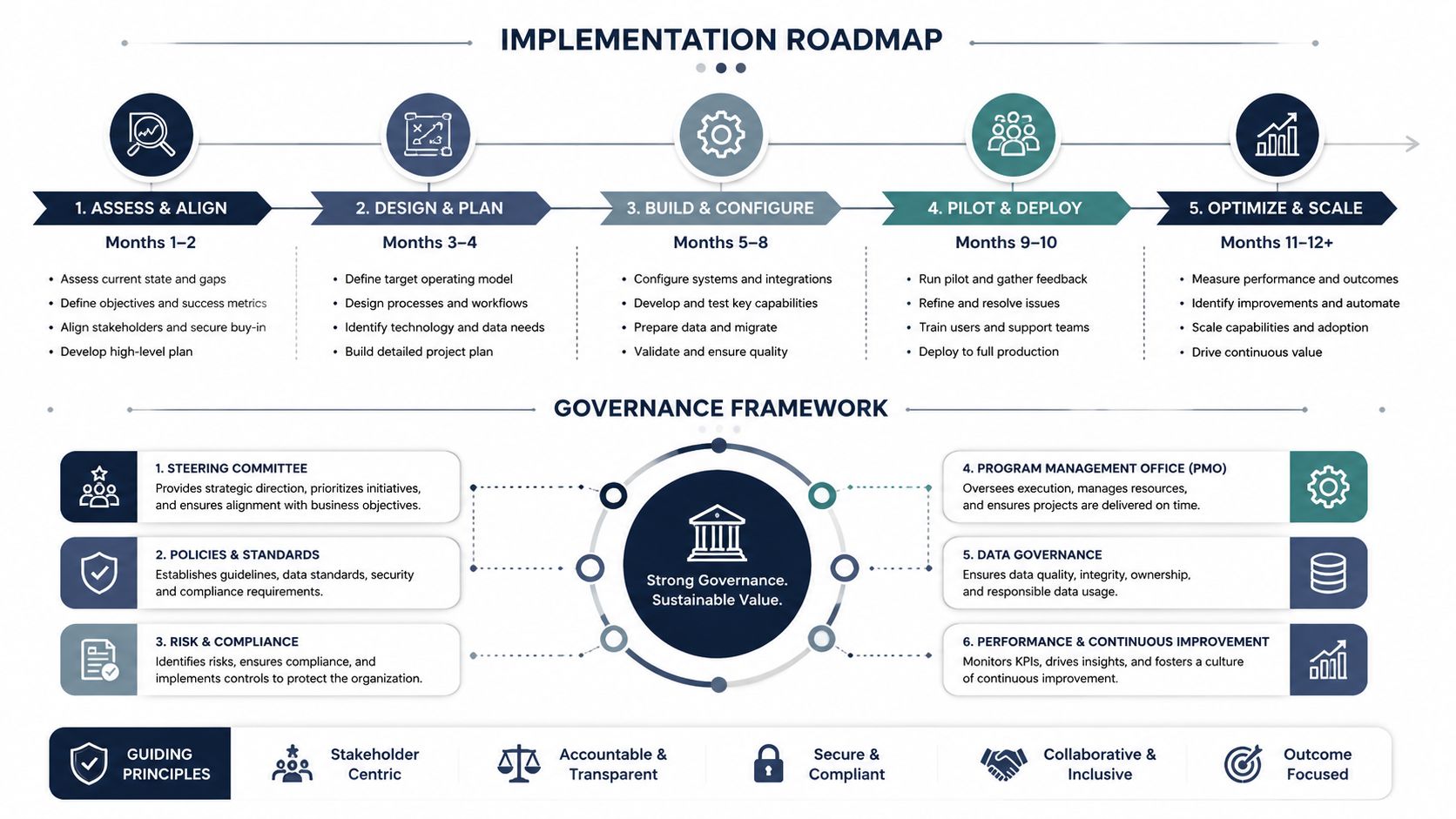
A migration plan needs delivery milestones, accountable owners, and evidence requirements. Without those elements, architecture reviews become abstract, and AI governance arrives after production deployment.
A practical 90-day AI implementation roadmap divides work into foundation, assessment, and action.
Days 1 to 30: Establish the foundation
Create an AI governance committee with representatives from technology, clinical operations, security, compliance, legal, and product. Assign an accountable owner for each AI system and inventory clinical and administrative use cases, including models embedded in vendor products.
Draft procurement, acceptable-use, validation, incident-reporting, and change-management policies. At the same time, map the current cloud estate, EHR interfaces, data stores, identity paths, and workload dependencies. The output should be a prioritized inventory, not a presentation describing general ambition.
Days 31 to 60: Assess risk and contracts
Risk-tier every inventoried AI system according to intended use, affected population, autonomy, data sensitivity, and potential clinical consequence. High-risk tools need technical and clinical reviews, documented human-in-the-loop controls, validation evidence, monitoring requirements, and an owner who can stop or constrain use.
Review vendor contracts and data-processing terms. Confirm where data is stored, how it is retained, which subprocessors are involved, how incidents are reported, and whether the vendor provides model, version, and performance documentation. Create a risk register that connects each issue to an owner, mitigation, due date, and residual risk decision.
Days 61 to 90: Take action and operate
Implement mitigations, configure monitoring, train leadership on AI literacy, and report progress to executives or the board. Tie AI incidents to existing security and HIPAA breach-response procedures rather than creating an isolated process that nobody uses during a real event.
FinOps belongs in this phase too. Tag workloads by product, environment, data domain, and owner. Track storage growth, managed-service consumption, data-transfer paths, GPU use, and idle resources. Set placement rules for cloud, edge, and on-premises execution, then review whether those rules still make sense as volume and clinical requirements change.
A migration should move in controlled slices. Begin with workloads whose dependencies and recovery requirements are understood, establish rollback paths, test degraded operation, and preserve dual-running interfaces when clinical continuity requires it. The healthcare platform transformation guide provides useful context for connecting technical modernization with operating-model change.
Example Architecture for a Healthtech SaaS Platform
Consider a multi-tenant care coordination SaaS product that receives EHR data, payer events, device observations, and clinician updates. The web and mobile clients connect through an API gateway, while tenant-aware services enforce authorization before accessing clinical resources.
Each tenant gets logical data isolation with tenant identifiers enforced in application policy and database access controls. Raw documents and device payloads land in encrypted object storage. A FHIR integration layer normalizes exchange, while an event bus distributes care-plan changes and clinical alerts to downstream services without coupling every participant to the EHR's availability.
Long-running document processing and imaging workflows use presigned uploads, queues, and asynchronous workers. That keeps large payloads off the synchronous API path and lets the platform retry processing without forcing users to upload the source again. AI inference endpoints run behind explicit model and version controls, with input references, output references, approval status, and monitoring records retained for provenance.
Operational telemetry covers API health, queue depth, integration failures, authorization denials, and model behavior. Security telemetry covers identity events, key use, data access, and configuration changes. This architecture supports SaaS product development without treating compliance as a wrapper added after the product is built.
Bridge Global provides custom healthcare software development, including cloud platforms, healthcare integrations, and modernization work for regulated products. If your team is evaluating delivery options, compare software development service models, review relevant client cases, and involve a healthtech software development partner early enough to shape data contracts, migration boundaries, and governance controls. Teams planning applied AI can also assess AI development services, enterprise AI solutions, and an AI implementation roadmap against their clinical, compliance, and operating requirements.
What works in production is rarely the most fashionable architecture. It is the one that makes interoperability explicit, keeps identity and evidence at every boundary, places workloads according to clinical need, and gives teams a controlled way to evolve as vendors and regulations change.
If you're planning a healthcare cloud migration, FHIR integration, or AI-enabled SaaS platform, Bridge Global can help define the target architecture, build compliant software, and connect legacy EHR environments with modern data and AI services. Visit Bridge Global to discuss your workloads, interoperability constraints, and the delivery model that fits your roadmap.

About Upendra Jith
Upendrajith completed his Master's in English and has been a commercial content developer for the past three years. He's more inclined to develop content with a 'street-smart' delivery on topics such as technology, media, or anything he can get his hands on. He has a fixation on lyrics, dark poetry, media, technology, and flow arts.
View all posts by Upendra Jith →