



Engineering Support for Digital Health Startups: A CTO Guide
In 2025, U.S. digital health startups raised a record $14.2 billion, and AI-enabled companies captured 54% of that funding according to Rock Health’s 2025 year-end digital health funding overview. That number matters for one reason. Investors aren't funding ideas alone. They're funding products that can survive clinical reality, compliance scrutiny, and enterprise rollout.
That changes how founders should think about engineering support for digital health startups. Engineering isn't a back-office delivery function. It's part of your go-to-market strategy, your risk model, your fundraising narrative, and your path to adoption.
I've seen first-time founders make the same expensive mistake repeatedly. They hire a team to build features before they decide what kind of healthtech company they're building. In digital health, the right engineering partner helps you make fewer wrong decisions early. That's usually worth more than writing code fast.
The Core Engineering Services Every Digital Health Startup Needs
Provider buyers are putting money behind products that fit real workflows. Health Management Solutions attracted the largest share of 2025 digital health funding with a 70% year-over-year increase, reflecting demand for EHR integration, workflow support, and measurable ROI, as noted by Galen Growth’s provider-led digital health analysis.

If you're choosing a healthtech software development partner for custom healthcare software development, assess whether they can cover the six capabilities below as one operating system, not six separate services. If they cannot, the founder ends up owning the gaps between architecture, compliance, product, and delivery. That creates more risk than most early teams can absorb.
MVP engineering that proves one workflow
An MVP in digital health has one job. Prove that a single workflow creates value for a specific user in a real care or administrative setting.
That often means saying no to a broader vision in the first six months. A care coordination tool for one specialty with clear task completion data is more fundable than a broad platform with weak usage signals. Early buyers and investors both look for evidence that the product changes behavior, not that it contains a long feature list.
Three markers matter early:
- Narrow scope: One workflow, one user group, one setting
- Operational proof: A task gets done faster, with fewer errors, or less staff effort
- Auditability: Actions, permissions, and key events are logged from day one
A good engineering partner will challenge scope before writing code. That pushback protects runway.
AI and ML that are tied to real product behavior
AI gets attention from investors, but attention does not equal product value. In healthcare, AI earns its place when the output changes a decision, reduces manual work, or improves timing inside an existing workflow.
Ask a simple question: what action will a clinician, operator, or patient take because of this model output? If the answer is unclear, the team is funding a demo, not a product capability.
For teams exploring AI development services, healthcare readiness includes governance, traceability, protected data handling, and safe deployment patterns. If you want a broader business view before committing engineering budget, this overview of automation and AI solutions is a practical read.
The commercial trade-off is straightforward. A modest model that removes five minutes from a reimbursement or intake workflow can matter more than a complex model that no one trusts enough to use.
Data engineering that makes the product usable
Many first-time founders talk about predictive models before they have reliable inputs. That order creates expensive rework.
Healthcare products pull from inconsistent systems and formats. EHR data, claims files, device streams, scanned PDFs, patient-entered forms, and lab messages rarely arrive in a clean structure. The engineering work is in validation, normalization, identity matching, routing, and quality checks before the product layer can make reliable promises.
Products either become usable or stay stuck in pilot mode. If your patient summary is wrong, or your risk flag appears late, user trust drops fast. Adoption suffers. Renewal risk rises.
Cloud architecture that won't force a rewrite
Cloud decisions shape margin, security posture, and sales readiness. They are not only infrastructure choices.
The stack should support secure storage, role-based access, environment separation, monitoring, backups, and scale testing from the start. That does not mean overbuilding for enterprise procurement on day one. It means avoiding a prototype that breaks when a provider asks for SSO, audit logs, or a second tenant.
Interoperability sits inside this decision. Teams that understand APIs, standards, and integration patterns make better platform choices early. Our guide to healthcare API integration services covers the engineering issues that often block adoption after a promising pilot.
Security and privacy engineering that is built in
Security work starts before launch and before a formal compliance review. Access controls, encryption, logging, secure development practices, secrets management, dependency review, and incident response planning all affect product risk.
Founders feel this first in enterprise sales and diligence. A buyer may like the product and still delay procurement because the engineering team cannot answer basic security questions with confidence. Investors notice the same gaps during technical diligence.
A partner who treats security as a final checklist item is telling you how they build.
Interoperability that respects existing systems
FHIR, HL7, SSO, and EHR integrations are often part of the core product, not an add-on for later. Clinicians will not tolerate duplicate entry. Operations teams will not accept brittle handoffs. Buyers will not absorb hidden integration costs once procurement starts.
A capable partner should be specific. They should explain which systems they have worked with, how they handle mapping and testing, what their fallback logic looks like, how they manage permissions, and how they deal with version changes.
In practice, interoperability affects revenue more than founders expect. It shapes implementation time, customer success load, and whether the product can support reimbursement-linked workflows at scale.
Choosing Your Engineering Engagement Model
Your engagement model shapes more than budget. It determines who owns product knowledge, how quickly decisions get made, and whether compliance context stays inside the team.
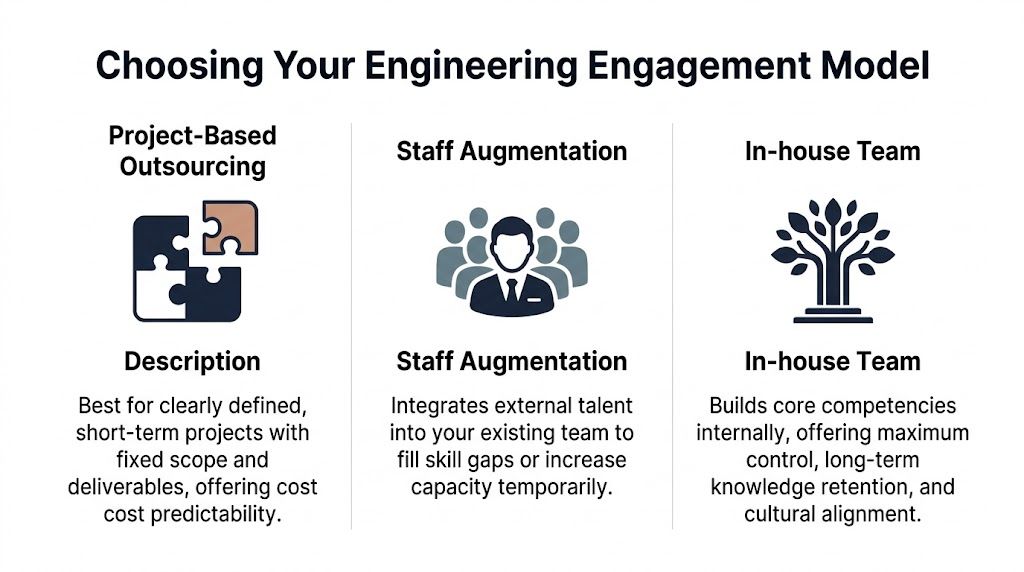
Founders usually choose among three models. None is universally right. The correct answer depends on your stage, internal leadership, and how much product complexity sits outside the spec.
Comparison of Engineering Engagement Models
| Factor | Project Outsourcing | Staff Augmentation | Dedicated Team |
|---|---|---|---|
| Best fit | Well-defined MVP or contained module | Existing internal team with skill gaps | Ongoing product development in a regulated setting |
| Scope flexibility | Lower once delivery starts | Moderate | High |
| Product ownership | Mostly vendor-led during build | Shared with internal leadership | Shared, with stronger continuity |
| Speed to start | Often fast | Fast if internal processes exist | Moderate, but better for sustained velocity |
| Knowledge retention | Lower | Higher inside your company | High if team stays stable |
| Management load on founder | Lower early, higher if handoff is weak | High | Moderate |
| Compliance context continuity | Variable | Depends on internal leads | Usually stronger over time |
| Cost predictability | Higher for fixed scope | Variable | More stable for long-running roadmaps |
Project outsourcing works when the problem is truly bounded
Project-based outsourcing is useful when you know exactly what you're building and what "done" means. A patient intake portal, internal admin dashboard, or specific interface layer can fit this model.
The problem is that many healthtech founders think their product is defined when it isn't. Clinical workflows shift. Buyer requests surface during pilots. Compliance requirements sharpen once legal and security reviews begin. A fixed-scope contract can become a change-order machine.
Use this model when the product risk is low and the business learning risk is already mostly resolved.
Staff augmentation works if you already have technical leadership
Augmentation can be efficient when you have a strong CTO, architect, or engineering manager who can assign work, review design decisions, and maintain quality standards. It helps when you need a FHIR engineer, QA specialist, DevSecOps lead, or data engineer for a focused phase.
It fails when founders expect augmented developers to create strategy on their own. They won't. That's not the model.
Bring in augmented talent to increase throughput, not to substitute for missing product leadership.
A dedicated team usually fits regulated product companies better
For most digital health startups moving from MVP into pilot, integration, and iteration, the dedicated development team model is the most durable. It gives you continuity without the overhead of hiring a full in-house group too early.
The advantage is memory. The same team learns your workflow assumptions, compliance boundaries, implementation constraints, and buyer feedback over time. In healthcare, that continuity matters because product decisions are rarely isolated. A change to onboarding often affects consent, data flow, support, reporting, and documentation.
How to decide without overthinking it
Use these questions:
- Is the product scope stable? If yes, outsourcing can work.
- Do you already run engineering well internally? If yes, augmentation may be enough.
- Will the product change repeatedly during pilots and enterprise review? If yes, choose a dedicated team or equivalent long-term model.
- Does your product depend on integrations, compliance interpretation, and operational support? If yes, optimize for continuity over short-term rate efficiency.
A cheap model becomes expensive when the team has to relearn your product every quarter.
How to Evaluate and Select the Right Engineering Partner
A polished pitch deck won't tell you whether a partner can keep your startup out of trouble. Their proposal might look modern. Their engineers might be excellent. That still doesn't mean they understand healthcare.
One of the most common failure patterns is building the stack before validating the indication and workflow. According to TechBlocks’ analysis of why digital health companies fail to gain traction, a primary reason companies fail is exhausting funds on technology validation before confirming product-market fit, and solutions that don't fit clinical workflows can see adoption drop by 40% to 60%.
Start with workflow knowledge, not framework knowledge
The first interviews shouldn't begin with React, Python, Kubernetes, or model orchestration. They should begin with the actual setting where your product lives.
Ask the partner:
- Which user is your team designing for first?
- What changes in that person's day if the product works?
- What existing systems does that user already rely on?
- Where will adoption fail if the workflow isn't mapped well?
A weak partner answers with technology. A strong one asks follow-up questions about clinicians, coordinators, nurses, technicians, billing, IT, and compliance stakeholders.
Look for evidence of healthcare-specific decision making
General software teams often underestimate healthcare in three ways. They treat compliance as documentation. They treat interoperability as a later integration issue. They treat adoption as a UI problem.
A better partner shows healthcare judgment in how they think, not just what they've built.
Use a scorecard like this during evaluation:
| Evaluation area | What good looks like |
|---|---|
| Clinical workflow understanding | Can describe how work moves across roles, not just screens |
| Compliance fluency | Understands HIPAA, GDPR, traceability, audit expectations, and security controls in delivery terms |
| Interoperability capability | Can discuss FHIR, HL7, EHR patterns, mapping, testing, and failure handling |
| Product thinking | Challenges unnecessary scope and ties features to outcomes |
| Delivery discipline | Has clear rituals for backlog, QA, release control, and issue escalation |
| Communication | Gives direct answers, names trade-offs, and documents assumptions |
Test how they handle ambiguity
Early-stage digital health products change constantly. Clinical input changes the workflow. Buyer procurement changes security requirements. New evidence changes product positioning.
Don't ask a partner only for polished success stories. Ask them about a moment when a requirement changed late and what they did next. You want to hear how they controlled risk, documented decisions, and protected the roadmap.
If a partner never pushes back, they aren't advising you. They're taking orders.
Ask architecture questions that expose depth
You don't need to turn the selection process into a technical exam. You do need enough depth to spot rehearsed answers.
Try questions like these:
- How would you design access control for multiple user roles across patient and provider contexts?
- What would you log by default for auditability?
- How would you isolate protected health information from analytics workloads?
- What would you build first if EHR integration is likely but not confirmed?
- How would you validate workflow fit before expanding the feature set?
The strongest answers usually include trade-offs, not certainty. That's what you want. Healthcare products live in constraints.
Red flags that should end the conversation
Not every warning sign is technical. Some are operational.
- They promise fixed timelines before discovery: That often means the estimate is sales-led.
- They avoid discussing compliance responsibility: That creates dangerous ambiguity later.
- They can't explain QA in healthcare terms: Regulated products need more than bug fixing.
- They rely on a single architect or founder for every answer: That creates delivery fragility.
- They don't ask about reimbursement, implementation, or support: That suggests a build-only mindset.
The right partner helps you avoid building a product that's technically functional but commercially weak.
Navigating Timelines Costs and Risk Mitigation
Founders often ask for a budget before they've defined the risk posture of the product. That's backwards. In digital health, timeline, cost, and risk are tightly linked. If you compress one without understanding the other two, you'll usually pay later in rework, delays, or failed security review.

The biggest cost mistake isn't paying for engineering. It's paying twice for the same system because the first version ignored regulated delivery discipline.
What actually drives timeline and budget
A simple patient-facing app with limited data handling isn't in the same category as a workflow tool that touches EHRs, role-based permissions, and operational reporting. Product complexity comes from what must be true behind the interface.
Your budget is shaped by factors like:
- Integration load: EHR, labs, devices, identity systems, and admin tools increase design and testing work.
- Compliance depth: Audit trails, validation, traceability, and access controls add effort but reduce future risk.
- User diversity: A product serving patients, clinicians, and internal operations needs more workflow and QA coverage.
- Post-launch responsibility: Monitoring, support, release controls, and issue triage affect real operating cost.
If you're trying to benchmark the broader economics of app builds, this breakdown of mobile app development costs is a useful companion piece. It helps founders separate surface-level feature pricing from the deeper cost drivers that usually decide whether a budget is realistic.
Compliance work is a schedule decision
According to Andela’s healthcare engineering whitepaper, failing to embed traceable regulatory requirements into the SDLC can delay market entry by 12 to 18 months and increase costs by 20% to 30%. The same source notes that integrating risk management through ALM tools can reduce mitigation efforts by 40% to 50%.
Those numbers explain why experienced teams build compliance into delivery mechanics. They don't wait for a final audit pass.
That means:
- Requirements are traceable: Product decisions map to controls, tests, and release records.
- Security reviews happen continuously: Not once, at the end.
- QA validates expected behavior against intended use: Not just against user stories.
- Change control exists early: Especially once pilots begin.
As we explored in our guide to compliance-driven software development, teams that treat compliance as a parallel workstream usually move more predictably than teams that bolt it on after the build.
DevSecOps is risk control, not process theater
A lot of startup teams hear "DevSecOps" and picture ceremony. In practice, it's how you prevent avoidable surprises.
A sound engineering partner should be able to describe how they handle:
| Risk area | What the process should include |
|---|---|
| Code quality | Reviews, branching rules, static analysis, test coverage expectations |
| Security | Dependency review, secrets handling, environment separation, access policies |
| Release safety | CI/CD controls, rollback plans, approval gates, deployment logs |
| Compliance evidence | Requirement mapping, validation records, change history, audit support |
| Operational stability | Monitoring, alerting, incident handling, backup and recovery plans |
Smart digital health teams don't aim for the fastest possible release. They aim for the fastest safe release they can repeat.
A realistic founder mindset
You don't need to gold-plate an MVP. You do need to identify which shortcuts are harmless and which ones create hidden debt.
Skipping nonessential features is fine. Skipping auditability, release discipline, or security architecture usually isn't. When founders understand that distinction, engineering support becomes easier to buy well.
One practical option in this space is a partner that combines product engineering services with cyber compliance solutions, so architecture, delivery, and compliance controls are planned together rather than negotiated across separate vendors.
Scaling Your Platform From MVP to Enterprise
Products that win pilots still fail enterprise rollouts. In digital health, that usually happens because the product was built to prove demand, not to survive procurement, implementation, reimbursement pressure, and multi-site operations.

The essential scaling question is not whether the MVP works. It is whether the business can afford to keep delivering it as customer count, data volume, and buyer expectations rise.
That shift changes the engineering brief. A pilot can tolerate manual workarounds. An enterprise customer will expose them fast. If every deployment needs custom configuration, if support needs engineers to inspect production data, or if one customer request forces a branch in the codebase, revenue growth starts to drag operational cost behind it.
Enterprise scale starts with architecture that supports repeatable delivery. Teams usually need clear service boundaries, stronger tenant separation, better audit trails, and release processes that let one customer go live without putting another at risk. Performance matters, but supportability often matters first. I have seen more healthtech companies lose momentum to messy implementations and slow issue resolution than to raw infrastructure limits.
As discussed in our guide to building scalable healthtech platforms, growth usually exposes weak architecture through onboarding delays, support escalation, and implementation exceptions before it shows up as a load problem.
Reimbursement and margins shape technical decisions
Founders often treat reimbursement as a commercial problem for later. That is a mistake. The delivery model affects unit economics from the start.
A PMC article on digital health implementation and support barriers describes a recurring issue. Post-deployment support activities such as troubleshooting and user training are often hard to reimburse directly. For a startup, that means every manual support dependency should be viewed as a margin decision, not just a service decision.
If clinicians need repeated hand-holding to complete onboarding, or if each customer requires one-off workflow tuning by your engineering team, adoption can still rise while the business gets weaker. Investors notice that pattern. So do enterprise buyers who want evidence that your team can support a broader rollout without adding headcount at the same pace as revenue.
What scalable support looks like in practice
The better approach is to design the product so implementation and support become more repeatable over time.
That usually includes:
- Role-based onboarding that reduces training time for clinicians, admins, and support staff
- In-product guidance that answers common questions without opening a ticket
- Admin and operations dashboards that let non-engineering teams diagnose routine issues
- Configuration tools that handle customer variation without custom code
- Structured event logging that gives support, compliance, and product teams a shared record of what happened
These choices are not cosmetic. They affect sales capacity, gross margin, and renewal risk.
A digital health platform starts to scale when the product absorbs more of the implementation burden itself.
Ongoing engineering support is part of the business model
Healthcare customers rarely buy a static application. They buy a platform they expect to integrate, validate, update, and expand over time. That means engineering work continues after launch in ways that directly affect commercial outcomes: payer requirements change, provider workflows shift, APIs evolve, and reporting expectations become stricter as larger customers come in.
Founders should plan for that continuity early. The company that budgets for ongoing platform work, support tooling, and architecture cleanup usually has more options later. It can pursue enterprise contracts with less delivery risk, defend margins as support volume grows, and show investors that scale will come from repeatable operations rather than heroics from the engineering team.
Your Action Plan for Securing Engineering Support
More funding is flowing to fewer companies, and founders feel that pressure in every product and hiring decision. Engineering support is one of the earliest choices that shapes whether the company looks investable, implementable, and credible to buyers.
Treat this as a company-building decision, not a procurement task. The partner you choose will influence how fast you can test workflow fit, how much custom work each customer needs, and whether your platform can support future reimbursement and enterprise diligence without a rewrite.
A founder checklist that actually helps
Use this sequence before you sign with any partner:
-
Define the first workflow
- Name the first user.
- Name the exact task that gets easier.
- Define what evidence would prove the product is useful.
-
Decide what kind of product company you are
- Workflow software
- AI-enabled decision support
- Patient engagement platform
- Infrastructure layer for providers or payers
-
Write down the constraints that will affect commercial viability
- Compliance boundaries
- Data sensitivity
- Integration assumptions
- Required audit behavior
- Reporting needs for customers, partners, or reimbursement
- Post-launch support expectations
-
Choose the engagement model that fits the actual risk
- Stable scope fits contained delivery.
- Ongoing uncertainty fits a team that stays involved through changes, customer feedback, and implementation learning.
-
Interview partners on judgment, not headcount
- Ask how they validate workflow fit before building
- Ask how they handle changing requirements after discovery
- Ask how they document architectural and compliance risk
- Ask what they would postpone in version one, and why
-
Test whether they connect engineering choices to business outcomes
- Do they challenge features that add build cost without improving adoption?
- Can they explain how architecture affects implementation time, support burden, and gross margin?
- Do they understand what enterprise buyers and investors will ask six to twelve months from now?
One warning from experience. Founders often hire for speed, then discover they bought rework. A team can ship screens quickly and still leave you with weak logging, fragile integrations, and no clear path to customer-specific configuration. That usually shows up later as delayed pilots, slow security reviews, and rising service cost per account.
What to do next
Shortlist two or three partners and run the same evaluation process with each one. Give them a real product scenario, ask what they would build first, what they would defer, what risks they see, and how they would staff the work. The quality of their questions matters as much as the proposal.
If you're assessing broader platform and AI delivery options, review factual material such as digital transformation consulting and an ai transformation framework in the context of your business model, not as a services menu. Then review relevant client cases and ask which engagements involved regulated workflows, integration complexity, phased releases, or long-term operational support.
A good engineering partner helps you ship the right first product, preserve room for reimbursement and enterprise growth, and avoid technical decisions that weaken margins later. That is the standard to use.
Frequently Asked Questions
FAQ
| Question | Answer |
|---|---|
| How early should a digital health startup bring in an engineering partner? | Earlier than most founders think. Bring a partner in once you've defined the first workflow and target user, but before you lock the stack. That timing helps you avoid technical decisions that don't match the business model or care setting. |
| Should we build the MVP with a generalist software team? | Only if they can show real healthcare delivery discipline. General product skill is useful, but healthcare products need stronger judgment around workflows, privacy, auditability, and integrations. |
| What's the biggest mistake first-time founders make? | They fund feature development before validating workflow fit and implementation reality. A product can look polished and still fail if it disrupts how clinicians or operators actually work. |
| Do we need compliance-heavy processes for an early MVP? | You need the parts that protect future viability. Early products don't need unnecessary ceremony, but they do need clear access control, logging, secure handling of sensitive data, and documented decisions. |
| When should we think about reimbursement? | At the product design stage. If onboarding, support, and post-deployment operations require too much manual labor, you'll create a delivery model that's hard to sustain even if customers like the product. |
| What makes a strong engineering partner different from a coding vendor? | A strong partner connects technical decisions to adoption, implementation, and commercial risk. They ask about workflows, buyer constraints, and support operations, not just backlog items. |
A final practical note. If a prospective partner talks mostly about velocity, ask what happens after go-live. Their answer will tell you whether they understand healthcare software or just software.
If you’re assessing a Bridge Global fit, start with a discovery conversation focused on workflow, compliance boundaries, integration assumptions, and scaling plans. That kind of discussion is usually more useful than a generic estimate request because it shows whether the team can think like a product partner, not just a delivery vendor.

About Preethi Saro Philip
Preethi Saro Philip is a Post Graduate Research Degree holder in Economics with more than 10 years of experience in writing, editing, research and teaching. She has an intense passion for content crafting and calls herself a ‘wordsmith’. She enjoys writing on wide-ranging topics including business, technology, health & lifestyle, education, environment etc.
View all posts by Preethi Saro Philip →