



Compliance Driven Software Development: A Practical Guide
When most development teams hear the word “compliance,” they think of roadblocks. It’s often seen as a chore – a long checklist of rules that slows down innovation and adds a ton of overhead.
But treating compliance as an afterthought is a huge, and increasingly expensive, mistake.
Why Compliance Is a Feature, Not a Flaw
Imagine trying to build a skyscraper, but you only start thinking about the fire code after the building is finished. The idea of going back to retrofit sprinklers, fire escapes, and structural supports into a completed tower is absurd. It would be inefficient, wildly expensive, and likely impossible to get right.
That’s exactly what happens when compliance is pushed to the end of a software project.
Compliance driven software development flips the script. It weaves those “fire codes” directly into your project’s blueprint from the very beginning. This proactive approach ensures your software isn’t just functional; it’s secure, trustworthy, and ready for regulated markets from the first line of code.
This isn’t just about avoiding fines; it’s about turning a requirement into a competitive edge. For any business looking to scale, especially a healthtech software development partner, this mindset is non-negotiable. It builds a foundation of trust and opens doors to lucrative markets your competitors can’t touch.
The New Reality of Regulatory Pressure
Let’s be honest: the rulebook for building and running software is getting thicker every year. It’s no surprise that a recent report found 69% of organizations find the sheer volume and complexity of regulations overwhelming to manage.
This pressure has pushed compliance from a back-office task straight into the boardroom. In fact, 21% of executives now rank compliance as their top strategic focus for the next 18 months – a massive leap from just 2% in 2024. And with new technology comes new rules; 65% of compliance teams are now directly involved in governing how their companies use AI. You can find more insights on how these compliance trends impact software development.
By treating compliance as a core feature, you are investing in your product’s long-term viability, security, and marketability. It’s a proactive measure that prevents costly fines, reputational damage, and security breaches down the line.
So, how does this work in practice? It comes down to building your entire development process on a few core pillars. Thinking this way provides a clear framework for any CTO or product leader looking to adopt a compliance-first strategy.
Key Pillars of Compliance Driven Software Development
This table breaks down the core components of a compliance-first development approach, from initial strategy to final deployment.
| Pillar | Description | Key Benefit |
|---|---|---|
| Regulatory Intelligence | Proactively identifying and interpreting all relevant regulations (e.g., GDPR, HIPAA) before development begins. | Avoids costly redesigns by ensuring requirements are clear from the start. |
| Privacy by Design | Embedding data privacy principles directly into the system’s architecture, not as a bolted-on feature. | Builds customer trust and minimizes the risk of data breaches. |
| Secure SDLC | Integrating security activities, such as threat modeling and code scanning, into every phase of the development lifecycle. | Reduces vulnerabilities and creates a more resilient and defensible product. |
| Audit-Ready Documentation | Maintaining comprehensive, real-time records of compliance activities, decisions, and controls. | Simplifies audits, reduces manual effort, and proves due diligence. |
By embedding these pillars into your workflow, you create a system where compliance is an organic outcome of good engineering, not a frantic scramble before a release or an audit.
The Business Case for a Compliance-First Mindset
Thinking about compliance as just a box-ticking exercise is a missed opportunity. Smart businesses now see it as a strategic advantage. It’s not just about avoiding trouble; it’s about actively building a stronger, more trusted company. This shift in thinking is driven by two powerful forces: the undeniable risks of getting it wrong and the huge rewards for getting it right.
On one hand, you have the “push” from regulators. A thicket of rules like GDPR, HIPAA, and SOX dictates how you must handle data. The consequences for ignoring them are no joke; we’re talking about massive fines, operational shutdowns, and a public relations nightmare that can sink a brand.
The Financial and Reputational Risks of Non-Compliance
Trying to save money by cutting corners on compliance is a dangerous gamble. Finding a critical compliance flaw after a product is already built is a recipe for disaster. The cost and disruption of retrofitting a solution are always far greater than building it correctly from the start.
This isn’t just a theory; it’s driving major market trends. The global compliance management software market was valued at USD 40.82 billion in 2026 and is expected to explode to USD 74.12 billion by 2031. This massive spending isn’t just for show. As one compliance software market report points out, it signals a fundamental shift toward weaving compliance into the very fabric of business operations.
The “Pull” Factors Driving Market Advantage
Beyond simply dodging penalties, a proactive approach to compliance creates a powerful “pull” that brings customers to your door. When you can prove your software is secure and respects user privacy, you build the one thing money can’t buy: customer trust. In a world where data breaches are common news, being the company that takes security seriously is a massive differentiator.
Suddenly, compliance isn’t a cost center anymore. It becomes a key part of your marketing message, signaling to the world that your company is mature, responsible, and a safe bet.
A strong compliance posture is a clear indicator of operational excellence. It tells the market that you not only build great software but also manage risk effectively, making you a more attractive and sustainable partner.
This is especially powerful when a custom software development process is built on these principles from day one. Truly understanding the nuances of standards like PCI DSS compliance gives you a business case that practically writes itself.
Ultimately, a compliance-first strategy is a direct investment in your company’s future growth and resilience. It allows you to:
-
Access Regulated Industries: It opens the door to high-value markets like healthcare, finance, and government that are otherwise locked.
-
Enhance Brand Reputation: You become known as the trustworthy choice, which helps attract and keep loyal customers.
-
Improve Product Quality: The discipline needed for compliance forces better architecture, tighter security, and more reliable code.
-
Increase Operational Efficiency: Getting it right from the start prevents the chaotic, expensive scramble of last-minute fixes and audit failures. As we explored in our guide to tech insurance coverage, this is another vital piece of the risk management puzzle.
When you stop seeing compliance as a burden and start treating it as a business asset, you’re on the path to building a more durable and successful company.
Integrating Compliance into Your Development Lifecycle
Trying to bolt compliance onto a finished product is a recipe for disaster. It’s like discovering you need to add a basement to a house that’s already built: messy, expensive, and fundamentally flawed. A much smarter way is to weave compliance into the very fabric of your Software Development Lifecycle (SDLC). This turns compliance from a last-minute scramble into a continuous, manageable part of how you build things.
True compliance-driven software development means every stage of the SDLC is actively shaped by your regulatory needs. It starts by asking the right questions long before a single line of code is written and follows through all the way to deployment and beyond. This approach makes compliance predictable and takes the guesswork out of the equation.
Shifting Left From Requirements to Design
The real work begins right at the start of a project. During the requirements gathering phase, your team needs to nail down every applicable regulation; whether that’s HIPAA for a health tech app, GDPR for handling user data, or SOX for financial software. These rules aren’t just suggestions; they directly inform your product’s functional and non-functional requirements.
From there, compliance shapes the design phase through a concept known as “privacy-by-design.” Instead of asking, “How do we secure this data later?” the question becomes, “How can we design the system to minimize data exposure from the very beginning?” It’s a fundamental shift in mindset.
-
Requirements: Map specific regulatory clauses (like GDPR’s “right to be forgotten”) to concrete user stories and technical tasks your developers can actually work on.
-
Design: Build the system with data encryption, access controls, and anonymization techniques as core parts of the architecture, not as afterthoughts.
Getting this right upfront saves you from painful and expensive architectural changes down the road. It ensures the foundation of your software is solid.
The diagram below shows how regulatory risks (the “push”) and business advantages (the “pull”) both drive the need for this integrated approach.
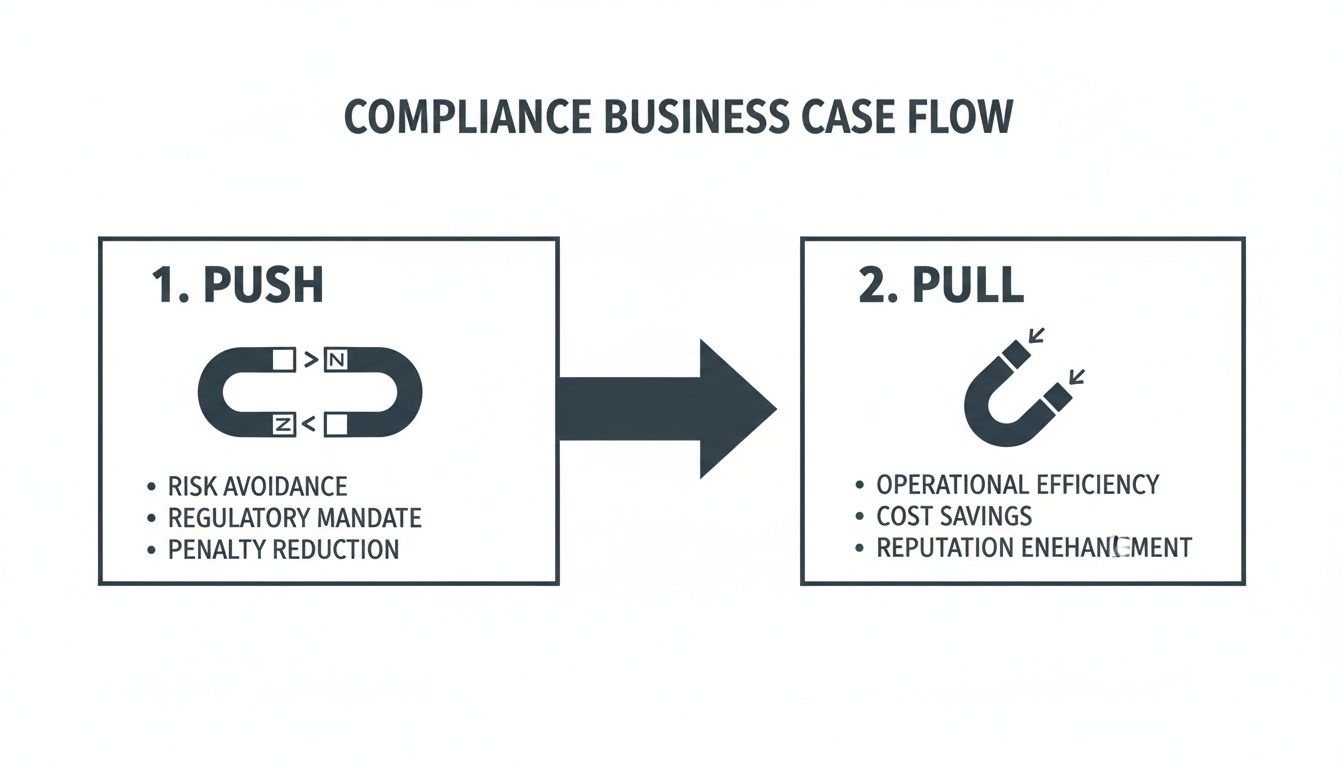
As you can see, compliance isn’t just about avoiding penalties. It’s also a real opportunity to build a more trusted and competitive product.
Automating Compliance with DevSecOps and Code
Once you move into the development and testing phases, the game becomes all about automation. This is where a DevSecOps culture really shines. By integrating security and compliance checks directly into your Continuous Integration/Continuous Deployment (CI/CD) pipeline, you create an incredibly powerful and immediate feedback loop for your team.
This practice is often called “compliance as code,” where you translate your regulatory policies into automated scripts and tests. Every single time a developer commits new code, the pipeline automatically checks it against these predefined rules.
By translating regulatory rules into automated policies, ‘compliance as code’ ensures that every single build is automatically validated against your specific requirements. This moves compliance from a manual audit process to an ongoing, automated engineering function.
For instance, an automated check could:
-
Scan for insecure coding patterns that violate your security standards.
-
Block the use of open-source libraries that have known vulnerabilities.
-
Confirm that all data-handling functions include proper logging for audit trails.
Our own product engineering services are built around this exact philosophy. We embed these automated checks to cut down on manual effort, reduce human error, and make sure every release is demonstrably compliant. This systematic approach turns compliance from a huge, scary obstacle into a predictable and manageable part of your daily workflow.
How AI Is Changing the Game for Software Compliance
Let’s be honest: trying to keep up with compliance manually is a losing battle. Regulations shift constantly, our systems get more complex by the day, and the sheer amount of data we handle is overwhelming. This is where Artificial Intelligence comes in, not as some far-off idea, but as a real, practical tool that’s already changing how we build compliant software. Discovering how to leverage AI for your business is the next competitive frontier.
AI helps by automating the most mind-numbing and error-prone parts of compliance, which frees up your developers to do what they do best: innovate. It’s like giving your team a crew of tireless assistants who can monitor new regulations, scan code for security gaps, and generate audit reports 24/7. This level of automation makes rock-solid compliance faster, more precise, and finally within reach for companies of any size.

Shifting from Reactive to Proactive Compliance
Perhaps the biggest impact AI has is moving teams from a reactive “fix-it-when-it-breaks” mindset to a truly proactive one. Machine learning models can analyze historical data to spot patterns that signal a future compliance breach. Instead of finding a problem during a stressful audit, the AI flags it the moment it starts to develop.
For instance, an AI system can:
-
Catch unusual access patterns that might point to a HIPAA data privacy violation.
-
Flag code commits that accidentally introduce a security hole that would violate SOX.
-
Automate GDPR data anonymization by finding and masking Personally Identifiable Information (PII) on the fly.
This isn’t just an improvement; it fundamentally changes the dynamic. It allows you to resolve issues before they spiral into costly data breaches, making compliance an intelligent, ongoing process instead of a periodic fire drill. As we explored in our guide on AI for software development, embedding these smart capabilities early on pays huge dividends down the road.
Creating Faster, Smarter, AI-Augmented Teams
We’re seeing a major industry shift toward smaller, highly effective engineering squads powered by AI. This isn’t just a trend; it’s a new standard for compliance-driven development. Forecasts show that by 2030, 80% of large engineering teams will evolve into these lean units, dramatically speeding up the delivery of secure and compliant software.
The pressure is on. As of 2026, 65% of compliance teams are already tasked with overseeing AI deployment, and 73% report needing new AI skills to meet tougher regulatory demands for transparency.
When AI handles the repetitive grind of compliance, it frees up your team to think bigger. They can focus on tricky architectural problems and high-level strategy, trusting that the essential compliance checks are running automatically and accurately in the background.
This is where expert guidance can make all the difference. As AI becomes more central to operations, understanding its governance becomes just as important as the technology itself. Frameworks like our AI transformation framework are becoming essential for ensuring your AI-driven systems are trustworthy and audit-ready, a topic also covered in this guide to SOC 2 for AI companies. Ultimately, AI transforms compliance from a manual enforcement chore into a source of intelligent, automated assurance.
Compliance-Driven Development in Action
Theory is one thing, but seeing how compliance works on the ground is what really matters. Compliance-driven development isn’t some generic template; it’s a mindset that adapts to the specific, high-stakes rules of different industries. Let’s look at a few real-world scenarios to see how it plays out.
By walking through these examples, you’ll see how a sharp focus on compliance shapes everything, from system architecture to the final user interface, and results in a product that’s as trustworthy as it is innovative.
Healthcare: Building a HIPAA-Compliant Telehealth Platform
Picture this: you’re building a new telehealth platform. From the very first line of code, the Health Insurance Portability and Accountability Act (HIPAA) is your north star. Every single feature, database field, and API call has to be engineered to protect sensitive patient data.
In this world, a compliance-driven approach means:
-
Secure Data Transmission: All video sessions, chats, and shared files must have end-to-end encryption. This isn’t an afterthought; it’s a foundational decision that dictates your choices for communication protocols and cloud services right from the start.
-
Strict Access Controls: The system must enforce role-based access control (RBAC) without fail. A doctor should never be able to access the records of a patient not under their direct care. On top of that, meticulous audit logs must track every view, edit, or action taken on a patient’s record.
-
Informed Patient Consent: The patient onboarding process has to be crystal clear. The UI must capture explicit consent for treatment and data use in a way that is unambiguous and securely logged.
For successful custom healthcare software development, it’s not just about a slick interface. It’s about building a digital fortress where patient privacy is guaranteed. As we’ve detailed before, this requires a deep, practical understanding of HIPAA-compliant software development from day one.
Finance: Ensuring Trust in a Fintech Application
Now, let’s jump over to the financial sector. Imagine a dedicated development team tasked with creating a new mobile payment app. They’re working under the strict watch of regulations like the Sarbanes-Oxley Act (SOX) and the Payment Card Industry Data Security Standard (PCI DSS). Here, the absolute priorities are transaction integrity, fraud prevention, and complete auditability.
This is how the team would embed compliance into the product:
-
Immutable Audit Trails: Every single financial transaction, from a simple peer-to-peer payment to a complex interest calculation, must be recorded in a tamper-proof log. This creates an undeniable source of truth for resolving disputes or satisfying auditors.
-
Data Segregation: The system’s architecture must physically and logically separate sensitive cardholder data from all other information. This data must then be encrypted both at rest (while stored in the database) and in transit (when moving across networks).
-
Regular Security Audits: A compliance-driven app is built to be audited. This means integrating tools and automated processes for regular vulnerability scanning and penetration testing, making it a routine part of the development lifecycle, not a one-off event.
In fintech, compliance isn’t just about dodging penalties. It’s the entire foundation of customer trust. People will only put their money in a system they know is secure.
Real-world success in these regulated industries proves that compliance isn’t a barrier to innovation. Instead, it acts as a guardrail, guiding development toward creating products that are robust, secure, and ready for market adoption.
Ecommerce: Respecting Customer Privacy Under GDPR
Finally, let’s look at an ecommerce platform expanding into Europe. Suddenly, the General Data Protection Regulation (GDPR) becomes a primary concern. The development focus immediately shifts to data transparency, user consent, and individual privacy rights.
A compliance-first strategy for GDPR requires:
-
Transparent Data Collection: Forget sneaky fine print. Consent forms and banners must state plainly what data is being collected (like browsing habits or purchase history) and exactly how it will be used for things like marketing.
-
Implementing User Rights: The platform must have user-friendly, built-in features that allow people to easily exercise their “right to be forgotten” (data deletion) or “right to portability” (exporting their data). These can’t just be manual support tickets; they have to be automated functions accessible to the user.
By weaving these principles into the software from the ground up, you move beyond just following rules and start building real products that earn customer loyalty. You can see how we apply these practices across industries in our client cases, which demonstrate how a compliance-first mindset leads to successful outcomes.
Building Your Compliance and Security Toolkit
Getting compliance-driven development right is about more than just a change in mindset. You need the right technology and the right people running it. It’s like equipping a world-class workshop; you wouldn’t ask a master mechanic to work without a full set of diagnostic tools, wrenches, and lifts. In the same way, your development stack needs specialized tools to build, test, and prove your software is secure.
Putting together this toolkit means carefully choosing technologies that cover different angles of security and compliance. But tools are only half the battle. Their real power is unlocked by the experts who know how to use them, and that’s where having a seasoned partner is a game-changer.
Essential Categories of Compliance Tools
To create a truly robust compliance framework, you need to layer different kinds of security and management tools. This approach creates a “defense-in-depth” strategy, where each tool has a specific job in protecting your software.
Your core toolkit should absolutely include these:
-
Static Application Security Testing (SAST): Think of these as your first line of defense, like a meticulous code inspector. SAST tools scan your source code before it’s even compiled, hunting for common vulnerabilities like SQL injection risks or other insecure patterns. Catching these flaws early saves a massive amount of time and money.
-
Software Composition Analysis (SCA): Let’s face it, modern applications are mostly assembled from open-source components. SCA tools act as your digital librarian, scanning every third-party library in your project. They flag any known vulnerabilities or license conflicts that could expose you to legal and security risks.
-
Compliance Management Platforms: These platforms are your command center for all things regulatory. They help you connect your internal processes and controls directly to specific rules from standards like GDPR, HIPAA, or SOX. More importantly, they automate the tedious job of gathering audit evidence, making compliance checks a smooth workflow instead of a frantic, manual scramble.
Beyond Tools: The Critical Role of Expertise
While the right tools give you visibility and automation, they can’t think for you. A high-powered scanner that spits out a thousand warnings is useless if no one on your team knows how to interpret the results or prioritize what to fix first. This is the gap where a true partner proves their worth.
Tools find problems; expertise solves them. A great partner doesn’t just help you pick the right software; they integrate it into your workflow, train your team, and help foster a culture where security is everyone’s job.
At Bridge Global, we don’t just offer development services. We provide complete cyber compliance solutions that pair best-in-class tools with deep, practical experience. We work alongside CTOs and CIOs to help them make smart decisions, ensuring their tech stack is a perfect match for both their business ambitions and their regulatory duties. This partnership turns a simple collection of tools into a powerful engine for building secure, compliant, and trustworthy products.
Frequently Asked Questions (FAQ)
What is the main difference between DevSecOps and compliance-driven development?
They’re closely related, but DevSecOps is the “how”; it focuses on integrating security practices into the DevOps pipeline (‘shifting left’). Compliance-driven development is the “why”; it’s a broader strategy that uses specific regulations (like HIPAA or GDPR) to define the security, privacy, and data handling rules that DevSecOps then helps automate and enforce.
How can small teams or startups afford to implement compliance-driven development?
Start by focusing only on the regulations most critical to your market. You can get a lot done by using open-source security tools (like OWASP ZAP) and the compliance features already built into your cloud provider’s platform. The most important thing is to prioritize ‘privacy-by-design’ from day one, because it’s always cheaper than fixing things later. Partnering with a healthtech software development partner can also give you a cost-effective path to compliance without a huge in-house team.
Is ‘compliance as code’ difficult to implement?
It does require an initial investment in setting up tools and training, but the long-term payoff is huge. The trick is to start small. Automate one or two critical policies first, like checking for hardcoded secrets or outdated libraries in your CI/CD pipeline. As your team gets comfortable, you can gradually expand your library of automated policies, making compliance a seamless part of how you work.
Ready to build software that’s secure, compliant, and ready for any market? Bridge Global provides expert AI development services and cyber compliance solutions to turn regulatory challenges into your competitive advantage.

About Stephanie Cornelissen
Stephanie Cornelissen is a Technical Solutions Consultant with strong experience helping organizations navigate complex digital change. She works closely with teams to align business goals with practical, scalable technology solutions. With expertise in system architecture, integrations, and emerging technologies, she focuses on solving real-world problems through thoughtful execution. She enjoys working where technology meets business strategy and measurable growth.
View all posts by Stephanie Cornelissen →