



A Guide to Building Scalable Healthtech Platforms
When you’re building a healthtech platform, scalability isn't just a nice-to-have feature on a technical checklist. It's the very foundation that determines whether your product will thrive or collapse under its own success. A platform that can scale is one that gracefully handles massive growth in users, data, and new features without needing a painful, expensive overhaul down the line.
Think about it: this is what allows a telehealth service to onboard millions of new patients during a health crisis or what enables a system to process real-time data streaming from thousands of remote patient monitoring devices.
Why Scalability Is Non-Negotiable in Healthtech
The days of building standalone, single-function healthcare apps are behind us. The market now demands interconnected digital health ecosystems that can manage explosive growth. This isn't just about handling more users; it's about building a resilient backbone for huge data streams, new technology integrations, and personalized care delivered at an unprecedented scale.
This pressure comes from the real world. A telehealth platform, for instance, has to be ready for sudden, unpredictable spikes in patient demand without crashing. Wearables and remote monitoring tools are constantly pumping out data that needs to be collected, analyzed, and turned into clinical action – often in real time. If the underlying system can't keep up, it gets overwhelmed. The result? Poor performance, frustrated users, and missed opportunities to improve patient outcomes.
A platform that can't scale is a platform with an expiration date. In healthtech, where lives and well-being are at stake, building for future growth isn't optional; it's a core responsibility.
The Forces Driving Scalable Architectures
A few powerful trends are pushing scalability from a technical goal to a top business priority for every healthtech company.
-
Explosive Market Growth: The global healthtech market is on a steep upward trajectory. This isn't just about more people using digital health; it's about how scalable systems are changing care delivery itself. They allow providers to manage a much larger patient population with AI-driven diagnostics and telemedicine without a proportional increase in costs. The market is projected to reach a staggering $1.1 trillion by 2025 and continue growing at a 13.5% CAGR through 2034. You can see just how significant this trend is in recent market analyses.
-
The Data Deluge: We're not just getting more data in healthcare; we're getting exponentially more. With over 100+ zettabytes generated annually, a scalable platform is the only way to ingest, process, and find meaning in this flood of information. It’s how you turn mountains of raw data into life-saving clinical insights.
-
Technological Convergence: We're no longer just talking about integrating AI, IoT, and big data; we're actually doing it. A scalable architecture is what lets these different technologies play nicely together, creating smarter, more predictive healthcare systems. Getting this right is complex, which is why working with a specialized healthtech software development partner is crucial to ensure every piece fits perfectly.
Ultimately, investing in a scalable platform is about future-proofing your business. It’s the difference between a fragile app that works for now and a resilient digital asset that will last for years. Since the path is littered with challenges, from architecture to compliance, many leaders choose to bring in experts in custom healthcare software development to build that solid foundation right from day one.
Choosing Your Architectural Blueprint
The architectural decisions you make at the beginning will define your platform's future. This isn't just an abstract technical choice; it's the fork in the road that determines whether you build a system that scales gracefully or one that hits a wall, forcing a painful and expensive rebuild just as you're gaining traction.
I’ve seen it happen. A platform gets a sudden surge of users or a new, data-heavy integration, and the whole thing grinds to a halt. A well-thought-out architecture is your insurance against that scenario. It’s what allows you to grow from serving hundreds of patients to millions without compromising on speed, reliability, or security.
Comparing Architectural Patterns for Healthtech Platforms
Choosing the right architecture means understanding the trade-offs. Each pattern offers a different path to scalability, and the best fit depends entirely on your product's specific needs, from real-time data processing to serving multiple enterprise clients.
| Architectural Pattern | Best For | Scalability Profile | Key Challenge |
|---|---|---|---|
| Microservices | Complex platforms with distinct business functions (e.g., billing, scheduling, EHR). | Independent, targeted scaling of individual services. | Increased operational complexity and potential for network latency between services. |
| Event-Driven | Systems requiring real-time responsiveness and asynchronous processing (e.g., IoT, remote patient monitoring). | Highly scalable for massive, concurrent data streams and event spikes. | Debugging can be complex; requires careful management of event flow and potential failures. |
| Multi-Tenant SaaS | B2B solutions serving multiple organizations (clinics, hospitals) from a single application instance. | Cost-effective scaling by sharing infrastructure across all tenants. | Requires rock-solid data isolation and security design to protect each tenant’s data. |
Ultimately, this isn’t about finding a single “best” architecture, but about selecting the one that aligns with your business goals and technical realities. Sometimes, the best solution is even a hybrid of these patterns.
Microservices: The Power of Independence
For most complex healthtech platforms, a microservices approach is a strong contender. Instead of one giant, monolithic application where everything is tangled together, you build a suite of small, independent services. Each one does one thing and does it well.
Think of a large hospital management system. It could be broken down into discrete services:
-
Patient Registration: Manages all new patient information and validation.
-
Billing & Payments: A dedicated service for handling insurance claims and patient payments.
-
Appointment Scheduling: A separate component for coordinating doctor availability and bookings.
-
EHR Integration: A specialized service that talks securely to external Electronic Health Record systems.
The beauty of this is independent scalability. If a marketing campaign causes a flood of new sign-ups, you can scale only the Patient Registration service to handle the load. The billing and scheduling services remain untouched. This focused approach saves money and builds resilience. If one service fails, it doesn’t take the entire platform down with it.
Event-Driven Architecture: For Real-Time Responsiveness
An event-driven architecture is your go-to for handling the asynchronous, real-time data that is so common in modern healthcare. This model is all about communication through “events.” A service produces an event, like a new reading from a wearable device, and other services subscribe and react to it.
Picture a remote patient monitoring platform. When a patient’s smart device flags an irregular heartbeat, it publishes a “HighHeartRate” event. Several independent services can act on this instantly:
-
An alerting service immediately pings the on-call care team’s phones.
-
A data logging service archives the incident in the patient’s permanent record.
-
An analytics service uses the data point to refine its patient risk-prediction model.
This decoupled design is incredibly scalable. It can process thousands of simultaneous events from IoT devices without choking the main application, ensuring critical alerts are never missed. When designing these intricate data flows, getting expert input from digital transformation consulting can make all the difference in getting it right the first time.
The flowchart below shows the critical choice every healthtech founder faces: plan for scale, or build an app that will eventually become obsolete.
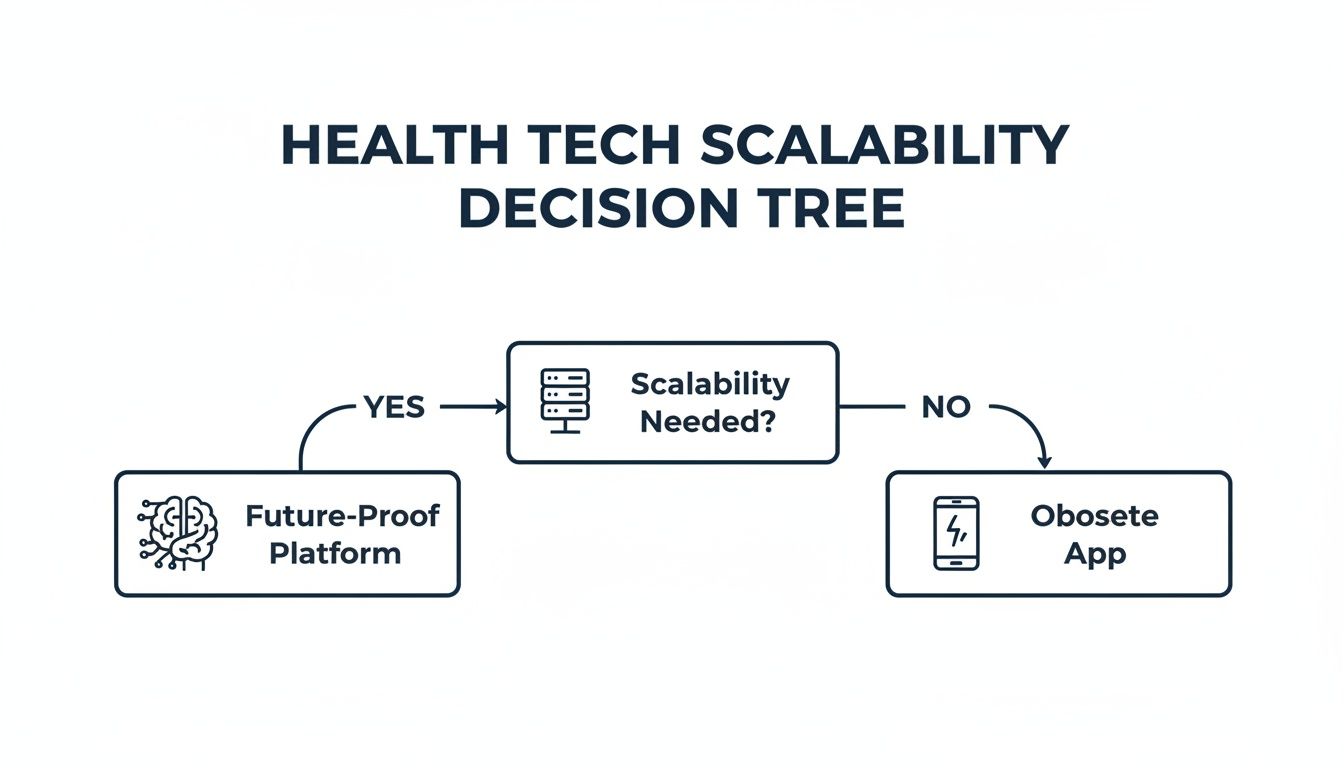
This image isn’t an exaggeration. Building a future-proof platform is an active choice, not a happy accident. Ignoring scalability from day one is a direct path to an application that simply can’t keep up.
Multi-Tenant SaaS: For B2B Efficiency
If you’re building a B2B healthtech solution: selling to clinics, hospitals, or insurance providers, a multi-tenant SaaS (Software as a Service) architecture is almost always the most efficient model. Here, a single instance of your software and infrastructure serves all your customers (or “tenants”).
The core principle of multi-tenancy is shared resources with strict data isolation. Each tenant’s data is logically separated and secured, ensuring that one clinic cannot access another’s patient information.
This approach massively reduces operational costs. You’re maintaining one codebase and one infrastructure stack, not spinning up new servers for every customer. Updates are pushed once to everyone. The trade-off? It requires a bulletproof design to guarantee security and prevent a “noisy neighbor” problem, where one tenant’s heavy usage degrades performance for everyone else. Nailing this requires deep expertise, which is why many companies turn to specialized product engineering services that live and breathe secure, multi-tenant systems.
Data Interoperability and Regulatory Compliance
In healthtech, data is everything. It’s your single most valuable asset, but it’s also your biggest liability. If your platform’s data is locked away in a silo or, even worse, left insecure, your product isn’t just failing to deliver; it’s creating risk. Building a platform that can actually scale means tackling the twin challenges of data interoperability and regulatory compliance right from the very beginning.

This isn’t about just ticking boxes on a checklist. It’s about engineering a secure, connected health ecosystem. Interoperability lets different systems speak the same language, and solid compliance is what builds the trust that allows them to communicate in the first place.
FHIR: The Lingua Franca of Health Data
I like to think of FHIR (Fast Healthcare Interoperability Resources) as the universal translator for health information. It’s a modern standard that lays out exactly how health data should be exchanged between different software systems, no matter who built them or what technology they use. Because it’s built on web-based APIs, it’s far more flexible and easier for developers to work with than older standards like HL7v2.
In the real world, this means a patient-facing app can use a FHIR API to securely pull a specific lab result from a hospital’s EHR, grab a medication history from a pharmacy’s system, and push appointment updates to a clinic’s scheduler. All of this happens through a consistent, predictable data format. This seamless data flow is what powers a truly connected health experience. As we explored in our guide on FHIR integration, getting this right is crucial for success.
Adopting FHIR isn’t just a technical decision; it’s a strategic one. It makes your platform inherently more valuable by enabling it to plug into the broader healthcare ecosystem, opening up new partnerships and use cases without the pain of building custom, one-off integrations every time.
Navigating the Maze of HIPAA and GDPR
Let’s be direct: compliance with regulations like HIPAA (Health Insurance Portability and Accountability Act) in the U.S. and GDPR (General Data Protection Regulation) in Europe is completely non-negotiable. A single breach can be catastrophic, leading to massive fines and destroying the trust you’ve worked so hard to build.
Instead of a dry legal lecture, let’s focus on the practical technical controls you need to implement.
Core Safeguards to Build Into Your Platform:
-
End-to-End Encryption (E2EE): All protected health information (PHI) must be encrypted, both in transit (as it moves across networks) and at rest (when it’s sitting in your database). No exceptions.
-
Role-Based Access Control (RBAC): This is the principle of least privilege. Users should only be able to access the absolute minimum data needed to do their jobs. A billing clerk doesn’t need to see clinical notes, period.
-
Ironclad Audit Trails: You have to be able to trace every single action involving PHI. Who accessed what? When did they do it? What changes did they make? This logging is your lifeline during a security investigation or compliance audit.
-
Data De-identification: For any analytics, machine learning, or research, data must be properly de-identified to strip out anything that could trace back to an individual patient.
These controls are the foundation of a trustworthy platform. It’s why we always insist on weaving cyber compliance solutions into the development lifecycle from day one, not as a panicked afterthought.
If you want a clearer path to implementing these safeguards, it’s worth getting familiar with the official HIPAA Security Rule requirements.
How Compliance Drives Scalability
Many engineering teams fall into the trap of seeing compliance as a roadblock that slows them down. I’ve found the opposite is true: a compliant architecture is an inherently scalable one.
The digital health market is exploding. Valued at $323.87 billion in 2026, it’s projected to hit a staggering $1,258.64 billion by 2033; that’s a 21.4% CAGR. Telehealth alone commanded a 61.5% market share in 2026. This kind of growth is only sustainable on a bedrock of trust. With the average healthcare data breach costing $10 million, patients and providers simply won’t use platforms they feel are insecure.
This highlights a fundamental truth: trust scales. When patients and providers know their data is protected, they are far more willing to adopt and engage with your platform. Building that trust demands real expertise in the nuances of health data. It’s why so many companies turn to specialists in custom healthcare software development, who know how to build these safeguards from the ground up, as you can see from our client cases.
Using AI for Smarter Scalability
True scalability isn’t just about handling more data; it’s about getting smarter with that data. This is where artificial intelligence and machine learning really come into play. They’re the engines that can turn a healthtech platform from a simple database into a dynamic system that learns, adapts, and actively improves both clinical outcomes and operational flow.

The impact is real and measurable. Think about a hospital using predictive analytics to forecast ER patient surges. By anticipating these peaks, they can adjust staffing in advance, which helps prevent staff burnout and maintain high care standards. It’s a perfect example of scaling intelligence, not just infrastructure.
Practical AI Applications That Drive Scalability
Bringing AI into your platform isn’t about chasing the latest buzzword. It’s about solving concrete scalability problems with focused applications. These tools don’t just add bells and whistles; they create genuine operational leverage, empowering organizations to achieve more.
Here are a few powerful examples I’ve seen work wonders:
-
Predictive Operations: AI models can sift through historical data, weather forecasts, and even local community events to predict patient influx, appointment no-shows, and supply needs. This shifts the entire operational posture from reactive to proactive.
-
Automated Triage and Diagnostics: We’re seeing machine learning models perform initial reads on medical images like X-rays or MRIs, flagging high-priority cases for radiologists. This gives expert clinicians their most valuable resource back: time to focus on complex, critical diagnoses.
-
Generative AI for Administrative Tasks: The administrative load on clinicians is a massive problem. Generative AI can tackle it head-on by drafting clinical notes from conversations, summarizing lengthy patient histories, or generating personalized follow-up instructions.
To make any of this a reality, your AI models need a constant flow of high-quality, real-time data. This is why building on top of scalable AI data streaming platforms is so fundamental. They are the data backbone that makes intelligent scaling possible.
From Use Case to ROI: The AI Implementation Path
Successfully adopting AI is a journey, not a single leap. It starts by identifying the right problems to solve, the ones that are causing the most friction or cost, and then building the technical and organizational muscle to execute. Following a proven AI transformation framework is a great way to zero in on high-impact use cases that actually align with your strategic goals.
This isn’t about one-off projects. It’s about cultivating an AI for your business mindset. The ultimate goal is to create a virtuous cycle where your platform gets smarter as it grows, delivering tangible returns like lower operational costs, better patient throughput, and improved clinical outcomes.
AI is the scalability superpower for healthtech platforms, with the global AI in healthcare market expected to jump from $39 billion in 2025 to an astonishing $504 billion by 2032. This explosive growth shows how AI helps platforms manage massive datasets and drive efficiency.
A recent 2026 industry outlook showed that over 80% of healthcare leaders believe AI-driven changes are key to addressing financial pressures and workforce shortages. They see the potential for scalable tools to boost clinician productivity by up to 40%. As you can see from these AI-driven healthcare trends from Deloitte, the key is moving away from rigid on-premise setups toward modular, API-first platforms that play well with EHRs, IoT devices, and telehealth services.
Turning these ambitious ideas into robust, compliant software is where specialized expertise becomes invaluable. Partnering with a team that offers expert AI development services can bridge the gap between a great concept and a market-ready product. They bring the hands-on experience needed to navigate the complexities of training models on sensitive health data while ensuring the final solution is both effective and secure. As we explored in our guide on practical healthcare AI solutions, this strategic partnership is key.
Building Your A-Team and Process
You can have the most brilliant architecture in the world, but without the right people and processes, it’s just a blueprint on a server. I’ve seen it happen. When you’re building a healthtech platform, the team you assemble and the rhythms you establish are every bit as important as your tech stack. It’s about blending different kinds of genius and creating a culture that can move quickly without ever compromising on the serious responsibility of healthcare.
The core of any successful healthtech project is a truly cross-functional team. This goes way beyond just developers and project managers. Think of it as building a “Centaur Team,” a concept borrowed from AI chess, where a human working with a computer can beat any human or computer alone. For us, it means putting developers, DevOps engineers, security specialists, and data scientists at the same table with one indispensable group: clinical advisors.
This mix isn’t a “nice-to-have”; it’s your foundation. Your developers are brilliant at building things, but your clinical advisors are the ones who can tell you if a feature is actually safe, usable in a chaotic hospital setting, or solves a genuine medical need. It’s no surprise that over 80% of HealthTech unicorns were started by founding teams, not individuals. The field is simply too complex for a solo act.
Adapting Agile for Healthcare
The “move fast and break things” mantra of Silicon Valley is a non-starter in healthcare. A bug in a social media app is an annoyance; a bug in a clinical platform can be a catastrophe. This doesn’t mean we have to abandon agile principles, but it does mean we need to adapt them into a more rigorous process, which I call validated iteration.
Here’s what that looks like in practice:
-
Clinical Checkpoints in Every Sprint: A sprint doesn’t end with a technical demo. It ends when clinicians have reviewed the new feature for safety, workflow fit, and real-world usability. Their sign-off is the true definition of “done.”
-
Compliance as a Core Feature: Don’t treat regulatory work as a separate, painful phase at the end. Weave it directly into your development process. An audit trail for HIPAA isn’t just a requirement; it’s a “user story” in your backlog with the same weight as any other feature.
-
Automated Guardrails: Build your quality and security checks directly into your CI/CD pipeline. Every single code commit should be automatically scanned against your benchmarks before it ever gets close to a production environment.
This tweaked version of Agile lets you keep your momentum while ensuring the platform is being built on a foundation of safety and trust. To dig deeper into finding a team that gets this, see our guide on choosing a healthtech software engineering partner.
The Strategic Value of Team Augmentation
Trying to hire an in-house expert for every single niche skill, from FHIR integration to AI model tuning, is a fast way to burn through your budget. This is where augmenting your team strategically can be a game-changer. By partnering with a flexible, dedicated development team, you can instantly tap into specialized talent exactly when you need it.
This approach gives you the power to ramp up development for a big feature push or scale back during slower periods, all without the overhead of permanent hires. It makes the entire process of custom software development more agile and financially sustainable.
In healthtech, your process is part of your product. A disciplined, cross-functional, and compliance-first process is what turns a promising idea into a trustworthy platform that doctors and patients can depend on.
Finally, you need to bake in reliability from day one. This is where Site Reliability Engineering (SRE) comes in. SRE takes an engineering approach to operations, using automation to manage infrastructure, monitor performance, and handle incidents. When downtime isn’t an option, you need a proactive system for keeping the lights on, and SRE provides that discipline. This entire journey is a core part of a larger strategy, often guided by expert digital transformation consulting.
Frequently Asked Questions (FAQ)
What is the biggest mistake companies make when building a scalable healthtech platform?
The single biggest mistake is treating scalability and compliance as afterthoughts. Teams often prioritize shipping an MVP, assuming they can add security or scale up later. This almost always leads to costly re-architectures, massive technical debt, and critical compliance gaps. In healthcare, where trust is paramount, these are unacceptable risks. From day one, think in terms of a scalable architecture like microservices, bake in interoperability with standards like FHIR, and integrate security controls into your development process.
How can I balance high development costs with the need for a scalable architecture?
The key is to be strategic and invest incrementally. You don’t need to build a massive, feature-complete platform at once. Instead, build one core service correctly using a scalable pattern to prove the model. Leverage pay-as-you-go cloud services (AWS, Azure, GCP) to avoid large upfront capital expenses. Augmenting your team with a flexible, dedicated development team is another smart move. It gives you access to specialized skills without the long-term overhead, allowing you to scale development power based on funding and milestones.
How critical is AI integration for a new healthtech platform?
AI is no longer a “nice-to-have”; it’s a core component for intelligent scaling and staying competitive. However, this doesn’t mean you need a complex neural network from the start. Your architecture must be “AI-ready” with clean data pipelines and well-defined APIs. Begin with practical AI applications that offer a clear ROI, such as automating administrative tasks, using predictive analytics for operational planning, or deploying a simple chatbot for patient inquiries. A partner with strong AI development services can help you identify these high-impact opportunities.
What is the role of the cloud in building scalable healthtech platforms?
The cloud is the non-negotiable foundation for any modern, scalable healthtech platform. Public cloud providers offer elasticity (scaling resources based on demand), managed services (freeing your team to focus on the product), and compliance support (offering HIPAA-eligible services). Trying to achieve this level of reliability and security with on-premise infrastructure is prohibitively expensive and complex. Therefore, the cloud is the default starting point for any custom software development project in healthtech.
Building a scalable healthtech platform is a complex journey, but you don’t have to do it alone. At Bridge Global, we are your dedicated healthtech software development partner, bringing two decades of agile delivery and deep AI expertise to turn your vision into a secure, compliant, and future-ready product.

About Stephanie Cornelissen
Stephanie Cornelissen is a Technical Solutions Consultant with strong experience helping organizations navigate complex digital change. She works closely with teams to align business goals with practical, scalable technology solutions. With expertise in system architecture, integrations, and emerging technologies, she focuses on solving real-world problems through thoughtful execution. She enjoys working where technology meets business strategy and measurable growth.
View all posts by Stephanie Cornelissen →