



Finding Your Ideal Healthtech Software Engineering Partner
Picking a healthtech software engineering partner isn’t like hiring any other developer. You’re not just looking for people who can write clean code; you’re looking for a strategic team that lives and breathes the complex world of healthcare, from patient data privacy to the intricacies of clinical workflows.
This decision is one of the most important you’ll make. It directly impacts your ability to innovate quickly, manage risk, and ultimately, improve patient outcomes.
Why Your Healthtech Software Engineering Partner Is Your Most Critical Hire
In the high-stakes environment of healthcare technology, your software’s quality and compliance can make or break your company – and can have real-world consequences for patient safety. The market is exploding, valued at USD 1,002.10 billion in 2024 and on track to reach a staggering USD 2,556.39 billion by 2032. That’s a 12.6% CAGR, driven by the massive push toward digital-first healthcare.
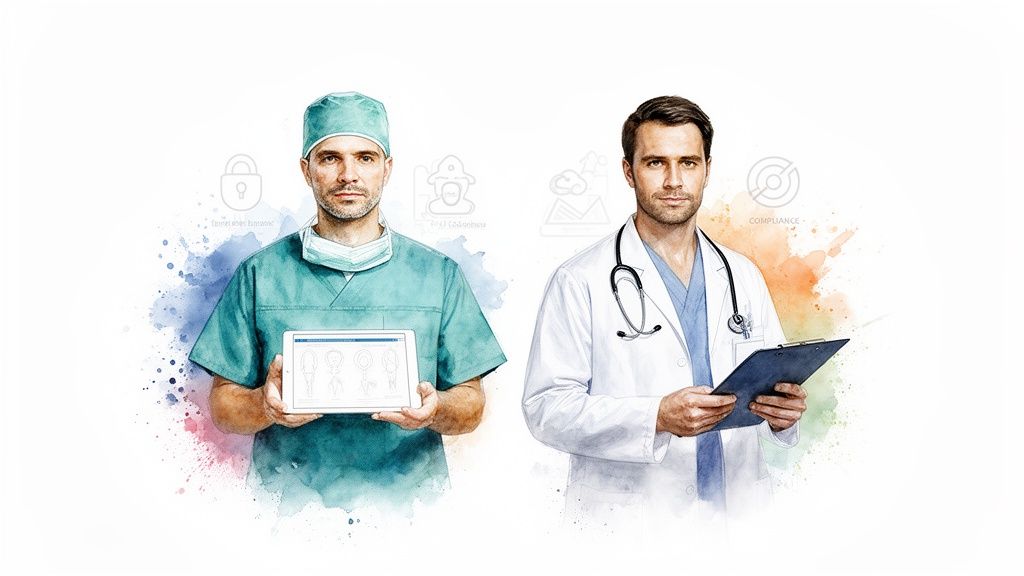
Think of it this way: you wouldn’t ask a general family doctor to perform open-heart surgery. Both are medical professionals, but only the surgeon has the hyper-specialized skills needed for such a complex and high-risk procedure. The same logic applies here. A generalist software firm might be able to build an app, but a dedicated healthtech software development partner is your specialized surgical team.
The Specialist Advantage in Healthcare Technology
So, what truly sets a specialist partner apart from a general vendor? It’s their deep-seated understanding of the industry’s unique demands. Their value goes far beyond just shipping code.
A true partner brings:
- Deep Regulatory Knowledge: They don’t just get HIPAA or GDPR. They design and build your software with compliance baked into its DNA, anticipating data privacy and security requirements from the very first line of code.
- Clinical Workflow Fluency: An experienced partner speaks the language of clinicians. They know how to build tools that fit naturally into the chaotic, fast-paced workflows of a hospital or clinic, which is the key to user adoption.
- Proactive Risk Mitigation: They have the experience to spot potential compliance landmines, security holes, and integration nightmares long before they become expensive, time-consuming emergencies.
Choosing the right partner means you’re not just building a product; you’re creating a compliant, secure, and genuinely useful medical tool. This decision has a direct line to your time-to-market, your appeal to investors, and your ability to earn the trust of both patients and providers. As we explored in our guide on the top AI companies in healthcare, this specialized knowledge is what separates the winners from the rest.
For any CTO or product leader, getting this right is non-negotiable. The right partner becomes a true extension of your own team – a guide to help you navigate the regulatory maze and build technology that actually makes a difference. This guide will give you a clear roadmap to find that partner and set your next project up for success.
The Core Services of a Modern Healthtech Partner
When you bring on a healthtech software engineering partner, you’re not just hiring coders. You’re looking for a specialist who understands the unique pressures of the medical world and can deliver specific, high-impact services. These capabilities are the engine for any modern healthcare platform, boosting efficiency, improving patient outcomes, and locking down sensitive data.
Let’s get practical and look at the services that separate a true partner from just another vendor. These aren’t just features on a checklist; they’re the foundational pillars of any digital health solution that’s built to last.
AI-Driven Development and Analytics
Artificial intelligence has moved out of the research lab and into the clinic. A strong partner knows how to use AI to build systems that do more than just store data; they generate real, actionable intelligence. We’re talking about creating predictive models that can flag high-risk patients or even forecast disease trends.
Our AI development services are built to turn raw health data into life-saving insights. Imagine an AI platform that analyzes years of hospital admission patterns to predict patient surges. This allows for smarter staff scheduling, ensuring doctors and nurses are exactly where they need to be, right when they’re needed most. This is a clear path to improving both operational efficiency and the quality of patient care. You can dig deeper into how we help organizations achieve this by learning more about implementing AI for your business.
Regulatory Compliance and Security by Design
In healthcare, security isn’t an add-on; it’s the bedrock of everything you build. A top-tier partner doesn’t treat HIPAA or GDPR as a final hurdle to clear. Instead, they weave compliance directly into the software’s architecture from the very first line of code. It’s an approach we call “compliance by design.”
This means putting concrete protections in place:
- Robust Encryption: All patient data, whether it’s sitting in a database or moving across a network, must be fully encrypted and unreadable to anyone without authorization.
- Continuous Threat Monitoring: Automated systems should be working 24/7, actively scanning for vulnerabilities and potential threats long before they can become a problem.
- Strict Access Controls: The system must be built so that clinicians and staff can only see the specific patient information required for their job, drastically reducing the risk of internal data leaks.
A partner’s approach to security is a deal-breaker. By building strong cyber compliance solutions into the development process, they shield your organization from devastating data breaches and regulatory penalties, which topped $9.16 million in 2024 for HIPAA violations alone.
Seamless EMR and EHR Integration
Fragmented data is one of healthcare’s most persistent headaches. When a patient’s story is split between the hospital’s Electronic Medical Record (EMR), a specialist’s Electronic Health Record (EHR), and the lab’s system, no one has the full picture.
A skilled engineering partner acts as your data architect, building secure connections that unite these disconnected systems. Using industry standards like HL7 and FHIR, they create a single, unified view of the patient. This gives clinicians the clarity they need to make better decisions, cuts down on redundant tests, and ultimately gives patients a much smoother experience. This kind of custom healthcare software development is essential for any modern care provider. As we explored in our guide, this level of expertise is crucial for successful digital health platform engineering.
Scalable Telehealth and RPM Platforms
Virtual care is no longer a temporary fix; it’s a permanent part of the healthcare landscape. A proven healthtech software development partner knows how to build telehealth and Remote Patient Monitoring (RPM) platforms that are not only secure but can also scale to meet growing demand.
These aren’t just simple video chat apps. They are sophisticated platforms that handle secure provider-patient communication, collect data from wearables and home devices, and fit seamlessly into existing clinical workflows. By focusing on an intuitive design for both patients and clinicians, they drive high adoption and make remote care a practical reality.
The Non-Negotiable Criteria for Partner Selection
Choosing a healthtech software engineering partner goes so much deeper than just technical skills. You’re not just hiring coders; you’re entrusting a collaborator with your product’s future and your users’ sensitive data. It’s critical to see past the polished slide decks and really dig into their actual capabilities.
The right partner doesn’t just build what you ask for. They push back, they anticipate challenges, and they build for where the industry is headed, not just where it is today.
The stakes are massive. The global Healthcare IT market was valued at USD 880.56 billion in 2025 and is expected to balloon to USD 3,715.34 billion by 2035. That staggering growth, a CAGR of 15.48%, shows just how much demand there is for specialized teams who truly get this space.
Proven Regulatory and Compliance Mastery
Let’s be blunt: a deep, proven understanding of the regulatory minefield is non-negotiable. This includes offering solid HIPAA compliance solutions. A surface-level familiarity with the rules just won’t cut it.
You need a partner who has been in the trenches and can show you the HIPAA, GDPR, and FDA-compliant solutions they’ve already built and deployed.
Ask for those specific examples. Dig into their process for risk assessments, data encryption, and even how they enforce security protocols within their own team. As we explored in our guide on building HIPAA-compliant applications, this isn’t a feature you tack on at the end; it has to be baked into their DNA. A partner who sees compliance as part of their daily development work, not a final-stage checklist, is the only way to protect your business.
Deep and Verifiable Domain Expertise
Technical talent is table stakes. The real game-changer is genuine healthcare domain expertise. Your partner absolutely must understand the messy reality of clinical workflows, the financial pressures on providers, and the day-to-day frustrations of both patients and clinicians.
This kind of insight is what turns a merely functional app into an indispensable tool that people actually want to use.
A partner with real domain expertise won’t just build a feature you specified. They’ll question your assumptions and suggest better alternatives because they know how a hospital floor or a clinic actually operates. They know the vast difference between a workflow that looks good on paper and one that a busy nurse will actually adopt.
This decision tree shows how the core pillars of a modern healthcare solution: AI, Compliance, and Integration, all have to work together.
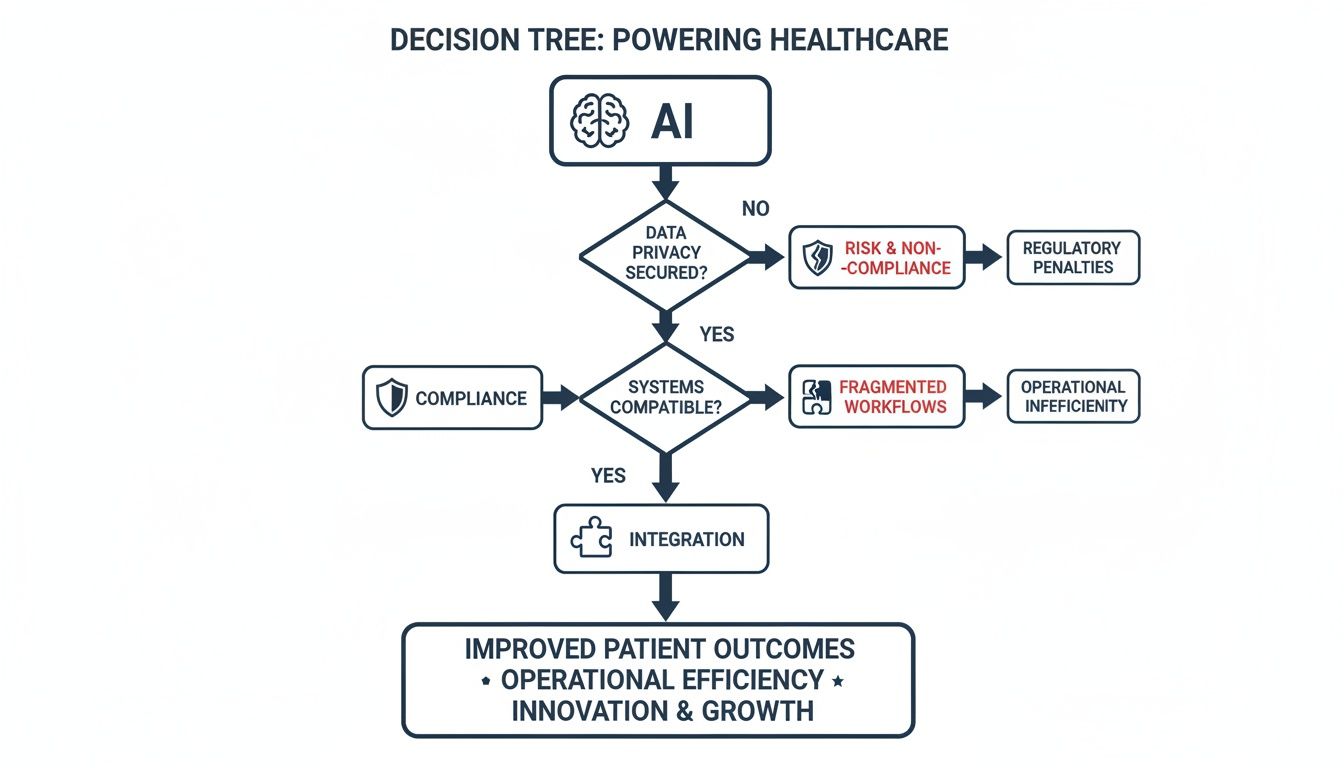
As you can see, true innovation happens at the intersection of these domains. Excellence in just one isn’t enough.
To test this, ask potential partners how they’ve tackled user adoption problems in a clinical setting before. Ask them to walk you through how they designed software to improve a specific care pathway. Their answers will tell you very quickly if they’re true healthcare specialists or just generalist developers with a healthcare client or two.
Scalable Delivery Models and Future-Ready Tech Stacks
Your needs are going to change. As your product grows from an MVP to a mature platform, you’ll need a partner who can scale and adapt right alongside you. A great partner offers flexible delivery models, not a one-size-fits-all approach.
Whether you need a couple of specialists to fill gaps in your team or a fully managed, end-to-end project team, they should have a model that fits.
But the delivery model is only half the story. You have to evaluate their tech stack. A partner still working with yesterday’s tools can’t possibly build you a product for tomorrow.
Here are the key areas to probe:
- Cloud Architecture: Do they have certified experts in AWS, Azure, or GCP? More importantly, can they show you a scalable, resilient, and cost-effective healthcare infrastructure they’ve built on those platforms?
- AI and Machine Learning: Get past the buzzwords. Ask for concrete examples of how they’ve used AI to solve a real healthcare problem. What were the results?
- Interoperability: How much hands-on experience do they have with crucial standards like FHIR and HL7? Seamless data exchange is everything in healthcare, so they need to be fluent in it.
A forward-thinking partner is already investing heavily in these areas. They are constantly training their team and exploring new technologies, ensuring the platform they build for you today is ready for whatever comes next.
Structuring Your Partnership for Measurable Success
Choosing the right healthtech software engineering partner is only half the battle. How you actually work together is what makes or breaks a project, and that comes down to the engagement model you choose.
The wrong structure can easily lead to friction, misaligned expectations, and frustrating delays. Getting this right from the start isn’t just a logistical detail; it’s the strategic foundation for building compliant, high-quality software that gets to market efficiently. It’s what separates a simple vendor transaction from a true partnership.
Finding the Right Engagement Model
Every project is different, and a seasoned partner will never force you into a one-size-fits-all box. Instead, they should offer flexible models that adapt to your specific needs, team structure, and project scope.
Here’s a breakdown of the most common models you’ll encounter:
- Team Augmentation: This is your go-to when you already have a solid in-house team but need to plug a few specific skill gaps. Maybe you need a couple of senior AI engineers or a compliance specialist to embed with your developers. It’s a smart, surgical way to add specialized expertise without the long-term overhead of hiring.
- Dedicated Development Team: When you’re tackling a major project, a dedicated development team is often the best path forward. With this model, you get a self-sufficient crew of developers, QA testers, and project managers who are 100% focused on your product. They operate as a natural extension of your organization.
- Full-Cycle Product Development: Got a project that needs to go from a back-of-the-napkin idea to a full-blown market launch and beyond? This is the most comprehensive approach. Your partner takes ownership of the entire journey, from discovery and design to development, deployment, and ongoing maintenance. This is the heart of what we do with our product engineering services.
Defining What Success Actually Looks Like
In healthtech, “success” is so much more than just shipping code on time and on budget. Real success is measured by the tangible value your software delivers: how it improves patient care, streamlines clinical workflows, and enhances operational performance. To measure the true ROI of your partnership, you have to look beyond basic project metrics.
A successful partnership is one where the partner is as invested in your business outcomes as you are. They should proactively track and report on metrics that matter to clinicians, patients, and administrators – not just lines of code.
Here are the KPIs that really show if your partnership with a healthtech software development partner is working:
- Accelerated Time-to-Market: How much faster are you getting new, compliant features into the hands of clinicians and patients? A clear reduction in development cycles is a powerful measure of your partner’s efficiency and expertise.
- Reduced Security Incidents: A measurable drop in security vulnerabilities and compliance-related issues is hard proof. It shows your partner is serious about building secure software from the ground up, not as an afterthought.
- Improved System Uptime and Performance: Clinical tools can’t afford to be slow or unavailable. Tracking system uptime and response times ensures the platform is reliable when it’s needed most.
- Positive Clinician and Patient Feedback: Ultimately, it all comes down to the end-user. High adoption rates and positive satisfaction scores are the clearest indicators that you’ve built something people genuinely find valuable.
By focusing on these outcomes, you can ensure your partnership is driving real-world improvements and delivering value long after the initial build is complete.
Real-World Examples of Healthtech Innovation
It’s one thing to talk about what’s possible in healthtech, but seeing these partnerships in action is what really tells the story. Let’s move past the theory and look at how a strategic healthtech software engineering partner can deliver tangible, game-changing results.
The momentum here is undeniable. The Digital Health market is set for explosive growth, with a projected CAGR of 25.8% between 2024 and 2029. It’s no surprise, then, that nearly 90% of healthcare executives plan to ramp up their use of digital tech in 2025. This isn’t just a trend; it’s a fundamental shift, and finding a partner who can deliver is more critical than ever. You can dive deeper into these figures in a recent report on the global digital health market.
Getting a HIPAA-Compliant Telehealth MVP to Market – Fast
We often see this scenario: a startup has a brilliant idea for a telehealth platform connecting patients with dietitians. The problem? They needed a HIPAA-compliant Minimum Viable Product (MVP) yesterday to secure their next funding round, but their small team lacked the deep compliance expertise to build it.
Solution: Rather than starting from scratch, they brought in a specialized partner. The key was to build on a secure foundation from the get-go, using a pre-vetted cloud architecture and weaving end-to-end encryption into every patient interaction. The team zeroed in on the absolute must-have features: secure video calls, private messaging, and scheduling, while ensuring every line of code met strict HIPAA rules.
Result: The startup launched its compliant MVP in just four months, a full 30% faster than they could have managed alone. This speed allowed them to sign up their first 100 patients, prove their business model, and lock in a critical seed extension round. It’s a perfect example of how targeted custom healthcare software development can help you hit a crucial market window.
Taming the Data Chaos in a Hospital System
A regional hospital system was drowning in data chaos. Patient records were stuck in different EMRs, lab results were in another system, and billing information was somewhere else entirely. This wasn’t just inefficient; it was impacting patient care and frustrating clinicians. They needed a unified view of their patients without ripping and replacing their multi-million dollar legacy systems.
When you bring scattered data streams together, you do more than just clean up a mess. You give clinicians a complete picture of a patient’s journey, empowering them to make faster, smarter decisions that lead to truly coordinated care.
Solution: The healthtech software development partner they engaged engineered a custom integration layer built on the FHIR (Fast Healthcare Interoperability Resources) standard. Think of it as a universal translator. This new hub pulled data from all the different sources in real time and displayed it in a single, easy-to-use dashboard for doctors and nurses. It was a complex job that required a deep understanding of both old-school systems and modern APIs, a challenge we’ve tackled in many of our client cases.
Result: Just six months after going live, the hospital saw a 15% drop in redundant lab tests and a major boost in clinician satisfaction. Having that unified patient view made a real-world difference, cutting down on wait times and improving how departments worked together. For ambitious projects like this, starting with an AI transformation framework is the best way to manage risk and set the stage for success from day one.
Your Next Steps Toward Healthtech Innovation
You’ve done the hard work of learning what makes a great healthtech software engineering partner. Now that you know what to look for, from essential services and engagement models to the non-negotiable criteria, it’s time to put that knowledge into practice. The key is to move forward confidently, but without taking unnecessary risks.
Jumping headfirst into a massive, high-stakes project is a recipe for anxiety. A much smarter approach is to start small. Think of it as a test drive. A low-risk, high-value engagement lets both your team and your new partner get a feel for the collaboration, align on the real-world goals, and prove the chemistry is right before you commit to a bigger investment.
Start with a Strategic Discovery Phase
The best partnerships always begin with a focused discovery phase. This is where you get everything out on the table, clarifying your vision and mapping out exactly how to get there. We typically kick things off with an AI Discovery Workshop, which is a key part of our digital transformation consulting services.
Here’s what that workshop helps you accomplish:
- Define and Prioritize Goals: We work right alongside you to nail down the most important business objectives and see how they line up with what’s technically possible.
- Assess Technical Feasibility: Our experts take a hard look at your current systems and data. This helps us figure out the best architectural path for a solution that’s both secure and built to scale.
- Create a Detailed Roadmap: You’ll walk away with a concrete, actionable plan that outlines the scope, timeline, and budget for an MVP or pilot project.
Starting this way ensures everyone is aligned from day one and builds a solid foundation for the project. For a deeper dive into managing external teams and keeping your projects on track, this guide on how to outsource software development is an excellent resource.
A pilot project or a well-defined MVP is the most effective way to test a partnership. It allows you to see how a team operates under real-world conditions, delivering tangible value quickly while minimizing your initial financial exposure.
At Bridge Global, we’re not just another vendor. We see ourselves as your partner in building what’s next in healthcare. Whether it’s our comprehensive custom software development services or our expertise in helping you implement AI for your business, we’re here to guide you at every stage. We’re ready to help you turn your vision into a secure, compliant, and genuinely impactful reality.
Ready to take that first step? Let’s talk about how a discovery workshop can get your healthtech innovation moving.
Frequently Asked Questions
Choosing a healthtech software engineering partner is a major decision, and it’s natural to have questions. Here are some of the most common ones we hear from CTOs, founders, and product leaders as they navigate this process.
What’s the Real Difference Between a General Software Agency and a Healthtech Specialist?
Think of it this way: a general agency can build you a great app, but a healthtech specialist knows the intricate world it needs to survive in. They speak the language of healthcare – not just the technical jargon, but the regulatory and clinical nuances that can make or break a project.
This goes far beyond just knowing acronyms. It’s a deep understanding of regulations like HIPAA and GDPR, hands-on experience with data standards like HL7 and FHIR, and a genuine familiarity with how clinicians actually work. A specialist partner can anticipate the roadblocks around data security, EMR/EHR integration, and user adoption because they’ve navigated them before. This expertise doesn’t just reduce risk; it gets a compliant, genuinely useful product into the hands of users much faster.
How Do We Handle Data Security and HIPAA Compliance with an Outside Team?
Trusting an external team with sensitive data starts with rigorous due diligence. First things first, check for credentials like ISO 27001 certification. More importantly, they must be willing and ready to sign a Business Associate Agreement (BAA). If they hesitate, that’s a major red flag; it’s a non-negotiable for anyone handling protected health information.
From there, you need to get into the weeds of their security practices. You should be looking for proof of:
- End-to-end data encryption for all information, whether it’s sitting on a server or moving across the network.
- Strict role-based access controls to ensure people only see the data they absolutely need to.
- Secure coding habits and a schedule for regular vulnerability checks.
A partner worth their salt will be completely open about their security infrastructure. For us at Bridge Global, our cyber compliance solutions are baked into every healthtech project from day one.
What’s the Best Way to Kick Off a Project with a New Partner?
Jumping headfirst into a massive, multi-year project is a recipe for anxiety. The smartest way to start is with a smaller, well-defined engagement that lets you test the waters. This could be a discovery phase or a tightly-scoped pilot project.
An initial AI Discovery Workshop or building a focused Minimum Viable Product (MVP) lets you see their team in action, validate their technical chops, and make sure your communication styles click.
This approach dramatically de-risks the entire relationship. You get to establish clear goals, agree on the technical architecture, and build a solid roadmap before committing a major budget. It’s a core part of our digital transformation consulting because we know it’s what sets projects up for success.
How Can AI Actually Improve Our Healthcare Software?
AI isn’t just a buzzword; it can add incredibly practical and powerful features to your software. For example, machine learning models can dig through historical patient data to predict who is at high risk for readmission, allowing for proactive intervention. They can also optimize complex hospital staffing schedules or even spot subtle patterns in medical images that a human eye might miss.
On top of that, Natural Language Processing (NLP) can be a game-changer for administrative bloat. It can parse unstructured text from doctors’ notes to streamline documentation, flag potential billing codes, and pull out critical insights that were previously buried in text. Our AI development services are all about helping organizations use these tools to move from reactive to proactive care, boost diagnostic accuracy, and automate tedious tasks, ultimately leading to better outcomes and a healthier bottom line.

About Upendra Jith
Upendrajith completed his Master's in English and has been a commercial content developer for the past three years. He's more inclined to develop content with a 'street-smart' delivery on topics such as technology, media, or anything he can get his hands on. He has a fixation on lyrics, dark poetry, media, technology, and flow arts.
View all posts by Upendra Jith →