



Healthcare AI Solutions: A Practical Guide to Implementation
Picture this: a brilliant assistant working alongside a doctor. This assistant can sift through millions of medical images, patient records, and research papers in seconds, spotting patterns a human might miss. That’s the core idea behind healthcare AI solutions. These aren’t about replacing doctors, but about giving them supercharged tools for faster, more accurate medical decisions and smoother hospital operations.
How AI Is Reshaping Modern Medicine

Artificial intelligence in medicine has officially moved from sci-fi to the clinic. Think of it as a powerful analytical engine that helps clinicians make sense of the tidal wave of data produced every single day in hospitals and labs.
By taking over routine tasks and flagging critical insights, AI gives doctors, nurses, and technicians their most valuable resource back: time. This lets them focus on the human side of medicine – providing compassionate, high-quality patient care.
The impact is being felt everywhere. We’re seeing predictive tools that catch diseases earlier than ever before and smart systems that finally solve the headache of hospital bed management. The goal isn’t to build robot doctors; it’s to arm our human experts with better instruments, just like a surgeon uses a precision scalpel.
The Driving Force Behind AI Adoption
So, why the sudden rush to adopt AI? It boils down to real, measurable benefits that tackle some of the biggest pain points in healthcare today.
Here are a few of the most compelling advantages:
-
Enhanced Diagnostic Accuracy: AI algorithms, trained on massive libraries of medical scans, can spot subtle signs of disease that are easy to overlook, often with incredible speed and precision.
-
Improved Operational Efficiency: Automating back-office work from scheduling appointments to processing bills slashes costs, cuts down on human error, and frees up staff to work directly with patients.
-
Personalized Treatment Plans: By analyzing a patient’s specific genetic data, lifestyle, and clinical history, AI helps doctors design truly customized treatment plans that lead to better results.
A Market Poised for Explosive Growth
The numbers tell a powerful story. The global AI in healthcare market is expected to explode from USD 54.19 billion in 2026 to USD 249.72 billion by 2031. That’s a compound annual growth rate of a massive 35.74%.
This incredible surge is fueled by the growing availability of health data and powerful cloud-based AI models. While North America is currently leading the charge, the trend is global. You can discover more insights about these market projections to see the full picture.
This growth sends a clear message: investing in healthcare software development has become a strategic imperative. To make it work, finding the right AI solutions partner is key. With deep expertise in custom software development, healthcare organizations can truly unlock what AI has to offer.
Real-World AI Applications in Healthcare

The real power of healthcare AI solutions isn’t in futuristic concepts; it’s in the practical, on-the-ground impact they’re making today. AI is already working behind the scenes, supporting human expertise in two fundamental areas: direct clinical care and the complex world of hospital operations.
In the clinic, you can think of AI as a specialist’s highly skilled assistant. It can process immense amounts of data at speeds no human could match, flagging potential red flags for an expert to review. On the operational side, it’s like a master logistician, untangling the administrative knots and supply chain snags that can bring a hospital to a standstill.
Clinical vs. Operational AI Solutions in Healthcare
To get a clearer picture, it helps to see how these two sides of the AI coin compare. One focuses on the patient’s body and health journey, while the other focuses on the health of the organization itself.
| Application Area | Primary Function | Key Benefit | Example Solution |
|---|---|---|---|
| Clinical | Analyze patient data to aid in diagnosis, treatment, and proactive care. | Improved accuracy, earlier intervention, better outcomes. | AI-powered medical image analysis for detecting tumors. |
| Operational | Automate administrative tasks, manage resources, and optimize workflows. | Increased efficiency, reduced costs, lower staff burnout. | Automated operating room scheduling to maximize usage. |
Ultimately, both paths lead to the same destination: a more effective and sustainable healthcare system. Clinical AI directly impacts patient health, while operational AI builds the strong foundation needed to deliver that care reliably.
Enhancing Clinical Precision and Patient Outcomes
In a clinical setting, AI’s knack for spotting subtle patterns in data is driving some incredible advances in diagnostics and proactive care. These tools give clinicians the backup they need to intervene earlier and with more confidence, which directly improves patient health.
Here are a few standout examples:
-
Medical Imaging Analysis: AI algorithms are now trained to scan X-rays, CT scans, and MRIs to spot early signs of diseases like cancer or diabetic retinopathy. The system highlights suspicious areas, helping radiologists focus their expertise where it matters most and catch problems long before they become critical.
-
Predictive Analytics for At-Risk Patients: By digging into Electronic Health Records (EHRs), AI models can identify patients who are at high risk for conditions like sepsis or a major cardiac event. This foresight allows care teams to step in with preventative measures, shifting the entire care model from reactive to proactive.
-
Personalized Treatment Recommendations: AI can sift through a patient’s genetic profile, lifestyle factors, and medical history to suggest the most effective treatment plans. This is a huge step toward true precision medicine, where care is designed for the individual, not just the condition.
These tools aren’t here to replace a doctor’s judgment; they’re here to amplify it. As we explored in our guide on AI-powered patient communication tools, healthcare AI chatbots, even patient-facing applications, are designed to support the human connection, not supplant it. For those curious about the technical side, guides on building an AI chatbot offer a great look into how these patient support systems are created.
Streamlining Hospital Operations for Peak Efficiency
Behind every great patient outcome is a hospital that runs like a well-oiled machine. This is where operational AI shines. It’s taking on the tedious tasks and logistical headaches that have bogged down healthcare for decades.
A recent study found that AI solutions can slash documentation time by 70% or more. This gives clinicians precious hours back in their day to focus on what they were trained to do: care for patients.
Operational AI is making a huge difference in areas that patients rarely see but are vital to a hospital’s health:
-
Operating Room Scheduling: Instead of a complex manual puzzle, AI can optimize OR schedules by juggling surgical times, surgeon availability, and equipment needs to minimize downtime and treat more patients.
-
Supply Chain Management: Predictive models can now forecast the demand for everything from gloves to critical medications, preventing surprise shortages and cutting down on the waste that comes from overstocking.
-
Administrative Automation: AI is a natural fit for automating tasks like medical coding, billing, and claims processing. This not only speeds up the revenue cycle but also cuts down on human error, freeing up staff for more complex problem-solving.
By tackling these operational challenges head-on, AI helps create a more resilient and efficient healthcare environment. The key is to partner with a team that gets both the technology and the unique demands of healthcare.
Working Through the Critical Hurdles of AI Compliance and Integration

Bringing healthcare AI solutions to life is much more than a technical exercise. It’s a delicate process, requiring careful navigation through a dense thicket of regulations and deeply entrenched system complexities. Before you can even begin to tap into AI’s potential, you have to lay a solid foundation of trust and security. Every solution must be built to respect patient privacy and fit neatly into the existing clinical world.
These challenges are real, but they’re far from unbeatable. The trick is to tackle them head-on from the very beginning, weaving compliance and smart integration strategies into the project’s DNA. This proactive approach saves you from costly rework down the line, helps get clinicians on board, and guarantees the final product is both effective and fully compliant.
Putting Data Governance and Patient Privacy First
In the world of healthcare, data is everything, and it’s incredibly sensitive. The absolute, number-one priority for any AI project is safeguarding patient information. This isn’t just about basic security; it’s about building a comprehensive data governance framework from the ground up.
Of course, strict compliance with regulations like the Health Insurance Portability and Accountability Act (HIPAA) is the table stakes. This means putting several critical practices into action:
-
Data Anonymization and De-identification: Before any data even touches an AI model for training, all personally identifiable information (PII) must be thoroughly scrubbed to protect patient identities.
-
End-to-End Encryption: Data has to be locked down tight. Whether it’s sitting in a database or moving across a network, it must be fully encrypted to keep prying eyes out.
-
Strict Access Controls: Not everyone needs to see sensitive data. Access should be granted on a need-to-know basis, enforced with strong measures like multi-factor authentication and role-based permissions.
Protecting private client information is a non-negotiable in healthcare. Security measures must be built into every aspect of an AI platform to foster trust between clients and providers. This includes meeting leading security standards like HIPAA, SOC 2, and ISO 27001.
Adopting a “privacy-by-design” mindset isn’t just good practice; it’s essential. A skilled partner won’t just bolt on security at the end; they’ll weave these protocols directly into the solution’s architecture right from the start.
The Challenge of Integrating with Legacy Systems
One of the biggest real-world roadblocks is getting shiny new AI tools to talk to older, often clunky, Electronic Health Record (EHR) systems. Many hospitals and clinics run on legacy platforms that simply weren’t built for the kind of data-rich, interconnected applications we have today.
This integration gap can cause serious friction, stalling projects, and leaving clinical staff frustrated. As we’ve explored in our guide, having a clear strategy for EHR integration services is absolutely crucial. It’s all about using modern APIs and middleware to act as a translator, creating a secure bridge between old and new systems. This lets data flow smoothly and efficiently without disrupting the core operations of the hospital.
Successfully connecting these systems is a specialized skill. It requires deep expertise in both modern AI and the unique, often quirky, architecture of healthcare IT. Without it, even the most groundbreaking AI model will end up stranded on its own island, unable to make a real impact.
Building Trust with Explainable AI
Finally, there’s the human element. Clinicians are rightfully wary of “black box” algorithms. If they can’t understand why an AI model is making a particular recommendation, they’re not going to trust it with patient care. This is where Explainable AI (XAI) becomes so important.
XAI is a set of tools and methods designed to make an AI’s decision-making process transparent and understandable to people. Instead of just giving you an answer, an explainable AI shows its work. It can highlight the specific features in a medical image or the exact lab values that led to a particular conclusion.
This transparency is the key to building confidence and driving adoption among doctors and nurses. By working with a team that knows the ins and outs of compliant development, healthcare organizations can ensure their AI solutions are not just powerful, but also transparent and trustworthy.
Your Roadmap to Successful AI Implementation
Launching an AI initiative can feel a bit like setting out on a major expedition. Without a clear map, it’s easy to get lost. This practical, step-by-step roadmap breaks down the journey of implementing healthcare AI solutions into five manageable phases, guiding you from a promising idea to a real, measurable impact on your organization.
A structured approach like this helps you sidestep common pitfalls, like chasing vague goals or diving in before your systems are ready. It’s all about building momentum through smart, well-planned steps. For a broader look at this process, it’s helpful to understand the general strategies for how to implement AI in business.
Phase 1: Pinpoint Your Use Case
The best AI projects don’t start with a fascination for technology; they start by solving a real problem. Before anyone writes a single line of code, you have to lock onto a specific, high-value challenge that AI is uniquely suited to address. A fuzzy goal like “improve efficiency” just won’t cut it.
You need to get granular. Think about concrete issues like “reduce patient no-show rates by 15%” or “cut down on administrative errors in our billing process.” That’s a much better starting point.
Pinpointing a clear, measurable problem is the single most important step. It becomes the North Star for your entire project, making it far easier to define success, calculate your return on investment, and get everyone on board.
This tight focus ensures your initial efforts are aimed where they’ll deliver the most significant and visible results.
Phase 2: Assess Your Data Readiness
AI models are hungry for data, and the better the quality of that data, the better they perform. Before you get too far, you have to do a serious audit of your data landscape. This isn’t just about checking if you have data; it’s about evaluating its fitness for the job ahead.
Start by asking these critical questions:
-
Is the data accessible? Can your team easily and securely pull what they need from your EHRs and other systems?
-
Is the data clean and structured? Is it riddled with errors, inconsistencies, or missing values?
-
Is the data relevant? Does it actually relate to the problem you’re trying to solve?
-
Is the data compliant? Are your data handling procedures locked down and fully aligned with HIPAA and other privacy regulations?
Be prepared: cleaning and organizing data is often the most time-consuming part of any AI project. But there are no shortcuts here. It’s a non-negotiable step for building a reliable solution.
Phase 3: Choose the Right Partner
Implementing AI is definitely not a solo mission. Picking the right technology partner is one of those decisions that can truly make or break your project. You’re looking for more than just technical skill; you need a team that gets the incredibly nuanced world of healthcare.
An ideal AI solutions partner brings both deep industry knowledge and technical expertise to the table. They should have a proven track record in healthcare software development, which you can see in their successful client cases. A partner who already understands clinical workflows and regulatory headaches will help you navigate the complexities and avoid common setbacks.
Phase 4: Launch a Pilot Program
Don’t try to boil the ocean. Instead of attempting a massive, organization-wide rollout from day one, start with a controlled pilot program. Think of it as a real-world test drive for your AI solution, giving you a chance to validate your ideas and get feedback in a low-risk setting.
A good pilot program is:
-
Focused: Target just one department or a single clinical area.
-
Measurable: Define clear KPIs upfront so you know what success looks like.
-
Iterative: Use feedback from clinicians and staff to tweak and improve the solution.
This is where theory meets practice. It’s an incredibly valuable chance to work out the kinks and build real confidence in the technology before you commit to a wider implementation.
Phase 5: Scale Across the Organization
Once your pilot has proven its value, you can start planning a strategic, phased rollout to the rest of the organization. Scaling isn’t just about flipping a switch and deploying the technology everywhere at once. It demands a thoughtful plan that covers training, ongoing support, and managing the change for your staff.
As you expand, keep a close eye on performance and continue gathering feedback. This ensures the solution adapts to the unique needs of different departments. This measured approach, guided by strong AI development services, leads to sustainable growth and long-term success. By following this roadmap, you can thoughtfully integrate AI for your business, turning ambitious goals into tangible results.
Choosing the Right AI Partner for Your Healthcare Goals
Getting started with an AI project can feel overwhelming, but its success often hinges on one make-or-break decision: picking the right technology partner. In healthcare, this choice is about so much more than just technical skill. You need a team that feels less like a vendor and more like an extension of your own staff – one that deeply understands the intricate dance of clinical workflows, patient care, and rigid regulations.
A true AI solutions partner brings a consultative approach to the table, not just algorithms. They start by listening, working to understand your specific challenges long before they even think about proposing a solution. That collaborative spirit is the difference between simply installing a piece of software and co-creating a tool that genuinely improves how you operate and care for patients.
What to Look for Beyond Technical Prowess
While strong technical chops are non-negotiable, the best partners for healthcare AI solutions have a unique blend of skills built for the medical field. Their real value isn’t just in the code they write, but in their ability to navigate the complex world where technology and patient well-being meet.
Here’s what you should be looking for:
-
Deep Healthcare Domain Knowledge: Do they get the difference between inpatient and outpatient workflows? Can they speak the language of your clinicians and understand the pressures they face every day? A partner with proven experience in healthcare software development can spot potential roadblocks and design solutions that feel natural in a clinical setting.
-
A Proven Record of Compliance: This is non-negotiable. The partner must be completely committed to data security and privacy, with hands-on experience building HIPAA-compliant systems. Ask them to get specific about how they handle data anonymization, encryption, and access controls.
-
A Portfolio of Relevant Success Stories: Don’t settle for generic testimonials. Ask to see detailed client cases that show how they’ve solved problems similar to yours. This is the tangible proof you need that they can deliver real-world results in a healthcare environment.
Evaluating a Potential Partner’s Track Record
When you’re vetting potential partners, it’s time to dig into their history. How have they helped organizations like yours before? A solid track record is the best crystal ball you have for predicting future success. Their portfolio should show more than just technical wins; it should tell a story of successful collaboration and reliable long-term support.
The global AI market can also give you some strategic clues. North America currently leads AI healthcare adoption with 49% of the global market share, making it a mature and stable environment for launching initial projects. At the same time, the Asia-Pacific region is seeing explosive growth, with the highest projected CAGR. This signals a huge opportunity for strategic scaling; something an experienced partner will understand and help you plan for. You can discover more about the global health care outlook to help shape your partnership decisions.
A partner’s ability to guide you through a structured, step-by-step process is also critical. A good implementation roadmap will break the journey down into manageable phases, from identifying the right problem to scaling the solution across your organization.
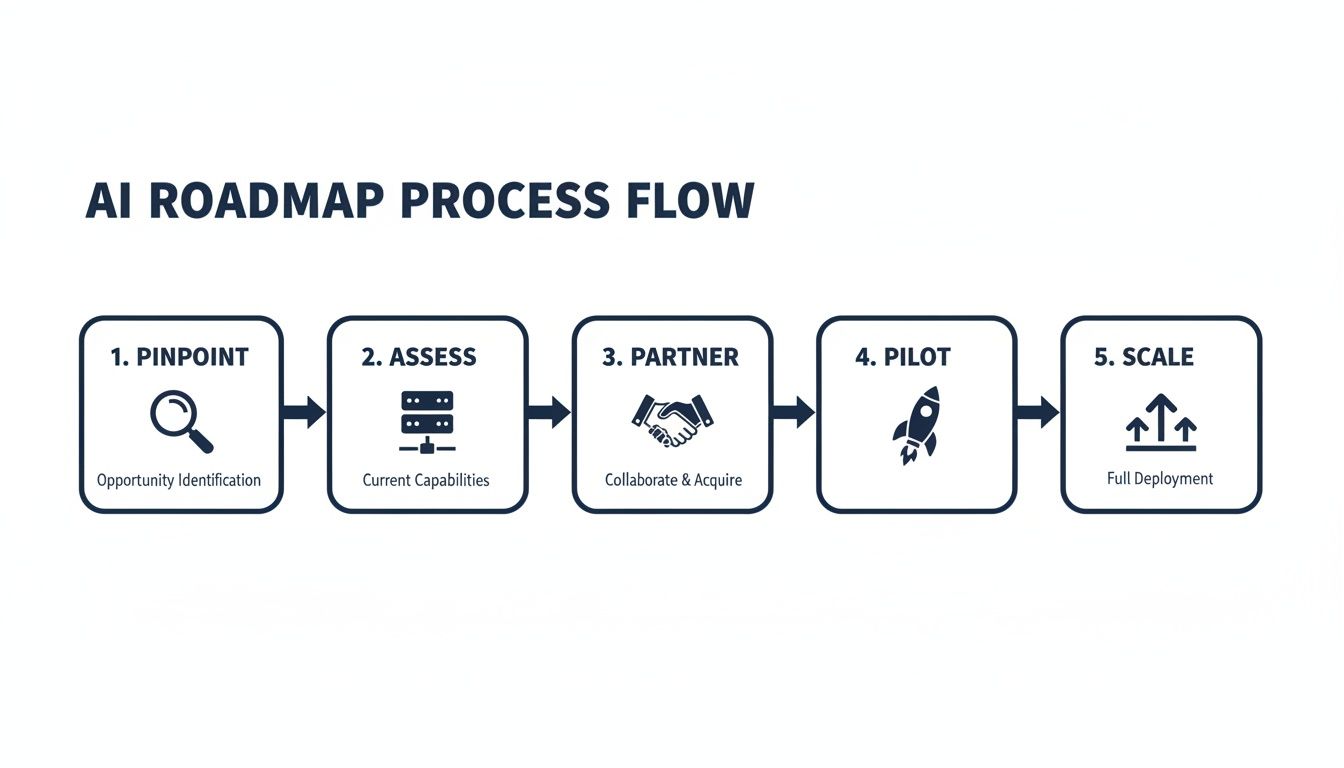
This kind of roadmap shows that a successful AI journey isn’t a one-shot deal. It’s a phased, collaborative effort that starts with a clearly defined problem and ends with a broad, positive impact on your entire organization.
Asking the Right Questions
To make sure you’re choosing a true strategic ally, your conversations need to go beyond the technical specs. Focus on their approach to partnership, problem-solving, and their long-term vision.
Try asking these questions during your evaluation:
-
How do you ensure your solutions will integrate smoothly with our existing EHR and other legacy systems?
-
Can you walk us through your process for making sure our project stays compliant from day one to final rollout?
-
What does your support model look like after the initial deployment is complete?
By prioritizing deep industry knowledge, a consultative style, and a proven track record, you’ll find a partner who does more than just build software. They will help you strategically apply AI for your business, ensuring your investment in custom software development and specialized AI development services translates into real, lasting value for your patients and your organization.
The Future of Medicine Is Intelligent and Collaborative
As we’ve explored the world of healthcare AI solutions, one thing has become crystal clear: this isn’t science fiction anymore. It’s happening right now. AI is already making a tangible difference in how we diagnose illnesses, run hospitals, and deliver care that’s genuinely tailored to the individual.
But adopting these tools isn’t just a tech upgrade. It’s about creating a powerful new partnership between human skill and machine intelligence. The most successful projects I’ve seen always start by targeting a specific, real-world headache. When you focus AI on a clear pain point, you unlock incredible value and set the stage for bigger wins down the road.
A New Era of Partnership
Let’s be clear: the future of medicine isn’t about replacing doctors. It’s about giving them superpowers. Think of it as a collaborative model where clinicians bring the critical thinking, empathy, and final judgment, while AI does the heavy lifting on data analysis.
This synergy, human insight guiding artificial intelligence, is the heart of modern healthcare. AI becomes a tireless assistant, freeing up clinicians from monotonous administrative tasks so they can focus completely on what truly matters: their patients.
This approach leads to a healthcare system that’s more proactive, efficient, and compassionate for everyone. And as we’ve discussed, keeping up with current AI trends in healthcare is essential to navigate this fast-moving field.
Choosing the right AI solutions partner is absolutely crucial to making this vision a reality. You need a partner with deep, hands-on experience in healthcare software development who can steer you through the maze of custom software development and regulatory hurdles. With the right team and a solid strategy, you can weave AI for your business into the fabric of your operations.
The path forward is about working with expert AI development services to build tools that truly empower your clinical teams. A quick look at successful client cases shows how this collaborative future is already unfolding, creating a smarter and more humane experience for us all.
Frequently Asked Questions About Healthcare AI Solutions
What is the best way to start implementing AI in a healthcare setting?
The best way to start is small and focused. Instead of aiming for a massive overhaul, pinpoint one specific, measurable problem you want to solve. This could be reducing patient no-show rates, automating a repetitive administrative task, or improving the accuracy of a particular diagnostic process. Starting with a targeted pilot project allows you to demonstrate value quickly, build buy-in from staff, and learn valuable lessons before scaling up.
How do healthcare AI solutions ensure patient data privacy and HIPAA compliance?
Patient data privacy is the top priority. Reputable AI solutions are built with a “privacy-by-design” approach. This involves several key layers of security, including data anonymization to remove personal identifiers before analysis, end-to-end encryption to protect data in transit and at rest, and strict, role-based access controls. Every step of the process is designed to be fully compliant with regulations like HIPAA to ensure patient information remains confidential and secure.
Will AI replace doctors, nurses, and other healthcare professionals?
No, the goal of healthcare AI is not to replace human expertise but to augment it. AI acts as a powerful assistant, handling data-intensive and repetitive tasks so clinicians can focus on what they do best: critical thinking, complex decision-making, and providing compassionate patient care. It’s a collaborative model where technology provides insights and humans provide judgment and empathy.
What kind of return on investment (ROI) can be expected from AI?
The ROI from healthcare AI solutions is twofold. Financially, it comes from increased operational efficiency, reduced administrative costs, and the prevention of costly medical errors. Clinically, the ROI is seen in improved patient outcomes, earlier disease detection, and more personalized treatment plans. The key is to define clear success metrics for each project to accurately measure its impact on both the financial bottom line and the quality of patient care.

About Preethi Saro Philip
Preethi Saro Philip is a Post Graduate Research Degree holder in Economics with more than 10 years of experience in writing, editing, research and teaching. She has an intense passion for content crafting and calls herself a ‘wordsmith’. She enjoys writing on wide-ranging topics including business, technology, health & lifestyle, education, environment etc.
View all posts by Preethi Saro Philip →