



WooCommerce Development Company: How to Choose One
Your shortlist is in a folder, and the quotes still don't say who owns patches, payment scope, or the test evidence after go-live. A WooCommerce development company designs, builds, integrates, secures, and maintains stores that run on WooCommerce, the open-source ecommerce plugin for WordPress. You need that partner when the store must enforce custom checkout or pricing, connect to an ERP or CRM, or change platforms. A theme swap or a few settings is a smaller job.
Does a WooCommerce Development Company Fit Your Store
WooCommerce fits when the catalogue, the content, and the checkout should stay on the WordPress stack you already run. The WooCommerce newsroom reports more than 4 million stores and approximately 4.1 million live installations, and states that WooCommerce powers about 30.5% of ecommerce websites. The same source reports that WordPress represents 41.5% of the web. Stores, live installations, and share of ecommerce websites are different measures, so keep them separate. The scale still explains why merchants keep paying for multilingual catalogues, regional payments, tax, subscriptions, and ERP or CRM sync.
Shopify fits when you want the vendor to carry platform updates, and you can accept limited server access. Magento, offered as Adobe Commerce, fits when complex B2B catalogues are the product, and you can staff Magento specialists. Heavy price rules or a long list of system links can overturn any row in the table. Treat it as a first filter.
Platform fit by situation
| Situation | WooCommerce | Shopify | Magento (Adobe Commerce) |
|---|---|---|---|
| Content-led store on WordPress | Native fit on the same stack | Separate platform to run | Separate platform to run |
| Full control over hosting and server settings | Yes, you choose and manage hosting | Vendor-hosted with limited server access | Self-hosted or vendor-hosted with full control |
| Complex B2B catalogue and pricing | Achievable with custom plugins and careful data design | Achievable with apps | Built for complex B2B catalogues |
| In-house WordPress skills | Reuses existing team skills | Needs Shopify-specific skills | Needs Magento-specialist developers |
| Many custom integrations | Achievable through the REST API and webhooks | Achievable through apps and APIs | Achievable through extensions and APIs |
| No developer on call | Needs a partner or staff for updates | Vendor handles platform updates | Needs a dedicated engineering team |
Run two tests this week. Write every custom rule the store must enforce, including price lists, approvals, coupons, and tax. Count every system that must send data to the store or take data from it. Those two lists are the written scope you send to every shortlisted partner. A WordPress team reuses its skills on WooCommerce. A team that wants the platform vendor to ship core updates will find Shopify simpler to run day to day.
Services a WooCommerce Partner Delivers
Buy the work in the order the store feels the pain.
Custom themes fix layouts that fight the catalogue. The useful question is whether business rules live in a plugin, with the theme limited to templates. Logic buried in functions.php breaks on the next design pass.
Plugin development is justified when a maintained extension can't express your price, stock, or checkout rule. Ask which extension they refused, and why a small custom plugin costs less to run over a year. As we explored in our guide to custom ecommerce development services, the expensive part is the rule, and the plugin is only the container.
Performance work covers caching, database indexes, and High-Performance Order Storage so checkout stops fighting the posts table. Ask what they measured on staging that matches production, including a peak-hour load test.
Payments and shipping means gateway setup, multi-country tax, carrier rates, and checkout changes your buyers see. A streamlined checkout UX write-up is a useful brief for that pass. Ask which countries, VAT rules, and failed-payment paths are in the test script.
ERP and CRM integration syncs orders, stock, and customers. Web application development covers custom account areas and B2B ordering portals that sit beside the shop. For the system links themselves, ERP and CRM integration is the work of mapping records both ways. The WooCommerce REST API documentation states that the REST API is integrated with the WordPress REST API from WooCommerce 2.6 onward. A production integration needs WooCommerce 3.5 or newer, WordPress 4.4 or newer, and human-readable pretty permalinks. Plain permalinks are not supported. Responses are JSON, and HTTPS is recommended. Ask the partner to confirm those versions before they estimate.
Migrations move catalogue, customers, orders, and URLs. Ask for the redirect map and the order-count check before cutover.
Maintenance keeps WooCommerce, WordPress, PHP, and extensions current. Ask who applies the patch, on what clock, and who signs the release.
Partner Evaluation Checklist for Code, Security and Support
Take this list into the call. The quality signal is a named practice, a sample artefact, or a refusal to guess.
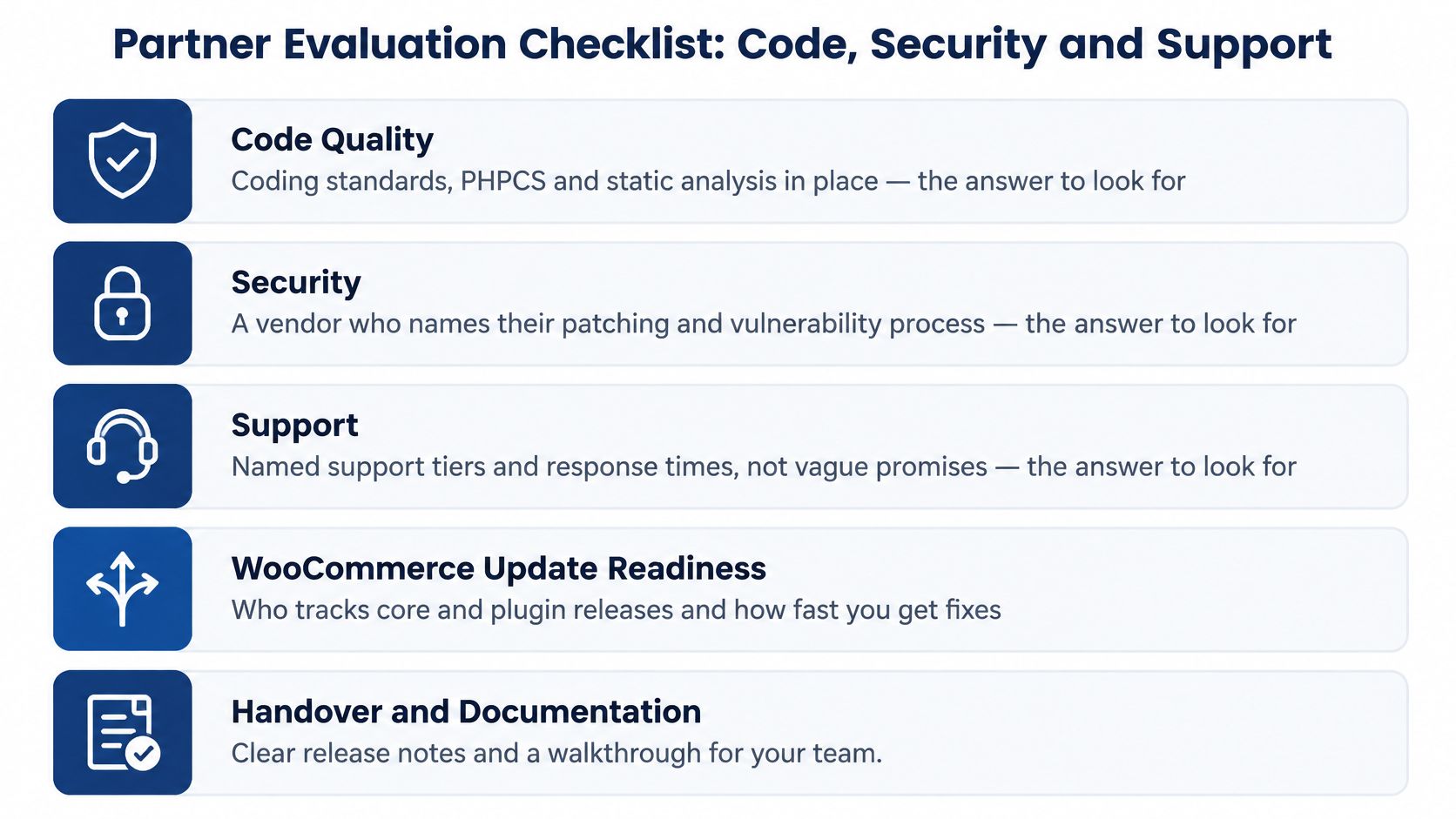
What to ask on the call
-
Code quality: Do you run coding standards, PHPCS, and static analysis in CI, with peer review on every change? WooCommerce security guidance calls out SQL injection, cross-site scripting, unsafe file inclusion, code review, PHPCS, and Semgrep. The gate I would accept is zero unresolved critical or high findings, plus unit tests and end-to-end tests. A generic success rate is not a substitute for escaped defects, failed deployments, and rollback time.
-
Plugin approach: Which rules stay in a maintained extension, and which become a small documented plugin? Business logic in theme files is a failure.
-
Hosting and performance: Who configures HPOS, caching, and a staging copy of production, and who load-tests before peak trade?
-
Security process: How do you validate and sanitise input, use prepared queries, rotate secrets, and log privileged changes? Checkout fields, account creation, coupon and product APIs, admin-ajax and REST endpoints, uploads, and payment callbacks are the trust boundaries. Our PCI DSS compliance checklist is the payment half of that conversation. Least-privilege API keys belong in the same answer.
-
Integrations: Can the receiver verify the HMAC-SHA256 signature on each webhook, and survive a repeated delivery? WooCommerce webhook documentation states that WooCommerce disables a webhook after five consecutive failed deliveries, meaning responses outside HTTP 2xx. You want monitoring and a re-enable step, or orders stop leaving the store.
-
Accessibility: Will you test the full journey with a keyboard and a screen reader, including extensions and payment widgets? The European Accessibility Act became applicable on 28 June 2025 for covered ecommerce businesses. A WooCommerce accessibility update notes progress toward WCAG 2.2 in the core front end, while the conformance report excludes the WordPress admin and add-on plugins. Ask them to test the admin screens your staff use, and every extension on the checkout path, and to file the results.
-
Support SLAs: What are response and fix targets by severity, who is the named engineer, and what rollback time have you measured?
Practical rule: Ask for a sample test report and one real rollback. A vague answer is a finding.
Project Phases From Audit to Post-Launch Support
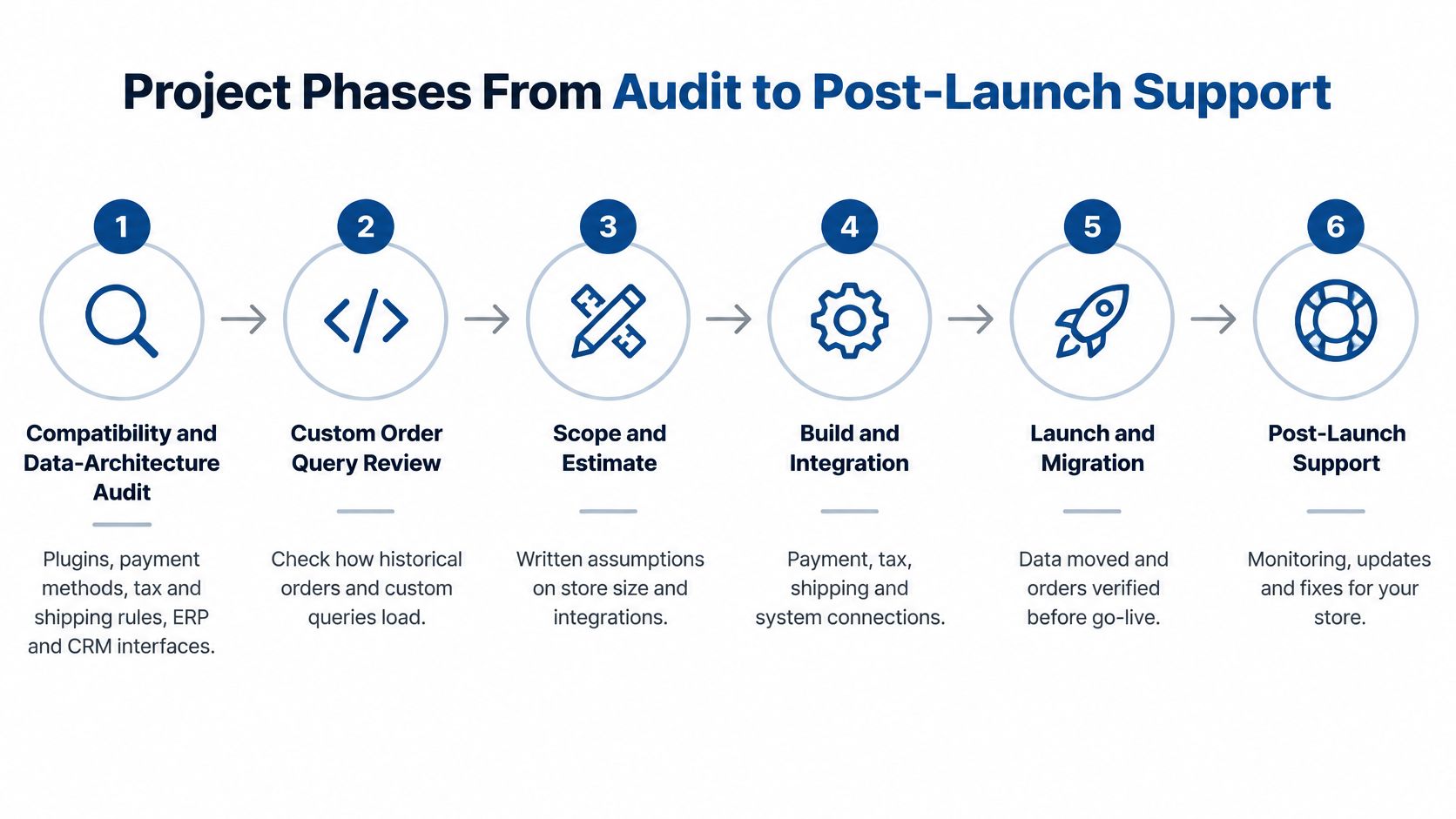
Each phase exists to stop a specific failure. Skip one, and the failure shows up in finance, in support tickets, or both.
-
Compatibility and data-architecture audit: Inventory plugins, payment methods, tax and shipping rules, ERP and CRM interfaces, custom order queries, and scheduled jobs. This stops a surprise extension from owning a checkout path nobody documented.
-
Scope and test definition: Agree on which custom components you need, and write a reproducible suite for checkout, failed payments, refunds, subscriptions, guest orders, multilingual tax, webhooks, exports, and ERP reconciliation. A faster homepage is not the success test.
-
Build on staging: Code review and automated tests run in CI before anything touches production data. This stops unreviewed checkout edits from shipping on a Friday.
-
HPOS migration: WooCommerce's HPOS documentation describes enabling compatibility mode, synchronising data, testing every payment path and refund, and only then making HPOS authoritative. HPOS stores orders, addresses, and indexes in dedicated tables. In WooCommerce's benchmark, 10 simple checkouts took 0.9917 seconds with HPOS and 1.5087 seconds with the posts table, about 1.5 times faster for that simple checkout. That figure is not a promise for a full store with plugins and tax. Extensions that query WordPress posts directly can omit orders after the switch. Compare record counts and financial totals, use CRUD APIs, and keep rollback until reconciliation passes.
-
Launch: Ship with a rollback plan and a change freeze around cutover, so a plugin update doesn't land in the same hour as the DNS move.
-
Hypercare, then a rhythm: Watch error logs, webhook failures, and reconciliation counts before you settle into scheduled updates.
Keep rollback controls until the order counts and the money totals match. Speed without that check is how a store loses a day's orders.
Cost Drivers and Engagement Models Compared
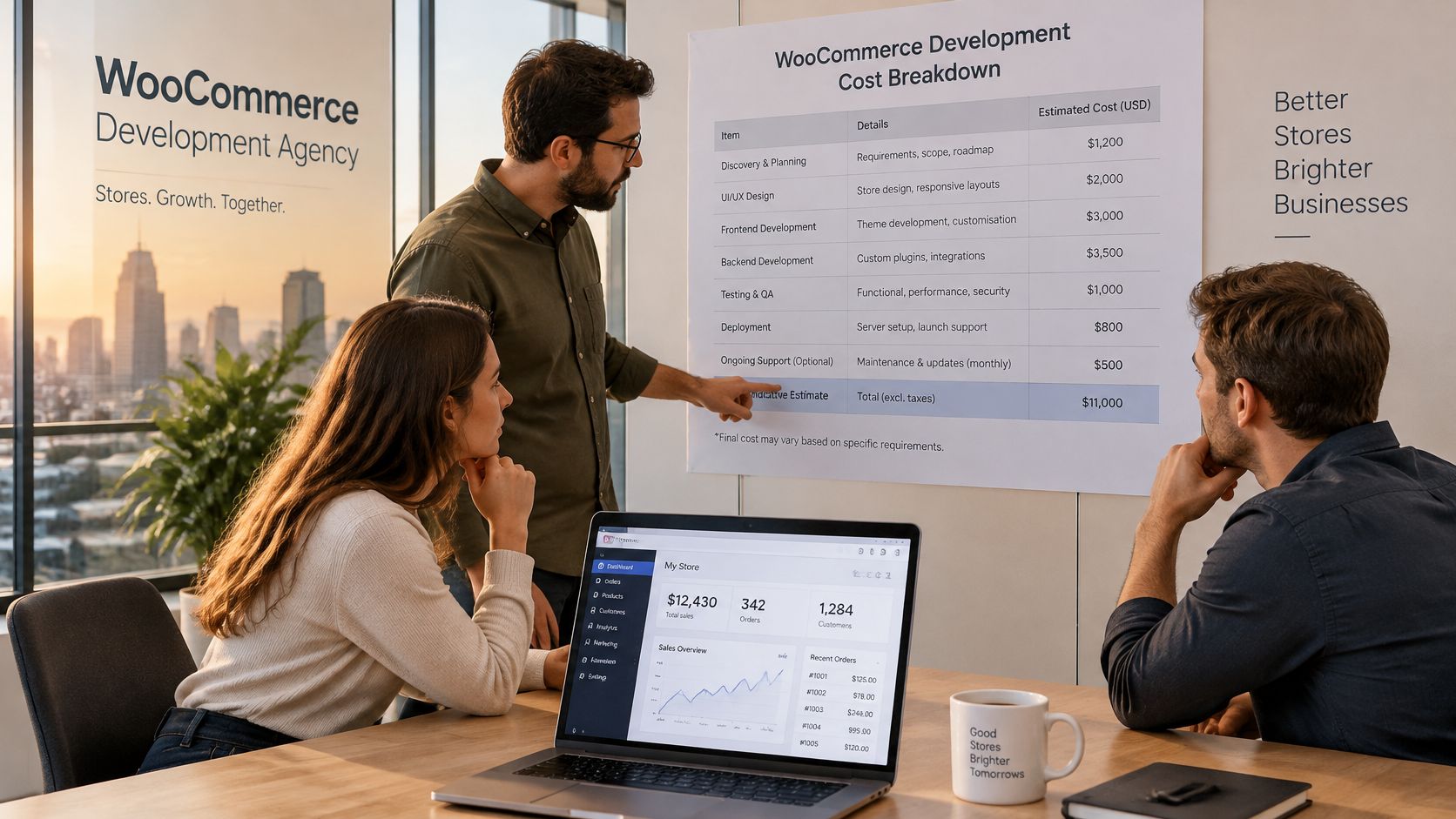
This guide has no fixed prices. Scope sets the bill. Read any vendor figure as an indicative estimate whose assumptions name store size, integrations, languages, countries, and plugin count.
Cost drivers and their relative effect
| Cost driver | What raises it | Relative effect on budget |
|---|---|---|
| Custom plugin or checkout logic | Pricing rules, B2B approvals, bespoke checkout flows | High |
| ERP or CRM integration | Number of systems, sync direction, real-time requirements | High |
| Migration | Order history volume, URL redirects, customer account transfer | Medium to high |
| Theme and design | Custom templates, accessibility testing across the journey | Medium |
| Payments and tax | Number of gateways, countries, VAT rules, subscriptions | Medium |
| Ongoing maintenance | Plugin count, release cadence, support hours | Recurring |
Four ways to buy the work, with different control:
-
Fixed-scope project: A defined migration or redesign. The budget is predictable if the scope is frozen. Change requests are how control comes back.
-
Time and materials: Discovery and work that shifts each week. You see the burn. You also own the weekly priority call.
-
Dedicated team: An ongoing roadmap. Our guide to the dedicated development team model spells out how that staffing works beside software development service models. Predictability comes from a monthly team cost, and day-to-day control stays with your product owner.
-
Retainer: Maintenance and security updates. Hours are capped. New features wait for a separate estimate.
Payment scope changes the security bill as well as the gateway fee. PCI Security Standards Council guidance states that a merchant may qualify for SAQ A only when it fully outsources payment processing and does not store, process, or transmit cardholder data on its own systems. Even with a redirect to a compliant processor, the merchant must protect that redirection, change default passwords, use unique IDs and strong passwords, and apply critical patches within one month of release. An external payment flow narrows card-data scope. It leaves the store and its routing code on your side of the line.
Send every shortlisted partner the same written scope so you can compare quotes line by line.
Contract, Onboarding and Code Ownership
A shortlist becomes safe when the contract names the owner of each risk.
Code: State who owns custom themes, plugins, and integration code. The store holds repository and deployment access from day one, or a dispute later becomes a lockout.
Credentials: Admin, hosting, gateway, and API secrets live in a shared password manager with a named custodian. WooCommerce REST API key guidance gives keys three levels: Read, Write, and Read/Write, tied to a WordPress user. Catalogue and order reads should use Read. Write stays on workflows that must change records. Put rotation and revocation dates in the contract.
Onboarding: The kickoff hands over the audit inventory of plugins, payments, tax and shipping, ERP and CRM interfaces, custom order queries, and scheduled jobs. The first estimate then rests on that inventory.
Acceptance: The test suite is a contract exhibit. Milestone payments follow a pass.
Support: Severity targets and a named contact become a service schedule.
Data: WooCommerce security notes identify GDPR obligations for stores serving EU visitors or customers. If a partner processes that personal data, the contract should set the processing terms in writing.
Exit: Require documentation, source handover, and a defined transition if you change partner. An external payment flow still leaves your redirection code as your responsibility.
Rule Out Red Flags and Shortlist Partners
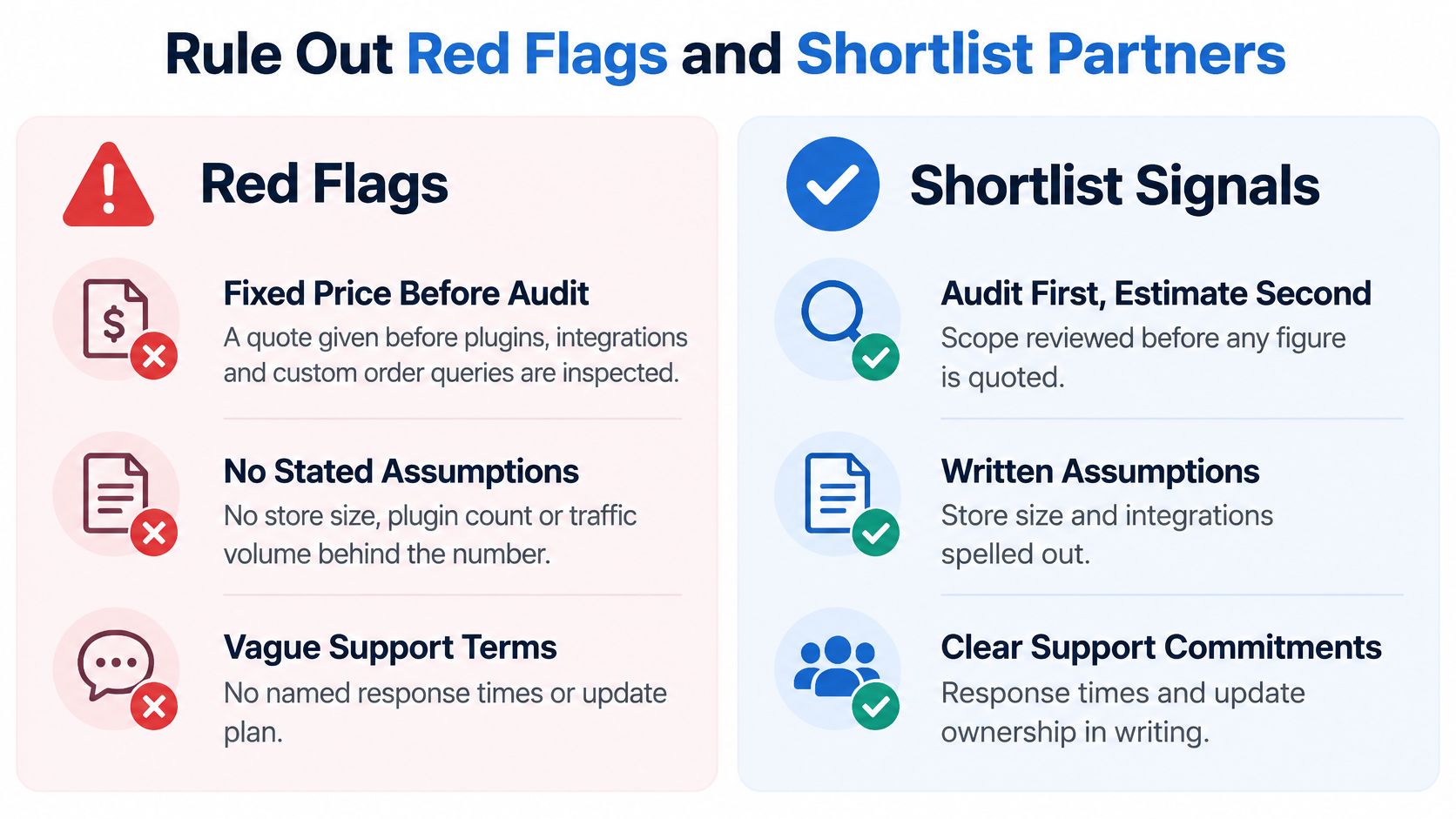
The quote that costs merchants the most is a fixed price given before anyone has audited plugins, integrations, and custom order queries. That number freezes assumptions nobody has checked, and the overage arrives as change requests once the order table is opened.
Commercial flags follow close behind. A vendor that won’t write an audit scope, won’t name the engineer accountable for architecture and review, or leaves code ownership, repository access, and credential custody out of the contract is asking you to trust a slide. References that can’t be arranged, and case studies that add nothing beyond the vendor’s own page, belong in the same pile. WordPress guidance from DesignStack is a useful cross-check on how a serious WordPress build is staffed and handed over, which is the same discipline a WooCommerce store needs.
Technical flags mirror the evaluation questions. No test suite or staging environment, direct SQL against WooCommerce tables, security claims without documents, and an accessibility sign-off from an automated scan alone should end the call.
Then decide in four moves. Shortlist three to five partners. Send each the same written scope from your two tests. Ask for a sample test plan, the security process, and a reference call. Score every answer against the checklist before you compare prices.
Bridge Global develops custom ecommerce platforms with ERP connectivity for B2B and B2C environments, so it is one option to score on that same basis. The page on custom ecommerce solutions describes the work. A scoped discussion is the fastest way to test it against the checklist.
Frequently Asked Questions
How much does a WooCommerce development company charge?
There is no fixed price, because scope sets the cost. Treat any quote as an indicative estimate and compare it against the same written scope, using the cost-driver table as the line items.
Can a WooCommerce partner handle maintenance and security updates alone?
A retainer can cover releases and patching. You still decide payment scope, credential custody, and who signs off each release.
Is WooCommerce secure enough for stores selling to EU customers?
Security follows hosting, plugins, update discipline, and the payment flow you chose. GDPR obligations apply when the store serves people in the EU, and the contract should record how personal data is processed.
When should a store move from Shopify or Magento to WooCommerce?
Move when the store already runs on WordPress, you need control of hosting, and you can staff or contract WordPress engineering. The platform-fit table is the filter, and the two scope lists are the confirmation.
How can I tell whether an accessibility claim is credible?
Ask for manual keyboard and screen-reader results across the whole journey, including extensions and payment widgets. An automated scan on its own is not evidence, and core WooCommerce conformance does not cover your admin screens or add-ons.
Bridge Global builds custom ecommerce platforms, including WooCommerce stores with ERP connectivity for B2B and B2C catalogues, and the same engineering covers checkout, integrations, and the update work after launch. If you want that work scored against a written scope, test evidence, and clear code ownership, start with the ecommerce practice. Visit Bridge Global and bring the two lists from this article to the first call.

About Preethi Saro Philip
Preethi Saro Philip is a Post Graduate Research Degree holder in Economics with more than 10 years of experience in writing, editing, research and teaching. She has an intense passion for content crafting and calls herself a ‘wordsmith’. She enjoys writing on wide-ranging topics including business, technology, health & lifestyle, education, environment etc.
View all posts by Preethi Saro Philip →