



A Practical Guide to Software Maintenance and Support
It’s tempting to think of software as a “one-and-done” purchase. You build it, you launch it, and it just works forever, right? If only it were that simple.
A better way to look at your critical software is to see it as a high-performance engine. It’s the core of what drives your business forward. And just like any engine, it needs constant attention: expert tuning, regular servicing, and occasional upgrades, to keep running smoothly and avoid a complete breakdown. This is what modern software maintenance and support is all about. It’s not a chore; it’s a strategy.
Why Software Maintenance Is a Strategic Must-Have
Letting your software decay is like inviting disaster. It’s a straight line to security holes, sluggish performance, and the kind of expensive downtime that can bring a company to its knees. In today’s world, your digital infrastructure isn’t just part of your business; it is your business. Treating its upkeep as an afterthought is a gamble you can’t afford to take.
The numbers back this up. For many organizations, the ongoing costs of maintaining software eat up a staggering 70% to 90% of the total IT budget. That figure alone tells you how critical this is for financial planning and day-to-day stability.
It’s More Than Just Squashing Bugs
When people hear “software maintenance,” they often picture a frantic developer fixing a bug that just crashed the system. While that’s part of it, true maintenance and support go much deeper. It’s a proactive discipline focused on keeping your digital tools perfectly aligned with your business goals as they change over time.
Think about what happens when a major software provider announces an “End-of-Service” date for a product you rely on, like when VMware did for vSphere 7. Businesses using it were forced to make a choice: adapt and upgrade, or risk running on an unsupported system that would no longer receive security patches. That’s the kind of real-world scenario where proactive maintenance pays off.
This forward-thinking approach covers several key areas:
- Keeping it Secure: The threat landscape is always shifting. Regular patching and security updates are non-negotiable for protecting your data and your reputation.
- Keeping it Fast: Code gets clunky and infrastructure gets old. Constant optimization is needed to prevent slowdowns that frustrate your users and kill productivity.
- Keeping it Compatible: Your software doesn’t exist in a vacuum. It needs to work with new operating systems, connect to different APIs, and integrate with other services.
- Keeping it Useful: The best software evolves. Refining features based on real user feedback is how you continuously improve the experience and deliver more value.
A smart maintenance strategy flips the script, turning a reactive cost center into a proactive engine for growth. It’s not just about keeping the lights on; it’s about making them brighter, more efficient, and ready for whatever comes next.
This cycle of continuous care and improvement is how you get the most out of your initial software investment. By working with a skilled AI software development company, you ensure your systems aren’t just surviving, but thriving. Whether you’re dealing with a platform built through custom software development or an off-the-shelf product, a solid maintenance plan is what secures your digital future and fuels real, sustainable growth.
The Four Pillars of Software Maintenance
An effective software maintenance and support strategy isn’t a one-trick pony; it stands on four distinct pillars. Each one handles a different aspect of the software lifecycle, and getting the balance right is what separates a fragile application from a resilient and valuable one. Think of it like maintaining a car – you don’t just wait for it to break down. You need oil changes, new tires for new seasons, performance upgrades, and regular check-ups to keep it running smoothly.
This is all about a holistic approach that drives security, efficiency, and ultimately, real business value.
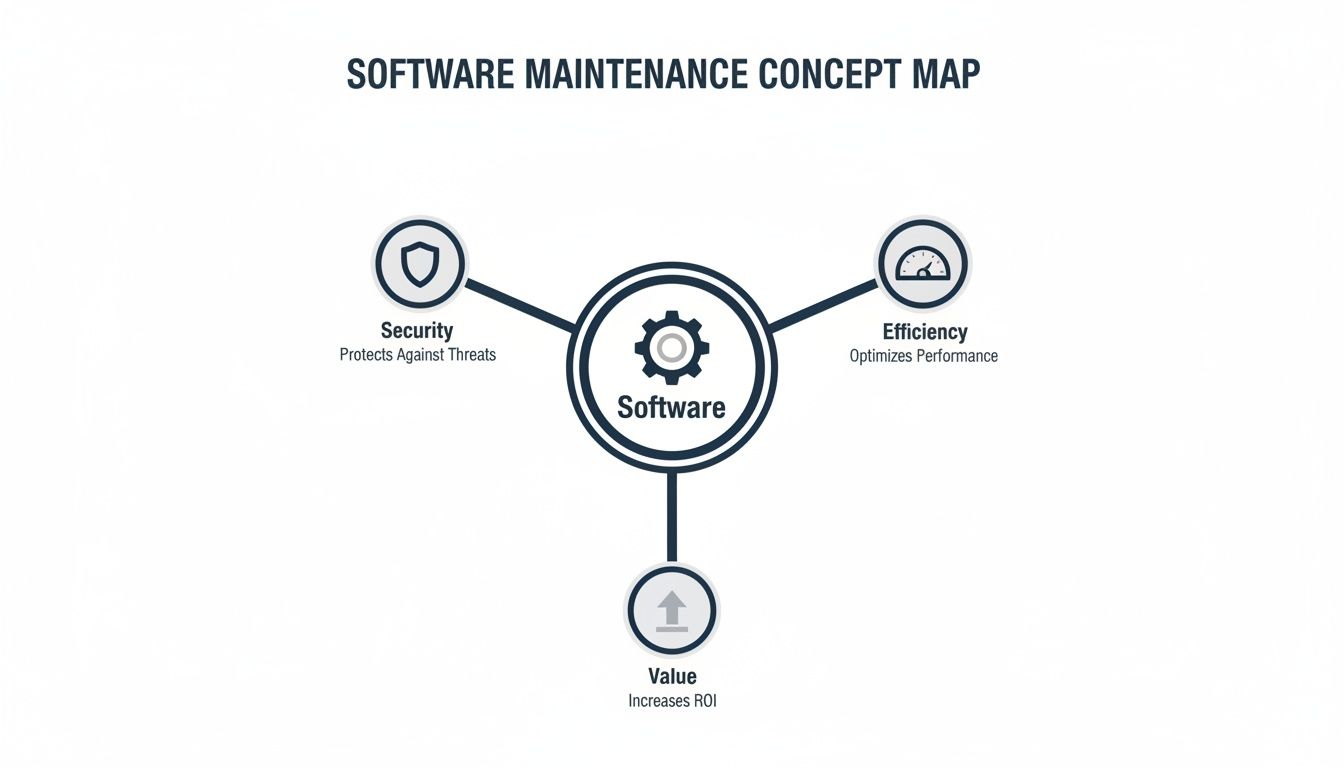
As you can see, these pillars work in harmony to protect your investment, optimize how it runs, and ensure your software keeps delivering. Let’s dig into what each one actually involves.
Corrective Maintenance: The Emergency Response
This is the one most people think of first. Corrective maintenance is your digital fire department. When a user finds a bug, a system crashes, or a feature just flat-out fails, this team rushes in to diagnose the issue and push a fix.
Their only job is to get things back to normal, fast. It’s entirely reactive, triggered by problems that are actively hurting the user experience or business operations. A swift, effective response is everything.
Adaptive Maintenance: Future-Proofing Your Software
Technology doesn’t wait for anyone, and your software can’t afford to be left behind. Adaptive maintenance is all about modifying your application to stay in sync with its ever-changing environment. It’s like renovating an old building to meet new city codes or upgrading its electrical system to handle modern appliances.
This kind of work is usually triggered by external shifts, such as:
- A new OS release (think updating an app for the latest iOS or Android version).
- Changes to a third-party API your software relies on.
- New hardware rolling out that requires software tweaks.
- Evolving data privacy laws or security standards.
The pressure to keep up is immense. The adaptive software maintenance market is expected to balloon from $4.2 billion to $12.6 billion by 2034, showing just how critical it is for businesses to manage compatibility in a world of constant updates.
Perfective Maintenance: The Evolution Engine
While corrective maintenance puts out fires and adaptive keeps the lights on, perfective maintenance is what makes good software great. This is where you refine and enhance the application based on what your users are telling you. It’s the engine of evolution, turning feedback into features.
This includes things like:
- Building new features that your customers have been asking for.
- Improving the user interface (UI) to make the software easier to use.
- Optimizing code under the hood to make the application faster.
- Refactoring code so it’s cleaner and easier for developers to work on later.
It’s all about actively increasing the software’s value over time, not just preserving it.
Preventive Maintenance: The Health Check
Finally, there’s preventive maintenance – the most proactive pillar of them all. This is like a routine health check-up for your code. It’s about finding and fixing small issues before they grow into major problems that impact your users.
The goal here is to boost the software’s long-term health and stability. This involves tasks like code optimization, updating internal documentation, and restructuring data. Implementing strong proactive maintenance strategies is a smart investment that drastically reduces the need for expensive, frantic fixes down the road.
To bring it all together, here’s a quick comparison of how these four types stack up.
A Comparative Look at the Four Maintenance Types
This table breaks down the core purpose, common triggers, and business value for each of the four software maintenance types we’ve discussed.
| Maintenance Type | Primary Goal | Common Triggers | Business Impact |
|---|---|---|---|
| Corrective | Restore normal operation after a failure. | Bugs, errors, crashes, system failures. | Minimizes downtime and maintains user trust. |
| Adaptive | Ensure compatibility with a changing environment. | New OS, hardware changes, updated regulations, API shifts. | Future-proofs the software and ensures it remains functional. |
| Perfective | Enhance features and improve performance. | User feedback, new business requirements, performance data. | Increases user satisfaction and adds long-term business value. |
| Preventive | Reduce future failures and improve maintainability. | Code deterioration, outdated documentation, performance audits. | Lowers total cost of ownership and improves system reliability. |
As you can see, a balanced approach is key. Relying only on corrective, “break-fix” maintenance is a recipe for high costs and unhappy users. A mature strategy blends all four to create software that’s not just functional, but reliable, modern, and consistently improving.
Choosing the Right Support Model for Your Business
Picking a support model for your software isn’t just an IT decision; it’s a strategic business choice. Think of it like choosing the right crew for a ship. Your decision will determine how well you can navigate rough waters, respond to emergencies, and ultimately, reach your destination. It’s all about balancing cost, responsiveness, and in-depth expertise.
There’s no one-size-fits-all answer here. The best model really hinges on how complex your application is, how critical it is to your day-to-day operations, and what your budget looks like. By getting to grips with what each model offers, you can build a software maintenance and support strategy that keeps your technology an asset, not a nagging liability.
Dedicated Teams for Mission-Critical Systems
Let’s say your main business application is like a high-performance race car. You wouldn’t want a new mechanic tinkering with it every week, would you? You’d want a dedicated pit crew that knows every single nut and bolt. That’s exactly what a Dedicated Support Team provides.
With this model, a group of engineers is assigned exclusively to your software. They live and breathe your product, becoming intimately familiar with its architecture, business logic, and history. This deep knowledge means they can resolve issues at lightning speed and suggest proactive improvements a generalist team simply couldn’t.
A dedicated team is the gold standard for:
- Complex, mission-critical software where even a few minutes of downtime costs you serious money.
- Applications that need ongoing development and new features built alongside regular support.
- Companies that require guaranteed availability and immediate access to engineers who are already up to speed.
Yes, this model is a bigger investment, but the return comes from unmatched stability, speed, and having a team that’s truly aligned with your goals. They operate as a genuine extension of your own crew.
Remote and On-Demand Support for Flexibility
Not every piece of software is a finely-tuned race car. For many businesses, a more flexible and cost-effective solution makes more sense. Remote or On-Demand Support is like having an expert mechanic on speed dial. You pay for their skills only when you have a problem, which is a smart way to manage costs for less critical or more stable applications.
This approach is perfect for companies whose support needs come in waves or those who need to back up an internal team during busy periods. It gives you access to a wide talent pool without the financial weight of a full-time, dedicated staff.
The real win here is agility. You can ramp support up or down based on what you need right now, getting expert help without being locked into a fixed long-term cost. This is a game-changer for startups and businesses with seasonal peaks.
Managed Services for Strategic Partnership
The Managed Services model is a step beyond just hiring a team; it’s about outsourcing the entire maintenance operation. You hand over the keys to a provider who takes complete ownership of the results. It’s like entrusting your fleet of vehicles to a professional management company that guarantees they’re always secure, in top condition, and ready to roll.
A managed services provider (MSP) handles everything, from monitoring and patching to incident response and long-term planning. Their performance is measured against strict Service Level Agreements (SLAs), so their success is tied directly to yours.
This is the best fit for businesses that want to:
- Focus completely on their core operations by offloading all IT maintenance headaches.
- Leverage advanced tools and expert processes without the huge upfront investment.
- Lock in a predictable, fixed monthly cost for all software support.
The success of this model depends entirely on your choice of partner. As covered in our guide on finding your strategic software delivery partner, you need someone who gets your business goals and acts as a real strategic advisor, not just a helpdesk.
Setting the Ground Rules: Workflows and Service Level Agreements
Great software maintenance and support isn’t magic. It’s the result of carefully planned, repeatable processes and crystal-clear promises that keep everyone aligned. Without this solid operational framework, even the most talented team ends up just fighting fires instead of preventing them.
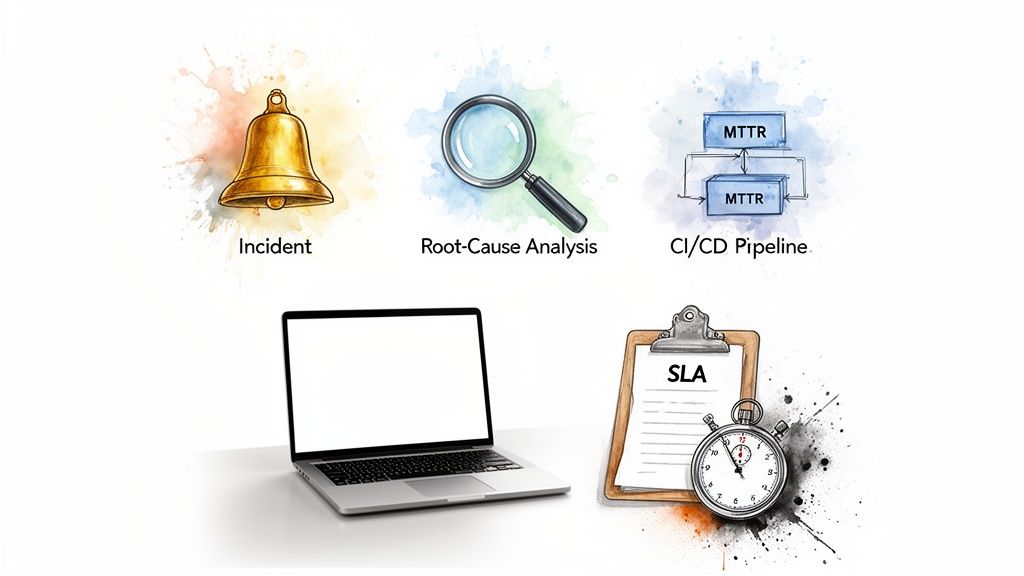
This structure is what transforms chaos into a predictable, efficient system. It all starts by defining how you handle problems, from the moment they pop up to the moment they’re solved for good.
The Core Workflows of Great Support
Think of these three workflows as the essential playbook for a mature maintenance operation. Each one has a specific job, moving from putting out immediate fires to making the system stronger for the long haul.
- Incident Management (The First Responders): This is all about speed. When something breaks, Incident Management is the team that rushes in to get things back online as fast as humanly possible. They’re like paramedics at an accident – the immediate goal is to stabilize the patient, not to perform a deep diagnosis on the spot.
- Problem Management (The Detectives): Once the immediate crisis is over, the detectives from Problem Management get to work. Their mission is to dig into the root cause of what went wrong. The goal isn’t just to patch the issue but to find a permanent fix so it never, ever happens again.
- Change Management (The Gatekeepers): This process makes sure that any change, whether it’s a bug fix from the detectives or a brand-new feature, is rolled out safely and without causing new problems. It’s a critical checkpoint to prevent a well-meaning update from accidentally breaking something else.
All of this is supported by a modern CI/CD (Continuous Integration/Continuous Delivery) pipeline. This automated system is the engine that tests and deploys changes, ensuring that fixes and updates are released quickly and reliably without introducing new headaches.
Making Sense of SLAs and KPIs
A Service Level Agreement (SLA) is much more than a piece of paper. It’s a binding contract that spells out exactly what level of service you should expect from your support provider. It turns vague promises like “we’ll be responsive” into hard, measurable commitments. A solid SLA is the bedrock of any transparent, accountable partnership.
For an SLA to have any real meaning, it needs to be backed by specific Key Performance Indicators (KPIs). These are the vital signs you’ll monitor to ensure your support is healthy.
- Mean Time to Acknowledge (MTTA): How long does it take for the team to even say, “We got your report and we’re on it”? This tracks pure responsiveness.
- Mean Time to Resolution (MTTR): From the first alert to the final fix, what’s the average time to completely solve an issue? This is a key measure of overall efficiency.
- Uptime Percentage: What percentage of the time is your software actually up and running? A common gold standard is 99.9% uptime (often called “three nines”), which still allows for about 8.77 hours of downtime per year.
- First Contact Resolution (FCR): How often are problems solved in the very first phone call or email? A high FCR rate is a great sign of an experienced and empowered support team.
Your SLA is your ultimate tool for accountability. It establishes clear, non-negotiable standards for performance, ensuring your business is protected and your provider is truly invested in delivering the quality you’re paying for.
Building a good SLA is a balancing act between your business needs and what’s technically feasible. It requires a real conversation about how critical your application is and what your provider can realistically deliver. As our client cases demonstrate, setting and hitting these high standards is how you build successful, long-term relationships. By defining these workflows and metrics upfront, you create a system built on reliability and trust from day one.
How AI Is Changing the Game in Software Maintenance
For as long as we’ve had software, maintenance has been a reactive game. Something breaks, a ticket comes in, and a team scrambles to put out the fire. But that entire model is being turned on its head. With Artificial Intelligence, we’re finally moving from a reactive, break-fix cycle to a proactive, predictive strategy. It’s not just a small adjustment; it’s a complete overhaul of how we keep our applications running smoothly.
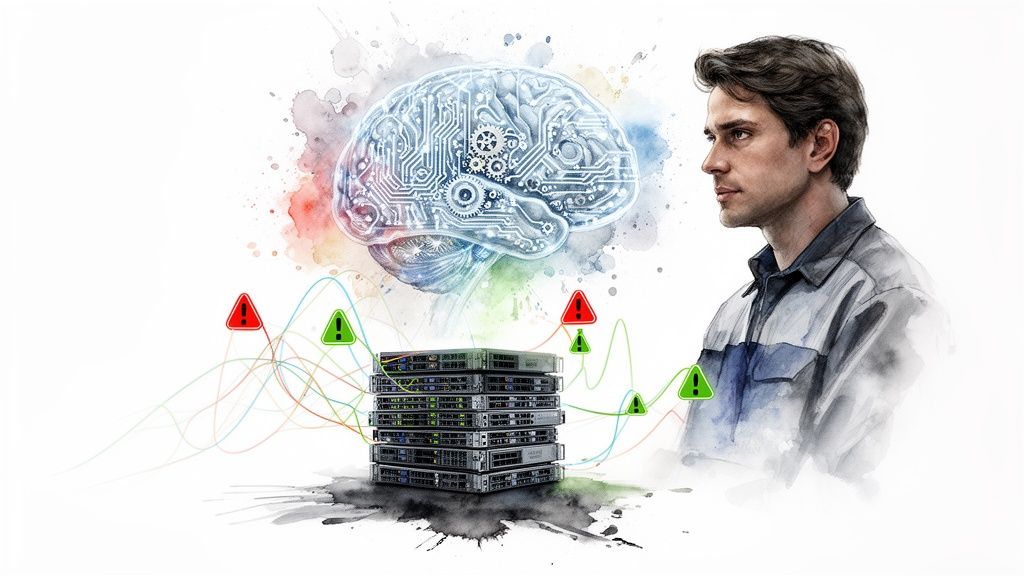
This shift gives a serious competitive edge to businesses willing to adopt it. By predicting issues, automating difficult diagnostic work, and optimizing performance on the fly, AI helps you dodge costly downtime, cut operational costs, and let your developers get back to what they do best: building new features, not just patching old ones. Our AI development services are designed to help companies harness this power.
Predictive Maintenance: AI’s Crystal Ball
Imagine knowing a critical server was on the verge of failing before it actually went down. That’s exactly what AI-driven predictive maintenance delivers. Machine learning algorithms chew through performance data, user activity, and system logs, learning to spot the almost invisible red flags that pop up before a system fails.
So, instead of a catastrophic crash right in the middle of your busiest workday, your team gets a heads-up to replace a failing component during a planned maintenance window. This is how you turn emergencies into routine check-ups. It’s no surprise that the market for this technology is booming.
The predictive maintenance software market is exploding, valued at $6.79 billion and projected to hit $20.18 billion by 2029. This growth is fueled by the urgent need to cut downtime costs and advancements in AI for data-driven decisions that slash operational costs.
Automated Root Cause Analysis
When something does go wrong, finding the “why” can be a frustrating, time-consuming hunt. Developers traditionally spend hours, sometimes days, combing through endless log files trying to connect the dots. AI-powered log analysis tools can do that work in seconds.
Using Natural Language Processing (NLP) and pattern recognition, these tools can instantly find the anomaly and backtrack through the sequence of events that caused the failure. This drastically cuts down the Mean Time to Resolution (MTTR), which means services are back online faster and your technical teams aren’t burning out on tedious troubleshooting. As we explored in our guide to leveraging AI for your business, this kind of automation is a massive win for team efficiency.
AI-Powered Code Optimization and Self-Healing
AI isn’t just about finding problems anymore; it’s starting to fix them, too. Some of the most exciting tools today can scan source code to find inefficient sections, recommend performance tweaks, and, in some cases, even rewrite code to be more optimized.
Beyond that, we’re seeing the rise of “self-healing” systems. These are platforms smart enough to:
- Spot Performance Bottlenecks: AI monitors can identify things like slow database queries or clunky algorithms in real time.
- Automate Resource Scaling: If an application suddenly gets a huge traffic spike, an AI system can automatically assign more server resources to handle the load and prevent a crash.
- Redirect Traffic: If one part of a system fails, AI can intelligently reroute users to healthy servers to keep the service running without interruption.
This level of automation isn’t just for the back end. The world of AI customer service solutions shows how artificial intelligence is also transforming support from the user’s perspective. By weaving AI into every part of your maintenance strategy, you’re building systems that are truly resilient and ready for the future.
Navigating Software Maintenance Costs and Contracts
Let’s talk about the money. Getting your software built is just the first check you’ll write. The real financial picture, what we call the Total Cost of Ownership (TCO), includes everything that comes after, and a huge chunk of that is maintenance.
Getting the contract right from the start is absolutely critical. It’s what defines your financial relationship with your support partner and protects you from surprise bills down the road.
Let’s break down the common ways these deals are structured.
Fixed-Price Contracts
If your maintenance needs are crystal clear and predictable, a Fixed-Price contract can be a great fit. You agree on one price for a specific list of tasks. Simple.
This model is fantastic for budgeting because you know exactly what you’re spending. But be warned: its biggest strength is also its weakness. The moment a problem pops up that isn’t on that pre-approved list, you’re back to the negotiating table, which can mean delays and extra costs.
Time and Materials (T&M) Contracts
When you need flexibility above all else, the Time and Materials (T&M) model is your best bet. You simply pay an hourly or daily rate for the actual work done.
This approach is perfect for chasing down those tricky, unpredictable bugs or when you know the software’s needs will change over time. The key here is trust. T&M requires close communication and a transparent partner to ensure costs don’t get out of hand.
Retainer-Based Agreements
Think of a Retainer-based agreement as the best of both worlds. You pay a set monthly fee to have an expert team on standby for a certain number of hours.
This guarantees you have skilled people ready to jump in the moment you need them, without having to pay for a full-time, in-house team.
This model is a lifesaver for businesses with critical systems, like complex custom ecommerce solutions, where downtime is not an option. You’re essentially paying for priority access and peace of mind.
Ultimately, the best contract comes down to what your business and your software truly need. No matter which model you choose, a detailed Scope of Work (SOW) is your most important document. It spells out exactly what’s expected, creating the foundation for a transparent partnership.
As we’ve discussed before, understanding what goes into a long-term tech partnership model is essential for building a support structure that’s both effective and financially smart right from the beginning.
FAQ: Software Maintenance and Support
What is software maintenance and support?
Software maintenance and support encompasses all activities required to keep a software application functional, secure, and relevant after its initial launch. This includes fixing bugs (corrective), updating it for new environments (adaptive), adding new features based on user feedback (perfective), and performing health checks to prevent future issues (preventive). It’s a continuous process that ensures the software’s long-term value and reliability.
What is a realistic budget for software maintenance?
A good rule of thumb is to set aside 15-25% of what you initially spent to build the software for your annual maintenance budget. This isn’t a hard-and-fast rule, as the right number depends on your software’s age, complexity, and how critical it is to your business. A mission-critical system will likely require a budget closer to the high end of that range.
How can I measure the ROI of maintenance?
Measuring the return on investment for software maintenance goes beyond just the expense. You can calculate ROI by looking at cost savings and efficiency gains, such as reduced system downtime (preventing lost revenue), lower emergency fix costs (proactive care is cheaper than reactive repairs), and improved user productivity from reliable, fast software. Strong maintenance also bolsters security, helping you avoid costly data breaches.
When does it make sense to outsource software support?
Outsourcing software support is a smart move when you lack the necessary in-house technical skills, want your internal team to focus on innovation rather than upkeep, or require 24/7 support that is too costly to staff internally. Partnering with an experienced AI software development company provides immediate access to specialized expertise, proven processes, and advanced tools without the overhead of hiring a full-time team.
Ready to build a resilient, future-proof software strategy? Bridge Global provides expert software maintenance and support designed to protect your investment and drive growth. Explore our services today!

About Upendra Jith
Upendrajith completed his Master's in English and has been a commercial content developer for the past three years. He's more inclined to develop content with a 'street-smart' delivery on topics such as technology, media, or anything he can get his hands on. He has a fixation on lyrics, dark poetry, media, technology, and flow arts.
View all posts by Upendra Jith →