



The Long-Term Tech Partnership Model for Sustainable Growth
Feeling stuck in a rut of short-term projects that fizzle out before they can make a real impact? A long-term tech partnership model offers a way out, swapping transactional, one-off vendor contracts for a genuine alliance built around shared success. For leaders serious about building sustainable market leadership, this is the blueprint. Here’s a fine example of some partnership models.
Moving Beyond Projects to Strategic Partnerships
Too many companies approach tech development as a series of disconnected gigs. They hire one vendor for this, another for that, and end up with a patchwork of systems, endless onboarding costs, and a team that never truly understands the business’s core mission. It’s like trying to build a custom race car by hiring a different mechanic for the engine, the tires, and the chassis, the parts might be good on their own, but they’ll never work together to win the race. Here’s an insightful read on finding your strategic software delivery partner.
A long-term tech partnership model completely flips that script. You’re no longer just hiring a temporary vendor; you’re bringing on an integrated, dedicated team that becomes an extension of your own. This team isn’t just there to close tickets. They become invested in your success and obsessed with helping you achieve your long-term vision.

The Strategic Shift to Collaborative Growth
This collaborative way of working builds deep alignment, sparks continuous innovation, and creates mutual growth. When dealing with complex initiatives like AI integration or full-scale digital transformation, this model isn’t just nice to have; it’s essential. It allows for the kind of progressive learning and context-building that’s simply impossible to achieve in short, isolated projects.
The payoff from this strategic shift is huge:
- Deep Business Acumen: Your partner develops an incredible depth of knowledge about your products, culture, and market. This allows them to be proactive and make insightful contributions, not just follow orders.
- Enhanced Innovation: A stable, long-term team feels secure enough to experiment and suggest improvements. This drives real innovation, not just maintenance work.
- Greater Efficiency: Think of all the time wasted sourcing, onboarding, and then offboarding different vendors. With a long-term partner, that cycle is broken, and everyone can focus purely on delivering value.
A true partnership is more than a service agreement. It’s a shared journey where both sides are equally invested in navigating challenges and celebrating wins, creating a culture where you build great things together.
Why This Model Is Gaining Momentum
The move away from project-based work and toward these strategic alliances is picking up speed. A recent Deloitte technology industry outlook found that nearly half (49%) of tech leaders said their firm had either engaged in a strategic partnership in the past year or planned to.
This isn’t a fluke. It’s a clear signal that to keep up with the pace of change, businesses need sustained, integrated efforts. As we explored in our guide on the topic, finding a strategic software delivery partner is about building a lasting competitive advantage.
Choosing the Right Partnership and Commercial Structure
Getting a long-term tech partnership right starts with picking the right blueprint. It’s a lot like building a house—the foundation you choose determines how stable and flexible the final structure will be. This decision isn’t just about saving money; it’s about finding the perfect balance between control, flexibility, and predictability for your specific goals.
You’ll need to decide on two key things: the engagement model and the commercial model.
The engagement model is all about how you work together. It defines the team structure, communication flow, and how deeply the partner integrates with your own people. Get this wrong, and you’re in for a lot of friction and wasted effort.
The commercial model, on the other hand, defines how you pay. This directly affects your budget and how easily you can shift priorities. A poor fit here can lead to painful scope creep, budget blowouts, or a rigid relationship that can’t seize new opportunities.
Common Engagement Models Unpacked
Let’s break down the most common ways to structure the working relationship. Each one offers a different mix of control and responsibility, so the right choice really depends on what you’re trying to achieve.
- Dedicated Teams: Think of this as your own off-site innovation hub. You get a full-time, hand-picked team that works only on your projects. They become a genuine extension of your company, fully embedded in your culture and workflows. Dedicated team is the go-to model for core product development or any long-term initiative where you need deep, continuous business knowledge.
- Team Augmentation: Sometimes you just need to fill a specific skill gap. Maybe your team is fantastic but doesn’t have an expert in generative AI. With augmentation, you can bring in specialists from your partner to work alongside your in-house crew. It’s the perfect way to get targeted expertise on demand, without going through a long and painful hiring process.
- Managed Services: This is the “set it and forget it” option. You hand over an entire function or project to your partner and define the outcomes you expect. They take full responsibility for the day-to-day management and delivery. This works best for well-defined, non-core functions where you want to offload the operational headaches and focus on your main business.
For most businesses diving into a custom software development project, a Dedicated Team provides the most strategic value. It’s the model that truly fosters the deep alignment needed for a successful long-term partnership.
Finding the Right Commercial Fit
Once you know how you’ll work together, you need to decide how the money will work. The goal here is to find a financial structure that supports agility while giving you clear, predictable costs.
- Time & Materials (T&M): This is the simplest model, you pay for the hours worked. It offers maximum flexibility, which is great for agile projects where requirements are bound to change. The catch? It demands a high level of trust and completely transparent reporting to keep costs from spiraling.
- Fixed Price: If you have a project with a crystal-clear, unchanging scope, this is your best bet. You agree on one price for a specific set of deliverables. It gives you absolute budget certainty, but it can be extremely rigid. If a great new idea pops up mid-project, get ready for a lengthy and often expensive change-request process.
- Retainer: This is a smart hybrid approach that’s often paired with a dedicated team. You pay a fixed monthly fee for a guaranteed block of work or a set team capacity. It gives you the budget predictability of a fixed-price model but keeps the flexibility of T&M, allowing you to reprioritize work as your business needs change.
Choosing the right structure isn’t just a contractual detail; it’s a strategic decision that sets the tone for the entire relationship. It defines how you’ll navigate challenges, adapt to change, and ultimately, build success together.
To make this even clearer, let’s look at how these models stack up against each other.
Comparing Long-Term Tech Partnership Models
This table compares common engagement and commercial models to help you choose the best structure based on flexibility, cost control, scalability, and ideal use cases.
| Model Type | Best For | Flexibility | Cost Structure | Client Control |
|---|---|---|---|---|
| Dedicated Team | Core product innovation and long-term, complex projects. | High | Monthly Retainer or T&M | High |
| Team Augmentation | Filling specific skill gaps for a defined period. | Medium | Time & Materials (T&M) | High |
| Managed Services | Outsourcing a complete, well-defined function. | Low | Fixed Price or Retainer | Low (Outcome-focused) |
Ultimately, there’s no single “best” structure. The right choice is the one that perfectly aligns with your project’s DNA, your comfort with risk, and your vision for the future. A good AI solutions partner won’t just sell you a service; they’ll help you navigate these options to build a partnership designed for mutual success.
The Essential Framework for a Thriving Partnership
A long-term tech partnership doesn’t just happen; it’s built. It needs a solid framework to keep it from derailing, one that turns good intentions and ambitious goals into real, measurable results. Without this structure, even the most promising collaboration can slowly drift apart.
Think of this blueprint as the operating agreement that transforms a vendor into a true partner. It lays down the ground rules for transparency, accountability, and a shared vision of success.
Establishing Clear Governance and Communication
The foundation of any strong partnership is a clear governance model. This isn’t about creating red tape; it’s about defining how decisions get made, who makes them, and how everyone stays on the same page. It’s the partnership’s central nervous system.
A smart governance structure usually involves a few key elements:
- Steering Committees: This is your high-level checkpoint. Key leaders from both sides meet quarterly to review strategic direction, sign off on major investments, and make sure the partnership is still delivering on the big-picture business goals.
- Technical Councils: Here, the lead architects and senior engineers get together. They hash out technical strategy, set quality benchmarks, and make the big architectural calls to ensure everything built is sound, secure, and ready to scale.
- Regular Cadence Meetings: The daily stand-ups, weekly check-ins, and monthly planning sessions create a steady rhythm. This constant communication loop is what keeps the day-to-day work aligned and moving forward.
This layered approach connects the 30,000-foot view with the work happening on the ground, stopping misunderstandings before they can even start.
Measuring What Matters Most: Key Performance Indicators
To know if a partnership is actually working, you have to look past simple metrics like hours billed or tasks completed. The real story is in the Key Performance Indicators (KPIs) that track the actual value being delivered to your business.
A partnership’s success isn’t defined by activity, but by outcomes. The right KPIs shift the focus from “Are we busy?” to “Are we making a difference?”
Focus on metrics that tell you about tangible impact:
- Innovation Velocity: How quickly can you get a new idea into the hands of users? Tracking the cycle time from concept to production is a powerful measure of the partnership’s agility.
- User Adoption & Engagement: Are people actually using the new features you’re building? High adoption rates are the ultimate proof that you’re creating real value.
- System Performance & Reliability: Keep a close eye on uptime, system response times, and a declining number of critical bugs. This is fundamental to system health, a topic we dive into in our guide to software maintenance and support services.
- Team Stability & Satisfaction: A low turnover rate within your partner’s team is a fantastic sign. It points to a stable, healthy, and committed relationship.
Agile Team Structures for an Evolving Landscape
Finally, the framework needs to be flexible. The market moves fast, and your partnership must be able to adapt right along with it. An agile team structure allows you to shift focus, resize the team, and bring in new skills as your priorities change over time.
The data backs this up. We’re seeing long-term partnerships become central to digital transformation, especially with AI in the mix. Global IT spending is projected to hit USD 5.6 trillion, and 64% of tech companies in North America and Europe are bumping up their budgets for exactly this kind of sustained change. With AI adoption skyrocketing among developers, it’s clear that both spending and engineering mindsets are shifting toward long-term, strategic collaboration. You can find more on these trends over at Statista.
Your Implementation Roadmap From Discovery to Scale
Jumping into a long-term tech partnership can feel like a huge leap of faith. How do you commit without putting your entire budget and roadmap on the line? The answer is a phased, structured approach that builds trust and proves value at every single step.
This isn’t about signing a massive contract and hoping for the best. It’s about de-risking the entire process by moving from initial conversations to a fully scaled, integrated team in manageable stages. This methodical journey is core to our digital transformation consulting because it lays the foundation for real, compounding returns over time.
Phase 1: The Discovery and Alignment Workshop
Every great partnership starts not with code, but with conversation. The discovery phase is essentially a deep-dive workshop where we get all the key players from both sides in the same room. The goal is simple but absolutely critical: get on the exact same page about the business vision, the technical realities, and what success actually looks like.
Here’s what we hash out:
- Defining Business Objectives: We dig past the surface-level requirements to get to the heart of the business problem. Are you chasing a new market? Fending off a competitor? What’s the real endgame?
- Technical Assessment: Our architects sit down with your tech leads to go through your existing systems, codebase, and infrastructure. This helps us spot opportunities and potential roadblocks early on.
- Success Metrics: Together, we agree on the KPIs that will tell us if this partnership is working. These aren’t just about hitting deadlines; they’re about measuring real business impact.
The main output here is a Strategic Partnership Proposal. Think of it as our shared blueprint. It details the proposed team structure, the initial project scope, the tech stack, and a clear plan for the next phase, ensuring no surprises.
Phase 2: The Low-Risk Pilot Project
Once we have a shared vision, it’s time to test the waters. A pilot project is a small-scale, time-boxed engagement designed to deliver a specific, tangible win. This is the “show, don’t tell” phase, where we prove the model works in a controlled, low-risk setting.
A good pilot achieves a few key things:
- It validates our working rhythm and communication style.
- It builds genuine trust and rapport between our teams.
- It delivers something of concrete value to the business, creating that crucial early momentum.
For instance, a pilot might focus on building out one high-impact feature for your main application or creating a proof-of-concept for a new AI service. The key is picking something meaningful but manageable, usually within a 6-8 week window. A successful pilot gives everyone the confidence to take the next step.
This framework shows how we govern, measure, and adapt the partnership as it grows.
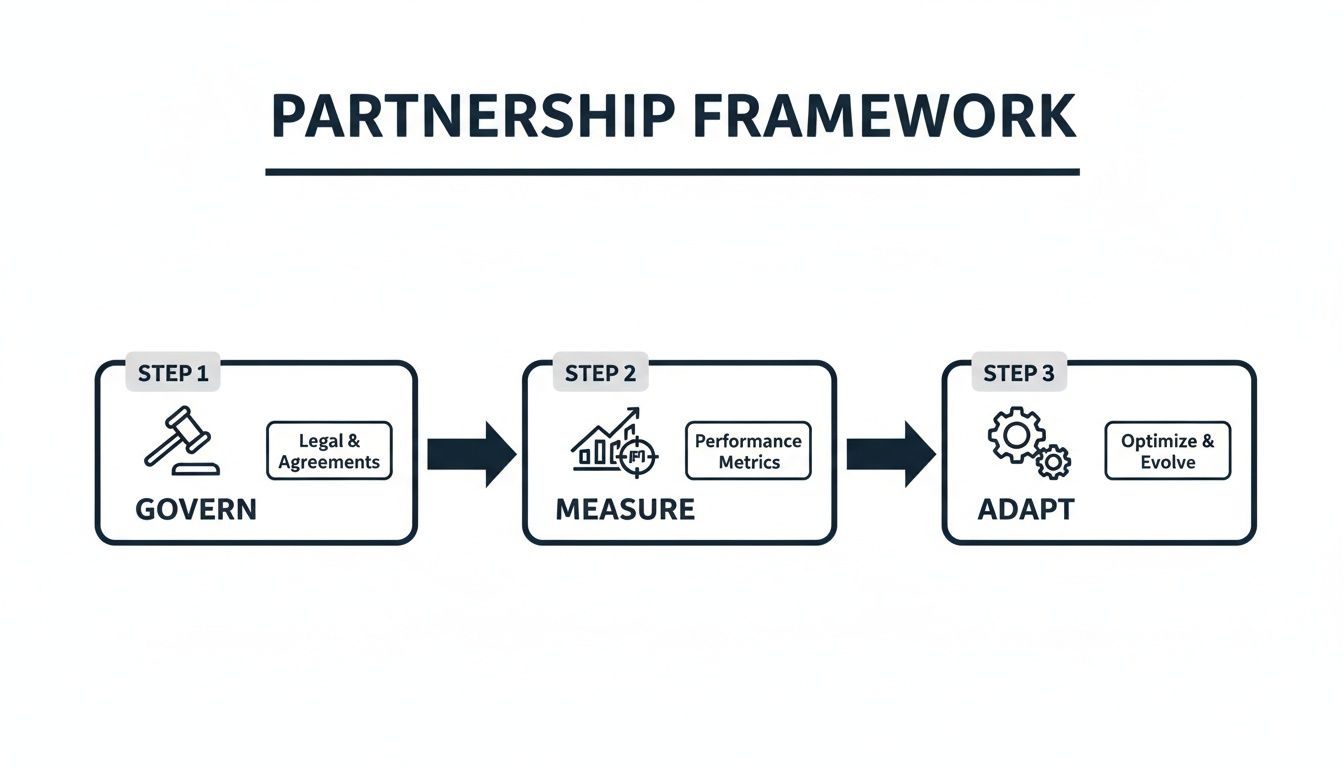
This cycle creates a constant feedback loop, making sure the partnership stays on track and effective as we scale up.
Phase 3: Scaling to a Dedicated Team
With a successful pilot under our belts, we can scale the engagement with confidence. This is where we expand that initial small team into a fully dedicated unit that acts like a natural extension of your own organization. This team isn’t just working on one-off projects anymore; they’re taking ownership of a major piece of your product roadmap.
Scaling up looks like this:
- Team Expansion: We carefully hand-pick and onboard more engineers, QA specialists, and other experts based on the long-term plan.
- Process Integration: The team fully plugs into your world, adopting your agile ceremonies, communication tools, and development workflows until it’s seamless.
- Continuous Delivery: The focus shifts from a single deliverable to a steady stream of value. The team starts delivering new features and improvements in regular, predictable sprints.
By starting small and scaling based on proven results, you turn a potential risk into a calculated, strategic investment. You build a resilient, high-performing long-term tech partnership model that’s truly built to last.
Tapping into AI’s Potential with Your Tech Partner
Think of artificial intelligence as a long game, not a one-and-done project. Unlike installing a piece of software, getting real value from AI means committing to a cycle of continuous learning, adaptation, and refinement. This is exactly why a long-term tech partnership model is so effective, it creates the right environment for sophisticated, enterprise-level AI to really take root and grow.
A lasting relationship goes far beyond just plugging in a few basic AI tools. It’s about co-creating a genuine strategic advantage. With a dedicated partner, you can tackle the tough stuff: building solid data pipelines, managing the complex lifecycle of machine learning models (what we call MLOps), and weaving capabilities like predictive analytics and generative AI right into the core of your products with expert AI development services.

From Simple Implementation to Constant Evolution
A project-based vendor might get an AI tool up and running, but a long-term partner helps you build an entire AI-driven ecosystem. That deeper collaboration is what you need to handle the ongoing demands of artificial intelligence.
- Data Pipeline Architecture: AI is only as smart as the data it learns from. A long-term partner gets to know your data inside and out, helping you design and maintain scalable pipelines that consistently feed clean, relevant information to your models.
- MLOps and Model Management: Machine learning models aren’t “set it and forget it.” They need constant monitoring, retraining, and redeployment to keep them from becoming less accurate over time. A dedicated team takes care of this entire lifecycle, making sure your AI systems stay sharp and effective.
- Strategic Integration: The whole point of AI isn’t just to have it; it’s to use it. Your partner works with you to embed AI insights directly into your user-facing features and internal workflows, turning raw predictive power into real business outcomes.
Think of an AI initiative as a living system. A long-term partner acts as its dedicated caretaker, ensuring it not only survives but evolves to become more intelligent and valuable over time.
This sustained focus is what it takes to get the full return on your investment, especially when dealing with specialized services like those found in AI integration consulting.
Using AI to Build Better Software
There’s another huge benefit to this kind of partnership: using AI to actually improve the software development process itself. When a partner has a deep, contextual understanding of your business goals, they can strategically apply AI to make the entire delivery pipeline faster and more efficient.
Here are a few practical examples:
- Automated QA and Testing: AI tools can predict which areas of a codebase are most likely to have bugs, helping QA teams focus their limited time where it will have the biggest impact.
- Intelligent Code Optimization: AI assistants can review code and suggest performance improvements or more efficient algorithms, helping developers write better, faster code from the start.
- Predictive Project Management: By analyzing data from past projects, AI can help forecast potential delays or budget overruns, giving you a chance to make corrections before things go off the rails.
To truly make the most of AI, working with specialized partners is key.
The Foundation for Real Innovation
At the end of the day, short-term projects just aren’t a good fit for the iterative nature of AI development. They don’t allow for the deep context, trust, and shared learning needed to go from simple automation to true, game-changing innovation. A long-term tech partnership model gives you the stability and strategic alignment required to go after ambitious AI goals and leverage AI for your business.
By investing in a lasting relationship, you’re not just buying a service. You’re building a dedicated innovation engine that can drive continuous improvement and secure a real competitive edge in a world that’s increasingly shaped by AI.
Measuring Success with Real-World Wins
Let’s be honest, the real test of a long-term tech partnership model isn’t how great it looks on paper. It’s about what it actually delivers to your bottom line. Theory is nice, but tangible business results are what truly matter. This is where the partnership stops being a concept and starts becoming a genuine growth engine for your company.
When you move past one-and-done projects, you build the kind of stability and deep-seated knowledge required for major breakthroughs. Think of it as the difference between hiring a freelancer to fix a bug and bringing on a strategic ally who lives and breathes your market, your customers, and your ultimate goals.
From Metrics to Milestones
The success stories that emerge from these partnerships all share a common thread: hard numbers. We’ve seen it time and again across different industries. A sustained, collaborative effort is what drives real efficiency, speed, and innovation.
Imagine what these kinds of results could mean for your own operations:
- Slashing time-to-market by 30% for a fintech company, letting them consistently lap their competition.
- Cutting critical system downtime by 40% for a logistics firm, all thanks to proactive maintenance from a team that knows their systems inside and out.
- Boosting operational efficiency by 25% for a manufacturing client after co-developing intelligent automation solutions.
These aren’t just vanity metrics. They’re game-changers. Getting to market faster means capturing revenue earlier. Keeping your systems online protects that revenue.
In a long-term partnership, you stop counting the hours and start measuring the value. Every metric tells a story of a business problem solved through true collaboration and a shared vision.
A Retail Evolution Case Study
Picture a mid-market retailer handcuffed to an old, clunky eCommerce platform. Their customer engagement was tanking, and the system was too rigid to support any real personalization. Instead of just patching it up, they brought in an AI solutions partner for a complete digital overhaul.
Over 18 months, they didn’t just get a new website; they got sophisticated custom ecommerce solutions powered by an AI personalization engine. It wasn’t a single project with a finish line. It was a continuous evolution. The dedicated team first stabilized the core platform, then began layering in features like predictive recommendations and dynamic pricing, always tweaking based on live user data.
The outcome? A 15% jump in average order value and a huge lift in customer lifetime value, all within the first year. This is a perfect example of how a true partnership connects a business challenge (customer retention) to a tech solution that delivers a clear financial return.
You can see more examples of this in our client cases. Each one highlights the incredible compounding value that a long-term tech partnership model can build over time.
Frequently Asked Questions
When leaders start exploring a long-term tech partnership, a few key questions always come up. Let’s tackle the most common concerns around cost, control, and getting real results.
How do you control costs without a fixed price?
It’s a fair question. You’re not just handing over a blank check. Instead of locking you into a rigid, fixed scope, cost control in models like Time & Materials or a retainer comes from transparent governance and predictable capacity. With a dedicated team, you have a set monthly cost for a guaranteed amount of expert work. Budgets are managed collaboratively through roadmap planning and frequent check-ins, ensuring every dollar is put to work on your biggest business priorities.
Will I lose control over my product roadmap?
Not at all. In fact, you gain more effective control. A true partnership gives you a dedicated team whose sole purpose is to execute your vision. You are always the product owner, the one calling the shots. Structures like steering committees and daily stand-ups aren’t just for show; they give you a constant, clear view into the development process. Your partner brings the execution muscle and strategic advice, but you’re the one steering the ship. The roadmap always aligns with your business goals because you’re the one setting the course.
How soon can we expect to see a return on investment?
While the partnership is built for the long haul, the returns start showing up quickly. You should expect to see tangible value within the first 3-6 months. This usually comes in the form of a Minimum Viable Product (MVP) hitting the market, a successful pilot project resolving a key business problem, or a significant improvement in system stability. That initial win is just the start. The real, compounding ROI builds over time as the partnership fuels continuous innovation and helps you adapt to market shifts.
Who owns the intellectual property?
You do. Period. In any reputable long-term tech partnership, the agreement should be ironclad on this point: all code, designs, and anything else created for you is 100% your intellectual property. The partner functions as an extension of your team, building your assets. Protecting your IP is fundamental to a trustworthy relationship and secures your competitive edge for years to come.
Ready to build a partnership that drives real results? At Bridge Global, we specialize in creating dedicated teams that accelerate your roadmap and unlock new opportunities with AI. Let’s discuss how we can build your future, together. Contact us today to start the conversation.

About Upendra Jith
Upendrajith completed his Master's in English and has been a commercial content developer for the past three years. He's more inclined to develop content with a 'street-smart' delivery on topics such as technology, media, or anything he can get his hands on. He has a fixation on lyrics, dark poetry, media, technology, and flow arts.
View all posts by Upendra Jith →