



A Guide to Population Health Analytics Platforms
Imagine trying to understand the health of an entire city by looking at one person’s medical chart. It’s an impossible task. This is the fundamental problem that Population Health Analytics Platforms were designed to solve. They act as the central nervous system for a healthcare organization, pulling together thousands of disconnected data points to create a single, unified view of an entire patient population.
The Shift from Individual Charts to Community Health
For centuries, medicine has focused on treating one patient at a time based on their immediate symptoms. While this reactive approach is the cornerstone of clinical care, it struggles to keep up with the complexities of chronic disease, prevent widespread illness, and manage healthcare costs across large groups.
A Population Health Analytics Platform marks a critical shift away from this model, moving beyond basic electronic records to enable proactive, community-wide care management.
Think of it like being a city planner. You wouldn’t try to manage traffic by watching a single car on one street. Instead, you’d want a map showing traffic flow across the entire metropolitan area. That’s what these platforms provide – a high-level perspective that allows healthcare organizations to see trends, predict risks, and get ahead of chronic disease at scale.
For instance, instead of simply treating an asthma attack, the platform can help identify every asthma patient in a specific zip code who repeatedly visits the emergency room. This might reveal a local environmental trigger, like air quality near an industrial park, allowing for a public health intervention that goes far beyond a single prescription.
Moving Beyond Reactive Care
So, how do they create this comprehensive picture? At their core, these platforms aggregate and analyze data from multiple, often siloed, sources:
- Clinical Data: This is the information you’d expect: data from Electronic Health Records (EHRs), lab results, and pharmacy records.
- Claims Data: This financial data from insurance providers reveals which services are being used, by whom, and how often.
- Social Determinants of Health (SDOH): This is the game-changer. It includes non-clinical factors like income level, housing stability, food security, and access to transportation that have a massive impact on health outcomes.
By weaving these disparate threads together, providers gain an incredibly rich understanding of the communities they serve. This isn’t just an academic exercise; it’s essential for success in value-based care models, where payment is tied directly to patient outcomes, not the volume of services performed.
Piecing together such a complex system requires deep expertise in both technology and healthcare. For a closer look at the specific technologies that power these systems, check out our overview of data and AI solutions.
How Data Flows Through a Modern Analytics Platform
To really get what a Population Health Analytics Platform does, you have to look under the hood. It’s less about a single piece of software and more about a sophisticated, multi-stage data pipeline that turns a chaotic mess of information into clear, actionable intelligence for healthcare providers.
Let’s walk through the four key stages of that journey.
Step 1: Ingestion – Pulling It All In
First, the platform has to gather the data. This data ingestion stage is like casting a massive net across the entire healthcare ecosystem. It pulls in everything: clinical notes from EHRs, billing codes from claims data, lab results, pharmacy records, and even patient-generated data from wearables and health apps.
With the sheer volume of healthcare data doubling every couple of years, trying to do this manually is a non-starter. The process has to be automated, constantly pulling information to create a single, unified patient record that’s as close to real-time as possible.
Step 2: Normalization – Creating a Common Language
Once the data is inside, the real work begins. This is the warehousing and normalization phase, and honestly, it’s where most platforms either succeed or fail. The raw data arrives in a dizzying array of formats, codes, and terminologies. Think of it as receiving thousands of documents in hundreds of different, slightly incompatible dialects.
The normalization engine acts as a universal translator. It meticulously maps and converts all this disparate information into a common, standardized format, often using standards like HL7 and FHIR. This is what ensures a diagnosis of “Type 2 diabetes” from one hospital’s EHR is understood as the exact same thing as a “T2DM” code from another clinic’s billing system. Getting this automated processing right is everything, as explained in PlotStudio AI’s data processing guide.
Step 3: Analytics – Finding the Signal in the Noise
With a clean, unified dataset ready, the analytics engine takes over. This is the brain of the operation. Here, powerful algorithms and machine learning models sift through the standardized data to uncover hidden patterns, calculate risks, and make predictions.
This is where the magic happens. Is a patient showing early signs of developing a chronic condition? Is a specific zip code about to see a spike in flu cases? The analytics engine provides the answers by turning raw data into predictive intelligence.
Step 4: Presentation – Putting Insights into Action
Finally, all those valuable insights are worthless if they can’t be easily understood and used by the people on the front lines. The user interface or presentation layer is the last, critical step.
Through intuitive dashboards, automated reports, and timely alerts, the platform delivers the right information to the right person at the right time. A clinician gets an alert about a high-risk patient, while an administrator sees a dashboard showing care gap trends across their entire network. This is where complex data finally becomes a decision that can improve a patient’s life, and it all depends on having the right tools and integrations to support the entire workflow.
Essential Features That Drive Real-World Outcomes
A Population Health Analytics Platform is much more than a fancy data repository; it’s an engine for action. Its real power comes from a set of core features that turn a flood of raw data into specific, often life-saving interventions. These are the capabilities that separate a basic reporting tool from a system that can actually move the needle on patient outcomes and financial performance.
Too many organizations are stuck looking in the rearview mirror, analyzing what went wrong last quarter. A truly modern platform helps you look ahead. It’s designed to anticipate what’s coming and give your teams the chance to intervene before a small health issue snowballs into a costly crisis.
The diagram below shows how data flows through the system to make this possible, transforming disconnected information into intelligence you can act on.
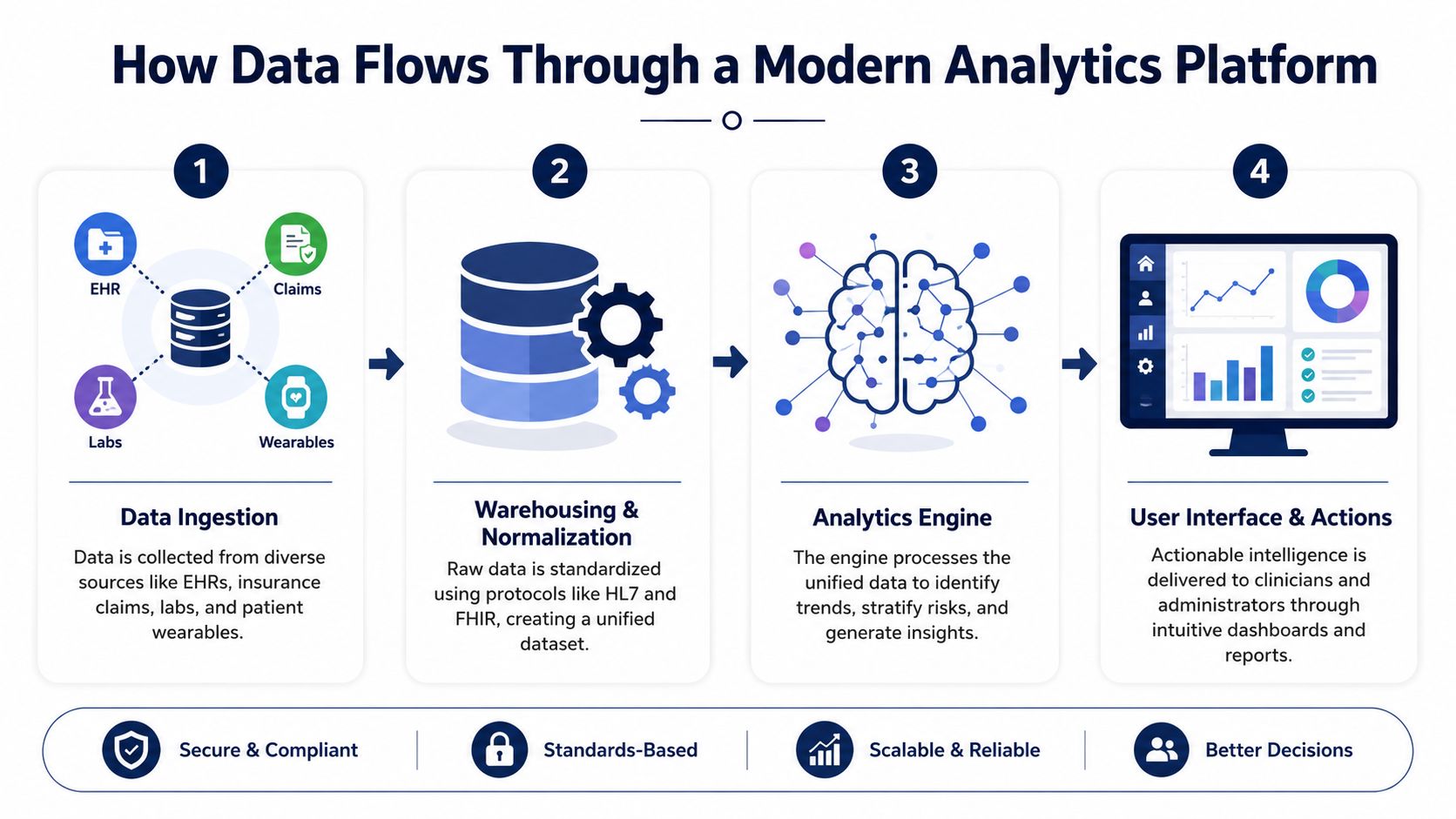
This journey from raw data to actionable insight is what empowers clinicians and administrators to stop guessing and start making data-driven decisions.
Core Capabilities for Actionable Intelligence
A modern platform’s toolkit is built around several key functions that work together. While the underlying technology is complex, the goal is refreshingly simple: get the right information to the right person at precisely the right time.
Here are the essential features that deliver tangible results:
- Risk Stratification: This is the bedrock of population health management. The platform sifts through clinical, claims, and demographic data to automatically segment patients into risk tiers, like low, rising, and high risk. This allows care managers to stop boiling the ocean and focus their limited time on the individuals who need them most, such as patients at high risk for hospital readmission.
- Care Gap Analysis: The system constantly scans patient records and compares them against evidence-based clinical guidelines. It can instantly flag a patient who is overdue for a mammogram, an A1c test for their diabetes, or a critical vaccination. This enables automated outreach to close these care gaps at scale.
- Social Determinants of Health (SDOH) Analytics: We all know health is shaped by factors far beyond the clinic walls. SDOH analytics integrate non-clinical data: on things like housing stability, food security, and access to transportation, to paint a complete picture of a patient’s life. This helps answer the crucial why behind a missed appointment or an unfilled prescription.
The Power of Predictive Analytics
While the features above give you a clear picture of the present, the most sophisticated platforms use artificial intelligence to predict the future. This is where partnering with expert AI development services can make a world of difference.
Predictive analytics, powered by machine learning, can forecast which patients are most likely to have an adverse event, like an avoidable emergency department visit. By identifying these individuals before something happens, care teams can step in proactively.
This shift from a reactive to a predictive model is absolutely fundamental for succeeding in value-based care. Instead of just analyzing last year’s readmissions, the system predicts next month’s. Weaving these predictive tools into your operations is a cornerstone of any effective AI implementation roadmap for a forward-thinking health system.
Build vs. Buy: A Strategic Checklist for Your Decision
Choosing whether to build a custom Population Health Analytics Platform from the ground up or buy an off-the-shelf solution is a real fork in the road for any healthcare organization. The truth is, there’s no single right answer. The best path depends entirely on your strategic goals, your team’s technical skills, and your budget. This decision goes far beyond the initial price tag; it shapes everything from how quickly you can get started to your long-term competitive edge.
This choice has become especially critical as the industry shifts away from fee-for-service and deeper into value-based care. When you’re paid for outcomes, you need a way to see the big picture. That’s what these platforms do: they pull together scattered data from EHRs, claims, and labs to give you a single, coherent view of patient risk. As you can read on Persivia’s blog, this turns raw data into actionable intelligence, helping you direct resources to the patients who need them most.
Key Factors to Guide Your Choice
To make a smart decision, you have to weigh a few critical factors. Thinking through these points honestly will make the right path much clearer.
- Total Cost of Ownership (TCO): Don’t just look at the initial price. Buying a platform means subscription fees, implementation costs, and training. Building requires a hefty upfront investment in development, but you won’t have recurring vendor fees. You really need to map out the TCO for both options over at least a five-year horizon.
- Customization and Control: A ready-made solution gets you going quickly, but you’re often locked into its specific workflows. If your care management processes are highly unique, or if you’re even thinking about spinning off a new SaaS product development venture, a custom build gives you complete freedom. A bespoke platform lets you design every feature to perfectly match how your clinicians and staff actually work.
- Speed to Market: This one is simple. A vendor’s platform will almost always be faster to deploy. If you need analytics capabilities now to meet new regulations or jump on a market opportunity, buying is probably your best bet.
- Internal Expertise and Resources: Be realistic about your team. Do you have the in-house talent for a complex custom healthcare software development project? We’re not just talking about developers. You need data scientists, UX designers, and project managers who truly understand the nuances of healthcare.
Finding the Right Path Forward
For organizations with very specific workflows or a vision for innovation, investing in custom software development can create a powerful competitive advantage. You end up with a proprietary asset built specifically to address the challenges of your patient population.
However, if your needs are pretty standard and you don’t have a dedicated development team, a well-vetted vendor solution can deliver value right out of the box. There’s also a middle ground: a hybrid approach. You could buy a core platform and then build custom modules to fill in the gaps. Different software development service models can make this work, whether you need to augment your team or hire for a specific project.
No matter which path you take, a few things are absolutely non-negotiable: strong data governance, robust security (HIPAA/HITRUST), and scalability. Whether you build or buy, your platform must be able to grow with your organization and protect patient data without compromise. The right healthtech software development partner can help you sort through these complexities and make the best strategic choice.
Your Platform Implementation Roadmap
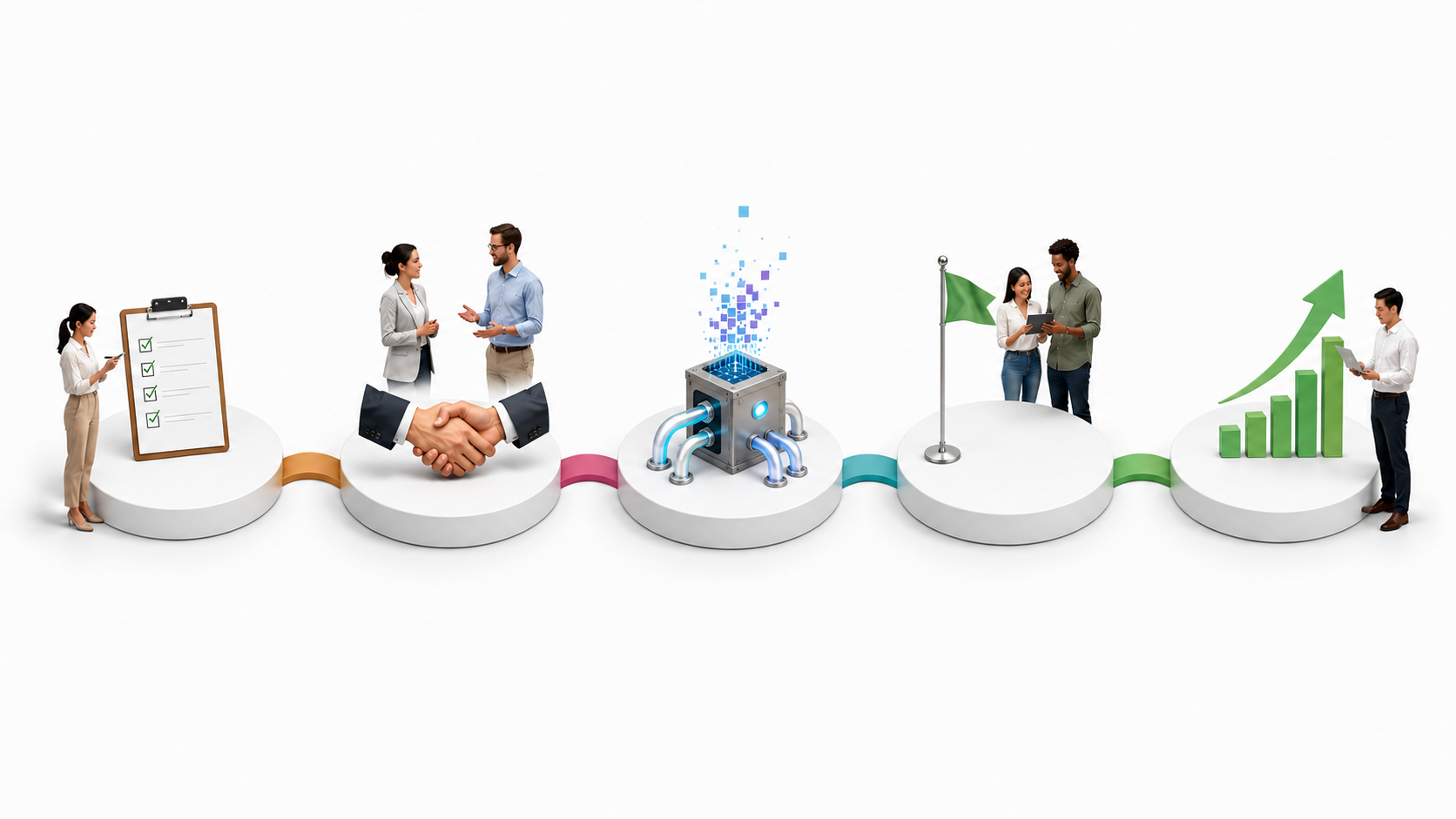
Putting a Population Health Analytics Platform into action is far more than a simple IT project. It’s a fundamental shift in how your organization approaches and delivers care. A smooth rollout all comes down to a well-thought-out plan that gets everyone, from the tech team to frontline clinicians, on the same page. Without a structured deployment, you risk low user adoption, persistent data silos, and a platform that never delivers on its promised ROI.
A phased approach is your best bet, breaking the complex journey into manageable stages. This strategy minimizes risk and helps build momentum. As you map out your implementation, it’s also the perfect time to consider your long-term strategy, including effective cloud modernization services that will keep your platform scalable and secure for years to come.
Stage 1: Strategic Planning and Goal Setting
Before you even look at a single piece of software, your leadership team needs to sit down and define what success actually looks like. We’re not talking about technical specs here; we’re talking about tangible clinical and financial outcomes.
- Define Clear Objectives: What are you really trying to accomplish? Get specific. Maybe your goal is to reduce hospital readmission rates by 15%. Perhaps it’s improving chronic disease management by lowering average HbA1c levels for your diabetic population.
- Establish Key Performance Indicators (KPIs): How will you know if you’re winning? Your KPIs are your scorecard. They must be specific, measurable, and tied directly back to those objectives you just set.
Stage 2: Partner Selection and Tech Stack Definition
With clear goals in hand, you can start the process of evaluating partners and technologies. Whether you’re leaning toward building a custom solution or buying an off-the-shelf platform, you now have a clear yardstick to measure them against. This is the time to scrutinize everything from data integration muscle to how intuitive the user interface feels for a busy clinician.
If predictive analytics are a big part of your vision, you’ll need a dedicated plan for that as well. A structured roadmap is crucial for getting AI implementation right.
Stage 3: Data Integration and Governance
This is where the real technical heavy lifting begins. Your team will be busy connecting the new platform to all of your critical data sources: EHRs, claims systems, lab results, and more. It is absolutely essential to establish strong data governance policies from day one.
Think about it now: Who gets to see what data? How are you safeguarding patient privacy? Answering these questions upfront will save you from major compliance headaches, ensure you’re following HIPAA, and maintain the trust of your patients.
Stage 4: Pilot Program and User Training
Whatever you do, don’t attempt a “big bang” rollout across the entire organization. It’s a recipe for disaster. Start small with a focused pilot program, perhaps in a single department or with a specific patient group.
This controlled test run is your chance to find and squash bugs, get honest feedback from actual users, and fine-tune your training materials before going live everywhere.
Stage 5: Scaled Rollout and Continuous Improvement
Once your pilot has proven successful, you can start the phased rollout across the rest of the organization, supported by comprehensive training for every user. But the work doesn’t stop at go-live. Implementation is an ongoing process.
The platform needs to be continuously monitored and refined based on user feedback and how it’s performing against your KPIs. A well-executed plan delivers real, measurable results – a principle you can see in action with tools designed to improve care coordination, like a patient journey mapping tool. Your journey with population health analytics is one of constant evolution and improvement.
Frequently Asked Questions
As you explore what Population Health Analytics Platforms can do, it’s natural to have questions. Here are some straightforward answers to the things we hear most often from healthcare leaders.
How do platforms ensure patient data privacy?
Patient privacy isn’t just a feature; it’s the absolute bedrock of any reputable platform. These systems are built from the ground up to meet and exceed stringent regulations like HIPAA, using a defense-in-depth security approach.
This typically includes several critical layers of protection:
- Data Encryption: All sensitive patient data is scrambled and unreadable, both when it’s being stored (at rest) and when it’s moving between systems (in transit).
- Role-Based Access Controls: This is a fundamental security principle. It means that a user’s role dictates exactly what data they can see, preventing a billing specialist from viewing clinical notes, for example.
- Detailed Audit Trails: Every click, view, and change made to patient data is logged. This creates an immutable record for security monitoring and ensures complete accountability.
- Data De-identification: When performing large-scale analysis to spot trends, all personally identifiable information is stripped from the dataset. This protects individual privacy while still providing invaluable insights.
When you’re vetting a vendor, their ability to demonstrate a deep, practical understanding of these security measures is non-negotiable. An experienced healthtech software development partner will have built these safeguards into their process from day one. Our client cases demonstrate this commitment to security and compliance.
What is the difference between an EHR and a PHAP?
The core difference comes down to perspective: are you looking at a single tree or the entire forest?
Think of an Electronic Health Record (EHR) as the detailed file for one person. It’s designed to answer the immediate question, “What is the best course of action for the patient in front of me?” Its focus is on the individual clinical encounter.
A Population Health Analytics Platform (PHAP), on the other hand, zooms out. It pulls together data from thousands of EHRs, claims systems, and labs to see the bigger picture. It’s built to answer questions like, “Which 500 of our patients are most likely to be readmitted in the next 30 days, and what can we do to intervene now?” The EHR is for the individual; the PHAP is for the community. Effective healthcare integrations are what make it possible for a PHAP to aggregate this diverse data.
Can smaller clinics benefit from population health analytics?
Absolutely. It used to be that only large hospital systems had the resources for these tools, but the game has changed. Modern, cloud-based platforms have made powerful analytics accessible and affordable for practices of all sizes.
Even a small clinic can see huge returns. A platform can help them quickly identify all their diabetic patients with an A1c over 9, flag every patient who is overdue for a mammogram, or gather the quality metrics needed to succeed in value-based care contracts. The trick is to start with a clear, specific goal and find a solution, or a custom software development partner, that solves that one problem exceptionally well.
How does AI actually improve these platforms?
AI gives these platforms a sense of foresight. Instead of just being a rearview mirror showing you what happened last quarter, AI acts more like a GPS, helping you navigate what’s coming next.
AI finds the faint, complex signals hidden in massive datasets – patterns that a human analyst, no matter how skilled, would likely miss. This leads to more accurate risk scoring, smarter resource allocation, and truly personalized care plans.
By incorporating enterprise AI solutions, organizations can shift from being reactive to proactive. It’s the difference between treating a heart attack and identifying and supporting the patient months before it happens. As we explored in our guide on AI-powered healthcare diagnostics, this ability to intervene earlier and more intelligently is what drives better outcomes and lower costs.
Ready to build a smarter, more proactive healthcare solution? Bridge Global is the expert partner you need. We specialize in building secure, scalable, and intelligent healthtech platforms. Start your journey with our custom healthcare software development services today.

About Upendra Jith
Upendrajith completed his Master's in English and has been a commercial content developer for the past three years. He's more inclined to develop content with a 'street-smart' delivery on topics such as technology, media, or anything he can get his hands on. He has a fixation on lyrics, dark poetry, media, technology, and flow arts.
View all posts by Upendra Jith →