



MVP Development for Healthtech Startups: A Practical Guide
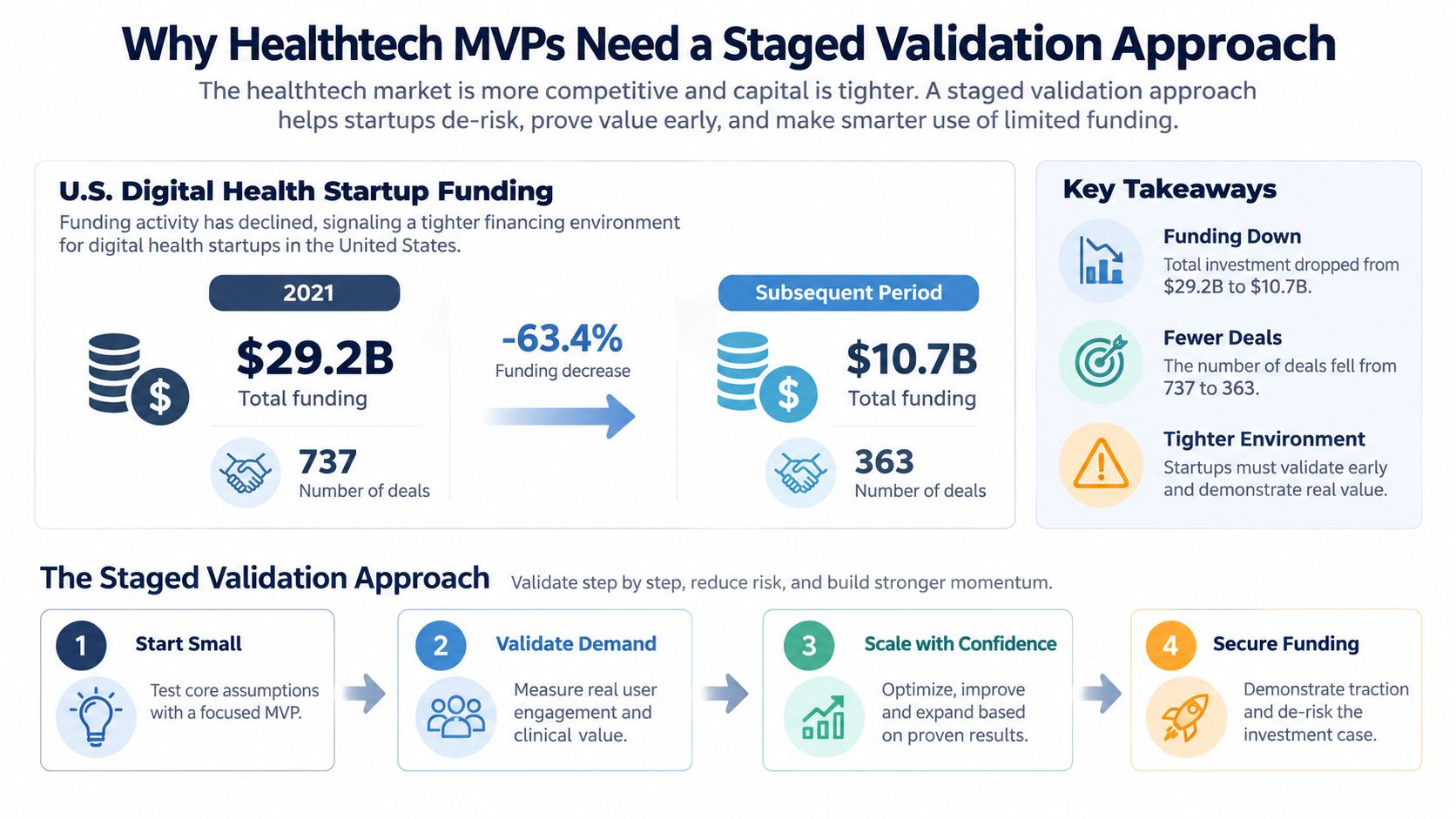
In the United States, digital-health startups raised $29.2 billion across 737 deals in 2021, but funding fell to $10.7 billion across 492 deals in 2023, the lowest annual level since 2019, according to Fierce Healthcare’s coverage of Rock Health data. That shift changes what an MVP has to prove. For a healthtech founder, the first release isn’t a smaller version of a future platform. It’s a controlled way to validate a clinical or operational problem, manage risk, and produce evidence that supports the next investment decision.
MVP development for healthtech startups works best when product scope, regulatory intent, security architecture, interoperability, and measurable outcomes are designed together. The practical question isn’t how many features the team can ship. It’s which narrow workflow can be delivered safely, adopted by real users, and measured well enough to justify expansion.
Why Healthtech MVPs Need a Staged Validation Approach
As noted earlier, U.S. digital-health funding fell from $29.2 billion in 2021 to $10.7 billion in 2023. That shift changes how founders should define an MVP. In healthtech, the first release has to reduce uncertainty in stages, not showcase the biggest feature set the team can afford to build.
A staged validation approach forces sharper decisions. Instead of shipping a broad platform and hoping adoption explains what matters, the team starts with a narrow workflow, a measurable hypothesis, and a clear risk boundary. That usually produces better evidence for investors, buyers, and clinical stakeholders, because each release is tied to a specific question: does this workflow solve a painful problem for a defined user without creating avoidable clinical, regulatory, or operational risk?
Start with a measurable problem
Founders often scope an MVP around features because features are easy to discuss. What matters is the decision the product needs to support. If the product is meant to improve medication reconciliation, reduce intake bottlenecks, or increase follow-through on reminders, write that down as a testable claim before approving the backlog.
A useful hypothesis record is short and specific:
- User and setting: Name the user, the care setting, and the point in the workflow where the problem appears.
- Current friction: Describe the manual work, missing data, handoffs, delays, or error-prone steps in the current process.
- Expected behavior: State what should change if the MVP works. That might be faster completion, fewer corrections, or more consistent follow-through.
- Evidence threshold: Define what signal would justify another release, such as repeated use, successful task completion, or a meaningful operational improvement.
- Risk boundary: List what the MVP will not do yet because the function needs more evidence or raises patient-safety concerns.
For a medication reconciliation MVP, the hypothesis record might say the first release is for care teams during intake, limited to importing and structuring medication lists, flagging missing fields, and recording staff corrections. It would exclude any recommendation engine, clinical prioritization, or treatment guidance until the team has evidence that the underlying data capture is reliable and the workflow is actually used.
That discipline prevents expensive confusion.
A founder does not need a disposable prototype. The product still needs sound data handling, auditability where appropriate, and a workflow people can complete without workarounds. Teams exploring patient-facing concepts can use Vision’s guide to fitness apps to study focused journeys and scope control, then apply a stricter health-data and clinical-safety lens where the product touches care, protected information, or decision support.
Treat the MVP as an evidence system
Every staged release should answer a small set of operational questions. Did users complete the intended task? Where did they stop? How often did they correct entries? Which steps still required manual intervention? If you cannot observe those signals, you are shipping software without learning from it.
Instrumentation belongs in the MVP from the start. Event design should reflect the workflow under test and respect privacy controls, role-based access, and data minimization. For a triage intake flow, for example, it is more useful to capture completion, drop-off, correction frequency, and handoff timing than to count generic page views.
The same logic applies to scope. A single high-value workflow usually teaches more than a collection of loosely connected modules. Medication reconciliation, prior authorization, triage intake, and care-coordination handoffs are strong MVP candidates because each one has a clear user, a visible process, and measurable failure points.
If an outside team is involved, choose a healthtech software development partner that can translate the clinical problem into user stories, acceptance criteria, instrumentation, and a release sequence. The core output is not a stack of screens. It is a safer, clearer next decision based on evidence from actual use.
Navigating Regulatory and Security Requirements
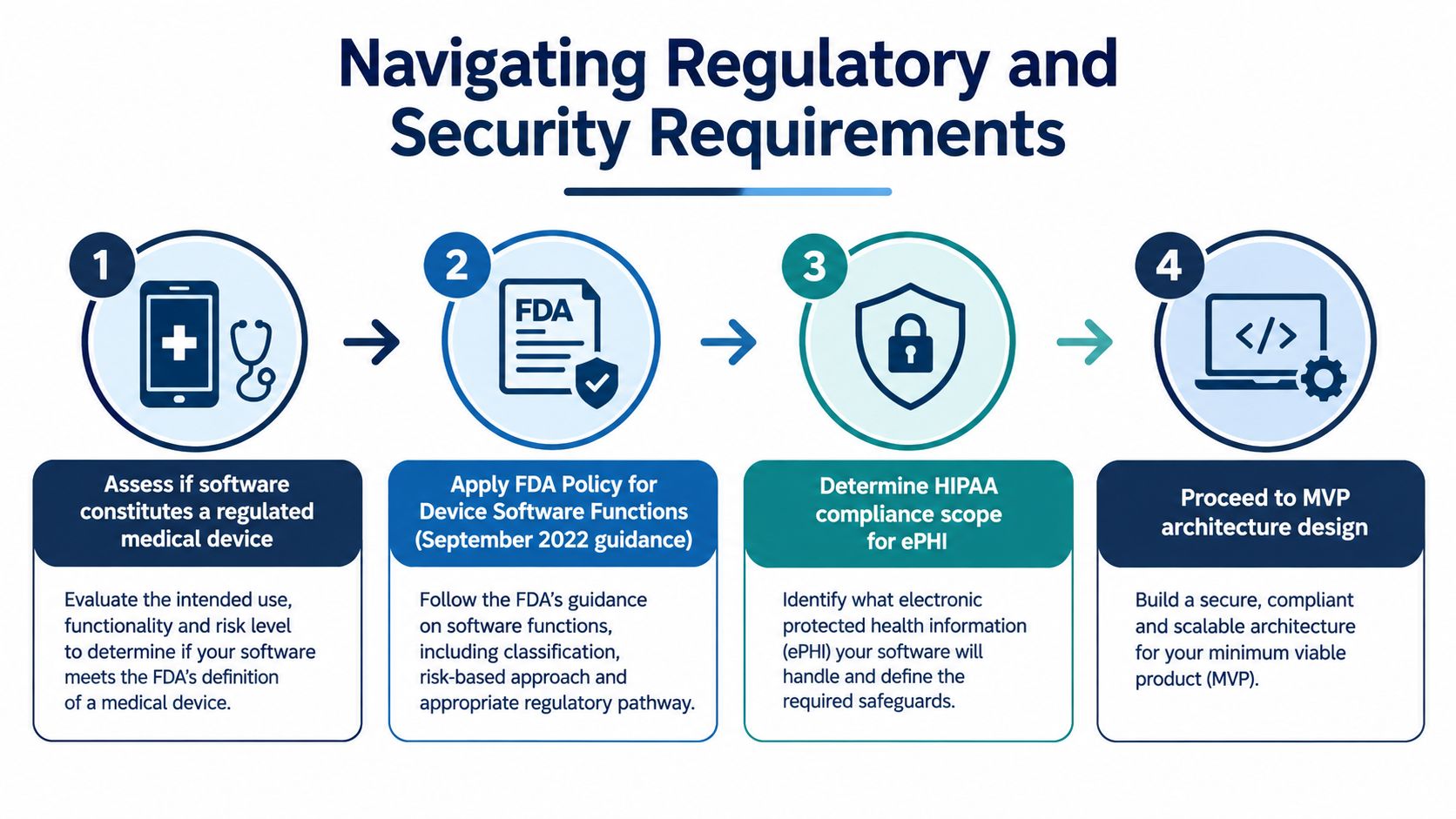
Regulatory scope is one of the first product decisions, not a cleanup task after design and engineering. The FDA’s Policy for Device Software Functions and Mobile Medical Applications, issued on September 28, 2022, draws a practical line between software for wellness, communication, workflow, or administration and software that performs medical-device functions or supports diagnosis and treatment decisions.
That line should shape the MVP before claims, architecture, and roadmap harden.
The FDA looks at what the software does, and the patient risk it creates, whether it runs as a mobile app, web application, or general-purpose computer program. Founders should write down intended use, target users, clinical setting, inputs, outputs, and launch claims before they approve a backlog. In practice, this is how you keep an MVP from drifting into a regulated product category by accident.
Use a risk-based release sequence
A staged MVP works best when each release tests a clear hypothesis while keeping regulatory exposure narrow. A practical compliance workflow usually includes seven connected steps:
- Define intended use: Specify who uses the product, in what setting, for which purpose, and with what claims.
- Classify each function: Assess whether individual software functions fall within medical-device functionality instead of labeling the whole product as one undifferentiated system.
- Separate risk levels: Keep low-risk workflow features distinct from diagnostic, monitoring, treatment-related, or predictive functions.
- Set acceptance criteria: Define objective requirements for safety, effectiveness, cybersecurity, data integrity, and usability.
- Perform analytical validation: Show that the system correctly processes its inputs and produces outputs according to its specification.
- Perform clinical validation: Show that clinically consequential outputs are meaningful for the intended population and context.
- Plan monitoring and change control: Define how incidents, performance drift, user feedback, and material changes will be reviewed after launch.
The FDA’s medical device software guidance navigator supports this function-level approach. Validation requires objective evidence, and for software as a medical device, clinical evaluation continues across pre-market and post-market activity. It is not a one-time test run at the end of a sprint.
A useful release gate is simple. Launch the smallest workflow you can validate end to end. If a recommendation engine, risk score, or other predictive feature cannot be justified yet, keep it behind a feature flag or leave it out of the initial claim set. That trade-off often saves a startup from changing its regulatory profile before it has even proved user demand.
Build security and usability into the definition of done
For U.S. products that handle ePHI, HIPAA’s Security Rule requires administrative, physical, and technical safeguards for confidentiality, integrity, and availability. Technical safeguards include access controls, audit controls, and transmission security. The exact scope depends on customer relationships and processing roles because the rule applies to covered entities and their business associates.
So the MVP should already include role-based permissions, reviewable activity logs, protected data transmission, and a documented identity and access approach. If your acquisition plan includes influencer or endorsement campaigns, review FTC disclosure rules early, because marketing claims can also affect how intended use is interpreted.
Usability belongs in the same release gate as security. A peer-reviewed review of usability and medication safety found that 36% of reported medication-safety events in three U.S. hospitals were associated with EHR usability problems, and 19% of usability-related events could have resulted in patient harm. In healthtech, poor interaction design is not just a UX issue. It can become a clinical risk.
Founders can use Bridge Global’s guide to HIPAA-compliant software development as a practical reference, then convert those requirements into backlog items and acceptance criteria. The test is concrete: can a specific user access only the information needed for the task, is every consequential action traceable, and does the interface help users catch and recover from mistakes?
Building the Architecture and Tech Stack
A healthtech technology stack should make the intended workflow safer and easier to validate. It shouldn’t be selected because a framework is fashionable or because a particular cloud service can produce a quick demo. Start with data classification, user roles, integration boundaries, audit requirements, and expected clinical consequences when a service fails.
For ePHI, HIPAA’s technical safeguards translate into architecture decisions. Access controls must restrict system access to authorized users. Audit controls must record and support examination of activity. Transmission security must protect ePHI while it moves across electronic networks. These requirements affect the identity layer, API gateway, logging design, secrets management, network configuration, and incident response process.

Prefer a narrow, observable architecture
A modular monolith can be a sensible starting point when one team is validating one workflow. It can keep deployment and troubleshooting manageable while preserving boundaries between identity, patient or member data, workflow logic, integrations, analytics, and audit services. Microservices may become appropriate when isolation, scaling, or organizational boundaries justify the operational cost, but they shouldn’t be introduced as a status signal.
Use managed cloud capabilities where they support security and operational control. Define environment separation, backup and recovery procedures, monitoring, access reviews, and change control before the pilot. A design that looks efficient in a demo can become expensive if every change requires coordinated releases across unowned services.
Technology choice still depends on the workload. Python may suit analytics and machine-learning services, while TypeScript or another web-oriented stack may fit transactional portals and APIs. Teams comparing lightweight API development with batteries-included frameworks can consult this explanation of the difference between Flask, Django, and FastAPI, then choose based on validation needs, team experience, dependency risk, and operational ownership.
Make interoperability part of the product
The ONC Cures Act Final Rule calls for standardized APIs that let patients securely and conveniently access structured electronic health information through smartphone applications, alongside information-blocking provisions intended to support access and exchange. A product that works in isolation may still be difficult to deploy if it can’t exchange structured information with the provider, payer, or patient ecosystem.
Define the minimum data set and exchange workflow before selecting integration patterns. The architecture should answer practical questions:
- Identity: How will the system match a patient or member, and how will ambiguous matches be handled?
- Permissions: Which user or external application may access each data element?
- Provenance: Can the product show where a value came from and when it was received?
- Failure handling: What happens when an API is unavailable, data is incomplete, or an update conflicts with an existing record?
- Auditability: Can the team reconstruct who accessed or exchanged information?
Detailed architectural patterns for protected data, cloud services, and operational controls are available in Bridge Global’s healthcare cloud architecture guide. The core principle is simple: build the minimum reliable exchange needed by the initial workflow, not an abstract integration layer with no tested user outcome.
Integrating AI and Machine Learning Responsibly
AI can sharpen a healthtech MVP, but it can also widen the product’s regulatory, clinical, and operational risk before the team has proved the core workflow. Treat AI as a staged validation problem. Start with the decision you are trying to support, the harm that could come from getting it wrong, and the evidence a user needs to verify the output.
The FDA evaluates digital health software by function and patient risk, not by whether the feature is labeled as AI or delivered through a mobile app. For clinical decision support, the Cures Act excludes certain functions from the device definition only when specific criteria are met. The software must not acquire, process, or analyze medical images or signals. It must not display or analyze medical information, support recommendations about prevention, diagnosis, or treatment, and let a healthcare professional independently review the basis for the recommendation rather than rely primarily on it for an individual decision. Review the actual intended use against the FDA clinical decision support software guidance.
Put the workflow before the model
A responsible AI feature has a named user, a bounded task, and a clear review step. Define the input, the output, who checks it, what evidence supports it, and what happens when the system is uncertain or wrong. “Add an AI assistant” is not a useful requirement. “Summarize recent records for a clinician who can inspect the source data before signing a note” is.
Early AI should usually target observational or administrative work if that gives the team useful learning without making an unsupported clinical claim. Good first candidates include document classification, information retrieval, structured data extraction, or draft generation with required human review. Predictive recommendations, triage outputs, and treatment suggestions need stronger analytical validation, closer monitoring, and tighter claims discipline.
The feedback mechanism matters as much as the model. Bridge Global’s guide to AI feedback loops in healthcare covers how to structure that capture. A useful loop records reviewer corrections, model version, source data, confidence or uncertainty information where appropriate, and whether the reviewer accepted, edited, or rejected the output. Feedback is not automatically ground truth. Clinical teams still need rules for adjudicating corrections and for deciding when a material model change requires revalidation.
Connect AI to interoperability and usability
Model quality is limited by data quality, context, and workflow placement. A model will not fix a bad patient match, missing medication history, weak provenance, or an interface that encourages blind acceptance. Test the full chain, from retrieval through display and user interpretation, not just model performance in isolation.
More than two-thirds of hospitals reported using a FHIR API for patient access in 2022, an increase of 12 percentage points year over year, according to the FDA-hosted evidence on FHIR adoption. That is meaningful progress, but it does not remove fragmentation. The same evidence points to uneven readiness for newer payer interoperability requirements.
The 2025 CAQH Index reported that nearly 63% of medical plans were developing FHIR-based prior-authorization APIs in the run-up to the January 2027 CMS-0057-F compliance deadline, according to the 2025 CAQH Index report. Provider readiness was still at an earlier stage. For an AI-enabled MVP, interoperability is not a nice-to-have integration project. It is a workflow dependency. Measure whether the needed data arrives on time, whether users can verify it, and whether the fallback path is safe when it does not.
Developing with Cross-Functional Teams and QA
A healthtech MVP succeeds or fails in the handoff between disciplines. Engineers can ship the workflow, but founders still need clinical users, privacy and security specialists, quality owners, compliance advisors, designers, and integration specialists involved before build starts. The goal is not a bigger team. The goal is clear ownership for decisions that can affect patient safety, data handling, workflow fit, or release risk.
Treat that group as part of validation, not as a review layer added at the end. If the MVP hypothesis is that a task can be completed faster, more accurately, or with fewer workarounds, each function should help define what evidence would prove or disprove it.
QA should begin with the riskiest tasks and the points where information changes hands. Map where clinicians, administrative staff, patients, or caregivers enter, review, confirm, correct, and pass along data. Then test those moments under realistic conditions: interruptions, missing records, delayed syncs, ambiguous labels, and time pressure. A scripted demo can confirm the happy path. It rarely exposes the failure that appears when a nurse is interrupted during medication entry or when a coordinator must decide whether to proceed with incomplete information.
Test what can harm adoption and safety
Usability testing for a clinical MVP has to go beyond asking whether the interface feels intuitive. Measure task completion, error frequency, time on task, recovery from mistakes, and whether users understand the alerts and status signals they see. Repeat those tests after material interface changes, especially for workflows involving medication, triage, diagnostic support, or care coordination.
The usability-related harm rates cited earlier justify a stricter definition of done. In practice, that means writing QA scenarios around the errors that matter most. For example, run an interruption test during medication entry: the user starts an order, gets pulled into another task, returns with partial context, and must confirm the right patient, dose, and status before submission. That single script can reveal weak labeling, poor autosave behavior, confusing warnings, and unsafe defaults.
A useful release standard includes:
- Prioritize severity: Fix defects that could alter a patient record, a decision, or a handoff before cosmetic issues.
- Confirm irreversible actions: Require explicit confirmation for deletion, submission, escalation, or other hard-to-reverse steps.
- Show system status: Make loading, synchronization, failures, and pending review visible at the moment users need them.
- Preserve provenance: Show where clinically relevant information came from and when it was last updated.
- Design alerts carefully: Give enough context to act without training users to dismiss every notification.
Link QA to release evidence
Every clinically consequential requirement should trace to a verification test, a validation protocol, an owner, and a decision threshold. Engineering QA shows whether a service behaves to spec. Clinical validation answers a different question: whether the output is meaningful and safe for the intended population, setting, and workflow.
Use a controlled pilot or shadow phase before users depend on the product for every critical operation. Record incidents, near misses, workarounds, support requests, and data-quality failures. Release decisions should weigh functional testing, security testing, usability testing, integration testing, and clinical review together.
Post-market discipline starts here, too. Decide who reviews incidents, how changes are classified, when a workflow requires revalidation, and how customers receive relevant release information. That makes QA an ongoing safety function, not a final checkpoint.

Launching Metrics and Scaling Considerations
Launch metrics should reflect the MVP’s hypothesis, not vanity activity. If the product addresses administrative burden, measure task completion, manual work, and error recovery. If it supports adherence, measure the intended engagement behavior and retention. If it supports clinical operations, define the relevant workflow and outcome signals with clinical stakeholders before the pilot.
Interoperability deserves its own scorecard. Test authorization success, patient matching, missing-data rates, latency, provenance, consent handling, downtime recovery, and the manual work required when an exchange fails. A green API health check doesn’t prove that a clinician received the right record or that a payer workflow can be completed without unsafe workarounds.
Scale the workflow that works
A thin MVP with one exceptionally reliable workflow may outperform a feature-rich platform with shallow connections. Scale only after the team understands which users adopt the product, which tasks they repeat, which errors matter, and which integration failures create operational cost. Expansion should add evidence and capacity, not merely surface area.
A practical next sequence is:
- Review pilot evidence: Compare observed behavior with the original hypotheses and acceptance thresholds.
- Resolve high-risk failures: Address safety, security, data integrity, and workflow blockers before adding convenience features.
- Strengthen the integration: Reduce manual fallback work and document customer implementation requirements.
- Reassess claims: Confirm that product messaging still matches validated functionality and intended use.
- Plan the next release: Tie every new feature to a customer, clinical, operational, or regulatory need.
For founders who need a team to turn this plan into a secure product, custom healthcare software development can cover discovery, workflow design, integrations, engineering, testing, and iterative rollout. Bridge Global also provides custom software development, SaaS product development, and AI development services, with the appropriate choice depending on the MVP’s architecture and validation needs. Review relevant client cases when assessing how an external delivery team approaches complex software work.
Frequently Asked Questions
What makes a healthtech MVP different from a standard software MVP?
A healthtech MVP must validate value without compromising patient safety, data integrity, security, or applicable regulatory obligations. It should launch with a deliberately limited scope, but the included workflow must be production-ready for its intended use.
Should regulatory assessment happen before development?
Yes. Define intended use, users, claims, data flows, and clinical consequences before finalizing features or architecture. This helps separate lower-risk workflow functions from software that may perform regulated medical-device functions.
Should an MVP include AI?
Only when AI tests an important hypothesis, and the team can validate, monitor, and explain its role appropriately. An administrative or assistive feature with human review may be more suitable for an early release than an unvalidated diagnostic or treatment recommendation.
How should a startup measure interoperability?
Measure the operational workflow, not only API availability. Include patient matching, authorization, missing data, latency, provenance, consent, downtime recovery, and the manual effort required when data exchange fails.
When is an MVP ready to scale?
Scale when the core workflow is adopted, repeatable, safe, and measurable in its intended setting. Resolve high-severity usability, security, data, and integration issues before expanding into additional workflows or markets.
Bridge Global can help you define a focused healthtech MVP, design its compliance and interoperability boundaries, build the required software, and validate it with real users. Visit Bridge Global to discuss your clinical workflow, measurable hypotheses, and next release decision.

About Stephanie Cornelissen
Stephanie Cornelissen is a Technical Solutions Consultant with strong experience helping organizations navigate complex digital change. She works closely with teams to align business goals with practical, scalable technology solutions. With expertise in system architecture, integrations, and emerging technologies, she focuses on solving real-world problems through thoughtful execution. She enjoys working where technology meets business strategy and measurable growth.
View all posts by Stephanie Cornelissen →