



AI Feedback Loops in Healthcare: A Practical Guide
A clinical AI model can keep a respectable retrospective AUC while its real-world safety deteriorates. That isn't a hypothetical edge case. A foundational healthcare machine-learning study showed that when predictions influence clinical actions, those actions can become future training labels, creating a feedback loop in which familiar metrics, including AUC, may become misleading. The authors argued that false positive rate is a more reliable signal when feedback loops are present.
That changes the engineering problem. AI feedback loops in healthcare aren't a human-in-the-loop improvement cycle. They're coupled clinical systems in which the model, clinicians, documentation practices, and retraining pipeline jointly shape what the next model learns. If your team monitors only model accuracy, you're watching the wrong system.
Why AI Feedback Loops Break in Production
Consider an ICU sepsis-alert model running in shadow mode during validation. Once deployed, an alert prompts a clinician to order additional tests, increase observation, or change treatment. The EHR records the resulting findings and interventions. During the next retraining run, those records appear to be ground truth, even though the model helped decide which patients received the workup that generated the labels.
The model may then become more sensitive to the cases it already selected. A random train-test split can miss the problem because both sets contain the same structural influence. The contamination isn't random noise scattered through the dataset. It's a causal pattern created by deployment.
The ICU simulation described in the foundational study makes the operational risk clear. If clinicians fully adopt model recommendations, the false positive rate grows uncontrollably with repeated model updates, showing how post-deployment use can shift the data-generating process and erode calibration over time.
The ward changes the labels
Clinical teams also modify the loop without intending to. Alert fatigue can lead clinicians to override frequent warnings. Low-risk patients may receive less documentation because staff take workflow shortcuts. Billing codes can become convenient proxies for clinical outcomes even when they reflect reimbursement requirements rather than disease status.
Each behavior changes the evidence available to the next training cycle:
The alert: A clinical decision-support notification selects attention and resources.
The action: A clinician orders, withholds, escalates, or delays care.
The record: The EHR captures an outcome, intervention, override, or administrative proxy.
The label: The retraining pipeline treats that artifact as a target for future predictions.
Production rule: “The model looks fine” is not a safety conclusion. It may only mean the validation process has reproduced the same bias on both sides of the split.
High-volume applications make this especially dangerous. Imaging triage, risk scoring, and alerting workflows can apply a small systematic bias across a large number of patient encounters. The model doesn't need to fail dramatically in one case for the system to create harm. It only needs to influence care and then learn from the care it influenced.
The correct mental model is a human-system feedback loop, not a static inference pipeline. Clinical AI architects must evaluate how predictions change attention, treatment, documentation, and future labels. Retraining more often without separating those effects can accelerate self-reinforcing bias instead of correcting it.
Anatomy of an AI Feedback Loop in Healthcare
Every loop has four essential movements:
Prediction: The model produces a risk score, classification, recommendation, or alert.
Clinical response: A clinician acts, overrides, delays, or ignores the output.
EHR capture: The system records a test result, treatment decision, override, diagnosis code, or outcome proxy.
Label reuse: The retraining pipeline imports that artifact as a new training row.
A CDS alert is the visible part of the process. The less visible parts are the documented override, the billing code, the feature-store event, and the label manifest that later turns those artifacts into learning data.
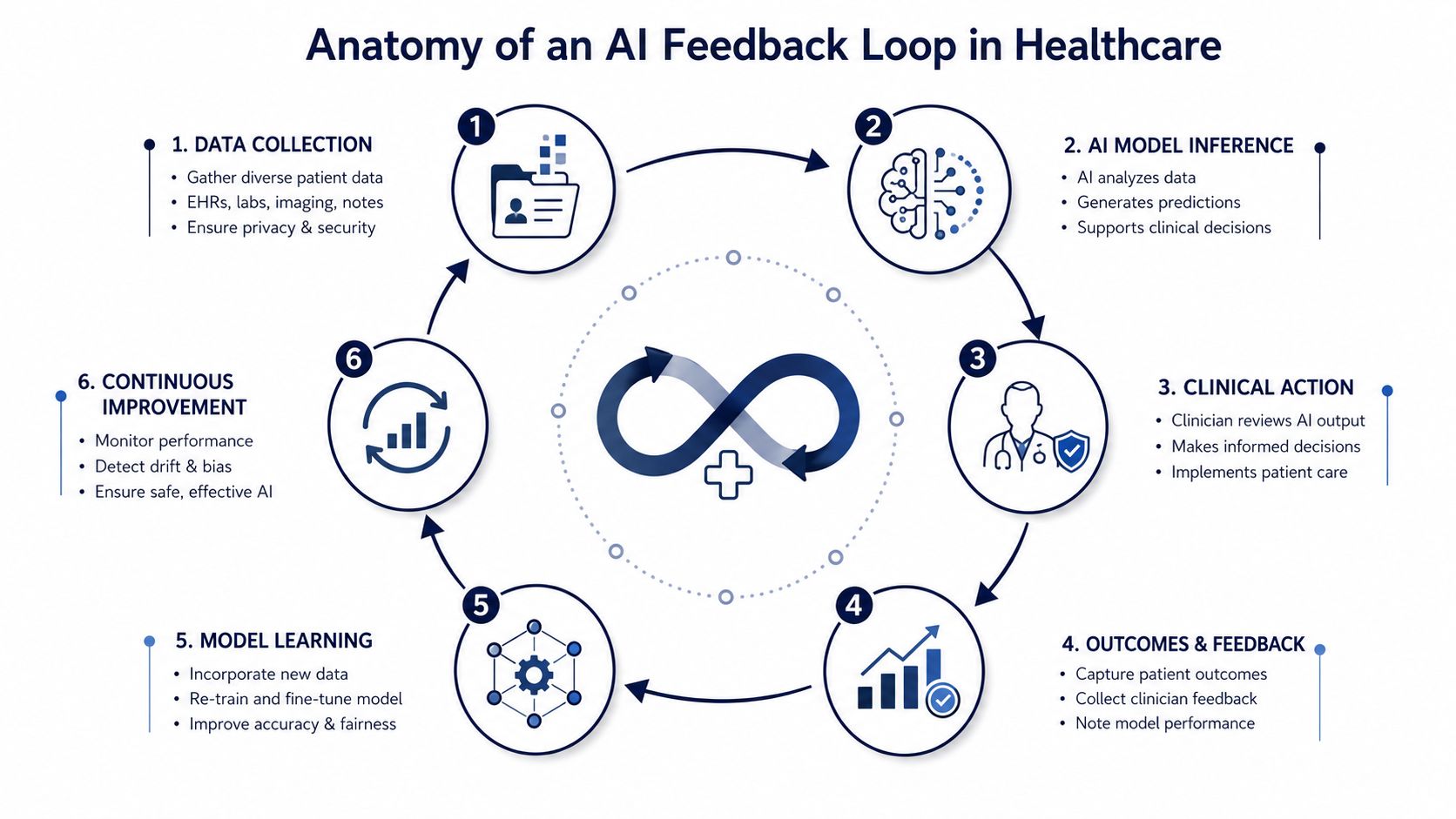
Three loop types require different controls
Closed-loop clinical decision support operates inside an encounter. An alert changes immediate care, and the resulting action or inaction becomes part of the record. Its blast radius begins with one prediction, but repeated use can still reshape what clinicians document and investigate.
A learning health system treats encounters as inputs to an institutional learning pipeline. The system may update population baselines, order sets, or care pathways. Because the organization's own practices influence the collected evidence, this loop can alter the reference population used across multiple services.
A model retraining pipeline periodically draws from a feature store, EHR extracts, registries, and adjudicated labels. Its risk is temporal. A pipeline can lock in months of production-influenced bias while appearing technically healthy because the code, infrastructure, and batch jobs all run successfully.
The implementation details differ, but the governance question is shared: which records were created independently of the model, and which records were shaped by it?
Clinical teams building voice-enabled documentation should apply the same reasoning to healthcare voice AI. A voice assistant can influence what gets documented, which means transcription and summarization events also need lineage when they later support training or evaluation.
A practical process map should be readable by clinicians, MLOps engineers, and compliance leads. Bridge Global's discussion of healthcare predictive intelligence is relevant here because predictive systems need workflow context, not just a model endpoint. Every box in the flow should identify an owner, an event source, a label status, and a decision about whether that record can enter future training data.
The control point teams miss
The most important control isn't the retraining job. It's the boundary between model-influenced evidence and independent evidence. If that boundary isn't represented in metadata, the training pipeline can't enforce it later.
Three Drift Types and the Metrics That Catch Them
Healthcare teams should separate data drift, label drift, and workflow drift. Treating all change as generic model drift hides the mechanism that caused it and leads to the wrong response.
Data drift changes the inputs. An EHR migration, a new lab vendor, a device integration, or a documentation-template change can alter feature distributions without any clinical deterioration.
Label drift changes what the target means or how it gets recorded. Coding practices, treatment protocols, test-ordering patterns, and clinical definitions can change the relationship between an observed record and the outcome the model is supposed to predict.
Workflow drift changes how people use the system. Clinicians may adopt the tool, abandon it, route alerts to another team, or change how they document overrides. That behavior can affect both immediate outcomes and the labels available for retraining.
The 2020 healthcare ML study specifically identified false positive rate as a stronger signal than AUC when feedback loops are present. A model could preserve its overall AUC while its false positive rate rises among patients resembling those it previously alerted on. The average score can remain stable while the affected subgroup absorbs the damage.
Map the failure surface to a dashboard
| Drift Type | Healthcare Trigger | Primary Metric | Secondary Metric |
|---|---|---|---|
| Data drift | EHR migration, new device, changed documentation template | Feature-distribution change | Subgroup calibration |
| Label drift | Protocol change, altered coding, AI-influenced reports | False positive rate | Outcome reconciliation |
| Workflow drift | Adoption, abandonment, routing change, rising overrides | Alert-to-action ratio | Override reversal rate |
Use alert-to-action ratio to distinguish a warning that changes care from one that merely adds noise. Use override reversal rate to identify cases in which a clinician initially rejects an alert and later follows the same recommendation or discovers the alert was useful. Use subgroup-specific calibration to prevent aggregate performance from masking harm in underserved populations.
A monitoring design should record the trigger and response together. If false positive rate rises, the clinical informatics owner should inspect alert burden and label construction. If feature distributions shift, MLOps should verify the upstream interface before anyone retrains. If override behavior changes, clinical leadership should review workflow fit rather than treating clinicians as annotation errors.
For teams building operational controls, practical AI monitoring with Digna offers useful context on model-drift detection. The principle remains simple: monitor the data, the labels, and the human response separately.
Governance, HIPAA, and FDA Oversight of Adaptive AI
Adaptive clinical AI sits inside overlapping obligations. HIPAA governs how protected health information moves through the prediction, documentation, evaluation, and retraining pipeline. FDA oversight focuses on whether a medical device remains safe and effective as performance changes. EU MDR and the AI Act add post-market and quality-management expectations for applicable systems.
HIPAA controls should include minimum-necessary access, appropriate de-identification, audit trails for label reuse, and business associate agreements covering retraining infrastructure where applicable. A label manifest should show who accessed the source record, whether the model influenced the encounter, and why the label was eligible for training.
The FDA says AI/ML-enabled healthcare software should undergo ongoing monitoring after deployment so it remains fit for use and can be updated when performance changes. That requirement makes feedback-loop lineage a safety artifact, not an optional MLOps feature.
Put a governance committee in the execution path
A healthcare AI governance committee needs named seats for clinical leadership, quality assurance, MLOps, and compliance. It should approve the intended use, the label-reuse policy, the change-control scope, the validation design, and the rollback path.
The committee's work becomes enforceable when each retraining event requires evidence:
Clinical sign-off: The intended use and clinical workflow remain valid.
MLOps evidence: Data manifests, lineage, drift summaries, and reproducible pipeline results are complete.
QA evidence: Subgroup performance, false positive stability, and discrepancy findings meet the release criteria.
Compliance evidence: The update fits the approved change-control process and has the required documentation.
| Loop Stage | HIPAA | FDA PCCP | EU MDR + AI Act |
|---|---|---|---|
| Prediction | Access control and auditability | Intended-use and performance scope | Risk management and quality controls |
| Clinical action | Appropriate use of protected data | Impact analysis for planned changes | Human oversight and post-market controls |
| EHR capture | Minimum-necessary handling and traceability | Monitoring evidence | Data governance and incident records |
| Label reuse | Authorized processing and documented lineage | Retraining protocol and validation gate | Change control and conformity evidence |
The FDA's Predetermined Change Control Plan approach is particularly useful because it forces teams to define the learning boundaries before deployment. Don't let the model decide what counts as an acceptable update after it has already influenced the data.
Teams establishing a formal policy can also consult practical tips for startup AI governance. For implementation details, Bridge Global's guide to HIPAA-compliant software development reinforces the need to design privacy and auditability into the software lifecycle rather than add them during review.
Two Real Failure Modes Compared
The kidney-stone composition test and the ICU sepsis simulation expose different mechanisms. That distinction matters because a label-contamination problem needs a different intervention from adoption-driven drift.
In the kidney-stone study, the newer model version, V2, showed a 10% lower concordance rate than V1 on a recent production hold-out set, despite being trained on a much larger dataset. V2 performed similarly to V1 on an older pre-AI validation set, but better on the recent subset containing human-only or human-corrected labels, especially for less common stone types.
The explanation is operational, not mysterious. Once clinicians relied on AI-assisted results, future reports could become influenced by the model. Recycling those reports into labels contaminated the retraining signal. The authors concluded that ongoing human annotation and carefully constructed validation sets are needed to prevent retraining from being confounded by the model's prior influence.
The ICU simulation presents a different loop. Labels remain comparatively stable, but clinician adoption changes care and therefore changes the data-generating process. Repeated updates can drive the false positive rate upward as the system's recommendations alter triage and treatment behavior.
| Dimension | Kidney-stone V2, label contamination | ICU sepsis simulation, adoption drift |
|---|---|---|
| Main mechanism | AI-influenced reports become retraining labels | Clinician adoption changes future care patterns |
| What shifts | Ground truth and label independence | Population and workflow behavior |
| Why random validation fails | The hold-out can contain contaminated labels | Historical splits don't reproduce deployment behavior |
| Primary safeguard | Human-only or adjudicated evaluation cohorts | Shadow scoring and pre/post-intervention designs |
| Retraining decision | Exclude or adjudicate model-influenced labels | Measure workflow impact before updating |
A stable AUC or calibration score can pass in both cases because the metric may reflect the same altered process that created the problem. Validation must test independence, not just representativeness. For label loops, preserve task-specific held-out evaluations. For adoption loops, compare shadow predictions with live use and study how clinical behavior changes before and after intervention.
Implementation Roadmap for Healthtech Teams
Ship adaptive clinical AI in four phases. Assign ownership before engineering begins, and define an exit criterion for every phase.
Phase one establishes the boundary
The clinical lead and compliance lead define intended use, patient population, prohibited uses, label policy, and the approved change-control scope. They seat the governance committee before modeling starts and document which production outputs can never become training labels.
An AI implementation roadmap becomes practical in this scenario. The deliverable isn't a slide deck. It's a signed operating boundary that tells engineering what the system may learn from.
Phase two creates an independent baseline
MLOps and QA build locked validation sets that exclude data touched by model output. They create signed dataset manifests, record label provenance, run shadow scoring inside the EHR, and document baseline metrics and rollback procedures.
Use healthcare integrations to make source-system events visible. A model can't be governed when the integration layer hides whether an alert influenced an order, a report, or a follow-up test.
Phase three limits exposure
The clinical informatics lead owns a controlled rollout. Capture clinician feedback in structured fields, review discrepancies on a defined cadence, and require explicit committee approval before retraining. The exit criterion is evidence that the workflow remains safe under real use, not merely that the endpoint responds.
Bridge Global can fit into this phase as a healthtech software development partner supporting workflow engineering, integration, QA, and audit-ready delivery. Other delivery choices can be evaluated through documented software development service models.
Phase four turns operation into evidence
MLOps owns pipeline health and lineage. QA owns recurring bias audits. Compliance owns regulatory records. Clinical leadership owns outcome review and escalation.
Every phase should produce an audit trail. FDA and notified-body reviews should retrieve evidence from the system, not depend on a team reconstructing decisions from email and disconnected notebooks.
Monitoring and Observability That Actually Works
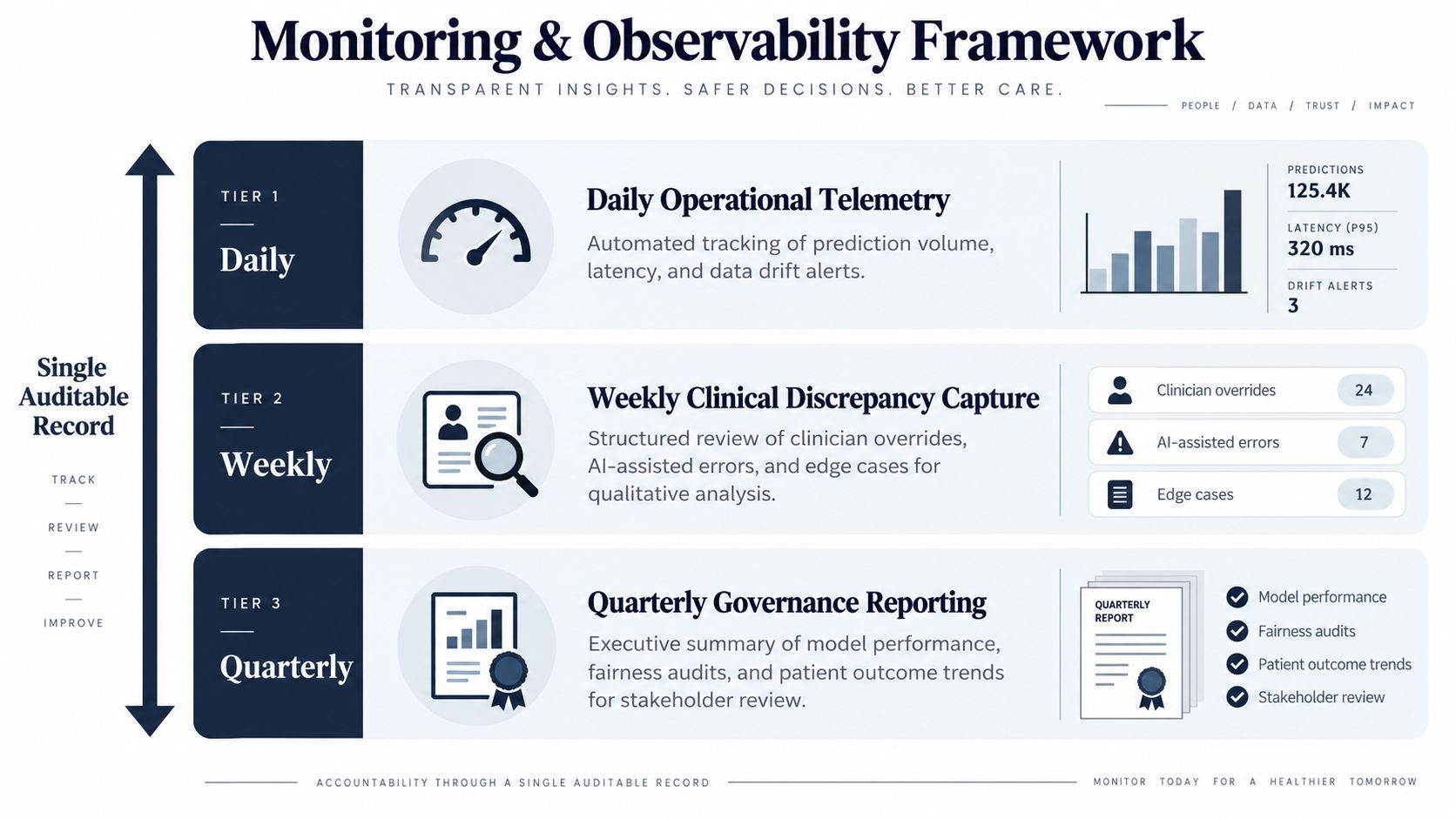
A useful observability program has three layers, but they must feed one auditable record. Daily telemetry detects operational change. Weekly clinical review explains what the numbers mean. Quarterly governance reporting decides whether the system remains within its approved operating boundary.
Daily telemetry catches movement
Track prediction volume, latency, feature distributions, alert rates, and overrides by clinical unit. Store the model version, input schema, workflow context, and decision event with each record. If the queue changes or a unit stops acting on alerts, that's workflow evidence, not merely a dashboard fluctuation.
Weekly review catches meaning
Clinical reviewers reconcile outcomes against the EHR, inspect clinician disagreement, and compare live results with shadow-mode scoring from the prior model. They should also inspect cases in which the model's recommendation influenced the diagnostic workup or documentation.
Use structured discrepancy categories. A reviewer should be able to mark an error as a data issue, label issue, workflow mismatch, clinical disagreement, or model limitation. That classification determines who acts next.
Quarterly reporting supports release decisions
The governance committee receives performance summaries, subgroup fairness cuts, model-card deltas, recalibration history, dataset manifests, and feedback-loop lineage. The committee should be able to answer why a recommendation reached a clinician, what happened afterward, and whether that record entered training data.
Avoid invented universal thresholds. A trigger such as a false positive rate change, unusual override pattern, or subgroup-calibration shift must be defined against the model's approved baseline and intended use. Each trigger needs a named owner, a response time, and a rollback decision.
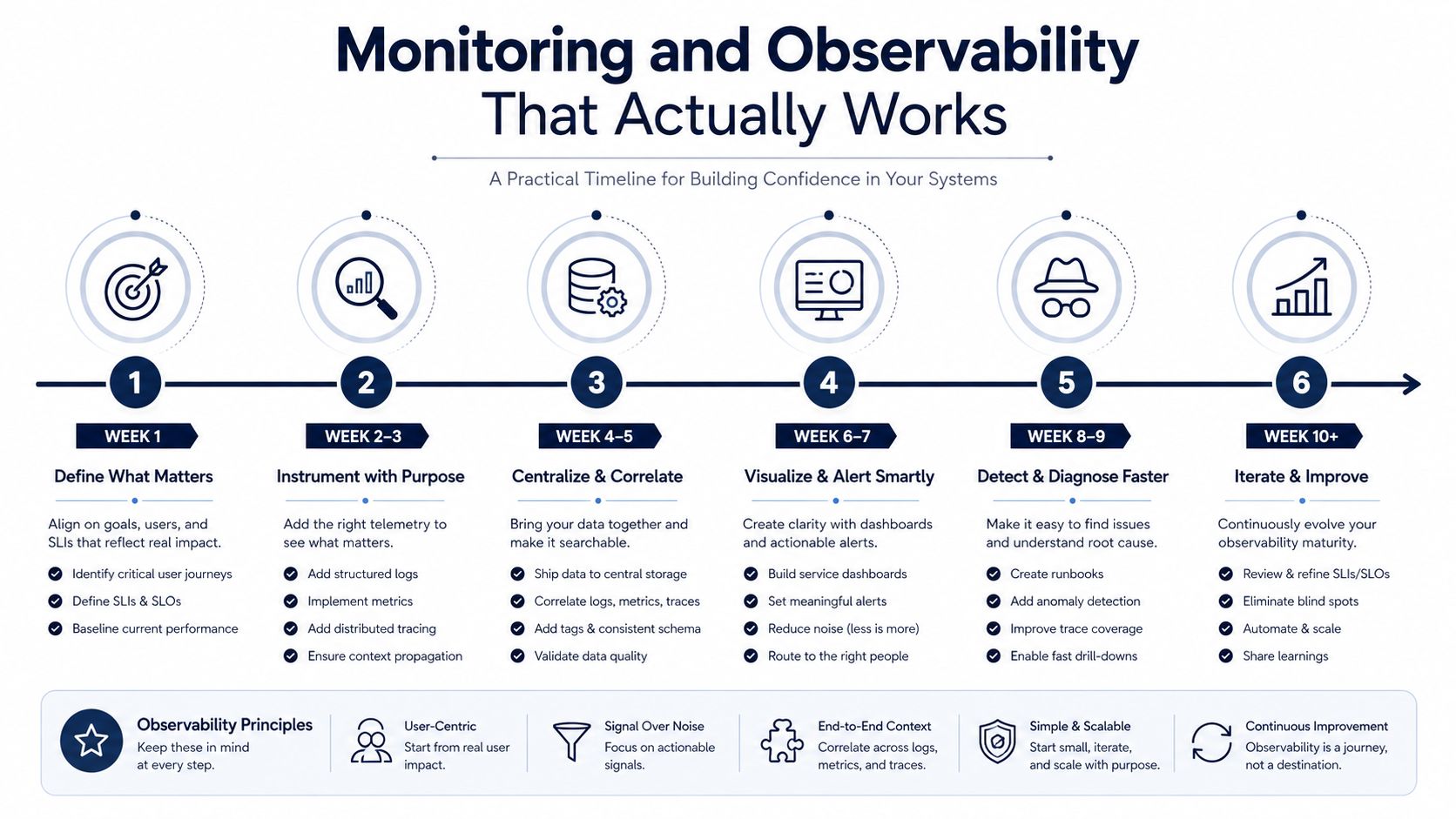
Bridge Global's perspective on healthcare observability solutions is useful for connecting application telemetry with workflow events. The architecture should make label contamination, adoption drift, and workflow shifts visible before they become patient-safety incidents.
Recommendations to Avoid Self-Reinforcing Harm
Frequent retraining doesn't neutralize feedback-loop risk. In a regulated clinical setting, it can make the model learn faster from labels that its own recommendations helped create. The safety question isn't how quickly the model updates. It's whether the evidence remains independent enough to justify the update.
Adopt these six practices as release requirements:
Maintain a contamination-free cohort: Refresh a prospective validation cohort from data that wasn't touched by production outputs.
Adjudicate influenced labels: Require dual review or formal adjudication whenever the model helped generate, select, or prioritize the evidence behind a label.
Throttle unsafe alerting: Cap excessive CDS exposure with automatic throttling. Don't rely on clinicians to absorb an alert burden that the system itself created.
Version the complete lineage: Version datasets, labels, prompts, model outputs, workflow events, and source-system changes together.
Gate on harm-sensitive metrics: Require stable false positive rates, subgroup-specific calibration, and fairness evidence, not just AUC.
Publish rollback criteria: Keep a clear Change Control Plan that defines who can pause deployment, which evidence triggers rollback, and how the previous model is restored.
The underserved angle deserves explicit treatment. A feedback loop can worsen disparities when clinicians repeatedly adopt recommendations, the resulting labels enter future training cycles, and the model becomes more confident in patterns produced by unequal access, documentation, or intervention. A 2026 PubMed review identifies this self-reinforcing bias as a mechanism that can worsen disparities rather than improve care.
A separate systematic review highlights site-level dataset shift, spurious correlations, over-trust, weak workflow integration, unresolved EHR interoperability, liability questions, and adaptive-training challenges as major implementation concerns. Governance must therefore include equity review, not just technical retraining.
Ask this question at every quarterly governance meeting:
Would this model's recommendations still be defensible if we deleted the last six months of production-influenced labels?
If the answer is no, pause the update and rebuild the evaluation boundary. For teams evaluating implementation options, AI development services, enterprise AI solutions, custom healthcare software development, custom software development, and SaaS product development can support different parts of an auditable clinical AI delivery model. Review relevant client cases for examples of the delivery context, then require any prospective partner to demonstrate label lineage, shadow evaluation, governance workflows, and rollback controls before production access.
Bridge Global helps healthtech teams design and build AI-enabled clinical software with workflow integrations, observability, QA, and compliance controls that account for feedback-loop risk. Visit Bridge Global to discuss an adaptive AI system that can be monitored, audited, and safely rolled back before its own recommendations start defining the evidence it learns from.

About Upendra Jith
Upendrajith completed his Master's in English and has been a commercial content developer for the past three years. He's more inclined to develop content with a 'street-smart' delivery on topics such as technology, media, or anything he can get his hands on. He has a fixation on lyrics, dark poetry, media, technology, and flow arts.
View all posts by Upendra Jith →