



Modern Software Engineering Guide for Scalable Products
A healthtech product can start with a clear use case, a capable team, and a promising pilot. Then adoption grows. A new integration becomes urgent, privacy requirements become stricter, and every release needs to satisfy product, security, operations, and compliance stakeholders. The difficult question is no longer whether developers can write features quickly. It's whether the organization can keep those features understandable, testable, observable, secure, and accountable as the system changes.
That's the territory of modern software engineering. It combines iterative delivery, modular architecture, automation, platform thinking, and human governance. AI can accelerate many activities, but it doesn't remove the need for sound decisions. In regulated products, especially, faster code generation only helps when teams can verify the result and explain how it reached production.
Introduction to Modern Software Engineering Today
A product team may begin with a small application and a straightforward release process. As the product expands, the team often inherits several kinds of complexity at once: external integrations, multiple user roles, sensitive data, changing workflows, and pressure to ship improvements without interrupting existing customers. A traditional multi-year build struggles in this environment because assumptions become outdated before the system reaches users.
Software delivery has steadily moved toward shorter feedback cycles. Research on long-term development trends found that projects in the early 1980s commonly took more than a year, while projects since 2000 have generally landed in the 7- to 8-month range. The historical movement described in the software engineering milestones review also runs from mastering machines and processes toward complexity, communication, productivity, and market-driven delivery. The historical review of software engineering milestones helps explain why iterative delivery, abstraction, distributed collaboration, and continuous delivery now matter so much.

Software has also become a major economic capability. In the United States, software generated $1.07 trillion in value-added GDP in 2014, including $475.3 billion directly from the industry, and directly employed 2.5 million people while supporting 9.8 million total jobs through indirect and induced effects, according to the BSA software impact analysis. The same analysis reported an average software developer wage of $108,760 in 2014, compared with $48,320 across all U.S. occupations, while software-related R&D spending exceeded $52 billion in 2012.
The leadership question: Can your team increase delivery speed without increasing uncertainty?
This guide is for CTOs, product leaders, healthtech founders, and enterprise teams modernizing systems under real operational constraints. It treats engineering as a business capability, from selecting architecture to establishing feedback loops and governing AI output. Teams evaluating a healthtech software development partner can use the same lens to assess technical capability, collaboration habits, compliance discipline, and long-term ownership.
For a practical perspective on the working habits behind sustainable delivery, SpecStory, Inc. on engineering efficiency habits provides useful context. You can also review our perspective on software engineering trends for the future when shaping a longer-term technology strategy.
Core Principles That Define Modern Software Engineering
Modern engineering starts with a way of making decisions, not with a framework choice. A team can use Kubernetes, serverless functions, or an AI coding assistant and still operate with slow feedback, unclear ownership, and fragile releases. Principles give engineers a stable basis for choosing tools and rejecting unnecessary complexity.
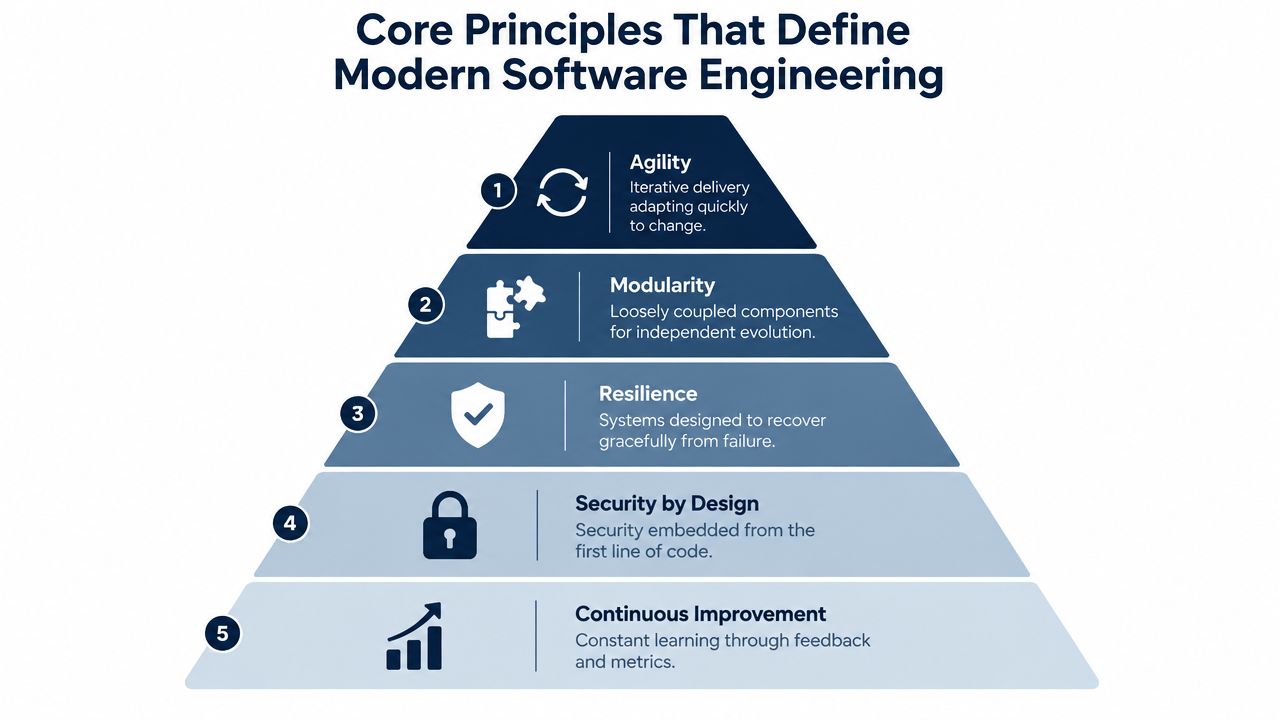
Start with small, reversible decisions
Agility means learning through delivery. A team breaks a large outcome into increments that users can evaluate, then uses evidence to refine the next increment. Agile product work depends on product discovery as much as sprint mechanics, so teams exploring product management agile methods should connect prioritization, design, engineering, and customer feedback.
Modularity limits the blast radius of change. Think of a well-designed building with separate electrical, plumbing, and structural systems. Each part has a clear boundary, but the building still works as a whole. In software, clear interfaces and cohesive components allow teams to improve one area without accidentally changing unrelated behavior.
Design for failure and protection
Resilience means the system has a planned response to failure. That response may involve retries, graceful degradation, queues, fallbacks, or a clear operational alert. Resilience isn't the same as pretending failures won't happen. It gives people and systems a controlled path when dependencies, networks, or data sources behave unexpectedly.
Security by design places protection inside architecture, code review, deployment, and operations. Teams define authorization rules, protect secrets, minimize data access, and test abuse cases before a release reaches customers. For healthcare and financial products, security also needs evidence that reviewers, auditors, and operators can understand.
Improve through visible feedback
Continuous improvement turns delivery into a learning system. Engineers need signals from automated tests, deployment results, logs, traces, user behavior, incident reviews, and product outcomes. Without those signals, teams may confuse activity with progress.
A practical principle is simple:
Build less, learn sooner, and keep every change understandable.
These principles support custom software development because bespoke systems rarely succeed through generic implementation alone. The team needs to understand the business model, identify the constraints that matter, and select an approach that preserves future choices instead of locking the product into accidental complexity.
Architecture Patterns for Scalable and Compliant Systems
Architecture is a set of trade-offs. A modular monolith may be the most responsible choice for a product that needs clear boundaries but has a small operations team. Microservices may support independent ownership in a large organization, but they also multiply operational responsibilities. Event-driven systems can separate producers from consumers, while serverless platforms can reduce infrastructure management at the cost of deeper platform dependence.
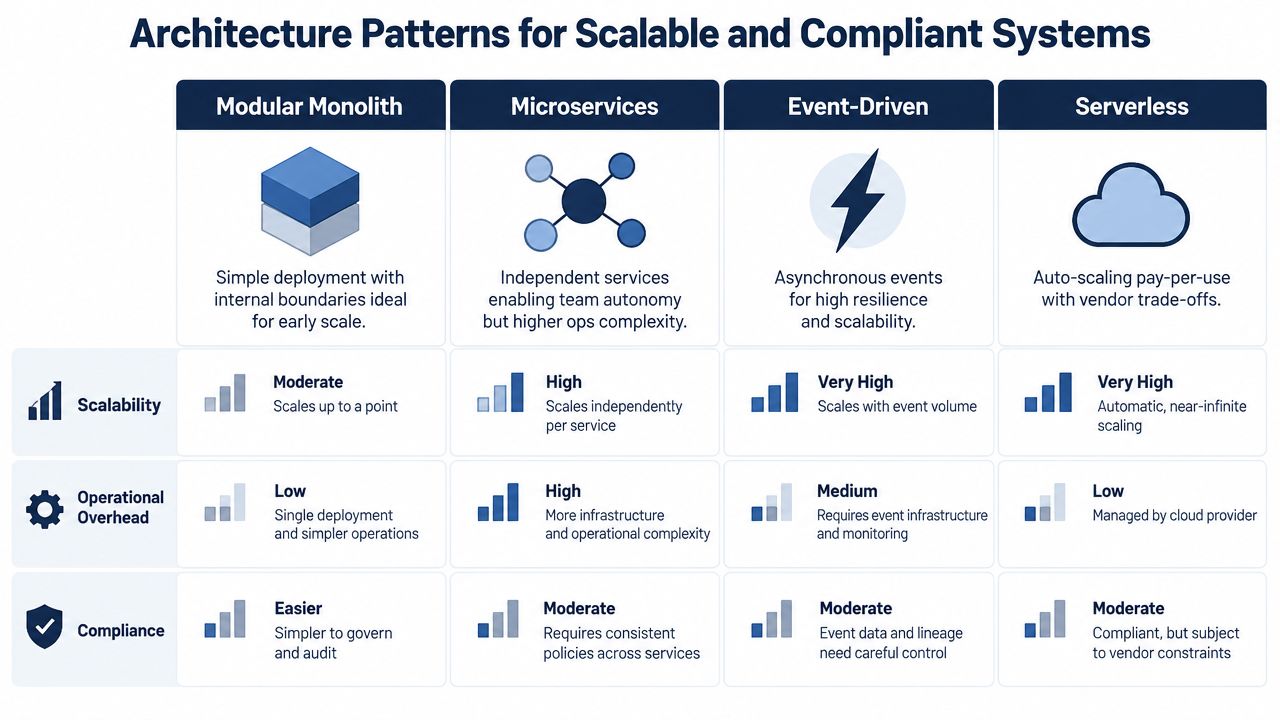
Compare the choices before choosing the label
A modular monolith keeps deployment relatively simple while preserving internal boundaries. It often fits an early-stage SaaS product, a regulated workflow with a focused domain, or an enterprise team still establishing delivery discipline.
Microservices separate services into independently deployable units. That separation can help teams own distinct capabilities, but each service typically needs CI/CD, logging, identity, secrets management, monitoring, and network policy controls. The resulting overhead can overwhelm small teams and make debugging, security, compliance, and API versioning harder, as described in the analysis of microservice operational complexity.
Event-driven architecture uses asynchronous messages to reduce direct dependencies between components. It suits workflows where producers and consumers can operate independently, but teams must manage delivery guarantees, event schemas, replay behavior, ordering, and traceability.
Serverless functions and managed services can scale infrastructure automatically and reduce routine platform work. They also introduce vendor-specific behavior, distributed debugging challenges, and governance questions around data location and execution controls.
| Architecture Pattern | Best For | Complexity and Trade-off |
|---|---|---|
| Modular monolith | Products needing clear boundaries with simpler operations | Easier deployment, but teams must protect internal boundaries as the codebase grows |
| Microservices | Organizations with strong platform capability and independently owned domains | Team autonomy increases, while operational and compliance overhead also rises |
| Event-driven | Asynchronous workflows and systems requiring loose runtime coupling | Resilient integration, but event tracing and schema governance require discipline |
| Serverless | Variable workloads and teams seeking managed infrastructure | Reduced infrastructure administration, with vendor and observability trade-offs |
Let interoperability shape the design
Healthtech architecture must account for data exchange, identity, consent, auditability, and tenant separation. HL7 FHIR is an API-focused interoperability standard maintained by HL7. The U.S. health IT office says FHIR strengthens interoperability and supports advanced applications and improved health outcomes in its FHIR interoperability guidance. WHO and HL7 also describe FHIR as a principal standard for person-centered digital solutions because it supports open, API-based data exchange through their interoperability collaboration.
Adoption is broad but still developing. The 2026 State of FHIR report found that 62% of respondents reported active FHIR use cases in their country, while 20% identified FHIR as their primary interoperability standard, according to Firely’s State of FHIR report. For teams building SaaS product development platforms or planning healthcare integrations, the architecture should treat interoperability as a core product capability rather than a final connector project.
For a focused comparison of deployment and ownership implications, see the guide to monolithic versus microservices architecture.
Essential Engineering Practices From CI/CD to Observability
A delivery pipeline is more than a deployment button. It’s a chain of controls that helps a team move from a code change to a production decision with useful evidence. CI/CD, testing, observability, platform engineering, and security work best when they reinforce one another.
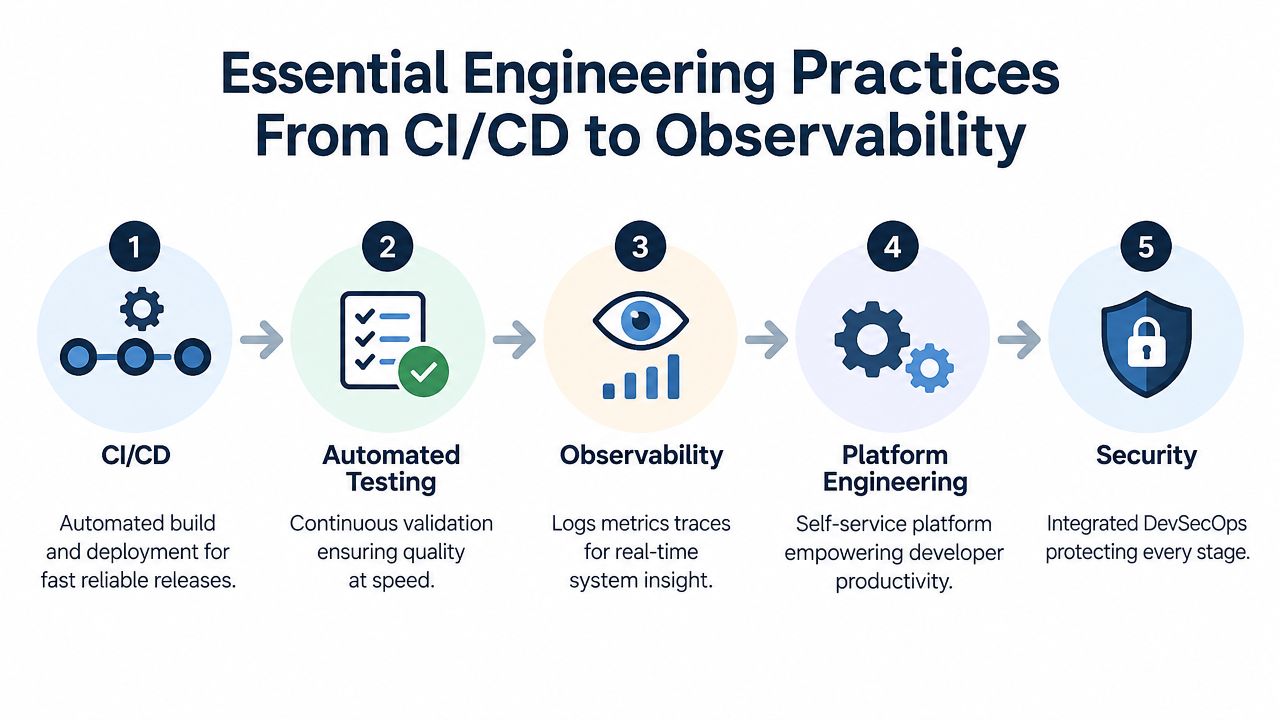
Build a delivery system with short feedback loops
A practical pipeline begins when a developer opens a pull request. The system should build the application, run relevant checks, scan dependencies and configurations, package an immutable artifact, and make deployment repeatable. Approval rules still matter, particularly when a change touches patient data, financial transactions, tenant isolation, or access control.
Testing should provide different kinds of confidence. Fast unit tests check local behavior. Integration tests verify boundaries such as databases and external APIs. Contract tests protect shared interfaces, while end-to-end tests validate critical journeys. The purpose isn’t to maximize test count. It’s to catch the most important failures as early as possible.
Observability then shows what happens after deployment. Logs explain events, metrics reveal trends, and traces connect a request across services and dependencies. Teams evaluating data observability platforms should also ask whether their monitoring covers data quality, freshness, lineage, and tenant context, not only infrastructure health.
Reduce toil through platform engineering
A platform team creates paved paths for common engineering work. It can provide reusable pipeline templates, service scaffolding, secrets handling, environment provisioning, approved libraries, dashboards, and documented operational standards. Developers still own their services, but they don’t need to reinvent foundational controls for every product area.
This approach matters because automation doesn’t eliminate organizational friction. Technical debt can consume delivery capacity directly. A longitudinal study of 43 developers found that technical debt accounted for 23% of working time, with additional testing among the most common forms of extra effort, as reported in the IEEE study on technical debt. Teams should therefore reserve capacity for refactoring, dependency upgrades, documentation, and removal of duplicated tooling.
Regulated teams need tenant-aware security controls throughout the pipeline and runtime. OWASP recommends binding tenant context to server-verified identity, checking authorization at every tenant-owned access path, isolating resources where required, and using unique encryption keys when appropriate. Its Multi-Tenant Security Cheat Sheet also addresses export capabilities and documented retention and deletion policies across backups and replicas.
Teams selecting software development service models should evaluate how the model handles release ownership, incident response, documentation, testing evidence, and security reviews. For custom healthcare software development, those operating practices are part of the product, not an optional layer around it. A deeper look at pipeline quality is available in the guide to test automation methodologies for modern CI/CD pipelines.
How AI Is Reshaping the Software Development Lifecycle
AI is changing the SDLC at several points, not only in the editor. Teams use it to summarize requirements, identify edge cases, draft implementation options, generate tests, explain unfamiliar code, analyze incidents, and support documentation. The value depends on where human judgment remains visible and where the system records enough evidence to verify the result.
The adoption problem is no longer access. Independent 2025 and 2026 surveys report that 90% of developers use AI at work and that more than 80% report productivity gains, while about 30% report little or no trust in AI-generated code and only a small minority express very high trust. These figures appear in Google’s 2025 DORA report coverage, which makes the central tension clear: teams may move quickly while still lacking confidence in the output.
Govern the output, not just the prompt
A responsible AI workflow defines which tasks AI can perform independently, which require review, and which are prohibited without explicit approval. It also distinguishes generated code from verified code. Pull requests should show tests, security checks, dependency changes, data handling implications, and the human owner accountable for the final decision.
Metrics need to measure outcomes rather than generated volume. Useful questions include:
-
Quality: Did escaped defects, rollback frequency, or review rework change?
-
Flow: Did the team shorten feedback time without increasing waiting or handoff delays?
-
Reliability: Did incidents, recovery work, or alert noise improve?
-
Maintainability: Can engineers still explain the code, tests, dependencies, and failure modes?
-
Governance: Can the organization identify who reviewed and approved high-risk changes?
One 2025 engineering-management survey found 90% of teams using AI coding tools, but only 20% using engineering metrics to measure AI impact, according to the DORA coverage cited above. That gap means many organizations are scaling AI before they can demonstrate whether it improves delivery.
Put AI behind a reliable platform
AI works better when repositories are organized, environments are reproducible, tests are dependable, and service boundaries are clear. Otherwise, an assistant can amplify existing ambiguity by producing more code inside an already confusing system. Google’s 2025 DORA coverage reports that 90% of organizations have adopted at least one platform and connects high-quality internal platforms with deriving AI value.
Near-term value often appears in developer experience rather than customer-facing automation. Another 2025 engineering survey reported that 66% of respondents had AI tools in production, while 85% remained focused on internal engineering use cases, as reported by Chainguard’s engineering reality report. Teams considering AI development services or enterprise AI solutions should begin with the workflow, controls, and measurable outcome, not the model brand.
As we explored in our guide to an AI implementation roadmap, a phased approach makes accountability easier. Start with a bounded use case, define review rules, establish baseline measures, and expand only after the team can explain both benefits and failure modes.
Putting Modern Engineering Into Practice With Real Examples
A practical transformation works best when responsibilities are clear. Product teams own customer outcomes and domain workflows. Platform teams supply reusable capabilities for secure delivery, including deployment templates, observability standards, environment automation, and approved integration patterns. A cross-functional or offshore squad can bring together product, design, engineering, QA, cloud, and security skills, provided ownership and communication rules are explicit.
Use a phased path from uncertainty to scale
Discovery and constraints: Document users, workflows, data classifications, integrations, regulatory obligations, and operational expectations. For a healthtech product, identify where FHIR resources enter or leave the system, which actors can access them, and how consent and audit evidence will be handled.
Architecture selection: Choose the simplest pattern that supports the known product boundaries. A modular monolith can be a safer starting point than microservices when the team has limited platform capacity. An event-driven component earns its place when asynchronous processing provides a clear business or reliability benefit.
MVP delivery: Build a narrow vertical slice across the full system. Include authorization, persistence, tests, observability, deployment, and representative integration behavior. The team then verifies more than a feature running in a developer environment.
Hardening: Add failure handling, load behavior, security testing, backup and recovery procedures, tenant isolation checks, and operational runbooks. Documentation belongs in the release because future engineers, auditors, and support staff must understand the system.
Scale with evidence: Expand services, automation, and AI assistance only when the platform can support them. Revisit architecture decisions as workload, team structure, and compliance needs change.
Apply the model to familiar enterprise problems
A healthtech team might begin with a patient-facing workflow that exchanges data through FHIR APIs. The engineering work covers resource mapping, identity, consent, audit trails, error handling, and variation among partners. A successful API call is only the starting point; the dependable clinical or administrative workflow that remains understandable when an integration changes is the outcome.
An enterprise modernizing ERP or CRM systems faces a different form of complexity. The team may separate legacy data access from new user experiences, introduce event-based synchronization selectively, and preserve operational continuity during migration. A platform approach can standardize deployment and monitoring while product teams concentrate on domain outcomes.
Bridge Global offers full-cycle healthcare engineering, AI development, integrations, and ongoing support as technology partnership services. Its client cases offer examples of delivery contexts a partner may handle. Buyers should still assess the evidence behind any engagement, including ownership boundaries, release practices, security controls, communication cadence, and the ability to explain trade-offs.
Practical rule: Choose a partner or platform based on the quality of its engineering system, not only the technologies listed in its proposal.
Frequently Asked Questions About Modern Software Engineering
Should every growing product adopt microservices?
No. A modular monolith can offer clearer ownership and lower operational burden while the product and team are still finding stable boundaries. Move toward services when independent deployment, team autonomy, or scaling needs justify the additional platform and governance work.
How can regulated teams adopt AI safely?
Define approved use cases, prohibit sensitive data exposure where required, require human review for high-impact changes, preserve audit evidence, and measure quality after release. AI-generated code should enter the same testing, security, and approval controls as human-written code.
Should we build engineering platforms internally?
Build the capabilities that differentiate your operating model and buy or reuse commodity components where they provide reliable controls. The decision should consider ownership, integration, data handling, support, and exit options rather than feature count alone.
What should a CTO assess first?
Start with delivery evidence. Review release flow, test reliability, incident learning, technical debt, architecture boundaries, security ownership, and the organization’s ability to measure AI impact. Those signals reveal whether the team can scale responsibly.
Modern software engineering connects principles, architecture, delivery practices, platform quality, and AI governance. Teams that align those elements can pursue speed without treating compliance, reliability, or accountability as later repairs.
Bridge Global helps product and technology leaders design, build, modernize, and support secure digital products across healthtech and enterprise environments. Visit Bridge Global to discuss your architecture, delivery model, AI governance needs, or next software initiative with a consultative engineering partner.

About Preethi Saro Philip
Preethi Saro Philip is a Post Graduate Research Degree holder in Economics with more than 10 years of experience in writing, editing, research and teaching. She has an intense passion for content crafting and calls herself a ‘wordsmith’. She enjoys writing on wide-ranging topics including business, technology, health & lifestyle, education, environment etc.
View all posts by Preethi Saro Philip →