



Software Engineering Trends Shaping The Future and Beyond
The most popular advice about software engineering trends is wrong. “Adopt AI everywhere” isn't a strategy. It's a procurement event. The question for 2026 is whether your engineering organization can prove that AI-assisted work improves delivery, quality, security, and operational trust.
That distinction matters in regulated environments. Stack Overflow's 2025 Developer Survey found that 84% of developers use or plan to use AI tools in development, up from 76% in 2024, marking the third straight year of year-over-year growth in AI-tool use. Yet a 2025 industry report found that 90% of engineering teams use AI coding tools while only 20% use engineering metrics to measure AI impact. The adoption gap is now an accountability gap. Gartner's software engineering outlook also records declining positive sentiment toward AI tools, from more than 70% in 2023 and 2024 to about 60% in 2025.
A CTO who measures throughput, defect escape, review burden, and recovery time will outperform the leader who licenses another copilot. This is a measurement-first playbook for healthtech, finance, ecommerce, and any organization that has to defend its engineering decisions after deployment.
Why 2026 Belongs to the Measured Engineer
AI adoption alone doesn't define engineering progress. Accountability does. A team that generates more code but can't explain its defect rate, security exposure, or production impact hasn't modernized its SDLC. It has increased the volume of work that requires supervision.
Consider three leaders. The first chases every model release, moving engineers between tools before establishing a baseline. The second standardizes on one assistant but collects no telemetry, so every productivity claim remains anecdotal. The third instruments delivery performance, code review effort, escaped defects, incident frequency, and MTTR before expanding access. The third leader has the evidence needed to make a budget decision, defend a control, and stop a rollout that creates more risk than value.
The evidence already challenges the easy narrative. A 2025 randomized controlled trial involving experienced open-source developers found that AI coding tools increased task completion time by 19%, although participants expected a 24% speedup before starting and still believed they had saved time afterward, as reported by TechCrunch's coverage of the study. AI can reduce typing while adding prompting, waiting, context correction, and review overhead. Your delivery system experiences the total, not the most flattering part of the workflow.
Practical rule: Don't approve an AI engineering investment until you can compare end-to-end delivery outcomes against a credible baseline.
The broader market makes measurement more urgent, not less. Gartner-linked reporting cited by Itransition's software development statistics overview projects global IT software spending to increase by 9.8% in 2026, exceeding $6 trillion in total IT spending. The same overview places the global software development market at roughly $0.64 trillion in 2026, rising to $1.11 trillion by 2031, and cites U.S. employment growth of 17% from 2023 to 2033 for software developers, QA analysts, and testers, adding about 327,900 jobs.
The next decisions aren't limited to tool selection. They cover platform design, observability, security evidence, clinical data exchange, model governance, and the shape of engineering teams. A Deloitte software industry outlook cites a Gartner prediction that 80% of organizations will evolve large software engineering teams into smaller, AI-augmented teams by 2030. Smaller teams can achieve more impact, but only if leaders build controls that make that impact visible and trustworthy.
The Eight Trend Clusters Every Leader Should Know
The 2026 environment makes more sense as a connected operating system than as a list of fashionable tools. The eight clusters are AI-augmented development, platform engineering, DevOps and SRE maturity, observability and telemetry, MLOps and model lifecycle, secure-by-design engineering, low-code and citizen development, and edge and distributed compute.
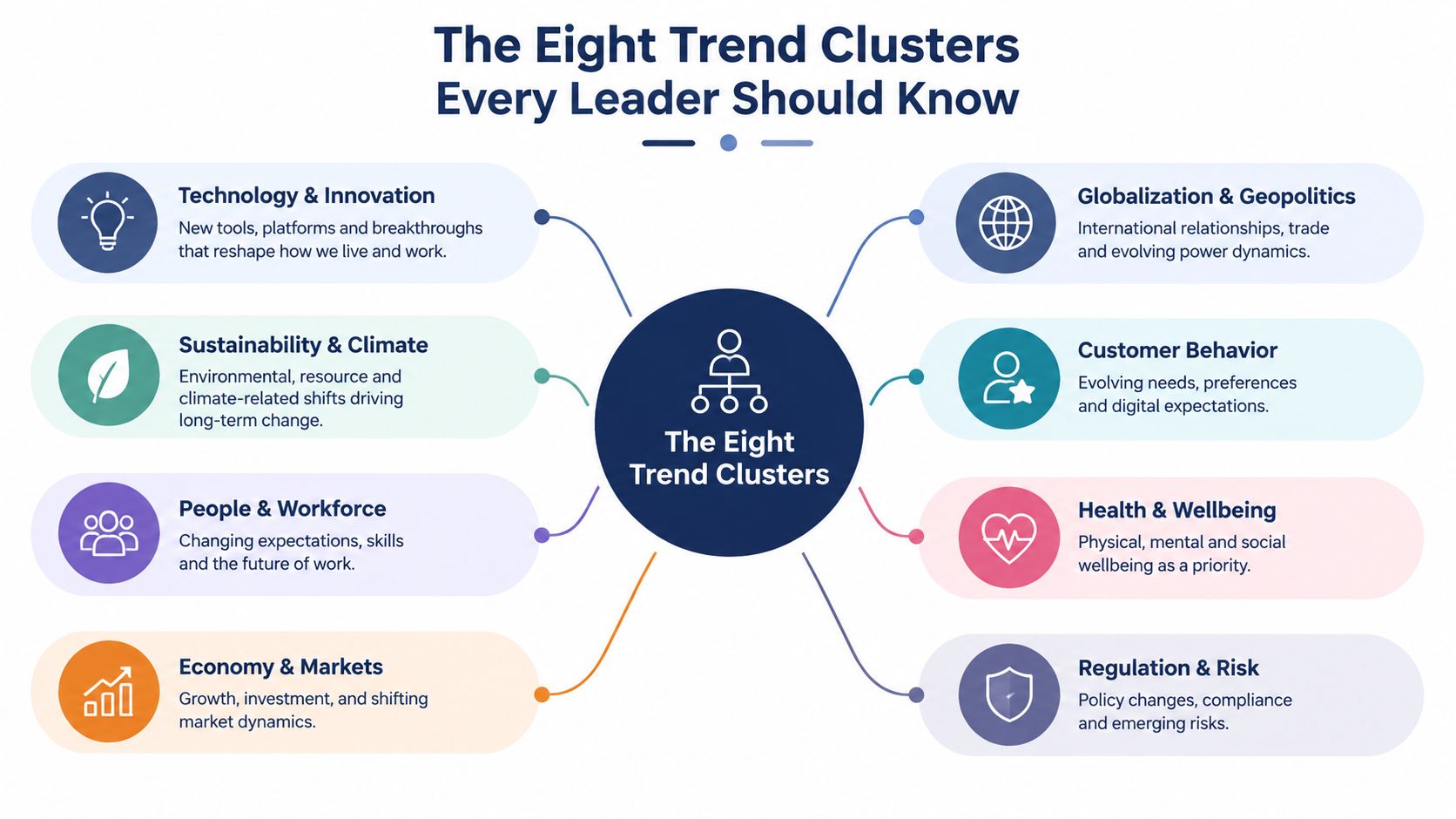
AI-augmented development sits near the center, but it can't operate safely without the surrounding clusters. Platform engineering creates internal developer platforms, golden paths, reusable CI templates, and standard access controls. Those paved roads let teams ship AI features without rebuilding deployment, secrets management, and telemetry from scratch.
DevOps and SRE maturity turn speed into a controlled delivery capability. SLOs, error budgets, release automation, and incident learning prevent AI-generated changes from becoming an excuse to weaken operational discipline. Observability and telemetry supply the evidence. Logs alone aren't enough for distributed systems, model-backed features, or debugging workflows in which an AI assistant proposes changes across multiple services.
The connected operating model
MLOps and model lifecycle management extend those controls into data and model behavior. Teams need evaluation datasets, versioned prompts or models, monitoring, rollback paths, and retraining decisions. Observability feeds that lifecycle by revealing drift, latency, failure patterns, and changes in user behavior.
Secure-by-design engineering protects every layer, including low-code output and agent-generated code. Threat modeling, software bills of materials, signed artifacts, and policy checks belong in the delivery path. Low-code and citizen development can shorten the distance between a business problem and a working automation, but engineering teams still need ownership boundaries, identity controls, data policies, and production review.
Finally, edge and distributed compute move latency-sensitive workloads closer to users and devices. That shift increases the importance of service contracts, resilience testing, regional data controls, and runtime telemetry. The clusters reinforce one another: platform teams provide the road, SRE defines safe operation, observability supplies evidence, MLOps manages changing model behavior, and security gates the entire route.
These shifts matter now because software demand is expanding across enterprise modernization, cloud adoption, healthcare, finance, ecommerce, and other regulated sectors. Developer adoption has already moved AI from experimentation into ordinary delivery workflows. The leadership advantage won't come from treating the eight clusters as separate programs. It will come from building one accountable system in which every new capability produces evidence.
The AI Productivity Paradox and Trust Gap
AI-assisted coding makes progress look faster than it is. A generated function, test, migration, or documentation draft appears within minutes, while production delivery still requires clarification, integration, review, testing, deployment, remediation, and accountability for the result.
The earlier randomized trial of experienced open-source developers remains a warning: AI output can increase verification and coordination work instead of reducing total delivery time. In familiar codebases, prompt refinement, context loading, review, and correction can outweigh the benefit of generation. Leaders should measure the completed change, not the speed of the first draft.
Trust creates a separate control problem. Engineers may accept suggestions they would not have written themselves because the code looks idiomatic and the assistant explains it confidently. That can weaken review, hide domain errors, and make a pull request appear more complete than it is. The right response is governed use, with evidence tied to each team and workflow.
Measure the whole change
Run a controlled pilot with comparable teams or services. Register the metrics before the trial begins, define an accepted AI contribution, and include production behavior in the evaluation period. Use a scorecard that connects delivery speed to quality, reliability, review effort, adoption, and cost.
| KPI Category | Metric | Target Direction | Data Source |
|---|---|---|---|
| Throughput | Cycle time from approved work to production | Down | Version control and deployment system |
| Quality | Defect escape rate | Down | Incident, support, and QA records |
| Review burden | Review iterations and reviewer time | Down without weaker controls | Pull request analytics |
| Reliability | Change failure rate and MTTR | Down | Incident management and observability |
| Adoption | AI suggestion acceptance rate | Informational, interpreted with quality data | Assistant telemetry |
| Cost | Cost per merged and successfully operated change | Down | Tool billing, engineering records, and production data |
Usage is an input, not a success criterion. Give a defined group access, compare its outcomes with a suitable baseline, and expand only when quality and delivery remain acceptable. Only the second approach gives an audit-ready explanation for why the tool belongs in the SDLC.
Agentic workflows need the same discipline. This practical guide to deploying Claude Code for engineers can help teams define access, usage boundaries, and governance questions. The tool is not the control. Policies for secrets, PII, proprietary code, regulated records, approvals, and human review are the controls.
As outlined in AI for software development, teams can apply AI to generation, debugging, testing, deployment optimization, and risk prediction. Connect each use case to accountable ownership and measurable outcomes. Secure execution environments, traceable changes, reproducible tests, and explicit approval rules let leaders increase AI use without surrendering responsibility for what reaches customers or regulated systems.
Platform Engineering, DevOps SRE, and Observability in Practice
Platform engineering is the operating model that turns scattered DevOps tools into a paved road. It gives product teams a supported path for repositories, builds, deployments, secrets, service ownership, telemetry, and rollback. It isn't merely a renamed infrastructure team, and it isn't SRE with a new label.
SRE defines reliability objectives and the operating discipline around them. Platform engineering packages reliable capabilities so teams can use them without becoming experts in every underlying system. Observability supplies the evidence needed to understand system behavior through metrics, traces, logs, events, and useful context.
What maturity looks like
A lagging organization asks every team to assemble its own pipeline. A scaling organization publishes golden CI templates and common deployment patterns. A leading organization treats its internal developer platform as a product, with documentation, support expectations, adoption data, and a roadmap tied to developer needs.
| Capability | Laggard | Scaling | Leading |
|---|---|---|---|
| Delivery path | Bespoke pipelines | Golden CI templates | Self-service paved roads with ownership |
| Reliability | Reactive incident response | SLOs for priority services | SLOs, error budgets, and learning loops |
| Telemetry | Logs-only visibility | Standard metrics and traces | OpenTelemetry-based, queryable service context |
| Developer experience | Tool assembly by each team | Internal platform capabilities | Product-managed portal and supported workflows |
| Change control | Manual release coordination | Automated checks | Policy-driven promotion, rollback, and evidence |
Prioritize a small platform team over another disconnected dashboard. Give it responsibility for one internal developer portal, one golden path for a critical service, and reusable templates for CI, secrets, observability, and release controls. Retire bespoke pipelines as the paved road proves safer and easier, rather than allowing both systems to expand indefinitely.
Instrument before you instrument more. Choose a coherent vocabulary for service, environment, release, owner, dependency, and incident. Adopt OpenTelemetry where it fits your architecture, then connect traces and metrics to deployment events so engineers can answer a practical question: what changed before this behavior changed?
Operational test: If an engineer can’t move from an alert to the responsible change, affected dependency, user impact, and rollback option, your observability stack isn’t finished.
SRE teams should also run incident learning loops. Record contributing conditions, detection gaps, recovery decisions, and follow-up ownership. A DevOps automation guide offers useful context for connecting automation with delivery performance. For leaders reviewing cloud programs, this analysis of why cloud projects fail is a useful reminder that tooling doesn’t compensate for unclear ownership, weak architecture, or missing operating discipline.
The benchmark worth watching is not deployment volume in isolation. A 2026 cross-team dataset reports elite DevOps performance at more than 1.2 deployments per service, with a change failure rate under 1% and cycle time under 25 hours at the 75th percentile, according to LinearB’s DevOps benchmarks. Use those figures as directional reference points, not universal quotas. Your services, risk profile, and release boundaries determine the right targets.
How Trends Land Differently in Healthtech, Finance, and Ecommerce
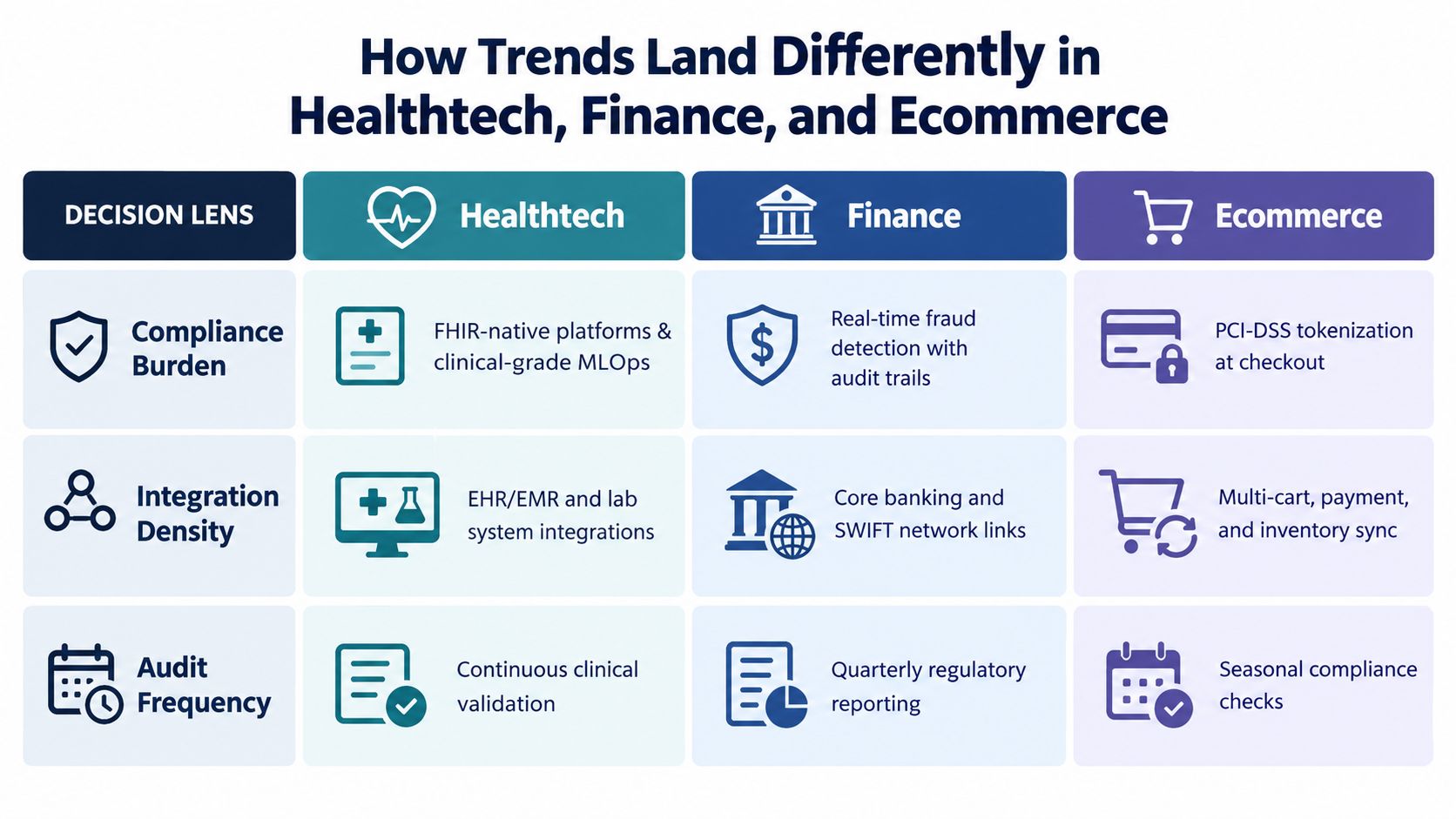
The same engineering trend produces different returns across industries because the constraints differ. Use compliance burden, integration density, and audit frequency as the decision lens. A generative coding assistant may help a low-risk storefront component while requiring severe restrictions around clinical decision support or payment authorization.
Healthtech
Healthtech should start with interoperability and evidence, not a flashy model. FHIR is the primary modern health data-exchange standard for API-based interoperability, patient access, and mobile or web integration, using structured resources in XML, JSON, or RDF over secure APIs and existing networks, as explained by the National Library of Medicine’s health data standards resource.
That makes FHIR-native platforms, clinical-grade MLOps, data provenance, access controls, and validation gates foundational. CMS interoperability guidance describes technical standards as the mechanism for secure and efficient exchange between provider, patient, and payer applications. Use the interoperability model of semantic, technical, and functional exchange described by AHIMA to structure implementation decisions.
Finance
Finance needs deterministic behavior where payment flows, ledger changes, identity, and regulatory reporting are involved. Prioritize model risk management, explainability, strict change control, real-time fraud observability, and reproducible evidence. Use AI assistants first in bounded engineering domains, such as documentation, test generation, internal tooling, or low-risk maintenance, then expand only when review and audit controls hold.
Ecommerce
Ecommerce can usually prioritize edge rendering, headless commerce, merchandising copilots, and fast experimentation, provided payment and customer data remain protected. The architecture must still control PCI-related boundaries, inventory synchronization, payment integrations, and rollback behavior. Faster A/B iteration matters only when teams can distinguish a genuine customer improvement from a tracking defect or operational regression.
Use a simple investment rubric:
-
Risk: What happens if the feature is wrong?
-
Integration: How many systems and contracts does it touch?
-
Evidence: Can the team reproduce the decision and show who approved it?
-
Reversibility: Can the change be rolled back without harming users or records?
-
Learning value: Will the work improve a reusable platform capability?
For healthtech leaders evaluating a healthtech software development partner, the partner should demonstrate FHIR, integration, security, and evidence practices, not just AI demos. The right first investment is the capability that removes a real bottleneck while preserving the controls your sector requires.
Risk, Compliance, and Secure by Design as Engineering Trends
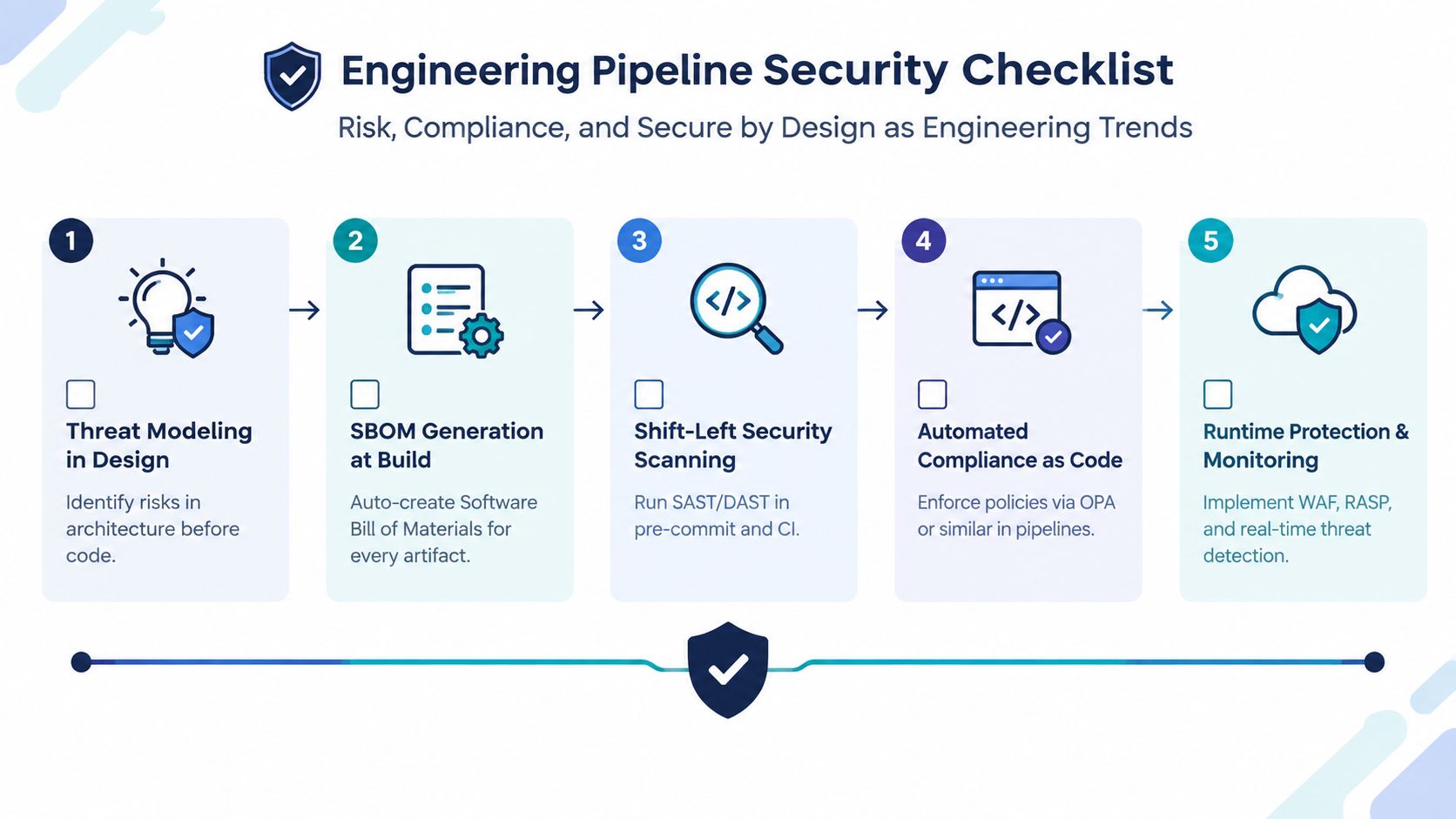
Security and compliance belong in engineering design because late evidence is expensive evidence. Secure-by-design, threat modeling, SBOM generation, signed artifacts, and policy-as-code turn regulatory expectations into repeatable pipeline behavior rather than a scramble before release.
Healthtech teams must account for clinical safety and health data obligations. Finance teams must protect payment, identity, and transaction flows. Ecommerce teams must manage customer data and payment boundaries. Across all three, the engineering question is the same: can the organization show what it built, what went into it, what risks it considered, and what controls ran before and after deployment?
Put evidence in the delivery path
Start threat modeling during architecture, not after implementation. Generate an SBOM for every releasable artifact, scan dependencies and code in CI, enforce policies through tools such as Open Policy Agent, sign artifacts, and monitor runtime behavior with controls appropriate to the workload.
Treat compliance evidence as a product output. Assign one engineer accountability for evidence quality, ownership, freshness, and retrieval. A committee can review exceptions, but it shouldn’t own the mechanics of proving that controls ran.
Track mean time to evidence alongside MTTR. If an auditor asks which version was deployed, which dependencies it contained, which approval applied, and which tests passed, the team should retrieve the answer from the delivery system rather than reconstruct it manually.
Engineering principle: A control that exists only in a policy document isn’t a production control.
Teams comparing governance tooling can use the SOC 2 software comparison from SOC2Auditors to structure questions about evidence collection and workflow fit. The specific product matters less than whether it integrates with repositories, CI, cloud environments, identity systems, and incident records.
A practical secure software development lifecycle guide should connect design review, dependency management, automated scanning, release approval, runtime detection, and incident response. Don’t create a separate compliance lane that engineers visit occasionally. Put the checks where work already happens, define exceptions explicitly, and make the resulting evidence searchable.
A 90 Day Adoption Roadmap for CTOs and Product Leaders
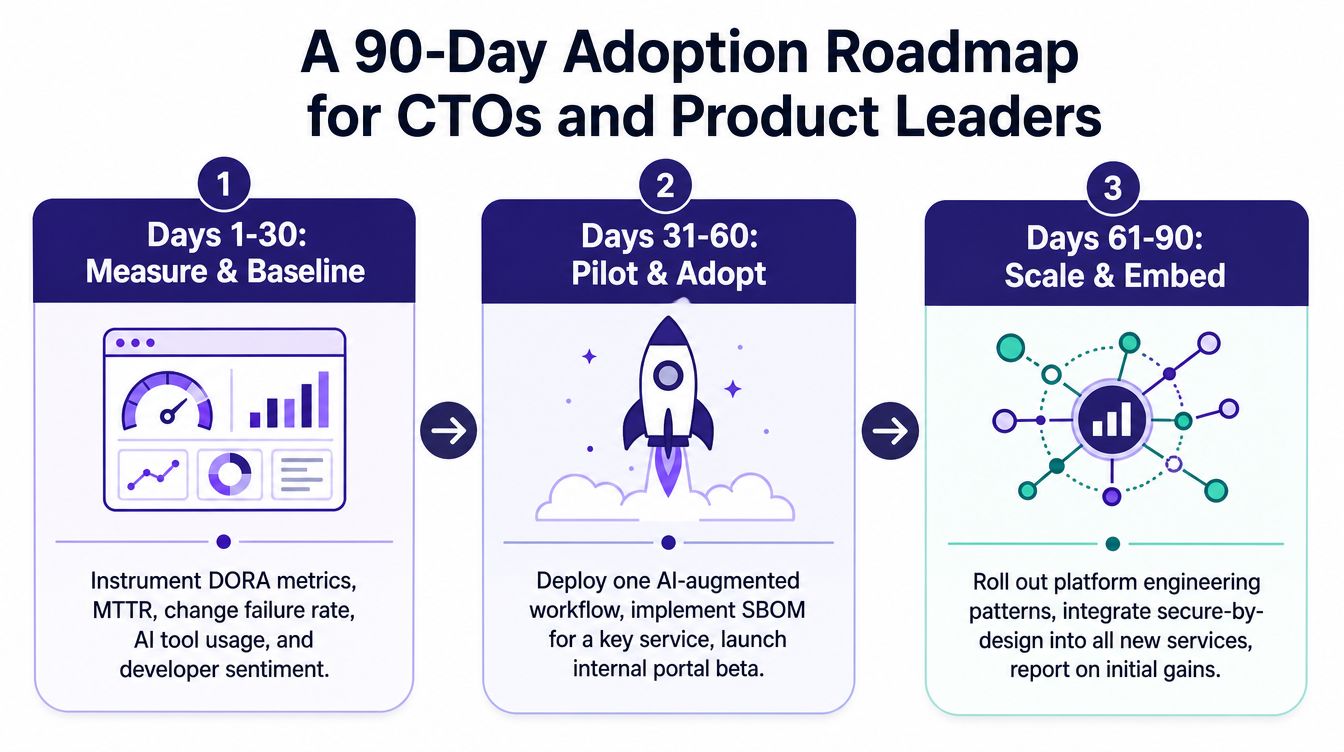
A 90-day plan should produce decisions, not a transformation theater deck. Sequence the work through measure, pilot, and scale, with a go or no-go gate at each stage.
Days 1 to 30: Measure and baseline
Instrument cycle time, deployment frequency, change failure rate, MTTR, defect escape, AI tool usage, and AI acceptance rates. Add cost per merged change and review burden. Segment the data by service risk and workflow so an average doesn’t conceal a critical-system problem.
At day 30, continue only if the data is credible and the team can identify where AI assistance helps or creates overhead. If telemetry is incomplete, the decision is to fix measurement, not expand licensing.
Days 31 to 60: Pilot and adopt
Stand up an internal developer portal and choose one critical service for a paved road. Provide golden paths for CI, secrets, observability, artifact signing, and rollback. Publish an AI code review policy covering permitted repositories, sensitive data, generated tests, human approval, and evidence retention.
Run one bounded AI workflow with a control group or a comparable baseline. Implement SBOM generation for the selected service and connect deployment events to operational telemetry. At day 60, expand only if delivery, quality, security, and reviewer workload move in the intended directions.
Days 61 to 90: Scale and embed
Deliver one high-value bet from each relevant cluster. That may mean a production AI feature with evaluation gates, an SLO-driven release, a model retraining loop, a secure edge workload, or a threat model that ships with the feature. Healthtech teams should anchor the choice in FHIR and clinical validation. Finance teams should prioritize controlled decision flows. Ecommerce teams should select a reversible customer-facing experiment.
Report the initial gains and the unresolved risks. A useful AI implementation roadmap should connect strategy, delivery, governance, and operating ownership. Use the software development service models available to your organization only after deciding which capabilities must remain internal and which require specialist support.
What to Stop, Start, and Keep Doing Next
Stop
Stop chasing every new copilot, framework, dashboard, or model release without a baseline. Stop treating AI productivity claims as strategy. Stop allowing platform engineering to become a renamed DevOps team with no product owner, service promise, adoption measure, or retirement plan for the old paths.
Stop measuring generated output as if it were delivered value. A larger pull request doesn’t prove better software. A higher suggestion acceptance rate doesn’t prove safer code. A lower typing burden doesn’t prove a shorter path to production.
Start
Start measuring trust alongside velocity. Track AI acceptance rates, review effort, escaped defects, change failure rate, MTTR, and time to the first production AI feature. Add evidence retrieval to the operating scorecard.
Start funding platform capability deliberately. I recommend a small platform team with explicit ownership, supported golden paths, and published expectations for internal users. Before architecture review, require a threat model, dependency visibility, and a clear data classification decision.
If the organization lacks the capacity to build these controls internally, evaluate a partner that can connect custom software development, AI development services, enterprise AI solutions, and healthcare integrations to the same delivery model. For product organizations, SaaS product development should include observability, security evidence, and operational ownership from the first release, not as later add-ons.
Keep
Keep investing in observability, SLOs, error budgets, and incident review. Keep treating platform teams as product teams with roadmaps and users. Keep code review rigor even as AI-generated code grows, especially around payment, identity, clinical, and safety-related logic.
The 2026 advantage comes from accountability under AI, not from adopting first. Leaders who measure first will make better tool decisions, protect trust in production, and give smaller engineering teams the controls needed to move faster without losing judgment.
Bridge Global helps healthtech, finance, ecommerce, and enterprise teams modernize software through AI-driven development, secure integrations, platform engineering, and SaaS delivery. Review its client cases and visit Bridge Global to discuss a measurable engineering roadmap for the next 90 days.

About Upendra Jith
Upendrajith completed his Master's in English and has been a commercial content developer for the past three years. He's more inclined to develop content with a 'street-smart' delivery on topics such as technology, media, or anything he can get his hands on. He has a fixation on lyrics, dark poetry, media, technology, and flow arts.
View all posts by Upendra Jith →