



Medical Device Software Development Company: A Guide
A HealthTech founder has three vendor proposals open, and all three look impressive. Each team promises experienced engineers, cloud delivery, interoperability, and an accelerated path to launch. Yet the proposals become vague when the founder asks what happens after clearance, who owns the evidence file, how vulnerabilities will be handled, and who decides whether an AI model update requires regulatory review.
That gap matters. A medical device software development company isn't just a team that builds an app, device interface, or cloud platform. It must help you operate a regulated product through maintenance, security response, controlled change, clinical feedback, and postmarket obligations. The global software as a medical device market was valued at USD 5.8 billion in 2025, with projections reaching USD 21.1 billion by 2035, according to this SaMD market estimate. That scale brings opportunity, but it also makes weak lifecycle practices expensive.
The right buying question isn't, “Can this vendor build version one?” It's, “Can this partner keep the product safe, traceable, secure, and defensible throughout its commercial life?” The answer should shape how you assess services, quality systems, engagement models, AI delivery, timelines, and commercial ownership.
The Real Decision Behind Choosing a Medical Device Software Development Company
The founder compares the proposals again. One vendor has a polished delivery roadmap. Another has a strong portfolio of healthcare integrations. The third offers the lowest initial estimate. None explains how it will maintain a software bill of materials, investigate field complaints, validate a security patch, or preserve traceability when the original development team changes.
That should immediately lower the score for all three.
The build phase is visible and relatively easy to sell. Vendors can demonstrate prototypes, sprint ceremonies, cloud environments, and feature backlogs. The difficult work begins when the product has users, connected systems, clinical consequences, third-party dependencies, and a regulator or notified body asking why a change was made.
Regulatory recognition of medical device software developed over time. The U.S. Medical Device Amendments of 1976 established FDA oversight for products intended to diagnose, treat, or manage disease. The FDA issued its Draft Policy on the Regulation of Computer Products in 1987. International definitions became clearer through later developments, including the EU adding software explicitly to its medical device definition in 2009, the Global Harmonization Task Force changing its definition in 2011, and the International Medical Device Regulators Forum publishing SaMD guidance in 2013, as documented in this history of software as a medical device.
Practical rule: If a vendor can't explain its postmarket operating model, don't let a compelling demo compensate for that weakness.
A durable partner should be able to describe how it manages cybersecurity upkeep, AI change control, ongoing validation, complaint handling, release evidence, and postmarket surveillance. It should also explain where your organization retains decision rights and where the vendor is accountable for execution.
The rest of this guide examines what that partner should deliver, how quality requirements influence engineering, which engagement model fits regulated work, how AI and SaaS alter lifecycle controls, how to evaluate vendors, what changes timelines and cost, and how to structure the first engagement.
What a Medical Device Software Development Company Actually Delivers
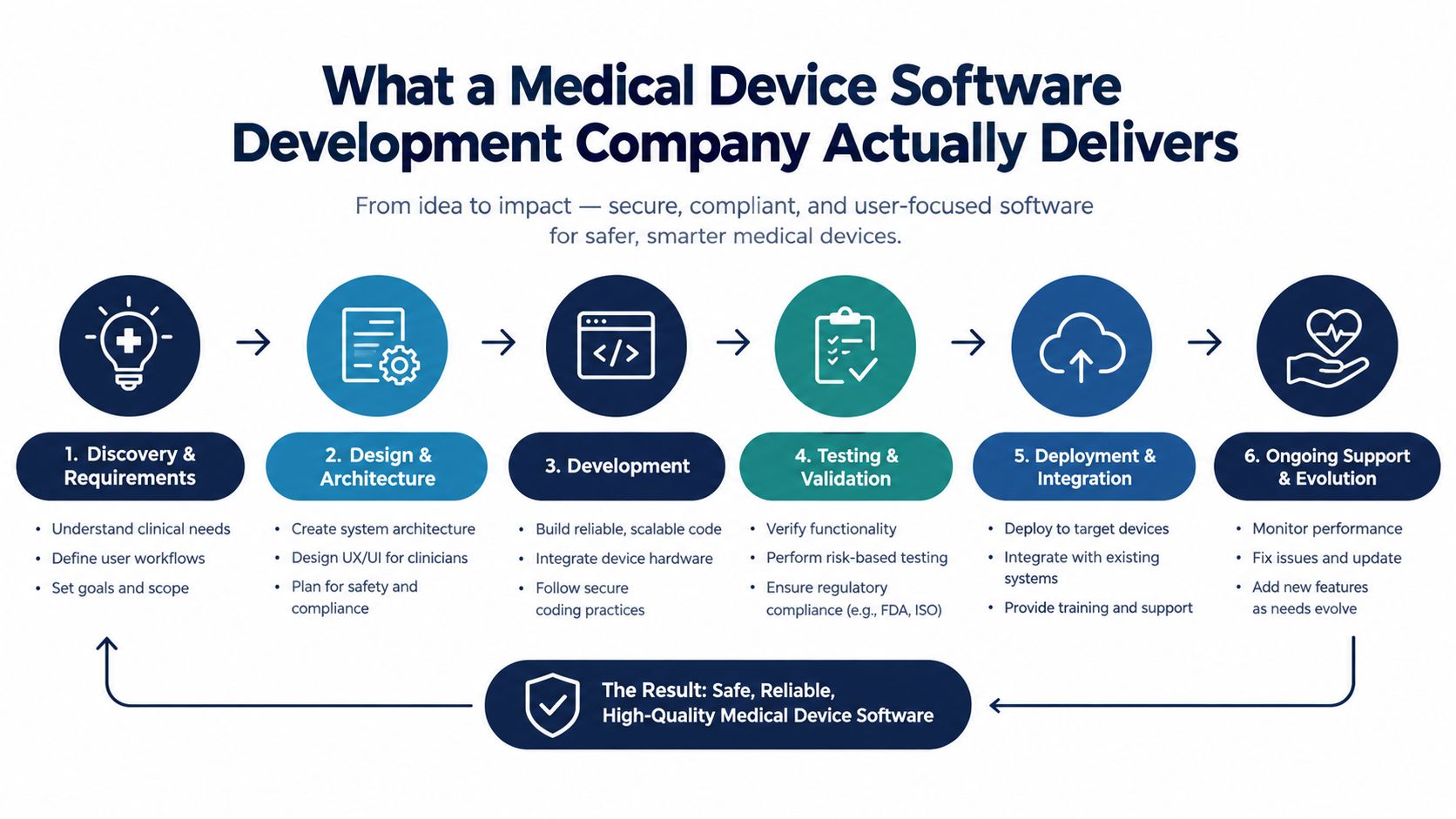
A serious partner delivers an evidence-producing development system, not just source code. It translates intended use and clinical workflows into software requirements, architecture, risk controls, test protocols, release records, and maintenance procedures.
The work should begin with a clear product boundary. Is the software Software as a Medical Device, or is it software embedded in or integral to a hardware device? What clinical purpose does it perform? Which users, environments, data sources, devices, and external systems affect its behavior? Those decisions influence the risk analysis and the development controls that follow.
The delivery chain
A mature team normally produces connected artifacts rather than isolated documents:
-
Requirements engineering: User needs, intended use, clinical requirements, system requirements, and software requirements are linked so the team can show why each function exists.
-
Architecture and design: The team documents software items, interfaces, data flows, dependencies, failure boundaries, and security assumptions.
-
Lifecycle planning: IEC 62304 provides the software lifecycle framework for devices that are software themselves or contain embedded software. The IEC 62304 standard covers development, maintenance, configuration management, and problem resolution.
-
Risk management: Hazard analysis, risk controls, residual risk decisions, and verification evidence connect to the broader device risk file.
-
Verification and validation: Unit, integration, system, usability, performance, cybersecurity, and simulated-use testing demonstrate that the product was built correctly and supports its intended use.
-
Release and maintenance: Version records, known anomalies, release notes, update impact assessments, regression evidence, and problem reports keep the product controlled after launch.
The vendor should also contribute to the Design History File or equivalent development evidence, technical documentation, submission materials, and postmarket change records. It doesn't need to own every regulatory decision, but it must know how its engineering evidence supports those decisions.
The maturity signal buyers miss
The strongest signal isn't a compliance slide in a sales presentation. It's the presence of quality, regulatory, clinical, security, and engineering roles in the operating model. These specialists should participate when requirements are defined, architecture is reviewed, risks are assessed, and releases are approved.
ISO 13485 provides the broader quality-management structure, while IEC 62304 provides the software lifecycle framework. A vendor that treats quality assurance as final-stage testing will create late findings, missing links, and expensive rework. A vendor that embeds QA and regulatory thinking into backlog refinement and design reviews can identify those problems while the architecture is still changeable.
Regulatory and Quality Foundations That Shape the Engineering Work
Compliance changes engineering decisions. It affects how teams write requirements, structure repositories, approve changes, test integrations, manage third-party components, and decide whether a release is ready.
IEC 62304 is a lifecycle standard, not a promise that the finished medical device is safe by itself. FDA's consensus-standard listing recognizes its relevance when software is a medical device or embedded in the final device, while also stating that IEC 62304 doesn't cover validation and final release of the finished medical device. That distinction is important. A vendor can follow a software lifecycle process and still fail to validate the complete product in its actual or simulated use environment.
From standards to daily work
ISO 14971 makes risk management a continuing engineering activity. Its process covers identifying hazards, evaluating and controlling risks, and monitoring the effectiveness of controls across the device lifecycle, from conception through decommissioning and disposal, as described in the ISO 14971 risk-management standard.
The practical result is straightforward. A risk control should appear in requirements, design, implementation, verification, and release evidence. If it only appears in a risk file, it isn't controlling anything.
ISO 13485 defines the quality-management environment in which design controls, supplier management, document control, corrective action, and records operate. IEC 62304 then gives software teams a way to structure development, maintenance, configuration management, and problem resolution. The team should tailor rigor to the potential harm from software failure, rather than applying identical documentation to every component.
FDA's software validation guidance defines validation through objective evidence that specifications meet user needs and intended uses, and that requirements can be consistently fulfilled. It also connects validation to the finished device and its actual or simulated use environment, as explained in the FDA guidance on device software functions.
How regulations translate into engineering work
| Standard or framework | Engineering impact | Typical artifacts |
|---|---|---|
| IEC 62304 | Structures development, maintenance, configuration control, and problem resolution according to software safety risk | Software development plan, requirements, architecture, test records, release records |
| ISO 14971 | Makes hazards, risk controls, residual risk, and control effectiveness part of the product lifecycle | Risk management file, hazard analysis, risk-control verification |
| ISO 13485 | Establishes the quality system around design, suppliers, records, change, and corrective action | Quality procedures, approvals, audit records, supplier controls |
| FDA software guidance | Requires objective evidence that software meets user needs and intended use | Validation plan, protocols, results, simulated-use evidence |
| Cybersecurity expectations | Pushes threat modeling, secure architecture, vulnerability handling, and component visibility into development | Threat model, security requirements, SBOM, vulnerability records |
Healthcare integrations deserve the same discipline. HL7 and FHIR interfaces, EHR and EMR connections, device gateways, identity services, and cloud data pipelines can all introduce hazards or alter clinical context. Teams building or modernizing these systems can use Bridge Global's application development in healthcare as a relevant reference point, but the buyer still needs to verify the proposed partner's specific evidence and ownership model.
Engagement Models Compared: From Onshore to Hybrid Teams
Geography doesn't determine audit readiness. Governance does.
An onshore team may offer easier communication and faster access to regulatory stakeholders, but it can still produce poor traceability. An offshore team may provide broad capacity and lower commercial overhead, but it needs explicit controls for access, documentation, handoffs, and decision escalation. Nearshore teams can offer useful timezone overlap, while hybrid models often combine a local product and quality core with a distributed engineering pod.
The right comparison asks who owns the evidence when the engagement ends. Your master service agreement and statement of work should address repository ownership, DHF or development-file access, configuration records, tool licenses, source-code escrow where appropriate, data residency, subcontracting, audit support, incident response, and postmarket obligations.
Where each model fits
| Model | Typical cost index | Audit readiness | Best fit |
|---|---|---|---|
| Onshore | Usually higher | Strong communication and local stakeholder access, if the quality system is mature | Early regulatory strategy, clinical collaboration, sensitive programs |
| Nearshore | Mid-range | Good overlap for reviews and issue resolution, depending on team experience | Distributed product teams needing regular collaboration |
| Offshore | Usually lower | Requires deliberate controls for handoffs, access, evidence, and audit response | Scalable engineering capacity with strong client-side governance |
| Hybrid | Variable | Can combine local accountability with distributed delivery | Multi-year programs needing regulatory control and engineering scale |
The most effective pattern is often a core-plus-pod model. A small accountable group owns product decisions, quality coordination, clinical interpretation, and regulatory communication. A broader pod handles implementation, automation, integration, test execution, and documentation under the same controlled workflow.
The contract should answer one uncomfortable question before the first sprint: who has authority to stop a release?
Don't assume a vendor can act as your regulatory stand-in. Specify whether it supplies a QA lead, supports audits, maintains traceability, performs change impact assessment, and participates in postmarket investigations. Ask how it protects patient and product data across environments, and require written controls for access removal when personnel leave the program.
Treat geography as a sourcing input, not as proof of medical device competence. The decisive factor remains whether the assigned team can produce and maintain regulated evidence under your quality system.
AI, ML, and SaaS Delivery in a Regulated Setting
A regulated AI component isn't an ordinary feature that happens to use a model. Its training data, model version, evaluation method, deployment environment, update criteria, and monitoring plan can all affect device performance.
That makes continuous delivery a governance problem. A pipeline that automatically promotes a new model or dependency to production may be technically efficient, but it can bypass the documented assessment needed to establish whether the change affects safety, intended use, clinical performance, or cybersecurity.
Design the postmarket loop before launch
For AI-enabled device software, require the vendor to define:
-
Dataset lineage: Identify the source, version, provenance, inclusion criteria, and approved use of training and evaluation data.
-
Model configuration: Preserve model versions, parameters, dependencies, evaluation results, and the exact release candidate.
-
Change boundaries: Describe which modifications are anticipated, which require additional review, and which could require regulatory re-evaluation.
-
Performance monitoring: Establish thresholds, review triggers, drift investigation, and escalation paths for unexpected behavior.
-
Update evidence: Link every model or software change to risk assessment, verification, validation, approval, and release records.
FDA's cybersecurity expectations now include processes for vulnerability monitoring and remediation after launch, along with a software bill of materials covering commercial, open-source, and off-the-shelf components. The agency's cybersecurity guidance for medical devices also makes security architecture, threat modeling, secure updates, and supply-chain visibility practical engineering concerns rather than submission decoration.
Cloud-hosted SaMD adds another layer. The partner must control environments, secrets, access, deployments, backups, observability, third-party services, and rollback procedures. HL7 and FHIR connections, EHR and EMR workflows, healthcare automation, and device data ingestion need validation in representative clinical contexts, not only API-level testing.
For general AI delivery principles, this safe AI deployment guide from Appjet.ai provides useful context. In regulated healthcare, however, add product-specific controls for risk management, clinical validation, data governance, security, and controlled change.
Bridge Global's discussion of AI-powered healthcare support systems is also relevant when evaluating healthcare AI use cases. The buyer should distinguish administrative or support automation from software that makes, informs, or changes a regulated clinical decision.
A Practical Framework for Selecting the Right Partner
Use a weighted assessment, not a generic capability checklist. A vendor may have excellent full-stack engineers and still lack the quality ownership required for a medical device program.
Evaluate five dimensions
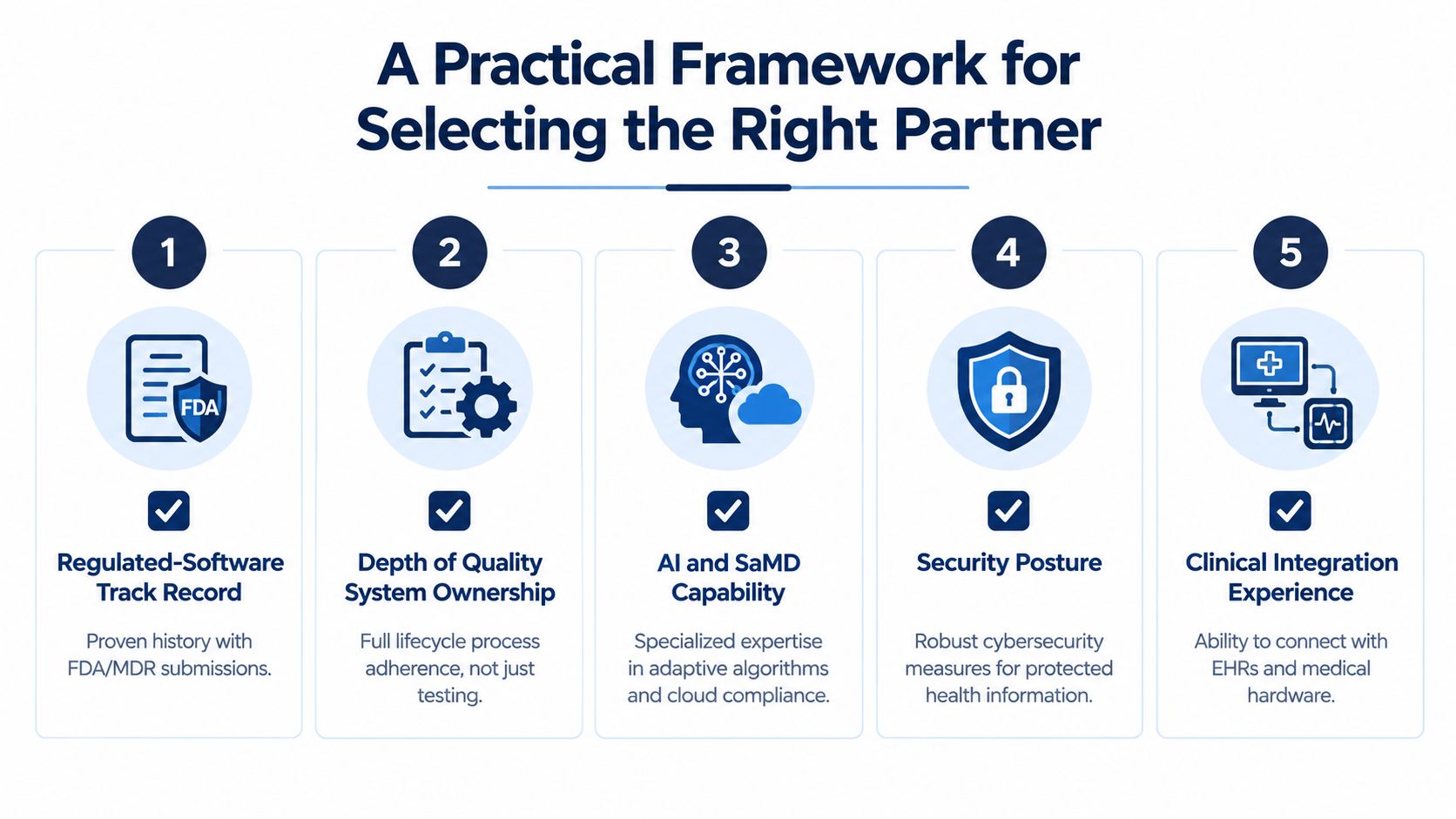
Regulated-software track record comes first. Ask for anonymized examples of requirements-to-test traceability, risk-control verification, release records, and audit findings. You don't need confidential customer documents. You do need evidence that the team has worked inside a controlled lifecycle.
Quality-system ownership determines whether compliance is part of delivery or an external review performed later. Ask who maintains procedures, who approves deviations, how nonconformities are handled, and which named person owns QA for your program. Request an anonymized template for the risk management file and a description of how it connects to software work.
AI and SaMD capability requires more than a machine-learning demo. Ask how the vendor versions data, evaluates models, controls retraining, monitors drift, documents model changes, and decides whether a change needs additional validation or regulatory review.
Commercial transparency includes the unglamorous items. Clarify what tooling, quality activities, security work, clinical input, audit support, postmarket monitoring, and regulatory documentation are included. A low build estimate that excludes lifecycle work isn't a low total cost.
Postmarket accountability should be tested before contract signature. Ask who handles vulnerability triage, complaint investigation support, urgent patches, regression testing, release approval, and change-control records. The answer should name roles and workflows, not just promise "ongoing support."
Red flags that should stop the evaluation
-
No qualified owner: The vendor can't identify the QA, regulatory, security, or clinical lead assigned to the program.
-
No risk artifact: The team has no practical risk management template or can't show how risk controls reach engineering tickets and tests.
-
Testing is a handoff: The vendor won't commit to verification and validation ownership or treats testing as a separate final phase.
-
The sales team is the core team: The proposed delivery staff haven't participated in the technical discussion.
-
Postmarket is undefined: The statement of work ends at deployment, with no process for vulnerabilities, anomalies, changes, or field feedback.
Use this guide to questions for a software development partner to structure the commercial and delivery conversation, then add medical-device-specific questions about evidence ownership and regulatory change.
References should confirm behavior, not personality. Ask whether the vendor responded to audit findings, preserved traceability during scope changes, handled a serious defect, supported a submission, and remained useful after launch. If references only discuss communication and velocity, you haven't tested the risks that matter most.
Timelines, Cost Drivers, and What Actually Moves the Numbers
A credible vendor won't give you one confident launch date before it understands intended use, risk, target markets, existing QMS maturity, hardware dependencies, clinical evidence, integration scope, and postmarket responsibilities.
Regulated programs move through phases. Discovery and quality-system gap analysis establish the starting point. Requirements, architecture, implementation, verification, and validation create the technical evidence. Submission preparation converts that evidence into a reviewable package. Postmarket activities begin during design, because the team must define how it will monitor, maintain, secure, and change the product after release.
What changes the estimate
The largest cost drivers usually aren't lines of code. They include:
-
Software safety risk: Higher potential harm requires more rigorous architecture, segregation, analysis, testing, review, and evidence.
-
Hardware and firmware integration: Physical device interfaces create timing, failure, environmental, and system-level testing concerns.
-
Clinical interoperability: HL7, FHIR, EHR, EMR, imaging, identity, and device integrations create mapping, workflow, privacy, and failure-mode work.
-
AI and ML: Data governance, model evaluation, retraining controls, drift monitoring, explainability needs, and change assessment extend the lifecycle.
-
Cybersecurity: Threat modeling, security architecture, dependency analysis, SBOM maintenance, vulnerability response, and secure-update planning require sustained effort.
-
Postmarket scope: Complaint handling, surveillance, field performance, corrective actions, and release maintenance add recurring work that many initial proposals omit.
A buyer should reject estimates based only on screens, features, or developer hours. Instead, ask how the vendor priced traceability tooling, review gates, test coverage, test-environment management, documentation updates, cybersecurity analysis, and ownership of the development evidence.
Phase-by-phase timeline and cost drivers for regulated medical software
| Phase | Typical duration | Primary cost drivers | What buyers miss |
|---|---|---|---|
| Discovery and gap analysis | Depends on product maturity and QMS state | Intended use, target markets, existing evidence, clinical input | The quality-system gap can redefine the entire delivery plan |
| Requirements and architecture | Depends on risk and system complexity | Hazard analysis, integrations, hardware boundaries, security architecture | Ambiguous requirements create downstream verification debt |
| Development and verification | Depends on safety class and integration scope | Architecture, implementation, automated testing, traceability, defect resolution | Every change can affect risk records and test evidence |
| Validation and release | Depends on intended use and environment | Clinical workflow, usability, simulated use, deployment controls | Passing software tests doesn't validate the finished device |
| Submission preparation | Depends on market and evidence completeness | Technical documentation, review cycles, regulatory strategy | Missing records are slower and costlier to recreate late |
| Postmarket maintenance | Ongoing | Vulnerability response, complaints, updates, surveillance, change control | Support obligations start before commercial launch |
The fastest programs make decisions early, keep intended use stable, automate traceability checks, and involve quality and security in architecture. The programs that quietly inflate spend change clinical claims late, postpone risk analysis, use uncontrolled third-party components, or treat postmarket support as an optional add-on.
Next Steps for Engaging a Medical Device Software Partner
Start with a discovery conversation, but use it as a technical and regulatory test. Ask the vendor to explain how it would classify the product, define the system boundary, structure the lifecycle, and manage changes after launch. A polished presentation matters less than whether the proposed team asks precise questions about clinical use, hazards, integrations, data, users, and maintenance.
Bring a concise product brief containing:
-
Intended use and indications for use
-
Target markets and planned regulatory routes
-
Your current safety-class hypothesis
-
Existing QMS procedures and evidence
-
Hardware, cloud, HL7, FHIR, EHR, and EMR dependencies
-
Clinical evaluation or performance evidence assumptions
-
AI or ML components and expected update behavior
-
Current cybersecurity and postmarket capabilities
Before signing a multi-year statement of work, commission a paid feasibility or compliance-gap assessment. The deliverable should identify missing requirements, evidence risks, architecture constraints, integration unknowns, security obligations, and decisions that could alter the regulatory pathway.
Request these items in writing:
-
The assumed IEC 62304 safety classification and the reasoning behind it.
-
Evidence of the vendor’s ISO 13485 audit experience or quality-system role.
-
Relevant prior 510(k), De Novo, PMA, MDR, or equivalent submission support, where applicable.
-
The name and responsibilities of the assigned QA lead.
-
Ownership of requirements, risk records, verification, validation, release approval, and postmarket changes.
-
The process for vulnerability response, SBOM maintenance, and security updates.
-
The rules for source code, repositories, development records, tools, and evidence access when the engagement ends.
Evaluate the delivery team, not only the sales engineers. Have the proposed architect, QA lead, security specialist, and product lead explain the first release and the first post-market update. Their answers will reveal whether the vendor sees lifecycle work as core engineering or as paperwork assigned to someone else.
For the first 30 days, agree on the intended use, target markets, safety-class hypothesis, system boundary, quality ownership, evidence repository, risk-management approach, and postmarket operating model. That preparation gives you a defensible basis for selecting a partner and prevents the first statement of work from hiding the obligations that will shape the product for years.
Bridge Global provides healthcare software engineering for organizations building compliant digital health products, connected platforms, integrations, and AI-enabled solutions. If you need a partner that can discuss architecture, interoperability, quality evidence, and lifecycle support in the same conversation, visit Bridge Global to start a focused discovery discussion.

About Preethi Saro Philip
Preethi Saro Philip is a Post Graduate Research Degree holder in Economics with more than 10 years of experience in writing, editing, research and teaching. She has an intense passion for content crafting and calls herself a ‘wordsmith’. She enjoys writing on wide-ranging topics including business, technology, health & lifestyle, education, environment etc.
View all posts by Preethi Saro Philip →