



AI-Powered Healthcare Support Systems: A Practical Roadmap
A hospital product team can spend months building an AI feature, pass an impressive internal demo, and still encounter its first serious test at clinical validation review. The model may classify risk correctly in a curated dataset, yet the review team asks harder questions: Which patient population was represented? What happens when the EHR record is incomplete? Who sees the output, who can override it, and what evidence proves that the workflow is safer or more useful after deployment?
That gap defines AI-powered healthcare support systems in 2026. These systems aren't prediction models added to a dashboard. They combine clinical data, software workflows, machine learning, retrieval, language models, human review, integration services, and operational governance. Their success depends less on a compelling prototype than on whether clinicians can use them safely during a busy shift.
U.S. hospitals increased their use of predictive AI from 66% in 2023 to 71% in 2024, while physician use of health AI rose from 38% to 66% over the same period, according to the hospital AI adoption review. Those figures point to a change in operating reality. AI support is moving into routine clinical and administrative work, not remaining confined to isolated experiments.
What AI-Powered Healthcare Support Systems Really Mean in 2026
A product team preparing for validation might describe its system as “an AI assistant for care coordination.” That label is too broad for a safe review. The team needs to specify whether the product predicts deterioration, prioritizes triage queues, drafts clinical notes, answers guideline questions, or automates authorization paperwork. Each function creates a different risk, evidence burden, user experience, and escalation path.
Four categories with different responsibilities
Clinical decision support helps clinicians identify risk, interpret information, or consider an intervention. A readmission model, sepsis alert, imaging support tool, and medication recommendation engine belong here. These systems can influence patient care directly, so performance, calibration, alert burden, clinical utility, and override behavior matter together.
Ambient documentation captures a consultation and produces a draft note or summary. Its primary risks include incorrect transcription, omitted context, fabricated details, inappropriate attribution, and clinician overreliance. The safest workflow treats the output as a draft that a qualified professional reviews before it becomes part of the record.
Patient-facing triage helps people describe symptoms, find relevant services, or decide whether to seek urgent care. It needs clear boundaries, accessible language, escalation to a human or emergency service, and careful handling of uncertainty. A system that sounds confident while missing a high-risk presentation can create more harm than a slower, less polished tool.
Back-office automation covers prior authorization, coding support, scheduling, claims workflows, and document classification. These use cases may have lower direct clinical risk, but they still affect access, reimbursement, staff workload, and patient experience. Bias or silent failure in an administrative workflow can become a care problem downstream.
From isolated models to orchestrated systems
Modern deployments often combine classical machine learning with retrieval pipelines and large language model reasoning. A risk model can calculate a structured score from EHR data, a retrieval layer can fetch approved clinical guidance, and an LLM can turn that evidence into a readable explanation. Human oversight remains the control that determines whether the output is accepted, edited, escalated, or rejected.
The FDA-cleared AI and machine learning device ecosystem illustrates this widening scope. Cumulative clearances reached 1,357 by late 2025, with 295 new clearances in 2025, and 76% of cleared devices were used in radiology. The same source reports adoption of ambient AI note-taking tools at 68% in surveyed health systems and AI-based clinical documentation improvement at 43%, showing that support systems now extend beyond diagnostic imaging into documentation and operations.
The difficult work starts after go-live. Workflow fit, data changes, governance, user trust, monitoring, and maintenance determine whether the system survives contact with clinical practice. The roadmap is therefore practical: define the problem and data, select an architecture, design privacy controls, validate in realistic conditions, integrate with clinical systems, and operate the product as a governed service.
Discovery and Data Strategy Before You Write a Single Model
The most expensive discovery mistake is choosing a model before choosing a decision. Teams often start with an available dataset, select a performance metric, and only later ask whether the output changes anything a clinician or operations manager can control.
Start with the workflow on paper. Identify the decision point, the person making the decision, the information available at that moment, the action that follows, and the consequence of delay or error. A triage prioritization tool, for example, might need to rank incoming cases, while a patient-facing assistant might need to identify when conversation should stop and human escalation should begin. Those are not interchangeable product problems.
Make the buy, build, or partner choice explicit
A commercial triage API can shorten time to a pilot, but it may expose limited detail about training data, threshold configuration, update policies, or regional performance. An in-house readmission model can fit local practice more closely, yet the hospital owns data preparation, validation, monitoring, and lifecycle maintenance.
A partner model sits between those choices. A capable healthtech software development partner can help a provider frame the use case, connect legacy systems, build the user workflow, and establish the operating controls. That arrangement only works when ownership is documented. The hospital still needs named clinical and compliance owners, even if an external team writes the software.
Bring the right people into discovery before procurement locks in a solution:
-
Clinicians: Define the decision, acceptable interruption, override behavior, and meaningful clinical outcome.
-
IT and informatics: Confirm identity, EHR access, interface constraints, hosting requirements, and support responsibilities.
-
Compliance and privacy: Establish permitted data use, retention, audit needs, and patient communication boundaries.
-
Procurement and finance: Test contract terms, business continuity, implementation effort, and total operating cost.
Audit the data, not just its volume
Review label provenance, missingness, timestamp meaning, coding changes, and differences between sites. A diagnosis code recorded for billing isn't automatically a reliable clinical label. Notes may be copied forward, observations may arrive late, and an apparently complete patient record may omit information held in another system.
Representativeness needs a practical test. Compare the intended population with the development data across age, sex, language, care setting, comorbidity, geography, and site-level documentation habits. If the product will run across multiple hospitals, hold out a site or evaluate each site separately. A single pooled result can hide local failure.
The data pipeline also needs an explicit contract. Define which resources or fields are required, how stale data is handled, what happens when a value is absent, and how corrections propagate. The healthcare data pipeline architecture guide provides useful context for designing those flows.
Practical rule: If the team can't explain which clinical action changes when the model is wrong, discovery isn't finished.
A useful discovery loop returns to the workflow after every data finding. If the required data isn't available at the decision point, change the use case, change the integration plan, or stop. No later architecture choice can compensate for a problem that never had a reliable operational input.
Choosing the Right Model Architecture for Clinical Support
Architecture should follow the workflow's failure cost, evidence requirements, and interaction pattern. A calibrated classifier may be the right choice for structured risk stratification, while a retrieval-grounded language model may better support a clinician searching approved guidance. A general LLM placed directly between raw patient data and a treatment recommendation is usually the wrong shortcut.
Match the method to the work
Classical machine learning remains strong on tabular EHR data. Gradient-boosted trees and calibrated classifiers can handle structured features, expose feature contributions, run with predictable latency, and support threshold-based escalation. Their limitations are equally important. They depend on stable feature definitions, can inherit documentation bias, and may fail when coding practices or patient populations change.
Fine-tuned domain models can perform better than general-purpose LLMs for specialized language tasks, such as extracting medications, summarizing a defined document type, or classifying authorization requests. They require carefully governed training examples and repeated evaluation against the actual writing styles, abbreviations, and edge cases found in the target environment.
Retrieval-augmented generation is safer for guideline-bound answers when the system retrieves content from an approved, versioned knowledge base and shows citations to the user. Retrieval doesn't eliminate hallucination. It creates a controlled evidence path that makes unsupported answers easier to detect and gives clinicians a way to verify the result.
Compare architecture options by workflow
| Workflow | Classical ML | Fine-tuned LLM | LLM + Retrieval | Hybrid |
|---|---|---|---|---|
| Triage prioritization | Strong for structured scoring and thresholding | Useful for symptom and message classification | Appropriate when responses must cite approved guidance | ML ranks risk, LLM explains and escalates |
| Clinical documentation | Limited to extraction and classification | Strong for defined note formats | Useful for policy or template references | Speech or text model drafts, rules validate required fields |
| Prior authorization | Strong for routing and document classification | Useful for extracting payer-specific language | Useful when policy documents change frequently | Classifier routes the case, retrieval supports the draft |
| Risk stratification | Strong for transparent structured prediction | Usually unnecessary for the score itself | Useful for clinician-facing context | ML generates the score, LLM produces a bounded explanation |
A practical decision rule is to combine approaches when one component can enforce a hard boundary for another. An ML risk score can gate whether an LLM generates a patient-facing explanation. A retrieval layer can restrict the answer source, while deterministic rules block unsupported recommendations or route uncertainty to a human.
Before selecting an architecture, confirm the validation target, latency tolerance, review cost, explainability requirement, and monitoring method. The evidence base should shape the choice. A 2026 systematic review of 50 studies across 17 medical specialties found a pooled AUC of 0.652, with a 95% confidence interval of 0.562 to 0.743, indicating moderate overall discrimination and substantial variation across settings, as reported in the predictive clinical decision support meta-analysis. That result argues against treating a single headline metric as proof of deployment readiness.
Privacy, Compliance, and Audit-Ready Architecture
Compliance can't be a ticket assigned to legal after the prototype is complete. In healthcare, privacy controls affect data models, API boundaries, cloud configuration, prompt handling, user permissions, retention, and incident response. Teams that postpone those decisions often discover that their preferred architecture can't support the required audit trail.
Map safeguards to engineering controls
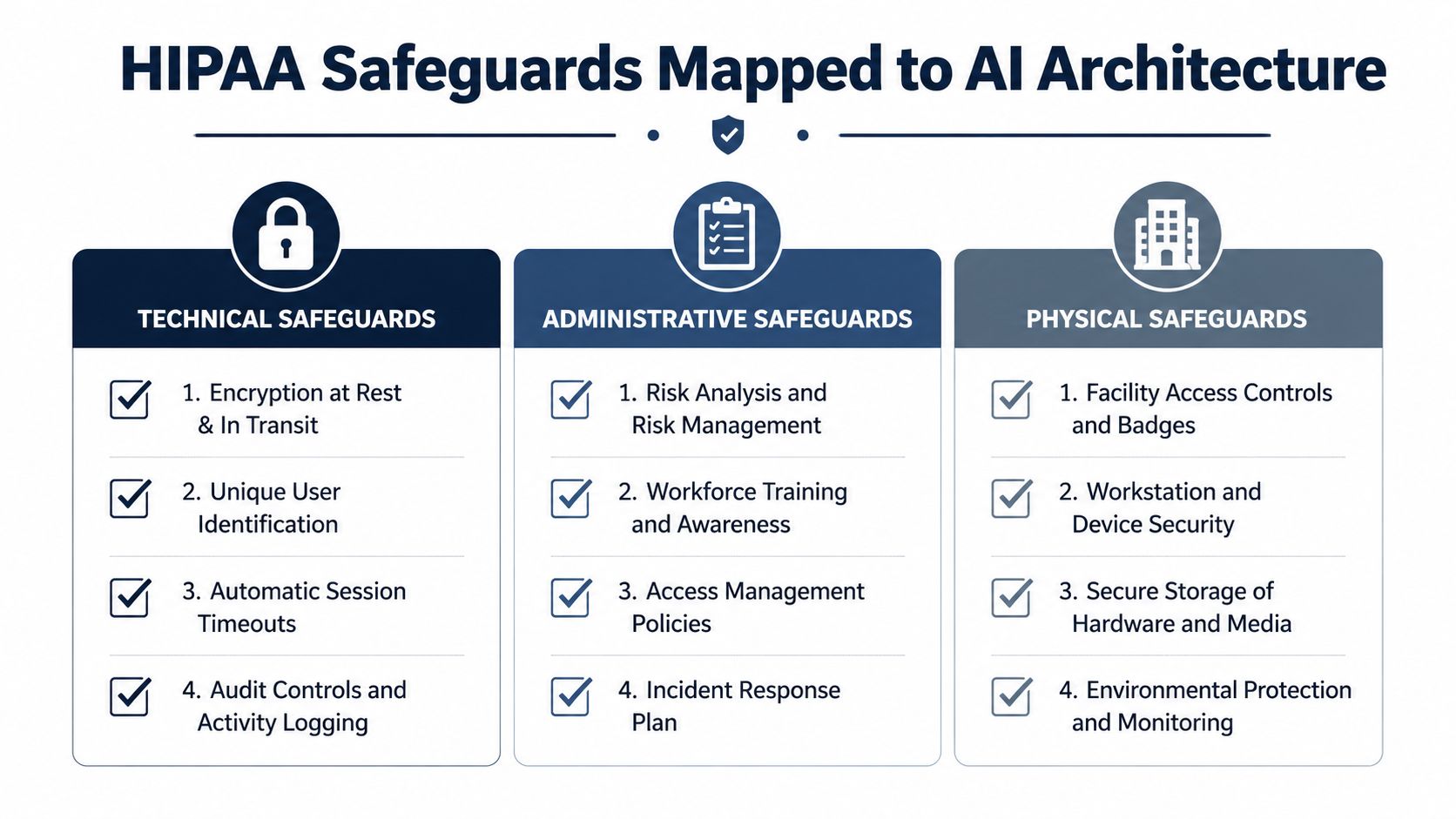
For HIPAA, translate Technical, Administrative, and Physical Safeguards into design decisions. Encrypt PHI at rest with KMS-managed keys and protect it in transit. Use tenant-scoped segregation, unique identities, least-privilege access, session controls, immutable audit logs, and monitored service accounts. A business associate agreement must be in place before a model API receives protected health information.
Administrative controls include risk analysis, workforce training, incident procedures, vendor oversight, and change approval. Physical safeguards cover hosting facilities, device handling, backup protection, and access to environments where sensitive data is processed. A useful overview of technical controls for healthcare can help teams translate policy language into implementation questions.
For international pilots, establish the GDPR lawful basis, complete a Data Protection Impact Assessment where required, define controller and processor responsibilities, and document cross-border transfer mechanisms. Don't assume that de-identification solves every issue. Prompt content, retrieved context, generated output, and user actions can each create a privacy record.
Treat intended use as a product boundary
An AI feature may cross into software as a medical device territory when its intended purpose supports diagnosis, prevention, monitoring, prediction, prognosis, treatment, or alleviation of disease. Classification depends on the function and claims, not merely whether the interface is called an assistant. The IMDRF framework and applicable FDA guidance, including the 2024 Predetermined Change Control Plan guidance, should inform the product and evidence plan early.
The HIPAA-compliant software development guide offers additional implementation context. The core principle is simple: define what the system is allowed to do, what it must never do, and which changes require review.
Build the evidence trail from day one
Version every model, prompt, retrieval source, input transformation, output, reviewer action, and release decision. Make each record queryable by patient encounter, workflow, model version, and deployment environment. Store enough context to reconstruct what the system saw and produced without creating unnecessary copies of PHI.
The World Health Organization's guidance on AI for health emphasizes lifecycle thinking, transparency, risk management, intended use, and analytical and clinical considerations. That principle matters operationally. Post-hoc evidence collection is slow, incomplete, and least reliable when a regulator or hospital compliance officer needs answers quickly.
Clinical Validation That Actually Predicts Real-World Performance
Retrospective validation is useful, but it answers a narrow question: how did the model perform on historical data prepared for evaluation? It doesn't show whether clinicians receive the output at the right moment, whether they understand it, whether alerts create work, or whether the intervention improves care.
A curated dataset can also make accuracy look better than it will be in production. EHR data contains missing values, copied notes, delayed results, inconsistent codes, and rare presentations that may be underrepresented. Teams should report discrimination, calibration, threshold behavior, subgroup performance, and operational outcomes rather than presenting AUC as a complete safety argument.
Use three validation modes deliberately
Retrospective benchmarks belong early in development. They help compare candidate models, identify leakage, test feature engineering, and expose obvious subgroup problems. They shouldn't be the only evidence for a system that changes clinical decisions.
Prospective evaluation tests the product with live or newly collected data under a defined protocol. Randomized shadow deployment can compare system recommendations and workflow behavior without allowing the model to influence care. A prospective trial or randomized evaluation provides stronger evidence when the intended use carries meaningful clinical risk or when a health system needs proof of clinical utility before procurement.
| Mode | Evidence Strength | Typical Duration | Cost Band | Realism |
|---|---|---|---|---|
| Retrospective benchmark | Low to moderate for deployment decisions | Short | Lower | Limited |
| Prospective evaluation | Moderate to strong | Longer | Medium to high | High |
| Randomized shadow deployment | Strong for workflow and safety assessment | Longer | High | High, without direct care influence |
The table’s duration and cost labels are qualitative by design. Actual effort depends on the data access process, clinical review capacity, intended use, and study protocol.
Write the protocol before reviewing results
Use relevant reporting and evaluation frameworks such as TRIPOD+AI, DECIDE-AI, and SPIRIT-AI. Pre-specify endpoints, inclusion criteria, thresholds, subgroup analyses, stopping rules, and the definition of a clinically meaningful outcome. Include a held-out site where possible, and use clinician adjudication when the ground truth is ambiguous.
A 2025 systematic review of 27 trust studies found that 17 of 27 came from hospital settings, with 16 of 27 using qualitative methods, according to the review of trust in AI clinical decision support. That evidence reinforces the need to measure usability, transparency, training, reliability, and alignment with clinician judgment alongside technical performance.
A model can be statistically competent and operationally unsafe if the person receiving its output can’t interpret, challenge, or ignore it appropriately.
Choose validation depth according to risk. A low-risk document routing feature may begin with retrospective testing and controlled production monitoring. A diagnostic support feature needs stronger prospective evidence, explicit human oversight, and a rollback plan before broad release. In every case, validation should continue after launch because the deployed workflow is part of the system being evaluated.
Integrating With EHRs, Devices, and Ambient Workflows
A keynote demo usually has clean inputs and a cooperative API. A hospital pilot has identity mismatches, incomplete records, stale observations, consent constraints, interface downtime, and users who need the output inside an existing workflow. Integration engineering decides whether the product becomes useful or becomes another window clinicians must ignore.
Select resources around the decision
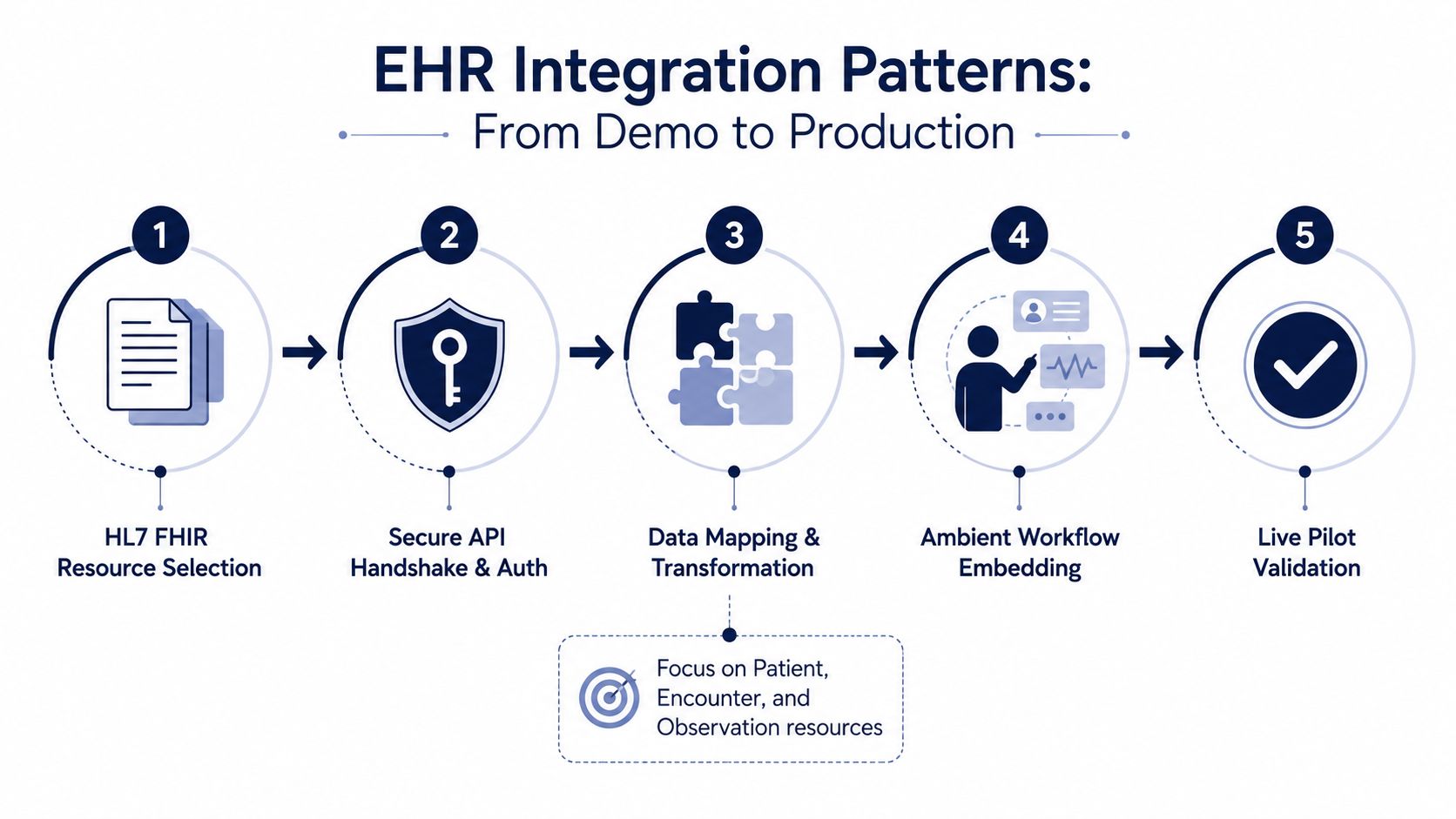
HL7 FHIR resources commonly support different parts of the workflow. Patient provides identity context, Observation carries measurements, DiagnosticReport represents diagnostic findings, and DocumentReference can store or reference generated summaries. SMART on FHIR can provide launch context and authorization, while CDS Hooks can surface decision support at defined points in the clinician workflow.
HL7 Version 2 and C-CDA remain important in environments where newer APIs don’t cover every exchange. Device feeds may arrive through HL7 v2 streams or device interoperability standards such as IEEE 11073. The health data interoperability research explains why shared standards are necessary for electronic health information to move across digital tools and systems.
Test the failure path in the first sprint
Before celebrating an end-to-end success, test authentication, consent, patient matching, encounter selection, missing fields, stale timestamps, time-zone handling, duplicate messages, interface retries, and downtime behavior. Confirm that generated content is labeled as generated, routed to the right role, and prevented from becoming a signed clinical record.
A production integration must also define what happens when the EHR returns incomplete data. The system should show uncertainty or defer rather than infer that an absent value is a negative value. For ambient workflows, test microphone permissions, speaker identification, interruption, language variation, and the clinician’s editing path.
Teams building these products can review the healthcare data interoperability strategy before finalizing interface boundaries. For broader integration planning, the Model Context Protocol and health data interoperability guidance describe how established health data standards and emerging AI connection patterns fit into the wider ecosystem.
Integration checkpoint: The first sprint is successful when the system handles a missing patient identifier safely, not when it processes the perfect test record.
Vendors that want to ship AI integration systems need to treat identity, authorization, consent, and error handling as product features. The model is only one component in a chain that includes interfaces, transformations, user permissions, and clinical action.
Monitoring, Governance, and Going to Market Without the Last-Mile Trap
Go-live isn’t the end of implementation. It’s the point at which the team starts observing the full system, including data quality, clinician behavior, patient response, infrastructure reliability, and the consequences of incorrect or ignored outputs.
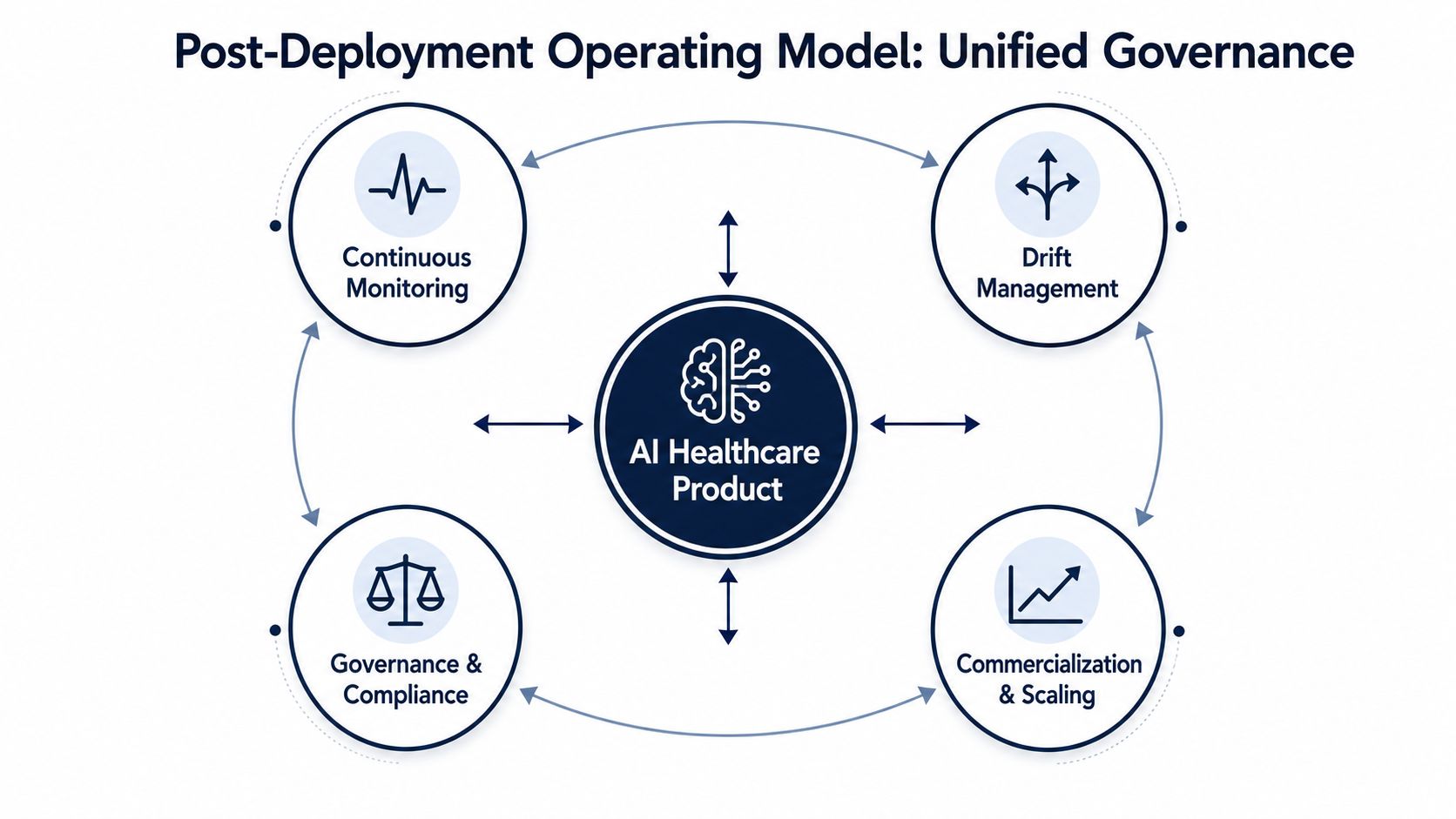
Operate four connected control loops
Continuous monitoring should connect inputs and outputs to the relevant FHIR resources, encounter types, user roles, and workflow events. Cohort-level dashboards can show calibration, alert volume, missingness, response time, acceptance, edits, overrides, and escalation. Route safety alerts to clinical informatics teams, not only to engineering dashboards.
Drift management needs separate tests for structured models and generative outputs. For tabular models, monitor feature distributions, missingness, calibration, threshold performance, and subgroup behavior. For LLM outputs, compare responses with approved references, sample clinician reviews, detect unsupported claims, and audit tone, omissions, and escalation behavior.
Governance and compliance work best through a lightweight RACI. A clinical owner approves intended use and safety thresholds. Data science owns evaluation and drift analysis. Product owns workflow and release decisions. Legal and compliance own privacy, regulatory interpretation, and audit readiness. Operations owns incident response and user support.
Commercialization and scaling depend on the first three loops. Reimbursement pathways require defensible documentation. Clinician champions need evidence that the tool reduces friction rather than adding alerts. ROI reporting needs trustworthy measures tied to the workflow, not a model metric selected because it was easy to calculate.
Define intervention thresholds before incidents
Write down when the system pauses, rolls back, routes to a human, or requires a new validation cycle. Examples include material calibration drift, an increase in unsupported generated claims, a change in intended use, a new data source, or a failure in the EHR interface. Human override should be visible and easy, with the reason captured for later review.
The AI monitoring page offers broader operational context, but healthcare teams need monitoring tied to clinical risk and governance ownership. A dashboard without a responder, threshold, and playbook is a display, not a control.
The WHO Europe report on patient trust shows why this operating model must include inclusion. 63% of healthcare professionals were optimistic that AI could improve outcomes, while fewer than half of patients were optimistic and only 33% of patients aged 45 and older were positive, according to the WHO patient and professional perspectives report. The same source reports concerns about lack of human empathy at 70%, biased decisions at 68%, and incorrect diagnoses at 59%. Those concerns should shape escalation design, language accessibility, usability testing, and communication with patients, especially older adults, low-literacy users, and marginalized groups.
Patient engagement tools have shown 20x year-over-year growth, while prior authorization tools have shown 10x year-over-year growth, according to market analysis of AI healthcare adoption and the last-mile problem. Commercial demand doesn’t remove the implementation gap. It makes disciplined monitoring more important because a product that works in a pilot can still stall when it meets legacy infrastructure, clinician workload, and post-launch accountability.
Bridge Global provides AI development services, enterprise AI solutions, custom healthcare software development, custom software development, software development service models, an AI implementation roadmap, healthcare integrations, and SaaS product development. Its healthcare work includes an AI-enabled multidisciplinary team collaboration platform that unifies clinical data through DICOM, HL7, and FHIR, supports decision-making and NLP-based extraction, and automates scheduling for video collaboration. You can review relevant client cases when comparing delivery options.
For a practical next step, ask your team to document one clinical decision, its available data, its human escalation path, and the post-deployment signals that would trigger intervention. Bridge Global can help turn that definition into validated, integrated, and audit-ready AI healthcare software. Visit Bridge Global to discuss the workflow, governance, and engineering support your product needs before its first production release.

About Upendra Jith
Upendrajith completed his Master's in English and has been a commercial content developer for the past three years. He's more inclined to develop content with a 'street-smart' delivery on topics such as technology, media, or anything he can get his hands on. He has a fixation on lyrics, dark poetry, media, technology, and flow arts.
View all posts by Upendra Jith →