



Medical Data Engineering: A Complete Guide
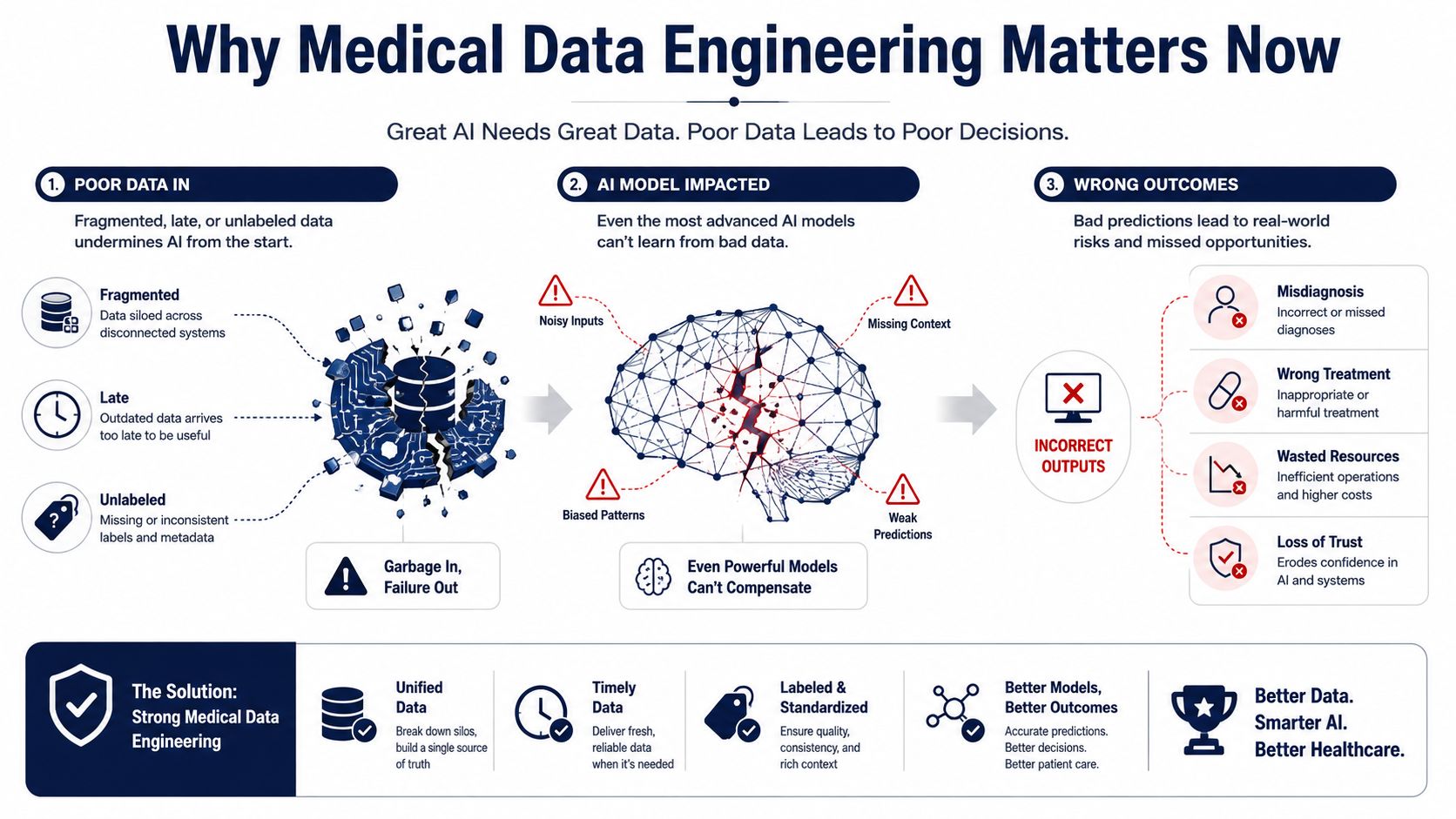
You can feel the problem before anyone names it. A product team has a promising model, a clinician is asking for a dashboard, and the data lead is staring at exports from three systems that don't agree on dates, names, or codes. The model looks advanced, but the inputs are late, fragmented, or unlabeled, so the output can't be trusted in a workflow that affects care.
That's where medical data engineering starts. It's the discipline that decides whether healthcare data becomes a reliable operational asset or a pile of disconnected records that nobody wants to use twice.
Why Medical Data Engineering Matters Now
A hospital team can have the right ambition and still miss the outcome. A clinician asks for a risk score, the data science team trains a model, and the result fails because the source feeds don't line up, the labels are inconsistent, or the latest lab values haven't reached the warehouse yet. The failure isn't usually the model. It's the path the data took before the model saw it.
That path matters more every year because the volume and complexity of healthcare data keep rising. One recent review estimates global healthcare data will reach 2,314 exabytes by 2030, and another 2025 review says it has already surpassed 4,200 exabytes and is growing at 63% annually; the same review also notes healthcare data error rates of 5% to 30% depending on the element and collection method. Those numbers explain why this field exists as its own discipline. The job isn't just to store more data; it's to make heterogeneous data usable, interoperable, and trustworthy enough for analytics, decision support, and AI systems.
Practical rule: if the people closest to care can't trust the data lineage, the model output won't matter.
The same pressure shows up in operations. A 2025 analysis says data quality issues cost the U.S. healthcare system approximately $467 billion annually, and 61% of healthcare IT projects fail because their data engineering infrastructure isn't adequate. That's not a tooling problem in isolation. It's a sign that healthtech products and provider systems need pipelines, validation rules, standardization layers, and governance built in from the start.
The rest of this guide follows that reality through the stack, from raw data types to architecture, governance, and delivery choices.
Defining Medical Data Engineering and Its Core Data Types
Medical data engineering is the work of designing, building, and operating the pipelines, models, and governance systems that convert raw clinical, operational, and device data into trustworthy inputs for analytics, machine learning, and clinical workflows. It sits between source systems and decision-making systems, and it has to preserve meaning while making data usable.
The data is not one thing
Healthcare data arrives in very different forms, and each form behaves differently in a pipeline. Structured EHR tables are easy to query but often incomplete. HL7 messages and other semi-structured feeds carry timing and transaction details, while free-text notes contain context that only becomes useful after careful processing.
Imaging, genomics, and wearable data add more friction. DICOM files are large and semantically rich, genomic data often needs specialized interpretation, and continuous device streams can overwhelm systems if the ingestion layer isn't built for time-series behavior. Treating all of that as a single “dataset” is how teams lose provenance and end up with brittle workflows.
A practical mental model helps here. Think of the data as a parcel network. The sender, recipient, label, and contents all matter, and if everyone uses different packaging rules, the system slows down or breaks.
Standards are the shared language
That's why terminology standards exist. SNOMED CT, LOINC, ICD-10, and RxNorm give clinicians, analysts, and systems a shared vocabulary so a diagnosis, lab value, code, or medication means the same thing wherever it appears. Messaging and API standards like HL7 v2, HL7 v3, and FHIR define how systems exchange that information.
FHIR matters because it gives teams a modern way to move clinical data through APIs, but the broader point is simpler. Standards reduce ambiguity, and ambiguity is expensive when data has to drive a clinical or AI workflow. Without them, the pipeline becomes a translation job at every hop.
Data engineering in healthcare is never just ingestion. It's translation, normalization, and proof that the meaning survived the trip.
Architectures and Pipeline Patterns That Actually Work
Good medical data platforms don't start with a tool choice. They start with a latency and governance decision. If the team needs raw retention for later exploration, a data lake makes sense. If the priority is curated analytics for reporting and BI, a warehouse gives tighter control. Some teams use a lakehouse when they want both flexibility and structure, while feature stores serve ML pipelines that need repeatable inputs. Streaming layers matter when data arrives continuously from monitors or devices.
ETL, ELT, and the cost of getting the order wrong
Healthcare teams increasingly default to ELT with a strong transformation layer because the source systems are messy and the schema often changes under them. ETL still has a place when transformation must happen before storage, but in practice many provider and product teams want to land source data first, then normalize it with validation and lineage preserved. That approach gives engineers room to audit what arrived before they transform it.
Change data capture, or CDC, helps keep downstream systems aligned with source EHRs without relying on expensive nightly batch jobs. It's useful when the source of truth changes often and the downstream environment needs to stay close to the current state. The trade-off is operational complexity, so teams need observability, retries, and schema-change handling from day one.
What a real evidence pipeline looks like
NIH researchers describe a real-world evidence pipeline with four modules: metadata harmonization, cohort construction, variable curation, and validation plus effective modeling. They also recommend a 3-phase cohort construction strategy that starts with an overly inclusive data mart and then narrows toward disease cohorts and treatment arms. That structure is useful beyond research because it shows how to move from broad ingestion to clinically meaningful subsets without losing traceability.
The architecture choice should follow the question. If the answer needs near-real-time device data, streaming and CDC matter. If the answer supports retrospective analysis, a governed warehouse and transformation layer may be enough. If the answer feeds AI, feature reuse and versioning become essential.
From Pipelines to MLOps and Analytics
A good pipeline doesn't end at a clean table. It ends where a clinician, analyst, or model can use the data without asking where every field came from. That's why lineage tracking, data versioning, and feature stores matter so much. They turn raw clinical events into reproducible inputs, which is the difference between a one-off experiment and a dependable ML process.
The dashboard should see one truth
A hospital command center is a useful analogy. Dozens of monitors, feeds, and systems may be active underneath, but the dashboard only works if the upstream layer aligns timestamps, entity IDs, and signal quality. In practice, BI dashboards, population health tools, and clinical decision support systems should consume curated data marts, not raw feeds. That separation protects operational systems from being tied to every analytical experiment.
The same logic applies to outcomes work. If your team needs a framework for measuring whether a clinical initiative is moving in the right direction, the guide to outcomes measurement is a helpful reference point for thinking about what should be captured, compared, and reviewed over time.
MLOps depends on upstream discipline
MLOps is often described as a model lifecycle problem, but the model lifecycle starts with stable inputs. If a training dataset changes without version control, the same experiment can't be reproduced. If a feature definition changes without notice, the model may look fine in testing and fail in production.
That's why analytics engineering and ML engineering shouldn't sit on separate islands. Curated schemas, lineage, and quality checks give both teams a common contract. The raw source can stay messy, but the layer above it has to be predictable.
If you're mapping a platform stack, our healthcare analytics engineering perspective shows how ingestion, modeling, and governance come together in practice.
Security, Compliance, and Governance as Engineering Concerns
Security and compliance can't be bolted on after the pipeline is built. HIPAA, GDPR, and newer healthcare rules shape what can be ingested, how it's stored, who can access it, and what gets logged. If those constraints are ignored during design, the team usually pays later with rework, delays, or a system that can't be approved for real use.
Governance belongs in the pipeline
Start with de-identification. In some workflows, Safe Harbor-style removal of direct identifiers is enough. In others, Expert Determination is the better fit because the use case needs more nuance and a formal assessment of re-identification risk. Either way, the goal is the same: reduce unnecessary exposure while preserving utility.
Then add encryption in transit and at rest, access controls, and audit logging. Those controls should be tied to roles and system actions, not just user accounts. If a data steward changes a mapping rule or a clinician exports a cohort, the system should record it.
A stronger governance model also treats metadata as a product of the pipeline. Data catalogs, lineage graphs, consent records, and quality SLAs are not side documents. They're part of how the platform proves trustworthiness to internal teams and external auditors.
Engineering insight: if governance can't be queried, versioned, or audited, it isn't really part of the system.
Trustworthy exchange needs system-level mechanics
A healthcare interoperability paper recommends standardized data collection and transmission systems, universal identifiers for patients and end users, a common data model for clinical data, automated data verification to prevent distortion, and a certified calibration process so the same analyte produces equivalent results across instruments and laboratories. That list sounds technical because it is, but the practical point is simple. Trustworthy exchange depends on shared rules all the way down.
Our healthcare data governance guide expands on how teams can turn those rules into operating practice without slowing delivery.
Startup, Enterprise, and the Role of a Delivery Partner
A startup building a SaaS product and an enterprise modernizing legacy systems face the same discipline, but they don't face it with the same constraints. A startup often needs to ingest from customer EHRs on day one, support changing integrations, and ship quickly without breaking compliance. An enterprise usually has deeper internal complexity, more inherited systems, and more process gates, so the challenge is coordination as much as code.
Two paths, two optimization problems
For a startup, the wrong move is overbuilding a platform before the first integration works. The right move is a narrow, secure foundation that can handle a real customer source, then expand as usage grows. For an enterprise, the wrong move is trying to replace everything at once. The right move is usually to modernize in slices, keeping legacy systems stable while creating a governed path to better data flow.
That's where delivery decisions matter. A team selecting between custom healthcare software development, custom software development, and different software development service models is really choosing how much control, speed, and specialization it needs. The right answer depends on integration load, regulation, and how differentiated the product is.
Where a partner can shorten the learning curve
A seasoned healthtech software development partner can reduce the number of mistakes made on standards, integration patterns, and governance design. Bridge Global offers AI development services, enterprise AI solutions, an AI implementation roadmap, healthcare integrations, SaaS product development, and client cases that show how delivery can be structured around regulated product work.
The value isn't magic. It's fewer false starts, faster alignment on architecture, and a team that can stay focused on the product logic instead of relearning every integration from scratch.
Common Pitfalls and How to Avoid Them
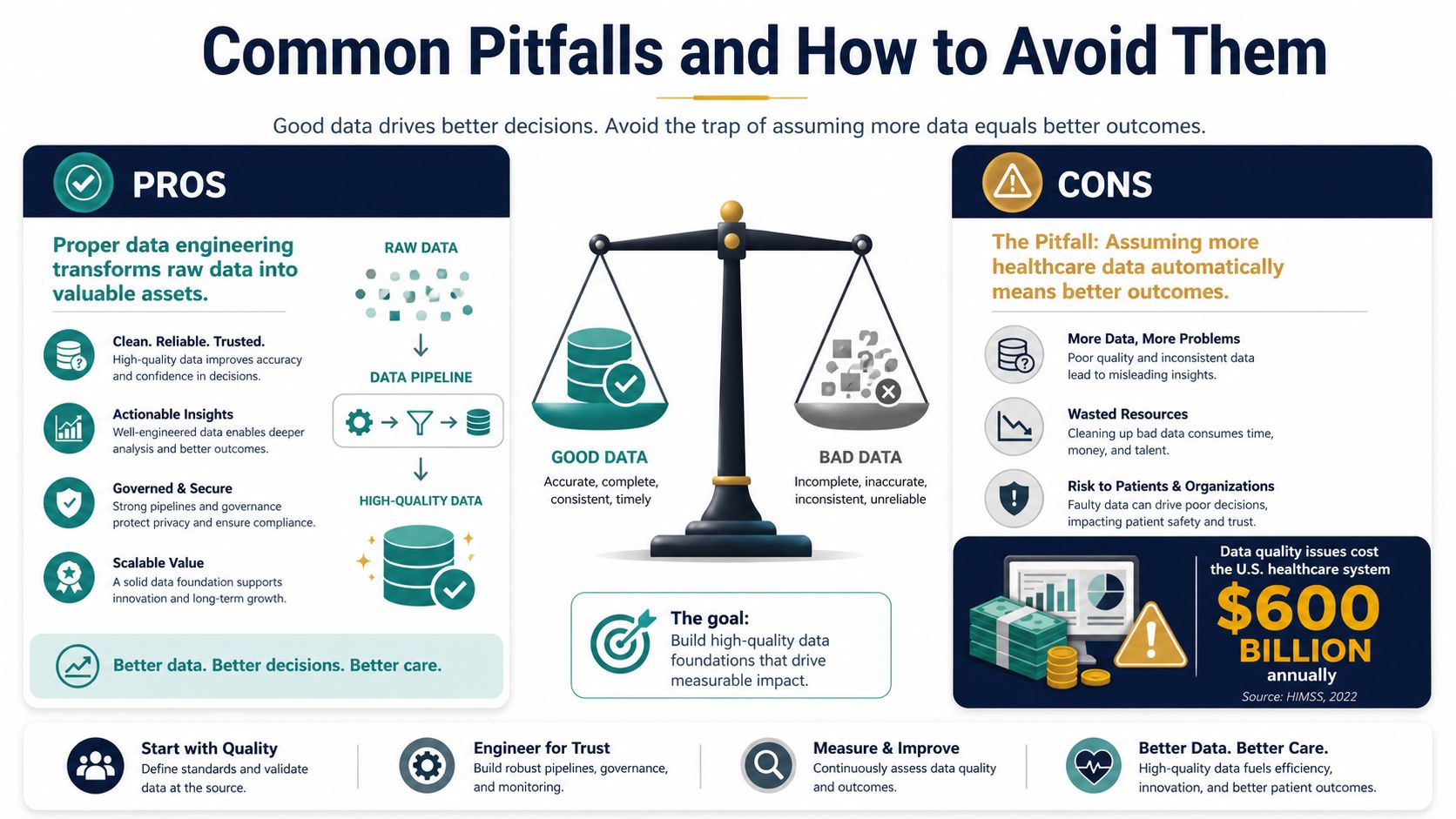
More healthcare data doesn't automatically mean better outcomes. In fact, poor data can create more risk, more manual work, and less trust, even when the pipeline looks busy. The economic signal is blunt. Data quality issues cost the U.S. healthcare system approximately $467 billion annually; 59% of healthcare datasets contain critical quality issues, and 61% of healthcare IT projects fail due to inadequate data engineering infrastructure.
The mistakes that create the most rework
A common failure is building pipelines without a canonical model. The team can move data fast, but every downstream consumer has to re-interpret it. Another is skipping terminology mapping, which turns one lab code, diagnosis, or medication into multiple inconsistent representations.
Under-investing in observability causes a different kind of pain. The pipeline appears healthy until a source schema shifts or a feed starts arriving late, and then the model or dashboard degrades before anyone notices. Treating governance as documentation creates a similar trap, because a PDF doesn't enforce access, lineage, or consent.
A platform becomes fragile when every source system gets its own exception.
Counter-moves that actually help
Build a canonical layer early: Normalize the most important entities first, so downstream teams stop rewriting the same logic.
Map terminology before scale: Align codes and definitions before you widen ingestion, or every new source adds more ambiguity.
Instrument for drift and delay: Put alerts around freshness, schema change, and null spikes so quality issues surface quickly.
Treat governance as executable: Make access, audit, and consent part of the platform, not a side policy.
Favor portability over one-off fixes: If a solution only works for one hospital feed, it'll break the moment the next customer uses a different source pattern.
Implementation Checklist and Next Steps
A strong first version of medical data engineering is usually built in layers. Start with the sources, then define the trust rules, then wire the pipelines, and only then move into ML and analytics. If a team skips the early steps, the later ones become expensive cleanup.
| Phase | Key Activities | Outcome |
|---|---|---|
| Data inventory | Map every clinical, operational, and device source, then classify data by structure and sensitivity | A clear picture of what exists and what's missing |
| Standards selection | Decide how FHIR, HL7, and terminology mappings will be used across systems | Shared language for exchange and normalization |
| Architecture design | Choose lake, warehouse, lakehouse, streaming, or feature store patterns based on latency and governance needs | A platform shape that fits the use case |
| Pipeline build | Implement ingestion, validation, CDC where needed, and transformation layers | Reliable data movement with traceability |
| Governance setup | Add access controls, audit logging, lineage, consent handling, and quality checks | Trustworthy, reviewable data operations |
| ML and analytics enablement | Create curated marts, versioned features, and reproducible data products | Safe inputs for dashboards and models |
A practical Monday-morning sequence
List the source systems first: You can't design trust rules until you know which systems produce the data.
Pick the canonical entities: Decide what a patient, encounter, lab result, and medication mean inside your platform.
Select the exchange pattern: Use the standards and architecture that fit the data's timing and volume.
Define data quality gates: Set rules for freshness, completeness, and terminology consistency before launch.
Add auditability from day one: Governance is cheaper when it's embedded in the build, not added after review.
Expose curated outputs only: Let analytics and AI consume trusted layers, not raw feeds.
If you're planning a first implementation, the question isn't whether you need more data. It's whether your pipeline can prove the data is trustworthy enough for the workflow that depends on it.
Bridge Global helps healthtech teams design and build the pipelines, integrations, and governed data layers that make clinical and AI workflows usable in practice. If you're planning a new platform or modernizing a healthcare stack, visit Bridge Global to discuss a delivery path that fits your source systems, compliance needs, and product roadmap.

About Preethi Saro Philip
Preethi Saro Philip is a Post Graduate Research Degree holder in Economics with more than 10 years of experience in writing, editing, research and teaching. She has an intense passion for content crafting and calls herself a ‘wordsmith’. She enjoys writing on wide-ranging topics including business, technology, health & lifestyle, education, environment etc.
View all posts by Preethi Saro Philip →