



Healthcare Analytics Engineering for Better Data Pipelines
Healthcare analytics engineering has moved from a niche reporting function into core infrastructure because the market was valued at $60.6 billion in 2023 and was projected to reach $187.7 billion by 2027. That scale matters less than what it signals: healthcare teams are no longer asking whether analytics belongs in production; they're asking how to build data pipelines that can survive compliance scrutiny, messy source systems, and clinical workflows that can't wait for broken dashboards.
The work is harder than generic data engineering because healthcare data is fragmented by design. EHRs, claims, wearables, imaging, genomics, and patient-reported inputs all land in different shapes, under different access rules, and with different clinical meanings StatPearls on healthcare analytics data sources. If you're building for a hospital network or a healthtech SaaS platform, the job isn't to warehouse data for its own sake. It's to turn operational and clinical signals into trusted, governed action.
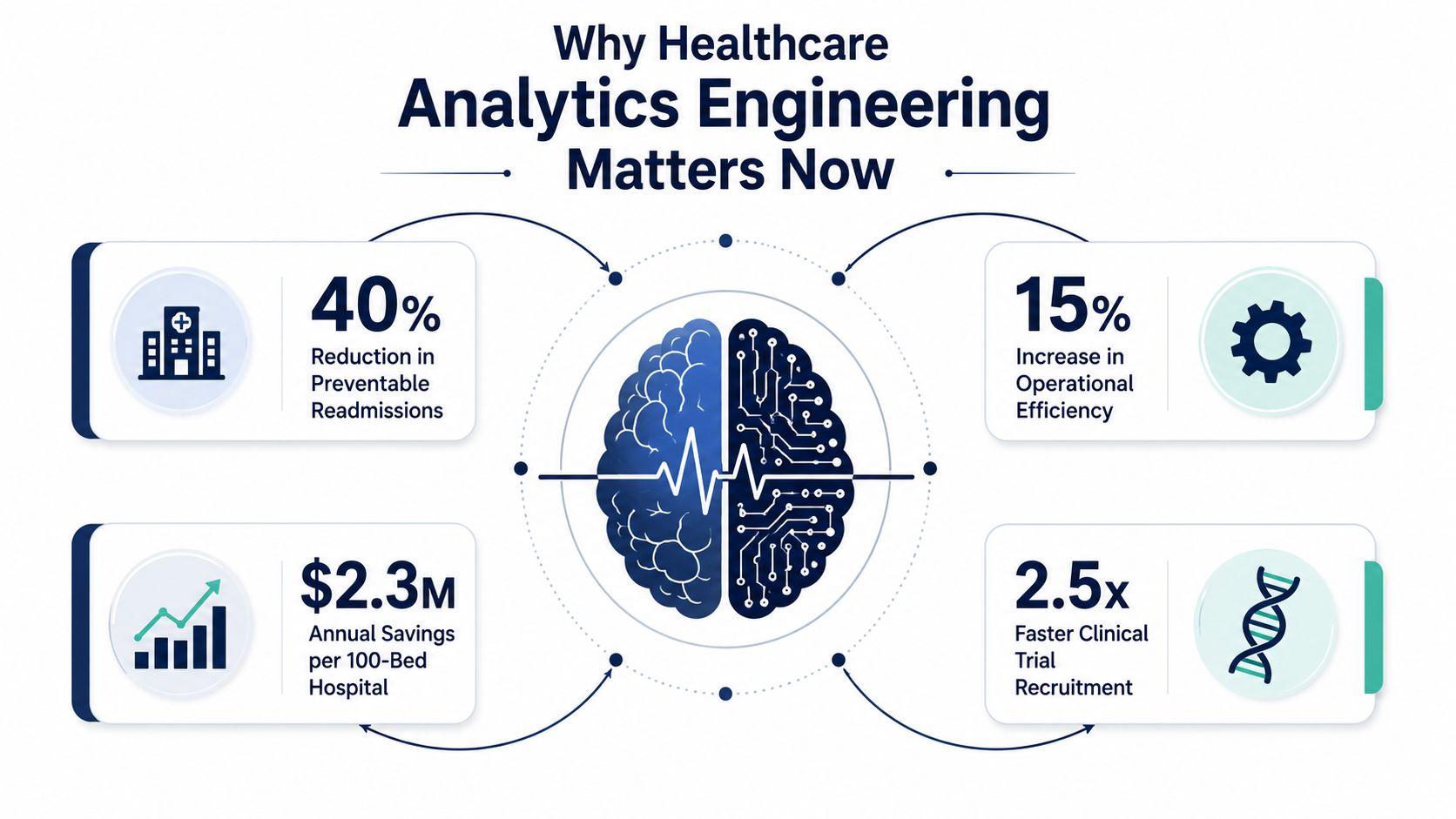
Why Healthcare Analytics Engineering Matters Now
Healthcare analytics was valued at $60.6 billion in 2023 and was projected to reach $187.7 billion by 2027. That growth points to a shift in how hospitals and healthtech teams use data. Static reporting is no longer enough. Teams need engineered pipelines that can support predictive care, operations, and value-based decisions without breaking under clinical and compliance pressure.
Pressure shows up in day-to-day work. A dashboard can summarize what happened, but it does not decide whether a deteriorating patient needs escalation, whether a care manager should intervene, or whether an operations team can trust the signal well enough to act on it. Healthcare analytics engineering closes that gap by turning operational and clinical signals into trusted, governed action. In practice, that means the data has to be usable inside care workflows, not just visible in a BI tool.
Why the role is different from generic data engineering
Healthcare analytics engineering has to handle compliance, interoperability, and decision support at the same time. A retail warehouse can absorb a few messy dimensions. A healthcare platform cannot treat patient identity, encounter timing, and clinical codes as casual implementation details. The pipeline has to preserve lineage, support audits, and still deliver analysis-ready data fast enough for care teams and operations staff to use it.
That is also why the work often crosses into operational education. A hospital management course from JAIN Online reflects how closely hospital operations, data, and care delivery now sit together. Teams that ignore that connection usually end up with clean tables and unusable workflows, or worse, metrics that look sound in a dashboard but fail once someone tries to act on them.
For teams deciding whether to build internally or work with a healthtech software development partner, the practical question is whether the data stack can support both clinical and financial use cases without turning every new metric into a custom one-off. That is the dividing line. Polished visuals are easy to buy. A governed pipeline that holds up in production, under audit, and inside clinical operations is the harder part.
Core Responsibilities of Healthcare Analytics Engineers
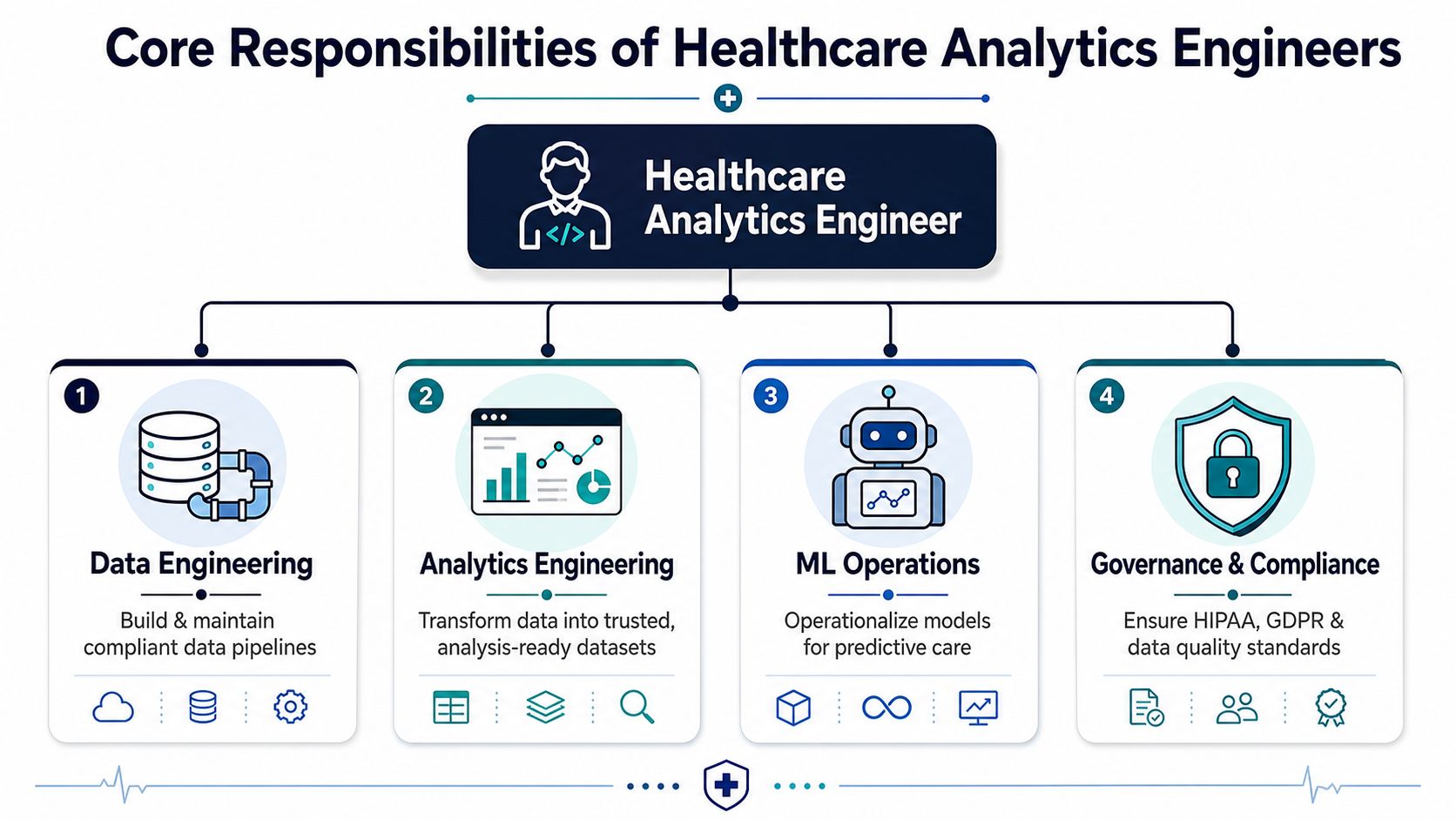
Healthcare analytics engineers work across data ingestion, analytics modeling, model operations, and governance, but the core job is closing the gap between descriptive dashboards and decisions that can be used in care delivery. In practice, that means moving between broken source feeds, metric definitions, test failures, and reviews with compliance or clinical stakeholders. The work is less about shipping one clean dataset and more about making sure insight can turn into governed action inside a workflow.
Data engineering and integration work
This is usually the first responsibility teams notice. It covers ingesting EHR, claims, wearable, imaging, and patient-reported data, then normalizing it so downstream teams can trust the output. In a startup, that might mean stitching together a few APIs and a warehouse. In an enterprise system, it often means reconciling legacy feeds, missing identifiers, and inconsistent timestamps across departments, while keeping the data usable for both operational reporting and care coordination.
The trade-off is straightforward. Faster ingestion gives product teams more data sooner, but a sloppy source inventory turns every downstream table into a moving target. Teams that do this well spend more time on contracts, schemas, and validation than on flashy transformations. That discipline pays off when a clinical leader asks why a patient cohort changed after a source refresh.
Analytics engineering and reusable models
The work becomes visible to BI teams when the engineer shapes raw operational data into stable, analysis-ready models. Those models let the same clinical metric appear in multiple dashboards without re-deriving it every time. Clean semantic layers matter because care leaders do not want three different versions of readmission, length of stay, or appointment delay.
A practical habit is to define metrics once, test them, and document their lineage before the first executive dashboard ships. That cuts the “everyone has a different number” problem before it starts. It also makes it easier to move from descriptive reporting toward prescriptive analytics, where the metric has to drive a specific decision in a care workflow.
ML operations and feature management
Healthcare teams often want predictive models, but they underestimate the support work behind them. Feature stores, offline and online feature consistency, and model monitoring all belong here when analytics is expected to feed predictions, not just reports. The engineering question centers on whether the same feature definition survives production drift and can be reproduced for review.
When a model cannot be reproduced from governed data, it should not sit inside a clinical workflow.
Governance and compliance
This responsibility does not belong in a separate drawer. Audit trails, lineage, access control, and retention policies need to be part of the pipeline design, not added after a review finds a gap. In healthcare, “we'll secure it later” usually means the team will rebuild it later under pressure.
For teams thinking in delivery models, a healthcare data modernization approach usually pairs engineering speed with explicit governance responsibilities. The right software development service models also matter, because healthcare analytics work crosses product, infrastructure, and compliance boundaries at once.
Architecture Patterns for Compliant Healthcare Analytics
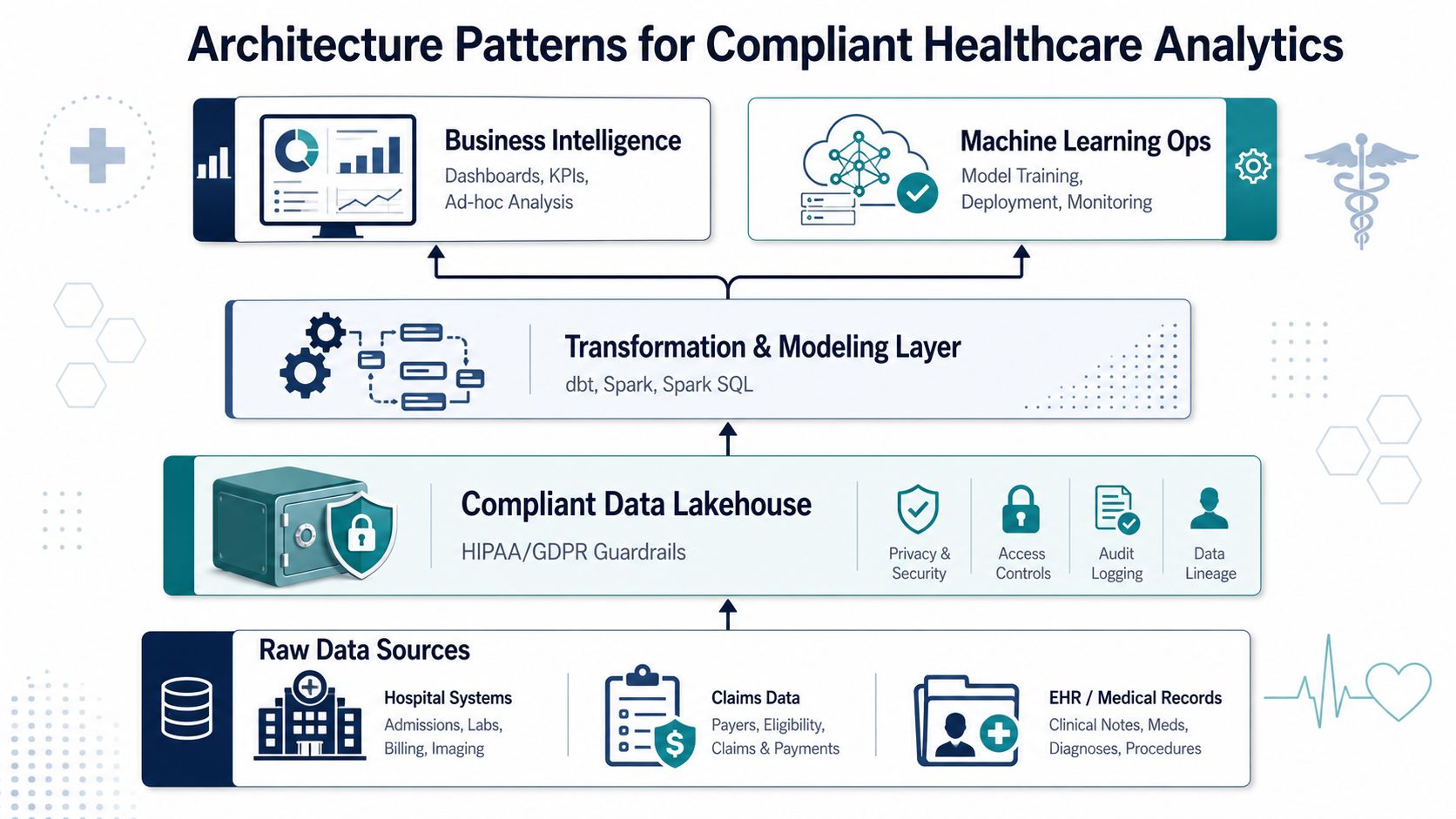
A healthcare analytics stack works better when the pipeline is split into layers. A single warehouse can hold a lot, but it should not be asked to do raw ingestion, transformation, governance, serving, and model support all at once. Layered design keeps raw clinical records auditable while still giving analysts and modelers stable data to work with. A value-based care platform example describes a raw lake, curated lakehouse, serving warehouse, and feature stores, with offline and online features plus model monitoring layered on top.
Why layer separation works in healthcare
Raw storage preserves source truth. Curated layers apply business logic, validation, and de-duplication. Serving layers expose the metrics that dashboards and operational users need. Feature stores sit beside the reporting stack so ML use cases do not recreate the same logic in notebooks and application code.
That separation matters when a metric changes. You need to know whether the break came from source data, transformation logic, or a downstream definition. Without that split, healthcare teams end up tracing production symptoms by hand, and that slows both reporting and model updates.
Where compliance controls belong
PHI controls belong at every layer that can expose sensitive records, not only at the edge. Encryption at rest and in transit is expected, but access policy design is where many teams stall. Analysts need speed, compliance needs restrictions, and the platform needs a clean record of who saw what and when.
In multi-tenant healthtech SaaS, hard isolation for customer data at the storage or schema level is often the safest pattern, along with tightly scoped serving views for reporting. In enterprise health systems, the pressure looks different. Shared infrastructure has to coexist with department-specific permissions and with stronger demands to harmonize data across business units.
What good sequencing looks like
The architecture example also points to a delivery sequence that works in production: KPI definition and source inventory first, then ingestion, curated schemas, predictive models, and governance automation. That order prevents a common failure mode: teams build models before they agree on canonical data.
If you are modernizing an existing stack, the right internal reading is healthcare data modernization, because the migration path usually matters more than the target diagram.
Tools and Integration Patterns for Healthcare Data
Healthcare analytics engineering lives or dies on integration choice. Some feeds are stable enough for batch processing. Others need near-real-time movement because the clinical or operational value drops once the data is stale. The mistake I see most often is forcing every source into the same ingestion pattern because one platform vendor promised simplicity.
The comparison below is a practical way to think about trade-offs.
| Pattern | Best For | Latency | Compliance Complexity |
|---|---|---|---|
| Batch ELT | Claims, historical EHR loads, finance marts | Higher | Moderate |
| API-first ingestion | Patient portals, partner apps, event-driven workflows | Lower | Moderate to High |
| Streaming pipelines | Monitoring, alerts, operational flags | Low | High |
| Integration engine passthrough | HL7, FHIR, and hospital interface feeds | Varies | High |
| Warehouse-centric transformation | Stable reporting and semantic layers | Batch or near-real-time | Moderate |
Picking the right tool shape
API-first ingestion works when source systems expose clean contracts, and the downstream consumer needs fresh data quickly. Batch still wins for a lot of healthcare reporting because it is easier to validate, replay, and audit. Streaming is useful, but it raises the operational burden fast, especially when events need deduplication or clinical reconciliation.
Tool choice should follow the integration architecture, not the other way around. A good overview of healthcare integration architecture helps teams decide where interface engines, orchestration, and transformation should sit in the pipeline.
For interoperability, HL7 FHIR is usually the first standard teams reach for, while imaging data often has to respect DICOM-specific handling. Claims data brings its own format quirks, and none of those sources should be treated as interchangeable.
What to avoid
Do not build every integration directly into your analytics warehouse. It is tempting, especially for smaller teams, but the result is usually brittle code and unclear ownership. A dedicated orchestration layer, transformation framework, and healthcare integration engine give you better recovery paths when a vendor changes a payload or a source starts dropping fields.
The practical choice set also affects product strategy. If you are building healthcare integrations, the safest answer is rarely “one connector for everything.” It is a controlled mix of ingestion, validation, and downstream contracts that fits the use case.
For teams adding analytics to a broader product roadmap, SaaS product development often becomes the right frame, because multi-tenant analytics and clinical workflows have to evolve together. If the stack needs predictive features, AI development services and enterprise AI solutions only work when the data layer is stable enough to support them.
Security and Compliance Controls in Practice
A lot of teams assume the cloud provider handles compliance once the data lands in a managed service. That’s not how healthcare works. Providers secure the platform, but your team still owns data classification, least-privilege access, audit logging, retention, and the way PHI moves across systems.
Healthcare analytics engineering also has to keep pace with governance obligations that don’t exist in the same form for generic BI. A review of big data analytics in healthcare points to six major application areas, including privacy protection and fraud detection, which is a good reminder that controls are part of the analytics mission, not an afterthought review of healthcare big data applications.
Controls that need to be built in
Encryption at rest and in transit should be baseline. Access control needs to map to roles that match how clinicians, analysts, and operations staff work. Audit logs should be detailed enough to support review, but not so noisy that nobody can use them.
De-identification is useful for analytics datasets, but it isn’t magic. If the downstream use case depends on linking patient journeys or validating outcomes, stripping too much context can destroy utility. The better pattern is controlled minimization: keep what the use case needs, remove what it doesn’t, and document the logic.
The GDPR and HIPAA balancing act
Under GDPR, data subject access and minimization force teams to think about delete, export, and consent workflows. Under HIPAA, the pressure often sits on disclosure, access, and traceability. In both cases, the engineering job is to make the policy executable, not to hope the policy doc will save a messy implementation.
Build policy into the pipeline, because manual review doesn’t scale once dashboards become operational tools.
If you’re setting governance direction, the healthcare data governance guide is worth reading alongside the control design work. It’s also where a broader AI implementation roadmap becomes relevant, since analytics and AI governance usually share the same data backbone.
Building Equity-Aware Analytics Pipelines
Collecting more data doesn’t automatically fix representation problems. In fact, it can hide them if the new data is uneven, noisy, or skewed toward the easiest-to-measure populations. Recent research on AI and analytics in underserved settings points to biased data sources, under-representation in training datasets, and geographic, gender, and socioeconomic disparities that can worsen inequities, according to recent equity-focused research.
A practical implementation usually starts with source review. Teams need to know which populations are missing, which fields are systematically blank, and where language or connectivity barriers are suppressing usable signals. In telemedicine and mobile health, weak connectivity and low digital literacy can create gaps that look like low demand but are low access.
What to validate first
Build validation checks around coverage, not just completeness. A dataset can be “full” and still under-represent a rural patient group or a non-English-speaking cohort. Stratified sampling checks help, but they should be paired with review of feature behavior across demographic slices.
Feature stores can help here if they preserve lineage and allow fairness-related checks before model training. That makes it easier to catch a broken upstream feed that disproportionately affects one region or care setting.
How the pipeline should behave
The pipeline should retain local-language usability where it matters, especially for patient-facing or care-navigation workflows. It should also surface when a model’s performance degrades for a subgroup, not after a clinician reports that the output feels wrong. That’s where monitoring, not just model training, becomes a fairness control.
I’ve seen teams make the mistake of assuming that a larger sample automatically means a better dataset. In healthcare, size without representation just creates a more confident version of the same blind spot.
Implementation Roadmap and Success Metrics
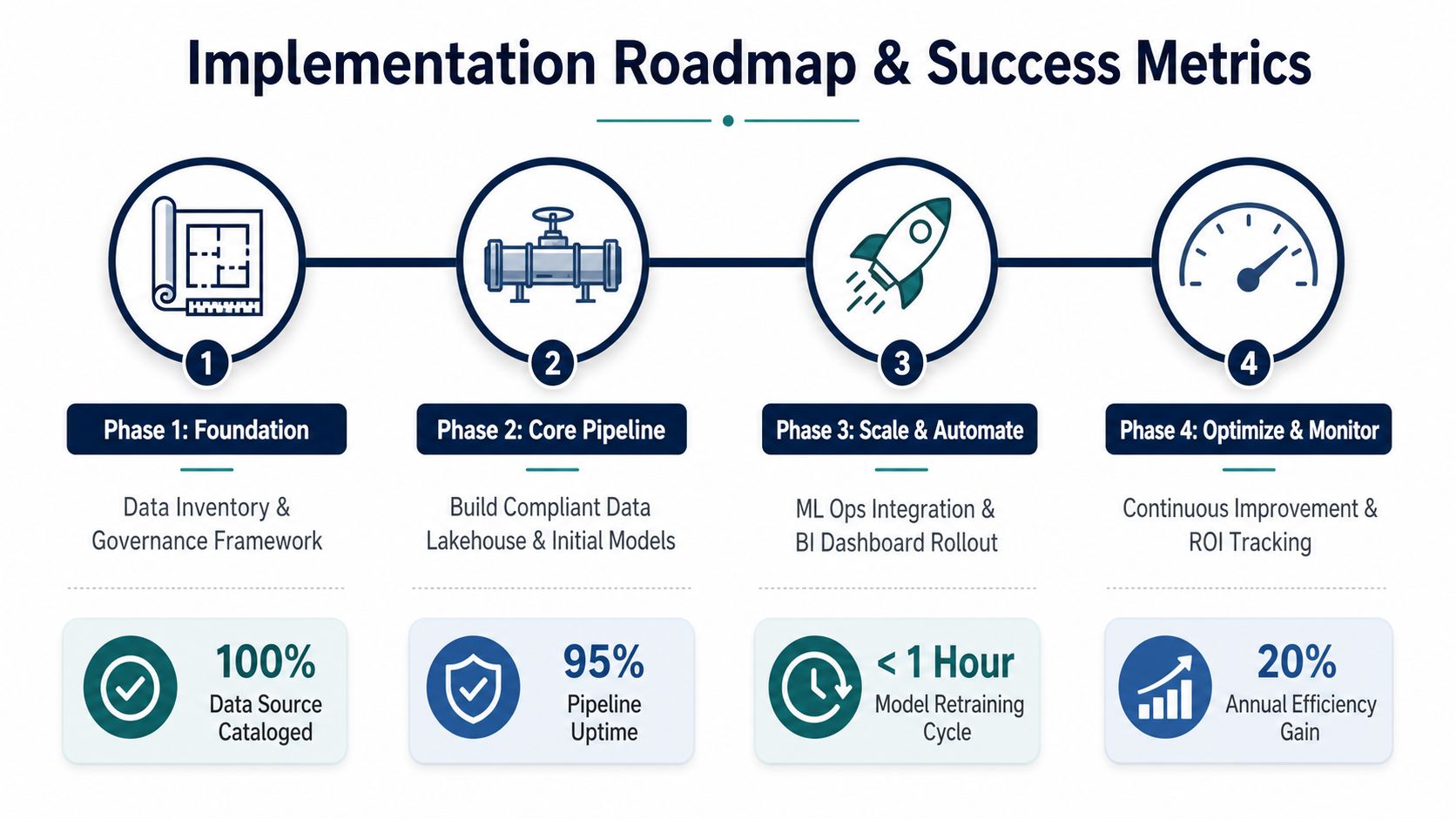
Healthcare analytics engineering works best when teams treat the roadmap as an operating plan, not a slide deck. The first job is source inventory and KPI definition. If stakeholders disagree on which metrics matter, the team will build the wrong marts, and once clinicians depend on the outputs, rework becomes slow and expensive. A phased rollout also lowers compliance risk because governance choices get embedded before the platform expands across departments.
Phase sequencing that holds up
Start with a catalog of data sources, owners, and use cases. Then build the compliant ingestion and curation layer before sending predictive models into production. After that, automate as much governance as the team can support, because manual approvals do not scale once the platform becomes a dependency. In practice, this order matters because care teams need governed signals inside their workflows, not just a model score sitting in a dashboard.
The best programs also define success metrics that reflect operational use. Data quality, uptime, retraining readiness, and audit readiness show whether the system can support clinical decisions, not just whether it looks polished.
What to measure
-
Data coverage and lineage, because every core source should be cataloged before the team claims readiness.
-
Pipeline reliability, because operational users notice failures before executives do.
-
Model usefulness, because predictive output only matters if care teams can act on it inside real workflows.
-
Compliance readiness, because audit pressure arrives when the platform is already live.
A client case review is often useful at this stage, not for copying a strategy, but for seeing how delivery patterns change by organization size and regulatory load. In many builds, analytics engineering and platform delivery sit in the same program, even if procurement or staffing splits them into separate workstreams.

About Upendra Jith
Upendrajith completed his Master's in English and has been a commercial content developer for the past three years. He's more inclined to develop content with a 'street-smart' delivery on topics such as technology, media, or anything he can get his hands on. He has a fixation on lyrics, dark poetry, media, technology, and flow arts.
View all posts by Upendra Jith →