

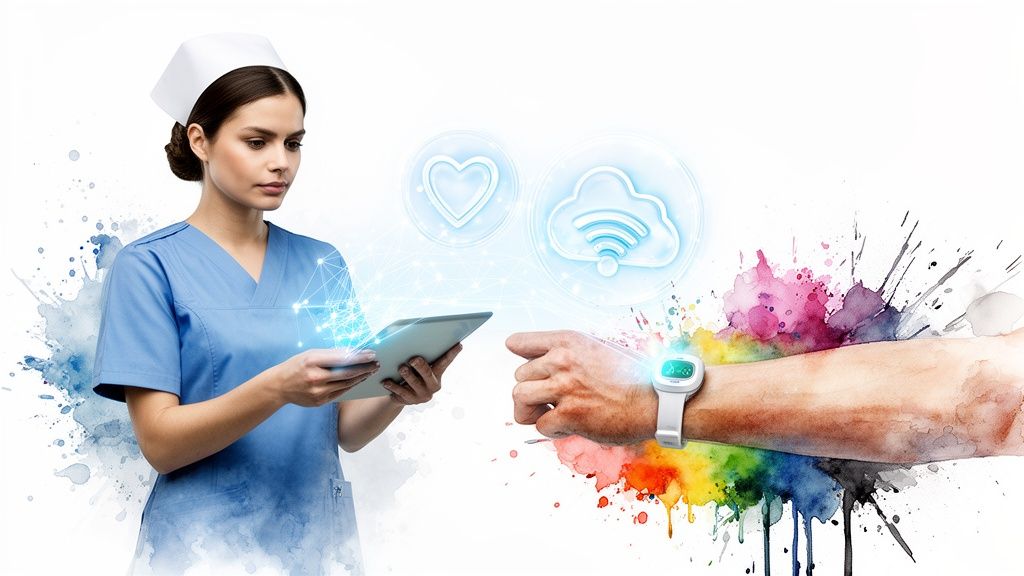

A Guide to Modern IoT Healthcare Solutions
At its core, IoT in healthcare is about connecting medical devices, sensors, and software to create a constant stream of real-time health data. This isn’t just about collecting information; it’s about fundamentally changing how we deliver care: moving from reactive, episodic treatment to proactive, continuous management of a person’s health.
The Digital Transformation of Patient Care
Picture a healthcare system that can see a problem coming before it becomes a crisis. That’s the promise of IoT healthcare solutions. It’s not science fiction anymore. We’re building this reality today by creating a kind of digital nervous system for the entire industry.
By linking devices as common as a fitness tracker to sophisticated in-hospital monitors, clinicians get a complete, ongoing picture of their patients’ health. This constant flow of data breaks down the traditional walls of a clinic, allowing care to follow patients right into their homes. It’s a huge shift from simply treating illness to actively promoting wellness.
This isn’t just a niche trend; it’s a seismic shift in the market. The global Healthcare IoT market is on an incredible growth trajectory, expected to surge from US$135.4 billion in 2026 to an astounding US$523.1 billion by 2033. That reflects a compound annual growth rate (CAGR) of 21.3%, with North America currently at the forefront. You can discover more insights about these market projections to see just how fast this space is moving.

Core Components of Modern IoT Healthcare Solutions
So, what actually makes up an IoT health ecosystem? It’s not just one thing, but a stack of technologies working together. To really grasp its power, you first have to understand the essential building blocks that collect, send, and make sense of all this health data.
Let’s break down these foundational pieces. The following table gives a quick overview of the essential components that bring any IoT healthcare solution to life.
| Component | Function | Example |
|---|---|---|
| Smart Devices & Sensors | The "things" that capture data directly from the patient or environment. They are the eyes and ears of the system. | Smartwatches, continuous glucose monitors (CGMs), smart inhalers, connected blood pressure cuffs. |
| Secure Connectivity | The communication layer that reliably transmits data from the device to a central platform. | Bluetooth, Wi-Fi, Cellular (4G/5G), Low-Power Wide-Area Networks (LPWAN). |
| Data Processing & Analytics | The central "brain" that ingests, stores, and analyzes massive volumes of raw data to find meaningful patterns. | Cloud platforms like AWS or Azure, data lakes, machine learning algorithms that predict health events. |
| Application & User Interface | The front-end where insights are presented to users, turning complex data into actionable information. | A physician's dashboard, a patient-facing mobile app, alerts integrated into an Electronic Health Record (EHR). |
As you can see, each layer has a critical job to do. Getting these complex systems to work in harmony is where the real challenge and opportunity lie.
Pulling this all together isn’t easy. It takes deep technical expertise and a solid understanding of the healthcare landscape. That’s why working with a skilled healthtech solutions partner can make all the difference, guiding the journey from initial idea to a fully deployed, life-changing solution.
Where IoT is Making a Real Difference in Healthcare
It's one thing to talk about connected devices in theory, but the real magic happens when you see them in action. IoT healthcare solutions aren't just a futuristic concept anymore; they're being used right now in hospitals, clinics, and even people's homes to save lives, make care more efficient, and give patients more control.
Let's look at some of the most powerful ways IoT is changing the game for patients and doctors alike.
Keeping an Eye on Patients, Remotely
Remote Patient Monitoring (RPM) is probably the most well-known use of IoT in healthcare, and for good reason. It tears down the walls of the traditional clinic, letting doctors keep tabs on patients with chronic conditions no matter where they are.
Think about someone living with diabetes. Instead of just relying on a few finger-prick tests a day, a tiny sensor, a continuous glucose monitor, can stream their blood sugar levels directly to their doctor's screen. If their levels start to dip or spike, the system can send an alert for immediate action. This isn't just convenient; it prevents emergencies and leads to better health in the long run.
This same idea applies across the board:
-
Heart Conditions: A patient wears a small ECG patch that spots an irregular heartbeat and instantly notifies their cardiologist.
-
High Blood Pressure: Smart blood pressure cuffs give a much clearer picture of a patient's health than a single reading at a doctor's office.
-
Asthma & COPD: Connected inhalers track when and where a patient needs their medication, helping doctors pinpoint triggers and fine-tune their treatment.
RPM helps medicine shift from putting out fires to preventing them in the first place. As we covered in our deep dive on remote patient monitoring solutions, this proactive approach keeps patients safer and takes a huge load off our busy hospitals.
Building Smarter Hospitals and Finding Lost Equipment
Inside the hospital, IoT is the key to a smoother, more organized operation. Every hospital struggles with a common, frustrating problem: finding things. Wheelchairs, IV pumps, and vital diagnostic machines seem to vanish when they're needed most.
IoT asset tracking is a simple but brilliant solution. By attaching small tags to equipment, staff can pull up a real-time map showing exactly where everything is. This ends the frantic searches, gets critical tools to the bedside faster, and saves a fortune by preventing equipment from getting lost or stolen.
But it goes beyond just tracking gear. Hospital rooms themselves are getting smarter. Smart beds can sense when a patient is trying to get up, monitor their vitals, and automatically alert a nurse if there's a risk of a fall. This kind of automation frees up nurses to focus on what they do best: providing hands-on, compassionate care.
The Next Wave: Advanced Wearables and "Smart Pills"
We've all seen fitness trackers, but the world of connected medical devices is evolving at an incredible pace. These devices are becoming smaller, more powerful, and seamlessly integrated into our lives.
Take ingestible sensors, for example. These are tiny, pill-sized monitors that can confirm if a patient has taken their medication. For conditions where missing a dose can be dangerous, like in mental health or with complex chronic illnesses, this is a massive breakthrough.
At the same time, new kinds of wearables can now detect faint physiological signals that might be the earliest warning sign of an infection or a flare-up of a chronic condition.
Each of these examples shows how IoT delivers tangible benefits to both patients and the people caring for them. Bringing these technologies to life requires a solid grasp of healthcare's strict demands, which is why partnering with experts in healthcare software development is so crucial for success.
Building a Secure Healthcare IoT Architecture
To get the most out of IoT healthcare solutions, you have to understand how all the moving parts connect and talk to each other securely. I like to think of it as a dedicated, four-lane highway built just for health data. Every vehicle is tracked, every route is secure, and information gets from a patient's home to a doctor's dashboard safely and on time.
The whole journey starts at the first layer, which is where the data is actually born.
The Device Layer: Where Data Begins
This is the physical foundation of any IoT system – the actual "things" collecting health data right from the patient or their environment. This layer is the sensory organ of the entire network. It's the point of first contact.
-
Wearable Sensors: These are the devices we're most familiar with. Think smartwatches tracking heart rate, continuous glucose monitors (CGMs) for managing diabetes, or smart patches that keep a constant eye on ECGs.
-
Stationary Devices: This bucket includes smart beds in hospitals that know when a patient gets up, connected infusion pumps that manage medication delivery, and the blood pressure cuffs people use in their own homes.
-
Environmental Monitors: In a hospital, these could be sensors tracking the temperature and humidity in rooms where sensitive medications are stored, ensuring they remain effective.
Every device in this layer is a starting point. They capture raw data points that, on their own, are just numbers. Their only job is to sense and report, creating that initial stream of information that feeds the rest of the system.
Connectivity and Cloud: The Data Superhighway
Once the data is collected, it needs to go somewhere. The Connectivity Layer acts as the transport network, using common technologies like Wi-Fi, Bluetooth, and cellular networks (including 5G) to carry the raw data from the device to its next stop.
That destination is the Cloud Layer, which you can think of as the system's central brain. This is where massive amounts of data from potentially thousands of devices are securely stored, sorted, and analyzed. Cloud platforms provide the heavy-lifting power needed to turn a flood of raw numbers into meaningful clinical patterns.
But this brings up a critical question: does all the data need to go to the cloud? For some things, processing data closer to where it's created, a concept called edge computing, is just plain smarter.
Edge vs. Cloud Computing: Here’s a simple way to look at it. Sending everything to the cloud is like shipping all your mail to a central post office across the country for sorting. Edge computing, on the other hand, is like having a local sorting station that handles urgent packages right away, cutting down on delays and network traffic.
For a time-sensitive alert, like a sensor detecting a patient's fall, edge computing allows the device to make an instant decision. For long-term trend analysis, the cloud’s immense processing power is exactly what you need. A well-designed architecture often uses a mix of both.
This diagram shows how different IoT applications, whether they're for monitoring, in-hospital use, or personal devices, all circle back to one thing: improving patient care.

The key takeaway is that no matter the device or setting, the end goal is always a more informed, proactive approach to keeping people healthy.
The Application Layer: Where Insights Drive Action
Finally, all that processed data reaches the Application Layer. This is the part of the system that people actually see and use: the dashboard on a clinician's tablet, the mobile app on a patient's phone, or the alert that pops up in an Electronic Health Record (EHR).
This is where the data truly becomes valuable. A cardiologist can now review a patient's heart rhythm history from the last three months without an in-person visit. A nurse gets an immediate alert that an IV pump is about to run dry. And a patient can see their own progress, empowering them to take control of their health.
Putting this entire four-layer system together isn't simple. It takes careful planning and deep technical expertise. Each layer must be secure, able to scale, and work flawlessly with the others. It’s exactly why many healthcare organizations partner with experts in custom software development to build a reliable and robust architecture that can truly support life-changing health outcomes.
Navigating Security and Compliance Challenges
In IoT healthcare, data is the lifeblood, but security is the heartbeat. If patients can’t trust that their most sensitive information is protected, even the most innovative technology is dead on arrival. Protecting that data as it moves from a sensor in someone's home to a doctor's screen isn't just a technical task; it's an absolute must for patient safety and legal compliance.
Think of it like running a digital armored truck service. Every single piece of data has to be shielded at every point in its journey. From the moment a device collects it to the second a clinician analyzes it, there can't be a single weak link. One vulnerability could bring the whole system down, with devastating results for patients and providers.
The Pillars of a Secure IoT Health Ecosystem
Building a fortress around patient data isn't about setting one big wall; it requires a defense strategy with multiple layers. This is far more than just setting a strong password. Real security has to be baked into the system from the very beginning, a principle known as privacy-by-design.
This approach means security is never an afterthought. It's a foundational element. Here are the core pillars that make it work:
-
End-to-End Encryption: Data must be scrambled and unreadable both when it’s traveling across a network (in transit) and when it’s sitting in a database (at rest). This ensures that even if someone intercepts the data, it’s just gibberish without the right key.
-
Secure Device Authentication: Every device trying to connect to the network must first prove it is what it says it is. This is like a bouncer checking IDs at the door, preventing unauthorized or fake devices from sneaking in and causing trouble.
-
Rigorous Access Control: Not everyone needs access to all information. Role-based access control ensures that doctors, nurses, and administrators can only see the specific patient data they need to do their jobs. This simple rule dramatically reduces the risk of an internal data breach.
Getting these measures right is a serious technical undertaking. As we’ve detailed in our guide on HIPAA-compliant software development, following the rules isn't just about ticking boxes on a checklist; it's about embedding a security-first mindset into your entire process.
Meeting Strict Regulatory Demands
Healthcare is, quite rightly, one of the most heavily regulated industries on the planet. Laws like the Health Insurance Portability and Accountability Act (HIPAA) in the U.S. and the General Data Protection Regulation (GDPR) in Europe establish strict, non-negotiable rules for handling Protected Health Information (PHI).
For IoT, this means every single device, every network connection, and every cloud server involved must meet these demanding standards. A single data breach can lead to fines costing millions, lawsuits, and a loss of trust that a healthcare organization may never recover from.
These regulations aren't set in stone, either. New laws are constantly being introduced to keep pace with technology. Staying on top of this shifting landscape requires constant vigilance and a deep understanding of both tech and healthcare law. This is exactly why working with an expert partner is so important. They know the terrain and can build solutions that are not just powerful but also compliant from the ground up, protecting you from risk and keeping patient confidentiality where it belongs: as the number one priority.
Turning IoT Data into Predictive Insights with AI
Think of healthcare IoT devices as tireless sentinels, constantly gathering a stream of vital signs and operational data. But on its own, all that data is just noise. The real magic happens when you add a layer of intelligence to make sense of it all. That's where Artificial Intelligence (AI) and Machine Learning (ML) come in.
AI is essentially the brain that interprets what the IoT network's senses are picking up. It can sift through massive, continuous data streams from countless sensors – an amount of information far too complex for any human team to analyze in real time. By spotting subtle patterns and correlations, AI turns raw data into life-saving predictive insights. This partnership is the very heart of modern IoT healthcare solutions.

From Reactive to Proactive Care
For centuries, healthcare has been reactive. A patient feels sick, they go to the doctor, and then treatment begins. AI-powered IoT flips that entire model on its head.
Picture an algorithm monitoring a cardiac patient's data from a wearable patch. It might detect a tiny, almost imperceptible change in heart rate variability – a change that often precedes a major cardiac event by hours or even days. Instead of waiting for an emergency, the system sends a proactive alert to the patient’s care team. This allows for early intervention that could prevent a costly and dangerous hospitalization.
This combination of IoT and AI doesn't just make things more efficient; it fundamentally changes the care paradigm. It allows clinicians to get ahead of health events before they become critical, personalize treatment plans on the fly, and manage chronic conditions with incredible precision.
Powering Intelligent Healthcare Applications
The fusion of AI and IoT data is already creating a new wave of smart health applications. These systems aren’t just collecting data; they're making intelligent decisions based on it. When designed well, this opens up a whole new world of capabilities.
-
Predictive Health Alerts: Sophisticated algorithms can analyze data streams from remote monitoring devices to predict the likelihood of events like sepsis in ICU patients, diabetic emergencies, or severe asthma attacks.
-
Personalized Treatment Plans: By analyzing how a patient’s vitals respond to different medications or therapies, AI helps clinicians fine-tune treatment plans in real time to get the best possible results.
-
Operational Efficiency: In a hospital setting, AI can optimize workflows by predicting patient admission rates, creating smarter staff schedules, and even anticipating equipment maintenance needs based on usage data from IoT sensors.
As we explored in our guide on the essentials of healthcare data engineering, building the right data infrastructure is the critical first step to making these advanced analytics possible.
Unlocking this potential requires specialized knowledge. Expert partners in AI development services are key for building, training, and deploying the complex machine learning models that make these systems tick. They can help you identify the best opportunities for integrating AI for your business, ensuring your IoT investment delivers truly game-changing results.
Your Roadmap to Implementing IoT in Healthcare
Bringing any new technology into a healthcare setting can feel daunting, but a structured approach can turn a complex challenge into a series of manageable steps. Think of it as a playbook for success. For IoT healthcare solutions, having a clear, phased roadmap is what gets you from a great idea to a functioning clinical tool without getting sidetracked.
This journey doesn't start with picking out gadgets and sensors; it starts with a clear-headed strategy. Before you even think about the tech, you need to nail down exactly what problem you're trying to solve. Are you trying to cut down on readmission rates for cardiac patients? Maybe you need to get a better handle on where your expensive medical equipment is at any given moment.
Setting clear, measurable goals is the most critical first step. A vague objective like "improve patient care" is nice, but it isn't actionable. A specific goal like "reduce patient falls by 15% in the orthopedic wing within six months" gives you a real target to aim for.
From Pilot Programs to Full-Scale Deployment
Once you know your destination, it's time to map the route. This next phase is all about choosing the right technology stack and running a tightly focused pilot program. A pilot is your chance to test the waters on a small scale. It lets you prove the concept works, iron out the kinks, and get real feedback from clinicians and patients in a low-risk setting. This step is absolutely essential for getting stakeholders on board and making sure the solution is actually user-friendly.
After a successful pilot, you can start thinking bigger. This is where you scale up the solution and weave it into your existing hospital systems, and honestly, it's where many projects hit a wall. Here’s what you need to focus on:
-
EHR Integration: Getting IoT data to flow cleanly into your Electronic Health Record (EHR) is a must. If doctors and nurses have to jump through hoops to see the information, they won't use it. The data has to be right there in their workflow, presented in a way that makes sense.
-
Scalability: The system you build has to be ready for growth. It needs to handle more devices and a ton more data down the road without slowing to a crawl.
-
User Training and Adoption: Great tech is useless if people don't know how or don't want to use it. A solid training plan for both clinical staff and patients is non-negotiable for making sure your new tools are actually adopted.
Designing for People First
Throughout this entire process, you have to keep one thing front and center: the people who will be using it. The technology has to feel natural, whether it's for a tech-savvy surgeon or an elderly patient managing their health at home. If a device is too complicated or a dashboard is confusing, it will just gather dust, and the entire project won't deliver on its promise.
Bringing a successful IoT solution to life often means finding a partner who gets the whole picture, from strategy to deployment. This requires deep expertise in both IoT software development and healthcare. Insights from our proven client cases show just how this kind of structured approach can deliver results you can actually measure.
FAQs on IoT Healthcare Solutions
What are the biggest hurdles in implementing IoT in healthcare?
The top three challenges are security, integration, and data management. Ensuring every connected device is secure and compliant with regulations like HIPAA is paramount. Integrating new IoT platforms with legacy systems, such as Electronic Health Records (EHRs), can be complex. Finally, managing the massive volume of real-time data generated by IoT devices requires a robust and scalable infrastructure.
How do you measure the ROI of an IoT healthcare solution?
ROI is measured through both quantitative and qualitative metrics. Quantitatively, you can track reductions in hospital readmissions, lower operational costs (e.g., less time spent searching for equipment), and improved staff efficiency. Qualitatively, benefits include higher patient satisfaction scores, better long-term health outcomes, and improved clinician morale due to streamlined workflows.
Can smaller clinics and private practices benefit from IoT?
Absolutely. IoT is not just for large hospitals. Smaller practices can implement focused, cost-effective solutions like remote patient monitoring for patients with chronic conditions or simple asset tracking for valuable equipment. The scalability of modern IoT software development makes it accessible for organizations of all sizes.
How does 5G technology impact IoT in healthcare?
5G is a significant enabler for advanced IoT healthcare solutions. Its high speed and ultra-low latency allow for the near-instantaneous transfer of large medical data files, like MRIs or CT scans. This paves the way for sophisticated applications such as real-time remote diagnostics, telerobotic surgery, and more reliable critical patient monitoring, where even a millisecond delay can be critical.
Ready to see how intelligent, secure technology can redefine patient care? Bridge Global is the expert healthtech solutions partner you need. We're here to guide you through every step of your IoT journey, from the first conversation to a full-scale, successful deployment.

About Upendra Jith
Upendrajith completed his Master's in English and has been a commercial content developer for the past three years. He's more inclined to develop content with a 'street-smart' delivery on topics such as technology, media, or anything he can get his hands on. He has a fixation on lyrics, dark poetry, media, technology, and flow arts.
View all posts by Upendra Jith →