



Healthcare Software Product Development: An Essential Guide
Six weeks before launch is when the truth shows up. The backlog looked clean in sprint review, then the details landed: HIPAA access reviews, FHIR mapping gaps, clinician questions about an AI triage feature, and a hospital security questionnaire that keeps circling back to identity, audit logs, and whether your team can prove who saw what, when, and why. That's the shape of healthcare software product development, the build isn't hard because the code is exotic, it's hard because the product has to survive the second half of the journey, where compliance evidence, interoperability, and clinical trust decide whether anyone keeps using it.
The market has already made the point for you. U.S. hospitals moved from fewer than 10% with a basic EHR in 2008 to 99% in 2018, and by 2024 hospital adoption stayed above 99%, while office-based physicians reached 91% certified EHR adoption and 95% any-EHR adoption. That means software is no longer a side tool in healthcare; it's the operating surface. If you're building in this space, the right question isn't whether to ship; it's whether you can prove safety, integration fit, and long-term maintainability after launch.
Why Healthcare Software Product Development Is Harder Than It Looks
A founder I'd rather not be on Slack with is six weeks from launch, and every thread is a different kind of pain. One message is from compliance asking about account lockout and remote access controls, another is from the integration lead who can't finish the FHIR mapping, and a third is from the clinician advisory board asking whether the AI triage screen will create unsafe overconfidence. That is the actual shape of healthcare software product development.
The build is only half the battle
Teams budget for the code and underbudget for everything that makes the code acceptable in a hospital. Layered regulation means HIPAA, FDA scrutiny where relevant, lifecycle controls, and jurisdiction-specific privacy rules all have to coexist. Identity-bound data means the system has to know exactly which workforce member or practitioner touched protected health information, and security guidance expects controls like unique user accounts, role-based access control, MFA for remote access, session timeouts, and lockout after failed logins.
The other two forces are less obvious and more damaging. Life-critical UX tolerance is low, because clinicians will not forgive screens that slow them down or create alert fatigue. Procurement gates are brutal because buyers want a product that fits the workflow, the security review, and the reimbursement reality. That is why a shiny v1 is cheap compared with an OCR audit, a state Medicaid review, or a hospital security questionnaire six months later.
Practical rule: If a decision affects patient data, clinical decisions, or system access, assume it will be examined later by security, compliance, and a clinical buyer.
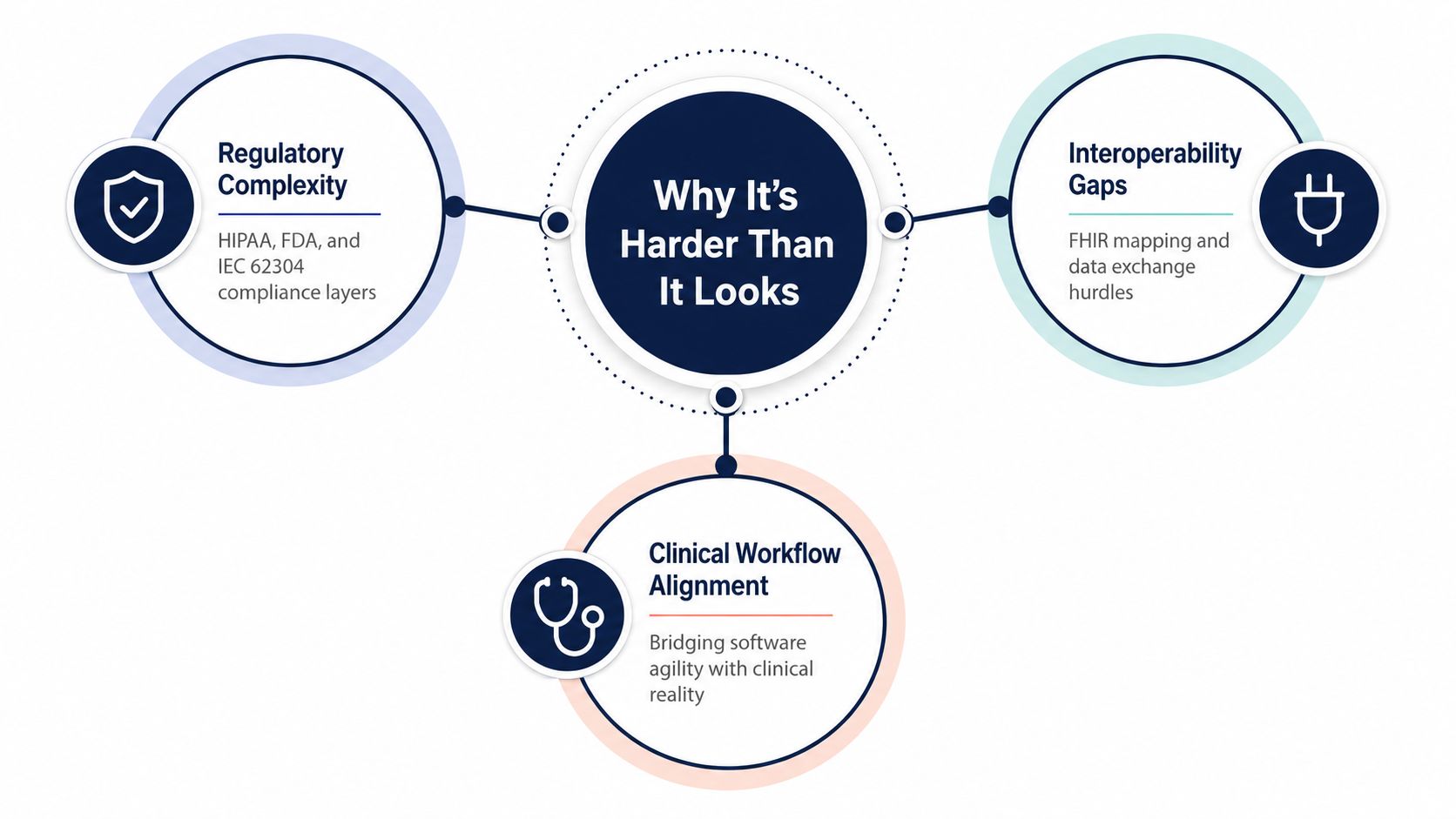
A clean product team treats launch as the midpoint, not the finish line. That mindset keeps the backlog from turning into expensive rework once auditors, integration teams, and hospital admins get involved.
Discovery, Requirements, and Regulatory Mapping
Discovery in healthcare is where product teams decide whether a build will ship cleanly or drown in compliance debt later. Every user story needs a requirement ID, and every requirement needs a clear path back to a regulatory citation or policy control. Reorgs, vendor swaps, and audit requests will break anything less disciplined.
Map the problem before you map the build
Start with the actual use case, then classify the software against the framework it belongs to. If a feature handles patient data, HIPAA and privacy obligations apply immediately. If it touches EU patient data, GDPR Article 9 matters. If it behaves like medical device software, IEC 62304 sets the lifecycle expectations, and if it drives diagnosis or treatment, FDA SaMD thinking has to shape intended use and the claims you make.
Product marketing should not write the intended use statement after engineering has already committed. That move creates mismatched documentation, and mismatched documentation creates rework. A modest first release with clean jurisdiction mapping is easier to defend than a clever product that cannot answer a regulator's question.
Here's the discovery week checklist I'd insist on:
Clinician interviews: Capture the workflow in practitioner language, not product jargon.
Data classification: Identify PHI, operational data, and any research or model-training data separately.
Intended use statement: Write what the software does, and what it explicitly does not do.
Jurisdiction matrix: List every geography and rule set the product has to satisfy.
Draft safety class: Assign a preliminary software safety class before architecture hardens.
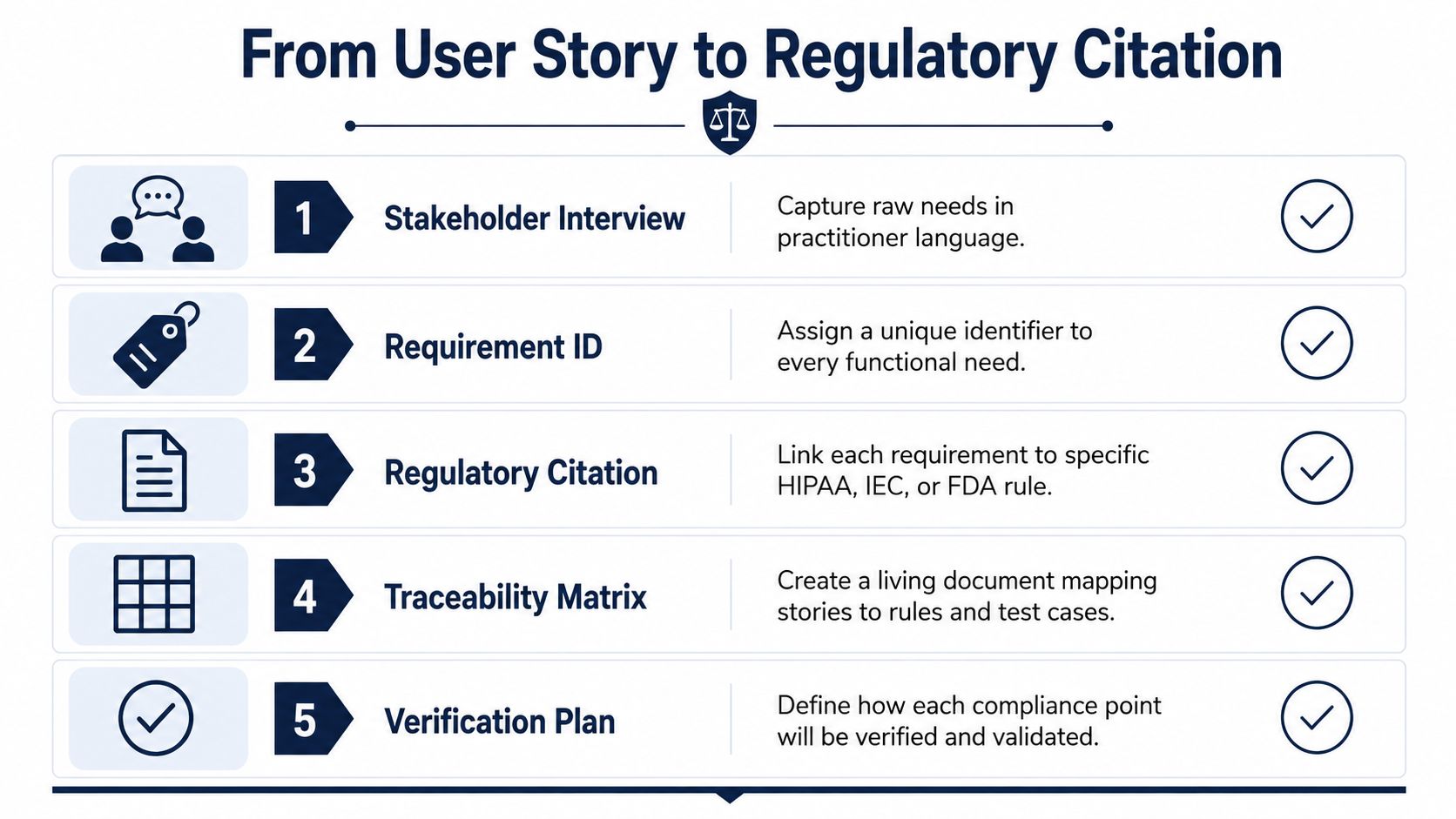
If your feature set includes model-based decision support, the EU AI Act compliance roadmap is a practical reference for adjacent AI governance planning.
Writing requirements with a regulator in mind produces defensible work. Writing them as feature wishlists creates future audit repair work.
Secure Architecture, PHI Controls, and Healthcare Integrations
Auditors and security officers ask the same questions in different words. Who can access the data, how is it encrypted, how do you verify the identity behind each action, and what happens when systems fail or data moves between old and new platforms. If your architecture cannot answer those questions cleanly, the rest of the stack does not matter.
Identity is the spine
For PHI, the baseline is blunt. Use unique user accounts, role-based access control, multi-factor authentication for remote access, session timeouts, and account lockout after failed logins under HIPAA security guidance. Then make identity the spine of every transaction. Every FHIR call should carry verified practitioner context, because audit trails only help when you can trace a specific action back to a real person.
Modern integrations usually split into two lanes. HL7 v2.x still shows up in legacy EHR feeds, often over MLLP, while FHIR R4 and R5 are the API-era interoperability layer for clinical systems. If you are building modern clinical workflows, design for both, because hospitals rarely retire the old stack before asking your product to work with it.
The ONC interoperability guidance for AI makes the security bar sharper. Scope which FHIR resources, code systems, and time windows AI can access, then use OAuth2/OpenID identity, TLS encryption, and audit logging so the AI's actions are attributable and reviewable. Paperwork aside, this keeps an AI-enabled workflow from becoming an invisible data mover.
| Integration Standards at a Glance | Use Case | Engineering Implication |
|---|---|---|
| HL7 v2.x | Legacy EHR feeds and older hospital interfaces | Build parsers, message queues, and resilient retry logic |
| FHIR R4 | API-based interoperability for modern clinical systems | Design versioned REST APIs and resource-level access control |
| FHIR R5 | More advanced API patterns, bulk data, and emerging AI-adjacent workflows | Plan for stricter resource scoping and stronger contract testing |
If you are evaluating cloud architecture patterns for regulated products, this guide to healthcare cloud architecture is the right companion piece.
Keep regulated workloads isolated. Training environments should never drift into production PHI by convenience, and deployment artifacts should be signed and reproducible so a release can be reconstructed years later during an investigation.
For document-heavy workflows, the guide to HIPAA-compliant document sharing is worth bookmarking. It fits teams that think they only need storage, then discover they need governed exchange.
| Control Area | What Auditors Probe | What Good Looks Like |
|---|---|---|
| Identity | Who accessed the record and whether access matched role | Named accounts, scoped permissions, MFA, and session controls |
| Data flow | Where PHI moved and why | Clear system boundaries, encrypted transport, and audit logs |
| Integration | Whether legacy and modern systems exchange data safely | HL7 v2.x where needed, FHIR where possible, contract tests everywhere |
| Release hygiene | Whether a change can be reproduced | Signed builds, immutable logs, and traceable deployment records |
This is the part of the stack that pays off two years after launch, when a customer asks for proof instead of promises.
AI Features as a Regulated System Behavior
Treating AI as a feature is the fastest way to create a compliance blind spot. Treating AI as a regulated system behavior changes how you design it, test it, and monitor it after launch. The model is not the product; the governed behavior around the model is the product.
Build the lifecycle, not just the model
Start by classifying the feature under IEC 62304 software safety thinking, then decide whether the output drives clinical decisions. If it does, use the relevant FDA SaMD and IMDRF risk framing before anyone promises outcomes to sales or investors. Capture the intended use, target population, and clinical claims in a model card that auditors can trace back to requirements and validation evidence.
Data lineage is essential. You need provenance from ingestion to inference, consent flags, labeling QA, bias checks, and a documented training-validation-test split. If the team can't explain where a training row came from or why a label was accepted, that model isn't ready for regulated release.
Release gating should be boring. Lock model artifacts, run shadow evaluations, define acceptance thresholds before the build starts, and require signed validation reports before production exposure. Then operate the model like software with a clinical footprint, because that's what it is.
Monitoring is part of the product
Post-launch monitoring can't be an afterthought. Watch input drift, output drift, and fairness slices across relevant demographics. Add a human-in-the-loop override path, then write those interventions back into the audit log so you can explain what happened later.
The EU side adds more structure. If you're operating there, run conformity assessment against the AI Act and align DPIA obligations under GDPR. That combination forces privacy and model governance to sit in the same delivery pipeline instead of being handled by separate teams in separate meetings.
Hard rule: If a clinician can't tell whether the model output is advisory, deterministic, or out of scope, the feature isn't ready.
A lot of teams think AI governance slows shipping. In practice, it's the opposite after the first release, because the team stops arguing about whether a model can be trusted and starts arguing about the actual product problem.
QA, Validation, and Audit-Ready Delivery
Validation is where healthcare projects get exposed. Teams will demo a polished UI, then find the traceability matrix does not line up, the change history is incomplete, or the release artifact cannot be rebuilt from the pipeline. Teams that miss that point usually have a delivery discipline problem.
Change control is the highest-risk step
The medical software recall data makes the point clearly. 7.7% of 3,140 FDA recalls from 1992 to 1998 were attributable to software failures, and 79% of those software-related recalls were introduced after software upgrades. Every patch needs impact analysis, regression scope, re-validation evidence, and an authorized approver before production.
The best teams tie each user need to a requirement, each requirement to a test, and each test result to a release artifact. They keep signed commits, immutable build logs, SBOMs, environment hashes, and time-stamped deployment records in the pipeline itself. Auditors do not care about pretty screenshots if they cannot reconstruct the release path.
| Validation Practices Compared by Risk Posture | Low-Risk Wellness Software | Regulated Health Software (HIPAA + IEC 62304) | SaMD or AI-Clinical Decision Support |
|---|---|---|---|
| Traceability | Helpful but lightweight | Bidirectional matrix across needs, requirements, tests | Full lifecycle traceability, including model or algorithm changes |
| Testing | Functional and performance checks | Unit, integration, security, usability, and clinical scenario testing | Formal verification, validation evidence, and release gating |
| Change control | Basic versioning | Impact analysis and approved regression scope | Strict configuration management and re-validation after every material change |
| Audit trail | Standard logs | Immutable records, build history, deployment evidence | Reconstruction-grade evidence and CAPA feedback loops |
If you need a broader vendor-side reference, the HIPAA-compliant software development guide is a useful complement to the validation mindset.
Health systems also check identity, access, and evidence handling. That means device and user identity, role scope, log retention, and incident response need to be in place before anyone calls the system audit-ready. If those controls are weak, validation records will not save you.
Auditors reward discipline they can reconstruct, not dashboards that only look green on demo day.
That is why I push teams to test the product the way a regulator or hospital security lead will inspect it. If you cannot explain the release, you do not really own it yet.
Clinical UX, Interoperability, and Adoption Reality
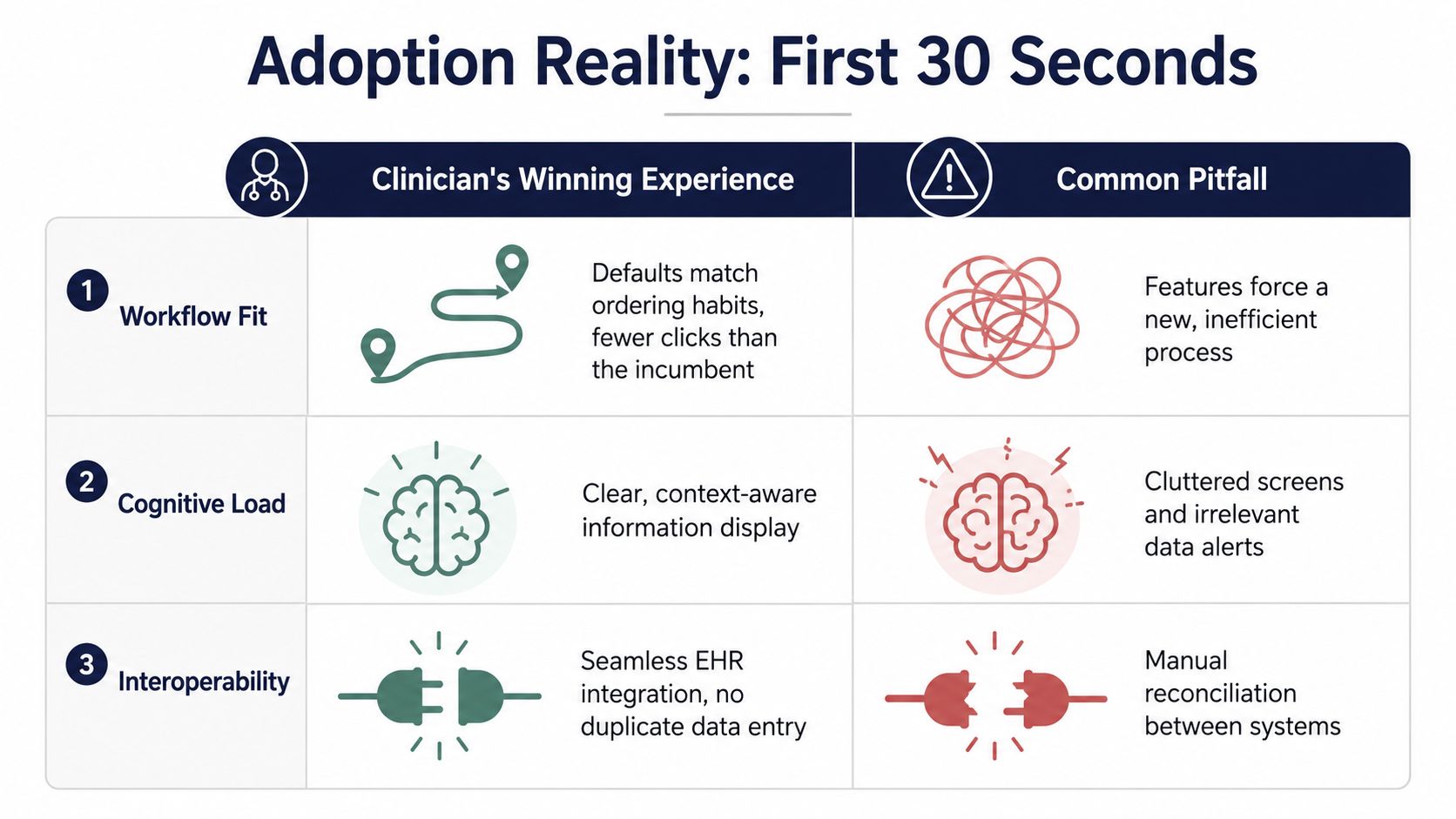
Adoption is decided fast. A clinician gives your product a few seconds, maybe less, and the verdict usually has nothing to do with feature count. It comes down to whether the tool fits the workflow, reduces clicks, and respects how the person already works.
Workflow fit beats feature depth
If your default settings don't match ordering habits, you've already created friction. If your alerting floods the screen with noise, clinicians will tune it out, and if your interface forces duplicate entry between systems, it becomes another administrative burden instead of a helper. Reimbursement reality matters too, because products that don't fit payer pathways or billing logic struggle to earn priority in procurement.
Interoperability is the price of admission. Use HL7 v2.x for legacy feeds and FHIR R4 or R5 for modern APIs, and align with ONC interoperability rules, including USCDI v4 data classes and the §170.315(g)(10) standardized API criterion. Add SMART on FHIR launch patterns so the app enters the EHR cleanly, and use CDS Hooks or a comparable pattern when decision support needs to show up at the point of care.
Identity and consent can't be bolted on after launch. Clinician SSO should carry proper scopes, patient-mediated exchange needs a clear consent path, and every access decision should be understandable when someone reviews the chart later. The product that survives procurement usually wins one workflow so completely that replacing it becomes harder than keeping it.
One useful pairing for this conversation is the SaaS product development page, because many healthtech products now live as workflow software rather than standalone tools.
If the product makes clinicians slower, they'll route around it.
That's the blunt reality. Build for the first 30 seconds of use, then keep building for the next 30 days of integration and habit formation.
Partner Models, Offshore Delivery, and Outcome Metrics
The choice between in-house, onshore, and offshore hinges on regulatory accountability, feedback speed, and audited delivery cadence, not geography. In healthcare software product development, the wrong model slows approvals, weakens traceability, and makes every release harder to defend later. The right one turns delivery into part of the control system.
What the operating model has to prove
In-house teams give direct control and shorter decision loops, but they are costly to scale and hard to staff across compliance, FHIR, and AI. Onshore vendors reduce communication friction and usually fit high-touch programs. Offshore pods can work very well when they are built for regulated delivery. That means BAA eligibility, segregated environments, audit log retention, a named QA lead, and a release engineer who gates production.
That structure matters even more once AI enters the product. Model governance has to sit with the delivery team, because MLOps failures do not care which time zone wrote the code. A good partner scorecard should look at compliance maturity, HL7/FHIR depth, MLOps capability, and evidence from SaMD or HIPAA work.
| Scoring Offshore AI-Enabled Healthtech Delivery Partners | In-House Team | Onshore Vendor | Offshore AI-Enabled Pod |
|---|---|---|---|
| Regulatory accountability | Direct ownership | Shared ownership with easier coordination | Needs explicit RACI and contractual controls |
| Integration depth | Strong if specialists are hired | Usually strong in discovery and implementation | Must prove HL7/FHIR implementation discipline |
| AI delivery | Good if ML talent is retained | Good for managed delivery | Strong if model governance and QA are embedded |
| Delivery cadence | Fast internally, limited by headcount | Predictable with close oversight | Strong when pods are isolated and release-managed |
If you are staffing flexibly, the Hire Latin American virtual assistants page is a useful reminder that distributed delivery only works when roles and accountability are clear. The same rule applies to regulated engineering pods. For teams that want a closer look at how to structure them, offshore software development teams for regulated products is the relevant internal reference.
Bridge Global also fits naturally here as a healthtech software development partner and a provider of custom healthcare software development, custom software development, software development service models, AI development services, enterprise AI solutions, AI implementation roadmap, healthcare integrations, and SaaS product development when a team needs one delivery partner that can cover product discovery, AI, integration, QA, and scaled engineering under one operating model.
Metrics that survive a board review
Choose outcomes that reflect the business, not vanity throughput. Track deployment frequency to production-like environments, mean time to remediate audit findings, model drift detection latency, clinician task completion time, and the 90-day defect escape rate. Then tie each metric to a contract clause so the partner is accountable for delivery quality, not just capacity.
Use client cases to verify whether a provider has shipped in environments that look like yours, not just adjacent industries. If you want all of this inside one partner conversation, Bridge Global also offers a consultative engagement model that spans discovery, architecture, delivery, and ongoing support.

About Preethi Saro Philip
Preethi Saro Philip is a Post Graduate Research Degree holder in Economics with more than 10 years of experience in writing, editing, research and teaching. She has an intense passion for content crafting and calls herself a ‘wordsmith’. She enjoys writing on wide-ranging topics including business, technology, health & lifestyle, education, environment etc.
View all posts by Preethi Saro Philip →