



Healthcare Software Modernization: A Roadmap for Clinics
When we talk about healthcare software modernization, we’re not just talking about a simple tech refresh. It’s the critical process of overhauling or replacing outdated systems so they can actually meet today’s standards for technology, patient care, and a mountain of regulations. Think of it less as an upgrade and more as a strategic pivot – one that boosts performance, tightens security, and keeps a healthcare organization relevant and effective.
Why Modernization Isn’t Optional Anymore
Healthcare providers are getting squeezed from all sides by rising operational costs, serious labor shortages, and patients who expect a modern, digital experience. Against that backdrop, modernizing your software stack stops being a “nice-to-have” IT project and becomes a core strategy for survival.
Clinging to legacy systems is a silent killer. It quietly racks up massive operational and security risks that eventually hamstring your ability to connect systems, share data, and deliver quality patient care. These old platforms just can’t keep up with the sheer volume of data today, let alone integrate with modern tools or fend off sophisticated cyberattacks. The result? Frequent slowdowns, frustrating crashes, and clunky workflows that burn out your staff. Meanwhile, the cost of just keeping these old systems running balloons, eating up funds that should be going toward innovation.
Read an insightful piece about the necessity of legacy application modernization, here.
The Real Cost of Doing Nothing
Putting off modernization doesn’t just kick the can down the road; it creates a domino effect of problems that ripple out far beyond the IT department. Over time, these issues pile up and create a significant drag on the entire organization.
- Gaping Security Holes: Outdated software is a sitting duck for data breaches because it’s often no longer supported with security patches. A single breach can lead to staggering financial penalties under regulations like HIPAA, not to mention the complete erosion of patient trust.
- Compliance Nightmares: Legacy systems were never built for today’s complex regulatory world. Trying to retrofit them to meet ever-changing compliance rules is often impossible, exposing you to serious legal and financial heat.
- Crippling Inefficiency: Nothing kills productivity and morale faster than clunky, slow, and unintuitive software. In fact, a study of one major legacy system found that a staggering 75% of its users felt it actively prevented them from being efficient at their jobs.
- Blocked Innovation: You can’t run the tools of tomorrow on the technology of yesterday. Old systems simply can’t support AI-powered diagnostics, telehealth platforms, or the kind of advanced data analytics that truly move the needle on patient outcomes.
A smart, well-executed modernization plan is the only way to build a resilient, future-proof healthcare ecosystem. It clears out years of technical debt and sets your organization up to adapt and win.
The first step to legacy system modernization is always building a rock-solid case for why action is needed now before getting into the “how.” Working with an experienced AI solutions partner can provide the specialized expertise needed to guide this complex but essential journey, ensuring the final result serves both your clinicians and your patients.
Check out how we successfully modernized a legacy application of a global company based in Canada.
Charting Your Modernization Course
A successful healthcare software modernization project never starts with code. It begins with a brutally honest assessment of where you are right now. Before you can even think about a roadmap, you have to understand the terrain. This initial discovery phase is all about digging deep into your existing systems to unearth technical debt, pinpoint exactly where your scalability limits are, and flag any compliance gaps with regulations like HIPAA.
This isn’t just an IT checklist. For CTOs and CIOs, the real goal here is to connect every single technical change to a measurable business outcome. Modernization for its own sake is a fantastic way to burn through a budget. But modernization that improves patient throughput bes billing errors? That’s a strategic investment. This deep dive helps you build a rock-solid business case, y 15% or slashget crucial stakeholder buy-in, and define the KPIs that will actually tell you if you’re succeeding.
Auditing Your Current Technology Stack
A thorough audit moves the conversation from vague feelings to hard data. You stop saying, “we feel our system is slow,” and start saying, “our EHR’s database query time balloons by 300% during peak hours, which directly delays patient record access.”
Your audit should get specific and cover these key areas:
- Performance Bottlenecks: Where are the choke points? Pinpoint the exact processes that are slow, crash-prone, or make clinical staff want to throw their keyboards.
- Technical Debt Analysis: Put a number on the “cost” of rework caused by messy code, rickety architecture, or nonexistent documentation. High technical debt means even small changes become risky, expensive ordeals.
- Scalability Limitations: Be realistic. Can your current infrastructure handle a sudden spike in telehealth appointments? What about a 50% increase in patient data over the next two years?
- Security and Compliance Gaps: Run a tough audit against current HIPAA, HITECH, and other regulations. Are you running on unsupported operating systems or sitting on unpatched vulnerabilities?
The pressure to modernize is only getting stronger. A 2026 Black Book Global Healthcare IT Survey found that 65% of hospitals in fast-adopting markets are already overhauling their EHR/EMR systems, primarily driven by government mandates for better interoperability. This just goes to show how urgent it is to move away from siloed legacy systems.
The insights you gather here are the bedrock of your entire plan. As we’ve explored in our guide on building a digital transformation strategy, you simply can’t build a successful future without a crystal-clear understanding of your present.
This flow chart neatly illustrates the core drivers: costs, risks, and rising expectations – that push organizations to finally take on modernization.
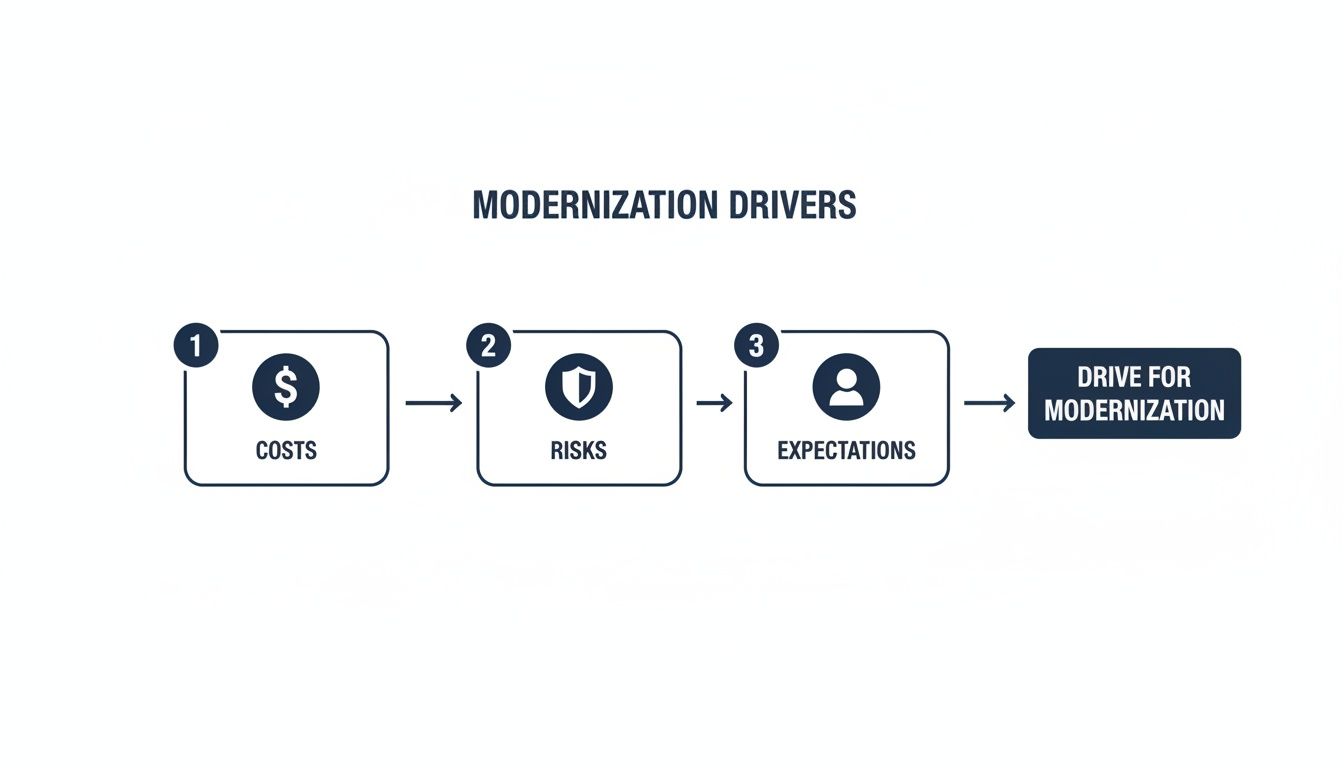
As you can see, it’s a balancing act. You’re responding to financial pressures, shoring up security vulnerabilities, and trying to meet the growing demand for a better digital experience from both patients and your own staff.
Choosing Your Modernization Approach
With your assessment complete, it’s time to pick your strategy. Not every application needs to be rebuilt from the ground up. The smart move is to match the approach to the system’s business value and its technical condition.
Choosing the right strategy is a balancing act. You must weigh the speed and lower cost of simpler approaches like rehosting against the long-term strategic value of a complete replacement. A hybrid approach is often the most practical solution for a complex application portfolio.
To help you decide, let’s look at the four main strategies, often called the “4 Rs,” and what they look like in a real healthcare setting.
Choosing Your Modernization Approach
This table breaks down the four primary modernization strategies to help you decide which path makes the most sense for different parts of your application portfolio.
| Approach | Description | Best For | Pros | Cons |
|---|---|---|---|---|
| Rehosting (Lift and Shift) | Moving an application from on-premise to cloud infrastructure with minimal to no code changes. | Stable, reliable applications on aging or expensive hardware where the core function is still valuable. | Fast, low cost, minimal risk of breaking functionality. | Doesn’t leverage cloud-native features; you’re just renting a new server room. |
| Replatforming (Lift and Reshape) | Moving to the cloud while making minor optimizations to take advantage of cloud services (e.g., managed databases, auto-scaling). | Applications that can benefit from cloud capabilities without requiring a major architectural change. | Moderate cost and effort, gains some cloud benefits like improved scalability and reduced overhead. | Can be more complex than rehosting; still doesn’t address core architectural flaws. |
| Refactoring (Rearchitecting) | Significantly restructuring the application’s code and architecture, often breaking a monolith into microservices. | Core, high-value applications that are difficult to update, scale, or maintain due to their monolithic design. | Maximizes agility, scalability, and resilience; enables independent feature development. | High cost, complex, significant risk, and time-consuming. |
| Replacing | Decommissioning a legacy system and replacing it with a new solution (SaaS or custom-built). | Outdated, unsupported, or non-compliant systems where the cost and risk of modernization outweigh the benefits. | Solves underlying problems completely, provides modern features and UX, eliminates technical debt. | Highest upfront cost, requires significant change management and data migration. |
Ultimately, there’s no single “best” answer. Your portfolio will likely require a mix of these approaches. The key is to make a deliberate, informed decision for each application based on the data from your initial assessment.
Architecting a Future-Ready Health System
With your roadmap in hand, it’s time to roll up your sleeves and start building. This is where the strategic vision for your healthcare software modernization becomes a technical reality, with a laser focus on creating a foundation that’s both resilient and ready for whatever comes next. The biggest hurdle? Untangling the rigid, monolithic legacy systems that are not only a nightmare to maintain but nearly impossible to update without bringing everything to a screeching halt.
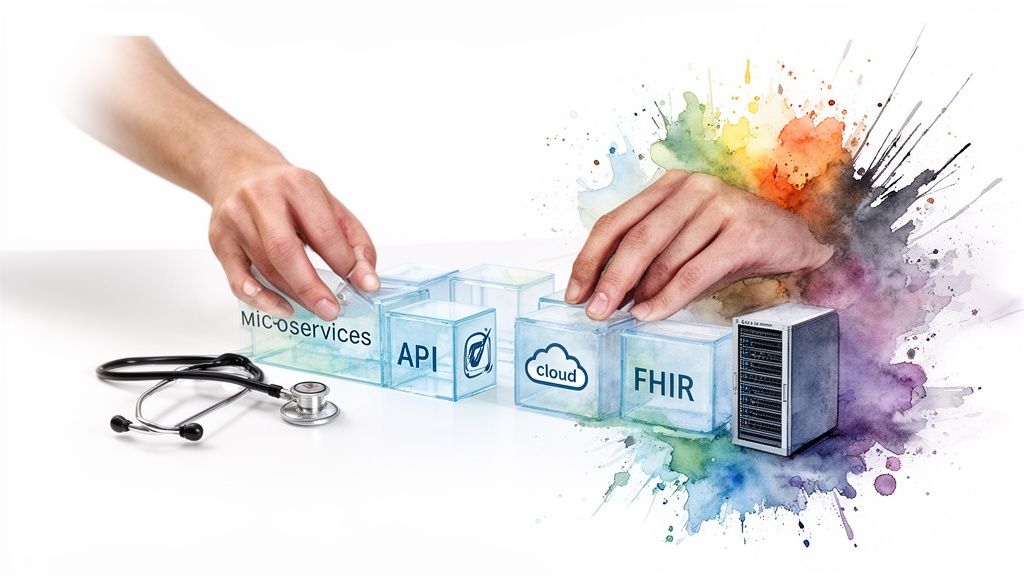
The answer lies in rethinking the entire structure around microservices and APIs (Application Programming Interfaces). Imagine your old system as one giant, tangled block of code. A microservices approach shatters that block into smaller, independent services, one for patient scheduling, another for billing, a third for lab results. Each one talks to the others through APIs, creating a flexible, interconnected ecosystem.
This modular design is a game-changer. You can update the billing service without ever touching the patient scheduling code, which dramatically slashes risk and speeds up development. It’s a fundamental shift that gives your organization the agility to innovate and adapt quickly, without needing to overhaul the entire system for every little change.
Choosing the Right Cloud Migration Pattern
Moving to the cloud is a non-negotiable part of any serious modernization effort, but how you get there matters. There’s no one-size-fits-all approach; the right strategy hinges on your application’s architecture, your budget, and what you’re trying to achieve long-term.
- Lift-and-Shift (Rehosting): This is the “get it done fast” option. You’re essentially picking up an application from your on-premise servers and dropping it into a cloud environment with minimal tweaks. It’s quick and relatively cheap, making it a great choice for stable legacy apps when the main goal is just to get out of your data center. The trade-off is that you don’t really tap into the cloud’s true potential.
- Replatforming: Think of this as a “lift, tinker, and shift.” You move the application to the cloud but make a few smart optimizations along the way. A common example is swapping a self-managed database for a managed cloud service like Amazon RDS. It’s a pragmatic middle ground that reduces your team’s administrative burden and often boosts performance.
- Hybrid Cloud: This approach gives you the best of both worlds, mixing private cloud infrastructure with public cloud services. It’s an ideal setup for healthcare, where you might need to keep sensitive patient data on-premise for compliance while using the public cloud’s massive scale for workloads like data analytics or patient portals.
The global healthcare IT market is projected to reach $172.3 billion by 2026, driven by this intense push for resilient, modernized systems. Experts warn that providers who fail to modernize by 2026 could see a 20% spike in cybersecurity breaches and a 15% drop in patient satisfaction.
Achieving True Interoperability with FHIR
A modern architecture is useless if your systems can’t talk to each other. For years, healthcare has been plagued by a lack of interoperability, a digital Tower of Babel where EHRs, patient portals, and third-party apps all speak different languages.
The Rosetta Stone for modern healthcare is Fast Healthcare Interoperability Resources (FHIR). FHIR is a data standard that sets the rules for how health information is exchanged between systems, no matter how that data is stored behind the scenes. Because it’s built on modern web standards, developers find it much easier to work with than clunky, older protocols.
Adopting FHIR is how you build a truly connected health ecosystem. It’s what allows a patient’s record to follow them seamlessly from their primary care doctor to a specialist and into the hospital, all without someone manually re-entering data or losing critical information. This doesn’t just improve care coordination; it unlocks innovation by allowing new third-party apps to securely plug into your systems. Of course, as we’ve explored in our guide, building these connections demands an unwavering commitment to security and a deep understanding of HIPAA-compliant software development.
Integrating AI for Smarter Healthcare Delivery
Modernizing your healthcare software isn’t just about moving to the cloud or speeding up old processes. The real leap forward comes from embedding intelligence directly into your clinical and operational workflows. This is where Artificial Intelligence (AI) and Machine Learning (ML) stop being buzzwords and become practical tools that genuinely reshape patient care and administrative efficiency.
Think of it this way: AI integration isn’t an add-on you bolt on at the end. It’s the central nervous system of a truly modern health system, allowing you to shift from reacting to illness to proactively anticipating patient needs. This is something legacy systems, with their siloed and unstructured data, could never hope to achieve. Integrating AI for your business is the key to unlocking this next level of proactive care.

Unlocking Practical AI Use Cases
The potential applications for AI in healthcare are nearly endless, but the most successful projects I’ve seen always start by solving a tangible, everyday problem for clinicians and administrators. The goal is to find those high-impact opportunities first.
Here are a few real-world examples I’ve seen deliver significant value:
- Predictive Analytics for Patient Risk: Imagine an AI model that constantly scans EHR data—lab results, vitals, nursing notes, historical diagnoses—to flag patients at high risk for sepsis or hospital readmission. This gives care teams a crucial heads-up, allowing them to intervene long before a patient’s condition becomes critical.
- AI-Powered Clinical Decision Support: This is about augmenting, not replacing, clinical expertise. An AI tool can analyze a chest X-ray and highlight subtle anomalies for a radiologist to review, acting as a “second pair of eyes.” It helps reduce diagnostic errors and speeds up interpretation without taking away the final judgment from the expert.
- Automating the Administrative Grind: Natural Language Processing (NLP) is a lifesaver here. It can scan unstructured physician dictations or clinical notes to automatically extract key information for medical billing codes or to generate concise patient summaries. This gives clinicians back precious time they were losing to paperwork.
The momentum behind these kinds of applications is staggering. The global AI in healthcare market is on a trajectory to grow from $10.4 billion in 2021 to a projected $504 billion by 2032. North America is leading the charge, but we’re seeing adoption accelerate globally as AI becomes a standard part of diagnostics and daily workflows.
Building and Deploying AI Responsibly
Having a great idea for an AI tool is one thing; actually building and deploying a secure, compliant, and ethical solution is a completely different beast. This is where the complexities of data privacy, algorithmic bias, and regulatory hurdles come into play.
As you integrate AI for smarter healthcare delivery, understanding the evolving landscape of AI governance law is crucial for responsible implementation. It ensures your innovations are built on a foundation of trust and compliance.
Success demands a disciplined, methodical approach. It all starts with clean, high-quality data for training your models. From there, you need rigorous testing to validate accuracy and, just as importantly, fairness. Finally, the tool has to be integrated seamlessly into the existing clinical workflow, otherwise, nobody will use it.
As we’ve explored in our guide, understanding the full scope of AI’s role in healthcare is the foundation for any organization looking to make a meaningful impact. When done right, this strategic integration ensures technology truly empowers, rather than disrupts, the people delivering care.
Making the New System Stick: Transition and Adoption
Let’s be honest. You can build the most brilliant, technically perfect software, but if your clinicians, staff, and patients don’t actually use it, the project is a failure. This final phase is where the rubber meets the road—where all the careful planning and coding must translate into a system people genuinely want to use.
Getting from a clunky old system to a sleek new one is a delicate process. It’s a moment ripe for disruption. That’s why we need to tackle two things with equal intensity: bulletproof testing to ensure the tech is solid, and smart change management to get your people on board. One without the other just doesn’t work.
Your Quality Assurance Game Plan
Before anyone in your organization logs into the new platform, it has to survive a trial by fire. We’re talking about a Quality Assurance (QA) process that mirrors the chaos and high stakes of a real hospital or clinic. This isn’t just about finding a few bugs.
For a healthcare system, your QA strategy has to be relentless. It should cover:
- Real-World Workflow Testing: Does the software actually work the way your team does? We test every single function, from a new patient check-in to a complex billing cycle, using the exact scenarios your staff face daily. The goal is to make sure the tech fits the workflow, not the other way around.
- Performance Under Pressure: What happens when three dozen nurses try to access patient charts at the start of a shift? Or when a huge batch of lab results comes in? We simulate these peak-load moments to find the system’s breaking point before your users do.
- Ironclad Security & Compliance: This is non-negotiable. Every piece of the system gets hammered with security tests, including penetration testing, to hunt for vulnerabilities. We also run rigorous audits to confirm that HIPAA compliance is baked in, ensuring patient data is always protected.
- Flawless Interoperability: If your new software needs to talk to an EHR, a lab system, or a patient portal, the connection has to be perfect. We verify that data flows between every connected system accurately and without a hitch. In healthcare, even a tiny data error can have massive consequences.
Winning Over Your People
Technology is only half the equation. The human side—managing expectations, calming fears, and providing training that actually helps—is what makes or breaks a modernization project. A major reason massive rollouts stumble, like the VA’s early EHR modernization where 75% of users felt the new system made their jobs harder, is a failure to manage the people-side of change.
You have to get ahead of the resistance and build enthusiasm from the start.
- Communicate, Communicate, Communicate: Leadership needs to be crystal clear about the “why” from day one. Your staff has to understand how this new system makes their lives better, whether it’s through less time spent on charting, faster access to critical information, or fewer administrative headaches.
- Find Your Champions: In every department, there are respected physicians, nurses, and administrators who people listen to. Get them involved early and turn them into advocates. Their voice and influence will do more to win over skeptical colleagues than any email from management.
- Train for the Real World: Forget generic, one-size-fits-all training. Sessions need to be tailored to specific roles. Show a nurse exactly how her charting process is now faster. Show a billing specialist how the new system simplifies his workflow.
Pro Tip: Don’t go for a “big bang” launch. A phased rollout, where you introduce the new system department by department or even module by module, is almost always the smarter move. It minimizes the shock to patient care, lets you collect invaluable feedback, and allows you to fix small issues before they become big ones.
Ultimately, navigating a smooth transition takes a partner who understands more than just code. You need a team that gets the unique rhythm and pressures of a clinical setting. An experienced partner in healthcare software development can manage these moving parts, using what they’ve learned from countless successful client cases to ensure your new system is not just launched, but truly adopted.
Let’s Build the Future of HealthTech, Together
Modernizing your healthcare software is more than just a tech upgrade; it’s a serious investment in the future of your organization and the quality of patient care you provide. Getting it right requires more than a simple vendor-client relationship. You need a genuine AI solutions partner who can guide you through the entire process, from the first assessment and architectural blueprint to integrating AI and managing the final rollout.
Sticking with the status quo isn’t a neutral choice—it’s a risky one. Outdated systems quietly bleed efficiency, leave you vulnerable to ever-evolving security threats, and ultimately hold you back from delivering the level of care your patients deserve. This guide gives you the map, but a true partner provides the seasoned expertise needed to navigate the inevitable twists and turns of a major transformation.
A great partner isn’t just about technical skill. They need to deeply understand the unique, high-stakes environment of healthcare. Success comes from a shared commitment to building a smarter, more connected, and fundamentally better system of care.
We’ve been in the trenches of healthcare software development for years, helping organizations just like yours tackle these exact challenges. Our client cases show what’s possible. If you’re ready to take the next step, let’s talk about what your specific modernization goals look like.
Your Top Questions Answered
When you’re staring down a healthcare software modernization project, a lot of questions come to mind. That’s natural. As an enterprise leader, you need to have the answers ready to build confidence across your organization and make sure the whole process goes off without a hitch. Let’s tackle some of the most common questions I hear from leaders in your position.
What Are the Biggest Risks We Should Worry About?
In my experience, the biggest headaches almost always come from three places: your data, your security, and your people.
Messing up a data migration is a nightmare scenario, corrupted or exposed patient information is a non-starter. At the same time, any big change can open up new security vulnerabilities, giving cyber threats a fresh way in. You have to be paranoid about this.
But honestly, the risk that often gets underestimated is the disruption to your clinical teams. If the new system feels clunky or slower than the old one, your staff will get frustrated fast, and patient care can suffer. This leads to poor user adoption, which can completely sink a project. The only way to get ahead of these risks is with obsessive planning, a phased rollout, relentless security testing, and bringing your clinical staff into the conversation from the very beginning.
How Can We Actually Measure the ROI on This?
Proving the value of a modernization project means looking beyond just the hard numbers. You’ll need to track a mix of financial wins and those less tangible, but equally important, quality improvements. The trick is to establish your baselines before you start so you can show a clear “before and after” picture.
The Hard Numbers (Quantitative Metrics):
- Lower Maintenance Costs: This is the easiest one. Track what you save by turning off those old, expensive legacy systems and their support contracts.
- More Revenue: Are you seeing better billing accuracy? Fewer denied claims? Faster payment cycles? Measure it.
- Staff Productivity Gains: Quantify the time your team gets back, whether it’s less time spent on charting, administrative tasks, or just hunting for patient info.
The Softer Wins (Qualitative Metrics):
- Better Patient Outcomes: Look at your clinical quality indicators. Do they improve when your team has better data and decision support?
- Happier Patients: Use satisfaction surveys to see how patients feel about new digital tools, like an improved portal or telehealth options.
- Fewer Clinical Errors: Dig into incident reports. Are you seeing a drop in medication or diagnostic errors?
What’s a Realistic Timeline for a Project Like This?
There’s no magic number here; it really depends on what you’re trying to accomplish. A simple “lift and shift” cloud migration might only take 6-9 months. But if you’re talking about a full, enterprise-wide EHR replacement, you could easily be looking at 18-36 months, maybe more.
The one thing I always advise against is a “big bang” launch where you flip the switch on everything at once. It’s just too risky. An agile, phased approach is a much smarter strategy. It lets you deliver value in stages, get crucial feedback from users along the way, and dramatically lowers the risk of a catastrophic failure.
Breaking a massive project into smaller, manageable chunks makes the whole effort more predictable and far less disruptive. This is where a seasoned healthcare software development partner can be a game-changer, helping you map out a realistic schedule and use proven methods to speed things up.
Should We Modernize What We Have or Just Replace It?
This is a classic dilemma. The answer comes down to a clear-eyed look at a system’s business value versus its technical health. You don’t have to throw everything out. The key is to apply the right strategy to the right system.
I like to think about it in four buckets:
- High Business Value, Good Technical Condition: Protect and invest. These are your workhorses. Don’t mess with them too much; just focus on small improvements.
- High Business Value, Poor Technical Condition: Modernize or Replace. This is where the real work is. If a system is critical but the old tech is holding you back, a full replacement is often the only answer. But if it just needs new features (like moving to the cloud), modernization (replatforming or refactoring) is often a smarter, more affordable path.
- Low Business Value, Good Technical Condition: Consolidate or Maintain. These systems work fine but aren’t core to your strategy. See if you can merge them into other platforms or just keep them running with minimal spending.
- Low Business Value, Poor Technical Condition: Eliminate. These are just draining your resources. Get rid of them and move on.
Taking the time to map your entire application portfolio against this framework will make it crystal clear what needs to be done with each piece of your tech stack.
Taking on a healthcare software modernization project is a massive undertaking, but it’s also a chance to define your organization’s future. To get it right, you need more than a vendor, you need a true partner who can guide you. At Bridge Global, we live and breathe this stuff. We bring deep industry knowledge together with expert custom software development and advanced AI development services to build health tech that’s ready for whatever comes next.

About Upendra Jith
Upendrajith completed his Master's in English and has been a commercial content developer for the past three years. He's more inclined to develop content with a 'street-smart' delivery on topics such as technology, media, or anything he can get his hands on. He has a fixation on lyrics, dark poetry, media, technology, and flow arts.
View all posts by Upendra Jith →