



Healthcare SaaS Engineering: A Compliance Guide
The most popular advice about healthcare SaaS is also the most dangerous: build a conventional multi-tenant product, add encryption and access controls, then complete a compliance review before launch. That approach treats healthcare as ordinary SaaS with extra checkboxes. In production, the difficult work is deeper. Clinical context changes how you model data, isolate tenants, handle failures, test integrations, and prove who accessed protected health information.
The market reflects that engineering pressure. Healthcare software as a service reached an estimated USD 32.22 billion in 2025 and is projected to reach USD 82.37 billion by 2031, with a projected 16.94% CAGR from 2026 to 2031, according to Mordor Intelligence's healthcare SaaS market analysis. Growth creates opportunity, but it also raises the standard for platforms that must support administrative and clinical workflows without compromising patient safety or regulatory evidence.
Why Healthcare SaaS Engineering Is Not Just SaaS Plus Compliance
A failed ecommerce deployment may interrupt purchases. A failed healthcare deployment can delay care, hide a medication history, expose sensitive records, or write an incorrect clinical value into a downstream system. That difference should influence architecture before the first endpoint is designed.
Healthcare SaaS engineering has to preserve meaning and context, not move records between services. A patient identifier without encounter context may be misleading. An observation without units, provenance, timing, or status may be unusable. A permission that looks valid at the organization level may still be inappropriate for a particular care relationship.
Clinical context belongs in the design
Generic SaaS patterns often begin with users, organizations, subscriptions, and roles. Healthcare platforms need those concepts, but they also need patient, practitioner, encounter, consent, care team, facility, payer, source system, and provenance relationships. The database must accommodate clinical events that arrive late, arrive twice, change status, or conflict with local records.
The same issue appears in failure handling. A retry that is harmless for a page-view event can duplicate an order or create an incorrect clinical task. Idempotency keys, message reconciliation, source timestamps, and human review queues aren't optional refinements when downstream workflows depend on the result.
Practical rule: Treat every clinical write as a business-critical transaction with provenance, validation, authorization, and a recovery path.
Checkbox compliance creates commercial friction
Enterprise buyers don't assess only whether a vendor has a policy document. They want evidence that access is controlled, changes are traceable, integrations are governed, and incidents can be investigated. A platform that passes a superficial checklist but can't explain why a user saw a record will struggle during procurement and an audit.
The healthcare SaaS market also shows why architecture must serve more than one workflow. Non-clinical information systems held 53.62% of market share in 2025, while clinical information systems were the fastest-growing segment, with an 18.12% CAGR, according to Mordor Intelligence. Administrative and clinical products may share infrastructure, but they shouldn't share assumptions about data sensitivity, availability, authorization, or acceptable failure.
Teams building a new platform often benefit from a healthtech software development partner that can connect product discovery, architecture, integration planning, and compliance engineering. The partner's value isn't a compliance certificate. It's the ability to make the right trade-offs before the system's boundaries become expensive to change.
Regulatory Requirements That Shape Your Architecture
Regulatory requirements become useful only when engineers convert them into system behavior. HIPAA safeguards, information-sharing obligations, FHIR requirements, and regional privacy rules should appear in authorization policies, data contracts, deployment controls, test cases, and incident workflows. Compliance is an operating condition that must remain true as data flows, integrations, and product behavior change.
The U.S. Department of Health and Human Services states that mobile health app developers may need to address the HIPAA Privacy, Security, and Breach Notification Rules when their products handle protected health information. The relevant question is therefore how the product collects, uses, shares, stores, and deletes data, not only where its servers run. A platform that passes a launch review can still fall out of compliance when a new integration, role, or export path bypasses the original controls.
Translate requirements into engineering decisions
The minimum necessary principle should determine what each endpoint returns. A scheduling service may need appointment and contact data, but it should not automatically receive a complete clinical history. Use scoped tokens, resource-level authorization, purpose-aware policies, and service-specific response projections. A broad role such as “staff” rarely provides enough context for safe access decisions.
FHIR also affects the normalization layer. FHIR was established in 2014 and is required for certified EHR APIs under the ONC Cures Act Final Rule. It uses RESTful APIs, JSON payloads, and OAuth 2.0 authorization, as described in this guide to EHR and EMR integration. Interoperability failures often come from inconsistent legacy identifiers, code systems, timestamps, and patient merges, rather than from a missing API. Keep a canonical model and translation layer where they reduce that inconsistency. Do not force internal tables to mirror every FHIR resource when the product's workflows need a different shape.
| Regulation or standard | Key requirement | Architectural implication | Common implementation pattern |
|---|---|---|---|
| HIPAA Security Rule | Protect PHI through administrative, physical, and technical safeguards | Centralize identity, authorization, encryption, monitoring, and evidence collection | Identity provider, policy enforcement point, encrypted managed services, security monitoring |
| HIPAA Privacy Rule | Limit uses and disclosures of PHI | Design APIs around purpose and minimum necessary access | Scoped claims, resource filters, consent-aware authorization |
| HIPAA Breach Notification Rule | Investigate and respond to breaches | Preserve reliable access history and incident evidence | Immutable audit events, alerting, investigation workflows |
| FHIR and certified EHR API requirements | Enable structured, authorized data access | Build versioned contracts and terminology mapping into integrations | FHIR R4 facade, SMART on FHIR, OAuth 2.0, contract testing |
| EHDS and MDR obligations | Support traceability, lifecycle control, and structured exchange where applicable | Make export, documentation, and change history architectural concerns | Versioned data packages, evidence repositories, controlled release processes |
A practical implementation primer is HIPAA software at Intelligent Contacts. Use it to connect safeguard language with application and operational controls, then validate those controls continuously through reviews, tests, and incident exercises. Avoid encrypting every field independently when it complicates indexing, backups, and key rotation without addressing a defined threat. Start with a documented data classification model, and apply controls according to exposure and clinical impact.
Reference Architecture for Compliant Healthcare Platforms
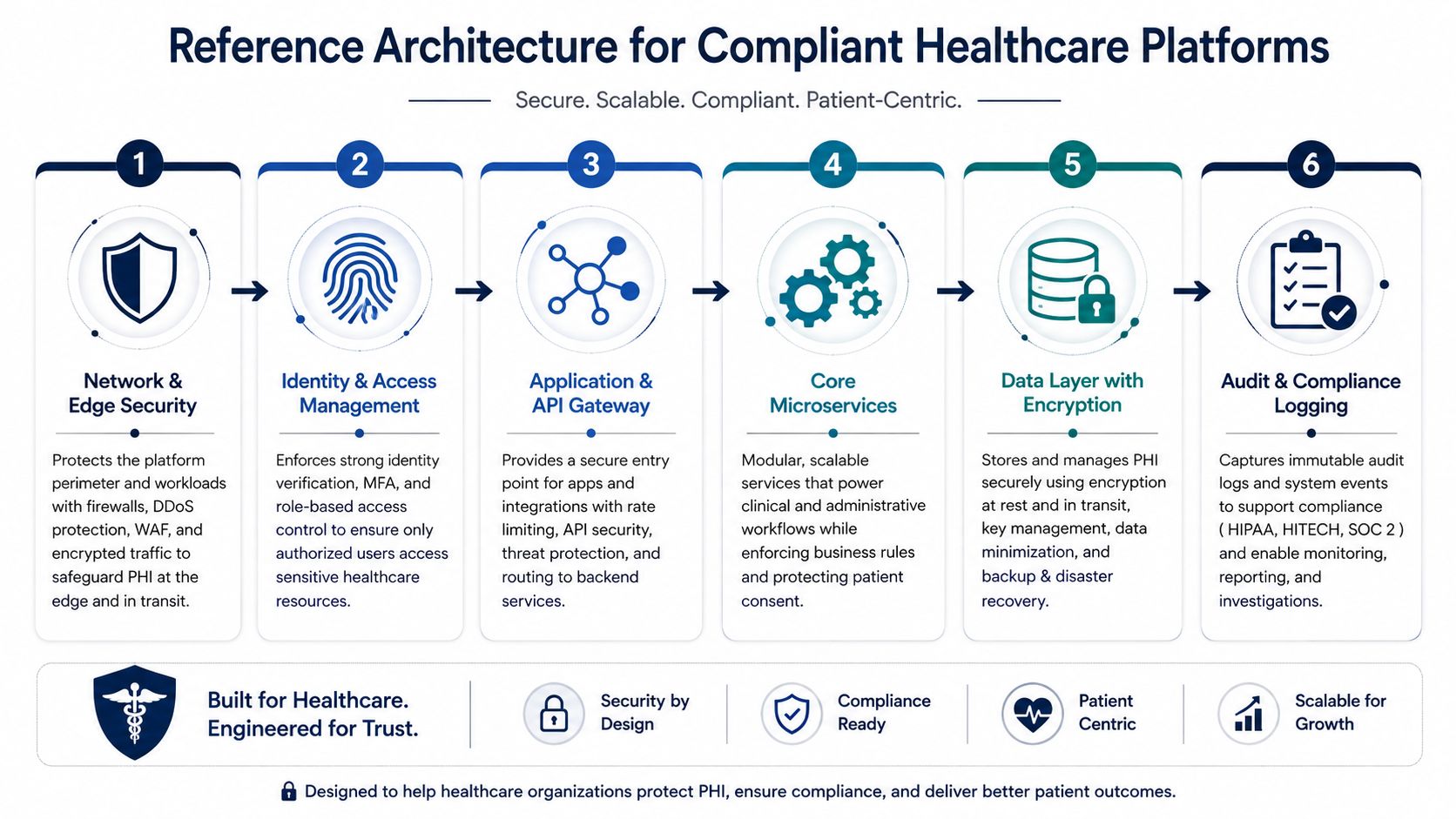
A compliant platform needs clear boundaries. The architecture below separates edge protection, identity, application behavior, clinical integrations, storage, and evidence. The exact cloud services may vary, but the responsibilities shouldn't disappear because a managed provider owns part of the infrastructure.
Start at the edge
Use private network boundaries for PHI workloads, managed web application protection, rate limiting, and separate ingress paths for user traffic and system integrations. The edge should reject malformed requests before they reach clinical services, but it shouldn't become the only security boundary.
Identity belongs in a dedicated provider where possible. Enforce phishing-resistant authentication options, single sign-on for enterprise tenants, short-lived access tokens, and service identities for machine-to-machine integrations. The authorization service then evaluates tenant, user, resource, relationship, purpose, and consent context.
The application tier should keep clinical workflows separate from billing, analytics, and administrative functions even when a modular monolith is more practical than microservices. Clear modules, explicit service boundaries, and transaction-aware events often provide better control than a distributed architecture adopted too early.
Make integrations a product boundary
Place FHIR servers, HL7 interfaces, document processors, terminology services, and vendor adapters behind an integration layer. This layer should normalize messages, retain source payloads, attach provenance, handle retries safely, quarantine invalid records, and expose operational status to support teams.
The data layer needs encryption, tenant-aware access enforcement, backup validation, and carefully designed indexes. Managed databases reduce operational burden, but they don't remove the need to test restores, verify access policies, and document key ownership. Secrets for EHR and payer connections should live in a managed secrets system with rotation procedures and access monitoring.
Audit events should flow to storage that application administrators can't rewrite. Design recovery around clinical consequences, not only infrastructure targets. A backup that restores the database but loses queued integration messages may still leave the platform in an unsafe state.
For teams evaluating custom healthcare software development, the architecture review should produce a data-flow map, trust boundaries, tenancy model, integration contracts, audit strategy, recovery design, and a control ownership matrix before implementation accelerates.
Security Controls and Audit Logging That Actually Work
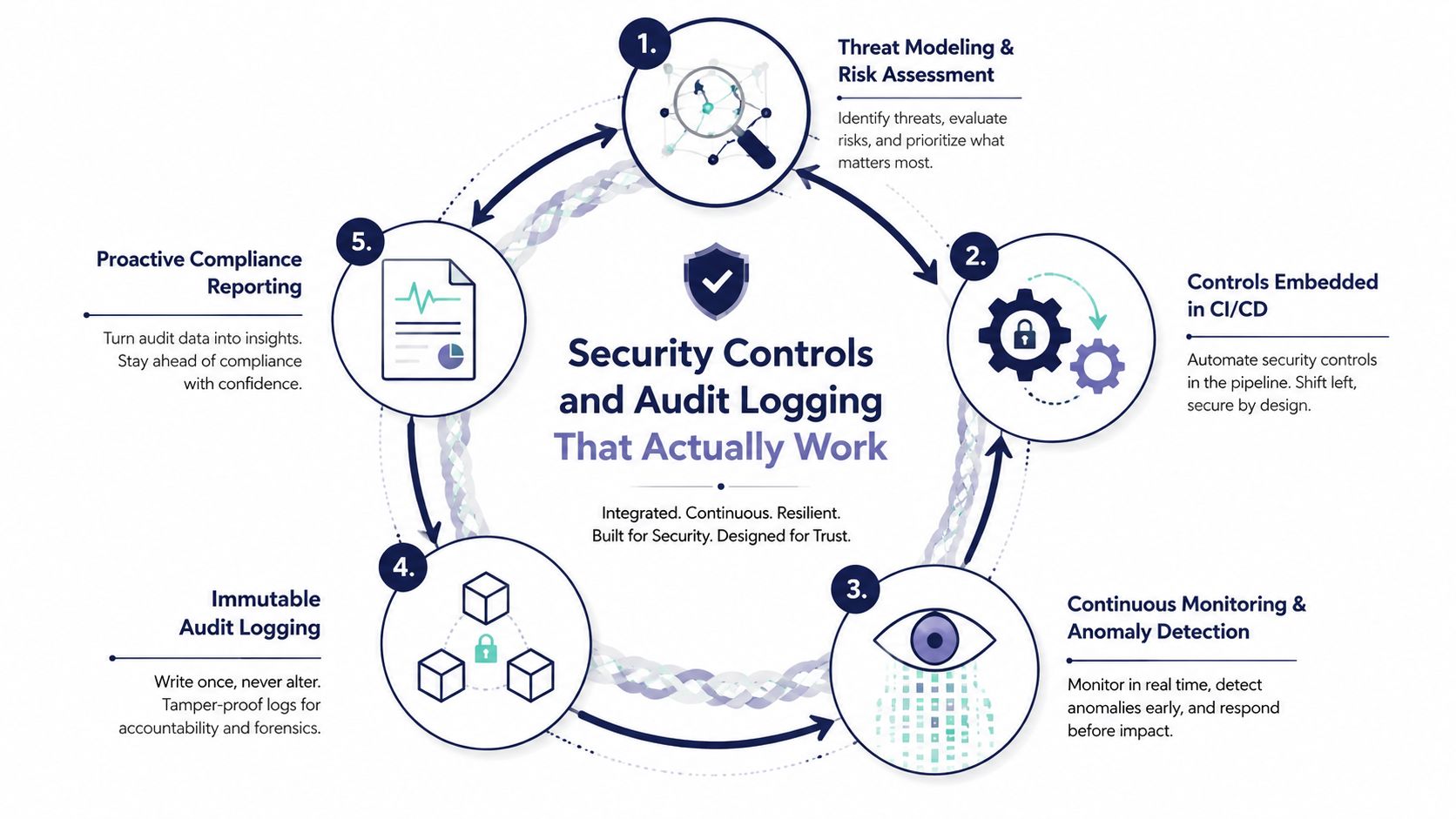
“Encrypt at rest, enable multifactor authentication, and call the product HIPAA-compliant” is not a security architecture. Those controls matter, but they don't answer the questions investigators and clinical operators ask during an incident: who accessed the record, what did they do, from where, under which authority, and what happened afterward?
Put controls inside the application
Use role-based access control for broad responsibilities, then add attribute- and relationship-based checks for clinical context. A clinician may access patients in an assigned care team. A support analyst may view account metadata but not clinical notes. An emergency break-glass path may permit exceptional access, but it should require a reason, trigger increased monitoring, and create a review task.
Manage encryption keys separately from application credentials. Managed key services can simplify rotation and hardware-backed protection, while customer-managed keys may support stronger ownership or residency requirements. The trade-off is operational: customer-managed keys require disciplined rotation, recovery planning, and access review.
Treat the audit trail as a forensic system
Healthcare SaaS engineering requires immutable, centralized logging for PHI access and administrative activity. Capture user identity, timestamp, patient or resource ID, action type, source IP, and outcome, then write the events to tamper-resistant WORM or object-lock storage. Implementations commonly retain these logs for at least six years to align with healthcare recordkeeping requirements, as detailed in this healthcare HIPAA and SOC 2 engineering guide.
Don't store the only copy in the application database. A privileged administrator who can alter business data shouldn't be able to erase the evidence of that alteration. Teams designing audit trails for compliance should also define event schemas, clock synchronization, retention policies, export controls, and alert thresholds before production traffic begins.
As we explored in our guide to HIPAA-compliant software development, logging must avoid leaking PHI into traces, error messages, and debug output. The most useful audit system is queryable by investigators, understandable by compliance teams, and tested during failure scenarios.
Cloud Deployment Patterns for Healthcare Workloads
Healthcare teams often frame deployment as public cloud versus private infrastructure. Production decisions are more nuanced. The right pattern depends on data residency, customer procurement rules, existing hospital infrastructure, integration latency, operational maturity, and whether every workload handles PHI.
Private cloud can provide stronger control boundaries, but it transfers more responsibility to the product owner. Public cloud offers managed identity, logging, encryption, and recovery services, but only within a correctly configured account and an appropriate contractual framework. Hybrid deployment can preserve on-premises systems while moving selected application and analytics components to the cloud, though it introduces network, observability, and configuration complexity.
| Pattern | Best for | BAA complexity | Isolation level | Cost profile |
|---|---|---|---|---|
| Single-tenant private cloud | Health systems with strict residency or dedicated infrastructure requirements | More direct vendor and operating model review | Strong infrastructure separation | Higher operational ownership and fixed cost |
| Multi-tenant public cloud | Digital health products that need shared services and elastic operations | Requires careful provider, service, and contract validation | Logical isolation with strong policy enforcement | Efficient shared infrastructure, with configuration responsibility |
| Hybrid cloud | Organizations retaining on-premises EHR or PHI systems | Spans cloud and local environments | Depends on segmentation and integration paths | Can reduce migration pressure, but increases operational complexity |
Keep deployment evidence consistent
Infrastructure as code should define network policies, identity bindings, encryption settings, logging destinations, and environment differences. A pipeline that deploys application code but configures security manually creates drift that becomes difficult to explain during an audit.
Kubernetes namespaces can support logical separation, but they aren't equivalent to dedicated infrastructure. Use stronger isolation for tenants or workloads whose risk, contract, or residency requirements justify it. Don't promise that a namespace alone solves tenant isolation. The application, database, secrets, queues, and observability stack all need consistent boundaries.
The same discipline applies to healthcare cloud architecture. Teams should document which services can process PHI, where backups reside, which vendors need a business associate agreement, and how a release moves through regulated environments.
FHIR Integration Patterns and Legacy System Challenges
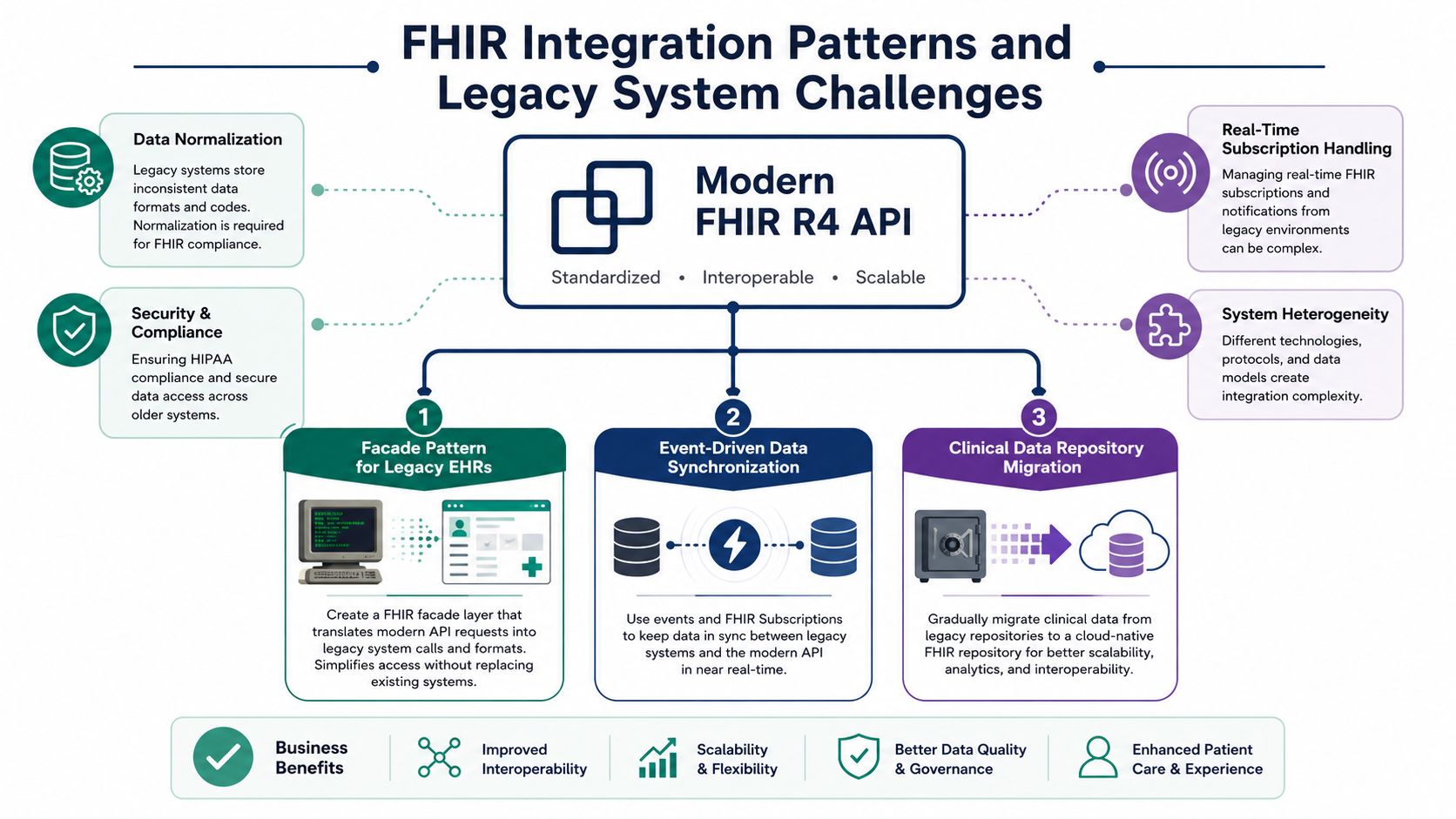
FHIR simplifies the interface contract, not the clinical data. Integration work usually becomes difficult after authentication succeeds, when engineers must interpret local codes, incomplete messages, custom workflows, and conflicting patient identities. The primary failure is often normalization, not a missing API.
A platform can expose a FHIR R4 API while maintaining a canonical internal model. Another can use FHIR resources internally and translate older feeds at the boundary. Either approach can work. The right choice depends on whether the product primarily supports exchange, clinical workflow, analytics, or orchestration.
Build for translation, not idealized interoperability
Common HL7 FHIR integration patterns include SMART on FHIR, CDS Hooks, and bulk export. FHIR represents resources such as Patient, Observation, Encounter, and Medication through REST APIs using JSON and XML.
SMART on FHIR fits EHR-embedded applications that need delegated authorization and clinical context. CDS Hooks places decision support within workflow events. Bulk export supports population-level data movement, but the implementation must handle asynchronous jobs, access scope, cancellation, and partial results.
The difficult work sits below the API layer:
Normalization: Map local representations to standard terminologies such as SNOMED CT and LOINC without removing source meaning.
Identity: Reconcile patients across systems with different identifiers, matching rules, and demographic quality.
Provenance: Record the originating system, author, timing, transformation, and confidence for each normalized value.
Resilience: Quarantine malformed messages, retry transient failures, and make duplicate processing safe.
Workflow context: Preserve encounter, facility, order, and status relationships rather than exporting isolated resources.
More APIs can create more failure points
Interoperability does not guarantee usable exchange. Legacy systems may expose APIs while returning customized schemas, inconsistent codes, incomplete fields, or behavior that differs from documentation. Engineers must test the customer's actual interface, not only a standards-compliant sandbox.
A reliable integration layer uses versioned data contracts, mapping governance, source-specific adapters, replayable events, and data-quality dashboards. Teams designing healthcare integrations can also review FHIR integration services for implementation considerations, then validate each assumption against production behavior.
Compliance continues after launch. Mapping changes, vendor upgrades, terminology updates, and new workflows can alter clinical meaning without changing the API surface. Track mapping versions, retain transformation provenance, and route uncertain matches for review instead of writing low-confidence data into the record.
FHIR quality also affects AI readiness. The FHIRTrustBench benchmark evaluates clinical AI readiness across five dimensions, including FHIR implementation quality, AI validation, clinical workflow integration, trustworthiness assessment, and governance readiness, as described in the FHIRTrustBench preprint. Weak resource mapping can reduce downstream model accuracy, fairness, security, and operational usefulness.
Testing Strategies for Clinical Safety and Compliance
Healthcare testing must answer more than “does the feature work?” It must demonstrate that the feature behaves safely when data is incomplete, permissions change, integrations fail, and infrastructure recovers.
Test the data boundary
Generate synthetic PHI for routine development and integration testing. Use de-identified production snapshots only under controlled procedures, with documented transformation and access restrictions. Add automated checks that scan application logs, traces, queues, analytics events, and error payloads for unintended clinical data.
FHIR contract tests should validate required fields, cardinality, terminology behavior, authorization scopes, error formats, and version compatibility. Test malformed HL7 messages and unexpected vendor extensions, not just the clean examples supplied by an interface partner.
Test failure as a clinical scenario
A database failover test should verify more than service recovery. Confirm that audit events remain complete, queued messages aren't duplicated, clinical status transitions stay consistent, and operators can identify what requires reconciliation.
A practical test suite should include:
PHI leakage prevention: Inspect logs, exports, notifications, and telemetry for unauthorized sensitive values.
Clinical decision support accuracy: Exercise edge cases, missing inputs, stale observations, conflicting values, and unsafe defaults.
API contract and interoperability: Test FHIR resources, authentication scopes, terminology mappings, and partner-specific variations.
Disaster recovery: Restore databases, replay integration events, validate backups, and document operator decisions.
Audit integrity: Simulate privilege escalation, break-glass access, failed writes, retries, and administrator activity.
Map automated tests to security and privacy controls so each pipeline run produces evidence that reviewers can understand. Manual clinical review still matters for workflows where a technically valid response could create an unsafe interpretation.
Building Continuous Compliance Into Your Engineering Culture
Compliance works best as a property of the delivery system, not a meeting held before launch. Developers should see policy checks in pull requests, deployment controls in the pipeline, and evidence generated from the same systems that build and operate the product.
Start with controls that are repeatable and objective. Validate infrastructure configuration, secret handling, encryption settings, dependency risk, access policies, logging destinations, and backup status automatically. Store deployment records, approvals, test results, and exception decisions in an evidence repository that supports both engineering investigation and audit review.
Operational principle: If a control depends on someone remembering a quarterly task, it isn't yet part of the product's engineering system.
Teams can assign compliance engineers to product squads, but ownership shouldn't stop there. Developers who change authorization, data models, or integration flows need to own the control consequences of those changes. A shared dashboard can show policy drift, failed evidence collection, overdue remediation, and exceptions without waiting for an audit cycle.
The move from manual compliance to pipeline-integrated controls should be incremental:
Inventory data flows and control owners.
Convert high-risk requirements into automated tests.
Block releases when critical controls fail.
Generate evidence automatically from CI/CD and cloud activity.
Review exceptions as product decisions with expiry dates.
The compliance-as-code for GitOps approach is useful here because it connects desired infrastructure state with version control and review. Continuous compliance also supports commercial viability. In Europe, emerging EHDS and MDR obligations point toward structured export, audit trails, documented lifecycle controls, and traceability built into architecture. Reimbursement adds another business constraint. IQVIA reports that more than 300 billing codes support digital health solutions and digital care, including 117 codes for software-based technologies such as SaMD, SiMD, and AI-SaMD, while reimbursement still varies by solution, therapy area, and care setting.
Healthcare SaaS engineering teams should therefore measure compliance velocity alongside delivery velocity. A platform that can produce trustworthy evidence, explain its data lineage, and adapt its controls across markets is easier to sell, operate, and evolve.
Bridge Global helps healthtech teams design compliant architectures, build healthcare integrations, develop SaaS products, and add AI capabilities without separating regulatory work from delivery. Review the Bridge Global approach, then bring your data flows, legacy-system constraints, and audit requirements to a focused architecture discussion.

About Preethi Saro Philip
Preethi Saro Philip is a Post Graduate Research Degree holder in Economics with more than 10 years of experience in writing, editing, research and teaching. She has an intense passion for content crafting and calls herself a ‘wordsmith’. She enjoys writing on wide-ranging topics including business, technology, health & lifestyle, education, environment etc.
View all posts by Preethi Saro Philip →