



Healthcare Operational Resilience: A CTO’s Playbook
Healthcare systems didn't just face a demand shock during COVID-19; they lost routine capacity at scale. The OECD recorded 7 million fewer elective surgical procedures in 2020 than in 2019 in its resilience work. That's the starting point for healthcare operational resilience, because when elective care falls off a cliff, the problem isn't a dashboard; it's throughput, continuity, and patient access.
Many teams still discuss resilience in abstract terms while operating systems they can't benchmark. In practice, the challenge isn't agreeing that resilience matters. It's translating it into metrics that a board can fund, a regulator can inspect, and an engineering team can operationalize.
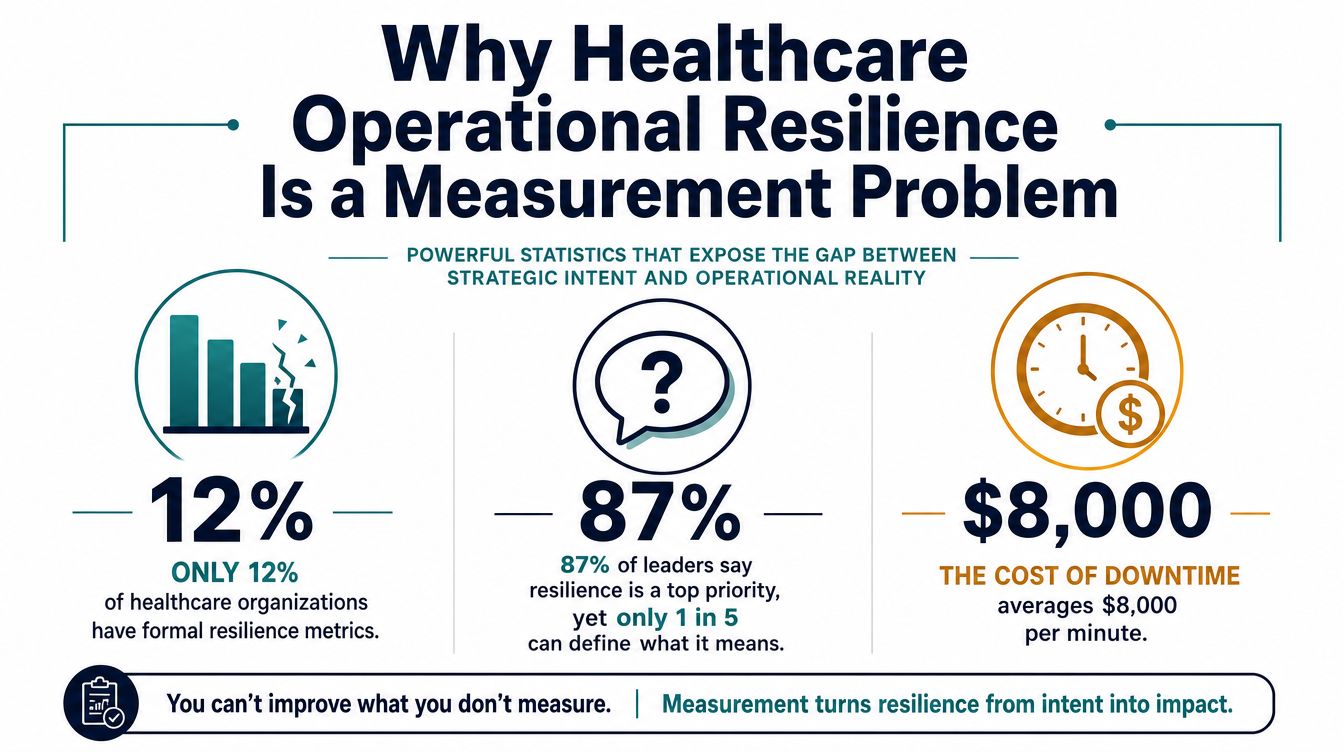
Why Healthcare Operational Resilience Is a Measurement Problem
BCG's 2022 survey found that only 6% of biopharmaceutical and medtech companies could anticipate and mitigate the impact of major disruptions. That number matters because it exposes the core issue. Most organizations are not short on intent; they're short on measurement.
A resilience program can sound strong in a strategy deck, but it falls apart fast if leaders can't prove what improved, what degraded, and what to fix next. Recent reviews of healthcare resilience measurement found no consensus on what to measure, which indicators to use, or how to evaluate resilience consistently. Another review found that organizational resilience is usually defined as the ability to anticipate, prepare for, respond to, and adapt to disruption, but only two of the four healthcare resilience measures identified had been validated.
That is why board conversations stall. A CIO can say the platform is more resilient, but if the organization cannot show service thresholds, dependency coverage, or audit-ready evidence, the claim will not survive scrutiny. I have seen that gap kill resilience budgets more than once, because leaders will not fund what they cannot measure.
Practical rule: if you cannot describe resilience as a measurable service outcome, you are still in the storytelling phase.
Healthcare resilience is not one KPI. It is a dependency map across staffing, infrastructure, service delivery, governance, and finance, with technical indicators such as nurse and doctor density, ICU and bed density, telemedicine uptake, preparedness plans enacted, surveillance, information systems, and health spending. For hospital infrastructure, research frameworks also track emergency power reservoir capacity, tertiary power supply, emergency water, oxygen stock, and bed-surge capacity because those inputs affect service outcomes like mortality, emergency department time, and length of stay.
That is the measurement shift CTOs need. The question is not whether a system feels strong. It is whether essential services can keep running when a utility fails, a supply chain breaks, or a staffing gap widens.
What Operational Fragility Looks Like in Practice
COVID-19 showed how quickly a healthcare system can lose routine capacity under stress. The disruption was not evenly absorbed, and the clearest sign was the loss of scheduled care, not just the strain on emergency response. Once non-urgent procedures are deferred, waiting lists lengthen, diagnosis gets delayed, and downstream throughput drops.
Service loss is the visible symptom
The WHO's resilience work pushes the definition in the right direction. Resilience is not just service availability; it also includes whether facilities can keep essential services running, conduct simulation exercises, and maintain standard operating procedures for essential supplies. That is a better lens because it focuses on the behaviors that keep care alive during disruption, not the aspiration to avoid disruption altogether.
Workforce strain, supply interruptions, and demand spikes do not stay isolated. They cascade. A delayed shipment affects inventory. A staffing shortage slows triage. A backlog in one service line spills into another, and soon the organization is making brittle trade-offs about which patients get scheduled and which do not.
Operational resilience is preserving core clinical activity
The practical question for leaders is simple. Which services continue, which degrade, and what gets sacrificed first? That is the level at which healthtech platforms and providers need to design for continuity rather than perfection.
If you have watched a service line go from normal to “we're deferring until next week” in a single incident review, you already know the difference between uptime and resilience. Uptime can look fine while core clinical activity erodes.
Direct lesson: a hospital can still be online while its care model is quietly becoming less usable.
A Maturity Model for Healthtech Resilience
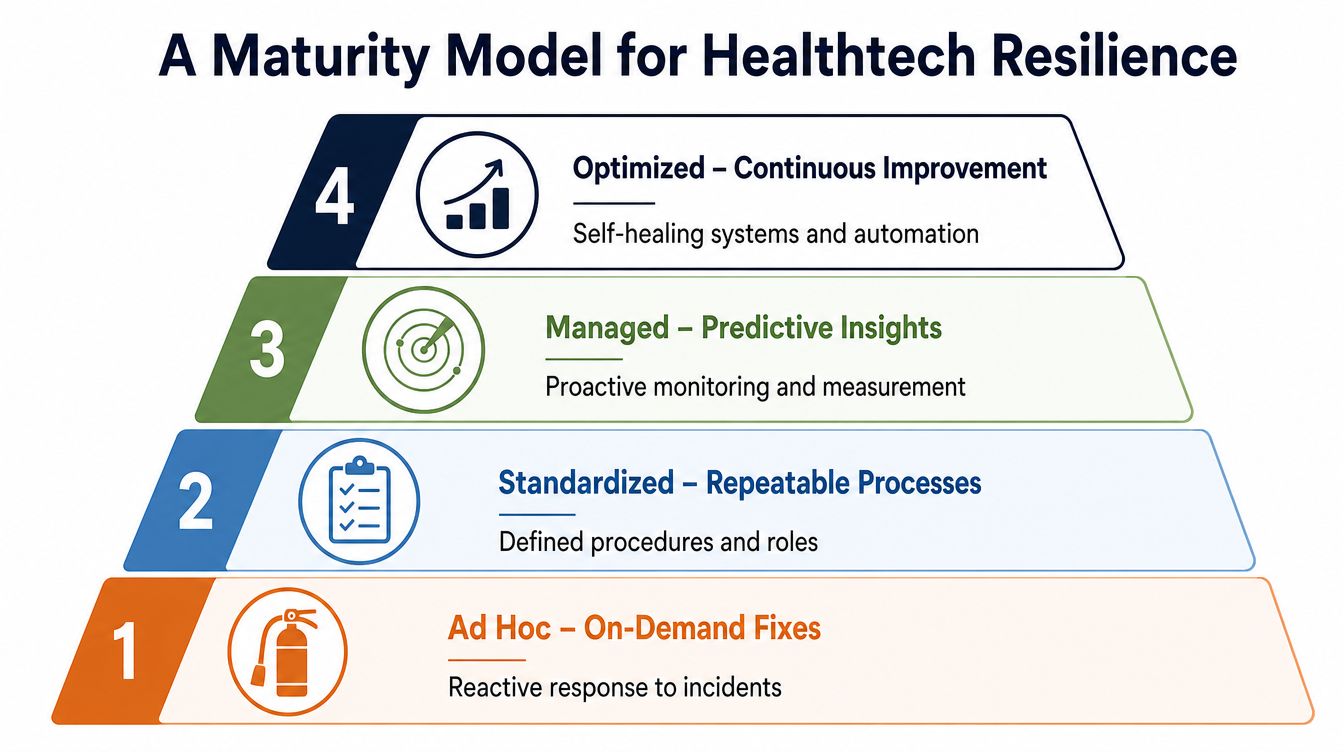
A useful starting point is a diagnostic, not a slogan. In healthtech, healthcare operational resilience becomes measurable only when teams can show how an incident changes service continuity, escalation behavior, and recovery quality. A practical maturity path moves from reacting to incidents toward improving through stress. The literature already recognizes reactive, proactive, and reflective strategies in healthcare resilience research, and that maps cleanly to how real teams behave.
Four practical levels
Ad Hoc: Teams fix things after they break. Alerts are noisy, ownership is unclear, and incident reviews focus on recovery rather than prevention. At this stage, hidden dependency is the biggest risk.
Standardized: The organization has repeatable incident procedures, named roles, and basic runbooks. Failures are still disruptive, but people know who does what and where to escalate.
Managed: Monitoring is proactive, dependency mapping is explicit, and leaders can see early warning signals before users complain. Service-level thresholds start to matter here, especially for workflows tied to clinical throughput and patient coordination.
Optimized: Automation closes the loop. Systems self-heal where they can, human escalation is targeted, and lessons from incidents feed back into architecture, operations, and policy. That is the stage where resilience starts to show up in board reporting, audit evidence, and change control, not just in incident retrospectives.
A useful test is simple. Can the team detect degradation before clinicians do? Can it route around a failure without improvisation? Can it prove the improvement after the fact with evidence that stands up in an audit or a board review?
What changes at each stage
At the lower levels, resilience is mostly documentation. At the higher levels, it becomes architecture and governance. The shift is practical: tooling, operating model, and escalation paths need to line up so the system can absorb failure without depending on heroics. That is also where the measurement gap starts to close, because leaders can tie incidents to service-level thresholds, decision owners, and corrective actions.
For teams building automation into those controls, a healthcare cybersecurity automation approach can help standardize response without removing human judgment. The point is not to automate everything. It is to automate the repetitive checks, route the right alerts to the right people, and preserve evidence that shows how the organization handled the event.
A hospital can still be online while its care model is becoming less usable.
Useful test: if resilience only exists in a PDF, it will not survive the next outage.
AI-Driven Practices That Prevent Cascading Failures
AI helps most when it's used to shorten the distance between signal and action. In healthtech SaaS, the first sign of trouble is often subtle: a latency increase in an API, a drop in message throughput, or a data sync failure that only affects one workflow at first. The value of AI is that it can spot that drift early, before clinicians or patients feel it.
Build the loop, not just the alert
The best pattern is a closed loop. Anomaly detection flags unusual behavior, root cause analysis narrows the issue, automated mitigation takes a safe corrective step, and on-call staff gets a focused alert. Then the system learns from the incident so the same pattern is less likely to recur.
That's where healthcare integrations become a resilience issue, not just a delivery issue. HL7, FHIR, scheduling feeds, device telemetry, and claims workflows all create dependencies that can fail in ways users won't immediately see. A resilient platform watches those interfaces as closely as it watches its own app layer.
If you want a concrete parallel, the UK remote patient monitoring guide is a good reminder that continuity depends on how well the remote flow is monitored end to end, not just whether the dashboard loads. The same logic applies to hospital-connected software.
What automation should actually do
Automation should not be a blunt instrument. It should fail over only when confidence is high, route critical traffic first, and preserve audit trails for later review. In a real incident, the goal is usually to keep the highest-value clinical workflow intact, not to pretend every service is equally important.
This is also where healthcare cybersecurity automation matters. Cyber events and operational incidents often overlap, and the response playbook has to account for both without creating new failure modes.
If you're designing a platform today, the architecture choices matter. A healthtech software development partner like Bridge Global can help teams build monitoring and response into the product lifecycle, but the core decision is whether resilience is treated as an engineering requirement or a post-incident retrofit. Bridge Global also works across custom healthcare software development and AI development services, which is relevant when resilience needs to be embedded into product logic rather than bolted on later.
Operational Resilience KPIs
Most dashboards stop at uptime, incident counts, and mean time to recovery. Those numbers matter, but they do not show whether care can continue under pressure, whether the right fallback path was used, or whether leaders can prove that recovery controls were tested. If you want board-level visibility, the metrics need to tie service continuity to operating capacity and audit-ready evidence.
| Metric Category | Reactive Metrics | Proactive Metrics |
|---|---|---|
| Service continuity | Incident count, downtime hours | Preparedness plan coverage, simulation exercise coverage |
| Staffing | Open ticket volume, overtime spikes | Nurse and doctor density, cross-coverage readiness |
| Infrastructure | Outage duration, utility failure count | Emergency power reservoir capacity, water and oxygen reserve status |
| Delivery performance | Missed SLAs, cancelled appointments | Telemedicine uptake, bed-surge capacity, workflow fallback readiness |
| Governance | Post-incident actions closed | SOP adherence, plan enactment, risk review completion |
Why reactive measures are not enough
Reactive metrics tell you what already broke. They are useful during incident review, but they do not show whether the next shock will hit harder or softer. A clean uptime chart can still hide weak coverage, untested handoffs, and a recovery path that only works on paper.
The measurement gap is a real problem in healthtech SaaS. A board needs to see whether the organization can still staff critical shifts, move data safely, and keep essential services intact when conditions worsen, not just whether systems came back after the fact. That is the difference between a status report and evidence that stands up in an audit. A measurement review also points to resilience spanning staffing, infrastructure, service delivery, governance, and finance, which is why a serious dashboard has to cover more than infrastructure health alone.
What to show the board
A board does not need every log line. It needs thresholds. It needs to know which workflows have tested fallback paths, which dependencies still have single points of failure, and where recovery plans have been exercised in a way that can be shown later.
Board-level standard: every critical workflow should have one metric for current state, one metric for readiness, and one metric for recovery confidence.
That standard only works if the underlying event streams are trustworthy. Healthcare observability solutions make that possible by tying together metrics, events, logs, and traces, so teams can show where a failure started and what they did about it. For implementation work, custom software development and healthcare integrations matter because resilience dashboards depend on clean, connected data rather than isolated tools. The same operational logic applies when teams need to safeguard their cryo inventory, since storage and transport dependencies can quickly become patient-care issues.
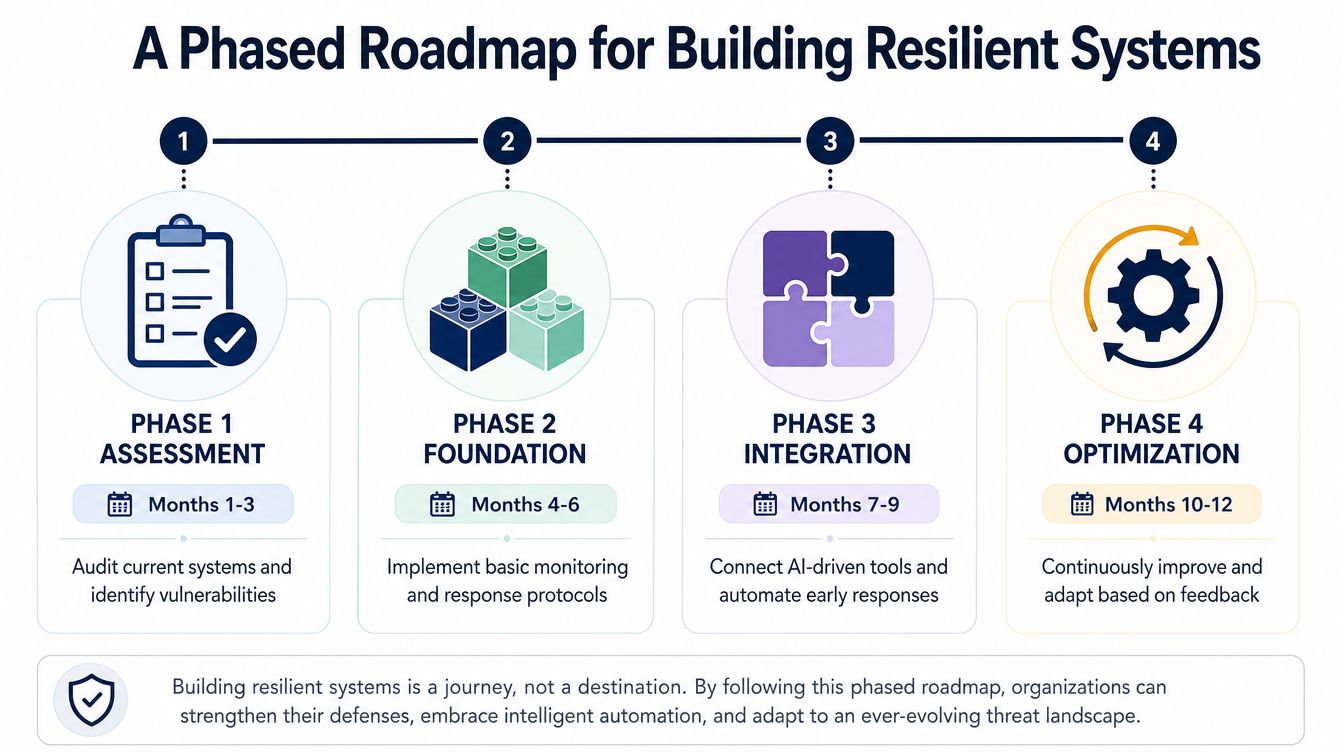
A Phased Roadmap for Building Resilient Systems
A healthcare platform can fail in ways that never show up in a product demo. The expensive mistake is buying tooling before you can describe the failure modes in your own environment. A phased plan keeps the work tied to actual dependencies, actual service lines, and actual recovery expectations.
Phase one: Assess and baseline
Start with a dependency audit. Identify the workflows that cannot stop, the systems they rely on, and the people who own each link in the chain. The output is a clear view of where service can break, where recovery is slow, and where evidence will be needed later.
Too many teams treat this as a documentation exercise. It is not. If you do not know where your critical paths run, you cannot decide which controls deserve funding, which runbooks deserve testing, or which services need tighter thresholds.
Phase two: Map and monitor
Next, instrument the dependencies. Observability becomes operational at this point, because teams need to see failures across infrastructure, integrations, and workflow layers. The goal is to catch degradation early enough to act before clinical service is affected.
That is also where service-level thresholds become useful. A board does not need raw telemetry. It needs a small number of measures that show whether the platform is drifting toward a patient-facing failure, and whether the team can prove it saw the drift in time.
If your environment includes high-risk inventory or time-sensitive logistics, resilience also depends on supply continuity. For a related operational angle, safeguarding your cryo inventory is a useful reminder that storage and transport dependencies can turn into patient-care issues very quickly.
Phase three: Automate early response
Once monitoring is trustworthy, automate the safe responses. Route traffic, scale capacity, isolate faulty integrations, or trigger fallback workflows where the decision rules are clear. The hard part is restraint. If the automation cannot be explained in an audit or during an incident review, it is too broad.
This phase is where software development service models matter, because resilience work has to fit how the platform is built and supported. The same applies to AI, where an AI implementation roadmap only helps if it stays within controls the team can validate. For product teams shipping regulated services, SaaS product development has to be designed with recovery paths, change control, and support handoff in mind.
Phase four: Test and improve continuously
The final phase is continuous testing. Run simulations, review outcomes, and update runbooks based on what happened. If the organization cannot prove it tested the recovery path, the path is still theoretical. That proof should be easy to pull during an audit, not assembled after the fact.
A practical build-out also benefits from a healthcare platform engineering guide when teams are aligning scale, compliance, and recovery in the same system. The section should read as an operating plan, not a slogan. Clarity, not perfection, is the success criterion here.
The Equity Gap in Resilience Planning
The hardest failures aren’t always technical. They’re often equity failures, where disruption hits vulnerable patients first and hardest. The 2024 review on healthcare disruptions points to the need for continuity planning for vulnerable populations, while a scoping review in fragile and conflict-affected settings highlights safety and security, infrastructure, social capital, and structural violence as still under-investigated even though they shape whether services keep functioning.
Dialysis, oncology, medication continuity, patient transport, and access for marginalized groups are the stress tests that matter. If those pathways fail, a system can look resilient on paper and still fail the people who need it most.
The new standard for healthcare operational resilience is proactive, equity-aware continuity design. That means planning scarce resources before multiple care pathways are hit at once, not after the first one breaks. It also means acknowledging that resilience is not equally distributed unless leaders deliberately design it that way.
Bridge Global helps healthtech teams design resilient platforms, connect critical workflows, and build software that can stand up to audits, outages, and growth. If you’re planning a resilience program, Bridge Global can support the architecture, integrations, AI-driven monitoring, and delivery model choices that turn risk management into operational practice.

About Preethi Saro Philip
Preethi Saro Philip is a Post Graduate Research Degree holder in Economics with more than 10 years of experience in writing, editing, research and teaching. She has an intense passion for content crafting and calls herself a ‘wordsmith’. She enjoys writing on wide-ranging topics including business, technology, health & lifestyle, education, environment etc.
View all posts by Preethi Saro Philip →