

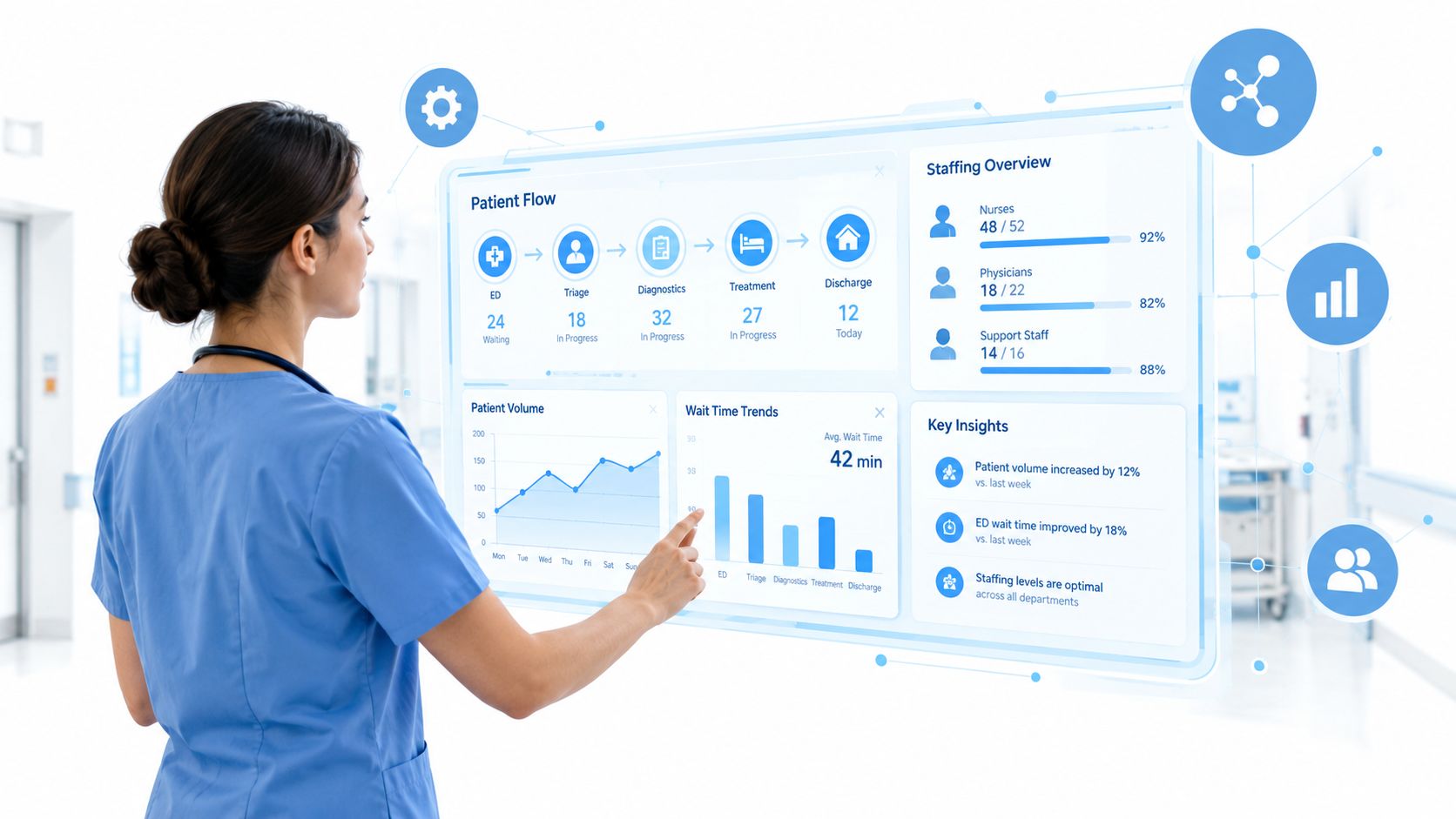

Healthcare Operational Analytics: The Complete Guide
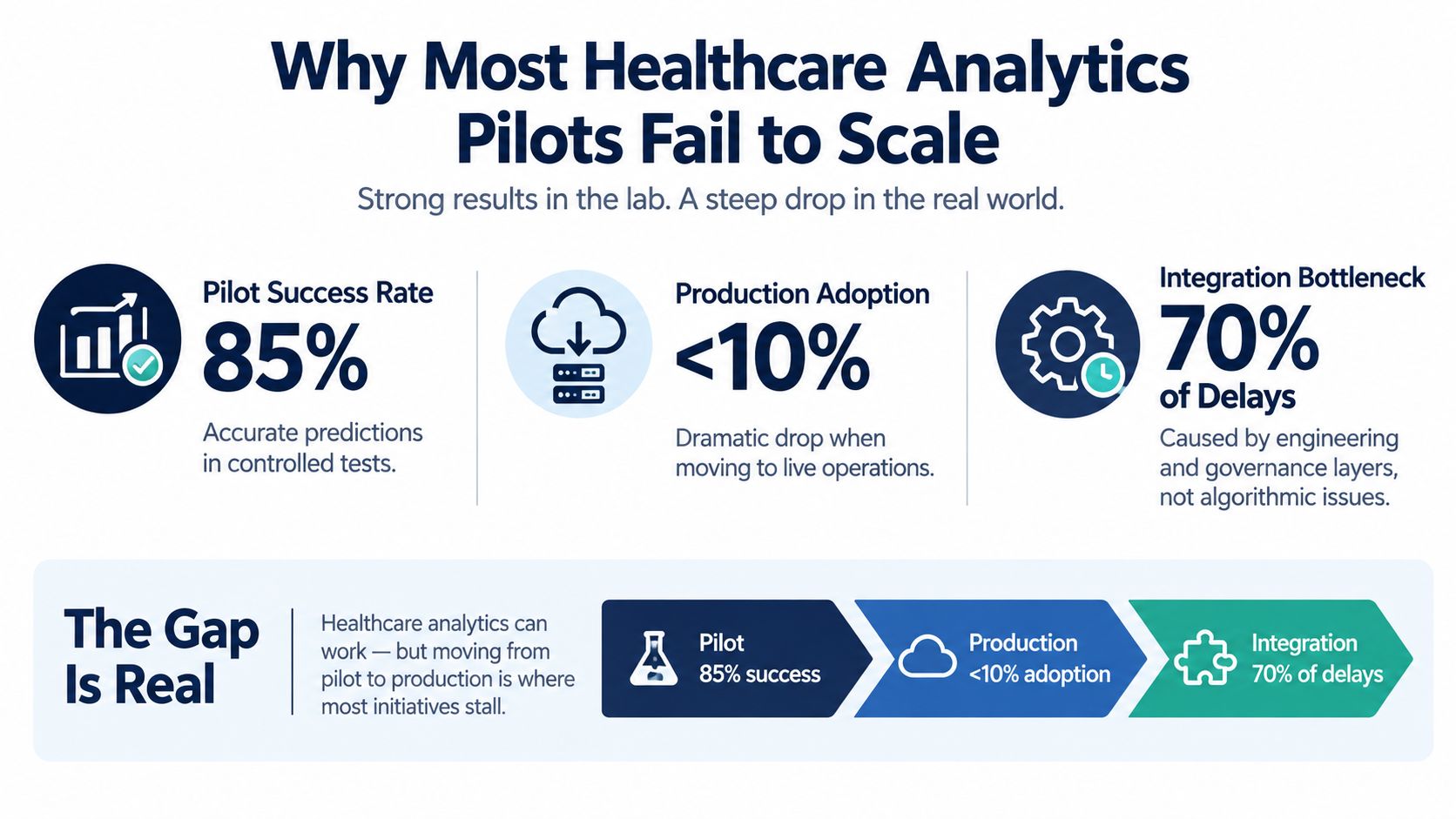
The popular advice is to start with the model. In healthcare, that's usually backwards. A prediction can score well in a test environment and still fail at the moment a bed manager needs it, because the underlying data is late, the patient identity is unresolved, the workflow has no owner, or staff receive an alert they can't act on.
Healthcare operational analytics is therefore less an algorithm project than a production engineering discipline. The hard work sits between electronic health records, scheduling systems, billing platforms, staffing tools, identity services, security controls, and the people responsible for patient flow. For healthtech founders, CIOs, CTOs, and product leaders, the central question isn't whether a model can predict an outcome. It's whether the organization can turn that prediction into a safe, timely, auditable decision.
Why Most Healthcare Analytics Pilots Fail to Scale
A pilot benefits from conditions that production cannot provide. Teams select a clean dataset, define a narrow outcome, investigate exceptions at leisure, and evaluate performance retrospectively. Live operations involve interfaces with different refresh cycles, conflicting departmental definitions, missing values, identity mismatches, and staff who must act while circumstances change.
Operational value depends on the prediction's connection to a real decision. Demand forecasts need a place in bed allocation. Length-of-stay signals need a route into discharge planning. Staffing predictions need escalation rules and an accountable owner. A dashboard that requires someone to remember to open it leaves the existing decision process intact.
The research base is substantial. A 2025 systematic review examined 414 healthcare operations-management studies published between 2010 and 2024, covering capacity planning, scheduling, resource allocation, quality, and process improvement. Research maturity helps teams choose sound methods, but dependable software also requires tested interfaces, clear ownership, and controls around data and decisions.
Adoption requires operational maturity
U.S. hospitals already use machine-learning functions inside many electronic health record systems. A study connecting the 2022–2023 American Hospital Association Annual Survey with the 2023–2024 AHA Information Technology Supplement analyzed 2,562 general and acute-care hospitals, representing 4,055 hospital-year observations. Approximately 73% to 76% reported at least one machine-learning function in their EHR systems during 2023–2024, with adoption increasing by 10.7 percentage points from 2023 to 2024.
Implementation capacity remains uneven. 83.8% of metropolitan hospitals reported EHR-based machine-learning adoption compared with 61.3% of nonmetropolitan hospitals. For SaaS builders, that difference means supporting varied interface quality, interoperability, staffing, infrastructure, and governance capacity. A deployment that depends on perfect feeds or dedicated data engineering staff will exclude the organizations that need careful implementation most.
Operational analytics needs a controlled layer around the model:
Data contracts: Define fields, ownership, refresh expectations, acceptable null rates, and change-management rules.
Workflow ownership: Name the person or team responsible for responding to a signal.
Human override: Let authorized users reject, defer, or correct recommendations, with the reason recorded.
Operational service levels: Monitor pipeline freshness, interface failures, prediction availability, and alert delivery.
Outcome measurement: Connect model use to wait time, throughput, staffing pressure, discharge completion, or another decision-level outcome.
Practical rule: If the analytics team cannot describe who acts on a prediction, when they act, and what happens after an override, the product is not ready for production.
Teams assessing the engineering implications can also consult Bridge Global's healthcare analytics engineering perspective. The platform must operate as a governed decision service across fragmented systems, with auditability, failure handling, and workflow ownership built into the delivery design.
Turning Data into Decisions and Core Use Cases
Useful healthcare analytics starts with a decision that needs to happen earlier, more consistently, or with better coordination. Bed allocation, discharge readiness, staffing coverage, procedure scheduling, and revenue-cycle exceptions each require different data, owners, and tolerance for error. An available dataset is not a use case.
Length of stay is a capacity signal
Predictive length-of-stay analytics can turn EHR data into an early warning of bed demand. A peer-reviewed study using New York State SPARCS data incorporated diagnosis codes, illness severity, and surgery requirements. Its strongest reported coefficient of determination was R² = 0.82 for newborns and R² = 0.43 for non-newborns.
Those results argue against treating one hospital-wide model as universally reliable. Production systems should support service-line-specific models, recalibration, subgroup evaluation, and uncertainty intervals instead of presenting one confident value for every patient. Generate a forecast at admission, then refresh it after clinically meaningful events, such as surgery, a change in acuity, or a new discharge barrier.
The forecast must connect to work. A high-risk stay prediction can create a case-management task, start post-acute placement work, or schedule a multidisciplinary review. Without one of those paths, the prediction leaves the existing capacity problem untouched.
Discharge predictions need coordinated ownership
Discharge forecasting becomes useful when it is embedded in a defined operating process. In a large hospital-network study, machine-learning models for short-term discharge and related outcomes achieved out-of-sample AUC values from 75.7% to 92.5% and were reported as well calibrated. Combining 48-hour discharge predictions with physician predictions was associated with 10% to 28.7% more patient discharges, fewer 7-day and 30-day readmissions, and p < 0.001 statistical significance.
The same study estimated a 0.67-day reduction in average length of stay and projected an annual contribution-margin benefit of $55 million to $72 million. Treat those figures as evidence from a particular intervention design, not as a ready-made business case. The reported result depended on forecasts being combined with coordinated clinical action.
A safer discharge workflow should:
Surface candidates: Identify patients likely to be ready for discharge within the operating horizon.
Validate clinically: Ask the physician and care team to confirm or reject the signal.
Resolve dependencies: Check transport, medication reconciliation, outstanding tests, home support, and post-acute capacity.
Record the decision: Preserve the prediction, action, override, and reason for auditability.
Measure safety: Track readmissions and delayed care alongside throughput.
Design the case-management task, post-acute placement step, or multidisciplinary review before the model ships. The forecast earns its keep only when that action path exists. The guide to predictive analytics in healthcare operations offers a companion view, while implementation still depends on local workflow design, data quality, and accountable ownership.
Essential Metrics and Fragmented Data Sources
A hospital can't calculate a trustworthy operational metric until it agrees on the event being measured. “Discharge time” might mean the physician order, the medication-ready timestamp, the patient's departure, or the bed's release. Each definition produces a different operational conclusion.
Start with a metric dictionary. For every KPI, document the business meaning, source system, event timestamp, refresh cadence, inclusion rules, exclusions, owner, and downstream action. This prevents different departments from publishing competing versions of occupancy, wait time, cancellation, or length of stay.
The KPI layer needs context
Useful metrics commonly fall into several operational groups:
Patient flow: Arrival-to-triage time, admission-to-bed time, transfer delays, discharge readiness, and emergency-department boarding.
Capacity: Bed occupancy, staffed-bed availability, operating-room utilization, procedure cancellations, and equipment availability.
Workforce: Scheduled versus required coverage, overtime pressure, agency use, shift gaps, and workload distribution.
Revenue cycle: Claim exceptions, authorization delays, coding queues, denial categories, and time to payment.
Quality and safety: Readmissions, delayed care, escalation events, and subgroup differences in access or outcomes.
The metric alone is never enough. A fall in average length of stay might reflect faster discharge, changes in case mix, premature transfers, or missing timestamps. A staffing dashboard can reduce visible overtime while shifting burden to a different team. Operational analytics should expose these trade-offs instead of hiding them behind a single efficiency score.
Integration is the actual work
The data usually sits across EHR tables, laboratory and imaging systems, admission-transfer-discharge feeds, scheduling applications, nurse rostering, payroll, claims, chargemaster data, payer contracts, and patient-facing tools. These systems rarely agree on identifiers, terminology, time zones, event order, or update behavior.
A practical ingestion design needs:
Patient and encounter identity resolution, with a clear strategy for merges, duplicates, and late corrections.
Incremental ingestion, so updates don't require rebuilding every historical record.
Lineage, showing where each metric and feature originated.
Quality checks, including completeness, freshness, referential integrity, and unexpected distribution changes.
Replay and recovery, because an interface outage shouldn't permanently remove events from an operational timeline.
A national survey of 243 U.S. healthcare CIOs and senior IT executives found that 42% cited operational goals such as efficiency improvement as an analytics driver. The same source reported that 65% considered administrative business intelligence more important than the previous year, while only 21% reported using cloud functions for business intelligence and 22% for clinical data analytics. The message is clear: demand for analytics can grow faster than the infrastructure needed to support it.
Architecting for Interoperability and AI Integration
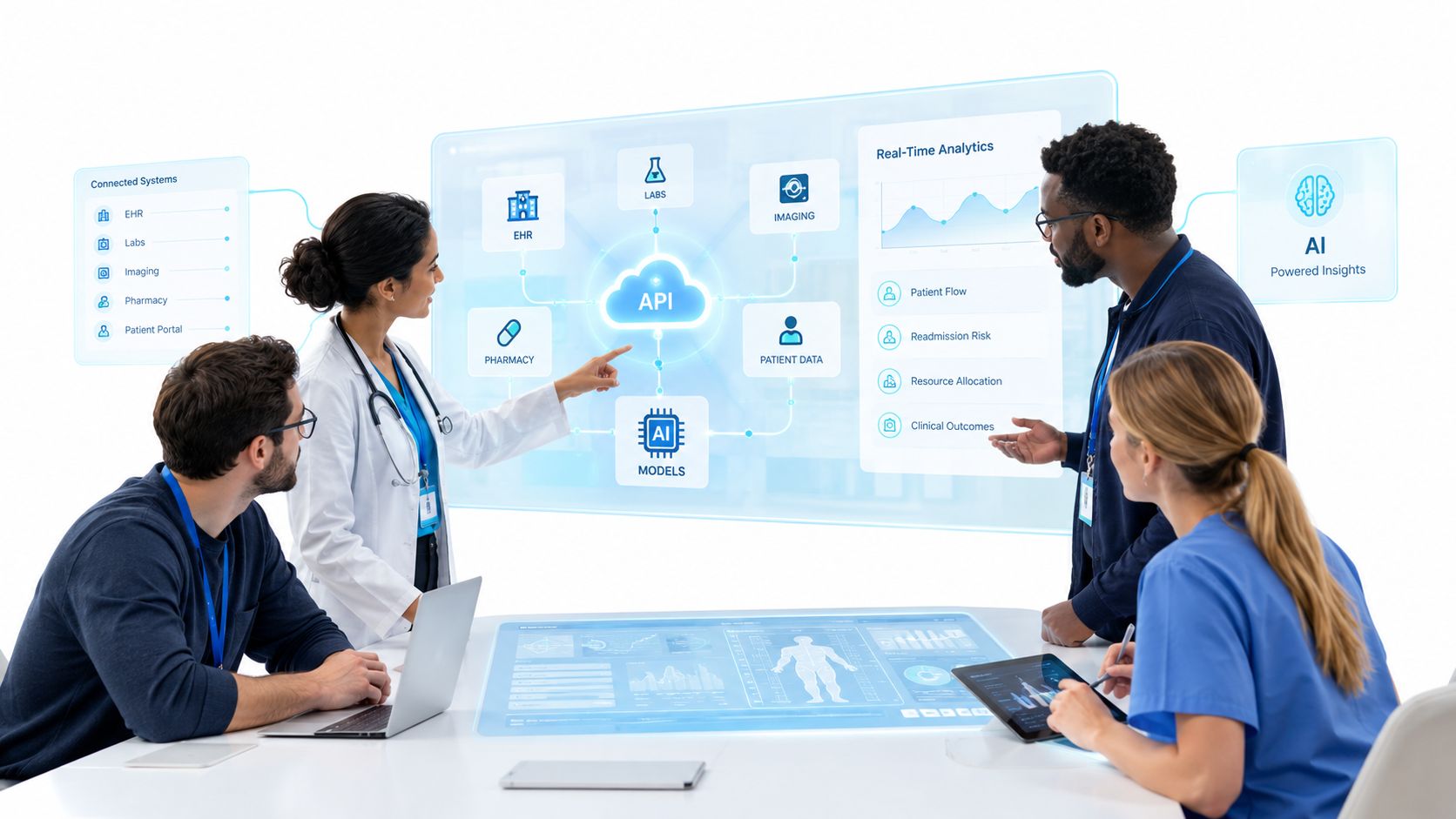
A production architecture should separate the systems that record care from the services that interpret operational signals. That separation makes it easier to change a model without rewriting the EHR integration, while preserving a controlled path for recommendations to return to the workflow.
A typical design includes source connectors, an interface and normalization layer, a governed longitudinal store, feature and metric services, model-serving endpoints, workflow APIs, and an observability layer. Each component needs an owner. A data lake without data contracts becomes another silo, while a model endpoint without versioning becomes an untraceable clinical dependency.
Interoperability must serve the workflow
FHIR can provide a machine-readable structure for exchanging clinical and administrative resources, but adopting a standard doesn't eliminate mapping work. Teams still need to handle local extensions, terminology differences, missing fields, consent boundaries, bulk extraction, and the distinction between a clinical record and an operational event.
Use interoperability standards where they reduce coupling, then supplement them with explicit event contracts for operational workflows. A bed-status update, staffing change, or scheduling cancellation may need a freshness guarantee and event history that isn't captured by a simple dashboard query.
A useful architecture question is not “Can we connect to the EHR?” It is “Can we prove which source generated this decision, when the data was current, and what the receiving workflow did with it?”
AI belongs inside delivery, not beside it
AI can support feature generation, anomaly detection, documentation, test creation, code review, forecast serving, and workflow recommendations. It shouldn't bypass software engineering controls. Every model needs versioning, evaluation data, approval criteria, rollback capability, and monitoring for drift and subgroup performance.
For clinical and administrative users, explainability needs to match the decision. A bed manager may need the drivers behind a capacity forecast. A clinician may need the recent events supporting a discharge recommendation. An engineer needs logs showing input freshness, feature transformations, latency, and model version.
Teams evaluating clinician-facing AI can also consult this guide to AI for clinicians for practical context on how conversational systems may support healthcare teams. The architecture should still keep generative interfaces separate from authoritative patient and operational records, with permissions and human review applied before any consequential action.
For healthtech builders, Bridge Global's AI development services are relevant when model work must be integrated with broader product engineering. The same principle applies whether the implementation is built internally or with a partner: AI should strengthen a governed workflow, not become an isolated demonstration.
Navigating Compliance and Data Governance
Compliance shapes the data model, access paths, logging strategy, deployment design, and operating procedures from the first architecture decision. Treating it as an approval step at the end leaves teams unable to explain lineage, restrict access, or prove that controls work in production.
The HIPAA Security Rule requires regulated entities to assess risks and vulnerabilities affecting the confidentiality, integrity, and availability of electronic protected health information. HHS describes risk analysis as the starting point for selecting safeguards. The work includes defining scope, gathering data, documenting threats and vulnerabilities, assessing existing controls, estimating likelihood and impact, assigning risk levels, and recording safeguards.
Build evidence into the platform
A governed analytics service needs more than role-based access. It should maintain:
Data inventory: Which patient, claims, workforce, and financial fields exist, where they originate, and how they move.
Access boundaries: Which users, services, and environments can access identifiable or sensitive data.
Transformation lineage: How raw events become metrics, features, predictions, and recommendations.
Operational logs: Who viewed, changed, approved, rejected, or exported a result.
Risk evidence: Which threats were assessed, which controls were selected, and when the assessment changed.
Retention behavior: How long data, predictions, audit records, and temporary processing artifacts remain available.
Governance must also account for human impact. Operational models can redistribute workload, intensify surveillance, or penalize departments whose records are incomplete. Review performance across relevant patient groups, locations, acuity levels, roles, and service lines. Give workers a defined route to challenge a metric that affects staffing or performance evaluation.
Price transparency is a data-engineering problem
U.S. hospitals must publish standard-charge data in one machine-readable file containing gross charges, discounted cash prices, payer-specific negotiated charges, and de-identified minimum and maximum negotiated charges. They must also provide a consumer-friendly display covering at least 300 shoppable services, or every shoppable service they provide if fewer than 300.
CMS can escalate from warnings to corrective action plans and civil monetary penalties, and it publicizes penalties for noncompliance. Pricing analytics therefore becomes a pipeline reliability responsibility. The system needs schema validation, service-level mapping, completeness checks, freshness monitoring, and reconciliation across chargemaster, contract, revenue-cycle, and patient-facing sources.
Organizations working across safety and quality programs may find this NSQHS Standards psychologist guide useful for broader governance context, although U.S. teams still need to map controls to their own regulatory environment. Bridge Global's healthcare data governance guide provides a related view of turning governance requirements into operating practices rather than policy documents alone.
From Pilot to Production and the Implementation Roadmap
A pilot asks whether a model can produce a useful signal. Production asks whether the signal remains available, understandable, safe, and actionable under changing conditions.
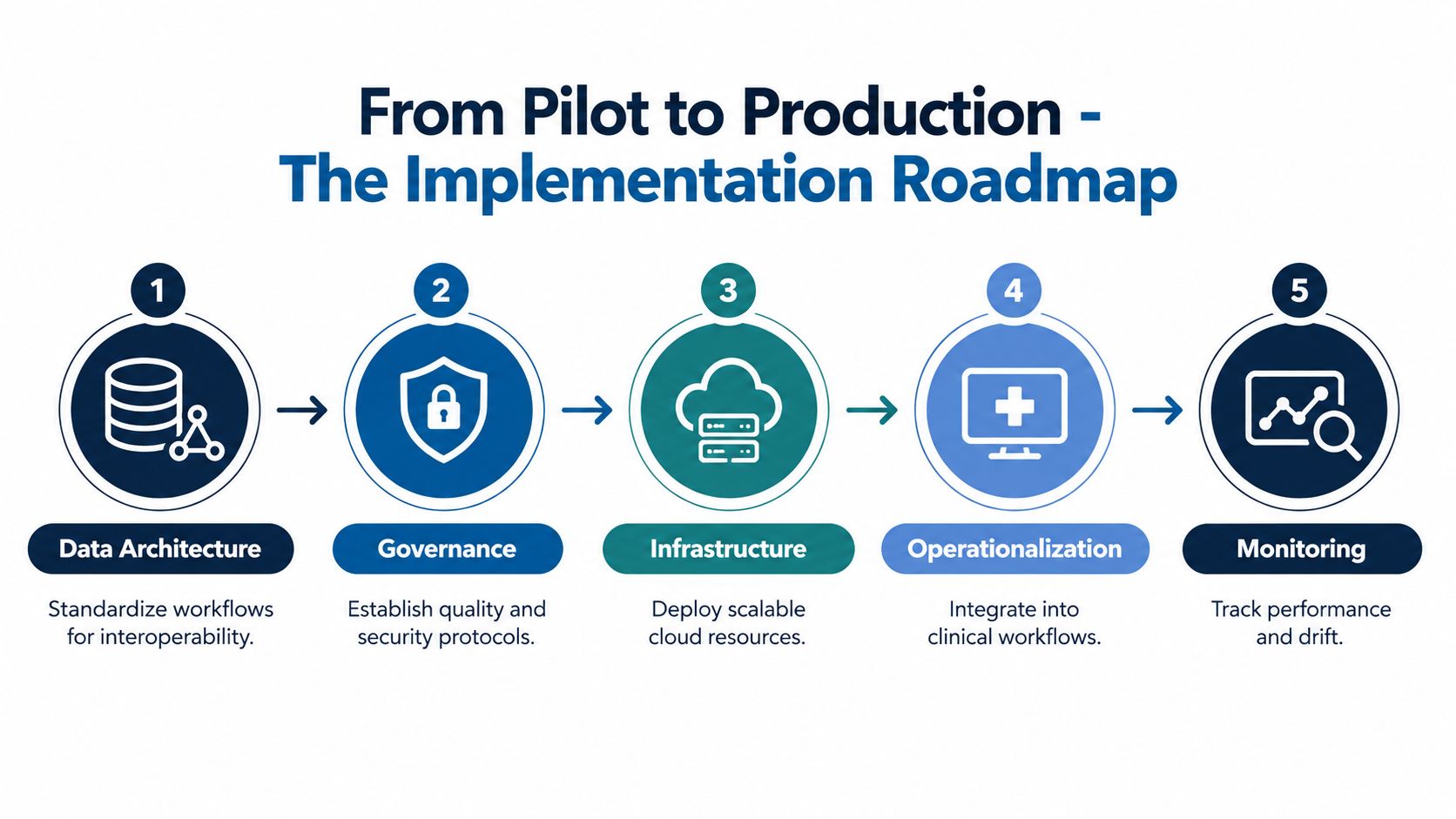
The transition needs explicit gates:
Data architecture: Standardize source definitions, identity resolution, event timing, and interface contracts.
Governance: Approve access boundaries, risk controls, human overrides, audit requirements, and ownership.
Infrastructure: Deploy repeatable pipelines, scalable storage, model serving, secrets management, and recovery procedures.
Operationalization: Embed outputs in the scheduling, staffing, bed-management, discharge, or revenue-cycle workflow.
Monitoring: Track freshness, latency, alert burden, calibration, drift, subgroup performance, intervention uptake, and operational outcomes.
The comparison is straightforward:
| Pilot environment | Production environment |
|---|---|
| Curated dataset | Continuously changing source systems |
| Retrospective evaluation | Live decisions with consequences |
| Expert supervision | Distributed operational ownership |
| Model score as a headline metric | Workflow, safety, fairness, and outcome measures |
| Manual recovery | Documented rollback and incident response |
Recent coverage reports that only about 30% of healthcare AI pilots reach production, while a 2025 health-system AI adoption study found 77% of respondents ranked inadequate tool maturity among their top two barriers. Those figures reinforce the engineering lesson: the last mile isn't a deployment detail. It's the product.
Teams should define success in operational terms, such as reduced wait time, fewer avoidable delays, safer discharge coordination, lower alert burden, or better staffing visibility. A model can remain technically accurate while becoming operationally harmful if its inputs drift, its recommendations arrive late, or staff stop trusting it.
Bridge Global helps healthtech teams connect analytics, AI, interoperability, and compliant software engineering into production-ready products. Visit Bridge Global to discuss the data architecture, workflow integration, and governance controls needed to turn a healthcare analytics pilot into a dependable operational service.

About Preethi Saro Philip
Preethi Saro Philip is a Post Graduate Research Degree holder in Economics with more than 10 years of experience in writing, editing, research and teaching. She has an intense passion for content crafting and calls herself a ‘wordsmith’. She enjoys writing on wide-ranging topics including business, technology, health & lifestyle, education, environment etc.
View all posts by Preethi Saro Philip →