



Healthcare Loop Engineering Explained
The popular advice is simple: improve the model, connect it to the EHR, and let a clinician review the output. That sequence sounds sensible, but it misses the failure point that matters most. A healthtech product can generate an accurate recommendation and still fail the patient if nobody owns the result, the action isn't completed, or the outcome never returns to the system.
Healthcare loop engineering treats care delivery as an engineered control loop. A referral should produce a completed appointment, a documented result, clinician review, and communication to the patient or referring professional. An AI recommendation should lead to an accountable response, an executed action, a recorded outcome, and evidence that the system behaved safely under real operating conditions.
Redefining Healthcare Loop Engineering Beyond AI Hype
A notification isn't a closed loop. It only proves that software emitted a message.
Diagnostic referral processes show why this distinction matters. A systems-engineering study found that referral-loop failure rates in health systems commonly ranged from 65% to 73%, with substantial delays despite years of improvement work in its analysis of diagnostic referral processes. In baseline data from 2018 to 2019, loop closure averaged 86% for skin lesions considered concerning for cancer and 80% for lesions considered non-concerning. Average closure times were 68.3 days and 94.7 days, respectively.
Those figures describe an operational problem, not a model problem. The system must identify who owns the result, confirm receipt, handle exceptions, reconcile duplicate or conflicting records, and communicate what happened. A highly accurate model can't perform those duties unless the surrounding product has been designed to support them.
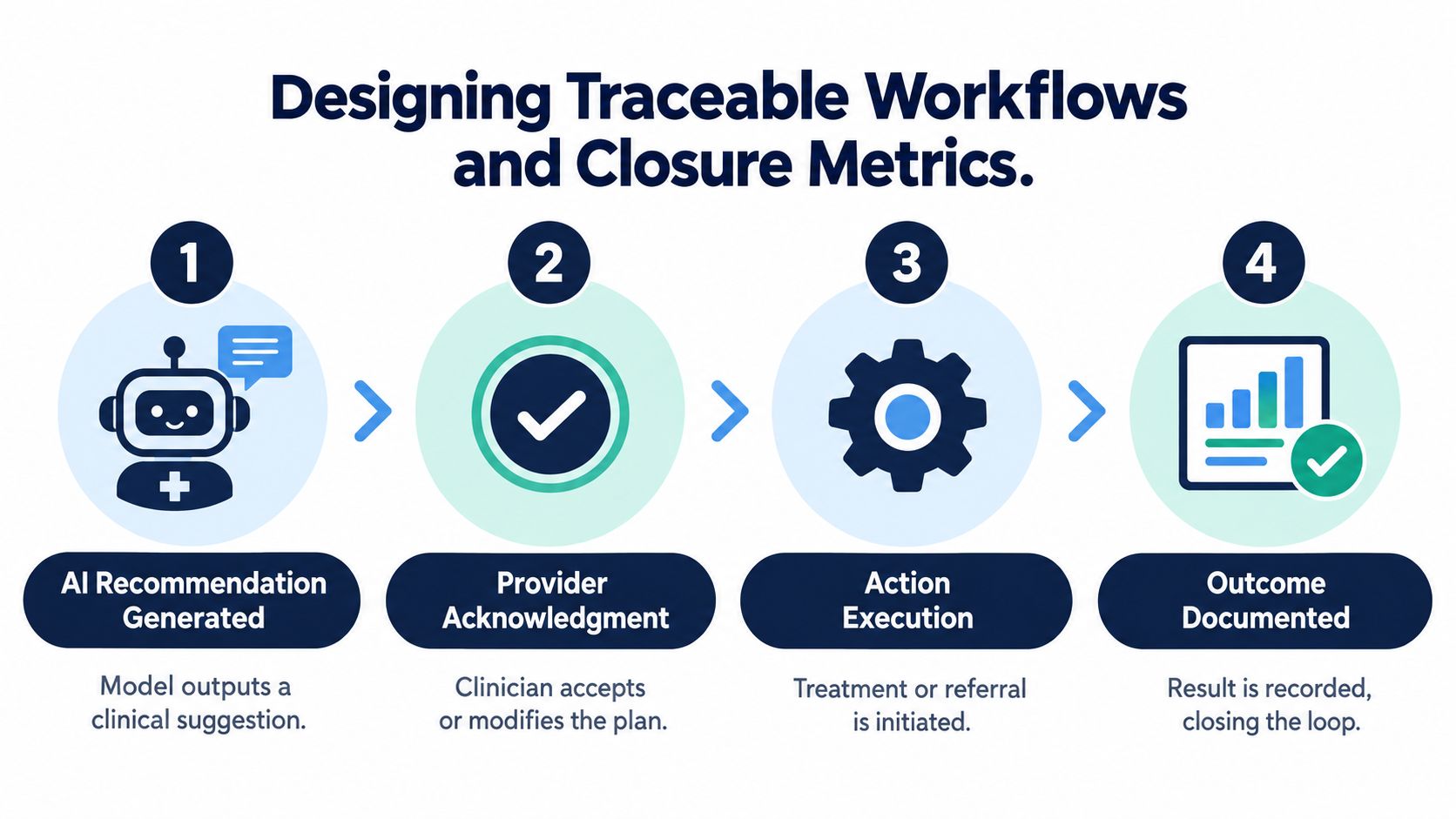
Practical rule: Treat every clinical recommendation as an unfinished transaction until the responsible person acknowledges it, the action occurs, and the outcome is documented.
Why ownership beats another dashboard
Healthcare organizations often respond to missed follow-up by adding alerts. That approach can increase message volume without creating accountability. An alert that lands in a shared inbox, lacks a due date, and provides no escalation path is technically delivered but operationally weak.
The AHRQ learning lab on closed-loop communication applies systems engineering, human-factors methods, and simulation modeling to timely follow-up of critical diagnostic actions. Its underlying lesson is practical: diagnostic-loop failure requires workflow redesign, not just another dashboard.
Fragmented safety data make the problem harder. Reports may be underreported, free-text records are difficult to analyze, and learning remains divided across hospitals and countries. Product leaders should therefore resist the assumption that the most valuable AI loop is an autonomous diagnostic engine. In many care pathways, the higher-value system is a traceable responsibility and escalation engine that ensures the right professional sees the right information and acts within a defined process.
Teams exploring the broader role of AI in clinical workflows can also browse AI healthcare innovations training for additional context. The engineering priority remains the same: measure completed care, not generated output.
Architecting Safe and Adaptive Closed-Loop Systems
A safe closed-loop platform separates real-time control from longitudinal learning. The first layer makes bounded decisions using current, validated inputs. The second studies outcomes and proposes changes through a controlled release process. Combining both layers into one adaptive service makes debugging, validation, and accountability unnecessarily difficult.
Closed-loop insulin delivery provides a clear engineering pattern. In a 16-week multicenter randomized trial involving children aged 6 to 13 with type 1 diabetes, closed-loop therapy increased time in the 70 to 180 mg/dL range from 53% at baseline to 67%, compared with an increase from 51% to 55% with sensor-augmented pump therapy. The adjusted between-group improvement was 11 percentage points, equivalent to approximately 2.6 additional hours per day in range, with P<0.001, as reported in the NEJM trial of closed-loop control.
The result isn't just a model-accuracy story. It reflects a complete system of sensing, algorithmic control, intervention, and physiological feedback.
Use two engineering speeds
The safety-critical controller should use conservative, bounded rules when confidence is low. It needs explicit limits for intervention changes, stale-data detection, fallback modes, alert escalation, and human override. A learning service can operate more slowly, evaluating real-world outcomes and changing parameters only after validation and clinical governance.
A dialysis environment illustrates why context matters. In adults with type 2 diabetes requiring dialysis, a fully automated closed-loop system increased time in the 5.6 to 10.0 mmol/L target range to 52.8%, versus 37.7% with standard insulin therapy. The 15.1-percentage-point improvement represented more than 3.5 additional hours per day in range, according to the Nature Medicine study of automated closed-loop insulin delivery during dialysis.
Dialysis introduces changing treatment schedules, meals, medication, fluid shifts, and physiology. A resilient loop must model context and uncertainty rather than assume stable patient behavior.
Make every decision reproducible
An event-sourced data model should preserve:
-
Input evidence: The original sensor payload, timestamp, quality indicators, and contextual features.
-
Decision context: The model or policy version, confidence, constraints, and selected action.
-
Execution record: The intervention, delivery status, safety override, and responsible user.
-
Observed response: The subsequent physiological or clinical outcome.
-
Release lineage: The code, configuration, prompt, and validation evidence active at decision time.
The related Bridge Global article on AI feedback loops in healthcare explores the broader feedback pattern. For a production platform, the standard is stricter than conceptual completeness. An engineer should be able to reconstruct why a recommendation was made and what happened afterward without relying on mutable logs or a model's current behavior.
Designing Traceable Workflows and Closure Metrics
A clinical loop closes only when the intended care action is complete and recorded. For an abnormal test, that means more than sending a result to a clinician. The system needs an owner, receipt confirmation, action status, patient-contact handling, and a documented outcome.
The same principle applies to referrals and symptom pathways. A referral created in one organization may pass through an EHR, laboratory, imaging service, primary-care practice, specialist office, and patient communication channel. Each handoff creates an opportunity for ambiguity.
Define the state machine before the interface
Start with explicit states rather than screens:
-
Created: The test, referral, or symptom event exists and has a responsible queue.
-
Assigned: A named role or professional owns the next action.
-
Received: The recipient has confirmed access to the relevant information.
-
Action pending: The system records what must happen and by when.
-
Action completed: The appointment, review, treatment, or outreach occurred.
-
Outcome documented: The result is stored in a form that downstream users and systems can interpret.
-
Closed or escalated: The loop is complete, or an exception has moved to a higher-responsibility path.
This model handles unreachable patients, cancelled appointments, duplicate referrals, conflicting results, and cross-provider handoffs more reliably than a notification table. It also gives product teams a common language for audit events and operational reporting.
Measure time, ownership, and exceptions
Useful metrics include time to acknowledgment, time to action, unresolved-result aging, failed-contact rate, referral completion rate, and percentage of results acknowledged by the responsible clinician. Track patient notification separately from clinician acknowledgment because one doesn't prove the other.
A dashboard should expose aging cases and missing transitions, not just counts of alerts sent. Escalation should be rule-based and visible. If a responsible user doesn't acknowledge a result, the system needs a defined next step, an audit trail, and a person or team accountable for resolution.
Custom healthcare software development must prioritize workflow integration over standalone analytics at this point. A polished dashboard can't compensate for missing status signals, weak identity mapping, or an interface that forces clinicians to leave their established workflow.
Navigating FDA Frameworks and Interoperability Rules
Regulation shapes the architecture before deployment. Teams building continuously improving clinical software need a defined boundary around what may change, how changes are validated, and which evidence supports release.
The FDA's Predetermined Change Control Plan, or PCCP, specifies three elements: planned device modifications, the methodology used to develop, validate, and implement those modifications, and an assessment of their impact. The FDA reviews the PCCP as part of the original marketing submission. Covered modifications can then proceed within the authorized plan, while changes outside its scope may require a new marketing submission. The mechanism applies to AI-enabled devices reviewed through the 510(k), De Novo, and Premarket Approval pathways, as described by the FDA overview of AI-enabled medical devices.
That distinction should appear in the release pipeline. A routine parameter update that fits the approved methodology isn't equivalent to a change in intended use or clinical behavior.
Define the learning boundary
The FDA's proposed framework for continuously learning medical-device software separates SaMD Pre-Specifications from an Algorithm Change Protocol. Pre-Specifications define what aspects may change. The protocol explains how the system will learn and change while maintaining safety and effectiveness, with transparency and real-world performance monitoring across the lifecycle. The FDA framework for predetermined change control provides the relevant structure.
Your engineering workflow should therefore include:
-
A versioned list of permissible modifications.
-
A documented validation method for each modification type.
-
An impact assessment and release approval record.
-
A rollback path and post-release monitoring plan.
-
A clear decision on whether a change remains within the authorized scope.
Interoperability creates a second constraint. Under ONC information-blocking rules, the applicability date was April 5, 2021. Before October 6, 2022, the EHI covered by the definition was limited to data elements represented in USCDI. ONC materials describe a broader transition period after which the scope expanded to all EHI as defined by the rule, as explained in the ONC information-blocking timeline.
For teams designing healthcare integrations, API authorization, provenance, auditability, and data scope need to be mapped to the applicable regulatory definition. The Bridge Global guide to interoperability solutions in healthcare offers related context. Data exchange isn't an informal implementation detail when clinical outcomes feed analytics or model improvement.
Validating AI Performance and Managing Automation Bias
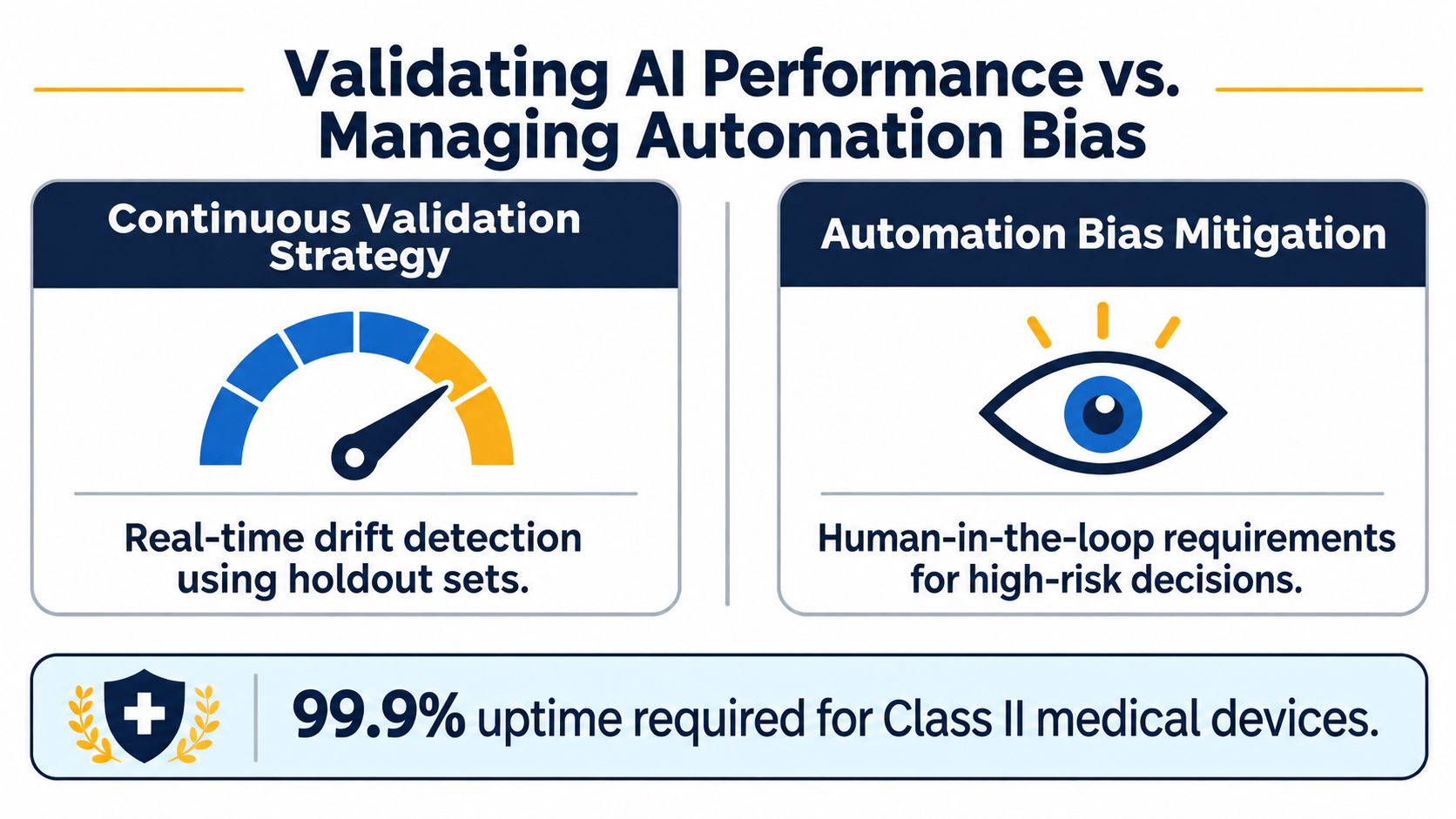
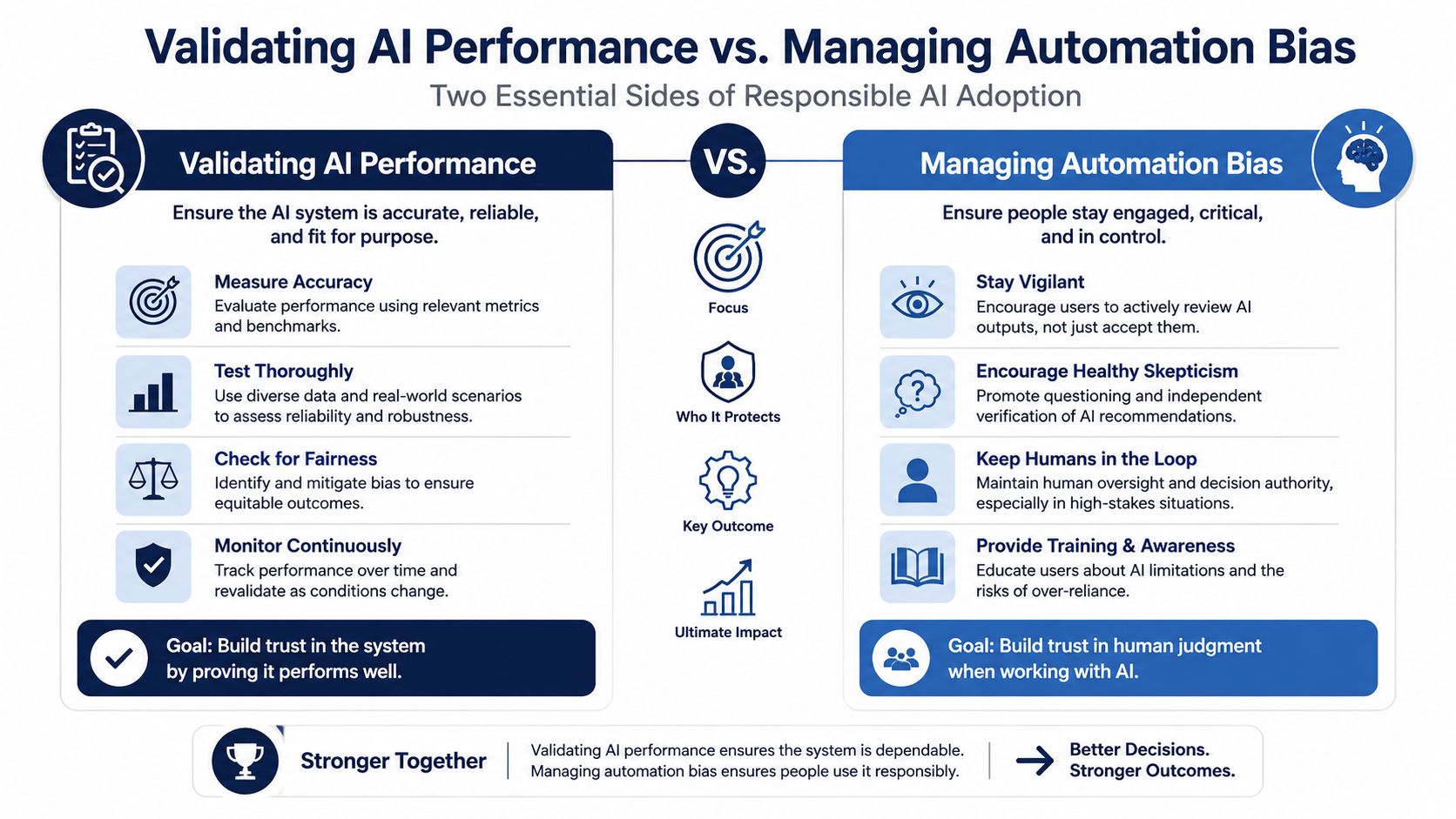
Post-market assurance must answer two different questions. Does the system still perform as intended? And does the workflow cause people to trust or ignore it in unsafe ways?
Automated monitoring is effective for detecting drift, missing data, latency, and changes in input distributions. It can compare production inputs with validation baselines, flag unusual confidence patterns, and identify subgroup performance changes. It can't decide whether a clinical workflow remains appropriate after a policy change, staffing change, or new patient population.
Human review provides context, but adding a reviewer doesn't automatically create safety. If the interface places an AI recommendation outside the clinician's normal workflow, presents confidence without useful evidence, or floods the user with low-value alerts, the reviewer may add cognitive load without providing meaningful scrutiny.
Compare control strategies
| Strategy | What it handles well | Where it fails |
|---|---|---|
| Automated drift monitoring | Input shifts, missingness, latency, and technical anomalies | It may not detect changed clinical meaning or unsafe workflow behavior |
| Human review gates | High-risk decisions, exceptions, and contextual judgment | Poor integration can create workload and automation bias |
| Scheduled revalidation | Formal evidence before a release | It can miss problems between review cycles |
| Continuous outcome monitoring | Real-world effects and downstream care results | It requires reliable outcome capture and subgroup visibility |
A systematic review of 71 clinical decision-support evaluations found that 48 systems, or 68%, significantly improved clinical practice, with a 95% confidence interval of 56% to 78%. A later meta-regression covering 162 randomized trials found improvements in care processes or patient outcomes in 94 studies, or 58% of the total. The systematic review of clinical decision-support evaluations also reported that systems with four effective design features improved practice in 68% of evaluations, compared with 46% for systems lacking those features.
The evidence supports disciplined design, not automatic deployment. The system should connect recommendations to the point of decision, make the responsible action clear, record acceptance or override, and capture downstream outcomes.
Establish explicit stop criteria
Use versioned models and prompts, immutable decision logs, confidence and abstention thresholds, independent subgroup audits, rollback procedures, and named ownership for every alert. A keep, modify, or disable decision should depend on outcome-specific evidence, safety signals, workload impact, and performance across relevant groups.
Adoption and login counts are weak proxies. A safe AI loop records whether recommendations were accepted, overridden, or ignored, then connects those responses to clinical outcomes and adverse events.
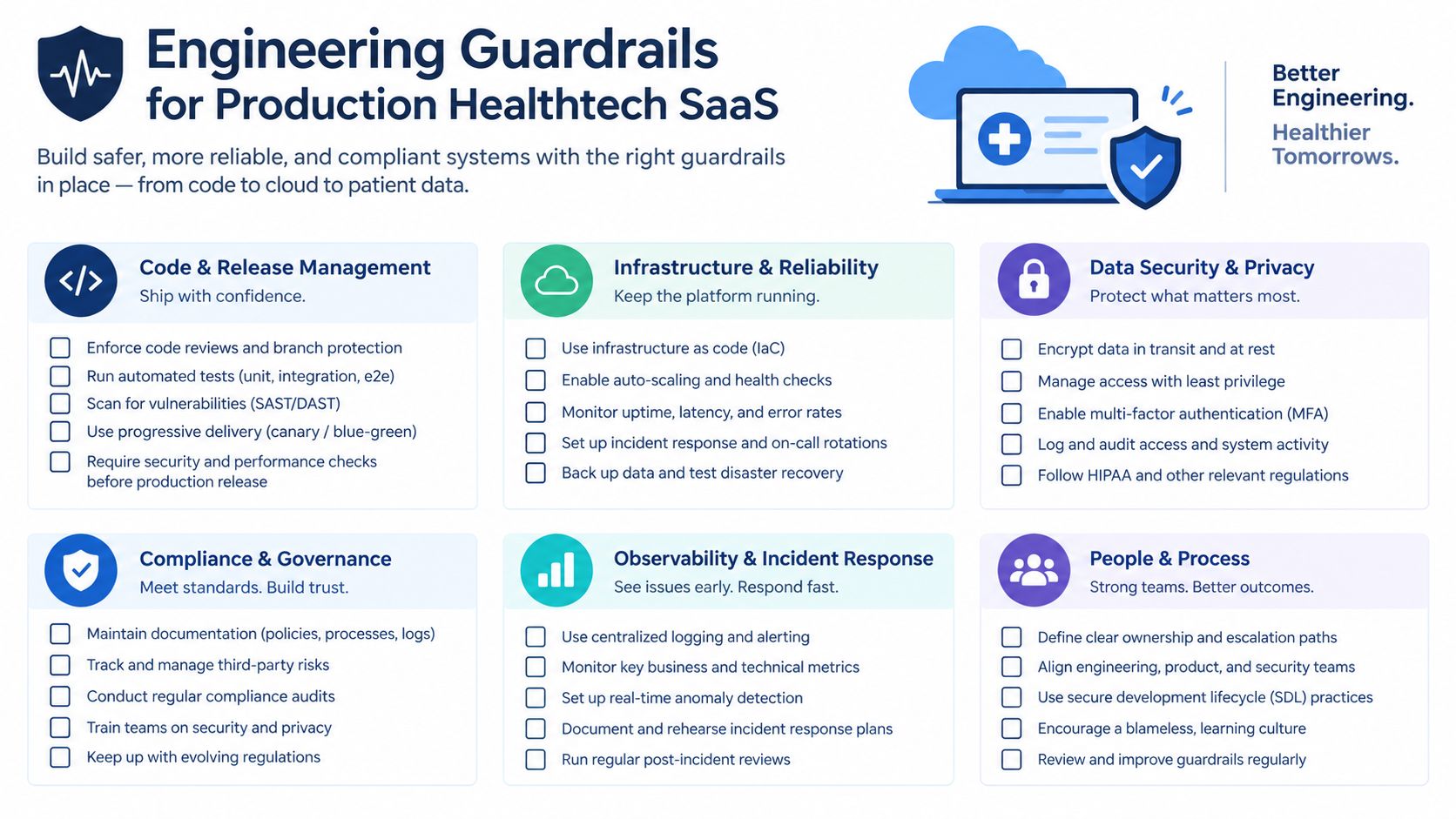
Engineering Guardrails for Production Healthtech SaaS
A production healthtech platform is safe only when the full operating loop stays predictable under stale data, network latency, missing observations, actuator failure, unexpected patient context, and model uncertainty.
That standard changes the engineering work. The hard part is rarely model serving alone. It is defining what the system may do, when it must abstain, how it fails, who owns each threshold, and what evidence remains after an incident review.
Closed-loop insulin systems make those requirements concrete. A production specification should define the sampling interval, maximum tolerated sensor age, intervention rate limits, bounded dosing, fallback control mode, alert escalation, and human override. Those values belong in versioned configuration with named ownership and formal review, not in undocumented assumptions buried in application code.
Prefer controlled degradation to silent failure
When data quality drops, the platform should narrow its behavior on purpose. It can pause automated intervention, switch to a conservative fallback policy, require human confirmation, or escalate to a clinician queue. It should never continue normal operation on stale or partial inputs just because the model endpoint still returns a score.
The guardrails that matter in production are operational, not rhetorical:
-
Stale-data detection: Reject or quarantine observations that exceed the allowed age for the workflow.
-
Bounded interventions: Limit both the size and frequency of automated changes.
-
Fallback operation: Define the behavior for sensor loss, network interruption, actuator failure, and model-service outages.
-
Immutable audit trails: Preserve inputs, decisions, overrides, releases, and outcomes in a form that supports investigation.
-
Distribution-shift monitoring: Compare live inputs and contexts with the validated operating range.
-
Access control: Separate service identities, clinical roles, administrative privileges, and release approval rights.
Event-sourced architectures support these controls well because they preserve sequence, causality, and replayability. Store append-only domain events for sensor receipt, model evaluation, policy decision, intervention, acknowledgment, override, escalation, and outcome. Materialized views can support responsive clinician screens. The event history remains the source of truth for traceability, incident analysis, and reproducibility.
This is a better foundation for SaaS product development than treating the platform as a set of dashboards and APIs. Multi-tenant healthcare products need tenant isolation, traceable configuration, controlled rollout paths, and observability from the start. In practice, that means release gates tied to safety checks, customer-specific policy controls, and logs that can answer a regulator’s first question. What happened, to whom, under which version, and with whose approval?
Engineering position: Models can be swapped. The evidence trail for how the clinical loop behaved must persist.
Executing a Compliant AI Implementation Roadmap
Teams often start in the wrong place. They compare models, debate vendors, and postpone the harder work of defining who owns the loop when a result is abnormal, delayed, duplicated, or ignored. In healthcare, implementation quality depends less on raw model accuracy than on whether the system can prove closure, preserve traceability, and support controlled change after go-live.
Start with one care pathway where the outcome is observable, and the failure mode is expensive. That could be referral follow-up, abnormal lab acknowledgment, prior authorization routing, or outreach after a missed monitoring event. Map the loop from the first trigger to final resolution, then identify where status disappears, who becomes responsible at each transition, and which conditions should force escalation instead of silent failure.
Discovery and workflow mapping
Put clinical, operations, compliance, and engineering leads in the same working session. Build the current-state flow from order or symptom event through acknowledgment, intervention, outcome, and escalation. Capture the source system for each data element, the role allowed to act on it, and the points where the workflow can stall, split, or terminate.
The output should be concrete. A state machine. A data inventory. A risk register. A measurement plan tied to closure.
If the team cannot define what closure means for a given loop, automation should wait.
Build the smallest traceable slice
Use AI development services where they change throughput or prioritization, not where they create unnecessary regulatory exposure in the first release. An initial deployment might rank work queues, detect missing follow-up, or route an abnormal result to a named owner. That is often enough to show whether the loop closes faster and with fewer exceptions.
The first release should include:
-
A versioned event schema with patient, user, and system identity reconciliation.
-
A workflow state machine with explicit ownership at each status change.
-
A clinician acknowledgment path with override capture and reason codes.
-
An escalation service for aging tasks, failed outreach, or unresolved exceptions.
-
A decision and outcome log that supports audit, investigation, and replay.
-
A baseline operations view for closure rate, time to action, backlog age, and exception volume.
For device-regulated products, begin PCCP and Algorithm Change Protocol work early, before implementation choices become expensive to unwind. For interoperable products, define how API calls, provenance, consent, and disclosure rules map to the relevant EHI and authorization requirements from the start.
Validate with real workflow conditions
Bench tests are not enough. Run the system against the conditions that break production workflows: missing observations, duplicate messages, delayed interfaces, conflicting records, unreachable patients, reassigned clinicians, and manual overrides that contradict the recommendation.
A controlled pilot should measure loop completion, time to closure, unresolved aging, patient notification success, clinician acknowledgment, override frequency, and safety events. Decide in advance what evidence supports broader rollout, narrower scope, rollback, or disablement. That decision framework matters as much as the model metrics because it determines whether post-launch changes remain governable.
Scale through accountable delivery
Clear ownership prevents compliance gaps. Clinical and product leaders define the workflow and interpret outcomes. Architects own identity, event lineage, integration reliability, and failure handling. Data scientists own model behavior, retraining criteria, and performance evaluation. Compliance and quality leaders define the release evidence and change-control record.
A delivery partner such as Bridge Global can support implementation, but accountability for the clinical loop should stay visible inside the product organization. Choose software development service models that preserve product ownership, approval authority, and traceable decision-making. The right AI implementation roadmap ties discovery, architecture, validation, controlled release, and post-market monitoring into one operating model.
A strong roadmap makes each clinical action traceable, each system change governable, and each outcome usable for the next safe iteration before automation expands further.
If your team is building a clinical loop that must remain measurable and auditable after deployment, talk with Bridge Global about the workflow, architecture, and delivery model required to support it.

About Stephanie Cornelissen
Stephanie Cornelissen is a Technical Solutions Consultant with strong experience helping organizations navigate complex digital change. She works closely with teams to align business goals with practical, scalable technology solutions. With expertise in system architecture, integrations, and emerging technologies, she focuses on solving real-world problems through thoughtful execution. She enjoys working where technology meets business strategy and measurable growth.
View all posts by Stephanie Cornelissen →