



The Ultimate Guide to Healthcare API Integration Services
Think of healthcare API integration services as the ultimate interpreters for medical software. They allow completely different systems, like your hospital’s electronic health records (EHR), the lab’s information system, and a patient’s own mobile app, to finally speak the same language. These services rely on Application Programming Interfaces (APIs) to build bridges between these digital islands, letting critical patient data flow securely and instantly where it’s needed.
The Backbone of Connected Healthcare

Picture a care team where every specialist uses a different, incompatible dialect. The cardiologist can’t make sense of the radiologist’s notes, and the pharmacist can’t read the prescription from the primary care physician. It sounds chaotic, but this is the digital reality for much of the healthcare industry. Data gets trapped in isolated systems that simply don’t talk to each other.
This is exactly the problem that healthcare API integration services are designed to solve. They act as the go-between, creating secure, standardized pathways for information to travel from one application to another. This ability for systems to not only exchange data but also understand and use it is what we call healthcare interoperability.
More Than Just a Tech Upgrade
But this goes far beyond a simple tech fix; it’s a strategic move toward a smarter, more connected model of care. When a skilled healthtech software development partner implements these services, they’re not just connecting apps; they’re building a unified digital ecosystem. The impact is felt everywhere.
-
Lighter workloads for clinicians: Doctors and nurses get a single, comprehensive view of a patient’s medical history. No more juggling multiple logins and screens, which means less administrative headache and more time focused on the patient.
-
Safer, faster decisions: When lab results, imaging reports, and medication histories flow freely, providers have the full picture. This leads to quicker, more accurate diagnoses and better-informed treatment plans.
-
A better patient experience: APIs are what make modern patient portals and health apps work. They empower people with direct access to their own records, the ability to schedule appointments, and a secure way to talk with their care team.
-
A launchpad for innovation: A connected data environment is the starting line for true innovation. It’s what makes advanced analytics, population health studies, and even artificial intelligence possible. A solid AI transformation framework can leverage this connectivity for groundbreaking results.
The industry is clearly all-in on this shift. The global market for healthcare data integration, with APIs as a key component, was valued at USD 31.8 billion in 2026. It’s expected to explode to USD 100.7 billion by 2034, according to Dimension Market Research. This massive growth shows just how serious organizations are about breaking down data barriers for good.
In the end, strong API integration puts the patient right where they belong: at the very center of their own care. It ensures their complete health story is available whenever and wherever it’s needed, turning a jumble of disconnected files into a single, actionable narrative.
By creating this level of connectivity, healthcare organizations can finally stop just managing data and start using it to drive real improvements. That’s why these services are no longer a “nice-to-have” but a critical investment for any provider serious about delivering quality, efficient, and truly patient-focused care.
Understanding Key Healthcare Data Standards
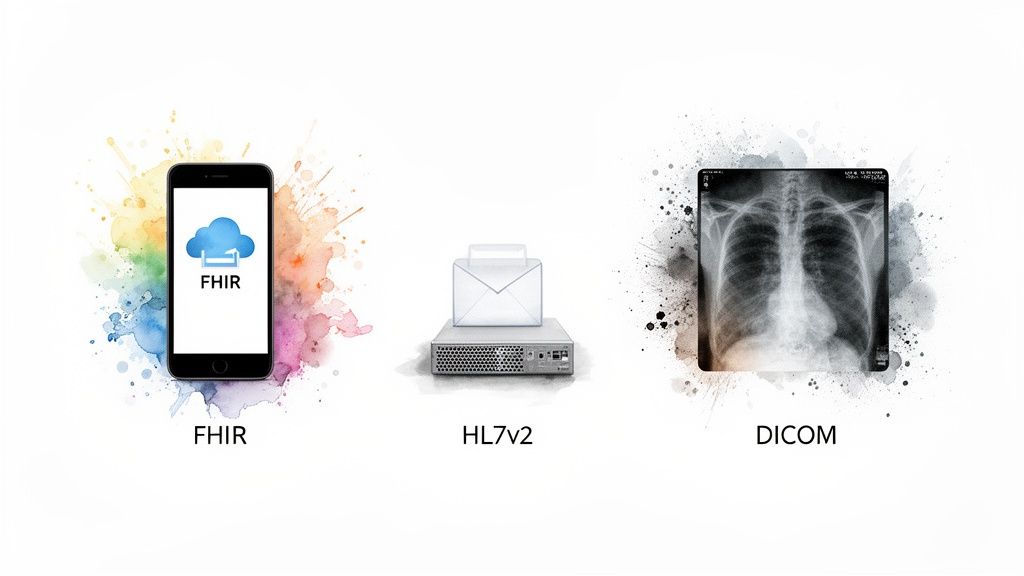
To make any healthcare API integration project work, you have to speak the language of health data. It often feels like there’s an entire alphabet soup of standards, but in reality, most of the work boils down to three big players: HL7v2, DICOM, and FHIR. Each one solves a different piece of the puzzle.
Think of them as specialized tools in a workshop. You wouldn’t use a hammer to turn a screw, and you wouldn’t use a modern web API to run a 30-year-old lab machine. Knowing which tool to use and how to get them working together is the mark of a well-executed integration strategy. Let’s break down what they do in the real world.
HL7v2: The Established Workhorse
For decades, HL7v2 (Health Level Seven Version 2) has been the engine running in the background of almost every hospital. It’s the established workhorse that lets core clinical systems talk to each other. When a patient is admitted, a lab result is ready, or a bill is generated, it’s almost always an HL7v2 message that makes it happen.
This standard is all about structured, text-based messages that trigger specific events. It’s incredibly reliable for what it was built for: internal communication.
-
Best Use Case: Transmitting critical data like patient demographics, orders, and results between a hospital’s internal legacy systems (like an EHR and a Laboratory Information System).
-
Analogy: HL7v2 is like a hospital’s internal pneumatic tube system. It’s highly efficient for sending specific packages (data messages) between known departments. It’s fast and dependable, but it was never designed to connect to the outside world.
Even though it’s an older standard, it’s so deeply embedded in healthcare infrastructure that it isn’t going anywhere. Any effective healthcare API integration service has to be fluent in translating these legacy messages into modern formats.
DICOM: The Universal Language of Images
DICOM (Digital Imaging and Communications in Medicine) has one, incredibly important job: it’s the global standard for all medical imaging. Every time a CT scanner, MRI, or X-ray machine captures an image, DICOM is the protocol that bundles that image with the patient’s metadata.
This ensures a radiologist sees not just the scan, but also the patient’s name, the date of the procedure, and other context needed for a safe diagnosis. Without DICOM, sharing and interpreting medical images would be pure chaos.
Any successful custom healthcare software development project involving Picture Archiving and Communication Systems (PACS) or imaging portals depends entirely on a deep understanding of the DICOM standard. It’s the non-negotiable foundation for all medical imaging workflows.
FHIR: The Modern, Web-Friendly Standard
FHIR (Fast Healthcare Interoperability Resources), pronounced “fire,” is what’s making modern, connected healthcare possible. Developed using the same web technologies that power the rest of the internet (like RESTful APIs), FHIR is built for today’s world of apps and cloud platforms.
Instead of rigid, all-or-nothing messages, FHIR breaks down health information into discrete “resources”: like a Patient resource, an Observation, or a Medication. This makes data exchange far more flexible and intuitive for developers. It’s the reason we’re seeing a massive wave of innovation in health apps. As we explored in our guide on EHR integration services, FHIR is a key enabler for modern connectivity.
-
Best Use Case: Building mobile health apps, patient portals, and cloud-based systems that need to request specific pieces of information on demand.
-
Analogy: If HL7v2 is the internal tube system, FHIR is the internet. It lets an authorized app on your phone securely ask for just your latest blood pressure reading, without needing the entire medical record.
Of course, exchanging data this freely means security and compliance are paramount. This detailed HIPAA compliance guide is a great resource for understanding the rules of the road. By using FHIR’s flexibility while respecting the roles of older standards, we can finally start unlocking the true potential of patient data.
Securing Patient Data in an Interconnected World
When you connect healthcare systems, the job is only half done. The real challenge and the most critical part is keeping every piece of patient data secure. A data breach in healthcare isn’t just a technical glitch; it’s a catastrophic event that shatters patient trust and brings on massive regulatory fines. That’s why security can’t be an afterthought; it has to be the foundation of any API integration project.
Protecting patient privacy, especially Protected Health Information (PHI), is the top priority. This is where regulations like the Health Insurance Portability and Accountability Act (HIPAA) in the U.S. and the General Data Protection Regulation (GDPR) in Europe come in. They aren’t just guidelines; they are strict, legally-binding rules for handling sensitive data.
A key part of compliance involves using secure tools from the very first point of contact, such as HIPAA-compliant online forms, to collect patient information safely. For API integrations, these regulations require specific technical and administrative controls to guard PHI every step of the way.
Building a Digital Fortress Around Patient Data
Securing healthcare APIs demands a layered defense that covers who can get in, what they’re allowed to do, and how the data is protected. You have to build a digital fortress where every gateway is guarded, and every single action is tracked.
Three security patterns are absolutely essential here:
-
OAuth 2.0 (Authorization): This has become the gold standard for granting limited, secure access to data without ever sharing a user’s password. Think of it like a hotel key card: it only opens your specific room for a set period. It doesn’t give you the master key to the entire hotel. A patient can use it to let a third-party wellness app access their lab results from a hospital’s EHR, but the app never learns the patient’s actual login credentials.
-
mTLS (Mutual Transport Layer Security): Standard encryption (TLS) protects the connection from the user to the server. Mutual TLS takes it a step further. It forces both the client and the server to prove their identities with digital certificates before any communication can happen. This ensures your API is only talking to other verified, trusted systems, slamming the door on any unauthorized apps trying to listen in.
-
Detailed Audit Logging: Traceability is a core pillar of HIPAA. Every single interaction with PHI, whether it’s viewing a record or updating a prescription through an API, must be logged. These audit trails create a permanent, unchangeable record of who accessed what data, when they did it, and precisely what they did. They are indispensable for investigating potential incidents and proving your compliance to auditors.
The Role of a Specialized Security Partner
Trying to manage this tangled mess of regulations and technical safeguards on your own is a huge undertaking. This is why working with an expert in cyber compliance solutions isn’t just a good idea; it’s a strategic necessity. These specialists make sure every layer of your integration, from the API gateway down to the database, is hardened against threats.
As we cover in our guide to HIPAA-compliant software development, true compliance requires a deep bench of both technical and legal expertise.
A proactive security strategy is built on two core ideas: “least privilege” and “zero trust.” This means every person and system gets only the bare minimum access they need to do their job, and every single request for access is thoroughly verified, no matter where it comes from.
In the end, committing to end-to-end encryption, regular security testing, and strict access controls does more than just lower your risk. It builds a lasting foundation of trust with patients, partners, and regulators, showing that you are a responsible guardian of the most sensitive data there is.
Choosing the Right Integration Architecture
Selecting the right integration architecture is a lot like designing the communications network for a new hospital. Do you just need a few direct phone lines between key departments? Or is it better to have a central operator routing all the calls? Maybe you need something more dynamic, like a flexible network where specialized teams can talk to anyone they need to, whenever they need to.
Your choice here is fundamental. It will dictate your system’s ability to grow, how much work it takes to maintain, and how well you can adapt to future technologies. This is where the theory of healthcare API integration services meets the practical reality of making your systems talk to each other. It’s a crucial decision that requires balancing your immediate needs against your long-term vision.
Point-to-Point Integration: The Direct Line
The most basic model is point-to-point integration. Think of it as a dedicated, private phone line connecting just two people. When one system, like your Electronic Health Record (EHR), needs to send data to another, say, a lab system, a custom connection is built just for them.
This approach is quick and easy to set up when you only have a couple of systems to connect. But that simplicity is also its biggest flaw. Every time you add a new system, you have to build a brand new, separate connection to every other system it needs to talk to. What begins as a few clean lines quickly devolves into a tangled mess that’s brittle, expensive, and a nightmare to manage.
-
Best For: Small, independent clinics or single departments with only two or three core systems.
-
Drawback: This model gets exponentially complex and costly as you scale. It’s often called “spaghetti architecture” for good reason.
Hub-and-Spoke: A Central Operator
The hub-and-spoke model brings some much-needed order to the potential chaos of point-to-point. It works by introducing a central integration engine, or “hub.” Going back to our hospital analogy, this is your central switchboard operator. Instead of every system connecting directly to every other one, they all plug into the central hub.
This hub takes on the heavy lifting of translating, routing, and managing all the data messages. If the EHR needs to send an order to the radiology department, it sends one message to the hub. The hub then translates it into the right format and delivers it. This is far more organized and much easier to scale, since adding a new system only requires a single connection to the hub, not dozens of individual ones.
-
Best For: Mid-sized hospitals or health systems that need to coordinate data between multiple, distinct departments like billing, labs, and pharmacy.
-
Drawback: The hub itself can become a single point of failure. If the hub goes down, your entire communication network grinds to a halt.
Microservices and API Gateways: A Team of Specialists
The most modern and flexible approach involves a microservices architecture managed by an API Gateway. Think of this not as a single operator, but as a team of highly specialized experts. You have one specialist for patient registration, another for scheduling, and a third for billing. The API Gateway acts as the team coordinator, routing every incoming request to the right expert.
Before we dive deeper, it’s worth looking at how this model prioritizes security, especially when patient data is involved.
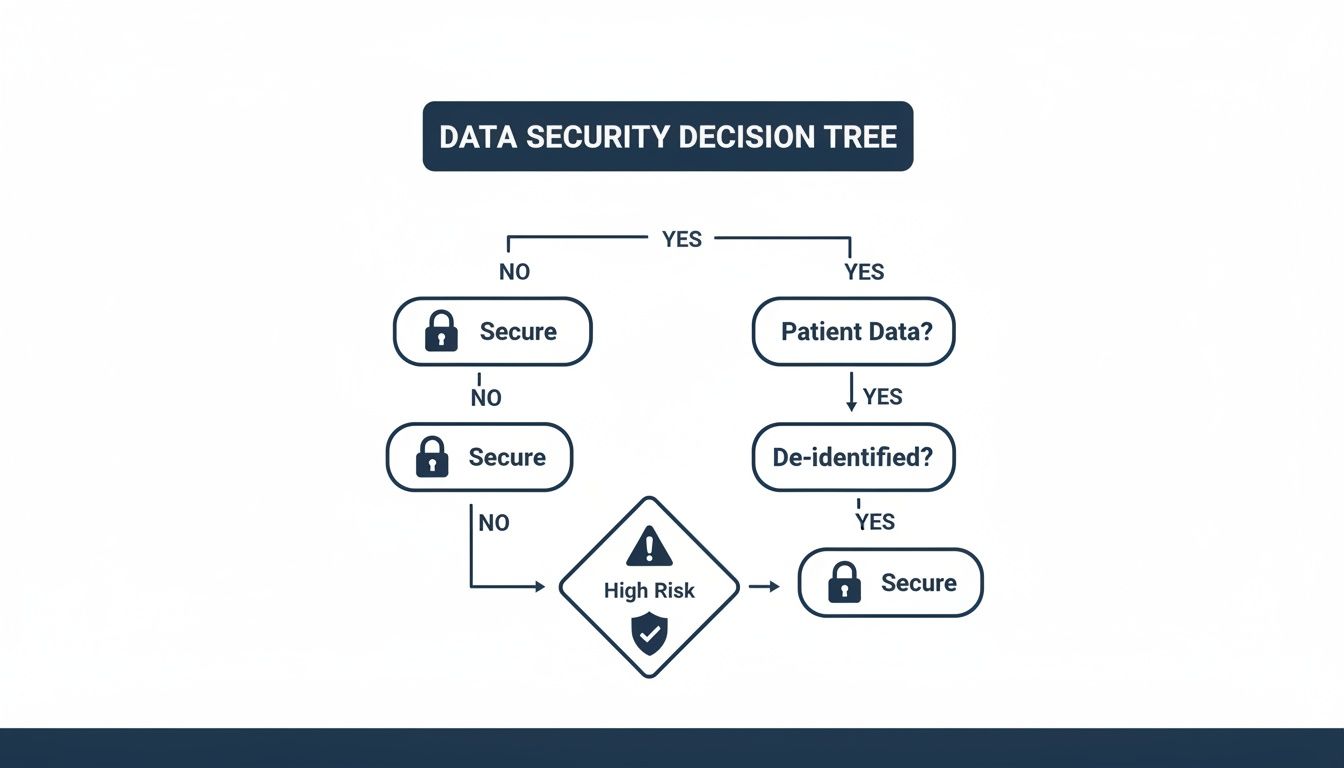
As the chart shows, the moment patient data enters the equation, security becomes the absolute priority. This is precisely what modern architectures are built to handle.
This distributed architecture is incredibly resilient and scalable. If one microservice, say, the billing service, has a problem, it doesn’t crash the entire system. Only that one specific function is affected. Your teams can update, improve, or even replace individual services on their own timeline, which allows for much faster innovation without disrupting day-to-day operations. The API Gateway handles all the security, routing, and monitoring, ensuring every connection is efficient and protected.
Opting for a microservices model is a forward-thinking move that builds in agility and prepares you for future growth. Designing and implementing this kind of resilient, scalable system is where expert product engineering services can make all the difference for long-term success.
This model is the backbone of most modern, cloud-based applications and is perfectly suited for the dynamic, ever-changing needs of today’s healthcare world. It gives organizations the power to build and evolve their digital tools with real speed and confidence.
Choosing the right architecture is a foundational decision with long-term consequences. The table below breaks down these three patterns to help you compare them at a glance.
Comparison of Healthcare Integration Architectures
| Architecture | Best For | Scalability | Maintenance Complexity | Initial Cost |
|---|---|---|---|---|
| Point-to-Point | Small-scale projects with 2-3 systems | Low; becomes unmanageable quickly (“spaghetti”) | High at scale; each connection is custom | Low |
| Hub-and-Spoke | Mid-sized organizations needing centralized control | Moderate; depends on the hub’s capacity | Moderate; hub can be a bottleneck | Medium |
| Microservices | Large, dynamic enterprises focused on agility and growth | High; services scale independently | Low; services are managed separately | High |
Ultimately, there’s no single “best” architecture, only the one that best fits your organization’s current size, budget, and future ambitions. Weighing these factors carefully from the start will save you significant headaches down the road.
Your Roadmap to Successful API Implementation
Building out your healthcare API integration isn’t just a coding project; it’s a strategic initiative. Trying to tackle it without a clear, phased roadmap is like starting construction on a new hospital wing with no blueprints. You’ll end up with a chaotic, costly mess that doesn’t serve anyone well.
Let’s break down this complex process into four manageable phases. By treating it as a series of deliberate steps, you can turn a daunting undertaking into a predictable, successful project.
Phase 1: Discovery and Strategy
This is arguably the most important phase. Before a single line of code is written, you have to define what success actually means for your organization. This is where you connect the technical work to real-world business goals.
We start by getting everyone in the same room.
-
Stakeholder Workshops: Bring together your clinicians, administrators, IT staff, and leaders. You need to hear their frustrations, understand their daily workflows, and identify where the biggest opportunities for improvement lie.
-
Goal Definition: Get specific. What are you trying to achieve? Is it about reducing patient check-in times, speeding up billing cycles, or powering a new telehealth app? Vague goals lead to vague results.
-
Workflow Analysis: Map out the exact processes your new APIs will touch. Understanding the “as-is” is the only way to design a “to-be” that actually makes life easier for your team, not harder.
The main output here is a solid project charter. This document becomes your north star, outlining the scope, objectives, budget, and the KPIs you’ll use to measure success. This phase often benefits from digital transformation consulting to ensure alignment between technology and business strategy.
Phase 2: Design and Development
With a clear strategy locked in, it’s time to start building. This is where the technical magic happens, but it must be guided by smart architectural decisions and a deep understanding of healthcare data standards.
This phase is all about turning the plan into a functional product.
-
API Design: This is like creating a contract for your data. You’ll define the API endpoints, specify request and response formats (likely using a standard like FHIR), and lock down security protocols.
-
Architecture Selection: Will a simple point-to-point connection do the trick, or do you need a more scalable hub-and-spoke or microservices architecture? The choice you make here will impact your ability to grow in the future.
-
Core Development: Now the developers get to work writing, testing, and documenting the API code. Whether you use a dedicated development team or in-house resources, this is where a skilled team really shines, building something that is not only functional but also clean and maintainable.
By the end of this phase, you should have a set of fully-functional, well-documented APIs that are ready for some serious stress testing.
Phase 3: Testing and Validation
Before any new API touches a live environment, it needs to be put through the wringer. In healthcare, a system failure isn’t just an inconvenience; it can have critical consequences for patient care. This step is absolutely non-negotiable.
Your testing regimen should be comprehensive, covering a few key areas:
-
Functional Testing: Does the API actually do what it’s supposed to? If you ask for patient data, does it return the right information correctly and consistently?
-
Security Testing: This is where you actively try to break it. You’ll probe for vulnerabilities to ensure the API is ironclad and fully HIPAA compliant, protecting against any and all unauthorized access.
-
Performance and Load Testing: How does the API hold up when things get busy? Simulate peak hours to ensure it can handle high traffic without grinding to a halt.
-
Interoperability Testing: Confirm that the API plays nicely with all the other systems it needs to connect with, from legacy EHRs to brand-new mobile apps. As we explored in our guide on hospital system integration services, this ensures a seamless end-user experience.
A successful validation phase doesn’t just confirm that the API works. It proves it works safely, securely, and reliably under real-world pressure.
Phase 4: Deployment and Monitoring
This is the home stretch. You’re ready to release the APIs into your production environment and, just as importantly, establish a plan to manage them for the long haul. The launch isn’t the finish line; it’s the start of the API’s operational life.
A smart deployment plan includes a few key steps:
-
Phased Rollout: Don’t flip the switch for everyone at once. Start with a small, controlled group of users to catch any unexpected issues before a full-scale launch.
-
Performance Monitoring: Set up dashboards and real-time alerts to keep a close eye on API usage, response times, and error rates. You need to know a problem is brewing before your users do.
-
Ongoing Maintenance: Have a clear plan for managing bug fixes, applying security patches, and rolling out future updates. An API is a living product that requires ongoing care and attention.
By following this four-phase roadmap, you can navigate the complexities of API implementation with confidence, turning a strategic vision into a reliable, high-impact technical reality.
Measuring the True ROI of API Integration
How do you prove that your investment in healthcare API integration services was actually worth it? The answer isn’t buried in technical reports about server uptime or API response times. The true return on investment (ROI) shows up in the real world: in your daily operations, clinical workflows, and ultimately, your bottom line.
To make a solid case for your integration strategy, you have to connect the dots between the technology and tangible business results. It’s all about translating backend performance into frontline value.
Key Performance Indicators for Business Impact
Forget about focusing only on the technical jargon. Instead, turn your attention to the key performance indicators (KPIs) that show real, meaningful improvements. These are the numbers that your leadership team and stakeholders actually want to see.
Here are the areas where a smart API integration strategy delivers results you can actually measure:
-
Reduced Administrative Costs: Automating manual processes is often where you’ll see the fastest payback. Start tracking the reduction in staff hours spent on tedious tasks like manual data entry, reconciling patient records, or processing referrals. An API that automates this, built through custom software development, can easily save hundreds of staff hours a month.
-
Faster Patient Intake and Throughput: How long does it take for a patient to get from the front door to the exam room? APIs that enable digital check-in forms or give providers instant access to a patient’s history can slash wait times and significantly improve the entire patient journey.
-
Streamlined Clinical Workflows: Just ask your clinical staff. Are they spending less time clicking around and hunting for information? APIs that push lab results, imaging reports, and medication histories directly into the main workflow are a lifesaver. They cut down on the frustrating need to jump between different applications, giving that valuable time back to patient care.
-
Improved Data Accessibility for Analytics: One of the biggest wins from integration is having a single, reliable source of data. You can track how much faster your analytics team can produce reports on population health trends, clinical outcomes, or operational bottlenecks. This clean, connected data is the foundation for making better-informed decisions.
Unlocking New Value with Integrated Data
Beyond the immediate cost savings and efficiency boosts, a connected data ecosystem opens up entirely new possibilities. When your information can finally flow freely between systems, you can start exploring advanced tools that were previously just a pipe dream.
By integrating disparate data sources, you create the fuel for powerful analytical tools. As seen in our client cases, unified data is the first step toward significant competitive advantage and unlocking new efficiencies across the organization.
This is where leveraging AI for your business can make a huge difference. With a solid integration backbone in place, AI development services can create models that analyze rich, comprehensive datasets to do things like predict patient readmissions, pinpoint at-risk populations, and optimize how you schedule staff and resources.
Without APIs feeding them clean, real-time data, these advanced capabilities are nothing more than a nice idea. In the end, a smart integration strategy isn’t just another IT expense; it’s an investment that pays for itself by making your entire organization run faster and more intelligently.
Frequently Asked Questions (FAQ)
When it comes to healthcare API integration, a lot of questions come up. Let’s walk through some of the most common ones to give you a clearer picture of what to expect.
What Is the Main Difference Between HL7 and FHIR?
Think of HL7v2 as the workhorse plumbing inside a hospital. For decades, it’s been the standard for getting different internal systems, like your EHR and lab equipment, to talk to each other. It’s a bit rigid and works with structured messages, but it’s incredibly reliable for those core, system-to-system data exchanges.
FHIR, on the other hand, is the modern, flexible connection to the outside world. It uses the same kind of web-based APIs that power most of the internet, making it much easier for developers to work with. This is what allows you to build secure mobile health apps or give patients a portal to access their own records. In short, HL7 is for internal stability, while FHIR is for external innovation.
How Long Does a Typical Healthcare API Integration Project Take?
The real answer is: it depends entirely on the scope. A straightforward project, like connecting two modern systems that speak the same language, might only take a few weeks. But if you’re looking at a major overhaul, uniting several legacy systems, migrating complex data, and building a new API from scratch, you could be looking at a timeline of 6 to 18 months.
Several factors will heavily influence your schedule:
-
The quality and organization of your existing data.
-
The sheer number of systems you need to connect.
-
The strictness of your security and compliance needs.
-
The experience of the team you hire to do the work.
Spending the time on a thorough discovery phase upfront is the single best thing you can do to set a realistic timeline.
How Can We Ensure Our API Integration Remains HIPAA Compliant?
HIPAA compliance isn’t a one-time checklist; it’s an ongoing strategy. First, all Protected Health Information (PHI) must be encrypted, both when it’s moving between systems (in transit) and when it’s sitting on a server (at rest).
Next, you have to lock down who can access what. This means implementing strong authentication and authorization controls, like OAuth 2.0, to ensure every user and system only sees the minimum data necessary for their job. Finally, you need detailed audit logs that track every single interaction with PHI through your APIs. This creates a trail you can follow if you ever need to investigate an issue.
One of the most critical steps is signing a Business Associate Agreement (BAA) with any vendor or partner you work with. This is a legal contract that obligates them to protect PHI with the same rigor you do. Partnering with a specialist in custom healthcare software development is the best way to make sure these requirements are built in from the start.
What is the ROI of healthcare API integration?
The return on investment (ROI) from healthcare API integration is measured through tangible business improvements. Key metrics include reduced administrative costs from automating tasks like data entry, faster patient throughput due to streamlined check-in processes, improved clinical workflows that give providers more time for patient care, and enhanced data accessibility for faster, more accurate analytics and reporting.
Why is a microservices architecture often recommended for modern healthcare systems?
A microservices architecture is recommended for its flexibility, scalability, and resilience. It breaks down large, complex applications into smaller, independent services. This means if one service (like billing) has an issue, it doesn’t crash the entire system. It also allows development teams to update, test, and deploy individual services independently, leading to faster innovation and easier maintenance compared to monolithic hub-and-spoke or point-to-point systems.

About Preethi Saro Philip
Preethi Saro Philip is a Post Graduate Research Degree holder in Economics with more than 10 years of experience in writing, editing, research and teaching. She has an intense passion for content crafting and calls herself a ‘wordsmith’. She enjoys writing on wide-ranging topics including business, technology, health & lifestyle, education, environment etc.
View all posts by Preethi Saro Philip →