



Healthcare Agentic AI: A Practical Guide
A discharge summary sits unsigned, a payer portal times out, and a nurse spends lunch reconciling meds that should've matched hours ago. That kind of Tuesday is exactly why healthcare agentic AI is showing up on roadmaps now, not as a futuristic demo, but as a way to close the loop on work that already exists. The question for clinical innovation leaders isn't whether software can answer questions. It's whether it can notice a task, move it forward, and hand it back to a human with the context intact.
Why Healthcare Agentic AI Is Suddenly on Every Roadmap
Healthcare leaders are moving from curiosity to deployment because the question has changed from whether the technology can work to where it can fit without creating risk. McKinsey reported that 19% of surveyed respondents already said their organizations had reached agentic AI or multiagent workflow maturity, while 51% were actively pursuing proofs of concept and only 1% said they had no plans to pursue AI agents. The same framing showed 50% of surveyed U.S. healthcare leaders saying their organizations had implemented generative AI, up from 25% in Q4 2023, with more than 80% saying their first gen-AI use cases had already been deployed to end users. That is no longer a research curiosity. It is budget planning.
Why this timing matters
Healthcare does not leave much room for vague automation. A workflow can touch clinical judgment, reimbursement, or patient safety in the same handoff, so the software has to do more than summarize text. It has to fit how care teams work, which is why the market discussion is moving toward orchestration, exception handling, and workflow completion.
The commercial forecasts point in the same direction. Grand View Research estimated the global agentic AI in healthcare market at USD 538.51 million in 2024 and projected USD 4.96 billion by 2030. Mordor Intelligence projected USD 1.03 billion in 2026 and USD 5.78 billion by 2031, and said North America accounted for 44.74% of revenue in 2025. Those figures matter because they show healthcare buyers treating agentic AI as infrastructure, not as a side experiment.
Practical rule: if the pitch sounds like a chatbot demo, it is probably not agentic AI. If it can take a task from trigger to completion with review points, you are in the right conversation.
What Healthcare Agentic AI Means
A useful way to understand healthcare agentic AI is through the work of a strong triage coordinator. That person watches the queue, decides what needs attention now, pages the right clinician, checks whether the action happened, and returns to the task if something failed. The software version follows that same pattern across clinical, claims, scheduling, and eligibility data.
The technical pattern is usually a continuous loop: perceive, reason, act, and monitor, rather than a one-shot answer generator. A provider-focused technical guide describes this model as one that can ingest live data, execute a task, observe the result, and escalate exceptions. It also notes that production workflows may require 100+ EHR connectors, 100+ payer connectors, plus ontology mapping across ICD-10, SNOMED, RxNorm, and LOINC to keep actions reliable. That matters because a smart answer is useless if it cannot find the right chart, policy, or code set.
How it differs from adjacent tools
Generative AI produces text, images, or structured output when asked. Agentic AI uses that reasoning capacity inside a workflow, then decides what to do next. RPA follows fixed rules, while agents can reason through ambiguous state and exception paths.
Classic clinical decision support works differently again. CDS usually surfaces a recommendation inside a defined clinical context. An agent can gather missing data, route a task, update the record, or escalate when a condition changes. That is why governance has to be part of the architecture from the beginning, not added later.
A useful operational definition appears in a research review, which describes healthcare agentic AI as a system built around a large language model that autonomously plans, reasons, and acts toward a complex goal through a self-correcting loop. Another review says the included studies combine planning, memory, and self-correction to reach clinical and research goals. In plain English, the system has to think through the work, remember where it left off, do the task, and verify the result.
A practical way to size up a vendor is to ask how the workflow behaves at the edges. If a prior authorization packet is missing one data element, does the system pause, request the gap, or push forward anyway? If a discharge task changes halfway through, can it revise the plan without losing context? Those are the questions that separate a helpful workflow assistant from software that only looks intelligent in a demo.
For teams comparing architecture options, this overview of healthcare data pipeline architecture is a useful reference point for the upstream systems that feed an agent.
One-sentence definition you can repeat internally: healthcare agentic AI is software that can perceive a clinical or operational task, reason through the next step, act through approved tools, and monitor the outcome until the workflow closes.
The Architecture Blocks Behind a Safe Clinical Agent
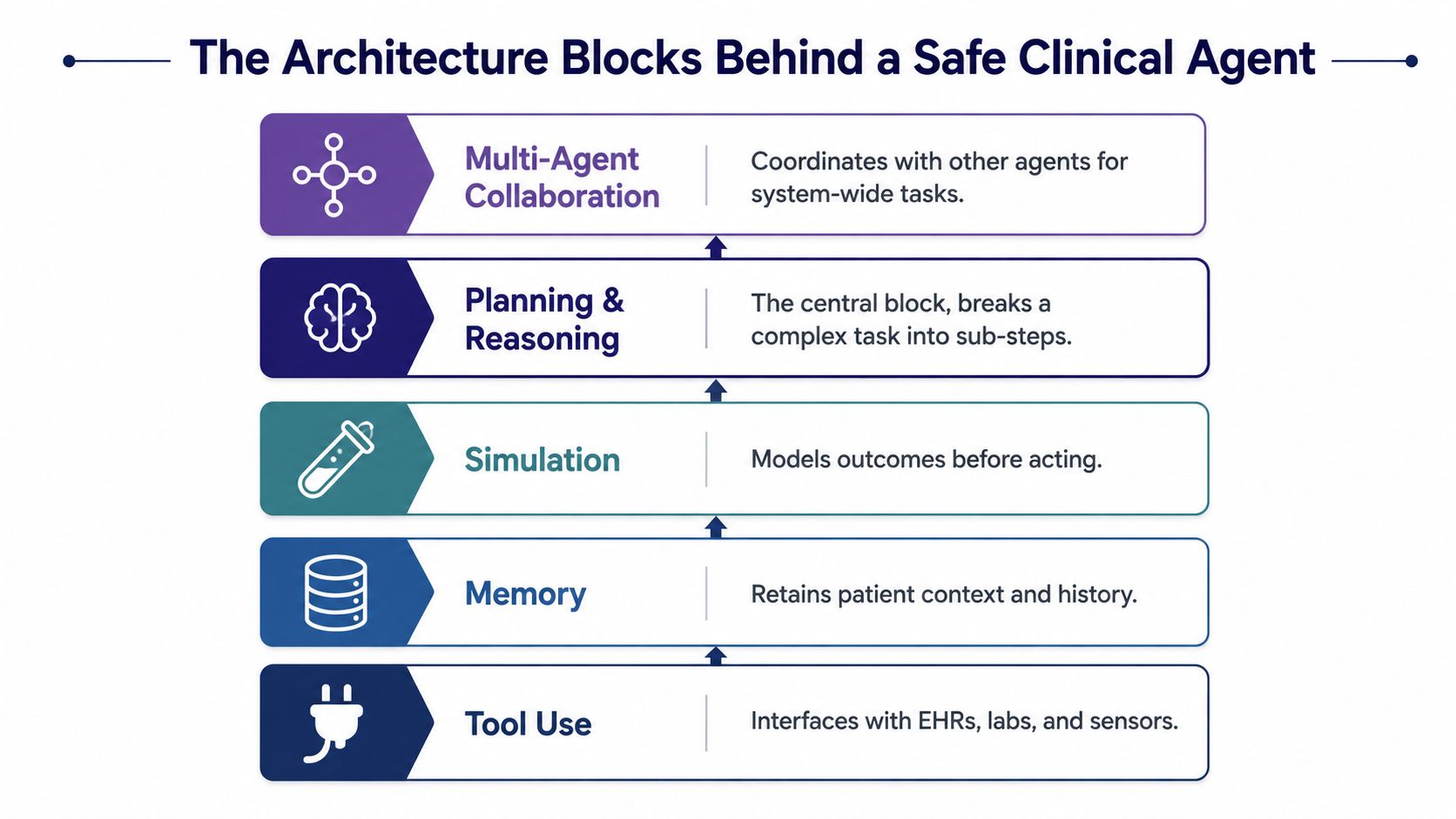
The safest way to evaluate a vendor diagram is to ask which layer does what. A real clinical agent isn't a single model wrapped in a shiny interface. It's a stack, and each block matters for a different reason.
Start with tool use and memory
Tool use is the layer that lets an agent touch real systems, EHRs, labs, scheduling platforms, and payer workflows. Memory preserves patient and task context across handoffs so the agent doesn't forget why it started or what's already been tried. In healthcare, that context retention is essential, because a discharge task that loses medication history becomes a safety risk.
The next layer is simulation. A good agent doesn't just act; it can test a proposed step before it reaches the chart or the patient. That's the difference between an assistant that suggests and an agent that checks whether the suggestion is safe enough to execute.
Planning, then collaboration
The central block is planning and reasoning, where the agent breaks a workflow into sub-tasks. For example, a discharge process can be split into medication reconciliation, follow-up scheduling, and instructions verification, instead of one vague “discharge completed” status. Above that sits multi-agent collaboration, which coordinates specialized agents when a task crosses departmental boundaries.
A healthcare governance paper adds a practical boundary: every action should be traceable to the clinical encounter, with role-based access and FHIR/HL7 v2 interoperability to support auditability and compliance (preprint on healthcare governance guidance). That traceability is not a nice-to-have. It's what lets compliance teams reconstruct what happened when something goes wrong.
The first question to ask in any demo is simple. Which part is reasoning, which part is memory, which part is acting, and which part is just dressing up an API call?
This is also where the difference between architecture and hype becomes obvious. If the vendor can't point to the block that handles escalation, you're probably looking at workflow automation with a language layer on top. If they can show tool use, memory, planning, simulation, and collaboration as separate controls, you're closer to a production system.
Clinical and Operational Use Cases Worth Piloting First
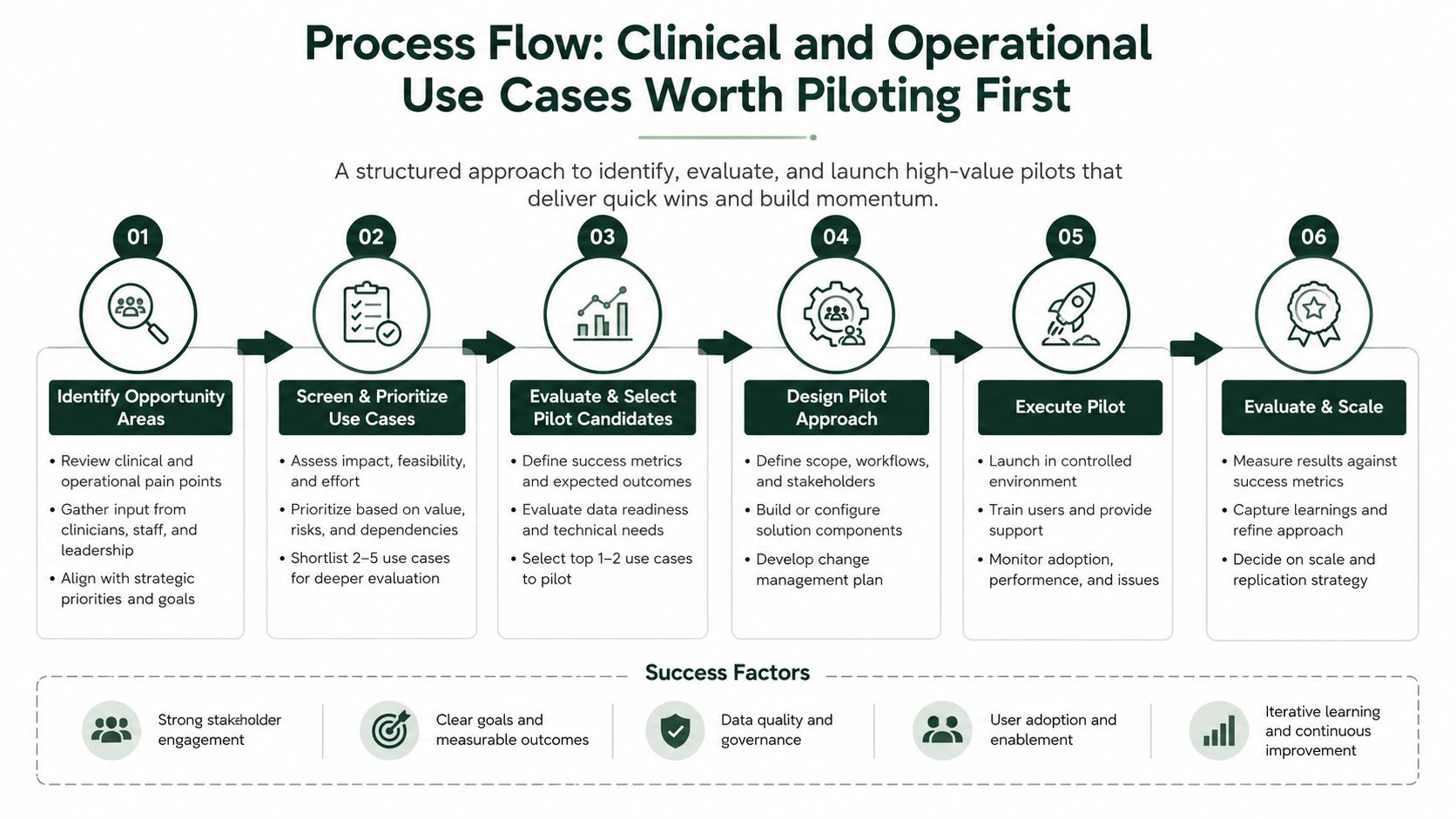
A useful first pilot starts where the agent can assist without being trusted to make the last clinical call. In practice, that means work that is repetitive, document-heavy, and already has a human checkpoint. It also means the architecture has to reach across EHRs and integrations, not sit inside a single product silo. For that reason, teams often begin with data flow planning, as outlined in Bridge Global's healthcare data pipeline architecture guide.
Prior authorization and documentation
Prior authorization is a practical starting point because the agent can gather evidence, compare the chart with payer rules, and draft the submission while a staff member checks the final packet before it goes out. The data inputs are the EHR, payer policy, and supporting attachments from the care team. The review point stays simple: a human approves the packet, and the pilot should measure whether the team reduces manual back-and-forth without creating more denials.
Ambient documentation follows the same pattern, but the handoff is more sensitive because the note becomes part of the clinical record. The agent listens to the conversation, drafts the note, and queues suggested orders, then waits for clinician sign-off. It needs the encounter transcript, order context, and patient chart history, and the clinician remains the author of record. If you want a fuller example of how this kind of workflow is framed, AI-driven clinical decision support is a useful adjacent reference. The question to answer in a pilot is whether documentation quality improves while the clinician spends less time cleaning up charts after hours.
Scheduling, discharge, and care coordination
Scheduling and follow-up workflows are also strong candidates because the scope is narrow and the actions can be reversed if something goes wrong. The agent can check availability, send reminders, and update appointment status across systems. Discharge planning agents can verify medication reconciliation and instructions before a patient leaves, then alert staff when something is missing. Care coordination agents can trigger follow-ups, route unresolved issues, and confirm continuity across settings.
Radiology triage and claims denial management can fit as well, but only when the organization has clear review rules. A triage agent might flag urgent studies for prioritization, while a denial agent rewrites or resubmits packets based on payer logic. If your team is comparing build paths, the practical choice often sits between extending an existing platform, buying a vertical agent, or building with custom healthcare software development and healthcare integrations as the connection layer.
For teams planning the broader delivery path, AI development services, custom software development, and SaaS product development are usually the three build surfaces that matter most.
If the workflow already ends with human approval, that is often the right place to begin. Let the agent handle gathering, organizing, and routing first.
When It Is Still Unsafe to Let the Agent Decide
The strongest contrarian point in this field is also the most important one. Autonomy is not the goal in every clinical setting, and in some settings it is still unsafe. Recent reviews argue that most healthcare agentic AI still operates under near-total human oversight because safety, regulatory, and liability constraints make autonomous clinical reasoning infeasible in high-stakes contexts.
That caution isn't fear of innovation. It's a response to the current evidence base. A 2026 scoping review in npj Digital Medicine found only seven eligible studies across five databases, with only one involving patients, and most studies were exploratory rather than clinically validated. The systems showed autonomous operation, goal-directed behavior, action initiation, and sometimes multi-agent collaboration, but the sample is still very small.
Where the gap actually is
The open questions are not just about model quality. They're about operational fit. Reviews keep pointing to the same missing pieces: multi-agent hospital systems, lifelong learning, and real-time monitoring, because those are the layers that determine whether an agent stays safe after deployment (Frontiers review on operational integration and governance). That's why a chief medical officer should default to human-in-the-loop controls unless the workflow is low risk and the review path is explicit.
The practical distinction is this. An agent can help gather, summarize, route, and prepare. It should not be trusted to make final calls in ambiguous, high-stakes scenarios just because the demo looks smooth. The evaluation methods also still lag the world, especially around trust and workflow fit, which are harder to measure than output accuracy.
A 2026 review in PMC also found that some systems lowered cognitive workload by up to 52%. That is a useful operational benefit, but it doesn't erase the need for oversight. Workload reduction is valuable precisely because it lets clinicians keep the final decision where it belongs.
HIPAA, FDA, and the Governance Layer You Cannot Skip
Most governance failures happen because teams treat compliance as a review step instead of an architecture choice. In healthcare agentic AI, that's a mistake. The model, the workflow, and the audit trail have to be designed together so the system can prove what it saw, what it did, and who approved it.
Translate policy into design decisions
HIPAA thinking starts with minimum necessary, role-based access, and logs that show what the agent touched. FDA thinking becomes relevant when the agent influences diagnosis or treatment, because that can pull the system toward Software as a Medical Device expectations. Internal review committees should also insist on model cards, data lineage, rollback plans, and post-deployment monitoring before any pilot goes live.
For teams comparing vendors, the article audit trail requirements for 2026 are a useful reminder that “we log everything” is not enough. You need logs that a compliance officer can reconstruct against the encounter, the role, and the decision path.
Bridge Global's HIPAA-compliant software development is one example of how buyers can frame the build conversation around controls instead of slogans. That's especially useful when the pilot needs to pass both security review and clinical review.
| Control or Principle | What It Means for the Agent | Architecture Decision to Demand |
|---|---|---|
| Minimum necessary | The agent sees only the data needed for the task | Scoped data access, not broad chart access |
| Role-based access | Different users and agents get different permissions | Separate clinical, operational, and admin roles |
| Auditability | Every action can be traced after the fact | Immutable logs tied to the encounter |
| Interoperability | The agent can exchange data with core systems | FHIR and HL7 v2 support |
| Safety escalation | The system stops and asks for help when uncertain | Human review gates for exceptions |
| Change control | Model or workflow updates can be rolled back | Versioned releases and rollback plans |
The most useful governance question is not “Is this AI compliant?” It’s “Which action is the system allowed to take on its own, and which action must pause for review?” That distinction tells you whether the vendor understands healthcare or just regulation theater.
Designing a Pilot That Survives Contact with Reality
A pilot works when the workflow is narrow enough to control and real enough to show whether the agent helps clinicians or staff. The safest starting point is a process where a wrong action has limited impact, the data is clean and consented, human review is built into the handoff, and the metrics are defined before anyone touches production. That order matters because agentic AI is easiest to overestimate at the demo stage and hardest to unwind after it is connected to a live workflow.
Choose the build path deliberately
There are three common paths. A vertical agent can make sense when the workflow is standardized, and the vendor already understands the domain. An EHR-native extension fits better when the task stays close to the core platform. A custom agent is the stronger option when data, policy, or approval logic is too specific for off-the-shelf software. That decision belongs in your AI implementation roadmap, not in a rushed procurement call.
The core question is whether the workflow has enough structure for automation without forcing clinicians to clean up after the system. An agent that can suggest, route, and document the next step may be useful. An agent that must make a judgment call in a gray area needs tighter guardrails or a narrower scope. For that reason, build choices should follow the task, not the vendor pitch.
For scoping, evaluate AI development services against the actual sequence of actions, not generic promises. A practical sanity check is whether the system can outperform its non-agent baseline on the same work. In clinical medicine, one review reported performance gains ranging from 3.5% to 76% and a median improvement of 53 percentage points in single-agent tool-calling studies. The range is wide for a reason, and it shows that fit between the architecture and the task matters more than the logo on the slide deck.
What to ask before you sign
-
Workflow fit: Which step is the agent allowed to start, and which step must end with a human?
-
Data readiness: Which source systems, codes, and consent rules are in scope?
-
Oversight design: Who reviews exceptions, and what happens when the agent is uncertain?
-
Measurement plan: What baseline will you compare against, and who signs off on the result?
If a vendor can answer those four questions clearly, the pilot deserves a closer look. If they cannot, the contract is too early.
Your Next Three Steps and How to Get Started
A pilot starts with one workflow, not a broad promise. Book an AI discovery conversation and pressure-test that workflow against the four gates above. If the agent cannot show where it will start, where it must stop, and who will review the edge cases, the idea is still in design territory, not pilot territory.
Next, choose the delivery path that matches the risk and the integration load. For regulated care delivery, Bridge Global can serve as a healthtech software development partner for the overall system design, while the broader software development service models page is a practical way to compare custom build, platform extension, and hybrid options. The decision should follow the workflow, the data, and the oversight model, not a vendor pitch.
Then define a 90-day pilot with one measurable outcome, clear human checkpoints, and an audit trail that compliance can review without guesswork. If leadership needs a structured path from idea to governed rollout, the AI implementation roadmap gives teams a way to plan the work before they commit to production.
FAQs
How long should a pilot take?
Long enough to show the workflow under real conditions, short enough that the review team can still control scope. The right answer depends on the data sources, approvals, and integration work, so avoid setting a timeline before the boundaries are clear.
What evidence exists today?
The evidence is promising but still early. The strongest published signal points to operational gains in narrow tasks, while the broader clinical evidence base remains small and heavily human-supervised.
How do we avoid vendor lock-in?
Keep the workflow, data mappings, and audit trail portable. Ask for clear interface boundaries, exportable logs, and a rollback path before the pilot starts. That way, the agent remains a controlled component, not a permanent dependency.

About Upendra Jith
Upendrajith completed his Master's in English and has been a commercial content developer for the past three years. He's more inclined to develop content with a 'street-smart' delivery on topics such as technology, media, or anything he can get his hands on. He has a fixation on lyrics, dark poetry, media, technology, and flow arts.
View all posts by Upendra Jith →