



Insurance App Development: A Practical Step-by-Step Guide
Your leadership team has approved the mobile app concept. The screens look convincing, the feature backlog is growing, and someone has asked for a launch date. Then engineering discovers that policy records, payment status, claim documents, and customer identities live in systems with different owners and incompatible release schedules.
That's where insurance app development becomes a regulated-systems engineering problem. A usable interface matters, but the harder job is making every customer action reliable, explainable, and recoverable across the insurer's operations.
Why Insurance App Development Demands More Than a Mobile Front End
An insurance app must do more than display information. It must establish who the customer is, determine which policies they can access, distinguish current coverage from historical documents, and submit requests without creating contradictory records.
Customers now expect to check coverage, submit evidence, and follow a claim from their phone. That makes mobile access an operating responsibility, not just a distribution experiment.
Start discovery with operational journeys
Don't begin by collecting feature requests from every department. Bring product, underwriting, claims, service, security, and core-system owners together around actual customer journeys.
For each journey, identify the actor, intended outcome, authoritative system, approval boundary, and failure path. A policyholder viewing a document needs different permissions from a broker servicing an account or an adjuster reviewing sensitive claim evidence.
Segment users by what they're authorized to accomplish:
Policyholders and beneficiaries: Access coverage information, provide evidence, make permitted changes, and understand outstanding actions.
Agents and brokers: Prepare submissions, monitor applications, and serve customers within delegated authority.
Underwriters and claims professionals: Review evidence, resolve exceptions, and record accountable decisions.
Service and operations staff: Correct records, investigate failed transactions, and support customers without bypassing controls.
Choose a thin vertical slice that reaches a real operational outcome. Displaying a policy document and recording a successful customer download is more defensible than building an attractive dashboard whose data can't be reconciled.
Build a roadmap around working groups
A feature catalogue becomes useful when stakeholders can see which operational capability each feature depends on.
| Working group | Candidate features | Early release decision |
|---|---|---|
| Policy and self-service | Policy documents, identification cards, billing visibility, profile updates | Prioritize trustworthy information and clear ownership of changes |
| Underwriting and distribution | Quote intake, evidence collection, application tracking, broker workflows | Separate collecting information from approving coverage |
| Claims and assistance | First notice of loss, evidence upload, roadside assistance, claim tracking | Choose a journey the claims organization can support end to end |
| Service and retention | Secure messaging, renewal reminders, notification preferences | Ensure staff can respond through the same operational record |
Score candidates against customer value, integration readiness, operational ownership, and decision risk. A feature with strong commercial appeal but no reliable source of truth shouldn't automatically outrank a less visible service improvement.
For credibility, prioritize correct coverage information, dependable authentication, understandable next steps, and recoverable errors. Defer personalization, elaborate dashboards, and autonomous recommendations until their dependencies are dependable.
Practical rule: Don't promise a digital action until someone owns its completion when the happy path fails.
Copying retail banking navigation can be tempting, but don't copy the underlying workflow assumptions. An insurance transaction may depend on evidence, policy wording, delegated authority, or professional judgment rather than an immediate balance update.
Define acceptance criteria in those terms. “Customer submitted a change” and “the insurer accepted the change” are different outcomes, and the interface must never confuse them.
Architecture Patterns and a Practical Tech Stack for Insurance Apps
Choose architecture according to system ownership and operational complexity, not fashion. Our default recommendation is the simplest structure that preserves clear domain boundaries and can support the intended release safely.
A modular monolith over an existing core is a reasonable starting point when a team needs cohesive delivery without operating many independent services. An API-first core with thin front ends fits when the insurer controls stable business APIs. Reserve event-driven services for workflows whose asynchronous handoffs justify the additional monitoring, recovery, and reconciliation work.
Stack reference for insurance app development
| Layer | Common choices | Why it matters for insurance |
|---|---|---|
| Mobile interface | Swift, Kotlin, React Native, Flutter | Evaluate device integration, accessibility, offline needs, and team expertise |
| Browser channel | React-based web application or progressive web app | Consider reach and deployment simplicity alongside device limitations |
| Application services | .NET, Java with Spring Boot, Node.js | Match existing engineering skills and core-system contracts |
| Operational data | PostgreSQL, managed object storage | Separate transactional records from documents and uploaded evidence |
| Workflow and messaging | Managed queues, Kafka, workflow engines | Support asynchronous work with explicit recovery paths |
| Identity and access | Established identity provider, OAuth, OpenID Connect | Keep authentication separate from policy-level authorization |
| Operations | OpenTelemetry, centralized logs, secrets management | Make failures diagnosable without exposing sensitive records |
Treat these as candidates, not a prescribed stack. Native development deserves consideration for demanding device interactions; cross-platform development can suit shared journeys; a progressive web app may fit a browser-first distribution strategy.
Don't rebuild a core system merely to make the mobile architecture look cleaner. Introduce a bounded application layer, document its contracts, and replace core capabilities only when their limitations justify the migration risk.
Integrations With Core Insurance Systems, Payments and Healthcare Standards
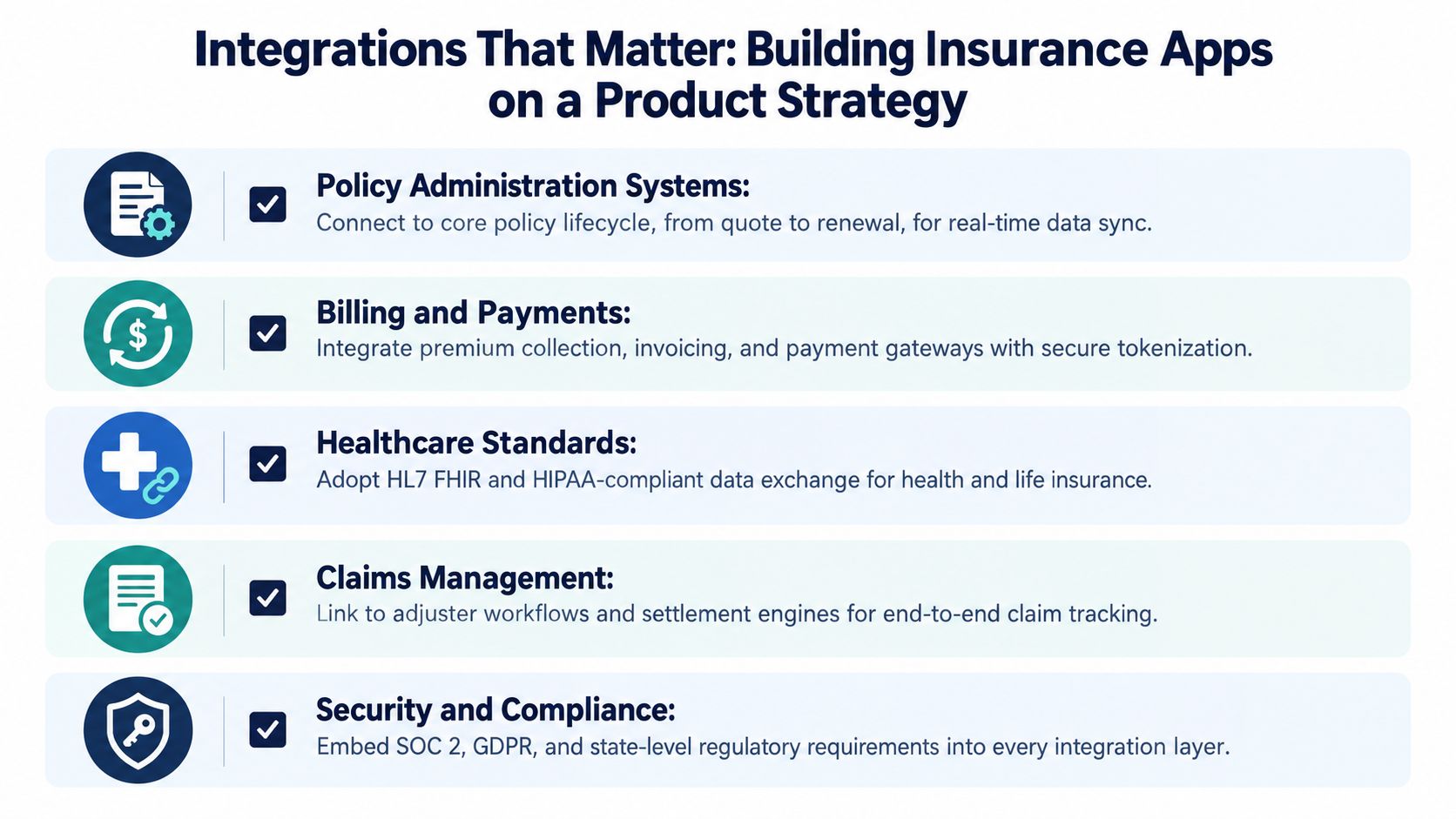
Treat integration scope as a product decision. A billing screen backed by a delayed export represents a different customer promise from one backed by a current ledger.
Inventory policy administration, billing, claims, document management, customer identity, agent portals, and payment providers. For each connection, record the authoritative owner, permitted operations, freshness requirement, error semantics, and recovery procedure.
Match integration patterns to customer promises
| Pattern | Suitable use | Design precaution |
|---|---|---|
| Synchronous API | Coverage lookup or immediate validation | Define timeouts and distinguish unavailable data from negative results |
| Batch reconciliation | Legacy exports and financial matching | Show freshness and assign unresolved discrepancies |
| Event stream | Claim milestones and document-processing events | Handle duplicates, ordering, retries, and replay explicitly |
For payments, distinguish request accepted, payment authorized, and ledger reconciled. Use provider tokenization where appropriate, and design duplicate-request protection before allowing customers to retry failed transactions.
For health-insurance journeys, assess HL7 interfaces and FHIR resources against the actual eligibility, provider, and clinical-data exchanges required. Don't assume adopting a standard resolves identity matching, terminology mapping, consent, or lawful data use. These healthcare interoperability considerations are relevant when the insurance workflow crosses into healthcare systems.
Turn security policy into engineering evidence
The stakes justify concrete controls. IBM's 2025 Cost of a Data Breach Report found an average global breach cost of $4.44 million. 13% of organizations reported breaches of AI models or applications, and 97% of those breached said they lacked proper AI access controls.
Use a control matrix that names the threat and the evidence required:
| Threat | Recommended control | Evidence to retain |
|---|---|---|
| Cross-customer access | Least privilege, tenant isolation, object-level authorization | Negative authorization test results |
| Sensitive-data exposure | Data classification, encryption, tokenized identifiers | Data-flow inventory and configuration checks |
| Compromised integration | Service authentication, dependency and API scanning | Scan findings and remediation records |
| Unapproved AI usage | Approved-model allowlist, prompt and data-loss controls | Access events and change approvals |
| Service disruption | Recovery procedures and incident rehearsals | Exercise findings and recovery validation |
For AI-enabled workflows, the NAIC's AI governance guidance supports governance across insurance operations rather than an isolated chatbot review. Translate that into model inventories, versioned registries, immutable decision logs, input provenance, bias and drift monitoring, and authorized human override.
Outsourcing doesn't eliminate oversight. The NAIC Model Bulletin on the Use of Artificial Intelligence Systems by Insurers, adopted in December 2023, covers AI systems developed by the insurer or by third-party vendors, so it requires validation and change evidence from AI vendors too.
Keep vendor-specific schemas behind an adapter layer. Otherwise, a supplier's configuration change can become a customer-facing release emergency.
AI and Automation Use Cases Worth Shipping First
Start with AI that helps staff interpret evidence and organize work. Don't begin with autonomous decisions about coverage, eligibility, or payout just because a demonstration looks convincing.
Prioritize assistance before authority
| Use case | Recommended starting boundary |
|---|---|
| Document extraction and triage | Suggest fields and routing, flag missing or conflicting evidence |
| Conversational service | Answer from approved material and transfer context to staff |
| Damage and image analysis | Assist assessment while preserving original evidence |
| Fraud signals | Prioritize investigation, not automatically accuse or deny |
| Underwriter and adjuster support | Present evidence and recommendations for accountable review |
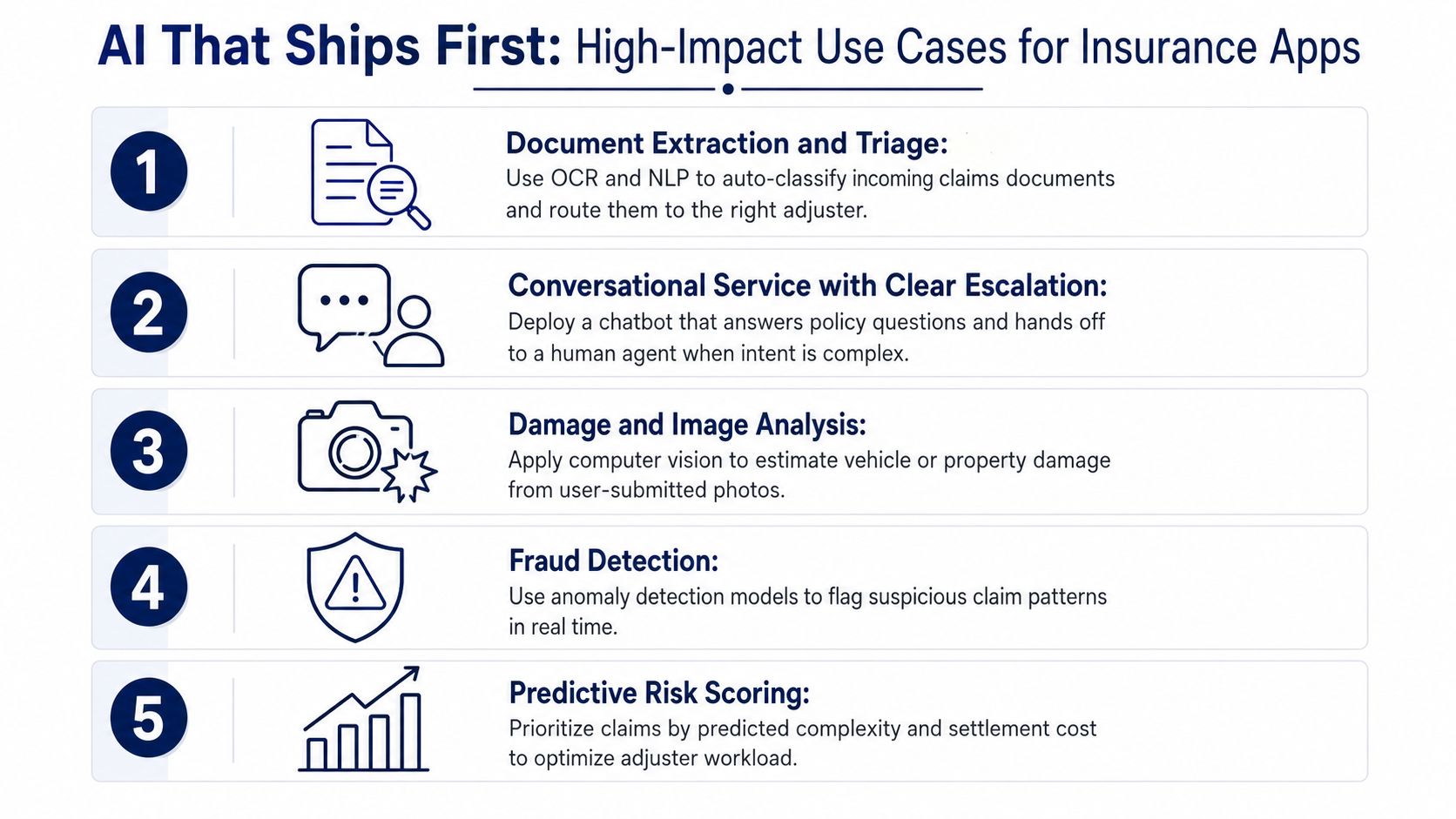
Evaluate candidates against representative cases, including incomplete submissions and unusual policy conditions. Route uncertain results and adverse recommendations to qualified staff with the evidence needed to review them.
For broader use-case exploration, see our practical AI-in-insurance considerations. A vendor demonstration or a generalized benchmark doesn't replace validation against your own claims and underwriting workflows.
A model's recommendation should never become a final decision merely because nobody was assigned to review it.
Buy extraction or model infrastructure where it fits. Keep responsibility for decision thresholds, customer explanations, appeals, and operational ownership inside the insurer's delivery model.
Designing for Claim Completion Rather Than Just Claim Submission
The most valuable claims improvement may be less visible than an intelligent intake form. It may be telling a claimant what happened, what's missing, who is responsible, and when they need to act.
J.D. Power's 2025 U.S. Claims Digital Experience Study identified proactive digital updates as a strong satisfaction driver, yet adequate updates were delivered only 22% of the time. Only 36% of auto claimants and 31% of homeowners claimants received status updates through their insurer's app.
Make handoffs visible and actionable
Design a claim journey around explicit business states, not vague labels such as processing. Separate evidence received, review required, inspection scheduled, decision issued, and payment confirmed wherever those distinctions reflect the insurer's real workflow.
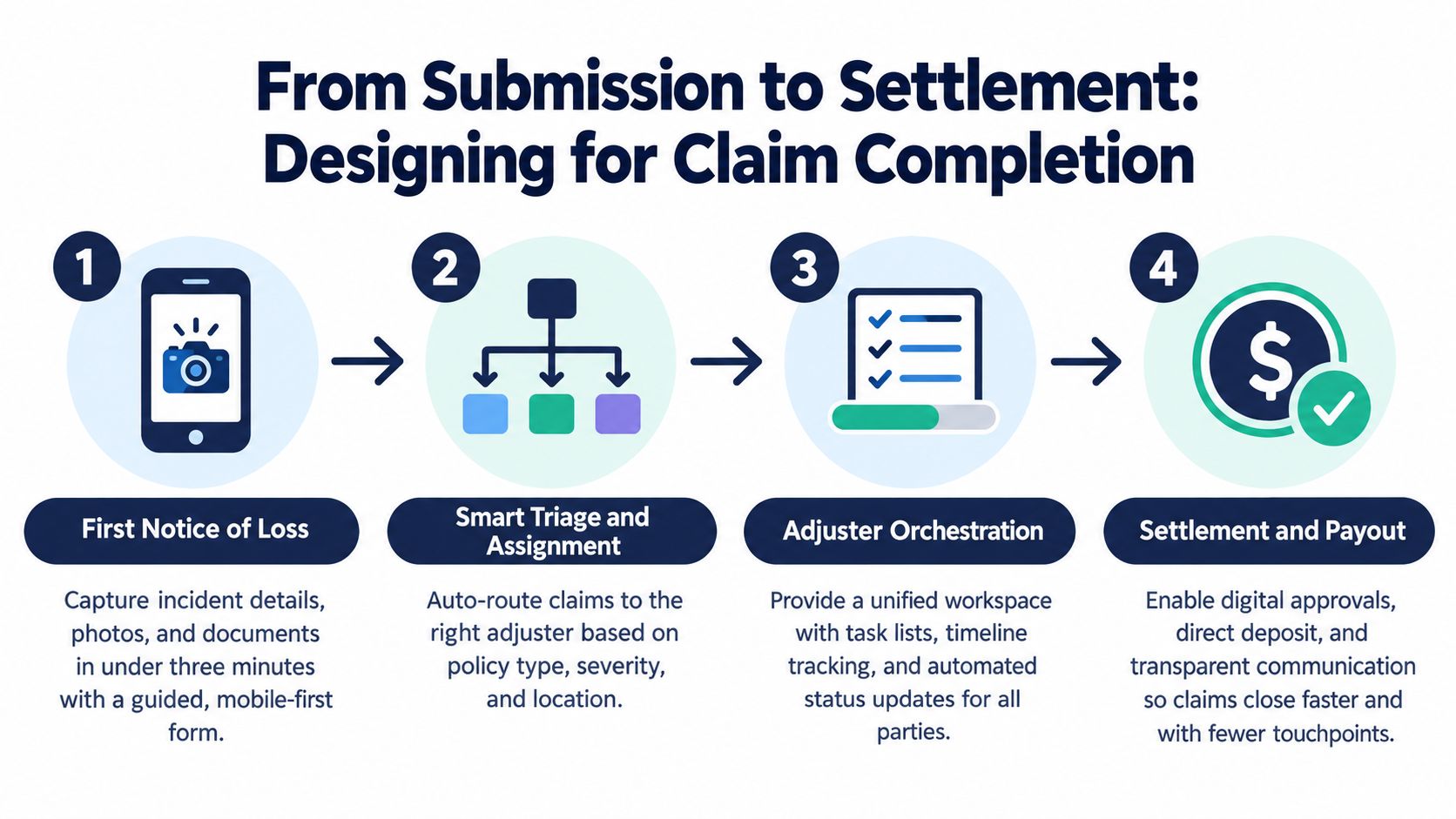
Each transition should identify the owner, supporting evidence, customer action, and escalation path. Don't mark a payment complete because a downstream request was merely accepted.
Event-driven status: Publish customer-visible updates from verified operational events.
Human escalation: Let staff intervene without forcing claimants to repeat their account.
Accessible notifications: Provide understandable messages, channel preferences, and an in-app history.
Auditable handoffs: Preserve who changed the state and why.
Fallback channels: Keep assisted journeys connected to the same claim record.
Measure digital completion, not just submission volume. Define which outcomes customers can finish digitally, where they must seek assistance, and which handoffs create repeated document requests or abandoned tasks.
Use an automated insurance claims processing solution as a discussion point for the complete workflow, rather than limiting the conversation to intake automation. The product objective should be a completed claim with a comprehensible outcome, including cases where a qualified human must make the final decision.
Testing, Deployment, Team Models and Engagement Options
A release isn't ready because its screens passed acceptance testing. Require evidence that the complete journey behaves correctly when dependencies fail, customers retry actions, and staff overrides automated recommendations.
Test business consequences, not just endpoints
Include functional and core-integration tests, object-level authorization checks, accessibility evaluation, and performance testing against plausible claim-event surges. Exercise partial outages, duplicate events, expired credentials, interrupted uploads, and reconciliation failures.
For AI, maintain representative evaluation datasets and repeat validation after relevant model, data, vendor, or workflow changes. The NAIC Model Bulletin expects governance across the AI system's life cycle, not just at launch.
Match operations and staffing to ownership
Consider platform-as-a-service when a smaller operations team needs fewer infrastructure responsibilities. Choose managed Kubernetes when workload requirements justify its flexibility and the team can operate it responsibly; neither choice establishes compliance by itself.
Use staged deployment, explicit rollback criteria, and named release authority. Separate deploying code from enabling consequential business behavior.
| Engagement shape | Appropriate fit | Insurer retains |
|---|---|---|
| In-house team with specialist augmentation | Established product ownership with specific skills gaps | Architecture direction and operational accountability |
| Full-Cycle Delivery | A bounded initiative needing coordinated implementation | Business decisions, acceptance, and governance |
| Corporate Business Solutions co-creation | Existing engineers sharing delivery with a partner | Shared technical decisions and clear interface ownership |
| AI Transformation Framework | AI adoption requiring structured discovery and validation | Risk acceptance and accountable business use |
Compare full-cycle software delivery, co-creation with in-house teams, and an AI implementation roadmap against your actual engineering bench.
Delivery test: If the partner leaves, your team should still know how to operate, investigate, change, and defend the platform.
Bringing It Together
A defensible insurance app starts with decisions that technology leaders can assign and verify. Approve a bounded customer journey, establish which systems remain authoritative, and agree on what constitutes operational completion before committing to a broad feature roadmap.
This quarter's planning should produce tangible artefacts:
Discovery agreement: A prioritized journey with named business owners and acceptance criteria.
Architecture decision: A documented boundary between the app, integration layer, and existing core.
Integration inventory: Contracts, dependencies, failure ownership, and reconciliation procedures.
Control baseline: Security and AI evidence required for release approval.
Delivery agreement: Team responsibilities, deployment authority, and support ownership.
Budget and schedule estimates should follow that work. Without an integration inventory and release-control scope, a precise enterprise build price or launch date would be a guess.
For external support, evaluate insurance software development against the whole operating model, and assess AI development services against validation and oversight requirements, not feature demonstrations alone.
The app should be a thin, well-governed surface over operations the insurer can explain and support. A polished interface can't compensate for an outcome nobody owns.
Frequently Asked Questions
How much does an enterprise insurance app cost?
A credible estimate needs a defined journey, integration inventory, security baseline, and operational support scope. Ask bidders to separate application delivery, core-system changes, vendor charges, migration, assurance, and ongoing operations rather than offering an unsupported headline range.
How long does a first regulated release take?
Set the release window after validating core-system access, identity integration, approval responsibilities, and testing environments. A narrow release with completed operational handoffs is a safer commitment than a broad launch dependent on unresolved integrations.
Which AI capability should we launch first?
Start with document extraction or staff-facing triage where reviewers can inspect and correct outputs. Progress toward consequential recommendations only after establishing representative evaluation, escalation, and customer-challenge procedures.
Should we extend, modernize, or replace a legacy core?
Extend it when dependable interfaces support the intended journey, and modernize selected boundaries when integration constraints are the main obstacle. Consider replacement when the core itself prevents required business capabilities and the organization can support the migration.
What evidence should an AI-enabled app retain?
Retain relevant model inventories, validation results, approvals, decision traces, incidents, and vendor assessments under an agreed retention policy. The NAIC Model Bulletin states that, in an investigation or market conduct action, regulators may ask about an insurer's AI governance framework, risk management, and internal controls.
Bridge Global offers insurance software engineering, mobile development, core-system integrations, and AI development through full-cycle delivery or co-creation with in-house teams. Visit Bridge Global to discuss a bounded insurance journey, its integration dependencies, and the engineering evidence your first release should produce.

About Stephanie Cornelissen
Stephanie Cornelissen is a Technical Solutions Consultant with strong experience helping organizations navigate complex digital change. She works closely with teams to align business goals with practical, scalable technology solutions. With expertise in system architecture, integrations, and emerging technologies, she focuses on solving real-world problems through thoughtful execution. She enjoys working where technology meets business strategy and measurable growth.
View all posts by Stephanie Cornelissen →