



Full Cycle Software Development Services: A Buyer’s Guide
Full cycle software development services make one accountable provider responsible for a product from discovery through deployment and ongoing maintenance. The buyer retains product direction while the provider manages delivery across the lifecycle.
Who owns the next security patch once the launch team moves on? That question exposes the gap between a provider offering every development phase and a contract that assigns durable responsibility. Evaluate the model through its handoffs, acceptance evidence and post-launch obligations.
What Full Cycle Software Development Services Cover Phase by Phase
A full-cycle engagement gives the buyer one delivery team to manage across the product lifecycle. Its defining feature is ownership of the handoffs, including the transition from implementation to production support.
The phase names matter less than the acceptance conditions connecting them. Discovery must produce decisions engineers can implement, and deployment must leave operators able to diagnose failures without calling the original developer.
Phases, deliverables and roles in a full-cycle engagement
| Phase | Typical activities | Deliverables | Lead roles |
|---|---|---|---|
| Discovery | Stakeholder interviews, user research, scope and risk review | Problem statement, prioritized backlog, risk register | Product owner, business analyst, architect |
| Architecture and design | Domain modeling, integration design, UX prototyping | Architecture decision records, data flow diagrams, clickable prototype | Solution architect, UX designer, tech lead |
| Build | Sprint-based implementation, code review, continuous integration | Working increments, reviewed and merged code | Engineers, QA engineers |
| Testing and validation | Automated and manual testing, security testing, performance tests | Test reports, security findings log, release candidate | QA lead, security engineer |
| Deployment | Infrastructure as code, release pipelines, staged rollout | Production environment, runbooks, release notes | DevOps engineer, release manager |
| Operations and maintenance | Monitoring, incident response, dependency updates, enhancements | SLA reports, patch releases, incident postmortems | Site reliability engineer, support lead, product owner |
These phases overlap. Engineers should establish monitoring during implementation, while security review starts before architecture approval and continues after release. Figr’s explanation of product development lifecycle stages provides useful context for connecting product decisions across that journey.
For engagement mechanics, our full-cycle software delivery guide describes the delivery model. Projects starting from a blank sheet also need custom software development planning; our software product development services guide addresses the broader product perspective.
Acceptance should leave you with a live product, usable runbooks, documented maintenance terms and a decision history another team can understand.
How Full Cycle Compares With Team Augmentation and Outsourcing
| Criterion | Full-cycle delivery | Team augmentation | Project outsourcing |
|---|---|---|---|
| Who owns the product outcome | Provider owns the journey from discovery onward; client retains product authority | Client owns the product and roadmap | Provider owns the agreed deliverable |
| Who manages the engineers | Provider delivery lead, with a client product owner | Client engineering managers | Provider project manager |
| How scope changes | Backlog reprioritized within agreed governance | Client adjusts the backlog directly | Formal change requests, often repriced |
| Typical pricing basis | Team capacity or milestones, agreed per engagement | Hourly or monthly rate per engineer | Fixed price or fixed milestones |
| Best fit | Launches, rebuilds and greenfield products without a full in-house product team | Teams needing specific skills while retaining control | Well-defined projects with stable requirements |
| Main risk | Dependence on partner governance and documentation | Coordination load on client managers | Handover gaps and costly change requests |
Team augmentation adds engineering capacity under your management. Your leads still resolve dependencies, approve technical decisions and organize releases. It works when those management functions already have capacity.
Project outsourcing puts a boundary around a deliverable. A stable integration specification can suit this arrangement, but unresolved requirements become commercial discussions once implementation reveals them.
Full-cycle delivery gives the provider responsibility across discovery and execution while a named client product owner controls priorities. The provider needs room to manage delivery, and the client still needs to make timely business decisions.
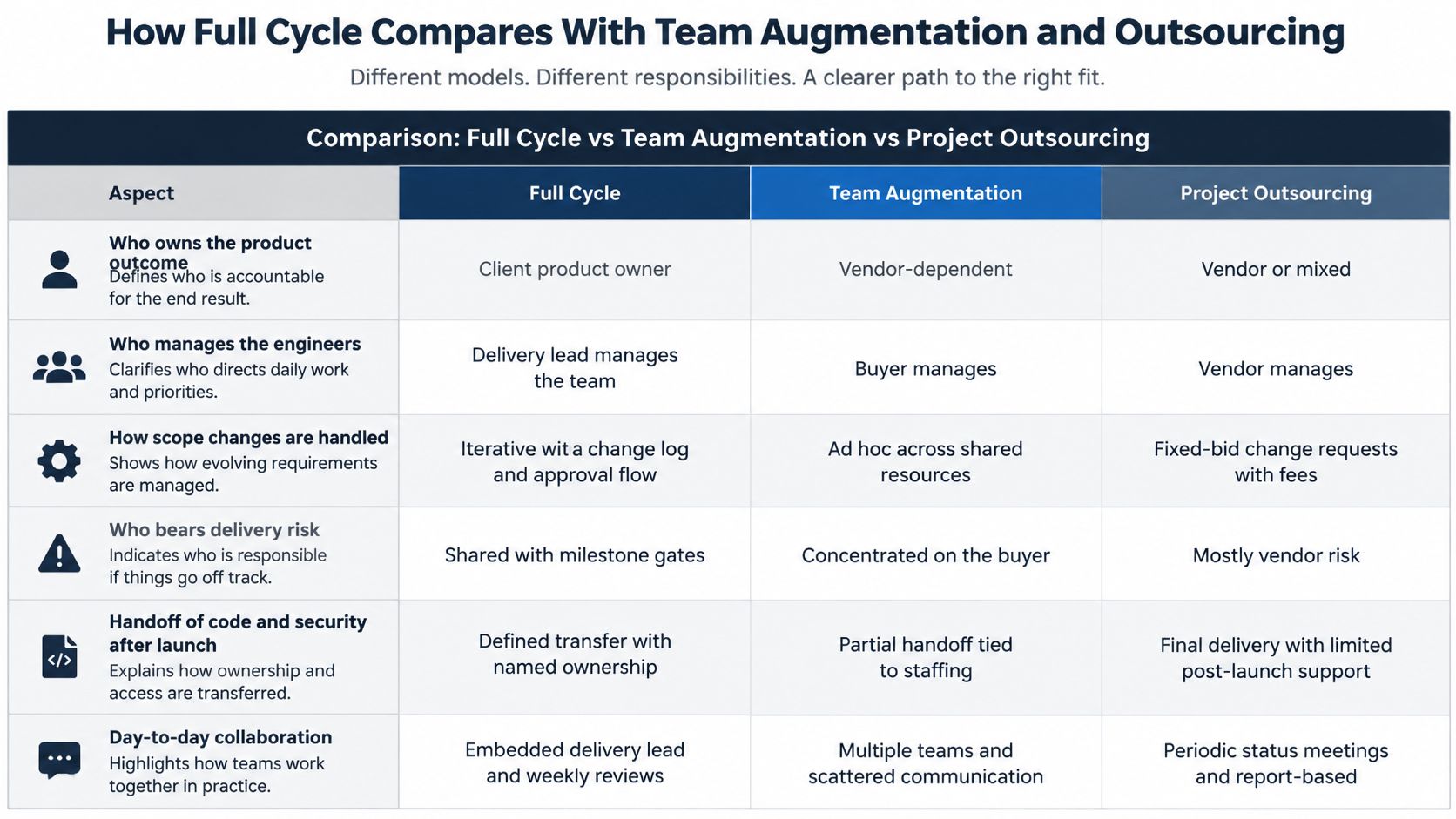
Contract terms take precedence over simplified model labels. In augmentation, for example, the buyer retains product accountability even when the supplier handles staffing.
You can combine software development service models across product lines. The deciding question is whether your organization can run the product team, including discovery and operations, with its existing leadership capacity.
What a Full Cycle Engagement Costs and How It Is Priced
Capacity-based pricing buys a team for an agreed period. It supports an evolving backlog, but the client product owner must stop low-value work and monitor the remaining budget.
Milestone-based pricing ties payment to verifiable deliverables. An architecture milestone should require accepted decision records and resolved design questions. A release milestone needs explicit test and operational acceptance criteria.
Fixed pricing suits a stable, well-specified scope. It transfers defined delivery risk to the provider, although incomplete discovery can lead to contingency allowances, exclusions or change requests.
Compare the assumptions behind each proposal before comparing its total.
The main cost drivers are discovery depth, integration complexity, regulatory scope, team composition, engagement duration and production operating costs. Medical-device classification can also change the evidence and specialist input required.
Every estimate should state its team size, role mix, duration, discovery allocation, hosting assumptions and rate basis. Our guide to custom software development pricing provides further context for evaluating those commercial choices.
This article publishes no price ranges because a figure without those assumptions can mislead budget planning. Give competing providers the same written brief and require them to separate implementation, third-party expenses and ongoing support so you can compare proposals line by line.
When a Full Cycle Engagement Fits Your Product
The Full-Cycle Delivery Model is best suited to product launches, platform rebuilds and greenfield applications. Each requires decisions that cross phase boundaries.
- A launch without an established product team benefits from keeping discovery context with the people responsible for implementation.
- A platform rebuild needs migration rehearsals and cutover planning owned alongside the replacement system.
- A greenfield application needs room to revise assumptions without negotiating separate contracts for every phase.
- A regulated product benefits from accumulating risk records and verification evidence as engineers make decisions.
The original 1994 Standish Group CHAOS report classified only 16.2% of software projects as successful, meaning on time, within budget and with specified functionality. That historical benchmark doesn’t prove a particular engagement model works; it illustrates why coding capacity alone is an inadequate buying criterion.
Full-cycle delivery is a weaker fit when your internal team already runs discovery and operations effectively. A narrow feature may need a short engineering engagement, while a stable, fixed-scope integration may suit project outsourcing.
List the lifecycle phases your organization can’t staff this year. If discovery, architecture or operations appear on that list, evaluate full-cycle delivery against the cost of establishing those functions internally.
Who Owns the Product, Code and Security After Launch
Handover doesn’t automatically transfer responsibility. A provider can deliver working software while leaving the buyer without anyone assigned to maintain dependencies or retain audit evidence.
Name a client product owner who sets priorities and approves scope. Define which decisions the provider can make independently, including architecture choices within agreed constraints, and which require client approval.

Make operating commitments measurable
The SLA schedule should define incident severity, acknowledgment and restoration expectations, coverage hours, escalation paths and availability calculations. Separate acknowledgment from resolution so a quick reply doesn’t count as successful recovery.
Require weekly delivery reporting and a monthly service review. The 2024 DORA report announcement distinguishes throughput and stability using deployment frequency, lead time for changes, change failure rate and failed-deployment recovery time. Establish baselines and review both dimensions rather than rewarding release volume alone.
Keep ownership enforceable
Require client-controlled repositories and administrator access from the first commit. The contract should assign bespoke source code, infrastructure definitions and documentation to the client, while identifying pre-existing components and third-party license restrictions separately.
Assign named responsibility for vulnerability monitoring, dependency upgrades, access reviews, incident response and evidence retention. Specify who funds remediation and who authorizes an emergency production change.
For applicable medical devices, FDA cybersecurity guidance recommends a Secure Product Development Framework covering security risk management, architecture, testing and lifecycle documentation. Deferring that work until final testing can create architectural rework and gaps in submission evidence.
Before signing, obtain a responsibility matrix, the SLA schedule and a handover plan. The provider’s contractual duties support your obligations; they don’t automatically transfer the regulated organization’s or manufacturer’s accountability.
Team Composition for a Full Cycle Engagement
Staff the responsibilities before agreeing to a headcount. A credible delivery proposal identifies who performs each function and when that person participates.
- Delivery leadership runs the plan, resolves dependencies and reports delivery risk.
- Product and domain ownership stays client-side so business rules and priorities have an authoritative decision-maker.
- Architecture and engineering cover technical design, implementation and peer review.
- Quality engineering owns test strategy and automation, with independence to challenge release readiness.
- Platform engineering maintains environments, deployment pipelines and production observability.
- UX and security specialists contribute during discovery and design, then return as changes require review.
A small launch can share specialist roles across the engagement. Avoid combining implementation and final quality approval without independent review; regulated platforms need explicit security and compliance coverage from the start.
Geographic sourcing is a separate decision from delivery ownership. LatHire’s Hire Latin American Developers resource is relevant when evaluating regional staffing options, but location doesn’t establish who owns architecture or production response.
For shared delivery, co-creation with in-house teams allows internal engineers to participate directly. Keep final release authority with the client, and identify the people who decide scope, approve security risk and respond to an overnight incident.
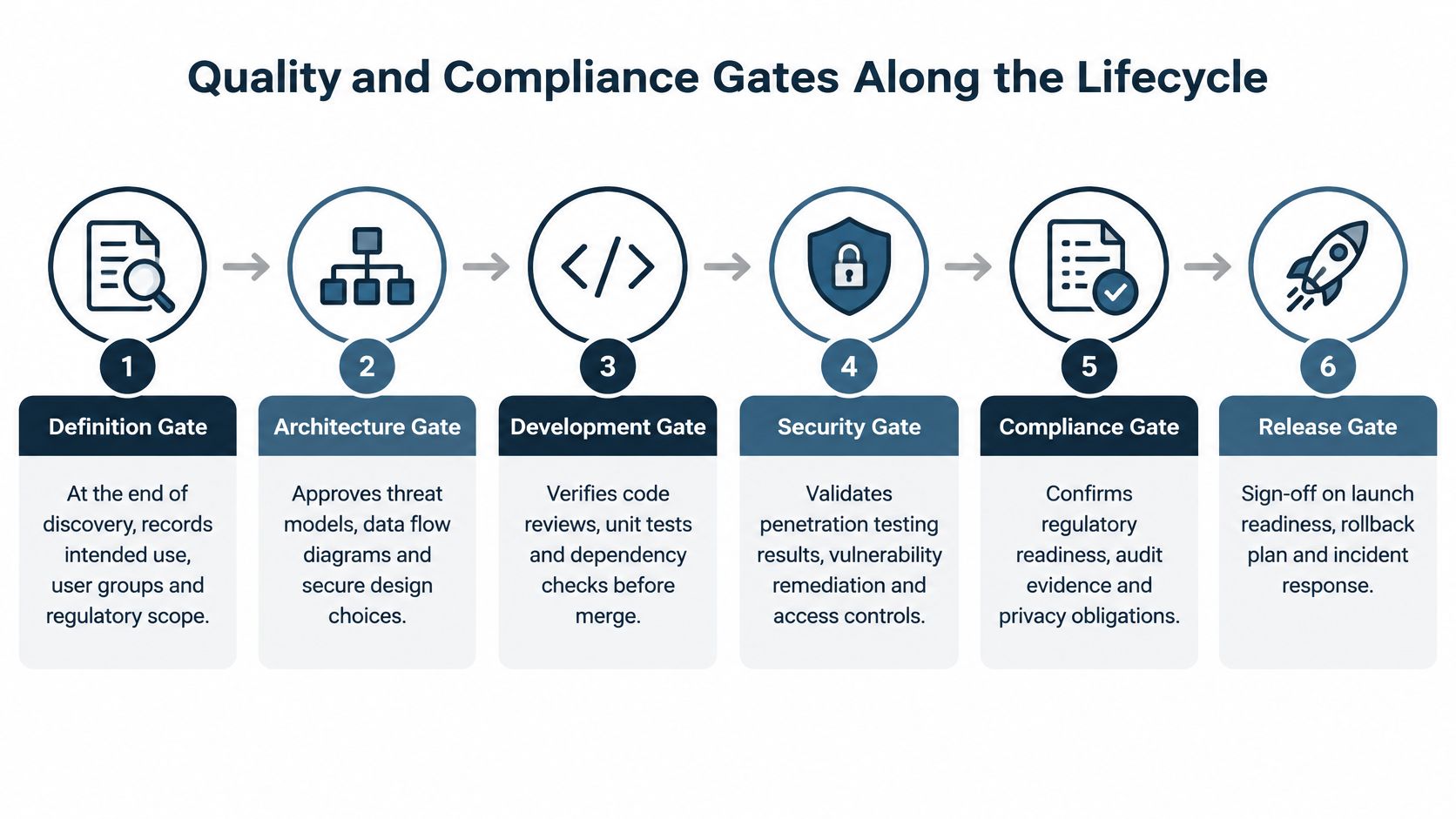
Quality and Compliance Gates Along the Lifecycle
Treat each gate as an evidence-based approval with named client and provider owners.
- Definition gate. Record intended use, user groups and applicable regulatory scope.
- Architecture gate. Approve threat models, data flows and integration standards.
- Build gate. Require automated tests, static analysis and code review before merge.
- Verification gate. Close test reports and security findings, or document authorized residual-risk acceptance.
- Release gate. Approve readiness with a tested rollback plan.
- Post-release gate. Review incidents, vulnerabilities and patch performance.
DOM Studio’s guide to catching real bugs during review offers practical context for making review substantive. Our DevOps implementation services guide addresses the delivery workflows supporting repeatable gates.
Standards and regulations mapped to evidence-producing gates
| Standard or rule | Applies to | Evidence the gate should produce |
|---|---|---|
| HIPAA Security Rule | Regulated entities handling ePHI in U.S. systems | Definition and architecture gates document risk analysis linked to requirements and controls |
| HL7 FHIR U.S. Core | Patient-data exchange implementing applicable U.S. Core profiles | Verification gate records conformance results for required profiles and REST interactions |
| DICOM | Medical imaging data and devices using DICOM | Architecture and verification gates collect supplier conformance statements and integration test results |
| EU MDR Rule 11 guidance | Medical-device software placed on the EU market | Definition and verification gates retain classification rationale, clinical or performance evaluation and lifecycle risk records |
| FDA cybersecurity guidance materials | Medical devices with cybersecurity risk in the U.S. | Release and post-release gates preserve premarket security documentation and vulnerability-management plans |
This is an evidence-planning map, not a claim that every row applies to every healthcare product. Request representative gate records before contracting; a passed gate without supporting evidence gives the buyer little assurance.
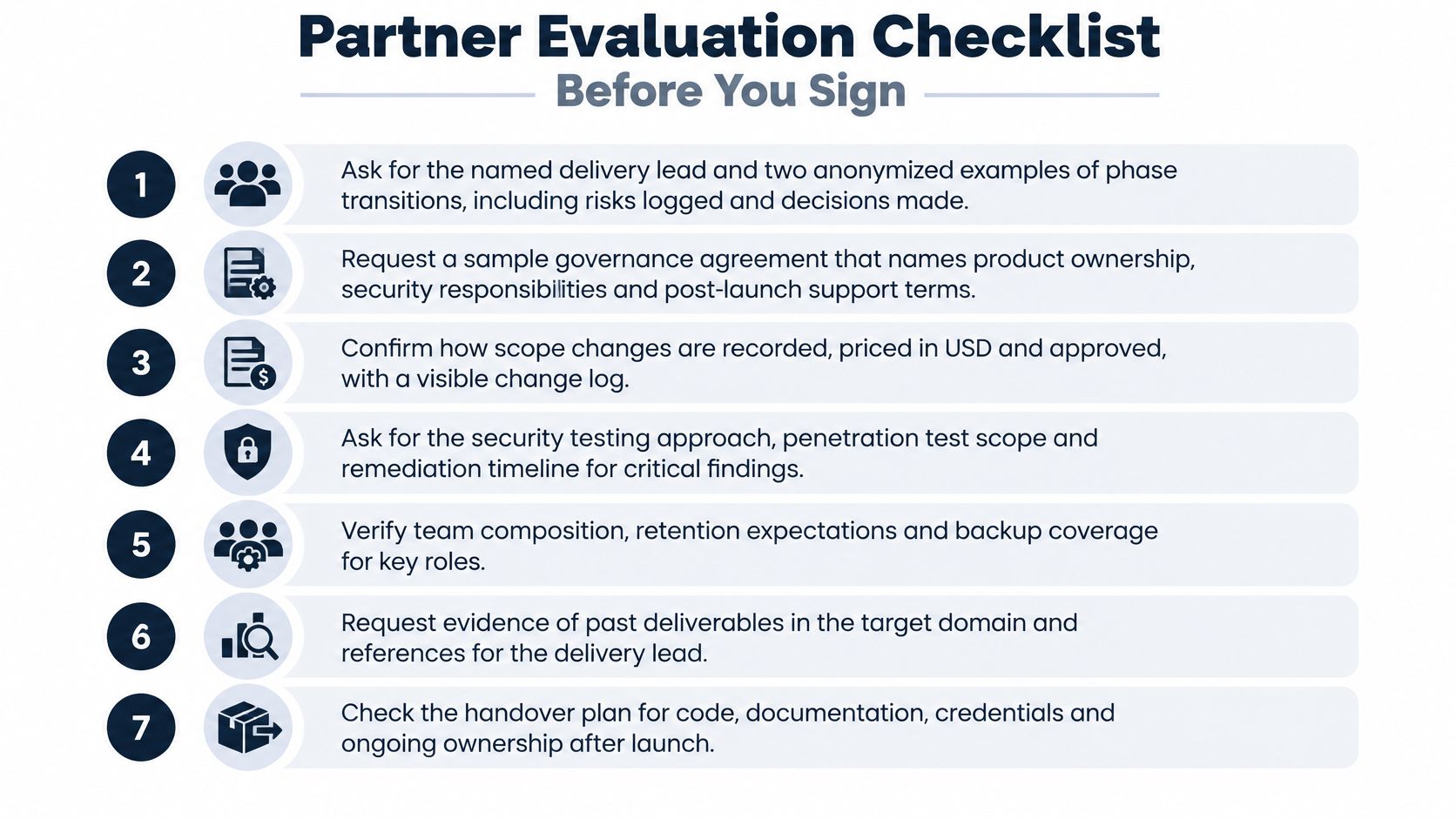
Partner Evaluation Checklist Before You Sign
Send these questions before the proposal meeting and require written answers that can become contract schedules.
- Delivery leadership. Who is the named delivery lead, and can you provide anonymized examples of discovery outputs and release-acceptance evidence?
- Commercial boundaries. Which pricing basis applies, and exactly which changes trigger repricing?
- Model fit. Which engagement model matches the lifecycle responsibilities our organization can staff?
- Working integration. How will your engineers use our tools, branching rules and sprint cadence?
- Administrative control. Who holds repository and pipeline write access, and will our administrators retain control throughout?
- Vulnerability handling. Can you share a redacted production-release record showing detection, triage, remediation and deployment dates?
- Continuity. What staff turnover has affected comparable engagements, and how is knowledge retained when engineers leave?
- Regulated delivery. Which gate records will you produce, and what documented QMS or ISMS scope covers the proposed work?
- Exit readiness. What knowledge-transfer activities, dependencies and completion conditions appear in the written exit plan?
Our engagement options include full-cycle delivery, Corporate Business Solutions and AI transformation frameworks, each aligned with client goals. Our solutions are designed to work alongside in-house technology teams and fit their development workflows.
Use our guide to choosing a software development partner for broader selection considerations. Reconcile every material answer with the proposed contract, especially exclusions, support coverage and exit obligations.
Settle These Risks Before You Sign a Full Cycle Contract
Partner dependence becomes expensive when only supplier engineers can build or deploy the system. Require a transition rehearsal in which another authorized engineer follows the documentation, provisions an environment and deploys a release without undocumented assistance.
Post-launch ownership gaps appear when project acceptance ends before operational responsibility begins. Make support activation an acceptance condition, including a staffed escalation route and confirmation that vulnerability alerts reach the accountable owner.
A handover is complete when the receiving team can operate the product and demonstrate that it can recover from a failed change.
AI-assisted delivery can shift effort from implementation into review. Require human approval for architecture, security-sensitive changes and releases, plus tracking of escaped defects, rework percentage and review latency. Specify permitted tools, data-handling restrictions and responsibility for correcting generated code.
Regulatory scope drift needs an explicit change-control trigger. A proposed change to intended use should return to definition review before engineers commit to implementation, so the responsible regulatory specialists can assess classification and evidence implications.
Choose the engagement based on the responsibilities you need covered. Prepare a written brief describing the product goal, regulatory scope, unstaffed lifecycle phases and contractual acceptance conditions, then use it to structure a conversation about Bridge Global’s software development services.
Frequently asked questions
How long does a first production release take?
There’s no dependable timeline without an agreed release scope. Discovery uncertainty, legacy migration, external integrations, security validation and regulatory evidence all affect the schedule, so request an estimate that identifies dependencies and acceptance conditions.
Can we buy discovery separately before committing to delivery?
You can structure discovery as a separate paid engagement with its own acceptance criteria. Require portable outputs, including the prioritized backlog, risk register, architecture options and estimate assumptions, so you’re free to choose a different delivery team afterward.
What should ISO 13485 or ISO/IEC 27001 status mean to a buyer?
Treat a certification claim as something to verify, not as product approval or a guarantee of compliant delivery. Obtain the certificate and confirm its validity, organizational scope, covered activities and locations with the issuing certification body.
How does full-cycle delivery differ from managed operations after launch?
Full-cycle delivery spans product definition and engineering through release and agreed maintenance. A managed operations contract usually focuses on running an existing service, so confirm whether feature development, application remediation and regulatory evidence updates are included or separately commissioned.
Bridge Global provides full-cycle custom software development for businesses that need a cross-functional team to own the product journey. Bring your product brief and lifecycle staffing gaps to discuss delivery boundaries, quality evidence and post-launch responsibilities before committing to an engagement.

About Upendra Jith
Upendrajith completed his Master's in English and has been a commercial content developer for the past three years. He's more inclined to develop content with a 'street-smart' delivery on topics such as technology, media, or anything he can get his hands on. He has a fixation on lyrics, dark poetry, media, technology, and flow arts.
View all posts by Upendra Jith →