



FHIR HL7 Integration Services Guide for Healthtech Teams
You do not get a quiet day to rethink interoperability. A partner sends a request, a new EHR connection lands in the queue, and product wants a timeline before the data mapping is finished. That is the point where FHIR HL7 integration services decide whether delivery stays on track or gets pulled into one-off interfaces.
For healthtech leaders, the question is whether HL7 and FHIR can be turned into something repeatable, governable, and supportable across products, partners, and releases. Bridge Global works as a healthtech software development partner, and this guide is written for people who need to make those calls with engineering reality in mind, not just standards language.

A legacy feed, a new app, or a trading partner that insists on a specific profile rarely calls for a full replacement. The practical work is deciding where FHIR fits, where HL7 v2 still belongs, and how to keep the setup readable for the next team that inherits it. The shift happens when teams treat implementation guides as contracts, build shared FHIR literacy, and keep semantic governance visible instead of buried in mapping notes. A reusable healthcare data interoperability strategy helps reduce dependence on a few scarce specialists and gives product and engineering leaders a clearer way to judge trade-offs.
By the end, you should be able to judge which integration pattern fits your environment, what to ask an implementation partner, and how to reduce dependence on a handful of scarce specialists without losing control of quality.
Understanding HL7 and FHIR Building Blocks Without the Jargon
HL7 is best understood as a standards family, not a single format. HL7 describes FHIR as having two main parts: a content model built from resources and an exchange layer built on real-time RESTful interfaces, messaging, and documents, so the standard covers both what the data looks like and how it moves between systems. That distinction matters because a lot of confusion comes from treating FHIR like “just another API,” when it's really a structured way to model healthcare exchange. HL7's product brief makes that split explicit.
Think in resources, not giant records
A FHIR resource is easier to picture as a LEGO block than a monolithic patient chart. One block represents a patient, another an observation, another a medication request, and those blocks can be assembled into the shape a workflow needs. That's why teams working on custom healthcare software development often find FHIR easier to reason about than older record formats.
The resource approach also helps explain why implementation guides matter so much. HL7 defines an implementation guide as a computable set of rules for how FHIR resources are used to solve a specific interoperability problem, which means the IG is the contract, not casual mapping notes. For enterprise delivery, a FHIR IG becomes the machine-readable definition you can version, validate, and hand to downstream systems as a reference point. HL7's implementation guide overview is the key reference here.
Practical rule: if the IG says a field is required, profile it that way in your own stack. Don't let a spreadsheet become the hidden source of truth.
Why the exchange layer matters
FHIR's exchange layer is where the web-style thinking comes in. RESTful endpoints give you a familiar way to query and update resources, which is why teams building healthcare integrations often treat FHIR as the bridge between clinical data and modern application development. Instead of inventing a custom transport for every partner, you expose a predictable interface and let the resource model do the heavy lifting.
That predictability is also what makes R4 important. HL7's history shows the standard moving through four releases since its initial presentation in 2011, with DSTU2 in 2015, STU3 in 2017, and the first normative R4 release on December 27, 2018, while the resource count grew from 49 in the early draft to 149. That growth reflects maturity, not just feature creep. HL7's history page shows how quickly FHIR became a production-ready interoperability foundation.
The practical takeaway is simple. If you understand resources, profiles, and REST separately, the whole system becomes much easier to debug, test, and govern.
Comparing HL7 v2 CDA and FHIR for Integration Decisions
A real integration decision starts with the job each standard is meant to do. HL7 v2 still fits hospital operations because it moves event-driven messages well. CDA packages clinical information as documents. FHIR is built around resources, profiles, and web-style exchange, so it works better for real-time access, validation, and reusable APIs. The choice is about fit, not preference.
Side-by-side view
| Standard | Data Format | Exchange Pattern | Best Fit |
|---|---|---|---|
| HL7 v2 | Pipe-delimited messages | Event-style messaging | Internal hospital workflows, admissions, labs, routing |
| CDA | Structured clinical documents | Document exchange | Summaries, continuity records, narrative-heavy handoffs |
| FHIR | Resources with RESTful exchange | API access, messaging, documents | Apps, patient access, partner APIs, reusable integrations |
FHIR becomes easier to trust when you look at its release path and version rules. HL7's history shows four releases since 2011, with the resource set growing from 49 to 149 and R4 becoming the first normative release in 2018. Normative content is meant to stay stable across future changes, which lowers the risk of building on a moving target. HL7's version history and versioning rules explain how that stability works.
What versioning changes in real projects
Versioning affects implementation choices, not just documentation. HL7 says existing resource names will not change, and RESTful endpoints will not be renamed or removed in ways that break systems built against prior versions. It also defines a fhirVersion MIME parameter, such as application/fhir+json; fhirVersion=4.0, so an API response can signal the release behind it with precision. That makes version alignment a design requirement, not a paperwork task.
The US Core Implementation Guide shows why implementation guides matter as contracts. It is based on FHIR R4, and HL7's US Core pages note support for R4 systems with packages for both R4 and R4B. If one partner expects US Core and another team builds against a different release, the mismatch shows up in validation, terminology, and field behavior fast.
Teams that treat FHIR as a shared vocabulary usually move faster than teams that rely on a few specialists. The practical work is to teach profiles, version rules, and semantic governance well enough that product and engineering can reuse playbooks instead of starting from zero each time.
If the partner says “FHIR,” ask which version, which IG, and which scopes before anyone opens a ticket.
Common FHIR HL7 Integration Patterns and Architectures
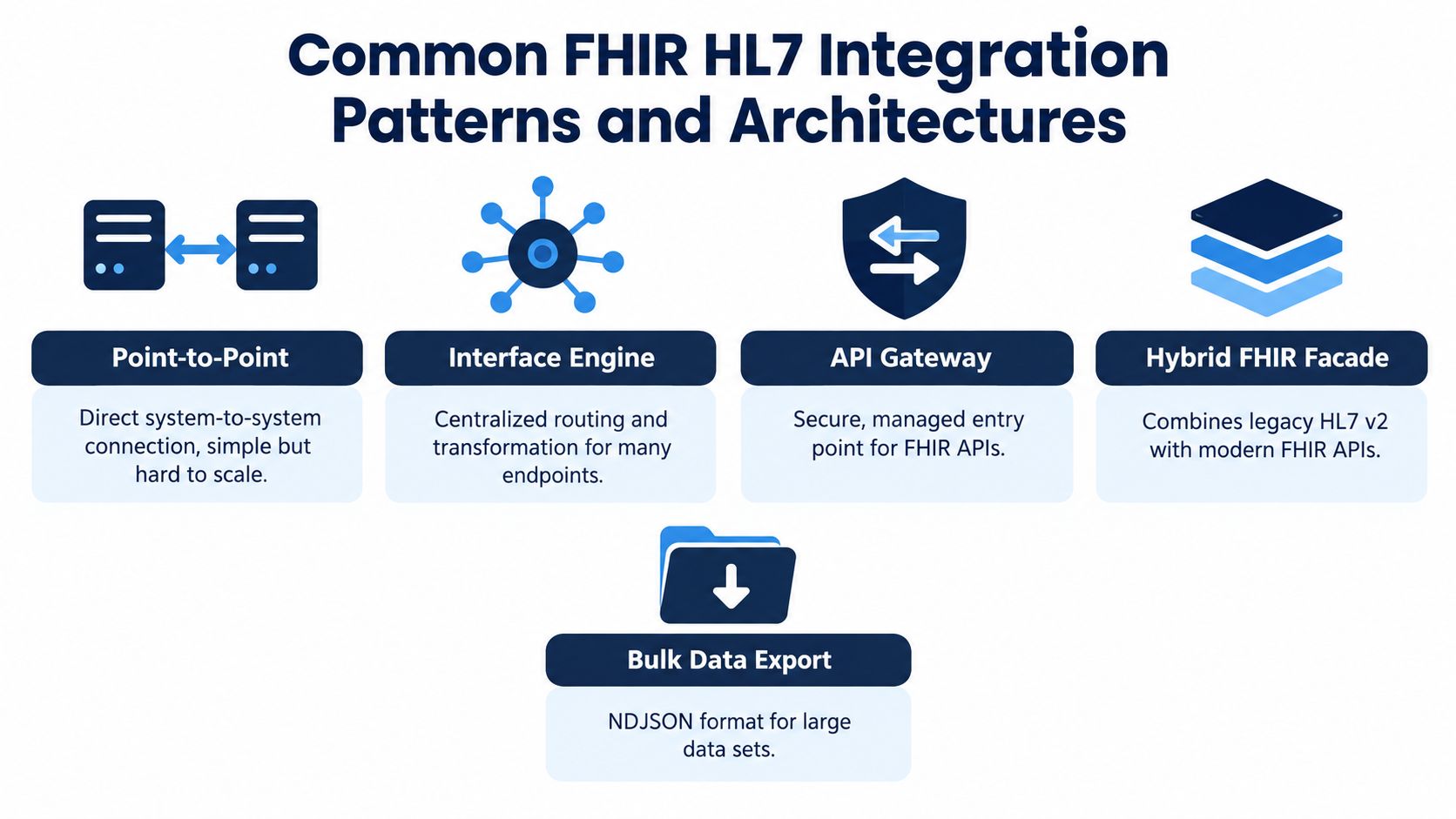
A good integration design starts with the shape of the system, because that choice affects team skills, test effort, and how much rework shows up later. A point-to-point setup can work for one connection, but every new partner adds another custom path to maintain. Production programs usually move toward a hub, a gateway, or a facade once the first connection proves useful. For teams modernizing larger stacks, SaaS product development and custom software development often overlap with interoperability design, and the broader healthcare integration architecture needs to fit both product direction and operational limits.
Patterns that show up in real programs
Point-to-point is the easiest way to begin, but it turns brittle as soon as each new system needs its own mapping logic. Interface engines centralize routing and transformation, so they fit better when several endpoints need to share normalized data. API gateways add managed access, auditability, and policy control around FHIR endpoints, which makes sense when outside apps need one stable entry point.
A hybrid FHIR facade often works best for legacy environments. It exposes modern FHIR APIs while the source system still speaks HL7 v2, CDA, or another older format. That lets teams keep current operations running while building new consumer experiences on top.
Bulk data changes the workload
For large cohorts, HL7's Bulk Data Access IG standardizes export from a FHIR server to a pre-authorized client using NDJSON, with $export operations and asynchronous status retrieval. The practical effect is simple: it avoids chatty per-resource REST calls and shifts the work toward file-based transfer suited to large datasets. HL7 aims that guide EHRs, data warehouses, and systems that need to share large FHIR datasets efficiently. Bulk Data Access IG is the reference to keep open during planning.
When a team has to wrap older systems instead of replacing them, the MakeAutomation legacy integration guide is a useful companion. It helps frame how older platforms can be routed, wrapped, and modernized step by step.
Where implementation guides fit
Implementation guides are not documentation after the fact. They define the contract the systems are supposed to follow. If an architecture cannot validate against the chosen IG, the design is too loose for production. Treating IGs as contracts also gives product and engineering a common reference point, which is where FHIR literacy and semantic governance start to reduce dependence on a few scarce specialists.
Practical Implementation Checklist and Timeline
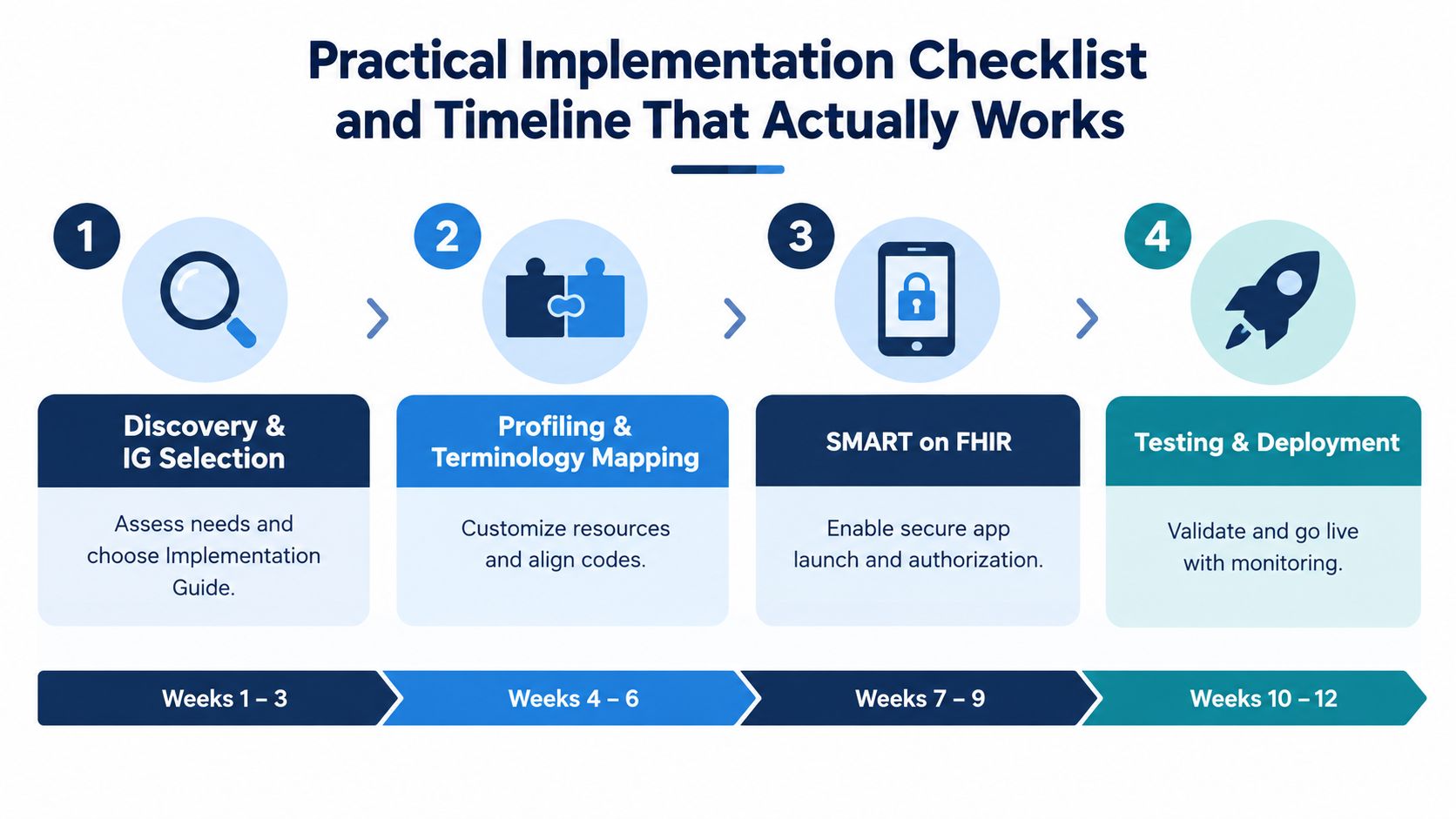
A project usually goes off track when the team starts coding before the contract is clear. In FHIR work, the contract is the implementation guide, the profile set, and the authorization model. Get those aligned first, then build. If you're comparing delivery approaches, software development service models can help match the engagement shape to the integration risk, and an AI implementation roadmap helps if automation or data extraction is part of the workflow.
The phases that keep projects from drifting
-
Discovery and IG selection: Confirm the source systems, the trading partner expectations, and the relevant IGs. For US-facing work, version alignment with FHIR R4 and US Core matters because the guide is based on R4 and supports R4 systems.
-
Profiling and terminology mapping: Decide which resources are constrained, how local codes map to standard vocabularies, and how the team will handle messy or incomplete source data. If the vocabulary decisions stay informal, every downstream interface becomes a special case.
-
SMART on FHIR design: HL7's US Core guidance says servers SHALL support SMART App Launch 2.0.0 or later for client-server interactions, and the API requires resource-level scopes plus granular scopes for patient data access. SMART on FHIR scopes guidance makes the scope model concrete.
-
Build, test, and deploy: Validate against the chosen IG, run conformance checks, then move to production monitoring only after the errors are understandable by the support team.
A realistic timeline mindset
A short pilot can move fast if the source data is clean and the IG is narrow. Broader programs take longer because the hard work sits in the edge cases, not the happy path. Terminology mismatches, authorization flows, and validation failures usually appear only when the partner sends real traffic.
A useful rule of thumb: do not call a build phase finished until the team that will support the interface can explain the validation errors without outside help.
The strongest teams also write down who owns the playbook. Reusable integration logic, profiles, and terminology rules turn the next connection into a repeatable pattern instead of a fresh search for FHIR specialists.
Security Compliance Tooling and Vendor Selection for Sustainable Interoperability
A team can build a solid interface and still struggle in production if governance tools are weak. Security review, consent handling, audit trails, version control, and scope enforcement need to sit inside the same operating model. For teams exploring automation or analytics around integration work, AI development services and enterprise AI solutions can support that work, but only after the data path is controlled.
A decision matrix for tool and partner selection
| Evaluation area | What to look for | Why it matters |
|---|---|---|
| IG support | Native validation against implementation guides | Keeps builds aligned with the contract |
| Versioning discipline | Clear handling of R4, R4B, and future releases | Avoids hidden compatibility breaks |
| Testing automation | Repeatable validation and conformance checks | Catches regressions before go-live |
| Hybrid support | Works across HL7 v2, FHIR, and CDA | Protects legacy investment |
| Security controls | OAuth patterns, scope enforcement, audit logging | Keeps PHI access traceable |
| Operations | Monitoring, error handling, support handoff | Makes the integration supportable |
The bottleneck is often not the API layer. It is FHIR literacy. The 2026 State of FHIR reporting cited in the brief says 75% of respondents said lack of FHIR knowledge was the biggest challenge, ahead of investment cost and unclear regulation, and the same material points to practical work being concentrated in high-volume operational use cases like prescriptions, pharmacy, terminology, diagnostic orders and reports, immunizations, and document exchange. That points to a simple choice: training, profiling, and governance need the same attention as code.
Vendor selection is really capability selection
A good vendor helps with mapping, validation, security, and support for hybrid environments. A weak one hands over a connector and leaves your team with the maintenance burden. The core question is whether the partner can build reusable systems, document the implementation guide as a working contract, and transfer the playbook so the next interface does not depend on a scarce specialist.
Bridge Global’s custom software development and SaaS product development capabilities matter in that context because the evaluation is about reusable delivery, not one-off interface work. Bridge Global’s healthcare work includes integration capabilities that cover FHIR and HL7 workflows, so teams often assess it as one option when they need a broader software partner rather than a narrow tooling vendor.
The practical filter is simple. Ask how the vendor handles contracts, validation, terminology governance, support handoff, and team enablement. If those answers are thin, the integration may work once and become hard to sustain.
Real-World Use Cases: ROI and Pitfalls to Avoid with FHIR HL7
A project feels real when it lands in a workflow people already trust. A provider may need EHR connectivity for a patient app. A payer may need data exchange for a new API requirement. A digital health company may need remote monitoring data to reach a clinical workflow without manual re-entry. A modernization team may need ERP or CRM systems to understand clinical events without brittle custom scripts. These are the cases where value is visible, and failure is expensive.
FHIR adoption is no longer a niche bet. In the 2025 State of FHIR survey, 71% of respondents said FHIR is already used for at least a few use cases in their country, up from 66% in 2024, while 73% reported that FHIR is either mandated or formally advised in their country, and 65 of 82 respondents said they have a base or core FHIR implementation guide under development or in place. HL7’s survey download shows the shift from experiment to everyday use in many markets.
The traps are familiar. Teams miss semantic drift, where the same concept is encoded differently across systems. They also underestimate duplicate records, brittle mappings, and the training load that comes with a new standard. A FHIR interface often fails not because the API is hard to call, but because people are not aligned on meaning, ownership, and change control.
Governance is the piece that survives staff turnover. If your mapping rules live in one engineer’s head, you do not have an integration program. You have a dependency.
A stronger pattern is to treat the implementation guide as a contract, not a PDF. That means profiles are tested, terminology choices are documented, and downstream systems know what to expect before go-live. It also means the team builds reusable playbooks, so the next interface does not depend on the same scarce FHIR specialist. FHIR literacy across product, engineering, and operations matters as much as the endpoint design.
The teams that avoid rework usually do two things well. They set semantic governance early, so code maps to agreed meaning instead of local guesses. They also prepare support handoff and team enablement from the start, which is why partners such as Bridge Global are often evaluated on reusable delivery rather than one-off connector work. Bridge Global helps healthtech teams design interoperable systems, modernize legacy integrations, and build FHIR-aware software with governance in mind.
FAQ
How do I know whether to start with FHIR or HL7 v2?
Start with the system you have, not the one you wish you had. If the source is legacy hospital messaging, HL7 v2 will probably be in the path. If the consumption side is a modern app or a partner API, FHIR is usually the cleaner surface to expose.
What makes an implementation guide more than just documentation?
An IG becomes operational when your team validates against it, profiles resources to match it, and uses it as the contract for downstream systems. Without that discipline, it is just a reference document.
Why do teams struggle with FHIR even when the API looks simple?
Because the difficulty is usually in terminology, version alignment, and governance, not in the HTTP call itself. The API is the easy part to demo and the hard part to sustain.
What should product leaders ask before approving a FHIR integration project?
Ask who owns the profiles, how version changes will be handled, what testing proves conformance, and how the team will support the interface after launch. Those answers tell you whether the project is buildable or just optimistic.

About Upendra Jith
Upendrajith completed his Master's in English and has been a commercial content developer for the past three years. He's more inclined to develop content with a 'street-smart' delivery on topics such as technology, media, or anything he can get his hands on. He has a fixation on lyrics, dark poetry, media, technology, and flow arts.
View all posts by Upendra Jith →