



Ecommerce Backend Modernization for Future-Proof Growth
That old backend system isn’t just a little sluggish; it’s a silent drain on your revenue. If you’re seeing high cart abandonment, dealing with inventory headaches, or finding it impossible to launch new features, the root cause is likely your aging infrastructure. Ecommerce backend modernization is how you stop the bleeding. It’s about strategically rebuilding your technical foundation to not only fix current problems but also unlock future growth.
The Real-World Costs of an Outdated Ecommerce Backend

In ecommerce, what happens behind the curtain is often more important than the show out front. A beautiful, fast-loading storefront gets all the glory, but it’s the backend that does the heavy lifting. When that backend is old and creaky, it’s not just a technical issue for your IT team; it’s a business-wide problem that hits your bottom line every single day.
These aren’t abstract technical debts; they are real, measurable financial losses and operational headaches that leaders like you have to confront.
When Performance Directly Hits Your Pocket
The most immediate and painful cost of a slow backend is lost sales. It’s a simple, brutal equation. Modern shoppers are impatient, and the link between site speed and conversion is undeniable.
The data speaks for itself. Research from Google has consistently shown that 53% of mobile shoppers will leave a site if it takes more than three seconds to load. Amazon famously found that even a 100-millisecond delay, a blip in time, could cost them 1% in sales.
Think about that. A half-second delay in your backend response, something your developers might not even notice, could be costing your business millions in lost revenue annually. This is why backend modernization isn’t an IT expense; it’s a core revenue-driving initiative.
The Slow Burn of Operational Chaos
Beyond just speed, a legacy backend system is a breeding ground for operational nightmares that slowly poison your customer relationships and burn out your team. When your core systems can’t talk to each other in real-time, you start seeing problems that directly affect your customers.
Have you experienced any of these?
-
The “In Stock” Lie: A customer excitedly orders a product, only to get a follow-up email hours later saying it’s actually sold out. This is a classic symptom of a website that isn’t properly synced with inventory management.
-
Promo Code Pandemonium: You launch a big flash sale, but the site crashes under the traffic or fails to apply discounts correctly. The result? A customer service firestorm and a PR mess.
-
The Manual Labor Tax: Your team wastes countless hours manually fixing orders, reconciling inventory spreadsheets, or correcting data entry errors. This hidden labor cost is a huge productivity drain that prevents them from working on strategic growth. As we explored in our guide, the cost of reactive software maintenance and support is always higher than proactive modernization.
Every one of these incidents damages customer trust. A shopper who gets a backorder notice after checkout is unlikely to come back, and they certainly won’t recommend you to their friends.
Comparing Old vs. New: The KPI Impact
The difference between a legacy monolith and a modern backend is stark, especially when you look at the key performance indicators (KPIs) that matter most in ecommerce.
Legacy vs Modern Backend Impact on Ecommerce KPIs
| Metric | Legacy Backend (Monolith) | Modern Backend (Microservices/Headless) |
|---|---|---|
| Conversion Rate | Lower. Directly impacted by slow page loads and poor checkout performance. | Higher. Faster response times and optimized checkout flows lead to more completed sales. |
| Average Order Value (AOV) | Stagnant. Difficult to implement personalized recommendations or complex promotions. | Increases. Easier to integrate AI-driven product recommendations and dynamic bundling. |
| Time to Market | Slow. A small change can require a full system redeployment, taking weeks or months. | Fast. New features or services can be developed and deployed independently in days or hours. |
| Customer Lifetime Value (CLV) | Lower. Poor experiences with stock, orders, and support erode trust and loyalty. | Higher. Reliable, consistent experiences and personalized interactions build long-term loyalty. |
| Operational Costs | High. Requires expensive maintenance, manual workarounds, and specialized, hard-to-find developers. | Lower. Cloud-native scaling, automation (CI/CD), and smaller, focused teams reduce overhead. |
| System Uptime/Reliability | Lower. A single point of failure can bring the entire site down. Scalability is limited and expensive. | Higher. Failures are isolated to individual services. Scales dynamically to handle traffic spikes. |
Ultimately, the table shows a clear story. Moving to a modern, event-driven architecture, where systems communicate instantly through events like “OrderPlaced” or “InventoryUpdated”, isn’t just a technical upgrade. It’s a fundamental business transformation that directly improves every metric you care about, turning your backend from a liability into a competitive advantage.
Auditing Your Current Backend for Bottlenecks
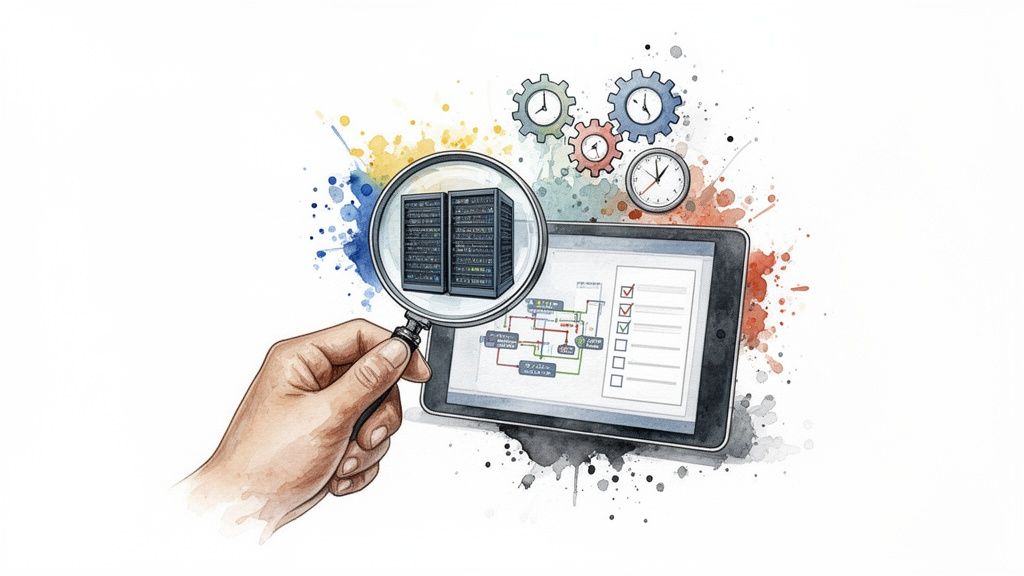
Before you can build a new backend, you need a painfully honest assessment of the one you have now. This isn’t about creating a simple list of technical issues. The real goal of an ecommerce backend modernization audit is to find the exact points of friction that are costing you money, slowing down new features, and giving your customers a poor experience.
Think of this audit as building your business case. You’re moving past vague complaints like “the site feels slow” and digging for the quantifiable pain points that justify a major investment in change.
Critical Questions to Kickstart Your Audit
A good audit starts with asking the right and often tough questions. Get your engineering, marketing, and operations leads in a room and work through these areas. Your goal is to get a 360-degree view of your system’s health.
-
Speed of Innovation: How long does it really take to launch a simple promotion or add a new payment gateway? If your team measures this in weeks instead of days, your backend is a major drag on the business.
-
Peak Performance Limits: What happens during a Black Friday surge? Do you know precisely where the system will break? If you haven’t stress-tested your platform to its breaking point, you’re flying blind during your most critical sales periods.
-
Operational Drag: How many hours do your teams spend on manual workarounds each day? Count everything: fixing order data, reconciling inventory, or processing returns. Every workaround is a hidden operational cost.
-
System Uptime: What was your total downtime over the last 12 months? Now, calculate the estimated revenue lost during those outages. This is a number that gets executives to pay attention.
-
Cost of Maintenance: Look at your development budget. What slice is dedicated to just keeping the lights on for the old system versus building new, revenue-generating features? If you’re spending more than 50% of your resources on maintenance, you’re officially falling behind your competitors.
The answers you collect will create a clear map of your system’s weak points, showing you exactly where to focus your modernization efforts first.
Mapping Integrations and Quantifying Technical Debt
With those initial answers in hand, it’s time for a deeper technical dive. Your backend is never a standalone system; it’s a tangled web of integrations connecting your ERP, CRM, PIM, and multiple payment processors.
Start by creating a visual map of every integration. Document how data moves: is it happening in real-time, or through slow, fragile nightly batch jobs? This exercise often reveals shocking dependencies and single points of failure that put your entire operation at risk.
The most crucial output here is a realistic calculation of your technical debt. This isn’t just about messy code. It’s the real-world cost of every shortcut, outdated library, and “we’ll fix it later” decision that now makes every new project slow and risky.
You can put a number on this. Estimate the total engineering hours it would take to fix all the known issues and patch the vulnerabilities. Then, calculate your total cost of ownership (TCO), which must include the hidden costs of lost sales and missed opportunities caused by your system’s limitations.
Once you see the true cost of your legacy system in black and white, the conversation shifts. It’s no longer about a nice-to-have upgrade; it’s a clear financial argument for investing in a modern architecture, often with guidance from an experienced AI solutions partner who has navigated this process before.
Designing Your Future-Proof Ecommerce Architecture
Once you’ve taken a hard look at your current backend, it’s time for the exciting part: designing what comes next. This isn’t just a technical refresh; you’re building a new engine for growth. The goal is to move away from the rigid, all-in-one systems of the past and embrace the flexible, scalable models that today’s top retailers run on.
Let’s break down the architectural pillars that will support your new platform. Getting these concepts right is crucial for building a backend that doesn’t just work for now, but gives you a real competitive edge for years to come.
Adopting a Microservices Mindset
Think of a traditional monolithic backend like one giant, overworked machine. If one part breaks, the whole thing grinds to a halt. A microservices architecture completely flips that model. It breaks down your massive application into a collection of smaller, independent services, each focused on a single business function like inventory, payments, or user-profiles. It’s like having a team of dedicated specialists instead of one person trying to do everything.
The benefits you’ll see are immediate and tangible.
-
Move Faster: Your
Promotionsteam can roll out a new feature for their service without waiting on or accidentally breaking theCheckoutservice. This autonomy is how you drastically cut down your time to market. -
Scale Smarter: Expecting a surge in holiday traffic? You can scale just the
Product-Searchservice to handle the load, rather than paying to scale your entire application. It’s a much more efficient use of resources. -
Use the Right Tools: One team might find Python is perfect for a new recommendation engine, while your core transaction service runs on Java. You get to pick the best technology for each job, which is also a huge plus for attracting top engineering talent.
This approach is the foundation of modern custom enterprise software development, enabling businesses to build platforms that are both resilient and incredibly adaptable.
Embracing API-First for Ultimate Flexibility
An API-first design, the engine behind headless commerce, fundamentally changes how you connect with your customers. Instead of locking your frontend (the website) and backend together, you separate them. The backend’s only job is to provide all its data and functions: product info, pricing, and order processing, through a clean set of APIs.
This decoupling gives your creative and marketing teams incredible freedom. They can build a lightning-fast progressive web app, a native mobile app, an in-store kiosk, or even a voice-shopping skill for smart speakers. They all connect to the same powerful backend APIs. You’re no longer stuck inside the box of a pre-built storefront theme.
This isn’t just a trend; it’s the direction the entire market is heading. The unified backend API market is on track to hit USD 13.7 billion by 2033, and 73% of businesses are already using a headless architecture. They’re seeing real results, with reports of 47% increases in conversion rates and cutting development time by up to 80% by reusing components. You can dive into the data in a recent report from Swell.is.
Building with Event-Driven Patterns
If microservices are your specialists and APIs are their language, then an event-driven architecture is the communications network that ties them all together without tangling them up.
Here’s how it works: when something happens, a service creates an “event.” For example, when a customer completes a purchase, the Order service doesn’t need to know who to notify. It just broadcasts an “OrderPlaced” event into the void.
Any other service that cares about that event can subscribe and react. The Inventory service hears “OrderPlaced” and immediately deducts the stock. The Shipping service hears it and creates a new shipment label. This loose coupling makes the whole system incredibly resilient. If the Shipping service is down for maintenance, it can simply catch up on all the events it missed once it comes back online. No orders lost, no data dropped.
As you map out your architecture, don’t forget the financial nuts and bolts. Properly integrating payment gateway systems is a non-negotiable piece of the puzzle. By weaving these three architectural pillars together: microservices, APIs, and events, you create the foundation for truly unique and agile custom ecommerce solutions built for what’s next.
Weaving AI and Data into Your Backend’s DNA
A modern backend isn’t just about being faster; it’s about being smarter. Once you break free from legacy limitations, you can start embedding real intelligence directly into your operations. This is where your backend stops being a simple transaction processor and starts acting like a strategic brain for your entire business. It’s a critical part of ecommerce backend modernization that gives you a genuine edge.
The real goal here is to shift from using data for backward-looking reports to using it for in-the-moment decisions. By integrating AI and machine learning, you can automate incredibly complex tasks, deliver true one-to-one personalization, and even start predicting market shifts. But none of that happens without a clean, unified data pipeline feeding your models high-quality, real-time information.
From Static Rules to Dynamic Intelligence
So many older systems are stuck with static, rule-based logic for everything from pricing to promotions. A modernized, data-driven backend throws those rigid rules out the window in favor of dynamic models that actually learn and adapt. The impact this has across the business is huge.
Here’s where the magic really happens with some concrete examples:
-
Dynamic Pricing Engines: Forget setting prices manually and hoping for the best. An AI model can tweak prices on the fly based on competitor moves, a sudden spike in demand, current inventory, and even local weather. You end up maximizing your margins without killing your sales volume.
-
Predictive Inventory Management: AI is fantastic at analyzing historical sales, seasonal trends, and planned marketing pushes to forecast demand with uncanny accuracy. This means no more costly stockouts on your bestsellers and no more cash tied up in products that just aren’t moving.
-
Truly Personal Recommendations: We’ve all seen the basic “customers who bought this also bought…” suggestions. Modern recommendation engines go so much deeper. They use machine learning to understand a single shopper’s behavior, suggesting products based on their unique browsing patterns, past purchases, and even things they’ve looked at but haven’t bought yet.
The Unsung Hero: A Unified Data Pipeline
None of these intelligent features can exist in a vacuum. They absolutely depend on a solid data foundation. A huge piece of any modernization project is building a unified data pipeline that pulls together information from all corners of your business: the ERP, CRM, PIM, and, of course, the ecommerce platform itself.
Think of this pipeline as the central nervous system for your smart backend. It cleans, standardizes, and streams data in real-time, making sure your AI models are always working with the freshest, most accurate information. Without it, your AI initiatives are just built on a house of cards.
Adding intelligence to your platform is about more than just adopting a new technology; it’s about building the infrastructure to properly support it. This is the foundational work that lets you scale your AI efforts and roll out new smart features over time. As we’ve covered before, there are countless ways to deploy AI for ecommerce to improve everything from customer experience to operational workflows.
Turning Data into Your Most Valuable Asset
Ultimately, embedding intelligence into your backend is how you future-proof your business. You’re creating a self-improving system that gets smarter with every single transaction and customer interaction. The data your platform churns out stops being a byproduct and becomes your most valuable asset, feeding a nonstop cycle of optimization.
This is a complex undertaking, and it’s where getting expert guidance can make all the difference. Leaning on a partner with specialized AI development services ensures you build and integrate these models correctly, so they line up with your business goals and deliver a return you can actually measure. When you combine modern architecture with a smart data and AI strategy, you’re not just updating your backend – you’re building an engine for sustainable growth.
Choosing Your Modernization and Migration Strategy
So you’ve decided to modernize your ecommerce backend. That’s the big decision, but what comes next is just as critical: how do you actually get from your old system to the new one? This isn’t a simple flip of a switch. The migration path you choose is a major strategic decision that hinges on your team’s risk tolerance, your budget, and how quickly you need to start seeing a return.
Let’s walk through the three most common migration patterns I’ve seen in the field. Each one strikes a different balance between speed, safety, and effort, so you can find the right fit for your business.
The Strangler Fig Pattern: A Gradual Takeover
One of the safest and most effective methods for tackling a complex system is the Strangler Fig Pattern. I’ve used this on high-risk projects where any downtime would be catastrophic. The name is a perfect analogy – you build your new system around the old one, piece by piece, until the new services have completely taken over and the legacy system can finally be retired.
Think of it like this: you don’t rebuild the whole house at once. You start with one room.
-
First, you pick a small, isolated piece of functionality. A product recommendation widget or a “Contact Us” form is a great place to start. Low risk, high visibility.
-
Next, you build that feature as a new microservice. This is your first piece of the new world.
-
Then, you put a routing layer in front of everything. This proxy, often an API gateway, is the traffic cop. It inspects incoming requests and sends just the traffic for that new feature to your new service. Everything else still goes to the old monolith.
-
You just keep repeating this process. Over time, more and more traffic gets routed to new services, until one day, the old system isn’t receiving any traffic at all.
The beauty of this method is that it dramatically minimizes risk. Your business keeps running, and you get to test new services with real users in a controlled way, avoiding that dreaded “big bang” failure.
Incremental Migration: A Function-by-Function Move
Incremental migration is a close cousin to the Strangler Fig, but the thinking is a bit different. Instead of focusing on small, user-facing features, the focus here is on migrating entire business capabilities. For instance, you might decide to move your entire inventory management system first, then tackle order processing, and then customer accounts.
This approach is all about strategic wins. It allows you to target the parts of your business that are causing the most pain or have the most to gain from an upgrade. If your current inventory system is a nightmare of sync errors and manual adjustments, moving that first can deliver a huge business impact early on.
As our client cases often show, this phased approach builds confidence and delivers value at every stage, which is crucial for maintaining project momentum.
Key Takeaway: Both the Strangler Fig and Incremental patterns are about one thing: de-risking your modernization. By delivering wins in stages, you build momentum, keep stakeholders happy, and give your teams the breathing room they need to learn the new tech without the crushing pressure of a single, high-stakes launch.
This kind of strategic replatforming is why the ecommerce market is projected to explode from $1.74 billion in 2025 to $7.16 billion by 2032. The results speak for themselves. With headless adoption now mainstream at 73%, businesses are seeing an average conversion rate increase of 42%. One of our favorite examples is an ecommerce leader who saved $3 million annually simply by unifying its fragmented databases into a modern cloud solution. You can see the full story in these data modernization results that led to massive annual savings.
This kind of modernization directly enables the AI-powered features that are setting the top brands apart.
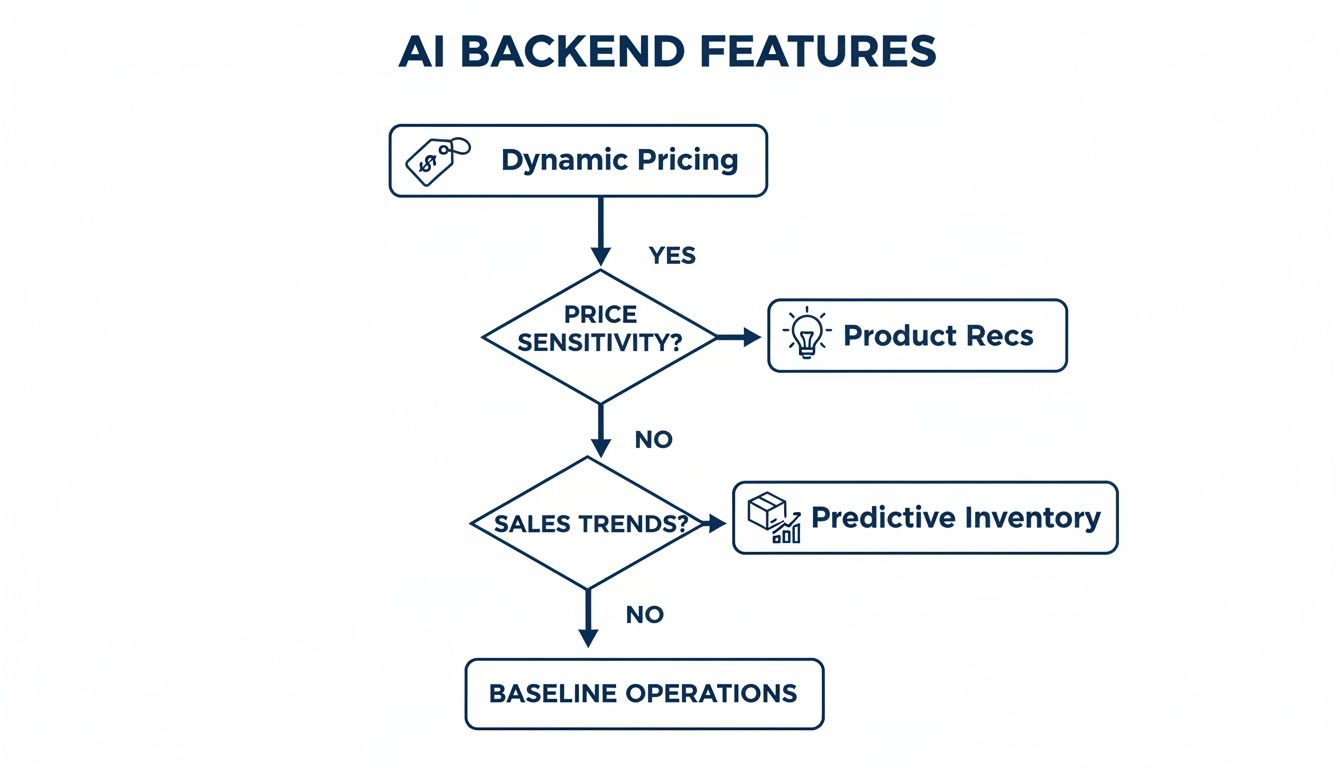
As you can see, a solid operational foundation makes it possible to build intelligent features like predictive inventory, which in turn optimizes sales and informs powerful dynamic pricing strategies.
Lift-and-Shift: A Quick Move to the Cloud
Finally, there’s the “lift-and-shift.” It’s the fastest option, but it’s also the least transformative. Essentially, you’re taking your existing monolithic application and moving it, more or less as-is, from your on-premise servers to a cloud provider like AWS, Google Cloud, or Azure.
This strategy doesn’t actually modernize your application’s code. What it does solve are immediate infrastructure headaches.
I recommend this approach when the main goal is to get off aging hardware, slash data center costs, or quickly gain the basic reliability of the cloud. It’s a tactical move. While it won’t fix your underlying architectural problems, it can be a smart first step that buys you the time and stability needed to plan for a more thorough, incremental modernization down the road.
Frequently Asked Questions
When you’re thinking about modernizing your ecommerce backend, a lot of questions come up. It can feel like a massive undertaking, but breaking it down is the key. Here are some of the most common questions I hear from CTOs and ecommerce leaders, along with some straight answers to help you find clarity.
What Are the First Signs My Ecommerce Backend Needs Modernization?
The early warnings are almost always hiding in plain sight, usually masquerading as operational headaches or customer complaints. If your tech teams are spending more time putting out fires than building new things, that’s your biggest red flag.
Look out for these classic symptoms:
-
Your site grinds to a halt during a Black Friday rush or even a well-publicized flash sale. That’s a clear sign of slow site performance.
-
You want to launch a new loyalty program or a simple promotional feature, but your team says it will take months. That’s a sign of difficulty launching new features.
-
Customers are complaining about glitches, or you’re seeing unexplained downtime and errors that are definitely costing you sales.
-
Your budget is getting eaten alive by high maintenance costs just to keep the lights on, leaving little room for innovation.
If you’re nodding along to this list, your legacy system isn’t just a technical problem; it’s a business bottleneck. Getting an outside perspective from an AI solutions partner can help you quantify these issues and build a solid case for making a change.
What Is the Difference Between Headless Commerce and Microservices?
This is a common point of confusion. People often use these terms together, but they solve different problems. Think of it this way: headless is about presentation, and microservices are about organization.
Headless commerce is an API-first approach. It completely separates your frontend: the customer-facing website, app, or even an in-store kiosk, from your backend commerce engine. This frees your marketing and design teams to create amazing customer experiences on any channel without being locked into a rigid backend template.
Microservices, on the other hand, are an architectural style for your backend. Instead of one giant, monolithic application, you break it down into a collection of small, independent services. You might have one service for payments, another for inventory, and a third for user profiles.
A headless platform can absolutely run on a microservices backend, and when they’re combined, you get incredible flexibility and scalability for your custom ecommerce solutions.
How Long Does an Ecommerce Backend Modernization Take?
There’s no magic number here. The timeline for an ecommerce backend modernization really depends on the complexity of your business and which migration path you choose.
A “lift-and-shift” to the cloud, where you’re essentially moving your current system as-is to new infrastructure, might take just 3-6 months. It’s faster but doesn’t fix underlying code issues.
In contrast, a full re-architecture to a microservices-based platform is a bigger commitment. If you do it incrementally (which I highly recommend), you’re probably looking at a 12-24 month project. The key is to show value along the way. A good partner will help you map out quick wins, so you can demonstrate real ROI in the first few months while the larger project unfolds. We’ve seen this phased approach build incredible momentum in our client cases.
How Do I Measure the ROI of a Backend Modernization Project?
Measuring the return on investment is non-negotiable. You need it to get buy-in, and you need it to prove success. The best way to do this is by tracking a mix of technical and business KPIs that you define before you write a single line of code.
On the technical side, look at:
-
Improved site speed: Get specific. Track Time to First Byte (TTFB) and core page load times.
-
Faster deployment times: How quickly can you go from an idea to live in production? This is a huge measure of agility.
-
Lower infrastructure costs: Are you seeing savings from moving to more efficient, cloud-native services?
For the business, you need to tie it to the bottom line:
-
Increased conversion rates: This is the most direct link between performance and revenue.
-
Higher average order value (AOV): A modern backend can power better upsells, cross-sells, and product recommendations.
-
Improved customer lifetime value (CLV): A smooth, reliable experience keeps customers coming back.
By tracking these metrics, you can draw a straight line from your backend investment to tangible business growth. This is where you really see the value of integrating advanced capabilities like AI for your business.
Ready to turn your ecommerce platform from a constant headache into a strategic advantage? At Bridge Global, we live and breathe this stuff. As your partner in AI-driven custom software development, we help businesses modernize their backends to unlock new levels of speed, scale, and intelligence.
Contact us today to schedule your AI Discovery Workshop and start building the ecommerce engine your business deserves.

About Upendra Jith
Upendrajith completed his Master's in English and has been a commercial content developer for the past three years. He's more inclined to develop content with a 'street-smart' delivery on topics such as technology, media, or anything he can get his hands on. He has a fixation on lyrics, dark poetry, media, technology, and flow arts.
View all posts by Upendra Jith →