



AI for Ecommerce: Your Guide to Boosting Sales & Efficiency
Think of AI for ecommerce as giving your online store a brain. It’s about using smart algorithms and machine learning to craft unique shopping experiences, automate the tedious behind-the-scenes work, and make sharp, data-backed decisions.
Instead of greeting every customer with the same generic homepage, AI acts like an expert personal shopper for each visitor. It anticipates what they want, smooths out their path from browsing to buying, and makes the whole process feel effortless. This isn’t just a “nice-to-have” anymore; it’s a core engine for growth.
How AI Is Redefining Modern Ecommerce
Welcome to the age of smart retail, where every click and search query tells a story. When we talk about AI for ecommerce, we’re not just throwing around buzzwords. We’re talking about practical tools that create a real gap between the businesses that are thriving and those that are just getting by.
AI is completely resetting what customers expect from online stores and what it takes to run one efficiently. In a packed digital marketplace, it’s become less of an advantage and more of a necessity.
The numbers don’t lie. The global AI in ecommerce market jumped from $6.63 billion in 2023 to $7.57 billion in 2024. Even more telling is its projected growth to $50.98 billion by 2033. This explosion shows just how urgently businesses are weaving AI into their operations to stay competitive.
The Core Impact of AI on Business Operations
So, what does this actually look like for your business day-to-day? At its heart, AI is a master data analyst. It sifts through massive datasets – browsing habits, past purchases, real-time behavior – to spot patterns that would be invisible to the human eye.
This gives you the power to:
- Automate Complex Tasks: Think of all the repetitive work, from managing stock levels to handling common customer questions. AI can take care of it with incredible speed and precision.
- Deliver Hyper-Personalization: Instead of guessing, AI algorithms build a unique storefront for every user, putting the products they’re most likely to love front and center.
- Make Smarter Predictions: You can forecast demand with greater accuracy, flag potentially fraudulent orders before they become a problem, and adjust pricing in real-time.
- Improve Customer Engagement: AI-driven chatbots offer instant, 24/7 support. They can answer questions, resolve issues, and guide shoppers, making sure no one feels stuck or ignored.
To get a feel for just how deeply this impacts business strategy, it’s worth exploring the power of AI as a game-changer for modern marketers.
To help you see the bigger picture at a glance, we’ve broken down the key ways AI is making an impact.
Key AI Applications Transforming eCommerce
This table offers a quick snapshot of the most common AI tools in ecommerce and the direct value they bring to a business.
| AI Application | Core Business Benefit | Example Use Case |
|---|---|---|
| Personalization Engines | Increased AOV & Conversion | Showing a returning customer products based on their past browsing and purchase history. |
| Recommendation Systems | Higher Customer Lifetime Value | Suggesting “customers also bought” or “frequently bought together” items on a product page. |
| AI-Powered Search | Reduced Bounce Rate | A shopper types “red running shoes” and gets relevant results, even with typos. |
| Dynamic Pricing | Maximized Revenue & Margin | Automatically adjusting prices based on demand, competitor pricing, and inventory levels. |
| Inventory Forecasting | Reduced Stockouts & Overstock | Predicting how many units of a winter coat to order for the upcoming holiday season. |
| Fraud Detection | Lowered Chargebacks & Loss | Flagging a high-value order with mismatched billing and shipping addresses for manual review. |
| Chatbots & Virtual Assistants | Improved Customer Satisfaction | A chatbot answers “Where is my order?” instantly, 24/7, without human intervention. |
Each of these applications solves a real-world business problem, turning abstract data into tangible results like higher sales and happier customers.
Navigating the AI Transformation
This guide is designed to be your roadmap. We’ll walk through everything from personalizing the customer journey to automating your operations and making smarter strategic moves. We’ll dive into specific use cases, show you the measurable results from our own client successes, and give you a practical blueprint for implementation.
Getting started can feel daunting, which is why finding the right expertise matters. Partnering with an experienced AI solutions team can help you build and integrate the right tools without the guesswork, ensuring your investment pays off. Whether it’s building custom ecommerce solutions or bringing in dedicated AI development services, the right partner can make all the difference.
Let’s explore how you can put these powerful tools to work.
Driving Revenue with AI-Powered Personalization
Of all the ways AI is making an impact in ecommerce, its ability to deliver true one-to-one personalization is arguably the most powerful. The old days of static homepages and generic marketing emails are over. Today, AI acts as a personal digital concierge for every single visitor, creating a shopping experience that feels like it was built just for them.
How does it work? Sophisticated AI algorithms chew through enormous datasets in real time—a customer’s browsing history, past purchases, abandoned cart items, and even how long they pause on a product image. By connecting these dots, the AI builds a deep, constantly evolving profile of each shopper’s unique tastes and what they’re likely looking for.
This deep understanding allows the system to change what the customer sees on the fly. The result is a store that adapts instantly, transforming from a static catalog into a living, breathing shopping assistant.

The Engines of Personalization
Behind this magic are recommendation engines, which use a few key methods to predict what a customer will love next. Think of it like a seasoned bookseller who knows exactly which title to suggest based on your last few reads.
- Collaborative Filtering: This is basically the “wisdom of the crowd” approach. It analyzes the behavior of thousands of users to find people with similar tastes. If you and another customer both bought the same three shirts, the system might recommend a pair of jeans the other person bought, assuming your preferences align.
- Content-Based Filtering: This method zeroes in on the products themselves. It analyzes item attributes—brand, color, category, material—to recommend things that are just like what a customer has viewed before. If you’ve been looking at blue running shoes, it will logically suggest other blue running shoes.
- Hybrid Models: The most effective systems don’t choose one or the other; they combine both. They use collaborative data to spot broad trends and content data to refine suggestions based on specific product details, giving you the best of both worlds.
These engines are what power the features we now take for granted, from the “Customers Also Bought” sections on product pages to personalized emails highlighting new arrivals you’ll actually care about. As we’ve explored in our guide to the best AI tools for ecommerce, these systems are becoming more accessible than ever.
From Personalization to Profit
Connecting these sophisticated personalization tactics to tangible business results is where the real value emerges. Every personalized interaction is designed to make the shopping journey smoother and more relevant, which directly boosts the bottom line.
The results speak for themselves. AI-driven product recommendations are poised to revolutionize sales, with projections showing they could boost revenues by 59% for businesses that get on board. It’s no surprise that 84% of eCommerce companies are already using or planning to use AI for personalization. In mature setups, recommendation systems can drive 31% of total sales by analyzing user data with incredible precision. Just look at Amazon—it attributes over 35% of its sales to its powerful AI recommendation engine, which crunches billions of data points every single day.
But this level of personalization does more than just secure a single sale; it builds the foundation for long-term customer loyalty and sustainable growth.
By making customers feel seen and understood, AI-driven personalization transforms a simple transaction into a lasting relationship. It’s the difference between a store that just sells products and one that provides genuine solutions.
When customers consistently and easily find what they’re looking for, they have every reason to come back. This has a direct, positive impact on key metrics:
- Conversion Rates: Showing the right product at the right time is the surest way to turn a browser into a buyer.
- Average Order Value (AOV): Smart cross-sells and “frequently bought together” suggestions naturally encourage customers to add more to their cart.
- Customer Lifetime Value (CLV): A great, personalized experience fosters brand loyalty, which means more repeat purchases over the long haul.
Optimizing Your Operations with Predictive AI
While flashy, customer-facing AI often grabs the headlines, some of the most impactful work AI for ecommerce does happens behind the scenes. This is where predictive AI becomes your operational workhorse, quietly fine-tuning your back-end processes to build a more efficient, resilient, and ultimately more profitable business. The goal is to move from constantly putting out fires to proactively managing your operations with data.
A huge part of this shift is using predictive analytics in retail to see what’s coming around the corner. By digging into historical data and reading market signals, AI can anticipate future outcomes. This allows you to get ahead of challenges long before they start eating into your bottom line. Let’s look at three areas where this makes a world of difference.

Intelligent Inventory Forecasting
Few things sting an ecommerce business more than getting inventory wrong. Stockouts lead to lost sales and frustrated customers. Overstocking ties up cash and shrinks your profit margins. AI-powered forecasting takes the guesswork out of the equation and delivers shockingly accurate predictions.
Instead of just looking at last year’s sales, machine learning models analyze a huge mix of data to predict what customers will want next.
- Market Trends: The AI can spot a product getting hot by analyzing social media chatter and search trends.
- Seasonality: It goes beyond just knowing about the holiday rush; it understands nuanced, cyclical demand patterns with incredible detail.
- External Factors: It can even consider things like upcoming weather events or economic news that might change how people shop.
By crunching all these numbers, the system produces precise demand forecasts, making sure you have the right products on your shelves at exactly the right time. The results speak for themselves. Businesses that get this right have seen logistics costs drop by 15% and inventory levels fall by a massive 35%; all while improving service. For any business trying to grow, that kind of efficiency is a game-changer.
Dynamic Pricing Strategies
Finding the perfect price is a classic tightrope walk. Go too high, and you lose sales to the competition. Go too low, and you’re leaving money on the table. AI-driven dynamic pricing automates this balancing act, adjusting prices in real-time to maximize revenue while staying competitive.
This is much more than simply matching a competitor’s price drop. A smart pricing engine is constantly looking at dozens of variables to pinpoint the best price at any given moment.
AI transforms pricing from a static, quarterly decision into a dynamic, minute-by-minute strategy. It ensures you are always capturing the maximum possible value from every transaction based on real-time market conditions.
The system weighs everything from competitor stock levels and your own inventory to customer demand signals and even the time of day. For instance, if a key competitor runs out of a popular item, your AI can nudge the price up slightly to capture that extra demand. On the flip side, it can automatically discount slow-moving products to clear them out before they become a bigger problem. This hands-off approach often boosts profit margins by 5-10%.
Automated Fraud Detection
As ecommerce booms, so does the risk of fraud. Old-school, rule-based fraud systems just can’t keep up with the clever tactics fraudsters use today. This leads to expensive chargebacks and, just as bad, a clunky checkout experience that blocks legitimate customers. AI provides a much smarter, more effective defense.
Machine learning algorithms are trained to spot the subtle, almost invisible patterns of fraudulent behavior. They analyze hundreds of data points for every single transaction, all in a split second.
- Transaction Patterns: Is this an unusually large order from a brand-new account?
- User Behavior: Did the customer copy-paste card details instead of typing them in?
- Device Information: Does the device’s location match the billing address?
By flagging suspicious activity instantly, AI systems stop fraud before the transaction is even completed. More importantly, they drastically cut down on “false positives”—those frustrating moments when a real customer’s order gets declined. Retailers using AI for fraud detection have cut their fraud losses by 40-50%. At the same time, they’re improving approval rates for good customers, which protects revenue and builds trust.
Using Conversational AI to Elevate Customer Support
In ecommerce, the moment a customer has a question is a make-or-break opportunity. A quick, accurate answer can lock in a sale and build lasting loyalty. A slow or unhelpful response? That’s often a one-way ticket to a competitor’s site. This is exactly where conversational AI comes in, turning what was once a support cost into a serious engine for customer engagement and sales.
Think of AI-powered chatbots and virtual assistants as your new digital frontline. They aren’t bound by business hours or time zones; they work 24/7, ready to provide instant answers to the most common questions shoppers have about order status, return policies, or product details. They’re always on, always consistent, and always ready to help.
This round-the-clock availability is a total game-changer for the customer experience. Shoppers no longer have to sit in a queue or wait for an email response. They get the information they need, right when they need it most, creating a much smoother and more satisfying journey from browsing to buying.
From Clunky Scripts to Intelligent Dialogue
The first wave of chatbots was, let’s be honest, pretty basic. They were built on rigid, pre-programmed scripts. If a customer’s question didn’t hit the right keyword, the bot would get stuck, and frustration would quickly set in. Thankfully, the conversational AI for ecommerce we see today is in a different league entirely.
Fueled by Natural Language Processing (NLP), modern virtual assistants can actually grasp the intent behind a customer’s words—typos, slang, and all. This allows for a far more natural, human-like conversation that solves real problems.
It’s the difference between a robot that matches keywords and a partner that understands context. Today’s AI can handle follow-up questions, manage complex inquiries, and even recognize a customer’s tone. It knows when a situation is getting tense and when it’s time to seamlessly hand off the conversation to a human agent.
This massive leap in capability means AI can take a huge volume of inquiries off your team’s plate. This frees up your human experts to focus on the high-value, complex issues that genuinely require empathy and creative problem-solving. This evolution is central, as we explored in our guide on AI chatbots for ecommerce.
The Real-World Business Impact
The move to conversational AI isn’t just about faster answers; it has a direct, measurable impact on your bottom line and customer happiness. The proof is in the numbers. The global conversational commerce market is expected to rocket from $8.8 billion in 2025 to $32.6 billion by 2035. And as you can see in this report on the future of AI in ecommerce, the results businesses are seeing are compelling.
AI-powered chatbots can now successfully handle up to 80% of all routine customer questions. This level of automation doesn’t just cut support costs; it transforms human teams into strategic problem-solvers. The payoff is huge: companies are slashing response times from hours down to seconds and reporting conversion boosts of up to 20%.
Here’s what that looks like in terms of tangible value:
- Drastically Lower Support Costs: You can scale your support capacity to handle growth without needing to scale your headcount at the same rate.
- Higher Customer Satisfaction: Instant, 24/7 help makes customers feel valued. That feeling is directly reflected in better CSAT scores and reviews.
- More Conversions: A chatbot can proactively engage a hesitant shopper on a product page, answer a last-minute question at checkout, or even offer a timely discount to prevent cart abandonment—all actions that push a sale over the line.
- Deeper Brand Loyalty: When customers know they can get a great support experience every single time, they have a powerful reason to keep coming back.
By offloading the routine work to AI, you build a more efficient operation and a far better customer journey from start to finish. This is the kind of strategic move that smart businesses are making with expert AI development services.
Your Practical Roadmap to AI Implementation
Putting AI for ecommerce to work isn’t a single, giant leap. It’s a journey, one that’s best taken with a clear map in hand. A structured approach is what separates a real business asset from an expensive science project, and this roadmap breaks the process down into manageable phases.
The first step isn’t about technology at all. It’s about asking the right questions. Before a single line of code gets written, you have to be crystal clear on the business problem you’re trying to solve. What specific pain point will this AI tackle? What does a “win” look like, and how will you actually measure it?
This initial discovery phase is everything. It’s where you define the scope, nail down your key performance indicators (KPIs), and make sure the entire project lines up with your bigger business goals. For a deeper look at this foundational stage, as we explored in our guide on implementing AI in business, strategy is key.
The whole journey really boils down to guiding a customer from their first question to a final purchase, turning what used to be a support cost into a new revenue stream.
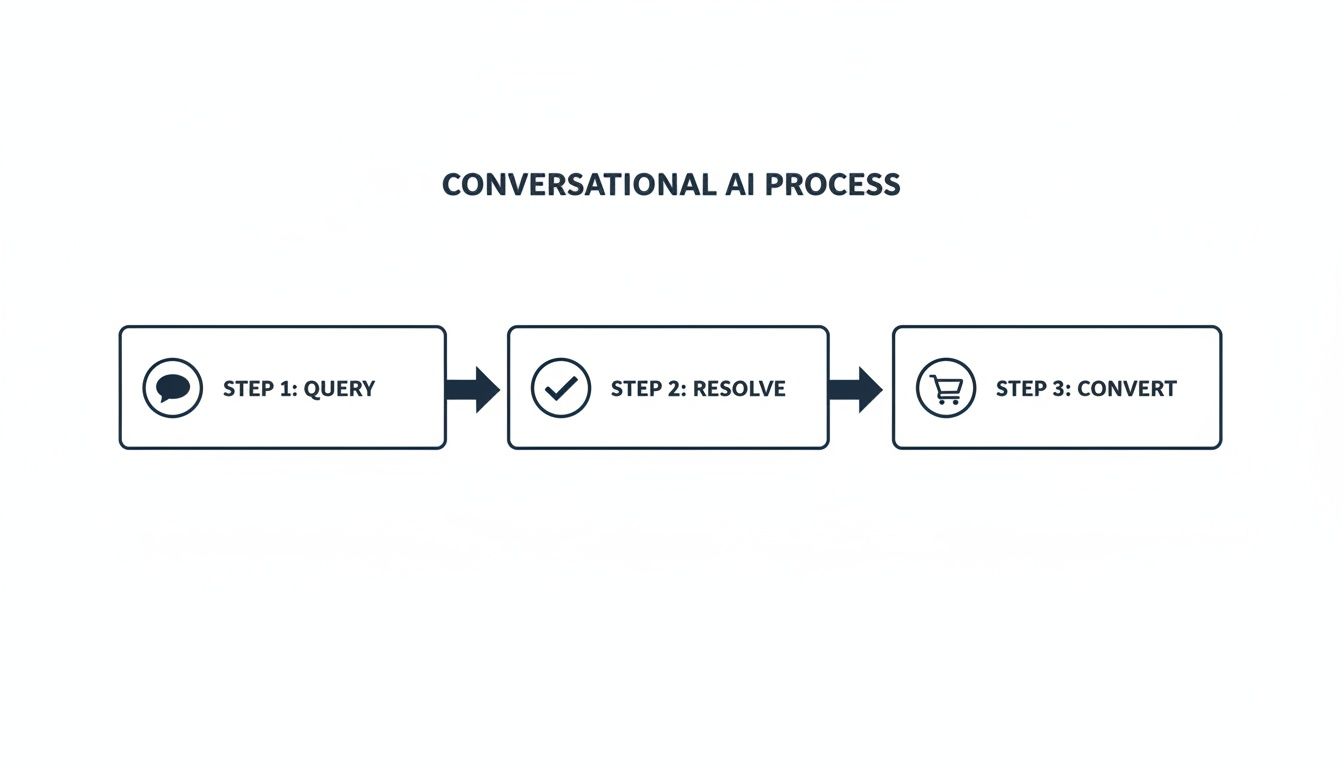
This simple flow shows how AI can smooth out the path from a customer’s query to a conversion, making the whole process smarter and more efficient.
Phase 1: Discovery and Strategy
Think of this as the blueprinting stage. Your goal here isn’t to pick an algorithm; it’s to find a high-impact business challenge that AI is uniquely suited to solve. Are you bleeding revenue from abandoned carts? Is your inventory turnover painfully slow? Are support tickets overwhelming your team?
Get specific. A vague goal like “improve personalization” is a recipe for failure. Instead, aim for something concrete, like “increase average order value by 15% using AI-powered product recommendations.” That’s a target you can actually hit.
During this phase, you’ll also run into the classic “build vs. buy” question. Should you grab an off-the-shelf tool, or do you need something built just for you? The answer hinges on your specific needs, your current tech stack, and where you want to be in a few years.
Phase 2: Data Readiness and Preparation
AI runs on data. Simple as that. Think of it as the fuel for your engine—without clean, high-quality fuel, even the most powerful engine will sputter and die. This phase is all about getting your data house in order.
Your AI model will only ever be as good as the data you feed it. Garbage in, garbage out isn’t just a saying; it’s the fundamental law of machine learning.
A full data audit is non-negotiable. You need to know:
- What data do you have? (Transaction histories, browsing behavior, customer demographics, etc.)
- Where does it live? (In your CRM, analytics tools, ERP system?)
- Is it any good? (Is it full of duplicates, errors, and missing values?)
This is often the most time-consuming part of the project, but it’s absolutely critical. Get this wrong, and nothing else matters.
Phase 3: Model Development and Integration
Okay, with a clear strategy and clean data, it’s finally time to build. This is where you select the right algorithms for the job, whether you’re building a recommendation engine, a forecasting tool, or a fraud detection system.
This process is a loop, not a straight line. Data scientists will experiment with different models, train them on your historical data, and test them relentlessly against the KPIs you set back in phase one. It’s a cycle of training, testing, and tweaking until the model is sharp enough to deliver real value.
Once the model is ready, it needs to be integrated into your actual ecommerce platform. A great integration is invisible; the AI just works, humming along in the background without disrupting your operations or the customer experience.
Phase 4: Optimization and Continuous Improvement
Launching an AI system isn’t crossing the finish line—it’s just the start of the race. The market is always changing, and customer behavior is a moving target. A truly successful AI implementation includes a plan for ongoing monitoring and optimization.
This is where MLOps (Machine Learning Operations) comes in. It’s the practice of keeping your models sharp in a live environment. You’ll be tracking performance, retraining the model with fresh data so its predictions don’t get stale, and always looking for new ways to get more out of it.
Your AI project doesn’t end. It evolves. And that’s exactly how it should be.
Choosing the Right Technology and Partner
Getting your AI for ecommerce initiative off the ground isn’t just about having a great strategy. It comes down to the technology you choose and, just as importantly, the experts you trust to bring it all to life. Making the right call here is what separates a plan on paper from a real-world competitive advantage.
The tech stack might look intimidating, but a good partner makes navigating it simple. They’re the ones who know how to work with powerful cloud platforms like AWS, Google Cloud, or Azure for heavy lifting and when to use open-source libraries like TensorFlow or PyTorch to build something truly custom. Their job is to assemble these building blocks into a system that actually solves your business problems.
What to Look for in an AI Partner
Picking a partner isn’t like hiring a contractor; it’s about finding a team that becomes an extension of your own. Their skills and approach will make or break your project, so you have to be picky.
Here’s what you absolutely can’t compromise on:
- Real Technical Chops: Your partner needs proven, hands-on experience in data science, machine learning, and the specific AI tools that fit your project. This is no place for them to learn on your dime.
- eCommerce in Their DNA: Find someone who gets the unique rhythm and pressures of online retail. Ask to see their client cases; the proof is in their past work.
- Business-First, Not Tech-First: The best partners don’t lead with a pitch for a specific technology. They start by asking about your goals, your customers, and your pain points. They should be focused on solving problems, not selling software.
- An Obsession with Results: Every conversation should come back to the KPIs you set out in your strategy. Their success is your success, and they should be able to prove it with data.
Your Next Steps with a Trusted Partner
Once you have the right team in place, the project becomes a genuine collaboration. A solid AI solutions partner will walk you through a clear, phased approach that takes the guesswork out of the process and keeps risk low.
The ideal partnership is one where technical execution and business strategy are perfectly aligned. It’s about building not just a tool, but a sustainable competitive advantage.
When you work with a partner who gets your vision and has the skills to build it, you can finally implement AI for your business and unlock the growth you’ve been aiming for.
Frequently Asked Questions About AI for eCommerce
Stepping into the world of AI for ecommerce usually brings up some very practical questions. How much will this actually cost? Do we have enough data? What kind of results can we realistically expect? Let’s break down the honest answers to these common concerns.
How Much Does It Cost to Implement AI?
The honest answer? It depends. The cost to implement AI can range from a modest monthly subscription to a significant capital investment, and it all comes down to what you’re trying to achieve.
Plugging in a pre-built AI tool, like a chatbot from a third-party provider, is often straightforward and relatively inexpensive. But if you’re looking to build something truly unique, like a custom machine learning model for hyper-personalization or a sophisticated demand forecasting engine, that’s a different story.
Projects like that require specialized data science expertise and serious cloud computing power, which naturally costs more. The best starting point is always a focused AI Discovery Workshop. It’s the clearest way to define the business problem you’re solving, map out the technical needs, and land on a budget that makes sense for your goals.
Do I Need a Large Amount of Data?
Not necessarily. While it’s true that more high-quality data is always better for training AI, you don’t need a Google-sized dataset to get started. Many powerful AI applications can deliver impressive results using the sales and customer behavior data you’re probably already collecting.
The real secret isn’t volume; it’s quality.
The quality of your data will always be more important than the quantity. A smaller, well-structured dataset is far more valuable for training an effective AI model than a massive, messy one.
This is why a data readiness assessment is a non-negotiable first step. It’s a process that helps you take stock of the information you have, spot any gaps or quality issues, and figure out what else you might need to collect. Think of it as laying a strong foundation before you build the house.
What Is the Typical ROI I Can Expect?
The return on investment for AI can be massive, and it shows up in multiple areas of the business. For example, it’s common to see a 20-30% lift in conversion rates from well-executed AI personalization.
On the back end, AI-driven inventory forecasting can slash carrying costs and stockouts by up to 35%. And those AI-powered chatbots? They’ve been proven to cut customer service expenses by as much as 30% by handling routine inquiries.
Of course, your specific ROI will hinge on the use case you choose and how well it’s implemented. To truly gauge the impact, you’ll want to keep a close eye on key metrics like Average Order Value (AOV), Customer Lifetime Value (CLV), and, of course, any direct reductions in operational costs. That’s how you measure what’s really working.
Ready to unlock the power of AI for your eCommerce business? The team at Bridge Global is here to help you navigate every step, from initial strategy to full-scale implementation. Explore our custom ecommerce solutions and see how our expert AI development services can drive real growth. Reach out to our experts to discuss more about your project.

About Preethi Saro Philip
Preethi Saro Philip is a Post Graduate Research Degree holder in Economics with more than 10 years of experience in writing, editing, research and teaching. She has an intense passion for content crafting and calls herself a ‘wordsmith’. She enjoys writing on wide-ranging topics including business, technology, health & lifestyle, education, environment etc.
View all posts by Preethi Saro Philip →