



AI in Retail and Ecommerce: A Guide to Smart Transformation
The age of “intelligent commerce” isn’t some far-off future concept. It’s already here, completely changing the game for retailers and ecommerce brands. At the heart of this shift is Artificial Intelligence (AI), which is turning standard business operations into smart, data-fueled machines. It’s the key to everything from creating truly personal customer experiences to fine-tuning the entire supply chain. In a market where customers expect instant, relevant connections, making this move is no longer optional.
The New Reality of Intelligent Commerce

Bringing artificial intelligence into the retail and ecommerce world is more than just a passing trend; it’s a fundamental change in how things get done. It helps businesses finally move past guesswork and tedious manual work. Instead, they get tools that can actually predict what customers want, handle complicated tasks automatically, and spot growth opportunities that would otherwise stay hidden.
Think of AI not as a sci-fi idea, but as a practical tool for solving everyday business problems. It works like a digital brain for your company, sifting through massive amounts of information to help you make smarter decisions, faster.
Why This Shift Is Essential for Survival
Today’s shoppers have high expectations. They want brands to know what they like and offer it to them before they even have to ask. AI is the only way to deliver this kind of hyper-personalization at scale, crafting unique shopping experiences for millions of different people all at once.
The numbers tell a powerful story, too. The global AI market in retail is expected to skyrocket from $6.99 billion in 2025 to an incredible $51.5 billion by 2030. This isn’t just hype; it’s driven by real results. AI-powered personalization can lift revenues by up to 40%, and chatbots are helping drive a 67% increase in sales. With 33% of retailers already using AI and another 47% actively testing it, standing still means getting left behind. You can explore more detailed AI in ecommerce statistics to understand the market’s trajectory.
This guide is your roadmap. We’ll break down:
- Practical Applications: How to actually use AI for things like personalization and forecasting.
- Strategic Implementation: A clear, step-by-step plan for bringing AI into your business.
- Measuring Success: How to figure out the real return on your AI investments.
- Common Pitfalls: How to handle challenges like data privacy and tricky integrations.
The trick is to see AI as a tool for solving specific business problems. When you do that, you can move from just talking about it to actually doing something with it. The real aim isn’t just to add new tech, but to build a smarter, more responsive, and more efficient company.
Making this change happen takes a mix of technical know-how and a solid plan. Working with an experienced AI solutions partner can give you the direction you need to turn big ideas into tangible results, helping your business not just keep up, but lead the charge.
Where AI is Making a Real Difference in Ecommerce

Let’s move past the hype. The real power of AI in retail lies in solving specific, tangible problems either by delighting customers or by making your backend operations smarter and more efficient.
Here are the high-impact use cases that are already delivering serious results.
Creating Genuinely Personal Customer Journeys
Today’s shoppers have come to expect more than a generic, one-size-fits-all experience. They want to feel like you get them. AI makes that possible on a massive scale by digging into customer data – browsing history, past purchases, even abandoned carts to create deeply personal interactions.
This is much more than just sticking a first name in an email subject line. True AI-driven personalization can boost revenue by as much as 40% because it delivers product recommendations that actually feel helpful. It’s like having a dedicated personal shopper for every single person who visits your site.
Dynamic pricing is another game-changer. AI algorithms can adjust prices on the fly based on a whole host of factors:
- Market Demand: Automatically raising prices for hot-ticket items.
- Competitor Pricing: Staying in the game without needing to manually check other sites.
- Inventory Levels: Marking down slow-moving stock to clear shelf space.
- Customer Behavior: Offering a unique discount to nudge a hesitant buyer over the finish line.
Using Predictive Analytics to Run a Tighter Ship
Some of the most valuable applications of AI in retail and ecommerce are completely invisible to the customer. Predictive analytics uses your historical data to forecast what’s coming next, and it does so with surprising accuracy. This fundamentally changes how you manage inventory and your supply chain.
When you can accurately forecast demand, you know what your customers will want before they do. This simple shift helps you avoid the two biggest profit killers in retail: costly overstocking and frustrating stockouts that send shoppers straight to your competition.
A business that gets this right can see logistics costs drop by 15%, inventory levels fall by 35%, and service levels jump by 65%. This isn’t just about small efficiencies; it’s about building a fundamentally more resilient and profitable company.
This goes beyond simple inventory counts. AI can also power sophisticated tools like automated shipping compliance solutions that adapt to ever-changing regulations.
Making Product Discovery Effortless and Engaging
How easily customers can find what they’re looking for is just as important as what you sell. AI is making this discovery process far more intuitive with two key technologies: visual search and conversational commerce.
Visual search lets a shopper upload a photo to find similar products. Instead of fumbling for the right keywords to describe a shirt they saw on the street, they can just show your store what they want. This simple feature can increase engagement by over 30% compared to a standard text search bar.
At the same time, conversational commerce—powered by smart AI chatbots—is changing the face of customer service. These bots can answer questions 24/7, provide instant order updates, and even suggest personalized products right inside the chat window. As we explored in our guide on AI chatbots for ecommerce, a well-implemented bot frees up your human team to tackle the truly complex customer issues.
Protecting Your Bottom Line with Smarter Fraud Detection
As online sales climb, so does the risk of fraud. Old-school, rule-based systems just can’t keep up with the clever tactics fraudsters use today. This leads to lost revenue and, just as damaging, legitimate customers getting their cards declined.
AI-powered fraud detection is different. It sifts through thousands of data points in real time, learning what normal customer behavior looks like. By spotting tiny anomalies that signal a potential threat, these systems can flag fraud with incredible accuracy, often leading to a 40-50% reduction in fraud-related losses. It’s an essential tool for protecting your revenue and building customer trust.
Not all AI projects are created equal. Some offer a quick win, while others are a heavier lift but promise a much bigger payoff. This table breaks down the most common use cases to help you see where you might want to start.
Impact vs. Complexity of Key AI Use Cases in Ecommerce
| AI Use Case | Potential Business Impact | Implementation Complexity | Primary Benefit |
|---|---|---|---|
| Personalized Recommendations | High | Medium | Increased Revenue & AOV |
| Demand Forecasting | Very High | High | Cost Savings & Efficiency |
| Dynamic Pricing | High | Medium-High | Margin Optimization |
| AI-Powered Chatbots | Medium | Low-Medium | Improved Customer Service |
| Visual Search | Medium | High | Enhanced User Experience |
| Fraud Detection | High | Medium | Risk Reduction & Trust |
Choosing the right starting point depends entirely on your business goals. Are you focused on top-line growth? Personalization might be your best bet. Worried about operational waste? Look at demand forecasting. The key is to match the tool to the job.
A Practical Roadmap for Bringing AI into Your Retail Business
Diving into AI can feel like a massive undertaking, but you don’t need to boil the ocean. A successful AI strategy is built one step at a time, focusing on a methodical approach that combines smart goals, the right tech, and a team that’s ready to learn. A clear roadmap breaks down this complex journey into manageable, value-focused phases.
The best place to start isn’t with the technology itself, but with a simple question: “What’s our biggest headache right now?” By tackling a specific, high-impact problem first—like slashing cart abandonment rates or getting a real grip on inventory—you can score an early win. That initial success builds incredible momentum and makes it much easier to get buy-in for bigger projects down the road.
Phase 1: Figure Out Your “Why”
Before anyone writes a single line of code, you have to be crystal clear on what you’re trying to achieve. This discovery phase is all about tying your AI project to real, measurable business outcomes. The goal isn’t to “do AI”; it’s to solve a problem.
Is your customer service team drowning in tickets? Maybe an AI-powered chatbot is the answer. Are stockouts killing your sales? Accurate demand forecasting should be at the top of your list.
Here’s what this looks like in practice:
- Get the Right People in a Room: Host workshops with leaders from marketing, sales, operations, and IT. Uncover the real-world challenges and opportunities they see every day.
- Frame the Problem in Business Terms: Don’t talk tech jargon. Instead of saying, “We need a predictive returns model,” frame it as, “We need to cut our return costs by 15%.”
- Define Success Upfront: Decide on the Key Performance Indicators (KPIs) you’ll use to measure success before you even start.
Phase 2: Get Your Data House in Order
AI runs on data. It’s the fuel for the engine. The quality, cleanliness, and accessibility of your data will make or break your project, which is why a thorough data readiness assessment is non-negotiable.
Think of it like cooking: you can be the best chef in the world, but if your ingredients are poor quality, the final dish will be a letdown.
An AI model is only as good as the data it’s trained on. Taking the time to get your data hygiene right from the start saves you from costly rework and bad predictions later on. It’s about building on a solid foundation.
This means looking at your data infrastructure, checking its quality, and understanding your governance policies.
Phase 3: Pick the Right Tools for the Job
Once you have a clear goal and clean data, it’s time to choose your technology. This is where you face a classic fork in the road: build a custom solution or buy something off-the-shelf? For many common retail problems like personalization or chatbots, pre-built tools offer a fast and budget-friendly way to get started.
But if you’re trying to solve a unique problem that could give you a serious competitive edge, a custom-built solution might be the way to go. This is a good time to work with experts in custom software development who can create AI tools that plug seamlessly into how you already operate. As we explored in our guide on implementing AI in your business, this decision is a critical part of the process.
Phase 4: Plan for a Smooth Handoff and Beyond
An AI project doesn’t end when you flip the switch. A solid plan must include how you’ll integrate the new tool with your existing systems—your ecommerce platform, CRM, and ERP—so that data flows smoothly without creating new silos.
Ongoing monitoring is just as critical. AI models aren’t “set it and forget it.” They need to be constantly checked and retrained to stay sharp as customer behavior and market trends change. You’ll want to set up a feedback loop to track the model’s performance against your original KPIs. This iterative cycle of monitoring and refining is what ensures your AI investment keeps paying off long after launch day.
Measuring What Matters: Calculating AI Success and ROI
It’s one thing to get excited about implementing AI in retail and ecommerce, but it’s another thing entirely to prove it’s actually working. To justify the time and money you’ve invested—and to make a solid case for future projects—you have to connect your AI initiatives to real business outcomes.
This means looking past surface-level stats and focusing on the Key Performance Indicators (KPIs) that truly signal growth and profitability. A successful AI project isn’t about flashy tech; it’s about delivering measurable value. When you define what success looks like from day one, you build a powerful business case that gets stakeholders on board and shows a clear return on investment (ROI).
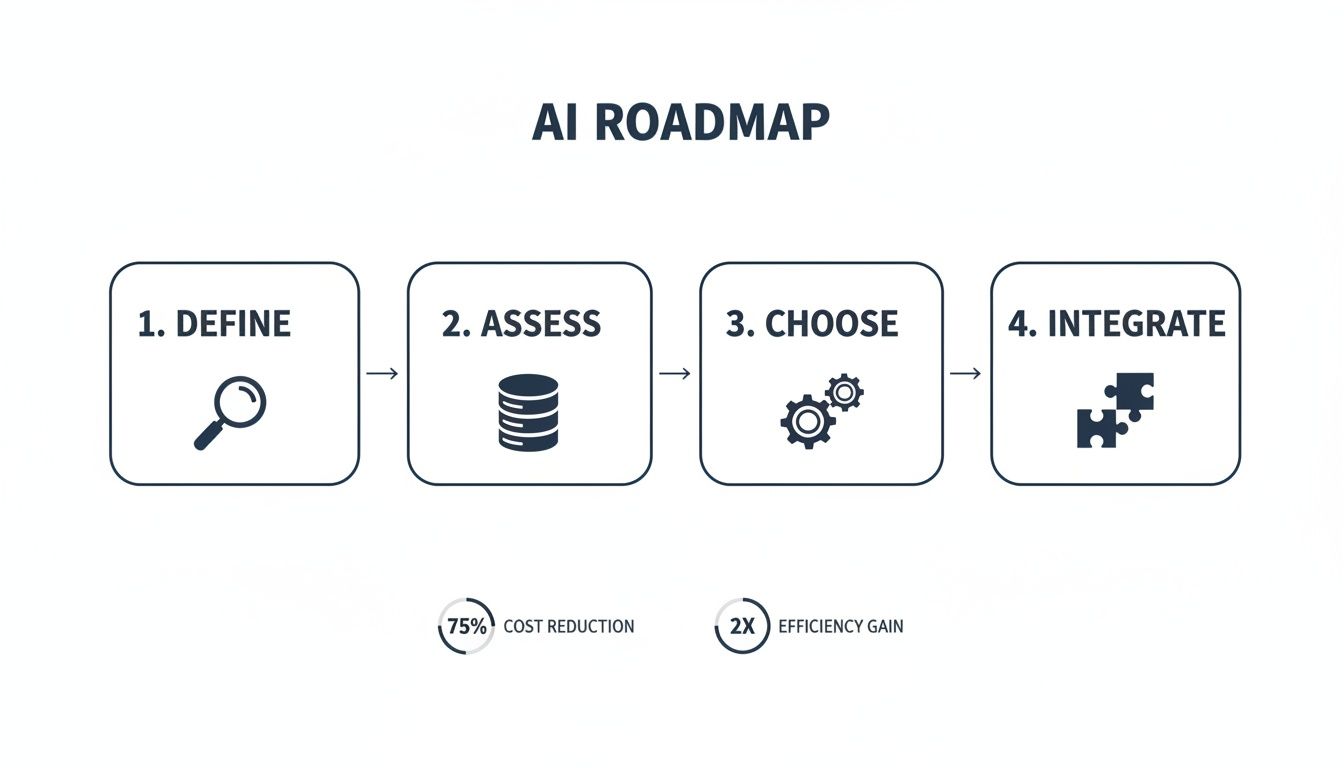
Following a simple roadmap like this ensures every AI initiative is tied to a core business objective, making it much easier to track the impact when all is said and done.
Key Metrics That Tell the Real Story
To figure out the ROI of your AI tools, you need to track metrics that have a direct line to revenue, cost savings, and customer happiness. Forget the abstract numbers; focus on what actually moves the needle.
Here are the core KPIs that matter most:
- Customer Lifetime Value (CLV): Are your AI-driven personalization efforts making customers stick around and spend more over time? A rising CLV is a fantastic sign that you’re building real loyalty.
- Conversion Rate: This is the ultimate test of an AI tool’s effectiveness. You can run a simple A/B test comparing a product page with an AI recommendation engine to one without. The numbers will tell you what’s working.
- Average Order Value (AOV): Are your smart upselling and cross-selling suggestions hitting the mark? A higher AOV is proof that AI is successfully encouraging shoppers to add just one more item to their cart.
- Operational Cost Reduction: This is where AI’s efficiency really pays off. Tally up the savings from reduced manual work in customer service or fewer costly errors in inventory management.
- Customer Satisfaction (CSAT) and Net Promoter Score (NPS): Happy customers are loyal customers. Higher scores here often link directly to better AI-powered service, like instant answers from chatbots or more relevant support articles.
Tracking the right metrics lets you tell a powerful story about your AI’s impact. Instead of saying, “Our chatbot is popular,” you can confidently state, “Our chatbot resolved 40% of customer queries instantly, saving 500 support hours last quarter.”
Building a Strong Business Case
A compelling business case is all about translating these metrics into dollars and cents—a language everyone in the business understands. The goal is to draw a clear line from a specific AI tool to a specific financial gain.
For something like an AI-powered fraud detection system, the math is pretty straightforward. You measure the drop in fraudulent chargebacks and weigh it against the system’s cost. For a new recommendation engine, you’ll want to attribute the sales lift on recommended products directly to the AI. This shows a clear cause-and-effect relationship between the technology and revenue growth.
When you focus on these concrete outcomes, you reframe the conversation. AI is no longer just another expense; it’s a strategic investment that pays for itself. To see how these ideas play out in the real world, take a look at our client cases and see the measurable impact we’ve helped other businesses achieve.
Navigating the Common Stumbling Blocks in AI Adoption
While the promise of AI in retail is exciting, the road to getting it right is often bumpy. Let’s be honest—it’s not always a straight line from idea to impact. Knowing the common hurdles ahead of time helps you build a smarter strategy, turning potential showstoppers into manageable steps.
First up is the big one: data privacy and security. The moment you start collecting customer data to create those amazing personalized experiences, you also become its guardian. This isn’t just a “nice-to-have”; it’s a matter of trust and legality. Regulations like GDPR and CCPA aren’t suggestions—they’re rules of the road that demand transparent data practices and ironclad security. Mess this up, and you risk losing your customers’ confidence for good.
Then there’s the thorny issue of algorithmic bias. AI models are only as good as the data they learn from. If your historical data reflects old biases—and most of it does, in subtle ways—your AI can accidentally put them on steroids. This could mean certain shoppers get worse deals or less helpful recommendations. Tackling this means being incredibly deliberate about where your data comes from, constantly auditing your models for fairness, and committing to ethical AI from day one. As we explored in our guide on responsible AI implementation, this is a non-negotiable part of the process.
Overcoming Technical and Cultural Hurdles
For many established retailers, a major headache is technical debt. Trying to connect shiny new AI tools with creaky old legacy systems can feel like performing surgery with a butter knife. It’s often a messy, complicated process just to get data flowing correctly. This is exactly why starting with a small pilot project is so wise. You can prove the concept and iron out the integration wrinkles without betting the farm.
But the challenges aren’t just about code and servers. You also have to build an AI-ready culture, and that can be even harder. This goes way beyond hiring a couple of data scientists. It’s about getting everyone, from marketing to merchandising, comfortable with using data to make decisions. Without buy-in from your people and the right skills on your teams, even the most powerful AI technology will just sit there collecting dust.
A successful AI initiative is a blend of technology, process, and people. Overlooking the human element—from skill development to change management—is one of the fastest ways to derail a promising project.
Preparing for What’s Next in Commerce
The retail world isn’t standing still, and AI is already powering the next big shifts. Take agentic shoppers, for example. These are smart, autonomous AI assistants that will one day shop on our behalf. It sounds like sci-fi, but by 2030, they’re projected to handle up to $385 billion in U.S. online sales. This will completely change how customers discover products and what brand loyalty even means. Building flexible, intelligent systems today is the only way to be ready for that future.
Getting through these complexities takes a clear vision and some serious technical skill. Working with a partner who provides expert AI development services can give your business the firepower and know-how to not just sidestep these challenges, but to build a real, lasting advantage in an increasingly intelligent market.
The Future of Retail and The Rise of Agentic Shoppers

As we look past the AI applications making waves today, the next big thing is already on the horizon. This future is being built with generative AI, promising customer interactions that are far more dynamic and human-like than anything we’ve experienced before. We’re moving beyond simple chatbots and into an era of truly intelligent, conversational partners.
The early signs are impossible to ignore. New research shows that traffic to U.S. retail sites from generative AI tools has exploded, growing by a massive 4,700% in just one year. Even better, these aren’t just empty clicks. These visitors are highly motivated, spending 32% more time on sites and viewing 10% more pages. The result? A stunning 84% jump in revenue per visit. You can read the full research about these powerful generative AI findings to see the data for yourself.
This is just the opening act for something much bigger.
Preparing for the Age of Agentic Shoppers
Perhaps the most profound shift will be the rise of agentic shoppers. Forget today’s chatbots—these are autonomous AI assistants that will quite literally shop on behalf of consumers. Picture an AI agent tasked with finding the best-priced organic groceries for your family this week, or one that’s sourcing the perfect running shoes based on your stride data, upcoming race, and budget.
This technology will fundamentally rewrite the rules of marketing and customer acquisition. When an AI agent is making the purchasing decisions, traditional marketing funnels and even brand loyalty become far less important.
The game is no longer about grabbing a person’s attention with a clever ad. Instead, it’s about proving to an algorithm that your product delivers the best value, quality, or features.
Building an AI-Ready Ecommerce Ecosystem
So, how can you possibly prepare for this automated future? It all starts with building a business that’s structured for AI from the ground up. This means your product data needs to be spotless, detailed, and easily accessible through APIs so that these AI agents can analyze it. It also means investing in superior custom eCommerce solutions that are flexible enough to connect with these intelligent systems.
Here’s where you can start now:
- Structure Your Data: Your product catalogs must be detailed, accurate, and machine-readable. Think of it as feeding the AI the information it needs to choose you.
- Sharpen Your Value Proposition: Get crystal clear on what makes your products better. AI agents will compare options logically, not emotionally.
- Invest in API-First Architecture: Build your technology stack so it can easily communicate with external AI platforms and agents.
This new frontier isn’t just about adopting another tool; it’s about a complete shift in how we think about commerce. By working with a forward-thinking AI solutions partner, you can start designing a business that’s not just ready for the next trend, but built to win in an automated world. As our client cases demonstrate, laying that future-proof foundation today is the surest path to long-term success.
Frequently Asked Questions About AI in Retail
How can small businesses start using AI in retail?
The best approach for small businesses is to start with a specific, manageable problem. Instead of aiming for a massive AI overhaul, focus on a quick win. Implementing an AI-powered chatbot for 24/7 customer service or using a simple personalization tool to recommend products are great starting points. These initial steps can deliver measurable value without requiring a huge investment, building a solid case for future AI projects.
Is using AI for personalization a risk to customer privacy?
It can be, which is why transparency and compliance are critical. To use AI responsibly, you must be upfront with customers about what data you collect and how you use it to improve their experience. Adhering strictly to regulations like GDPR and CCPA is non-negotiable. The goal is to build trust by showing that you are a responsible steward of their data, which is key to fostering long-term loyalty.
What’s the difference between AI, machine learning, and deep learning in retail?
Think of it in layers. Artificial Intelligence (AI) is the broad concept of creating smart machines that can perform tasks that typically require human intelligence. Machine Learning (ML) is a subset of AI where systems learn from data to identify patterns and make decisions with minimal human intervention—this powers most recommendation engines and demand forecasting. Deep Learning is a further subset of ML that uses complex neural networks to solve even more intricate problems, like image recognition for visual search.
Should we build a custom AI solution or buy an off-the-shelf product?
For most common retail challenges like personalization or fraud detection, buying an off-the-shelf solution is usually faster and more cost-effective. These tools are already proven and can be integrated relatively easily. Building a custom solution makes sense only when you have a unique business problem that no existing software can solve and you have the necessary data and technical expertise.
At Bridge Global, we don’t just talk about AI’s potential; we help you turn it into real, measurable results. From our AI Discovery Workshops to full-scale implementation, our teams are here to guide you every step of the way. Discover the AI for your business advantage, and get in touch with us for knowing how we can help.

About Upendra Jith
Upendrajith completed his Master's in English and has been a commercial content developer for the past three years. He's more inclined to develop content with a 'street-smart' delivery on topics such as technology, media, or anything he can get his hands on. He has a fixation on lyrics, dark poetry, media, technology, and flow arts.
View all posts by Upendra Jith →