


AI Software Development Solutions Explained
For years, the image of a software developer was someone staring intently at lines of code. That picture is quickly becoming outdated. We’ve entered a new phase where AI software development solutions are fundamentally changing the game, turning a manual craft into a powerful, intelligent partnership between human creativity and machine efficiency. This isn’t science fiction; it’s the new reality of building software.
The New Reality in Building Software
This guide is designed to cut through the noise. We’ll explore what these AI solutions actually are, how they work under the hood, and the tangible business results you can expect. Think of this as moving past the buzzwords to see how an AI-augmented approach can speed up innovation, improve quality, and hand your team a real competitive advantage. As an expert AI software development company, we’re here to walk you through it, starting with the basics.
The move toward AI-powered development is more than just a passing trend. It’s a seismic market shift. The global market for AI in software development is expected to jump from an estimated USD 674.3 million in 2024 to an incredible USD 15,704.8 million by 2033. That’s a compound annual growth rate (CAGR) of 42.3%, a clear signal that this is where the industry is heading. Discover more market growth insights from Grand View Research.

What AI-Driven Development Really Means
So, what are we actually talking about here? In simple terms, AI-driven development means using smart algorithms and machine learning to give developers a helping hand across the entire software development lifecycle (SDLC). The goal isn’t to replace developers, but to give them supercharged tools that take care of the repetitive, predictable, and frankly, boring tasks.
This frees up your team to focus on what people do best: thinking strategically, solving complex problems creatively, and truly understanding the nuances of user needs. This collaborative approach is at the very heart of modern custom software development.
Key Benefits of Embracing AI Solutions
Bringing AI into your development process isn’t just a tech-for-tech’s-sake move; it’s a smart business decision with clear, measurable upsides. Through our dedicated AI development services, we’ve seen companies achieve some incredible results.
- Accelerated Speed-to-Market: Imagine automating chunks of code generation, testing, and bug detection. AI does just that, slashing development timelines so you can get new features into your customers’ hands faster than the competition.
- Enhanced Code Quality: These intelligent tools act like a seasoned code reviewer, scanning for potential bugs, security holes, and performance issues long before they can cause a headache.
- Increased Developer Productivity: When you offload the tedious grunt work, your developers can pour their energy into high-impact activities like designing elegant architecture and innovating on core features.
- Data-Driven Decision Making: AI can surface insights from development and usage data, helping your team make better-informed decisions about what to build next and where to allocate resources.
At the end of the day, it’s all about using AI for your business to build a development process that is smarter, more efficient, and more robust.
How AI Actually Helps Build Software
To really get a handle on how AI software solutions work, it’s best to pull back the curtain on the technology that makes it all possible. Instead of thinking about a single, all-powerful “AI,” picture a highly specialized team where each member brings a unique skill to the table. It’s this collaboration of intelligent systems that truly changes the game.
This approach weaves AI into the entire development lifecycle, giving human developers a serious boost rather than trying to replace them. By building these components directly into our custom software development process, we’re not just creating applications; we’re engineering smarter, more resilient systems right from the start.

The Brains of the Operation: Machine Learning
At the very core of most AI development tools, you’ll find Machine Learning (ML). Think of ML as the team’s super-smart analyst. It chews through massive datasets. We’re talking millions of lines of code, old bug reports, and entire project histories—to spot patterns that a human simply couldn’t.
This knack for pattern recognition is a huge deal. For example, an ML model can look at your team’s code and accurately predict where bugs are most likely to pop up based on similar projects from the past. It can also recommend more efficient code snippets, which saves developers a ton of time and cuts down on simple human error. As we explored in our guide, understanding the real-world applications of machine learning for businesses is the first real step to unlocking what it can do for you.
The Communicator: Natural Language Processing
Next up on our AI team is Natural Language Processing (NLP), the communicator. NLP is what lets machines understand, interpret, and generate human language. In the world of software development, this technology closes the gap between what a developer wants to do and what the machine actually does.
So, instead of typing out line after line of complex commands, a developer can describe what they need in plain English. An NLP-powered tool takes that description and generates the code to match. This is the magic behind those AI assistants that can build entire functions from a single sentence. For any developers looking to build in this kind of advanced conversational AI, checking out resources like the introduction to the ChatGPT Apps SDK is a great place to start.
By automating routine coding and documentation tasks, AI-powered tools allow developers to focus on what they do best: creative problem-solving and architectural design. This shift doesn’t just increase efficiency; it elevates the strategic value of the entire development team.
The Eyes of the System: Computer Vision
Last but not least, Computer Vision serves as the team’s eagle-eyed inspector. This tech gives machines the power to “see” and make sense of visual information, like images and videos. Its role in software development might not be as obvious, but it’s incredibly important.
Just think about the user interface (UI) design process. A computer vision model can:
- Analyze UI Mockups: It can scan design files and ensure that every color, font, and spacing element is consistent across hundreds of different screens.
- Automate Visual Testing: It can compare a live application to its original design, automatically flagging tiny visual bugs that a human tester could easily overlook.
- Improve Accessibility: It can even review designs for compliance with accessibility standards, making sure the final product is truly usable for everyone.
Put them all together, and these technologies are driving a new generation of tools that are fundamentally changing how software gets made. It’s not about replacing developers; it’s about giving them superpowers. As an experienced AI software development company, we see this powerful synergy as the key to building the next wave of intelligent applications.
Real Business Wins with AI-Driven Development
Adopting AI is more than just a tech upgrade; it’s a strategic business decision that pays off in real, measurable ways. It’s not about swapping out one tool for another. It’s about fundamentally rewiring your development engine to be faster, smarter, and more reliable. The conversation has moved past “what if” and is now firmly in “what’s next,” as companies see tangible victories from AI.
This isn’t just hype—the market numbers tell a powerful story. The broader artificial intelligence software market, which includes AI software development solutions, was valued at US$122 billion in 2024 and is projected to jump to US$174.1 billion in 2025. Looking ahead, that figure is expected to hit a staggering US$467 billion by 2030, which shows just how much faith businesses are putting into these tools. You can explore the full artificial intelligence market forecast.
A Clear Boost in Productivity and Speed
One of the first things you’ll notice is how much faster everything gets. Imagine cutting your time-to-market in half. That’s the kind of acceleration we’re talking about because AI handles the repetitive, draining tasks that slow down even the best developers.
AI-powered tools can instantly generate boilerplate code, recommend the best algorithms for a job, and even build out complex functions from a simple prompt. This is far more than a small efficiency bump; it’s a massive productivity multiplier. It frees your team to focus their creative energy on solving core business problems instead of wrestling with syntax. By tapping into our AI development services, businesses can redirect those precious engineering hours toward true innovation.
Unprecedented Gains in Software Quality
Speed is great, but AI also delivers a huge leap in software quality and reliability. Think about launching a new app with virtually no critical bugs because an intelligent system flagged potential issues long before any user saw them.
AI-driven testing tools don’t just mindlessly follow scripts. They learn from past projects to pinpoint high-risk areas, anticipate security weak spots, and ensure code meets best practices. This proactive approach to quality saves a fortune in post-launch fixes and, more importantly, protects your brand’s reputation.
This kind of rigorous quality assurance is a cornerstone of modern custom software development, where building resilient, secure applications is absolutely essential.
A New Way of Building Software
To really see the difference, it helps to compare the old way of doing things with the new AI-powered approach. The contrast is stark, moving from a manual, reactive process to an automated, predictive one.
Traditional vs AI-Powered Software Development
| Development Aspect | Traditional Approach (The Challenge) | AI-Powered Solution (The Advantage) |
|---|---|---|
| Coding | Manual, repetitive, and prone to human error. Developers spend hours on boilerplate code. | AI generates code snippets, auto-completes complex functions, and suggests optimizations in real-time. |
| Testing & QA | Manual test scripts that are slow to create and maintain. Bugs are often found late in the cycle. | AI predicts potential bugs, generates test cases automatically, and identifies security vulnerabilities early. |
| Project Management | Estimates are based on gut feelings and past experience, often leading to inaccurate timelines. | AI analyzes historical data to provide more accurate project timelines and resource forecasts. |
| User Experience (UX) | UX design relies on user surveys and A/B tests, which can be slow and limited in scope. | AI analyzes user behavior patterns to identify pain points and suggest data-driven design improvements. |
As the table shows, AI doesn’t just improve individual steps—it creates a more intelligent, efficient, and reliable system from start to finish.
Smarter Decisions Backed by Data
Perhaps the biggest strategic win is the shift from gut-feel decisions to data-driven product strategy. AI delivers the deep, analytical insights you need to make smart choices about where your product is heading.
AI models can comb through user behavior, development metrics, and market trends to give you clear answers on:
- Which features to prioritize: Find out what your users actually want based on how they use the product.
- Where to allocate resources: Pinpoint parts of the codebase that are getting overly complex or brittle.
- How to optimize performance: Get recommendations for improvements that will have the biggest impact on the user experience.
This analytical firepower transforms your development process into a strategic advantage. It builds a solid business case for embracing AI for your business by ensuring every bit of effort is tied to real results. For any top AI software development company, delivering these data-backed insights is how we create lasting value for our partners.
Seeing AI Development in Action Across Industries
It’s one thing to talk about AI in theory, but what really matters is seeing AI software development solutions deliver actual results in the real world. The true power of artificial intelligence isn’t just a technical curiosity; it’s a tool for solving real business problems, whether that’s in online retail or medical labs.
Every industry puts AI to work differently, each with a story of a specific challenge met by an intelligent solution. Let’s take a look at how a few different fields are using these advanced tools right now.
Powering Personalized eCommerce Experiences
In the cut-throat world of eCommerce, making things personal for the shopper is everything. AI is the secret sauce behind the recommendation engines that seem to know what you want before you do. These systems look at your browsing history, what you’ve bought before, and even how you move your mouse to suggest products you’re highly likely to buy. We’re way past the simple “customers who bought this also bought” feature; this is dynamic, one-to-one marketing.
According to McKinsey, this level of personalization can boost revenues by 5-15% and make marketing budgets 10-30% more efficient.
On top of that, AI algorithms are also the brains behind the dynamic pricing you see on modern custom ecommerce solutions. These systems can adjust prices on the fly based on a competitor’s pricing, current demand, or even the time of day, helping businesses stay competitive without someone having to watch the market 24/7.
Transforming Healthcare with Data-Driven Insights
In healthcare, AI is making a huge difference in patient outcomes and helping hospitals run more smoothly. One of the most powerful examples is in medical imaging. AI-powered tools can analyze X-rays, CT scans, and MRIs with incredible accuracy—sometimes even better than a human radiologist—to help doctors spot diseases like cancer much earlier.
But it doesn’t stop at diagnostics. AI is also being used for:
- Predictive Analytics: Figuring out which patients are at high risk for certain conditions so doctors can step in proactively.
- Drug Discovery: Speeding up the R&D process for new medicines by crunching complex biological data.
- Administrative Automation: Taking over tedious tasks like scheduling appointments and processing medical records, freeing up staff to focus on patients.
This isn’t just a small upgrade. It’s a fundamental shift toward a more predictive and preventative way of practicing medicine.
By sifting through massive and complex datasets, AI gives clinicians deeper insights, leading to more accurate diagnoses and treatment plans tailored to the individual. This data-driven approach is what’s pushing modern medicine forward.
Securing the Financial Sector
For banks and financial institutions, security and managing risk are top priorities. AI software development is front and center in the fight against fraud. Modern fraud detection systems use AI to learn and adapt to new threats in real-time. Unlike old rule-based systems that fraudsters could easily figure out, machine learning models can spot tiny, unusual patterns in transaction data that scream “fraud,” protecting both the business and its customers.
AI is also changing the game in algorithmic trading, where models analyze market data faster than any human ever could to make trades at the perfect moment. It’s also making credit scoring and loan approvals faster and more consistent. As a leading AI software development company, we’ve seen firsthand how these solutions give our clients a serious competitive advantage.
Frequently Asked Questions
How does AI help in personalizing customer experiences?
AI digs through huge amounts of customer data, like browsing habits, past purchases, and demographics—to figure out what people like. It then uses those insights to offer up personalized product recommendations, send targeted marketing messages, and even change a website’s content on the fly to create a unique experience for every visitor.
What are the primary benefits of using AI in healthcare diagnostics?
The two biggest benefits are accuracy and speed. AI models can be trained on thousands of medical images, learning to spot subtle signs of disease that the human eye might miss. This helps doctors make diagnoses earlier, create better treatment plans, and frees them from some of the repetitive work so they can focus more on patient care.
Can AI completely eliminate financial fraud?
While it can’t get rid of fraud completely, AI makes it much, much harder for criminals. AI systems spot and flag suspicious activity in real-time and can adapt to new scam tactics far faster than older systems. Think of it as a super-smart, always-on security guard that dramatically reduces financial losses and protects customer accounts.
Your Roadmap for Implementing AI Solutions
Jumping into AI can feel overwhelming, but it doesn’t have to be. With a clear, strategic roadmap, the process becomes a series of manageable steps. A good plan breaks the journey into logical phases, helping you build momentum, sidestep common risks, and achieve real results. It’s the foundation for any successful AI software development solutions project.
This phased approach ensures every AI initiative is grounded in real business outcomes, a principle that holds true across industries from e-commerce and healthcare to finance.
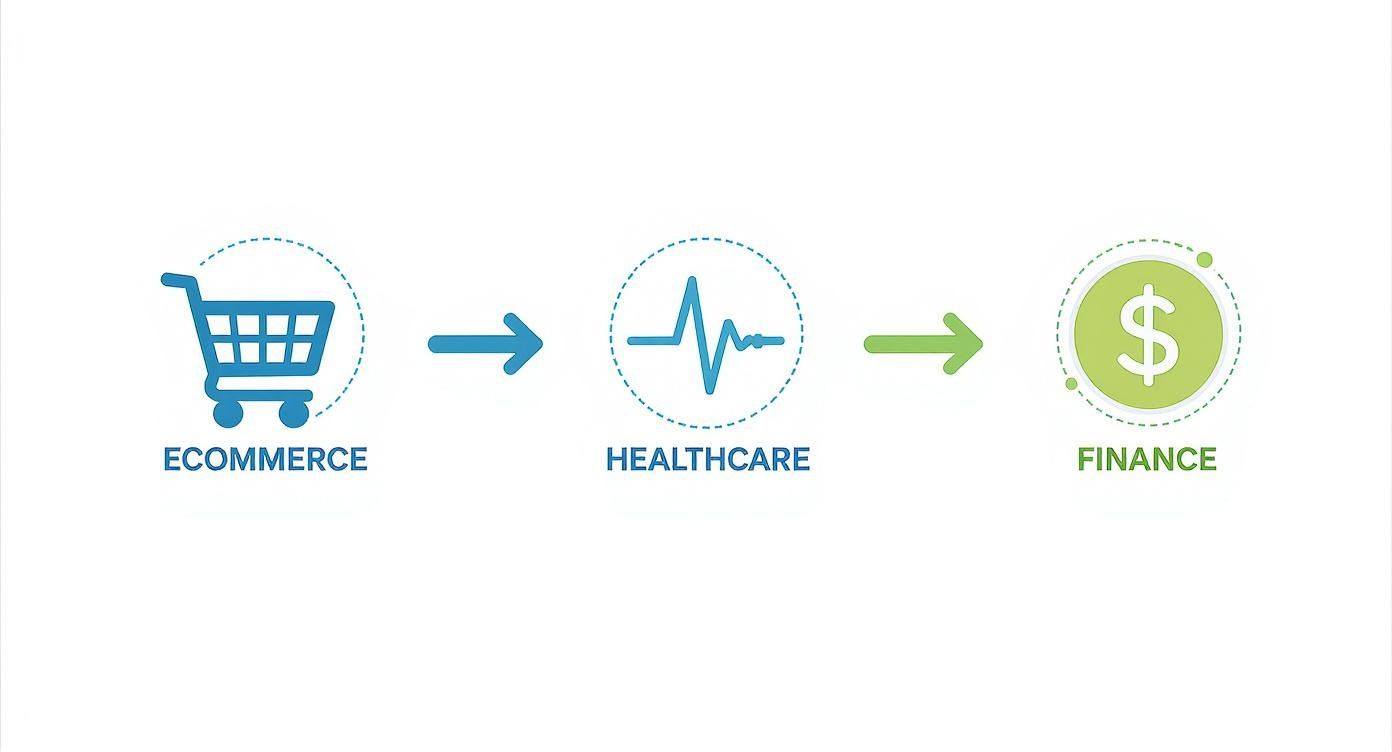
The image above shows how AI adoption often flows from one sector to another, with each industry adapting core principles to crack its own unique challenges. Let’s walk through the step-by-step process that makes this kind of innovation possible.
Phase 1: Discovery and Strategy
First things first: Discovery. Forget about the tech for a moment; this part is all about your business. You need to start by pinpointing the high-impact problems or untapped opportunities where AI could actually make a difference. Success here is all about defining exactly what you want to achieve with clear, measurable Key Performance Indicators (KPIs).
A solid discovery phase answers some tough questions:
- What specific business pain point are we really trying to solve?
- What does a win look like? Are we talking more revenue, better efficiency, or happier customers?
- Do we even have the data we need to tackle this?
Getting these answers upfront makes sure your AI project is pulling in the same direction as your business goals from day one.
Phase 2: Data Preparation and Governance
Once you have a clear goal, the spotlight turns to your most valuable asset: your data. The Data Preparation phase is where you lay the foundation for a smart model. AI is only as good as the data it learns from, which makes this step a make-or-break moment. It’s all about gathering, cleaning, and structuring your data so it’s reliable and accurate.
You simply can’t build a great AI solution without a great data foundation. That means getting serious about building AI-ready data pipelines that can consistently feed your models high-quality information.
Phase 3: Pilot Project and Validation
Instead of going for a massive, company-wide rollout right away, the smart move is to start with a Pilot Project. Think of it as a focused proof-of-concept (PoC). A successful pilot proves the solution’s value on a small scale, builds confidence within the team, and gives you crucial insights before you commit major resources.
This validation step is a low-risk way to test your assumptions and fine-tune your approach. A pilot that works is the best business case you can have for more investment. As we explored in our guide on implementing AI in business, starting small to prove value is a time-tested strategy for long-term success.
Phase 4: Scaling and Integration
After your pilot proves its worth, it’s time for Scaling and Integration. This phase is about weaving the AI solution into your actual daily workflows and systems. It requires careful planning to make sure the tech plays nicely with your current software and, just as importantly, that your team is trained and ready to use it.
Phase 5: Monitoring and Continuous Improvement
The work doesn’t stop at launch. The final phase, Monitoring and Improvement, is a long-term commitment. AI models aren’t “set it and forget it” tools. They need regular check-ups to perform at their best. This means keeping an eye on their performance, retraining them with fresh data, and tweaking algorithms to keep up with changing business needs.
This drive for constant improvement is why the market is growing so fast. The global AI market was valued at around USD 638.23 billion in 2024 and is projected to hit an astounding USD 3,680.47 billion by 2034. That kind of growth shows just how much businesses are relying on sophisticated, well-maintained AI.
Frequently Asked Questions
What is the most common mistake companies make when starting with AI?
The biggest mistake we see is people falling in love with the technology before they’ve identified a clear business problem. Starting with a cool solution and then searching for a problem is a recipe for an expensive project with zero impact. A thorough Discovery phase prevents this by tying every AI effort to a specific, measurable business goal.
How long does a typical AI implementation roadmap take?
It really depends. The timeline can vary wildly based on the project’s complexity, the state of your data, and how deep the integration needs to go. A simple pilot might take a few months, but a full-scale, enterprise-wide system could easily take a year or more. The beauty of the phased approach is that you can score early wins and deliver value along the way.
Why is data preparation so important in the AI implementation process?
Because data is the fuel for any AI model. If you feed it inaccurate, incomplete, or biased data, you’ll get a weak model, no matter how fancy the algorithm is. The old saying “garbage in, garbage out” is the absolute truth in AI. Meticulous data prep isn’t just a step; it’s a non-negotiable requirement for success.
How to Choose the Right AI Development Partner
Picking the right partner for your AI software development solutions is one of the most important decisions you’ll make. This isn’t just about hiring a team of coders; it’s about finding a strategic ally who can guide you through a complicated process and turn your vision into a real competitive edge. The entire success of your AI project rests on this relationship.
The right fit is a unique blend of technical mastery, sharp business acumen, and a proven history of success. Your ideal partner won’t just build what you ask for—they’ll challenge your assumptions, suggest new possibilities, and make sure the final product delivers real, measurable value. That collaborative spirit is what separates a vendor from a true technology partner.
Technical Expertise Meets Industry Insight
First things first: your partner needs deep technical chops. This means a solid command of machine learning, data science, and the specific AI technologies your project requires. But raw technical skill isn’t enough. They also need to genuinely understand your industry’s unique challenges and opportunities.
A great partner speaks your language. They know the regulatory hurdles in healthcare, the supply chain nightmares in eCommerce, or the intense security demands in finance. This industry-specific insight allows them to build solutions that don’t just work in a lab but are practical and compliant in the real world.
A Proven Track Record of Tangible Results
Always ask for proof. A credible partner will have a portfolio filled with successful projects and be more than happy to share their past work. Look past the shiny demos and ask for case studies that show concrete business outcomes.
The right partner can clearly explain the ROI they delivered for previous clients, whether it was boosting revenue, cutting operational costs, or making customers happier. These success stories are the best evidence they can deliver on their promises.
Digging into their past projects gives you a window into their process, how they solve problems, and their commitment to seeing their clients succeed.
Scalability and Future-Proofing Your Solution
Your business will grow, and your AI solution has to be ready to grow with it. A forward-thinking partner builds for scale from day one. This means designing a flexible architecture that can handle more data, more users, and new features down the road without needing a complete tear-down and rebuild.
Their focus should be on creating a system that lasts. This involves making smart technology choices and building something that can be easily updated and maintained over time. That approach ensures your investment keeps paying dividends for years. As we explored in our guide on artificial intelligence integration services, this covers how to weave AI into existing systems for long-term growth.
A Commitment to Ethical and Responsible AI
Finally, and this is crucial, your partner must have a strong commitment to ethical and responsible AI. This means being transparent about how data is used, actively working to remove bias from algorithms, and having a firm grasp of data privacy regulations. An ethical partner works with you to build solutions that aren’t just powerful, but also fair and trustworthy. In today’s world, this is non-negotiable.
Frequently Asked Questions
What should I prepare before contacting a potential AI partner?
Before you make the call, have a clear idea of the business problem you want to solve. Pull together any relevant data you have and try to define what success would look like for your company. This homework makes for a much more productive first conversation.
How important is ongoing support after the project is launched?
It’s absolutely essential. AI models aren’t “set it and forget it”; they need constant monitoring and tweaking to stay sharp. A good partner will offer ongoing support and maintenance plans to ensure your solution remains effective as your business changes.
Should I choose a niche specialist or a generalist company?
It really depends on your project. If you have a very specific, niche problem, a specialist firm could be perfect. However, a partner with broad experience across different industries and technologies can often bring fresh ideas and ensure the AI solution plays nicely with all your other business systems.
Still Have Questions About AI Development?
It’s natural to have questions when you’re looking to bring AI into your software development lifecycle. Let’s tackle a few of the most common ones we hear from business leaders.
Where Do I Even Begin With AI in My Business?
The best place to start is with a simple, focused discovery phase. Forget about boiling the ocean. Instead, pinpoint a specific, high-impact business problem that AI could realistically solve.
From there, you’ll need to take an honest look at your data readiness and set some clear, measurable goals for what “success” looks like. The key is to start small before you write a single line of code.
Can AI Actually Make My Software More Secure?
Absolutely. This is one of AI’s biggest strengths. AI-powered tools are fantastic at spotting patterns, which means they can analyze your code for potential vulnerabilities or monitor network traffic for anything that looks out of the ordinary. It’s like adding an intelligent, proactive security guard to your team.
AI doesn’t just react to threats; it learns from data to anticipate them. This shift from reactive to predictive security is a game-changer for protecting digital assets and maintaining user trust.
Aren’t AI Solutions Just for Big Companies With Deep Pockets?
That’s a common misconception, but it’s no longer true. Thanks to cloud services and specialized partners, AI is now well within reach for small and medium-sized businesses. It lets you automate tedious tasks, pull valuable insights from your data, and level the playing field without a massive upfront investment.
How Can I Measure the ROI of an AI Project?
Measuring the return on an AI investment comes down to tracking the business metrics the project was designed to improve. This isn’t about fuzzy benefits; it’s about real numbers.
You can look at things like:
- Reduced development time, which gets your product to market faster.
- A sharp drop in post-launch bug fixes, which directly lowers your maintenance costs.
- Increased developer productivity, freeing up your best people to work on new, innovative ideas.
- Direct revenue growth from new features that are only possible with AI.
At the end of the day, successful AI software development solutions deliver tangible improvements to your bottom line and how your business operates. The value of every project can be tied directly back to the goals you set from the start.
Ready to transform your development process and build smarter software? Bridge Global provides the expertise and partnership you need to succeed. Contact our experts for any help from initial strategy to full-scale implementation.

About Preethi Saro Philip
Preethi Saro Philip is a Post Graduate Research Degree holder in Economics with more than 10 years of experience in writing, editing, research and teaching. She has an intense passion for content crafting and calls herself a ‘wordsmith’. She enjoys writing on wide-ranging topics including business, technology, health & lifestyle, education, environment etc.
View all posts by Preethi Saro Philip →