



Distributed Product Engineering at Scale
At its core, distributed product engineering is about building teams based on talent, not geography. The old model of cramming your entire product team into a single, expensive office is quickly becoming a relic. Today, it’s about strategically assembling experts from different cities, countries, and continents to build better products, faster.
A Strategic Guide to Global Collaboration

Imagine trying to form a world-class orchestra. Would you limit your search to musicians living within a 30-mile radius? Of course not. You’d find the best violinist in Italy, the finest percussionist in Japan, and a brilliant cellist from Brazil. Technology would be the conductor’s baton, uniting their individual talents into a breathtaking symphony.
That’s exactly the principle behind distributed product engineering. It’s no longer just a remote work policy; it’s a powerful business strategy. By intentionally building teams with diverse skills and perspectives from around the globe, companies are creating a serious competitive edge.
Unlocking a Competitive Advantage
But this isn’t just about saving a few bucks on office space or finding cheaper labor. The real magic happens when you unlock 24-hour development cycles. A team in Europe can hand off its progress to a team in North America, which then passes the baton to a team in Asia. This “follow-the-sun” model slashes delivery timelines and gets your product to market before anyone else.
Spreading your talent across different regions also builds incredible resilience. If a local market faces instability or a talent drought hits one area, your entire operation doesn’t grind to a halt. Your product engine keeps running, insulated from single-point-of-failure risks.
The core idea is to assemble a dream team without borders. It’s about finding the absolute best talent for the job, whether they are in Silicon Valley, Eastern Europe, or Southeast Asia, and giving them the tools to collaborate effectively.
Pulling this off requires more than just a handful of Slack channels. It needs deliberate orchestration. An expert AI solutions partner can act as that conductor, implementing smart workflows and ironclad communication protocols. They turn a scattered group of brilliant individuals into a single, high-performing unit capable of delivering anything from complex health tech platforms to massive e-commerce sites.
In the end, distributed product engineering is how modern, ambitious companies operate. It’s about recognizing that the best minds aren’t confined to one place and building a system to unite them for a common goal: creating truly exceptional products.
Why Global Collaboration Is a Strategic Imperative
Let’s get one thing straight: moving to a distributed product engineering model isn’t just about cutting costs anymore. That’s old thinking. Today, it’s a fundamental strategic shift required to compete – and win. In a world where getting to market first can make or break a product, companies that can innovate around the clock are the ones who will lead. Global collaboration is what makes this continuous innovation possible.
It’s not about finding cheap developers. It’s about completely rethinking how you build and deliver value. When you assemble teams across different time zones, you can create a true 24/7 development cycle. Work done in one region gets handed off to the next as their day begins, creating a constant flow of progress. This drastically shortens your time-to-market and turns product development into a non-stop engine for improvement.
The Market Proves the Point
The numbers don’t lie. The global product engineering services market, the very foundation of this distributed model, hit an incredible $1150.78 billion in 2025. It’s expected to climb to $1250.67 billion in 2026. This isn’t just organic growth; it’s being driven by companies that are cutting their time-to-market by up to 30% by outsourcing complex engineering. And 68% of them are using cloud tech to make their distributed workflows feel seamless. A deeper dive into the market report reveals even more about these global engineering trends.
What this data really shows is a major power shift. While North America had the largest market share in 2025, the Asia-Pacific region is quickly becoming a talent powerhouse. This opens up incredible opportunities to find specialized skills that might be rare or just too expensive to hire locally.
A distributed model lets you hire the world’s best talent, not just the best talent within a 30-mile radius. It’s about building a team based on skill, not on a zip code.
Using Global Talent as an Innovation Engine
When you break down geographical walls, you suddenly have access to an incredible diversity of thought, experience, and skill. This isn’t just a “nice-to-have”; it’s a massive advantage. A team made up of engineers from different cultures and technical backgrounds will naturally question assumptions and come up with more creative solutions. The end result? Products that are built for a global audience, by a global team.
This is where having an experienced partner can make all the difference. For example, a dedicated development team can act as a natural, long-term extension of your own crew. You get the stability and deep product knowledge of an in-house team combined with the raw advantages of a global talent search.
An AI solutions partner can take this even further by putting smart systems in place that make global work truly click. AI-powered tools can help manage workflows, improve asynchronous communication, and even spot potential problems before they happen. As we’ll get into later, weaving AI into your process is a huge part of building a top-tier distributed team. This is how modern custom software development is done, and it’s what sets the leaders apart from everyone else.
Choosing Your Distributed Engineering Model
Picking the right operating model for your distributed team isn’t a one-size-fits-all decision. It’s more like choosing the right tires for a car – what you pick depends entirely on the road ahead. Are you racing for a deadline, navigating highly specialized terrain, or settling in for a long, steady journey?
Forget the old, simplistic labels of “offshore” or “nearshore.” A smart strategy starts with asking the right questions. Are you trying to get to market faster with around-the-clock development? Do you need access to a niche talent pool that’s impossible to find locally? Or is your goal to build a stable, long-term extension of your core team? The answers will point you directly to the right model.
This decision framework helps visualize how your core business drivers should shape your team structure.
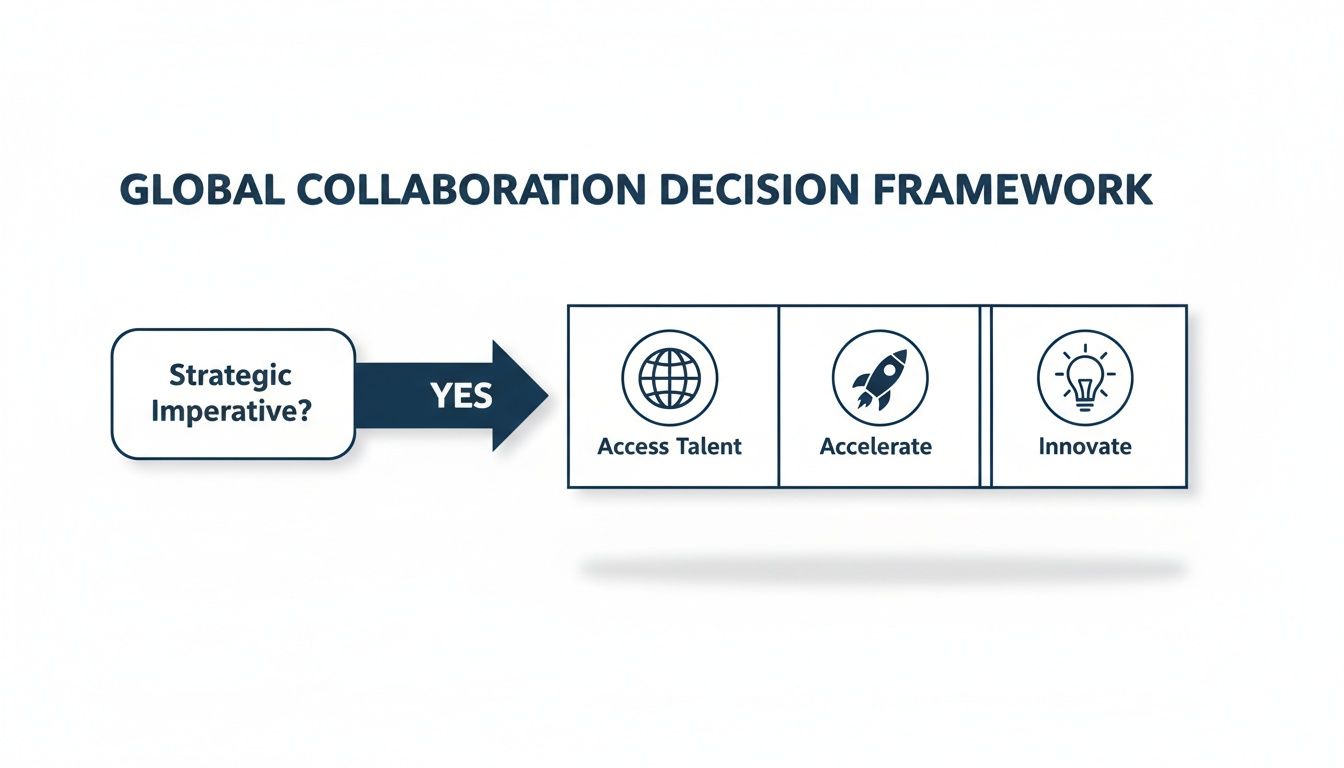
Think of it this way: the “why” behind your move to a distributed model will always define the “how.”
Core Distributed Models
While every company’s situation is unique, most successful distributed teams are built on one of a few proven models. Each one is designed to organize global talent in a way that targets a specific outcome.
-
The Follow-the-Sun Model: This is all about maximum velocity. You strategically place teams in different time zones, say, North America, Europe, and Asia, to create a continuous 24-hour development cycle. As one team signs off, they hand the work over to the next team signing on. It’s the perfect setup for projects with aggressive deadlines where rapid, non-stop iteration is the name of the game.
-
The Center of Excellence (CoE) Model: When a project hinges on deep, specialized knowledge, the CoE is your best bet. Instead of spreading experts out, you concentrate them in one dedicated hub. This is ideal for complex domains like advanced AI research or cybersecurity, where putting all your top minds in one “virtual room” is the fastest path to a breakthrough.
The Dedicated Team Model
For many companies, the real goal isn’t just to ship a single project. It’s about building lasting product knowledge and ownership for the long haul. This is where the dedicated development team model truly comes into its own.
In this setup, you partner with a technology firm to build a team that works only for you, becoming a genuine extension of your in-house crew. They aren’t just contractors clocking in and out; they become deeply integrated into your company culture, your roadmap, and your long-term vision. They learn your business inside and out.
This stability fosters incredible innovation and institutional knowledge, something we’ve detailed in our guide on the long-term tech partnership model.
This structure is a game-changer for complex projects that demand ongoing maintenance, iteration, and a deep understanding of the business logic. Over time, the team builds invaluable context, making them more proactive and efficient. It’s the right move when you see your distributed team not as a temporary fix, but as a permanent, strategic part of your engineering organization.
Distributed Engineering Models Compared
Choosing between these models means weighing their unique strengths and weaknesses against your business goals. The table below breaks down where each model shines and what challenges to anticipate.
| Model | Best For | Key Advantage | Primary Challenge |
|---|---|---|---|
| Follow-the-Sun | Projects with tight deadlines requiring rapid, 24/7 development. | Speed. Continuous workflow dramatically accelerates delivery timelines. | Coordination. Requires flawless handoffs and communication to avoid fragmentation. |
| Center of Excellence | Complex initiatives needing deep, concentrated expertise (e.g., AI, R&D). | Expertise. Consolidates top talent to foster innovation and solve hard problems. | Silos. Can become disconnected from the rest of the business if not managed carefully. |
| Dedicated Team | Long-term product development and building institutional knowledge. | Integration. Becomes a stable, deeply integrated extension of your core team. | Investment. Requires a commitment to building a long-term relationship and cultural alignment. |
Ultimately, there’s no single “best” model – only the one that best serves your product’s immediate needs and your company’s long-term vision. The key is to match the structure to the strategy.
How to Build High-Performing Distributed Teams
Building a top-tier distributed team isn’t about mastering logistics. It’s about intentionally engineering a culture rooted in trust, clarity, and genuine connection. Once you’ve picked an operating model that fits, the real challenge begins: turning a group of talented people into a single, cohesive unit, no matter where they are in the world. This is so much more than project management; it’s about creating a system where great work and new ideas can flourish across continents and time zones.
The absolute bedrock of any great distributed team is clarity. In an office, you can clear up confusion with a quick chat over a cubicle wall. Remotely, that same ambiguity creates friction, misunderstandings, and painful delays. Every single person needs to know exactly what they’re responsible for, what a “win” looks like in their role, and who to go to when they get stuck.
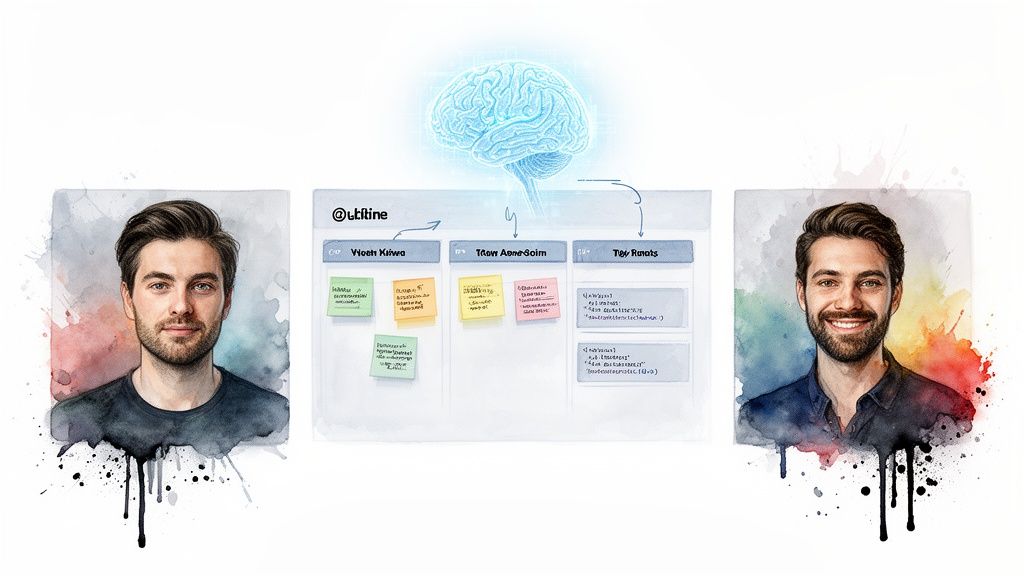
This need for clarity extends directly to your processes. Familiar Agile ceremonies like stand-ups and retrospectives have to be reimagined for a global team. A daily stand-up might work better as an asynchronous update in a dedicated Slack channel. Retrospectives need a skilled facilitator to make sure every voice, regardless of their time zone or comfort level with speaking up, is truly heard.
The Role of AI in Team Performance
This is where Artificial Intelligence stops being a buzzword and becomes a real-world asset. Modern AI is fundamentally changing how distributed teams work together, communicate, and deliver results. It acts as a smart layer that helps bridge the gaps created by distance and time, making teams far more efficient. An expert AI solutions partner can help you weave these tools into your existing workflows. Our AI development services are designed to implement these smart solutions seamlessly.
Think of AI as an intelligent assistant working 24/7 for your team. AI-driven platforms can automate parts of the code review process, flagging potential bugs or style issues long before a senior developer needs to get involved. This doesn’t just speed things up; it helps enforce consistent quality standards across the board.
AI doesn’t replace great engineers; it gives them superpowers. By taking over the repetitive, analytical grunt work, AI frees your team to focus on the complex, creative problem-solving that drives real product innovation.
Beyond that, predictive analytics can analyze commit patterns and communication logs to forecast potential project delays or integration headaches. It’s like having a data-driven crystal ball, giving leaders a chance to step in and solve small problems before they balloon into major crises. Integrating these tools is a central piece of any modern AI transformation framework.
Structuring for Asynchronous Success
One of the biggest mental shifts for distributed teams is mastering asynchronous work. Instead of being chained to back-to-back meetings, high-performing remote teams document everything. Key decisions, spirited debates, and project updates are all captured in shared wikis, documents, or project management tools. This creates a single source of truth that anyone can check at any time.
This “document everything” approach has some powerful benefits:
-
Deep Work: It protects developers from the constant ping of notifications and “quick questions,” giving them long, uninterrupted stretches of time to actually code.
-
Inclusivity: It puts everyone on a level playing field. Team members in different time zones are never left out of the loop on important conversations.
-
Clarity: It forces people to communicate with more thought and precision because they have to write their ideas down clearly.
The goal is to build a system where progress doesn’t grind to a halt just because everyone isn’t online at the same time. This is especially important for teams that also handle ongoing product support, a topic we explore in our guide to software maintenance and support services. When you get the tools and the culture right, a distributed team becomes more than the sum of its parts; it becomes a smart, resilient engine for building incredible products.
Navigating Common Global Engineering Challenges
While the benefits of distributed product engineering are huge, let’s be realistic; it’s not always a smooth ride. Leading teams spread across different continents means facing a unique set of hurdles. If you ignore them, you’re setting yourself up for missed deadlines, a weak company culture, and even serious security risks.
The place where things most often fall apart is communication. This isn’t just about language barriers. It’s the subtle cultural cues and work styles that get lost when you’re not in the same room. A direct comment that’s seen as helpful feedback in one culture might come across as harsh criticism in another. These small misunderstandings can easily snowball into real friction and disengagement.
Another big challenge is creating a cohesive company identity. How do you make someone in a completely different time zone feel like a core part of the team, not just a contractor on the other side of the world? Building those informal bonds that glue a team together takes real, consistent effort when everyone is physically apart.
Overcoming Cross-Cultural Communication Barriers
The only way to bridge these communication gaps is to be incredibly intentional about how you talk to each other. You need to build a clear communication playbook that everyone on the team understands and follows.
-
Create a Single Source of Truth: Use a tool like Confluence or Notion to build a “team brain.” This is where everything lives: project specs, meeting notes, key decisions, and processes, so there’s no room for ambiguity.
-
Make Asynchronous the Default: Encourage your team to communicate in detailed, thoughtful writing. This gives people in different time zones a fair chance to catch up and contribute without having to be online at odd hours.
-
Define Your Channels: Be crystal clear about what each tool is for. For example, Slack is for quick, informal chats. Email is for talking to people outside the company. And your project management tool is for official task updates.
When you create intentional communication rules, you replace guesswork with clarity. You’re building a system where context isn’t just assumed but spelled out, making sure everyone is on the same page, no matter their location or background.
Protecting Security and Intellectual Property
In a distributed setup, your digital assets are everything – and they’re also your biggest vulnerability. You simply can’t afford to be casual about protecting your intellectual property (IP) and maintaining tight security. Every laptop and network connection is a potential doorway for threats.
A scattershot approach to security just won’t cut it. You need a structured, multi-layered defense. Working with an expert in custom software development can be a game-changer here, as they bring proven security protocols from day one. As we explored in our guide on the secure software development lifecycle, a proactive security posture is non-negotiable.
Here are a few battle-tested strategies to lock things down:
-
Implement a Zero-Trust Architecture: Work from the principle of “never trust, always verify.” Every single user and device must be authenticated and authorized before they can access any company resource, no exceptions.
-
Enforce Strict Access Controls: Use role-based access control (RBAC) to give team members access only to the data and systems they absolutely need to do their jobs. Nothing more.
-
Mandate Security Training: Your team is your first line of defense. Train them regularly to spot phishing attempts, use strong passwords, and follow secure coding habits.
By tackling these challenges head-on with proven strategies, you can turn the risks of global engineering into strengths. Many of our successful client cases show just how a proactive approach can build a resilient, high-performing, and truly connected distributed organization.
Mapping Your Global Talent Strategy
Building a successful distributed product engineering team starts with a global mindset. It’s not just about finding talent wherever you can; it’s about looking at the world as a strategic talent map. You need to understand the unique strengths, costs, and opportunities different regions bring to the table.
Think of it this way: the right location can unlock specialized skills at a great price point. Another might offer a timezone advantage that helps you build a true 24-hour development cycle. For example, a US-based fintech company might work with a team in Eastern Europe to speed up development while having local experts on the ground to navigate complex regulations.
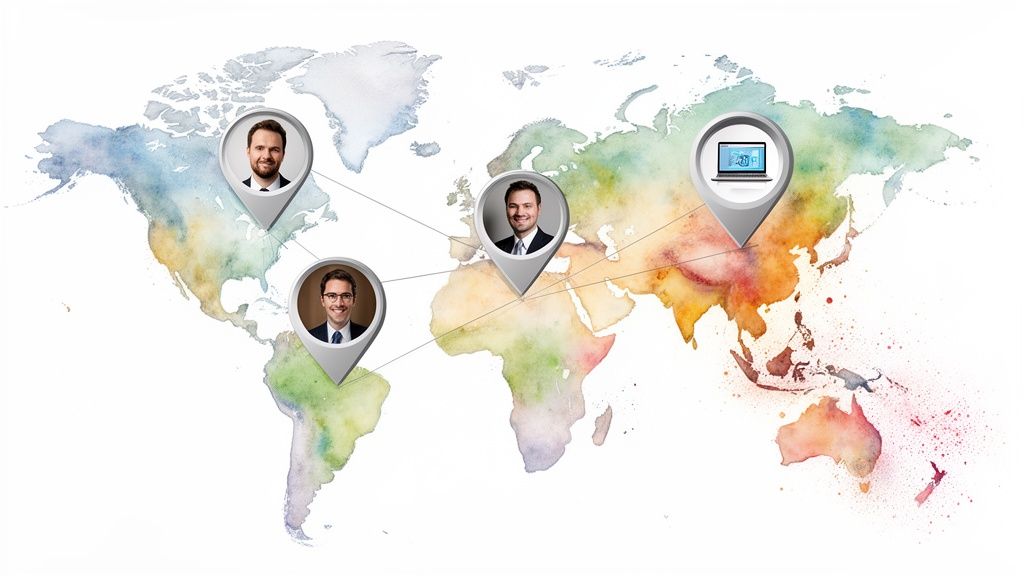
Decoding Global Market Dynamics
To make smart decisions, you have to understand the numbers behind the map. The market for distributed engineering is massive, and different regions play very different roles.
Consider this: North America holds a 34% share of what’s projected to be a $1.478 trillion market by 2026. This is largely because 71% of businesses there are already using cloud-native tools to manage their global teams. Meanwhile, Europe (28%) and Asia-Pacific (30%) are catching up, using offshore talent to modernize their platforms.
The real story, though, is the explosive growth in the Asia-Pacific region. It’s on track for an 8.97% CAGR, set to hit $3.202 trillion by 2035, backed by a staggering 78.90% growth in engineering services since 2021.
Why does this matter? Because a distributed model is proven to cut production costs by 15-20% and drastically improve time-to-market. In fact, 59% of companies are using automation within these distributed teams to become even more efficient. For any leader, this data paints a clear picture: a global talent strategy isn’t just an HR initiative; it directly impacts your bottom line.
Choosing Talent Hotspots for a Competitive Edge
Once you have the big picture, you can zoom in on specific regions to build a competitive advantage. Each hotspot offers a unique mix of skills, costs, and cultural fits that you can match to your product goals.
-
Eastern Europe (Poland, Ukraine, Romania): This region is a beast when it comes to great technical skills. If you need experts in complex fields like C++, embedded systems, or heavy-duty enterprise software, this is your spot. The timezone nicely overlaps with both Western Europe and the US East Coast, which makes real-time collaboration a breeze.
-
Latin America (Brazil, Argentina, Colombia): Known for its incredible creative and UI/UX talent, Latin America is a fantastic choice for building beautiful, user-friendly applications. The huge timezone overlap with North America is a major plus, allowing for the kind of tight-knit collaboration that feels like everyone is in the same office.
-
Southeast Asia (Vietnam, Philippines, Malaysia): This is where you go for scale at a competitive cost. The talent pool is massive, growing fast, and perfect for mobile development, QA testing, and establishing a long-term dedicated development team for ongoing projects.
When you’re planning your global strategy, don’t forget to check the market for available remote jobs. It gives you a real-time pulse on where the skills are and what top candidates are looking for, which is critical for both attracting and keeping great people.
By placing teams strategically in these hotspots, you’re not just hiring developers; you’re building a diversified talent portfolio. This approach strengthens your development capabilities and makes your entire organization more resilient, ensuring your product engine can adapt to whatever the market throws at it next.
Frequently Asked Questions About Distributed Product Engineering
Moving to a distributed model brings up a lot of questions. It’s a big shift, and it’s natural to have concerns. Let’s tackle some of the most common questions we hear from leaders just like you.
What Is the Biggest Advantage of Distributed Product Engineering?
Most people immediately point to cost savings or faster development, and while those are definitely great perks, they aren’t the main event. The single biggest advantage is the ability to tap into a global talent pool.
Think about it. You’re no longer limited to hiring the best engineer within a 30-mile radius of your office. You can find and hire the absolute best person for the job, regardless of where they live. This freedom to access top-tier specialists is what directly fuels higher-quality products, faster innovation, and a serious competitive advantage that’s tough for office-bound competitors to match.
How Does AI Help Manage Distributed Teams?
AI’s role here is much bigger than just automating a few tasks. It’s about making the entire distributed operation smarter and bridging the gaps that distance and time zones create.
-
Smarter Communication: Instead of getting lost in endless chat threads, AI-powered tools can summarize key decisions, translate conversations instantly, and keep everyone on the same page, even when they’re working asynchronously.
-
Predictive Insights: Modern AI can analyze project data to see around corners. It can flag potential delays or integration risks before they become major problems, giving you a chance to step in and help proactively. This is a huge part of a modern AI transformation framework.
-
Automated Guardrails: You can use AI to handle routine code reviews, check for style guide consistency, and spot common bugs. This frees up your senior developers from tedious work so they can focus on solving the really hard problems.
When you start using AI for your business this way, it’s not just about efficiency. It’s about building a more resilient and intelligent team.
How Do You Maintain a Strong Company Culture with a Distributed Team?
Let’s be clear: a great culture doesn’t just happen, especially when you’re remote. You have to build it intentionally.
This means being deliberate about your communication norms. It means turning on your camera for meetings to build real human connections. It means organizing virtual hangouts and creating digital “water cooler” channels where people can chat about things other than work. If you can swing it, bringing everyone together for an in-person meetup once or twice a year can be incredibly powerful for cementing those relationships.
A strong distributed culture is built on trust, transparency, and intentional connection. It’s about making every team member feel valued and included, no matter where they are in the world.
Is Distributed Product Engineering Secure?
Absolutely, but with a critical caveat: security can’t be an afterthought. It has to be baked into your model from day one. You have to operate as if your network perimeter is everywhere, because it is.
This means adopting a zero-trust security architecture, where no one gets access to anything without verification first. You’ll need strict access controls, end-to-end encryption for all communications, and regular security training for the entire team. Working with a partner that specializes in custom software development ensures these practices are part of your DNA from the start. In fact, many of our client cases involve high-stakes projects that prove security and distributed work can, and do, go hand-in-hand.
Ready to build a world-class distributed engineering team? Bridge Global is your expert AI solutions partner, helping you harness global talent and intelligent workflows to build better products, faster.

About Shreesha Chandrabose
Shreesha Chandrabose is a commerce graduate with a growing passion for content writing and digital media. With a curious mind and a creative approach, she enjoys transforming ideas into simple, relatable, and engaging narratives. She loves poetry, photography, and editing, and enjoys bringing ideas to life through words and visuals.
View all posts by Shreesha Chandrabose →