


Unlocking the Secure Software Development Lifecycle: Build Resilient Software
In a world where software development moves at lightning speed, the Secure Software Development Lifecycle (SSDLC) isn’t just another framework. It’s a fundamental change in how we think about building secure applications. It’s about weaving security into the very fabric of the development process, from the first napkin sketch of an idea all the way to deployment and beyond.
Think of it as building security in, not bolting it on. This “shift-left” philosophy is the difference between building a fortress from the ground up versus trying to patch up a wooden shack after it’s already built. It’s about being secure by design, not by chance.
Why a Secure SDLC Is No Longer Optional
Software runs everything these days, but our deep reliance on it has also opened the door to massive risks. A single, overlooked vulnerability can snowball into a catastrophic data breach, leading to devastating financial losses and a tarnished reputation that’s hard to rebuild.
The old way of doing things—tacking on a security review right before launch—simply doesn’t cut it anymore. That approach is like building a skyscraper and only checking the foundation’s integrity after the penthouse is complete. It’s wildly inefficient, incredibly expensive, and dangerously risky. This reactive model forces security teams into a perpetual game of catch-up, where they’re always one step behind the next potential flaw.
The Rising Cost of Security Debt
When you push security checks to the end of the line, you start accumulating security debt. This is the growing collection of unaddressed vulnerabilities that become more dangerous and complicated to fix over time. And this debt is piling up fast.
Since 2020, the average time it takes to fix a security flaw has jumped by a staggering 47%. This backlog is so severe that about half of all organizations are now saddled with critical security debt. What’s even more concerning is that 70% of this critical debt comes from third-party libraries and open-source code, a stark reminder of the hidden risks in our software supply chains. You can get more details on these trends in Veracode’s latest State of Software Security report.
Adopting a secure SDLC confronts this problem directly. By embedding security into every stage, you immediately start seeing real benefits:
- Slash Remediation Costs: It’s exponentially cheaper to fix a flaw discovered during the initial requirements phase than one found after the application is live.
- Build Unshakeable Customer Trust: Showing a real commitment to security isn’t just good practice; it’s a powerful way to tell your clients that their data is safe with you.
- Get to Market Faster: It might sound backward, but catching security issues early on prevents those last-minute, fire-drill situations that cause delays and rollbacks. The result is a smoother, more predictable path to deployment.
A proactive SSDLC turns security from a frustrating roadblock into a genuine business advantage. It gives your teams the freedom to innovate, knowing that every line of code and every design choice is backed by a solid, resilient foundation.
Ultimately, a strong security posture isn’t just an IT problem to solve; it’s a cornerstone of business continuity and sustainable growth. As your trusted AI solutions partner, we help organizations implement comprehensive cyber security services to fortify their custom software development projects, ensuring they are both innovative and secure.
Integrating Security Across Every Development Phase
A truly secure software development lifecycle, or SSDLC, isn’t about adding a security checklist at the end. It’s about weaving security into the very fabric of how you build software. Think of it as a cultural shift: security becomes a continuous, shared habit, not an isolated event handled by a separate team after all the “real” work is done.
The old way of doing things—bolting on security after development—is a recipe for delays, friction, and frustration. The modern approach embeds security thinking and tooling directly into the development workflow everyone already uses.
This image perfectly illustrates the difference between the old, siloed model and today’s integrated approach.
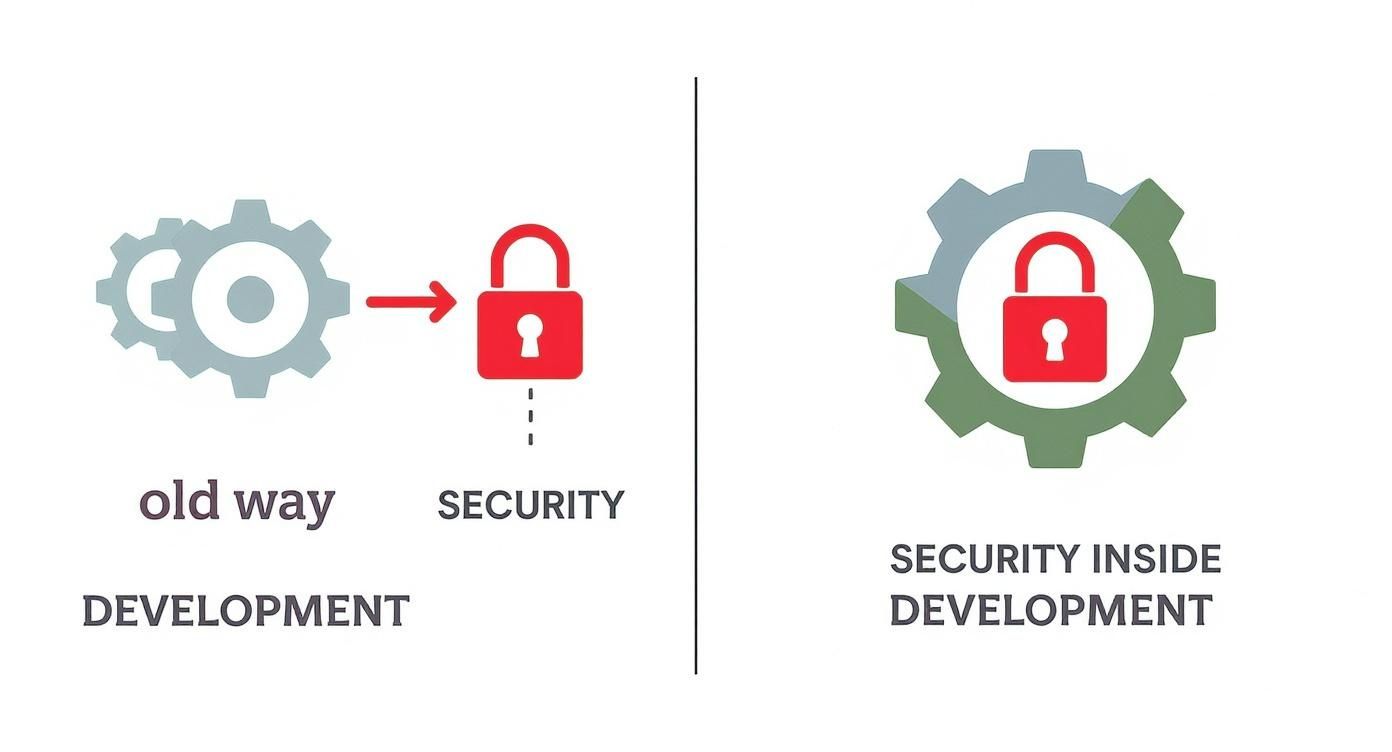
As you can see, security stops being a roadblock and becomes part of the engine driving the whole process forward. Let’s break down what this actually looks like, phase by phase.
The following table provides a high-level overview of the key security-focused actions embedded within each stage of the development lifecycle.
SSDLC Phases and Corresponding Security Activities
| SDLC Phase | Key Security Activity | Primary Goal |
|---|---|---|
| Requirements | Abuse Case Definition & Risk Assessment | Identify what the software should not do and prioritize security efforts based on business impact. |
| Design | Threat Modeling | Proactively design defenses by thinking like an attacker to find architectural flaws before they’re built. |
| Development | Secure Coding Standards & SAST | Empower developers to write secure code from the start and automatically catch common errors. |
| Testing | DAST & Penetration Testing | Actively try to break the application to find vulnerabilities in a running state that static analysis might miss. |
| Deployment | Infrastructure Hardening | Secure the production environment (servers, cloud services, containers) to prevent unauthorized access. |
| Maintenance | Continuous Monitoring & Patching | Actively monitor for new threats and quickly fix vulnerabilities discovered after release. |
This table maps out the journey, but the real value comes from understanding how each step builds on the last to create a resilient final product.
Requirements and Planning
This is ground zero for security. Just like you define what the software should do for users, you must also define what it should not allow attackers to do.
- Define Abuse Cases: Instead of user stories, think in “abuser stories.” How could a malicious actor misuse a feature? If you have a file upload function, an abuse case is someone trying to upload malware instead of a profile picture.
- Conduct a Risk Assessment: Figure out what your most valuable assets are and what threats they face. This helps you focus your security budget and effort where it matters most.
- Review Compliance Needs: Do you need to meet GDPR, HIPAA, or PCI-DSS standards? You have to build those requirements in from day one; you can’t add them later.
Secure Design
The design phase is where you draw up the application’s blueprint. Getting security right here prevents deep architectural flaws that are a nightmare to fix later on. It’s the difference between designing a skyscraper with fire escapes and trying to bolt them onto the outside after the building is finished.
The core activity here is threat modeling. It’s a structured way of thinking like an attacker to find weak spots in your design. Threat modeling essentially asks four simple questions:
- What are we building?
- What can go wrong?
- What are we going to do about it?
- Did we do a good enough job?
By mapping out how data will flow and what components will interact, your team can build defenses against the most likely attacks before a single line of code is written.
Secure Development and Implementation
This is where your secure design becomes reality. The goal is to make writing secure code the path of least resistance for developers, not a chore.
Secure coding isn’t about writing flawless code every time. It’s about creating a system of prevention. With clear guidelines and the right tools, you can eliminate a huge number of common vulnerabilities before they ever become a problem.
Key activities here include:
- Secure Coding Standards: Create and enforce a clear rulebook for developers, often based on well-established guides from organizations like OWASP (Open Web Application Security Project).
- Static Code Analysis (SAST): Run automated tools that scan your source code for known security flaws—like a spellchecker for vulnerabilities—without even having to run the app.
- Dependency Scanning: Check all your third-party and open-source components for known issues. This is absolutely critical, as over 70% of critical security debt often comes from code you didn’t even write.
Robust Testing and Verification
Now it’s time to try and break what you’ve built. The testing phase is where you actively attack your application to see if the security controls hold up. This goes far beyond just making sure features work; it’s about testing for resilience. As we’ve explored in our guide, any strong software quality assurance strategy must have a dedicated security testing component.
The main activities include:
- Dynamic Application Security Testing (DAST): These automated tools probe your running application from the outside, looking for vulnerabilities like SQL injection or cross-site scripting (XSS).
- Penetration Testing: You bring in ethical hackers to simulate a real-world attack, finding complex vulnerabilities that automated scanners often miss.
- Interactive Application Security Testing (IAST): A newer, hybrid approach that combines the “inside-out” view of SAST with the “outside-in” view of DAST for more accurate findings.
Secure Deployment and Maintenance
Your application is live—but the job isn’t done. The focus now shifts to protecting the production environment and being ready to respond to new threats as they emerge.
- Configuration Hardening: Lock down your servers, containers, and cloud services. Follow the principle of least privilege—if a component doesn’t need access to something, it doesn’t get it.
- Continuous Monitoring: Use tools to keep a constant watch on your live application. You need to know immediately if there’s suspicious activity or an attempted breach.
- Patch Management: Have a rock-solid process for quickly deploying security patches. When a new vulnerability is discovered, you need to be able to fix it fast. This ongoing vigilance is what separates secure organizations from the ones you read about in the headlines.
The Modern DevSecOps Toolchain for Automation
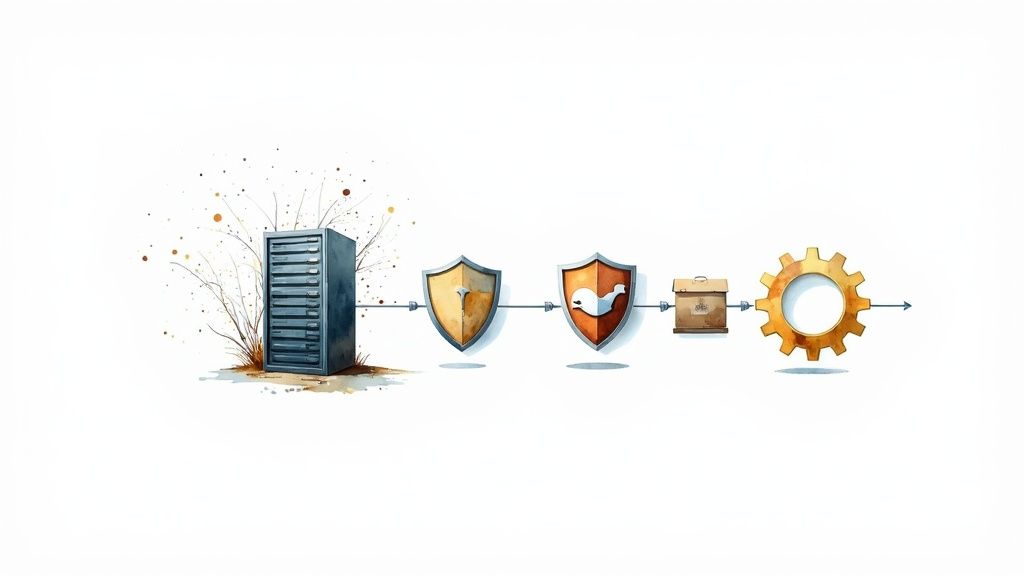
Trying to manually enforce security checks in a high-speed development environment is a losing battle. It’s not just inefficient; it’s practically impossible. This is where a modern, automated toolchain comes in, integrating directly into your Continuous Integration and Continuous Delivery (CI/CD) pipeline. This automation is the very heart of DevSecOps. It turns security from a periodic, after-the-fact audit into an always-on, automated reflex.
The real win here is for your developers. They get instant feedback on security issues right inside the tools they already use, allowing them to find and fix vulnerabilities on the fly. It’s all about making the secure way the easy way. As we’ve touched on in our guide about the AI business advantage, this kind of intelligent automation is what truly powers both speed and robust security.
The image below, from the popular developer security platform Snyk, is a perfect example of this in action. It shows how vulnerabilities are flagged and explained right within the development workflow.
Notice how the dashboard visualizes vulnerabilities, ranks their severity, and provides clear, actionable steps for fixing them. This transforms complex security data into something a developer can immediately understand and act on.
Core Automated Security Testing Tools
To build this automated security net, organizations weave a suite of specialized tools into their pipeline. Each one has a specific job, scanning for different kinds of weaknesses at different points in the development cycle.
- Static Application Security Testing (SAST): Think of a SAST tool as an expert code reviewer that never sleeps. It scans your source code—without ever running the program—to find common coding mistakes that open the door to attacks like SQL injection or buffer overflows. It gives developers that crucial, early feedback right in their editor.
- Dynamic Application Security Testing (DAST): If SAST is the insider’s view, DAST is the attacker’s. DAST tools test your application while it’s actually running, simulating real-world attacks to find flaws that only surface during execution. This gives you a critical “hacker’s-eye view” of your security posture.
- Software Composition Analysis (SCA): Let’s face it, most modern applications are assembled from a huge amount of open-source code. SCA tools are essential for managing this reality. They act like a librarian for your dependencies, identifying every third-party component and checking it against a massive database of known vulnerabilities. This is non-negotiable for managing software supply chain risk.
These tools aren’t an either/or choice. They’re designed to work together, providing layered, automated defenses that secure your software from the inside out.
Securing Infrastructure and Deployments
Automation can’t just stop at the application code. It has to extend to the very infrastructure your software runs on, which is where Infrastructure as Code (IaC) and container security become so important.
An application is only as secure as the environment it runs in. Automating infrastructure security ensures that your deployment environments are consistently configured, hardened, and free from known vulnerabilities before your code ever reaches them.
A few key practices are essential for locking down your deployment pipeline:
- Infrastructure as Code (IaC) Scanning: Before any cloud resources are created, these tools analyze configuration files (like Terraform or CloudFormation scripts) to spot misconfigurations that could leave you exposed. It’s like proofreading your security policy before it goes live.
- Container Image Scanning: This is a mandatory checkpoint. Before a container is deployed, these scanners inspect the image for any known vulnerabilities in the base OS or other software packages included inside. This simple step prevents a compromised image from ever making it to production.
This deep integration of security—often called the “shift-left” movement—is what separates mature security programs from the rest. Modern DevSecOps is all about these automated scans in the CI/CD pipeline, hardened container security, and rigorous supply chain verification. It’s a core principle of any modern custom software development practice that refuses to sacrifice security for speed.
How AI Changes the Secure SDLC Game
AI-powered coding assistants are changing the way we build software, and there’s no going back. These tools bring incredible speed to the development process, but they also introduce a whole new class of risks we can’t ignore. Suddenly, a machine is co-writing the code, and that forces us to ask a critical question: is our secure development lifecycle ready for this?
The trick is to grab all the efficiency AI offers without inheriting its security blind spots. This means your SSDLC needs an update. You have to treat AI-generated code with the same scrutiny—or even more—as code written by a junior developer. The goal remains the same: every single line of code, whether from a human or a machine, must pass through your security gates.
The Double-Edged Sword of AI in Development
AI coding assistants are far more than just souped-up autocomplete. They’re active collaborators, capable of drafting entire functions, suggesting complex logic, and even writing unit tests. This is a massive productivity booster, but it also opens the door to new and subtle security problems that your existing SSDLC might not be designed to catch.
Recent industry data tells this story loud and clear. While around 72% of organizations have jumped on the AI bandwagon for code generation, many are now dealing with the fallout. The same report found that 36% of companies pointed to security vulnerabilities in AI-generated code as a top concern, and another 37% were bogged down by errors and bugs.
What does this tell us? You can’t just trust the code an AI gives you. It needs to be validated, tested, and secured with the same rigor you apply to everything else.
Practical Steps for Integrating AI Securely
To bring AI into your workflow responsibly, your SSDLC has to evolve. Think of the AI as a new, incredibly fast, but completely untrusted team member. This mindset helps you build the right checks and balances into your process.
Here are a few non-negotiable strategies to start with:
- Mandatory Human Review: Every piece of AI-generated code must go through a human-led code review. Period. This is where you’ll catch the logical flaws, subtle security holes, and style issues that automated tools might miss.
- Tune Your Scanners: Configure your SAST and DAST tools to be extra sensitive. Modern scanners are getting better at spotting the common mistakes AI models make, like using deprecated crypto libraries or generating insecure API calls.
- Set Clear Guardrails: Create formal, written guidelines on how developers can and can’t use AI tools. This policy absolutely must cover data privacy—forbid pasting sensitive or proprietary code into public AI models to prevent disastrous data leaks.
The AI-Inclusive SBOM is Now a Necessity
Your software supply chain just got a lot more complicated. A Software Bill of Materials (SBOM), basically a detailed ingredient list for your application, is no longer a nice-to-have. It’s essential. More importantly, your SBOM needs to be able to identify and track which code snippets were written by humans, which came from third-party libraries, and which were generated by an AI.
An SBOM that accounts for AI-generated code gives you the visibility you need to react fast. When a vulnerability is found in code produced by a specific AI model, you can instantly trace where it exists in your applications and start fixing it.
Staying on top of this means understanding the broader threat landscape, especially the rise of new AI Cybersecurity Threats. This context is crucial for building a security program that can withstand the next wave of attacks. At the end of the day, using AI securely is about augmenting human intelligence, not replacing it.
Building a Culture of Security Ownership
You can have all the best tools and automated workflows in the world, but they’ll only get you so far. A truly secure software development lifecycle isn’t just about technology; it’s built on a foundation of human engagement and a strong, security-first culture. This is where we move past seeing security as some other department’s problem and start treating it as everyone’s mission.

When this cultural shift happens, security stops being a gatekeeper and becomes a shared value. The entire organization gets stronger when every engineer, project manager, and developer feels a personal stake in keeping things secure. This human element is what elevates a good SSDLC program into an exceptional one.
From Silos to Security Champions
The first step is to tear down the walls that traditionally separate development and security teams. Forget the old “throw it over the wall” approach, where security is just a final, often tense, checkpoint. The goal is constant collaboration from day one.
One of the most powerful ways to do this is by creating a Security Champions program. Think of these individuals as developers and engineers who are already passionate about security. You just give them the training and authority to act as security advocates right inside their own teams.
These champions become the go-to people for security questions, help their teammates use secure coding practices, and act as a vital link to the central security team. It’s a brilliant way to scale security knowledge naturally across the entire organization.
A strong security culture doesn’t happen by accident. It’s cultivated through intentional efforts to educate, empower, and reward security-conscious behavior across all teams and roles.
With this model, you embed security expertise exactly where you need it most: on the front lines of development.
Practical Steps to Foster Ownership
Building this culture takes more than a company-wide memo; it demands a practical, supportive framework. The idea is to weave security into the daily workflow so seamlessly that it doesn’t feel like an extra burden.
- Provide Continuous Training: Ditch the generic, once-a-year security presentation. Instead, offer role-specific, hands-on workshops that teach secure coding, threat modeling, and how to use the latest security tools. This keeps skills sharp and relevant.
- Establish Clear Channels: Make it simple and safe for developers to report potential security issues. When people feel they can raise a red flag without blame, you’ll uncover risks much, much faster.
- Celebrate Security Wins: When a team or an individual finds and fixes a critical bug or suggests a smart security improvement, recognize them publicly. Positive reinforcement is a massive catalyst for cultural change.
This comprehensive approach goes beyond just writing code—it covers the entire data lifecycle. A true culture of ownership means being responsible for data from its creation all the way to its final disposal. Properly implemented secure data sanitization methods like wiping and shredding are crucial for preventing breaches and completing the security picture. When this mindset becomes part of your company’s DNA, you’re not just building secure software; you’re building a truly resilient organization.
How to Measure Success and Manage Risk
You’ve invested time and money into building a secure software development lifecycle, but how do you know it’s actually working? You can’t just go by gut feeling. To really understand the impact, you need to measure it.
This is where you shift from just putting out fires to proactively managing risk. Using the right key performance indicators (KPIs) and metrics helps you track the health of your application security program, prove its ROI, and make smarter decisions about where to focus your efforts. Good data turns abstract security goals into tangible results.
Key Metrics for Your Security Dashboard
To get a clear picture of your SSDLC’s performance, you need to track metrics that show you trends over time. These aren’t just numbers; they tell a story about where you’re strong and, more importantly, where you have room to improve. A solid security dashboard should give anyone, from an engineer to a C-level executive, a quick, clear view of your security posture.
Here are a few essential metrics to start with:
- Mean Time to Remediate (MTTR): How long does it take your team to fix a vulnerability once it’s been found? This is one of the most important metrics. If your MTTR is consistently dropping, it’s a great sign that your security processes are getting more efficient.
- Vulnerability Density: This is simply the number of vulnerabilities found per thousand lines of code. It’s a great way to benchmark code quality and can help you pinpoint specific projects or teams that might need more security training.
- Percentage of Flaws Found Pre-Production: This metric is the ultimate proof of a successful “shift-left” strategy. A high percentage here means your security checks—like automated scanning and threat modeling—are doing their job and catching problems before they ever see the light of day.
Measuring your SSDLC’s performance isn’t just about counting bugs; it’s about proving you’re getting better at preventing them in the first place. These metrics give you the hard evidence to show that security is a value driver, not just a cost center.
From Data to Actionable Insights
Collecting data is just the start. The real magic happens when you turn those numbers into insights you can act on.
For example, a stubbornly high MTTR might point to a bottleneck in your patching process. Or maybe it signals that your developers need better training on how to actually fix the vulnerabilities being reported. This is how data helps you drive continuous improvement.
By tracking these trends, you build a powerful case for security investments, whether you’re working on internal enterprise applications or building out scalable custom ecommerce solutions. Understanding your starting point is key, which is something we’ve touched on before in our guide on QA maturity evaluation.
Ultimately, this data-driven approach ensures your secure SDLC doesn’t just reduce risk—it actively contributes to the company’s bottom line.
Frequently Asked Questions About the Secure SDLC
Got questions about putting a Secure Software Development Lifecycle into practice? You’re not alone. Let’s tackle some of the most common things people ask when they’re moving from theory to real-world implementation.
What’s the First Step to Implementing a Secure SDLC?
Before you buy a single tool, take stock of where you are right now. A simple maturity assessment of your current development process will tell you what security practices—if any—are already happening. You might be surprised.
Once you have that baseline, go for the quick wins. The best starting point is usually something high-impact but low-effort, like adding automated security scanning (think SAST or SCA) right into your CI/CD pipeline. Starting small builds momentum and makes it much easier to get everyone on board for the bigger changes to come.
Will This Slow Down Our Developers?
There’s a bit of an adjustment period at first as your team gets used to new tools and a new mindset. But in the long run, a properly implemented SSDLC actually makes you faster.
Think about it: finding a security flaw early is a quick fix. Finding it after the product has been deployed means pulling developers off new features, emergency patches, and a whole lot of expensive rework. By automating security checks and giving developers instant feedback, you stop security from ever becoming a bottleneck. As we’ve seen in our client cases, a smooth process is a fast process.
Is an SSDLC Only for Big Companies?
Not at all. The principles scale to fit any size organization, and frankly, no one is too small to be a target.
The cost of a security breach almost always far outweighs the investment in proactive security, regardless of a company’s size.
For startups and mid-sized companies, building secure products from day one is a huge competitive advantage. There are plenty of fantastic open-source and affordable security tools out there, so you don’t need a massive budget to get started. It’s a core part of what modern custom software development is all about.
How Does This Work in an Agile Environment?
A Secure SDLC is a natural fit for Agile. The whole idea is to break security out of its old, slow, gatekeeping phase and weave it directly into each sprint.
Here’s what that looks like in practice:
- Threat modeling becomes a quick, collaborative exercise during sprint planning.
- Secure coding standards are baked right into your “Definition of Done.”
- Automated security tests run with every single build, catching issues immediately.
By integrating this way, your teams can move fast without racking up security debt. This is a must for any team, especially a forward-thinking AI solutions partner.
At Bridge Global, we don’t just add security at the end; we build it in from the very first line of code. Whether you’re exploring advanced AI development services or figuring out how to apply AI for your business, our DevSecOps approach ensures your software is robust and resilient. Contact us today to strengthen your security posture.

About Preethi Saro Philip
Preethi Saro Philip is a Post Graduate Research Degree holder in Economics with more than 10 years of experience in writing, editing, research and teaching. She has an intense passion for content crafting and calls herself a ‘wordsmith’. She enjoys writing on wide-ranging topics including business, technology, health & lifestyle, education, environment etc.
View all posts by Preethi Saro Philip →